Showing posts from December 2009 (33 posts). Show all posts

December 31, 2009

The Top 15 Stories on LouisGray.com in 2009

The Top 15 Stories on LouisGray.com in 2009


Ever since I stopped doing my monthly summaries on blog statistics, as some had judged them as internal navel gazing and self-gratification, I haven't talked much about statistics and numbers, hits, page views or visitors. But in the interest of sharing, and wrapping up the year 2009, I thought I would expand on my yearly summary post from last week and show just what visitors were looking for that drove traffic. In aggregate, I should mention that total traffic in the year was not dramatically higher than 2008, which I take to mean more people read the content via RSS or in aggregators. In addition, there were fewer posts on the site in 2009 than in 2008, thanks to reduced guest posts.

The Top 15 stories authored in 2009, in order of highest traffic to least:

1. Google Wave Hits Shore. Flash Flood Warning In Effect.
October 1, 2009

The summary of my initial reactions to Google Wave was surprisingly visible. Although I felt as if my thoughts were actually late to the game, the post ended up being far and away the highest trafficked article of the year. The spike was led by Robert Scoble posting how much he thought Wave was overhyped. Subsequently, someone posted our pair of posts to Slashdot, and Der Spiegel of Germany also highlighted the summary. Although I was not overly negative of Wave, I did say it was very busy, and my reaction often got lumped in with Robert's much more critical response.

2. 40 Key Elements to Getting Started In Social Media
January 5, 2009

At the beginning of the year, Mike Fruchter wrote an extremely detailed guide on the necessary tools required to be engaged in social media. His effort was rewarded through the post being among the most bookmarked on Delicious, and being highlighted by Darren Rowse of ProBlogger. Mike is one of those talents that I hope to be working alongside someday, should I ever get the chance.

3. The Story of Google's Closure: Advanced JavaScript Tools
November 8, 2009

When Google released Closure tools to the Web, response to this was fairly neutral. Most folks tended to just repeat the news. But I thought it made more sense to ask Google developers how they had benefited from the tool while in house. Mihai Parparita of Google Reader gave a wonderful first person account of his use, and other geeks appreciated it. It was featured on Hacker News.

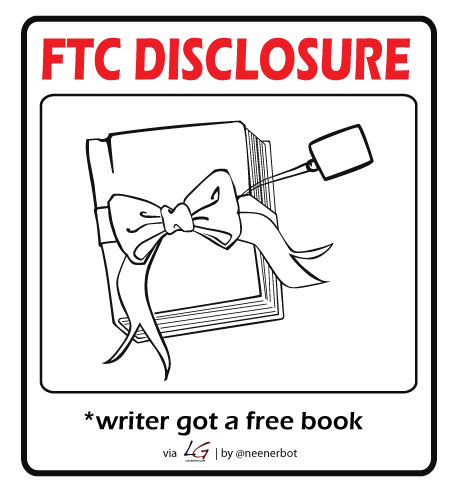
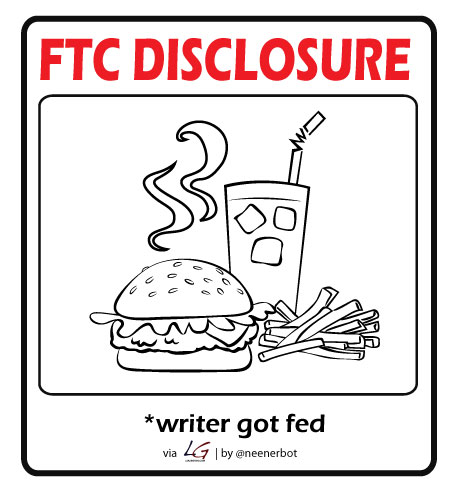
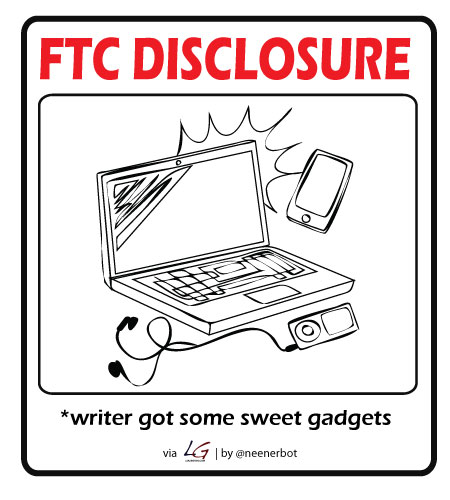
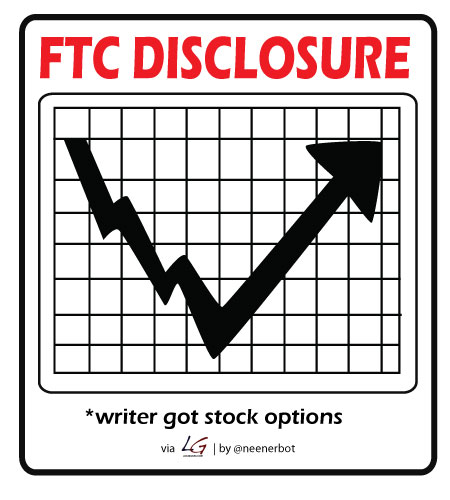
4. FTC Disclosures Made Simple For Bloggers With Conflicts
December 4, 2009

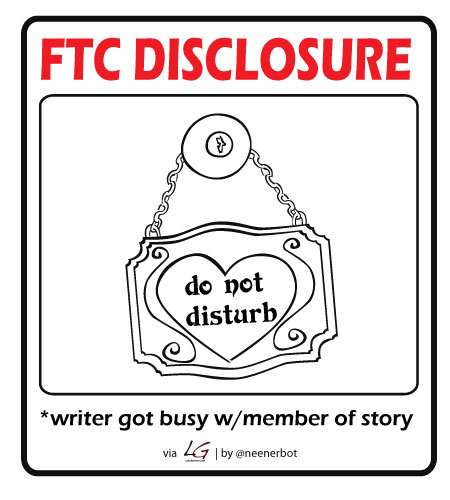
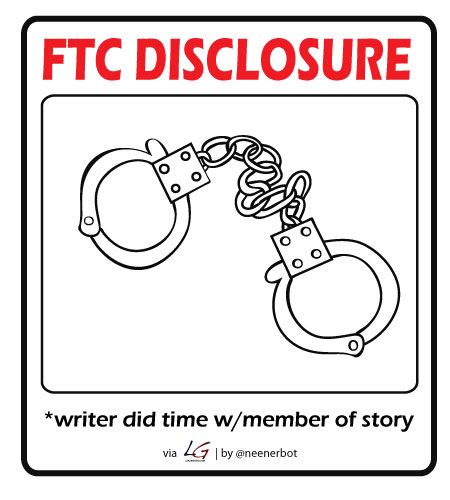
Among my most fun posts of the year was a collaboration with Jeannine Schaeffer earlier this month on some icons to help bloggers disclose relationships to the FTC. It was a fun idea, and Jeannine came through in a big way. Mashable and others highlighted the story, and I've enjoyed seeing the humorous icons make their way around the Web in the weeks since.

5. Facebook Drops the Walled Garden, Opens Up Possibility for Track
March 16, 2009

Jesse Stay, a preeminent expert on both Twitter and Facebook, highlighted Facebook's increased openness and the ability to let updates leak into Google and the wider Web at large. He is the author of multiple books on Facebook worth checking out if you ever want to write Facebook apps or just learn more about the largest social network in the world.

6. Twitter's Search Engine Is Very, Very, Broken
May 21, 2009

As Twitter has grown well beyond initial expectations, the service's fragility has shown in a number of ways. Among the most visible has been the disappointing index from the company's search engine. It's now widely known that the engine only goes back a few days, and it doesn't index some of the most visible accounts, making data discovery and retention difficult. It would be wonderful if this were to be solved in 2010.

7. Could A Real Apple Fan Completely "Go Google"?
October 29, 2009

At risk of having to throw away my Apple fanboy card, I became more entranced by Google in 2009, thanks to the company releasing solid product after solid product, many of which competed head to head for my attention with Apple's well-known suite of offerings, including iLife and the iPhone. The more I thought about it, the more realistic I thought about switching, and I am definitely watching this space closely.

8. What FriendFeed Needs to Do To Grow and Keep New Users
January 2, 2009

At the beginning of the year, seeing a lack of growth on FriendFeed's part that met my own aggressive expectations, I gave some unsolicited feedback as to how I thought the company could improve. They had other ideas, and launched many great tools, but didn't go the way I had thought. Months later, they were absorbed into Facebook.

9. The Newest Annoyance on Twitter: Follow and Refollow Spam
March 7, 2009

Twitter's problems weren't limited to their own back-end infrastructure. Users often got tired of being bombarded by different types of spam, either on the service itself, through direct messages, or through what I found as refollow spam. Some automated accounts were following my account every few hours to get in front of me and my connections. This annoyance was thwarted in time.

10. iPhone Call Recording: It Makes Too Much Sense Not to Do
August 9, 2009

While BlogTalkRadio's CinchCast product has largely filled this need, it seems to me that Apple could easily enable us to record phone call conversations for interviews and podcasts. So far, my understanding is that applications posted to the iTunes Store that accomplish this very thing have been slowed or stopped outright.

11. How To Cleanly Separate Personal and Work Social Media Personalities
March 22, 2009

Many people are looking for a way to act in social media on behalf of their company, while maintaining their own personality. Having accomplished this myself, I thought I would share how. It seems many others were curious and this post remained popular and shared through the second half of the year.

12. Blogger Quietly Turns Ten, Plans Slew of Feature Upgrades
August 23, 2009

As one Blogger holdout who hasn't moved to WordPress, I watch the platform closely, and Blogger turned ten years old this fall, without fanfare. Following my quick summary, this surprisingly hit the front page of Digg (only my second time ever), which was appreciated, but befuddling, as it was not a huge story, in my opinion.

13. Hi Facebook, It's Me, FriendFeed. This Relationship? It's Complicated.
August 10, 2009

The announcement that Facebook acquired FriendFeed struck the many people who like FriendFeed in a very personal way. I have talked to many top users of the site who felt as if the announcement had hit them emotionally, as no other simple merger or acquisition had before. Much of the concern lies in the fact that Facebook has a reputation that runs contrary to what some hoped FriendFeed would become. My amusing tongue in cheek response tried to explain just how we were feeling, rather than encapsulating the news like many other sites already had.

14. Feedly Explore Highlights Recommended Blogs, Reader Activity
September 26, 2009

Feedly, a 2008 debut here, has been among the most popular ways to get RSS updates. The service's Explore feature enhanced feed discovery. After posting this piece it was highlighted within Feedly and many users came to the blog to see what was new.

15. Twitter Caps Following Limits, Denting Auto-Follow Services
April 20, 2009

In a year I wrote many good things about Twitter, it's no surprise the more negative stories gained traction. Among them was a move that blocked some Twitter developers from using advanced auto-follow tools, reducing the option for some accounts to be automated.

In a year with more than 500 posts (the fourth straight above 500), these 15 top ones showed me that people are always eager to learn more about Google and Twitter, and how to best use these social media tools. While I don't let traffic define what I intend to cover, it's always worth making sure I keep on topic for what the readers want to see.

10 Predictions for 2010 In the World of Tech

10 Predictions for 2010 In the World of Tech

Following on to predictions for 2009 and for 2008, as well as their results. (2009 | 2008)

Keep in mind I would rather not predict the obvious.


1. Twitter Manages to Complete 2010 With No Major Hacking or Security Incidents

Despite a strong 2009 that saw the microblogging service graduate from the geeks to more mainstream appeal, Twitter remained plagued by a number of uptime issues and some extremely visible hacking and security incidents that led to slowness and downtime. As part of the company's maturation process, Twitter will build the personnel and infrastructure necessary to withstand such future attacks, and 2010 will go major incident free. There may be some slowness, but no outages via the dark corners of the Web.

2. Seeing Android and iPhone, Windows Mobile Will Aim for Parity, and Fail

Microsoft, jealous at all the consumer and media attention around the iPhone, and now Android, will try to remain relevant, launching a new version of Windows Mobile, and hyping its own apps, just like they did when they launched the Palm PC line (later Pocket PC) following the PDA's rise to power. Their approach will not be seen as comparable to Android or iPhone and will not change their market share in a positive way.

3. Apple Will End Exclusivity With AT&T, Adding T-Mobile and Verizon

With AT&T being a massive black eye for Apple's iPhone in the US, the company will finally end exclusivity with the telecommunications carrier, and strike deals with both T-Mobile and Verizon. Consumers will be able to switch carriers and keep their numbers. Unsurprisingly, users may find that those networks aren't perfect either.

4. Facebook Will Announce a Migration Plan for FriendFeed Users

The mystery around Facebook's plan for FriendFeed will become clear in the first half of 2009, as not only does the company improve its network with FriendFeed-like elements, but existing users of FriendFeed will be given guidance on how the two networks can converge, while protecting their existing content and contacts.

5. Google Wave Will Exit 2010 Still In Beta

While Google Wave will continue to improve and may open up to all visitors, without requiring invites, the product will still be seen as experimental, and will not shed its beta tag, keeping it through the end of the year, much like GMail and other products from Mountain View before it.

6. Facebook, Zynga, LinkedIn Will All Go Public

After a dearth of IPO activity in the last two years, 2010 will see a resurgence, especially from Silicon Valley VCs, who are eager to make profits to help assuage the wounds of losses from the last few years. Facebook and LinkedIn will be among the larger IPOs, with Zynga also filing, and other smaller companies following suit.

Twitter may file, but will not be public by the end of 2010.

7. Chrome OS Netbooks Will Be Available from Major Retailers

Google's Chrome OS will reach a maturity level that it will be sold on netbooks alongside more traditional offerings from major retailers including Best Buy.

8. Many Social Media Experts Will Launch Mediocre Agencies

Many of the self-proclaimed social media experts will leave their corporate day jobs and strike it out on their own, looking to convert the world to Twitter and Facebook fan pages. A good number of them will find that the world of business relies a lot more on revenue than it does on retweets and @replies, and may walk away disappointed.

9. Google, Facebook and Apple Will All Make $1B+ Acquisitions

In addition to the new public market activity, acquisitions will again become trendy. Google and Apple will make full use of their growing cash hordes, and will make at least one ten-figure transaction in the year. Facebook, fresh off its cash raised from the IPO, will do the same, largely in stock.

10. The Real-Time Search Market Will Consolidate

One or more of the active dedicated real-time search companies will find differentiation difficult, especially with Google, Bing, Twitter Search and others participating. The trailing market share participant will either merge with an existing site, will close down, or look for a low-budget buyer.

December 30, 2009

Like Convergence, Aggregation Is Better In Theory

Like Convergence, Aggregation Is Better In Theory

There always seems to be a tug of war in technology between those who want a converged, multi-purpose device that does everything, or those who want a dedicated device that does one thing (or just a few things) extremely well. For every successful hulking converged printer/copier/scanner/fax machine device, there are utilities like toasters or microwaves that just do one specific function. The truth is that when differing technologies converge, it usually leads to a single unsatisfying experience where none of the functions are high quality. More common is the practice of product diversification, where one device turns into a family of devices, with differing features for differing price points.

On the Internet, many of us are creating a ton of content in a ton of different places, and in most cases, this content differs by the site. I may use Flickr or Smugmug for photos, and use Twitter or Identica for microupdates. I may use last.fm or Pandora for music streaming, and Blogger or Wordpress for more lengthy pieces. The solution, which I've long championed, has been the development of an aggregator, which takes all this disparate activity and presents it in a single place. This aggregation is what is at the heart of sites like FriendFeed, and more recently, Cliqset, Arktan and, increasingly, Facebook. In parallel, there has been this development of personal lifestreams, which can capture all our content in one place, and be hosted on our site or on a third party URL.

It sounds great. But despite my excitement and evangelism around such tools, for the most part, they have not flourished. It seems that, instead, people want to enjoy the content in its native environment, or keep things simple. I look at the developments behind Arktan and Cliqset, and wonder, does the world need to develop a perfect aggregator, again?

It's possible that the disappointing answer is no. It's possible that while an aggregator is among the fastest ways to get caught up on individuals' activity from around the Web in once place, that getting the downstream data at the aggregator instead of at the source somehow reduces the quality or impact of that message, in the same way that the iPhone isn't the best cell phone on the planet, or the best Web browser, thanks to it being a converged device and not a specialized device.

Hardware specialization enables products to be refined and refined until they cannot be completely virtualized or emulated by software. A good example of this is the DVD player. The DVD player on your computer, and its associated software, is good, but it's not as good as the dedicated device in your entertainment center. And that convergence of your media player and your TV hasn't really been a success either. The VCR/TV combos were never a good idea, and WebTV wasn't exactly considered the quality leader. Convergence always sounds wonderful, but ends up coming up short.

For the past two years plus, I have been among the loudest proponents of aggregation. For me, an odd person at one end of a data consumption curve, it solves a need that I have to concentrate my activity and discover my friends' updates from around the Web. But for the more common user, they just want a few things to work well. They have chosen Facebook as their social network. They have chosen Twitter as their micromessaging platform. They have chosen LinkedIn for their business platform. Even those who have chosen all three aren't crawling the Web looking for a single site solution the way some of us early adopters have.

In his 2009 wrap-up post, Lifestreaming advocate Mark Krynsky confirmed that he "didn’t see many things this year that took Lifestreaming to the next level," adding "Lifestreaming was pretty stagnant." 2007 and 2008 saw a lot of new services come to the fore, and 2008 was the year that FriendFeed looked like it could change the game, threatening sites like Twitter and Facebook. But as polished and professional as the site was, it just wasn't capable of converting those away from the original, refined, source of the data.

I have to believe that aggregation tools are interesting, and useful to a small minority of people. Lifestreaming tools are fun for individuals to highlight their activity. Sites are out there that do a good job, and more are coming, but I am thinking that "aggregation" is the new "convergence". It looks great on paper, and some people will carry a Swiss Army Knife with them everywhere, but most won't.

December 29, 2009

Collecta Delivers Real-Time Search for MySpace

Collecta Delivers Real-Time Search for MySpace

Any time I hear the word MySpace, my inner geek coughs and the eyes tend to roll a little. But to other geeks, who recognize the social network's 75 million users are posting a significant amount of increasingly rich media every day, the ability to harness this flow of updates and find information sounds like a true tech challenge worth pursuing. Collecta, a real-time search engine best known for indexing Twitter search, blog posts, photos and videos, this morning has introduced a site-specific search engine just for MySpace, pushing their discovery engine toward what CEO Gerry Campbell called "a different vibe and message than any other service."

MySpace, part of News Corp., while languishing in comparison to the juggernaut of Facebook and the geek hipness of Twitter and others, has become something of a hangout for creative artists and consumers, giving the site a tremendous amount of images, videos and text flowing through the network. In addition to this data, one of MySpace's hallmarks (or quirks) has been its mood features, and a highly entertaining way of language, with all sorts of misplaced capital letters, caps lock and exclamation points. The result is a flow that Campbell called "monstrous" and "rich".

In 2009, as mentioned in the wrapup of my predictions post entered at the beginning of the year, real-time became legitimized. In a conversation I had with Campbell yesterday in advance of this announcement, he said that "people are beginning to expect data is fresh and hot," adding "We see this as the fabric of the Web." Collecta's mission is to not only grow traffic on their main site, at Collecta.com, but to enable site-specific searches for other brands to bring real-time search to their content. The first trial was with branded identi.ca search, and the second is with MySpace, which you can find at http://myspace.collecta.com/.


MySpace Search, Powered by Collecta

"We have, since the inception of Collecta, said our destination site is important to us, but equally as important to our strategy is to make sure others who can take advantage of the real time platform can feed into us, or in other cases, they can start with a finite set of data, and we can turn on a full, streaming, bells and whistles site, to tap into the vibrancy and excitement of the community," Campbell said yesterday.

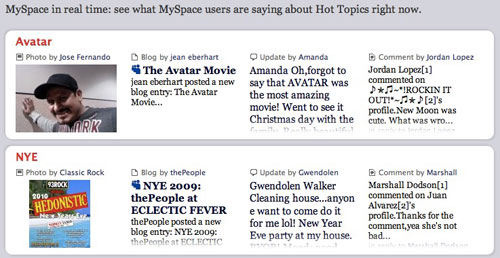
Differentiating in a world of multiple real-time search engines can seem difficult to the typical visitor. Lumped in with OneRiot, Twitter Search, Topsy and others, Collecta is trying to present more than just the newest results, with Twitter dominating, but to also present hot topics in context. The site's front page, echoed on their MySpace specific search, highlights a photo, a story, an update, and a comment, from the real-time Web.

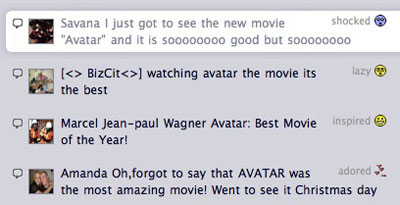
The hot topics on MySpace become especially interesting when mood is involved - giving the results a very emotional feel. In response to the failed airplane bombing on Christmas, the response on MySpace was very guttural, as moods displayed just how MySpace's members were taking the news. In more positive news, you can see reactions to movies or music, such as "Avatar" (See MySpace search for Avatar Movie) and get moods displayed alongside the messages, ranging from shocked, to inspired, rejuvenated and impressed.


MySpace Moods and Updates Around the Avatar Movie

Lest we get too caught up in the frequent hype around Twitter, the site's messaging traffic is still measured in the tens of millions per day, and Campbell reported that MySpace's flow is at a much higher volume. The difference is even more dramatic when you consider how many retweets are counted in that number.


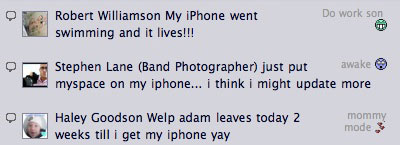
MySpace Updates and Moods on the iPhone

To separate the signal from the noise on sites like MySpace and Twitter, Collecta is working hard to also include concentrated content from traditional news sources and blogs - working to maintain the integrity of a single blog post that may have dozens of retweets. One approach the company has taken is to have a human editor work to curate the data, and then try to match that activity through algorithms.

While many of us may not have ever registered MySpace accounts, or logged into our long-since dormant accounts, the information and moods flowing through the new Collecta-powered MySpace search is very interesting, and a good proofpoint for the real-time search engine pointing to a new data set. Check it out here: http://myspace.collecta.com/

December 28, 2009

You Would Have to Be Insane to Get a New iPhone Now

You Would Have to Be Insane to Get a New iPhone Now

By my own conventional standards, this Christmas should have seen the arrival of two new iPhones in the Gray household. My iPhone 3G is somewhat long in the tooth, and has clear cracking in the bottom right corner, where Sarah clunked it on the kitchen tile. My wife's cell phone, inexplicably, is missing, and has been for weeks. While mentally, I'm all set to close out her old account, and sign us both up with new iPhone 3GS units, every single time I start the process, I just start getting ticked off at AT&T, and the more I think about it, the more ridiculous it seems that I would sign on the dotted line to any kind of long-term contract with Apple right now.
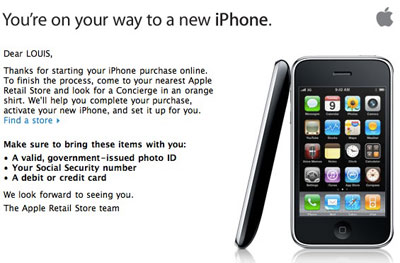
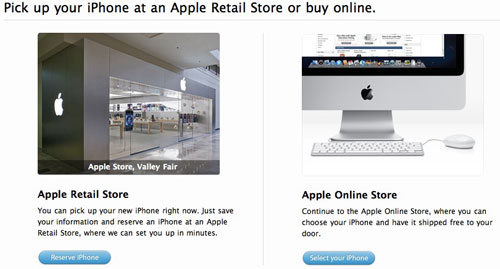

The number 3 has been bandied about a lot of late, with Verizon and AT&T having a proverbial pissing match over maps in the last few months. But the number 3 also frames the major sticking points that have stopped me from heading to the mall and forking over a few hundred bucks to get us both on the near cutting edge.

Apple Says I'm THIS CLOSE to Upgrading...

Those three reasons all begin with the letter A:

1) AT&T
2) Android
3) Apple

AT&T

Forget about Verizon's stupid map for a second. The entire battle around 3G is a complete farce if the iPhone can't even maintain consistent call quality or avoid dropping calls, the most basic of requirements. Just today, I have had only two phone calls with my iPhone, and both dropped. The first was with a new client, who I hung up on in the middle of discussing success criteria, and the second was with a PR rep talking about a new announcement set for tomorrow. I joked that the iPhone hung up when it heard the word MySpace, but we both knew AT&T had choked.

The iPhone drops calls whether I have one bar or five bars. And where it should have five bars, I find myself doing a contortionist's dance to edge toward a window or a safe spot in the house where it doesn't sound like static or the person on the other line is underwater. Many other times, I get voicemail notifications when the phone itself never rang. Ridiculous.

So every time I log into the Apple Web site to test buying the iPhone 3GS, I am reminded of a two-year contract with AT&T, for me, and for my wife. Why would I ever agree to be hooked to this ball and chain when there is any chance that Apple could open up to new, better, providers in that time period, especially in the first year?

Android

Android does not have the most applications today. Switching to Android would not magically port over the applications and iTunes I have purchased, making those major roadblocks in switching platforms. But in a year when it seems all that Apple did was speed up the iPhone and add rudimentary video recording, Android went from being a niche player to a real competitor. If Google's pace of innovation continues on the platform, the iPhone's once thought to be insurmountable feature lead could be vastly eroded.


It Wouldn't be THAT Hard to Upgrade

Apple

I saw the iPhone 3GS announcement as a ho-hum improvement. Albeit the third version of the platform, following the initial iPhone and the 3G model I have, the 3GS didn't alter the landscape. That said, it's expected Apple will come out with the next generation iPhone in the middle of 2010, following WWDC. Combined with all the current buzz around the tablet, one wonders what would be missed by buying the 3GS today, if one could instead hold out for generation four.

Walking through the terms and conditions for AT&T just made me a bit sick to my stomach. I recognize that I have a lot invested in the iPhone platform. I've always been a good iPhone fanboy. I know my wife needs a new phone, and it does make some sense that we're both on the same carrier and plan, but I do feel like if I do what my natural tendency is and wander over to the Apple Store with credit card in hand, that I would be a big sucker, chained to AT&T's sub-standard service for another two years. And at the end of those two years, where will Android be? What other carriers will Apple have opened up to?

In the world of gadgetry, two years is an incredible amount of time. Maybe I should just buy these units now and plan on facing a hill of early termination charges later. But that just makes me more of a victim to the entire system. I know I'm considered crazy by some, but to do this, I would have to be certifiably insane.

2009 Internal Year In Review (Month by Month)

2009 Internal Year In Review (Month by Month)

At the end of 2008, I posted an internal year in review, month by month, which wasn't just a look at the world through louisgray.com lenses, but also at the Web at large, seeing companies debut and change through the year. As you can imagine, what seemed important at the end of the year varied a great deal from that catching my eye at the beginning of the year. Similarly, the issue is no doubt true for 2009 - year that saw a lot less, at least for me, in terms of new startups, and instead, a lot more concern and issues with the economy. As mentioned in last week's roundup of new Web services that debuted in the year, many new products were extensions to others, or leveraged existing platforms.

That's a message you can see through the site's activity... below. Last year's big word was "launched". I dare say this year's word was "Twitter".

January

In what proved to be a prophetic (or ironic) post, I advised FriendFeed on what they should do to gain market share... and said why I talk to companies via the blog... Twitter OAuth slipped... Mike Fruchter penned an epic post on getting started in social media... non real-time Web got me down... Steve Jobs took sick leave... the recession started impacting ads... TweetDeck got funded... but Twitter kept screwing up... scammers joined Facebook... Twitter was funded... and BuzzGain launched.

February

FriendFeed tapped their database with advanced search capabilities... and I visited Lijit in Boulder, Colorado... seeing Gnip as well... Sirius Radio tried to die... and Outbrain was funded... Facebook ads remained off-topic... while I started playing iShoot on the iPhone... while wondering what companies would get us out of the recession... Trendrr launched... we debated Twitter's utility for following people... embraced Google Translate... talked about the cloud and SocialToo blocked automated direct messages.

March

I attended SXSW in Austin, and future Twitter screenshots were leaked... Likaholix launched... I said you should stand for something... while Twitter spammers got creative... Kosmix launched MeeHive... Google Reader added comments... the iPhone gained Facebook Connect... I talked about how to blog live events... CloudContacts launched... as did DoodleJump and FeedBlitz RSS... the recession highlighted a downward spiral and Britney Spears passed President Obama on Twitter. Although mocked at the time for the post, it was a key "tell" in the trend that saw Ashton Kutcher, Ellen and Oprah become top names over the geeks.

April

Twitter ticked me off again... ReadBurner launched BurnURL... while FriendFeed went real-time... Shyftr filtered RSS feeds... I rode a Segway at TechCrunch... Twazzup challenged Twitter Search... Tweetie for Mac was released... I said to stretch me thinner as trade show attendance cratered... Lunch.com debuted... and more Twitter screenshots were leaked.

May

Adobe didn't want me as a customer... saying they were expensive... Microsoft said search could be improved... I debated the intersection of skill and luck for job hunters... Socialmedian integrated into XING... the mob yelled at Twitter... I gave up on Apple rumors... discussed social media data flow and being an early adopter... Twitter's search engine broke down... Flickchart launched... as did Qajack, Topsy, and PeopleBrowsr... and blogging and RSS "seemed slow"...

June

Google introduced an improved blog search... Drew Olanoff got cancer... I bought Robert Scoble's BMW... Palm and Bing managed not to suck... I was on SocialWeb TV... BackType launched BackTweets... FriendFeed spiked my RSS stats... I subscribed to Sirius Radio... Matthew and Sarah turned one year old... as I visited TiVo and highlighted the importance of blogging.

July

FriendFeed added real-time search... retweeting started to trump linking... TweetDeck turned one... Google announced Chrome OS... Lazyfeed launched... as did Echo and Seesmic Web... I discussed beta processes and being a VC in text form... Pubsubhubbub launched... I drooled over the potential of the CrunchPad... and my6sense debuted.

August

I was curious about Apple's plans beyond Mac OS X... noted RSS Feed readers giving way to Google Reader... suggested not to unfollow everyone on Twitter... held a Lunch 2.0 panel with Kosmix, Mozilla and FriendFeed... tried Spotify for the first time... as Favorit shut down and FriendFeed sold out to Facebook... while that was debated... Twitter was under attack... conversations on Google Reader skyrocketed... Blogger turned 10... and Lazyfeed and my6sense opened for everyone.

September

Following an SFAMA panel, I said social media was infrastructure... as Brizzly debuted... I was on a panel with Ev and Biz to discuss Blogger... Steve Jobs showed his face... Reader2Twitter sent updates from Google Reader to Twitter... Ecademy went real-time... as I flew to London to speak on social media for business... I told you my 10 favorite Google products... MaxiScale debuted... as did Simler... and I got tired of the distributed conversations battle... and talked about why companies raise money and the pressures that result from VC funding... and Twitter readied lists.

October

Google Wave proved to be cool, but very busy... as Twitter took over the world... I yawned at the FTC... and was curmudgeonly about social media... explained why I share what and where I do... lauded corporate openness... and said there was no perfect Twitter client... I went back to BlogWorld... and said blogging wasn't dead yet... the Salmon protocol was spec'd... FriendFeed started to crumble at Facebook... I said Twitter couldn't replace RSS... Google Reader launched Magic... BlogTalkRadio launched Cinch podcasts... I debated going completely Google... and discussed the issue of open APIs.

November

The Motorola Droid looked pretty cool... Stalqer was interesting... every Twitter client added lists... Cadmus launched... and Google released Closure... I went to Defrag and discussed the social Web and the flow... introduced Paladin Advisors Group... Facebook filtered out my sister having a baby... I discussed the pillars of successful social networks... and the Chrome OS release... Twitter promised ads... I found issues with FTC's disclosure rules... and the CrunchPad was dead, unfortunately.

December

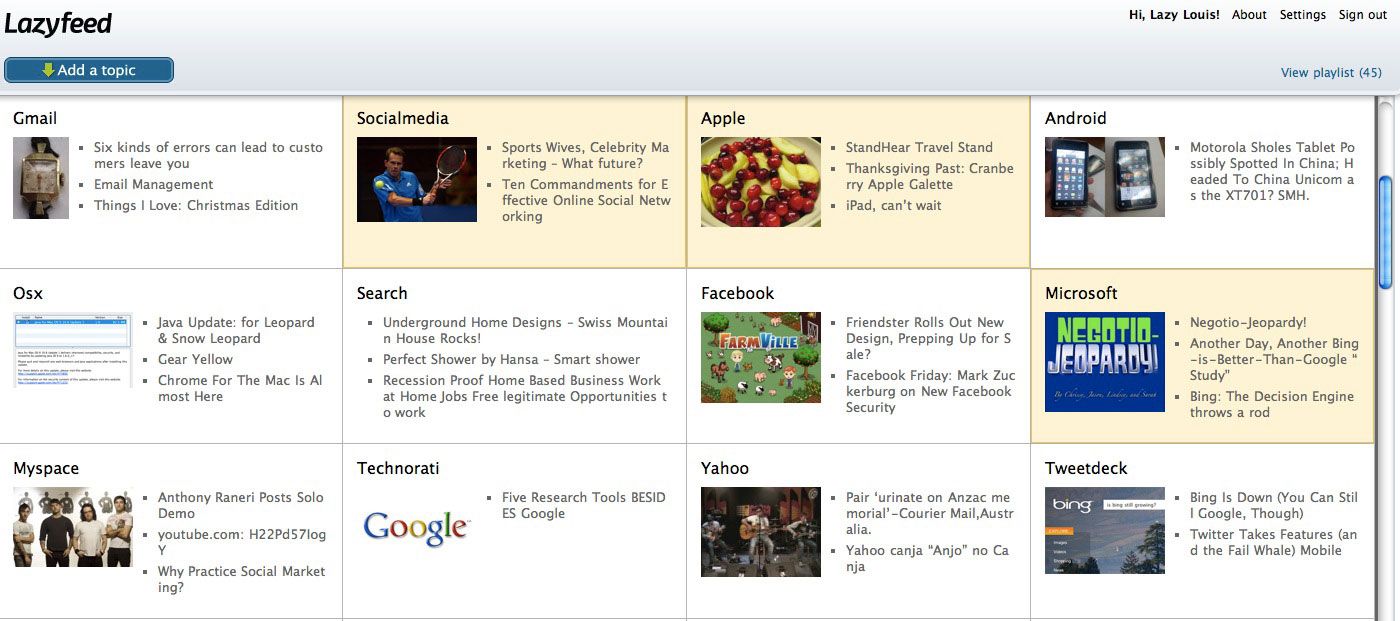
I said Google wasn't going to go evil... Lazyfeed revamped into square mode... we released FTC disclosure icons... SocialToo did the dirty work on Twitter for me... as the microblogging service matured... my6sense introduced mytweetsense at LeWeb... where I was hosting a Twitter apps panel... Google expanded Web Elements... I fell in love with Icerocket search and Spotify for the iPhone... I said companies that set the agenda win... highlighted how tech news writers are incentivized... and showed how RSS readers continue to grow. More recently, I recapped ten top applications from the year, recapped my yearly predictions and whether I met the year's goals.

And that, barring dramatic news in the next few days, encapsulates much of 2009, as captured by the site. Now you can see how the year's developments took place, get an idea for the events I attended, where I spoke, and what companies were making news. A busy year, as every year seems to be. The year was marked by some slowness in terms of new company debuts, but plenty of movement at the big ones. 2010, as the economy improves somewhat, should see some new names again, and I'll be looking forward to recapping those in a year.

Disclosures: I am an advisor for SocialToo, ReadBurner and BuzzGain. In addition, my6sense, Kosmix, Ecademy, and Simler have all been clients of Paladin Advisors Group in 2009.

December 25, 2009

How I Aimed to Do Better On the Web in 2009

How I Aimed to Do Better On the Web in 2009

As 2009 loomed, near the end of 2008, I took a look back at how I was utilizing the Web and set for myself some direct goals, not necessarily number-oriented, but measurable nonetheless. As I illustrated in 10 Things I Wish I Would Do Better On the Web Come 2009, I wanted to make a concerted effort to interact with readers on the site (and on other blogs), and be more active away from home, participating in events, panels, podcasts, and the like. (Note Steven Hodson's reaction to this list as well)

With the goal of keeping myself accountable, here's the year's goals revisited, and summarily rated with a success or failure.

1) Make More Comments on Original Blog Posts

Success: Although a great number of comments continue to remain on FriendFeed and Facebook, or Google Reader, I made a concerted effort to leave comments in reaction to posts for blogs big and small this year, be it the individual Posterous or Tumblr account, or a large blog network, such as TechCrunch or GigaOM. I don't think I will ever fully do as good a job here as I would like, but I was certainly aware of my activity in 2009.

2) Respond to More Comments on louisgray.com

Success: Disqus makes this process extremely easy, letting me respond to comments that come to the blog via e-mail, or in rapid fire with their simple user interface. On "hot" blog topics, I made sure to respond to a good number of thought-provoking readers, and "walk down the line" to add my views. As with the above, this too could be improved, but I believe I was better at this in 2009 than in 2008.

3) Be More Interactive On Twitter

Success: I am still not as huge a Twitter fan as many people. I continue to use Twitter more for links than conversation. But I also wanted to use the service to help promote the #BlameDrewsCancer phenomenon, and have been very active in responding to @Replies. I try not to use the site as a status update service all too often, but this became more than just a repository for "New Blog Post" in 2009.

4) Spend Less Time on a Few Sites, and More Time on Many Sites

Failure: I believe I merely exchanged some sites for others here. I continue to spend a lot of time on Google Reader and FriendFeed (no surprise to most of you). While in 2008 I spent a bit of time on Socialmedian and Strands, I removed myself from those sites for the most part in 2009, and replaced them with more use of Facebook, plus the addition of Ecademy and Simler. (which have some FriendFeed-like elements)

The leverage of RSS continues to keep me on Reader more than in visiting many different downstream sites, and I still am visiting non-tech at a bare minimum.

5) Have More Time for In-Depth Reviews

Success: In addition to a great number of in depth reviews of new iPhone applications, I also started using YouTube to help describe some services, including Lazyfeed and my6sense. In terms of other Web services, I have tried to make sure when covering a site that I have walked through it and included a good number of screenshots or explanatory items to provide more background, even if it means I am not first to publish.

6) Follow Up On Sites and Services After Their Launch

Partial Success: Following up on all sites and giving equal time is practically impossible. But for every site I discussed only once, there were many more, such as Brizzly, Lazyfeed, Simler and others that saw multiple pieces of coverage that included updates on the product and company.

7) Attend More Industry Conferences and Panels

Success: 2009 saw me attend BlogWorld Expo for the second straight year. In addition, I attended SXSW in Austin, LeWeb, multiple TechCrunch CrunchUps, and had other speaking opportunities.

8) Participate More Visiblity on Conferences and Panels

Success: Adding on to the above, I gained the opportunity in 2009 to branch out a bit, leading a panel on Twitter applications at LeWeb, speaking on content aggregation at SXSW, speaking on realtime at BlogWorld, on information overload at the Inbound Marketing Summit, the death of advertising with the SFAMA, and other opportunities. I aimed to say yes to as many as I could, travel and expenses willing. 2010 should continue the trend.

9) Be More Active on Podcasts, Videoconferencing

Partial Success: 2009 did not feature the regular podcasts that were attempted in 2008 with the ReadBurner Weekly and Elite Tech News podcasts being shuttered. I did participate in FFundercats a few times, joined Leo Laporte for a holiday This Week In Tech, and Steven Hodson for another, but this was less than I had anticipated.

However, in addition to the group podcasts, I started using Cinch a lot, letting me send off single person podcasts from the iPhone, or 1-1 interviews, as were done at LeWeb.

10) Highlight More Bloggers and Entrepreneurs

Failure: As in 2008, I continued the highlighting of five new bloggers and ten new Friendfeeders each month through the first half of the year. But the purchasing of FriendFeed by Facebook in August pushed this plan askew, making me openly wonder if it made sense to continue that practice. I continue to seek out new content and highlight it through Google Reader shared items and other places, but could improve.

By setting these goals at the end of last year, they were somewhat in the back of my head as I made plans and actions through 2009. I tried not to set an arbitrary number-based goal that would make things seem like a chore, but did want to do the right thing. As you can see, many of these goals, especially in regards to events, were much stronger in 2009 than 2008. I just thought it made sense to report back to you.

December 24, 2009

My 2009 Tech Predictions: Mixed, But Nailed Real-Time

My 2009 Tech Predictions: Mixed, But Nailed Real-Time

Another yearly tradition here on louisgray.com. Following on to last year's 10 Predictions for 2009 In the World of Tech (and its 2008 predecessor), it makes sense to review how we fared. Recall my 2008 predictions were a complete mess. Unlike some other bloggers, who opt to pick non-controversial items and guess at obvious developments, I like to have fun each year and stretch. That's why I'll never go ten for ten. Besides, that's no fun.

As of Christmas Day 2009, here are how those ten predictions in the world of tech stand:

1) The Real-Time Web Will Become Critical for News and Information Discovery

Right. Critical is a subjective word, but real-time ended up being the word of the year in 2009. It was in real-time that the world shared their reactions to the Obama inauguration, and shared feedback to the Iranian elections. It was in real-time that we saw the aircraft land in the Hudson River, with a picture posted to TwitPic alongside. While it is true that Twitter and other real-time mechanisms lack the fact-checking and robustness of more traditional media, there were many many cases that had CNN and others following real-time's lead. Real-time later became such a big deal it was integrated into Google Search and Bing, so this was a clear win.

2) Businesses Will Be Expected to Be On Social Media If They Have Web Sites

Right. In 2009, the majority of businesses woke up to social media. While there are no doubt many holdouts, and even a bigger number doing a poor job, 2009 was the year that companies realized you could get business done on Facebook, Twitter and other networks. There is still much work to be done, but with tens of thousands of self-proclaimed social media experts out there, and some real help, others will make the leap.

3) Apple Will Introduce A Succession Plan for Steve Jobs as CEO

Wrong. And it's too bad! While Steve Jobs was out due to liver surgery, his position was well covered by Tim Cook, Apple's COO. Cook did such a great job running the company during his absence, the company's stock is at all-time highs, and its cash hoard is multiples greater than it was at the beginning of the year, even during a global recession. It could be assumed that had Steve Jobs passed away in 2009, Cook would have maintained control - and it would make sense that Apple have an internal plan for how Steve would fade to the limelight.

That said, I would still love it even more if Steve Jobs were proven immortal.

4) TechCrunch Will Acquire VentureBeat or Silicon Alley Insider

Wrong. In 2009, TechCrunch instead acquired only one writer, MG Siegler, from VentureBeat, and MG has gone on to be one of the most recognizable faces for the site. In parallel, Silicon Alley Insider went to more of a copy and paste model, and carries many of TechCrunch's articles in excerpt form, making the whole thing more confusing. But TechCrunch didn't find any need to acquire either site and continues in its highly visible position.

5) Android Will Have Less than 20% the Sales of iPhone in 2009

Right. (Unless somebody can prove differently) Despite a surge in Android news and new handset introductions in the latter half of the year, including new models from HTC and Motorola, Apple's iPhone still outsold Android in a big way through the year. Though figures are difficult to get for the newest models, and the trend shows Android gaining in market share, it does not appear that their combination managed to pass 20% of the volume of iPhones in the year. 2010 will no doubt be a different story.

6) A Major Alternative to FeedBurner Will Emerge As the Service Stagnates

Right and Wrong. FeedBurner finally got its act together with Google this year, adopting Pubsubhubbub, and rebranding under the corporate name. In parallel, FeedBlitz launched a serious competitor to FeedBurner which could replace the service outright. It hasn't been a "major" alternative, but absolutely works if you prefer it.

7) FriendFeed and Twitter Will Both Be Independent Through 2009

Wrong. FriendFeed's sale to Facebook took many of its hard-core users by surprise, and its no doubt that many are still reeling, unsure what will happen to the popular aggregator and social network. That I linked FriendFeed and Twitter together in my prediction is unfortunate, as Twitter not only remained independent, but flourished, raising more than $100 million, and ensuring profitability, by some reports, thanks to deals with Google and Microsoft. The company's $1 billion valuation makes it a difficult target for acquisition indeed by any potential suitors.

8) Companies Will Continue Budget and Staff Cuts Through the Third Quarter of 2009

Right. While recent months have seen isolated good news, especially in some parts of Silicon Valley, for the most part, companies have kept their belts tight, and unemployment remains high. While the dramatic job cutting that took place from late 2008 to mid 2009 has slowed, the recovery is not yet in perfect view.

9) An Extremist Group Will Manage to Take Down or Deface the White House Web Site

Wrong. Luckily, I was wrong about this. I don't believe that some groups out there would like to make this happen, but thus far, the White House Web Site has made it through the year unscathed. Of course, that's more than we can say for our good friends at Twitter, who just a week ago were defaced by an Iranian Cyber group.

10) eTrade, Digg, StumbleUpon, Skype and Yahoo! Will All Be Sold.

Wrong. (But A Little Right) Again, I failed by linking all these companies at once. eTrade and Digg stayed independent, and Yahoo! managed to keep its name despite giving up on search to Microsoft. Skype was sold, and StumbleUpon similarly was sold, back to its private investors. In my prediction last year, I said, "eBay will want to ditch its non-core assets like StumbleUpon and Skype" and yes, that happened, but we did not see the list of companies change hands as I had expected.

My 2008 predictions, made in late 2007, saw a massive 1 1/2 answers correct out of 10. Contrasted with that year, I did a little better in this calendar year, especially when it came to the expectations around the economy, real-time, and social media. But I still scored below 50%, with 4 1/2 right. We'll see how I do for 2010 when that post rolls around.

10 Top New Web Services of 2009 (From My Perspective)

10 Top New Web Services of 2009 (From My Perspective)

Last year, I highlighted ten top Web services that debuted in the year, from Socialmedian to BackType and Feedly. Not an all-encompassing list, blogging colleague Robert Scoble asked if "I was right", adding on a few of his own.

With 2009 coming to a close, I thought it made sense to highlight some of my own personal favorites which are gaining traction. Keep in mind that I am not ranking these services necessarily in a most important to least important order, and I am ignoring some other top services (for example, Foursquare, which launched in March, or some Zynga properties), due to my own non-use.

As with 2008, many services debuted in 2009 that were not stand-alone services, but instead, hooked into existing environments, like Twitter and Facebook, or the iPhone.

1) Pubsubhubbub

2009 was all about real-time and moving data more quickly from place to place. No technology or service better epitomized that than Pubsubhubbub, an open protocol engineered from a team of Googlers who were looking to accelerate the delivery of updates between services with near-zero latency. Pubsubhubbub's simplicity and clear benefits resulted in many major services adopting it and virtually eliminating the expected wait times for aggregators and readers to get updates, while also reducing the need for said aggregators to repeatedly poll content sources.

Pubsubhubbub, adopted by Blogger, FeedBurner, Cliqset, FriendFeed and many others, also spurred into action the launch of Dave Winer's RSSCloud, adopted by Wordpress for similar purposes. The launch of Pubsubhubbub also fed the growth of Superfeedr, an increasingly popular utility that aims to deliver real-time notifications via the cloud.

2) Google Wave

Google Wave made a huge splash in 2009. (Review) If you weren't trying it out and aiming to find out what value it actually brought, it was probably because you were begging for an invite and hadn't found one yet. The real-time collaboration tool was mischaracterized by many who thought it could replace e-mail, or different social networks' activity, and it hasn't found too many people relying on it as a core service yet, but its innovation has many looking to see what the end game looks like.

3) Square

Although extremely new, Jack Dorsey's follow-up to Twitter, Square, is very alluring. A simple hardware add-on to the iPhone (and in the future, other mobile devices), Square lets any individual accept credit card transactions, verifies the purchaser, and provides the purchaser with an electronic record of the activity via their Web site.

Dorsey and team skillfully looked at a daunting world of differing devices and managed to find the commonalities between them (an audio port to be specific) and delivered something that could potentially change the game for small merchants and individuals, providing true mobile commerce that doesn't require cash.

4) Echo

The launch of JS-Kit's Echo product was such a big move for the company that they changed their name to reflect it. Echo, recognizing the sea change evident in social media that has moved much of the discussion of content away from core blogs, aggregated downstream activity at the host blog, including retweets and other social network reactions.

In addition, Echo brought real-time to everyone's comment stream, turning a once static entity into a live chat room. You can see Echo in action on popular sites including those from Brian Solis and 1938media.

5) my6sense

With more data coming in from more sources than ever, it is unlikely that most people are following fewer people or feeds at the end of 2009 than they were at the beginning of the year. Combined with a rise in mobile Web access, and you can see how my6sense's digital intuition for RSS feeds, Twitter and Facebook makes sense, surfacing relevant data that is customized just for you.

The company has an iPhone app available, free, now, and has publicly promised that Android development is planned in the short term. Keep in mind that I am helping to advise the service, but I have been impressed with their offering, and see the issue of curation as one that many services will tackle in 2010.

6) Brizzly

Brizzly, a product from Thing Labs, is one of the more novel approaches to consuming one's Twitter and Facebook streams. The first to enable in-line viewing of images and video, the addition of customized trend definitions and novel approaches to direct messages and multiple account support, Brizzly is a compelling Web-based alternative to the standard interface from Twitter and competing clients, such as Seesmic.

Earlier in the year, Thing Labs also introduced Plinky, which while cute, doesn't look to be setting the world on fire.

7) Lazyfeed

For a technology supposedly on its last legs, RSS sure had a lot of very interesting innovation in 2009 (See also: Pubsubhubbub and my6sense). Lazyfeed came on the scene this summer with a real-time approach to feed discovery and the ability to follow several topics at once. A live interface and rapidly displayed content has made the product easily among the most fun ways to take in a lot of information, while keeping things "lazy".

With the slowing of central directories like Technorati, Lazyfeed became one of the best sites for me to use to find new sources who were discussing topics I was interested in, letting me add them to my reading list.

8) Flickchart

In May, Flickchart introduced a site for comparing your favorite movies, across time, genres, or even against your previous picks. Although simple, the "pick your favorite" approach became very addicting, and the site now sports more than 40,000 registered users, who have contributed more than 60 million rankings. (See blog post)

One of the unexpected side benefits of Flickchart for me was finding top movies rated by friends which I had never seen, which spurred me to finally add them to my iTunes or NetFlix.

9) Lunch.com and Simler

I am combining both Lunch.com and Simler, as both sites seem to be in their growth stages, and have similar goals - helping you to find interesting people who share the same interests. Lunch.com asks you for your spheres of interests, and to rank specific items on a -5 to +5 scale. In contrast, Simler asks you to add tags that describe your interests, and links you with those others who have also added the same tags.

Both Lunch.com and Simler suggest that you post new items to topic-oriented pages, and engage in discussion with others in your network. Lunch.com seems to be more product-oriented, while Simler is more focused on more abstract things, such as television, music and technology. Simler, like my6sense, is a client of Paladin.

10) Tweetie

If Brizzly was included, it also makes sense that Tweetie makes the list, even if it has no specific Web-only interface. Tweetie has become the gold standard for Twitter clients on the iPhone, and was among the first to incorporate many of the advanced capabilities introduced by Twitter, including Lists, geolocation, and retweets. Tweetie also has a solid Macintosh version, which I use often.

Also on this year's list but outside of the top 10:
Blippy, Cadmus, Cliqset, Gowalla, Salmon, Twazzup

What did I miss, overlook or understimate in 2009? Let me know. I am sure you have some better ideas.

December 23, 2009

Mozzler Filters Your Social Stream for Links, Displays Media

Mozzler Filters Your Social Stream for Links, Displays Media

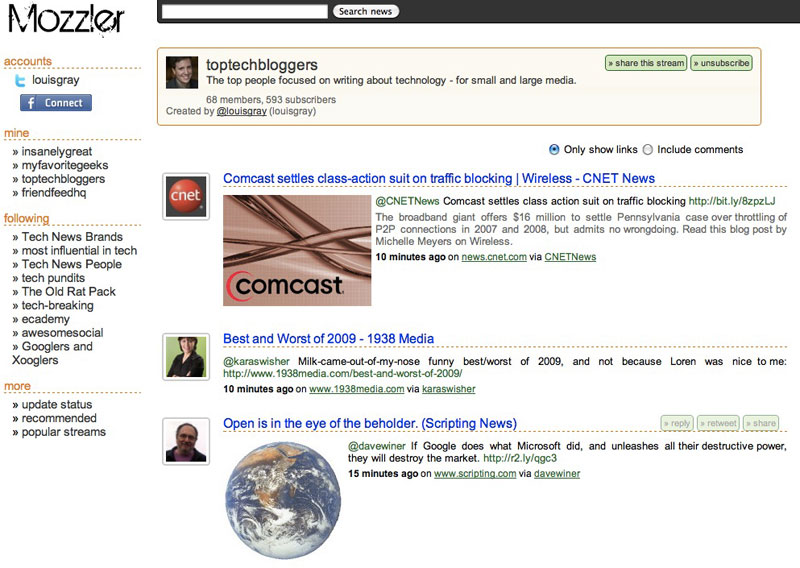
For many, Facebook and Twitter have evolved to be much more than just social networks for connecting to people and their status updates. The services have also become top discovery centers for links, including images and videos. But these images, links and videos are floating in the stream alongside status updates, location service check-ins, and replies. If you are looking for links, the other content can be seen as noise, and if you are looking for status updates, it could be a preponderance of links get you annoyed. The advent of Twitter lists, and some early adopters' creation of technology news brands has helped hone in on the "signal" over noise, but a new service from Mozzler, currently in private beta, makes finding links, and displaying rich media, very simple.

Mozzler, like a number of other services, including Brizzly, TweetDeck and Seesmic, lets you combine your Facebook and Twitter streams into a single feed, utilizing Facebook Connect and Twitter OAuth.


Mozzler Filtering My TechBloggers List for Links
(Click for Full Image)

Upon logging in, Mozzler displays the Twitter lists you have created, those you are following, and also suggests popular streams, highlighting a number of Twitter lists that have crested beyond 500 followers.


Twitter Filtered for Updates With Links Only

Click on your Twitter ID, and you can see all friends' updates, as with other Twitter clients, and rich media, including photos and video, is displayed in the stream, as it does in Brizzly. But to me, the most interesting wrinkle with Mozzler is the option to "only show links". This eliminates all status updates without links, and all @replies that don't contain a URL.


Rich Media Flows In With Mozzler

Combine a high quality Twitter list with the option to only show updates that contain links, and you have a highly relevant social stream, sorted by time - much like I've highlighted previously with the mytweetsense product by my6sense.


Top Brands on Twitter With Links

Chris Were, founder of Mozzler, sent me an e-mail, saying the service "aims to aggregate all the news from your social network into one place", while "At the same time, it aims to help find new sources of news (whether they be twitter/facebook users/fan pages/lists)."

Chris also said the product has much more to do to improve prior to being opened to the public, but expectations are that it will open up mid-January 2010.


Matt Cutts, Filtered by Mozzler for High Quality

Without jumping back into the fray (again) around what is more relevant to find the best news, RSS or Twitter, Mozzler's ability to showcase tweets with links, combined with the most popular Twitter lists, many of whom feature top news brands, such as my "Top Tech Bloggers" list, makes it a very interesting service. You can even drill down on individual accounts to show link-based tweets or Facebook updates, without everything else.

You can find Mozzler at http://beta.mozzler.com and on Twitter at @mozzler_news. The service is in private beta, and I've been told you can get in to the service if you retweet this post and use the hashtag of #mozzlerbeta.

December 22, 2009

For All the Gloom Around RSS, Readers Continue to Climb

For All the Gloom Around RSS, Readers Continue to Climb

Skimming many of the leading technology outlets, you would think RSS had given up its ghost, making way for new services, like Twitter. Just this week, ReadWriteWeb claimed the RSS reader market was in "disarray" and continued a "decline". This came after a summer in which TechCrunch IT's Steve Gillmor declared RSS dead and suggested that it "rest in peace" and others ditched RSS for microblogging lists. With the world watching Twitter's top names and their Suggested User List-boosted following counts cross well into seven digits, data from FeedBurner and other sources shows RSS counts climbing - in some cases dramatically - for nearly all blogs, and a number of them also sport reader counts in the millions. While the independent market for RSS readers may be in bad shape, having ceded ground to Google Reader, RSS as a utility is actually growing. It's not going down, not by a long shot.

Prior to ReadWriteWeb's alarmist article, back in August, I arrived at similar conclusions, when I said "stand-alone feed readers are collapsing", highlighting the fact that Google Reader, and followers on FriendFeed, dominated my personal statistics.

That Google Reader and iGoogle have reached a dominant position in the market does by no means indicate the technology's death, but instead its maturity - something that, beyond aggregate reader counts, does not take in to account the fact that RSS is the mechanism for getting data between sites practically everywhere, even if it is not called out as such.

In January of 2008, I highlighted the debut of a new service called Rating Burner, which aims to display the most subscribed to blogs that utilize FeedBurner. The site shows not only a leaderboard, but also the change in subscriber data from day to day.

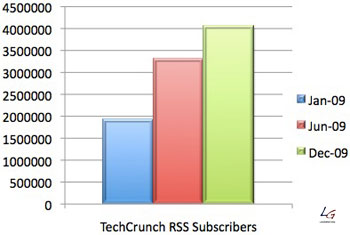
Data from Rating Burner shows green, positive growth across the board for feeds. And while total counts can always be debated as to their accuracy, sites including TechCrunch (with 4 million subscribers), the YouTube blog (with 2.4 million), Smashing Apps (with 1.5 million) and Simply Recipes (1.5 million) are into seven digits. This parallels the top Twitter accounts, who crest in the 4 million range, crowned by screen celebs Ashton Kutcher, Britney Spears and Ellen Degeneres.

Yes, statistics are statistics. The high numbers for these well-known personalities is suspect, thanks to their inclusion on Twitter's Suggested User List, and it is also expected that some top blogs here are bundled and not read every day - adding to their counts. Also true is the fact that not every blog uses FeedBurner, and thus cannot be tracked as well. Many sites point instead to a raw XML file, keeping control. That said, regardless of the data's perfection, the growth in 2009 for RSS subscribers cannot be questioned.

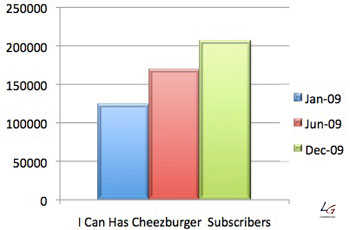
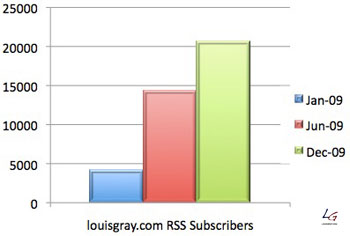
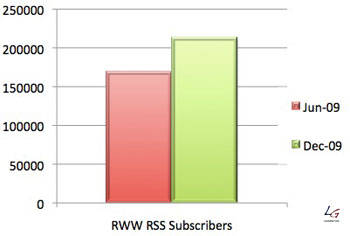
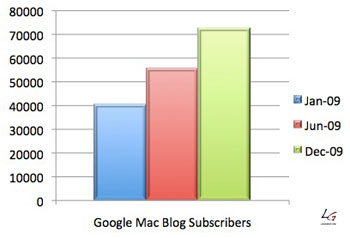
Using BlogPerfume's Feed Analysis tool, I took many top blogs and plugged in their statistics, to see how they grew in 2009. Running their query for the last 12 months provided 11 months worth of data. (Not perfect, but good enough)

For the charts below, I used three data points to show blogs' subscriber trends:
  • January 22, 2009
  • June 22, 2009
  • December 22, 2009
(Yes, the gap between January and June is 5 months, and the gap between June and December is 6, but you get the idea.)

To run the numbers yourself, simply plug in any FeedBurner enabled feed. (Examples: TechCrunch, Mashable, louisgray.com and I Can Has Cheezburger)


ProBlogger Nearly Double Subscribers in 2009 to ~140k


LOLCats Added 100,000 Readers to 200k+


TechCrunch Doubled from 2 million to 4 million


My Own Stats, Aided by FriendFeed, Quintupled


ReadWriteWeb added 40k from June (Jan. data flawed)


Google's Mac Blog Added 30k Subs to Top 70k.


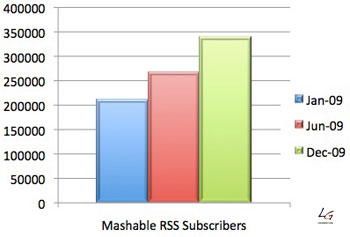
Mashable Added Almost 150k Subs to Near 350k.


Also - keep in mind that my own personal numbers are inflated thanks to FriendFeed, but most non-personal blogs are not.

So what is the point? The point is that while some services (read: Twitter and Facebook) may be getting many people's attention, and while it is also true that Google Reader has the lion's share of the RSS reader market, the current discussion around RSS being less useful, or less important, than in years past, is flawed, period.

Lest this early adopter sound too much like a curmudgeon, just because something is newer does not automatically make it better, nor does it mean that there will be a rapid mass exodus from the previous technology. Just like Twitter can drive good traffic to a Web site, so too can RSS. Just like Twitter can pass along top content, so too can RSS. Just like top followed accounts can get million-plus audiences, so too can RSS. And both are growing in terms of connections, with no reversal in sight. Both are tools to be used well, and both are being used more than ever. The only "disarray" is in the current thinking.

December 19, 2009

Growing Grumblings on Tech News Don't Address Incentives

Growing Grumblings on Tech News Don't Address Incentives

If you are the subject of the news, people will judge your actions and how you react to being in the spotlight. If you are the distributor of the news, how you message that news, and how accurately you report that news, will also be dissected. On the Web, especially in our sliver of Silicon Valley, where real time is becoming the standard, analysis of said news is itself happening in real time. From many corners, often from the more technically-oriented folks on the Web, I am seeing discussion around the tech news industry's alleged failings, inaccuracies, and usefulness (or lack thereof). While some of the feedback no doubt has merit, it too comes in simplified form, without offering potential solutions, taking into account how the creators and publishers of this tech news blogosphere are incentivized and rewarded.

On Sunday, Mike Arrington of TechCrunch, as he often does, started a discussion around what he termed "fast food content", saying that "hand crafted content is dead", summarizing a piece that lamented sites which steal content without attribution, and more darkly, sites that employ people to rewrite others' content, without adding anything new or doing "real reporting", the kind one learns in journalism class, or is required to do when working for a "dead tree" newspaper or magazine.

Given Mike's focus, running one of the more widely read tech news sites on the Web, his concerns lie around those who borrow much of his and his writers' content and publish it as their own. But I have also given a lot of thought, especially of late, to the vast number of tech news sites and blogs that are out there covering the same stories, and are jostling amongst each other to beat their competition by a few minutes - opting not to win on quality, but instead, on time. In this case, it's often not another tech blog's news that is being borrowed, but official announcements from companies.

One of the easiest things for tech blogs to do is repeat updates from the official blogs of interesting companies, add a few internal links to previous coverage they have done on that topic, add a paragraph or two of analysis, and hit the post button. I've no doubt done it myself over the last few years, even with this self-awareness, but you can see the process unfold practically every day. Watch for phrases like "According to a post on the official Twitter blog..." or "In an update on Google's blog this morning"... as many of the better-known sites all post their own interpretations of the news that came from the top.

This, in my opinion, is the very definition of the "fast food news" Mike is talking about, and time spent both producing it and consuming it could be put to better use - as in these cases, links could serve just as well as full articles.

I am by no means an ombudsman for tech media and the tech news consumer. I am but one person who takes in a lot of content, and produces a little on my own. But I see a few other areas where the tech news engine is falling short for news consumers, news makers and the news authors themselves.

I believe "fast food news" also can refer to the mass hysteria over making sure every site posts the news that a major browser or a major operating system has issued a point release, or when a popular site has an outage, that the incident becomes front page news for every blog. At some point, given the vast multitude of interesting tech stories, individuals and companies out there, one must take a deep breath and realize that being the 10th site to report that Twitter got hacked last night didn't really add a lot of value to readers.

In fact, when Twitter did get hacked Thursday night, Mike (again) had a solid post that added information, and, as he gained more knowledge of the incident, he updated the same post multiple times throughout the night. Because he was the first to the scene, with real data, his post had meat, while many, many others that followed were just echoes of the obvious.

So why is this happening? There are a few reasons:

First, the advertising model that forces many sites to drive page views and social interactions, through Digg, StumbleUpon, and Twitter retweets, is turning many tech news sites into post mills, staffed largely by inexpensive writers and freelancers. Instead of deep analysis posts that require interviews, backgrounds, and research, these sites are instead home to excerpts from YouTube, polls, user surveys, and whatever happens to be trending on Twitter that day. Quality is exchanged for quantity.

Second, many of these sites operate under the guise that they are the only site their readers see. Just because one major tech site covered a story 30 minutes before doesn't mean they should assume their readers already know. That is why if you do subscribe to many technology blogs, as I do, you can expect the vast majority of them to report the same story around the same time - instead of choosing a specific focus that can set them apart from the competition.

Third, thanks to competition and personal interactions, not every site likes the others. Years of infighting and annoyances, thanks to individual posts, personalities, or business priorities means that some sites really dislike each other. They won't link to one another. They will ban the competition from their user conferences, and when they aren't taking potshots, they will act like the other doesn't exist. Thus, if the competition "breaks" a story, the other will post it anyway, or try to find a wrinkle that makes their own version of events "improved" or invalidating the other.

Fourth, the rise of aggregation sites makes piling on to the news something that is rewarded. If all competitive blogs have covered a major story, many others will follow suit, be it to get into "discussion" on Techmeme, to see TrackBacks on the originating posts, or to come up when the popular terms are searched for on Twitter, Google and other engines.

In essence, the incentives, for the most part, do not tilt in favor of writing unique stories or doing the required research necessary to get a full story, to get quotes from a source, or find data points that back up analysis.

That's why you see people like Alex Payne (of Twitter) complain, saying "Rarely does technology journalism produce informed, correct, relevant, and readable content. This is a sorry and damaging state of affairs." in his rant from March (Towards Better Technology Journalism), and why Marco Ament, the lead developer of Tumblr and Instapaper creator, this week, wrote: "Over the last few years, I have unsubscribed from nearly every tech-news feed. I have never regretted the decision afterward, and I haven’t missed anything important. Tech news needs help. Badly. It’s truly terrible."

Keep in mind that it's not unexpected for the more technical among us to dislike the way their works are interpreted. Engineering distrusting marketing is practically a requirement and a religion. But we know they are somewhat right. As much as we can complain about the public relations industry as a whole, many flaks often find that their offers for reporters to speak with the CEO or an official representative of the company go without interest, either due to time issues or a lacking skill set. It's always a lot easier just to ask for the press release ahead of time, and an embargo date.

In an ideal world, those who are acting as our news filters would take the extra time necessary to ferret out news before its time, would ask those making the news the questions they didn't want to answer, would understand competitive landscapes, and wouldn't worry about getting a post up in a few minutes to hit a quantity threshold, without it first passing a quality threshold.

Lest we think Alex and Marco are the lone cries for help, you can see other comments this week from The Angry Drunk, and from Google's DeWitt Clinton, who posted to Twitter, "Don't worry. Save some time. Your story doesn't need a shred of truth to it. It will be retweeted just the same." in response not to a tech blog story, but a mainstream media piece that had missed the mark. (He later, in contrast, praised Marshall Kirkpatrick of ReadWriteWeb for solid reporting)

Content producers need to make choices in terms of what it is they cover, and where their field of expertise lies. If not breaking the news, or having access to the technology elite, there are many other ways to make your voice heard, through analysis and personal use cases, as well as the option to find new stories. Content consumers too have the choice as to where they get their news. I would hope that those people who are being spoon fed repeats of others' original reporting, or are waiting, jaws agape, for recaps of company blog posts, recognize what it is they are really missing.

Given the low cost structure needed to create content, it doesn't look like there is going to be a painful consolidation any time soon. In the meantime, the system is set up to reward those who publish quickly and pile on - for extra effort doesn't bring home the page views. There are going to be pockets of the Web that harbor original ideas, a focus on quality and data, and there are going to be other places where copying, scraping, and shortcuts are going to rule the day. I know what I hope to be. The question is, can we do our part, as publishers and consumers, to somehow reward those that do things right?

December 18, 2009

My iPhone Data Consumption Workflow

My iPhone Data Consumption Workflow

Early in 2008, I tried to illustrate how I go about consuming data online, prioritizing some networks over others, and finding time to get everything accomplished, even as social sites and the sheer quantity of connections proliferated. While that routine has not changed dramatically in the last year-plus, what has changed is that I am consuming much more of this same data while mobile, on my iPhone 3G. Using the iPhone has its benefits, but also, its detractions, the smaller screen, and reduced bandwidth, relative to a hardwired desktop connection, which mean I need to be more selective in what I take in and how I can find the right information.
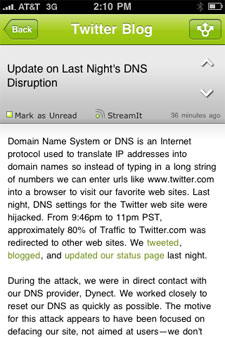
Last week, after arriving in California, after a week in Paris, France, at LeWeb, followed by 12 hours in the air, I found myself stuck in the airplane, as we taxied, and then waited for other passengers to retrieve their items from their respective overhead bins. This gave me the chance to execute what I see as my new iPhone workflow, aimed to get caught up quickly.

The process is as follows:

1) E-mail

It may not be as sexy as many of our more modern apps, but as I mentioned with my desktop process, everything begins with e-mail. To ignore e-mail outright, which could have the most personal messages, requests, action items, and updates, would be a step backwards. Not only do I still get a lot of information out of e-mail, it is also the repository for many online actions, which could alert me to relevant data elsewhere, such as saved search results, following notifications, etc.

2) my6sense


my6sense surfaces most relevant RSS feeds and tweets


As I follow hundreds of RSS feeds in Google Reader, the service's mobile application, while good, isn't robust enough for me to power through and find the most relevant data to me quickly. my6sense, a client of mine who I advise at Paladin, is built specifically with mobile in mind, and, having watched my own activity for the last few months, has a fantastic idea in terms of what stories are going to be most interesting to me. Now the the company also has mytweetsense, it will also surface relevant tweets that contain links.

Essentially, it's like sifting through the top 1% to 5% of my Google Reader feeds. I know I'll get the other 95% to 99% when I get back to the laptop. If I find items that catch my eye and are worth sharing, I can use my6sense's built-in capability to reshare this content to my downstream social networks.

3) Tweetie


Tweetie Lets Me Peruse Lists, Searches on Multiple Accounts


Tweetie is my default Twitter application both on the desktop (Mac only) and on my iPhone. It lets me review the multiple Twitter accounts I monitor, and quickly track down relevant Tweets, which may or may not contain links. Using Tweetie, I can browse my @replies, thumb through saved searches, or even check in on any of the Twitter lists that I am subscribed to. While I may still prefer RSS over tweets, ignoring Twitter would be as dumb as ignoring e-mail. When I find interesting content, I can either reply or retweet from within the app, from any of my accounts.

4) FriendFeed for iPhone

FriendFeed has many 3rd party client iPhone applications, but no one official iPhone app. In its place is the Web URL: http://www.friendfeed.com/iphone, which offers the same capability of one of my favorite social networks, from lists to prior discussions, search groups, and the ability to take action on any content, including comments and likes.

Using this workflow enables me to power through not just the top content sources, including e-mail, RSS and tweets, but the most relevant ones to me. Relevancy is more important on a screen like the iPhone, and when you only have limited time. While it may be comfortable to sit in front of a laptop for 8 to 16 hours a day (as I tend to do), your thumbs can really only take a good 30 minutes of iPhoning before it seems tedious.

This workflow does not mean to indicate that there are no other good sources of data. On rare occasions, I will hit the Facebook application and pull down messages or see feeds, but only after the first four major items have been hit. Other good news source apps for the iPhone include those from MeeHive, Regator and Techmeme's new mobile page - but none are more tailored for me than the above.

Do you have a workflow, or have you just been scrolling blind?

Disclosure: my6sense is a new Paladin Advisors Group client. I am Managing Director of New Media for Paladin.

December 17, 2009

iTunes, Sirius Seem Antiquated After Spotify iPhone Trial

iTunes, Sirius Seem Antiquated After Spotify iPhone Trial

After an initial test of Spotify back in August, I said the product was the best streaming music service I had ever tried. While I still listen to much of my music through the dozens of gigabytes I have in my iTunes library, Spotify makes searching for practically anything or finding new tracks I haven't yet purchased very simple. After meeting with Shak of Spotify last week at LeWeb, I was given early access to Spotify's iPhone application - still not yet approved here in the United States - and my experience with it has me rethinking my traditional marriage to purchased and downloaded music. While there has been a lot of recent talk about Apple's purchase of LaLa and their future plans with the service, Spotify has me seriously thinking if I even need a stored music library at all.


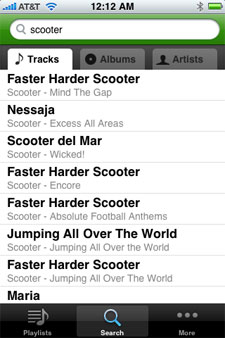
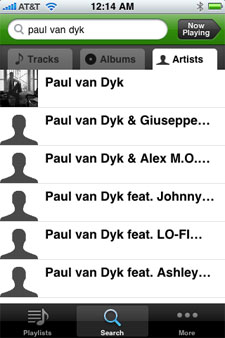
Search and Find Artists, Tracks on Spotify for iPhone

As I told you back in June, I subscribed to Sirius XM satellite radio after the company debuted its iPhone application. Combined with my iTunes library, I have a solid archive of music I've purchased, and access to new music through Sirius' stations. Now that I have Spotify on both the desktop and the iPhone, I haven't found a need for Sirius, and I have even avoided opening iTunes, which has become far too bloated for me, slowing down my computer as it loads my ever-growing database.


Some of the Great Tracks (and art) on Spotify for iPhone

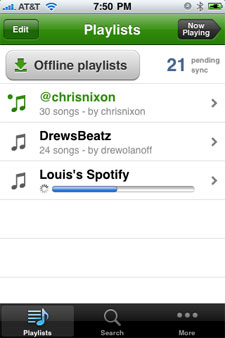
As you might expect, the iPhone version of Spotify mirrors that of its desktop sibling. Its two core sections are Playlists, both those you have made and friends' who you are following, and Search, which will find you Tracks, Albums and Artists that match your search criteria.

Click on any song in the search results, and it will start playing, streamed onto the iPhone. Hooking it up via my audio cable to the car stereo gave me excellent sound, as good, if not better, than Sirius has. Selecting an artist displays their albums on Spotify. You can choose an album and have it shuffle the songs, or start from the top.


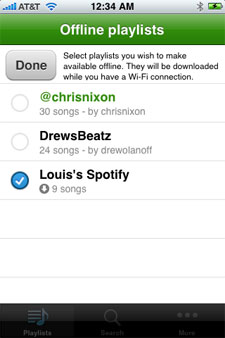
Spotify Playlists Are Available and Sync to the iPhone

As one needs to log in to their Spotify account to gain access to music, the application synchronizes the playlists you have made or follow on the iPhone as well. This means that if you have selected any number of tracks and made them part of your personal playlist on the desktop application, the iPhone knows about it. And most interestingly, you can set up the application to use one or more of these playlists in an "Offline" mode, which will store the tracks to disk instead of streaming them over the air and hogging your bandwidth. While you are streaming, the app displays in green. If you are "offline", the background is blue, reminding you of your current state.

One of the selling points of the iTunes/iPhone phenomenon is that you can take all of your music with you anywhere you go. But as my own personal music library has expanded, now reaching 6,500 songs, comprising 41 Gigabytes and 26 days worth of tunes, Apple doesn't even make an iPhone large enough to do so, forcing me to synchronize a subset of my content. Even if it could, it's not as if the iPhone battery could last long enough to play every song once. That leaves only convenience as a benefit to having all of one's music with them when they are on the go, as well as possibly the feeling of self-satisfaction from knowing you paid for the individual tracks. Also beneficial to iTunes? Your own manufactured playlists, of course. But Spotify does that too. And with the speed at which you can search for tracks and find them anytime, it's close to that proverbial "any song on demand at any time" panacea we have always wanted.

My laptop, which I have been using for more than two years, after I bought it in September of 2007, often feels like it is getting a little long in the tooth. Apps don't boot up as quickly as they once did. The spinning wheel of death is a frequent visitor. Launching iTunes and its 40 gigabyte library isn't exactly something I am as fond of as I once was. With more and more applications moving to the cloud, Spotify seems well positioned to replace iTunes for me, if I ever were to take the plunge. The sheer geek pleasure of driving around town while streaming Spotify's hand-made playlists through the car stereo has been great, and the sound quality is excellent. The world of music has changed, and I am thinking differently about the value of music ownership and music access in general.

As mentioned in my last post on Spotify, the service, very popular in Europe, is looking to make its way to the US for more than just the select few using it now, in early 2010. The iPhone application is already being used outside of the US, and should arrive here around the same time. It has already changed the game for me, and I bet it will for many others once it debuts officially.

FTC Disclosure: I have gained free access to Spotify premium, as well as access to the iPhone app prior to its US debut, without cost.

December 16, 2009

Videos: Talking About Advertising, Social Media in Business

Videos: Talking About Advertising, Social Media in Business

A few weeks ago, I sat down with good friend Sunshine Mugrabi, and she picked my brain on a number of topics, ranging from the best ways for businesses to leverage social media, to my thoughts on relevancy, social networks, advertising on blogs and Web services. After some editing (which makes it sound like I am talking only with myself), she posted both videos in a pair of posts on her site. (Part One and Part Two)

While I am just going to have to ignore the non-glorious look I have in the paused frames of both videos, some of the content might actually be relevant to you. So check them out if you like. You can find Sunshine on her blog, and on Twitter at http://www.twitter.com/sunshinemug

Louis Gray on Advertising from Sunshine Mugrabi on Vimeo.


Louis Gray on Participating in Social Media from Sunshine Mugrabi on Vimeo.

December 14, 2009

Companies That Set the Market's Agenda Win

Companies That Set the Market's Agenda Win

When I was very young, I remember hearing the debate in advertising of whether you should mention your main competition by name, or simply allude to them, such as saying "the leading cola brand", or "the leading paper towel", when comparing your product to theirs. While I've often been told you should never introduce your competition into the conversation when with a potential client, the vagueness of alluding to the competition actually has the reverse effect - getting the viewer or reader to think in their mind of just who that leader is, instead of taking in your message - defeating your sneakiness.

If you are a frequent consumer of news or advertising, you can see who is also being smart in terms of setting the agenda by which other competitors are measured, or putting them on the defensive. As a big Apple fan, it is very easy for me to see when Cupertino is pushing the agenda, and when they are not. When they are not, the situation is always much worse. But for any company, if they can set the agenda, and the stage, forcing competition to play by their rules, they have a significant advantage.

The iPhone Agenda: Thousands and Thousands of Apps

First, take a look at the iPhone's success and message:

The phrase "There's an app for that" and the climbing total number of applications has had Apple in a happy place - blowing past 100,000 individual programs. By setting the focus on how many total applications, the handfuls available for the Palm Pre, and the admittedly rapid growing ten thousand from Android seem relatively small. Apple set the stage in terms of how smartphones were measured, not just in terms of forcing a touchscreen, but also in the yardstick being the application store itself.

So long as Apple keeps the lead in total applications, other companies are going to be in a defensive posture when talking about how many programs they offer, or trying to suggest that most people only need a few, or that they have higher quality. It's not a good message.

Verizon's Agenda: Our 3G Coverage Is Better

But look how Verizon changed the game, and threw AT&T under the bus:

After months and months of hearing "There's an App for That", Verizon got sick of it, and started their "There's a Map for That" campaign, saying that Verizon's 3G service is much more widely available than is AT&T. Even if most pundits say that AT&T's 3G service is faster than that of Verizon, the image that remains with people is one full map for Verizon, and a sparsely dotted one for AT&T. AT&T's response to Verizon has been lackluster, not just because they were thrown together quickly, but because they were fought on Verizon's turf, by their rules.

Apple has even had to jump in to bail out their ball and chain network buddy, by trying to highlight the use of the iPhone for voice and Internet at the same time. But the whole time, we're thinking of those darn maps. Point to Verizon.

I'm a Mac, and You're a PC

Sticking with Apple for a bit, the company's Mac vs. PC commercials, as long in the tooth as they are, have set the agenda for how PC users are perceived and how Mac users are perceived, for better or for worse.

Microsoft tried to fight back, on Apple's turf, with it's "I'm a PC" ad line, but that was largely panned and ineffective, because they were unable to wrest control away from Cupertino's mindset.

It wasn't until Microsoft was able to turn the conversation away from "I'm a PC" and to "Lauren" with her low budget to push a different agenda around price that Apple was caught on the defensive.

Setting the agenda is important for any company to promote their agenda. If you are Google, you might once have said your search index is bigger, due to its billions of indexed pages, and that was why you are better - forcing competition to try and show how large their own index was, and coming up short. If you are Facebook, you will highlight your vast population of users, in the hundreds of millions, making competitors fade in comparison.

Will Android Force a New Agenda?

The battle for an agenda is especially interesting in markets that are unsettled, or at a point of change. In addition to the Verizon vs. AT&T battle mentioned before, we are at a very interesting point in the smartphone battles, with Google pushing Android into the market with Motorola's Droid, HTC's Eris and the rumored Google branded phone (coming soon). Droid has tried to make a mark on Apple by saying it "Does" things that Apple's iPhone cannot, but there hasn't yet been a cohesive approach by all Google-powered handsets to promote whatever their agenda will be. Will it be on openness in software? Will it be on openness in terms of supported voice and data carriers? Will there be a killer app that is on Android and not the iPhone at all? And if you are Microsoft or Symbian, or God forbid, Palm... what do you do? You can't win on total apps or touch, or openness, so do you make a new agenda, or call it quits?

I've seen the agenda game play out at previous jobs, and seen colleagues struggle to try and meet the criteria set by the competition - fighting a never-ending battle of certifications and partnerships or benchmarks. While we (and others) spun in place trying to catch up to others' previous mark, the competition nimbly pushed ahead with the new agenda, and changed the game again. It would make more sense to find out, for each of us, what your benefits are and how you can present the agenda to win.

December 13, 2009

Icerocket's Blog Search, Twitter Search Tough to Top

Icerocket's Blog Search, Twitter Search Tough to Top

With all the recent news around Bing and Google making deals with Twitter to gain a foothold in the world of real-time search, not much has been said about the often frustrating world of blog search, and not a peep has been made about Icerocket, a company I'd myself largely neglected until a few months ago, having mentally relegated it to the Technorati-like category of Web 2.0 dustbins. But very quietly, Icerocket has built out what I believe to be the best blog search out there, and its Twitter search is quite potent as well. I have been using it exclusively to find links to my blog, and its relevancy blows Google Blog Search out of the water, barring any upgrades from Mountain View.

Aside from an October post from Doc Searls, Icerocket's improvements have practically been invisible. But it's a disservice to the site, which has easy to find RSS feeds for any search, total number of positive hits in the database by URL, and improvements on the standard Twitter search that include the "smack your forehead and say 'duh'" additions of retweeting and replying to any successful search result, which Twitter's search engine lacks today.

In years past, most bloggers have turned to Technorati or Google Blog Search to find relevant posts. Google Blog Search does a great job finding keywords, and until the most recent revamp, Technorati did the best job in finding which sites were linking your way. (In March, I even said Technorati was trumping Google for blog reactions) The October update to Technorati (covered here) added some interesting twists, but the "reactions" function that I liked has pretty much become impossible to use, or disappeared.

Icerocket, which CrunchBase reports gained its first funding round way back in 2004, from Mark Cuban, has not gotten some of the buzz that other real-time search companies, including Collecta, Topsy and OneRiot, have, but its results are top-notch. Like any good blogger, I've bookmarked a search on the site to find links my way, and more often than not, Google's Blog Search doesn't find them for me in the database.

Compare for yourself: Google Blog Search vs. Icerocket Blog Search


Recent Links to the Blog, Via Icerocket


Icerocket does more than just find the most answers. It highlights the ranking of the domain being searched in its database (mine has hovered just below 2,000), and shows the rank of linking blogs - a simple way to assume "Authority", including the total number of references these downstream blogs have. Also, helpfully, the results are sorted by date! Not bad. Google Blog Search won't do that. Icerocket also lets you display total results for a specific post, by URL.


Some Notable Blogs' Rankings in Icerocket


More than 20 Blogs Linked to My Recent FTC Badges Post


Similarly, Icerocket thumps Twitter Search for the same results.

Compare for yourself: Twitter Search to that of Icerocket Twitter Search


Some Twitter Results from Icerocket's Search


Icerocket's Twitter search results are the same as those presented by the microblogging giant, but in addition to the standard responses, you see the number of people following those mentioning a keyword, you see more results on one page, and have the smart additions of "Reply" and "RT" at the end of each result, having you one step away from making an action on the search. In contrast, to do so on Twitter Search, you would need to click the timestamp of the specific update, and then, from that window, hit reply or retweet.

You can even tell Icerocket to show all tweets, just those containing links, or those without links. Also helpful? A cool tool that shows common followers on Twitter of selected users, up to four, saying who follows all of those specified, and who all four follow. (Here's an example with @dewitt, @louisgray, @arrington and @jenna.)


Want to See Who Follows Who? Try Icerocket.


Just about the only thing Icerocket is not doing when it comes to Twitter search results is having the newest flow in from the top to present the illusion of real time. Instead, to get the newest answers, you still have to refresh. It's a small price to pay for a single site that offers great blog search and Twitter search results in one. I've switched. I just wonder if Icerocket, considered an older property, can have new users recognize its new life.

December 11, 2009

Spotify Plans Early 2010 US Launch, Updates Android App

Spotify Plans Early 2010 US Launch, Updates Android App

Spotify, the streaming music service that has taken Europe by storm, has amassed more than 7 million tracks and promises to debut in the US in early 2010, once licensing issues are resolved, according to a conversation I had with Shakil Khan the company's professed consigliere at LeWeb yesterday afternoon in Paris. The company has also embraced mobile access to music, delivering both an application for iPhone and Android handsets (the latter updated just yesterday).

Shakil even said the company could be ready to launch in the US "tomorrow" if it wasn't for business licensing issues, visas, etc.

I gained access to Spotify in early August, and it's the first streaming music service I have ever really liked, going beyond Pandora, Last.fm, Real Player, Napster or any of the others. Once the service hits the US, and I get hold of the iPhone app as well, I could be able to listen to my playlists or selected tracks anywhere, even when offline, thanks to the company storing some songs locally on both the PC and the handset.

Today, Om Malik of GigaOM asks, "How Hot Is Spotify?". Be sure you check out his summary. I have embedded my quick conversation with Shakil below, made via CinchCast. Enjoy.

December 10, 2009

Google Expands Web Elements, Adds Reader, Translate

Google Expands Web Elements, Adds Reader, Translate

Google is trying to make it ever easier to take little pieces from Google and bring them to your Web site. As the company embraced YouTube embeds following their 2006 acquisition, which have helped the video site become far and away the leader on the Web, the company is extending and centralizing its "Google Web Elements" property, hoping users from around the Web will see how easy it is to add Google content to their Web pages. Each code snippet now leads viewers back to the company's expanding Web Elements section, and today, the company added tools to highlight shared items from Google Reader, enable automatic translation of your Web page into viewers' language of choice, and the ability to share content to their social network, Orkut.


Example Web Elements for Reader and Translate

In a recent meeting I had with Google engineers at the company's Mountain View campus, I was told the expansion of Web Elements is an extension of the company's goal to be open and enable data to flow between sites, rather than keeping all the traffic for itself in a central location. But it is perceived that Google hasn't yet done a fantastic job of highlighting this available content, so, starting today, Web Elements on downstream sites will feature a Web Elements logo and click through to the service's directory.

The addition of the three new items brings the list of currently available Web Elements to eleven, joining Calendar, Conversation, Custom Search, Maps, News, Presentations, Spreadsheets and YouTube News. One assumes that Picasa albums or other Google properties can't be all that far behind.

The Google Reader shared items Web Element isn't all that different from the JavaScript code I have featured on my site the last few years, but it puts the option in a more visible place, and sports the Web Elements logo. The Translate feature doesn't rely on a pull-down menu option on each active blog, but instead, gets triggered when it is detected the visitor has a native language other than the content's tongue. Sharing on Orkut is nothing dramatic, acting like the "Share to Facebook" icons common around the Web.

The story of content going viral is well-known. Seeing YouTube on practically all downstream videos made YouTube a market leader. Similarly, in earlier days, the Hotmail text in Hotmail messages encouraged friends to sign up. If Google can provide enough widgets in their Web Elements area and can show real value that is easily discoverable, it isn't too far out of line to see these new products popping up more and more around the Web. Go find them at www.google.com/webelements.

Video: LeWeb Twitter Apps Panel via UStream

Video: LeWeb Twitter Apps Panel via UStream


This morning, I moderated a panel on Twitter Applications, at LeWeb, featuring:
The panel lasted for approximately one hour, and is embedded above, courtesy of UStream.

Disclosure: my6sense is a new Paladin Advisors Group client. I am Managing Director of New Media for Paladin.

Talking With TweetDeck and Tweetmeme at LeWeb

Talking With TweetDeck and Tweetmeme at LeWeb


At LeWeb 2009 here in Paris, France, I participated in a panel on Twitter applications and the Twitter platform, featuring TweetDeck, Seesmic, TwitterFeed, OneForty.com, my6sense, Ping.fm and Microsoft. Following the panel, I sat down with Iain Dodsworth of TweetDeck and Nick Halstead of Tweetmeme, getting the opportunity to talk with each of them about the origins of their product, how they are working with Twitter, and what's next. In these free-form podcasts, we also talked about competition, business models, and their approach to innovation.


Talking With Tweetmeme's Nick Halstead


Talking with TweetDeck's Iain Dodsworth


Both podcasts were recorded using CinchCast on the iPhone from BlogTalk Radio.

mytweetsense Makes Twitter Relevant, Personal and Mobile

mytweetsense Makes Twitter Relevant, Personal and Mobile

When you follow as many people as I do on Twitter and other social networks, there is clearly the potential to feel as if you are going to miss something if you are not continuously connected. The sheer waterfall of information rushing into your Twitter client of choice is also often a confusing mess, with status updates mixed in with location check-ins, and actual, real, news, photos or video. Twitter's recent move to offer users Lists, helping to group relevant people, is a step in the right direction, but it still doesn't solve the issue of relevancy - finding information that is personally applicable to you, based on your own interests. Yesterday, my6sense, best known for their iPhone application that uses digital intuition to surface the best news for you from RSS, introduced mytweetsense, applying their strong digital intuition to your social streams.

As an advisor to the company, I have had access to mytweetsense for some time, and it is the first time I have really found Twitter useful as a news source, rivaling RSS. The product learns from my own activity, seeing what topics and sources I like to read, and surfacing the very best tweets from the more than 10,000 people I follow and bringing them to the top.


mytweetsense surfaces the best Twitter content to me on the iPhone

I have set up mytweetsense to look only for tweets that contain links. my6sense then presents relevant tweets, with links, as part of my news stream, either alongside my RSS updates, or in a folder dedicated to social streams. Clicking on a relevant tweet then presents an excerpt and headline from the shared link, much like you see on Facebook or other sites.

The idea behind mytweetsense is fairly simple, even if the implementation is hard, which explains why my6sense is the first to debut such a personally relevant filter for Twitter. mytweetsense does more than just surface interesting headlines and links, but it also parses the downstream URL and surfaces content that is relevant to me. That means that in a sea of @replies and personal conversations, mytweetsense can find me links on items I am most interested in, such as Google, the Real-time Web, Apple and iTunes.


mytweetsense displays Tweets with links like RSS with previews

If you are someone who is used to staring, unblinkingly, at your Twitter client, seeing a flow of updates from all your connections, you know that not every update is relevant to you. Even the most highly-selective lists can be overrun with data that is not personally relevant. While I still follow individuals through Tweetie, mytweetsense brings me the best content directly. Considering that I don't have hours to thumb through feeds and tweets on my iPhone, finding the most relevant content and only spending a few minutes at a time, but still not missing what's most important, is critical.

In October, I asked if Twitter could replace RSS for sharing the best content from the Web. Despite others saying RSS is dead, I believe it is alive and well. But with mytweetsense, many of the limitations in quality and relevance that have plagued Twitter are eliminated. It essentially turns my tweets into RSS and gets me the best stuff, period.

Disclosure: my6sense is a new Paladin Advisors Group client. I am Managing Director of New Media for Paladin.

December 9, 2009

Stalqer's Location Sharing App Hits iTunes Store

Stalqer's Location Sharing App Hits iTunes Store

After a November preview of Stalqer, a location sharing application which connects you to your existing Facebook social graph, the application underwent a notoriously lengthy review cycle by the nice folks at the Apple iTunes Store. More than a month later, the program is now available for free download - joining the fray alongside more visible players Foursquare and Gowalla for geolocation.

(Download Stalqer from this iTunes link)


My Location and Friends' Updates on Stalqer


As noted in November, Stalqer is less about owning a specific venue and showing the frequency of visits. Instead, it operates around real friend connections, through Facebook, highlighting others' current locations, and their updates over time. You can even get Push notifications for specific friends, if you want notes on where they are at all times.


You can configure Stalqer to update your location in the background, through its use of a dedicated e-mail account on the iPhone, and see a feed of updates from all your friends in chronological order. Alternatively, you can zoom in on a specific friend and get the story on their recent travels.


Stalqer Updates Friends' Feeds and Connects with Facebook Friends

Developer Mick Johnson's focus is less about gameplay and more about reconnecting or expanding social relationships, separating his app from some of the others - which for the most part, I have not used. Stalqer, however, occupies a central role on my iPhone. I assume as the product increases in circulation, I will be able to find even more friends nearby with whom I can connect in real life. That's not necessarily "Stalqing", but just staying connected. (Get Stalqer Here)

Gowalla Raises $8.4 Million for Location Check-in Service

Gowalla Raises $8.4 Million for Location Check-in Service

Much of the talk from LeWeb and other Silicon Valley get-togethers of late has centered around geolocation and the future of how geolocation is going to be integrated in social activity, search, advertising and communication. To date, the most visible company centered on geolocation has been Foursquare. But Gowalla, based in Austin, Texas, has gained significant traction over the last three months, and today, announced the completion of a Series B funding round for more than $8 million, bringing their total funding to date to more than $10 million.

According to the company's press release, Greylock Partners led the round, which will be used to accelerate the company's growth and enable future development.

Despite Foursquare's share of voice, Gowalla has managed to attract 50,000 active users, who have checked in at 150,000 locations in nearly 100 countries. Unlike Foursquare, which requires the service to support specific cities, Gowalla users can participate anywhere they are connected. Gowalla is available for both Apple's iPhone and the Android platform, and all this growth has taken place in only ten weeks.

In contrast, Foursquare raised $1.35 million in September of 2009.

Twitter Maturation Continues As They Embrace Developers

Twitter Maturation Continues As They Embrace Developers

As Twitter grows from early adopter curiosity to full-fledged mainstream phenomenon, the company is undergoing a much-anticipated and much-welcomed maturation process, one that comes following the company's highly-visible raise of a significant venture capital round, which valued them at a billion dollars, the hiring of well-respected team members from Valley titans Yahoo!, Google and Facebook, and the recent roll-out of new features to the platform, including Retweets and Lists. Today, at LeWeb, Ryan Sarver, Twitter's director of platform, unveiled even more proofpoints that show the company is moving beyond its shaky relationships with developers (and uptime) and looking forward to a more public, more robust experience.

Over the last two years, some of my more public criticisms of the service have centered around the company's struggles with uptime, and lack of transparency with developers, who often got short shrift as Twitter worked to keep its products stable, throttling API access or changing functionality, often with no warning. The results, in some cases, were drastic, leading to products being delayed, canceled, or simply rendered ineffective.


Though it seems like ancient history now, it was just July of 2008 when Tweetmeme relaunched after struggling with Twitter's API. (See also from July '08: Twitter Chokes Unauthenticated API Requests By IP, Sites Gasp for Air) It was June of this year when TweetStats was taken down for 24+ hours for other issues, and April when Twitter reduced the functionality of auto-follow services.

This history was a major reason I started out so sour on Twitter, saying Every Time I Try To Embrace Twitter, They Push Us Away in January of this year and noting in May that Twitter's Search Engine Is Very, Very, Broken. But the Web moves fast, and there's little that some great talent and serious money can't fix. By October, I mentioned that the Web is effectively Twitter's world and we all just live in it. Today, at LeWeb, Sarver took some of the major issues I have seen in the developer community and approached them head-on.

As summarized elsewhere, including by TechCrunch and ReadWriteWeb, Sarver announced some major initiatives, including the opening of the firehose to all developers, a new Web site dedicated to developers to leverage others' activity and search on known issues, the increase of OAuth requests to Twitter from a mere 150 an hour to 1,500, a 10x increase, and the introduction of a Twitter developers conference, called Chirp, in San Francisco in 2010.

Following his presentation, I talked with Ryan and told him that it was a pleasure to see Twitter growing in front of us, saying the developer moves are aimed at the holes I have seen in their interaction with the community and the platform. I have been very pleased with Twitter's publicly telling users about upcoming features in advance, and today's announcements do more to cement this company as one that is to be respected and trusted.

As Ryan said multiple times in his presentation, much of what makes Twitter a success today originated from its users, and the success of Twitter depends on the success of the users. Now, developers are going to be increasingly part of the team, and not on the outside looking in.

Cliqset Clicks With Pubsubhubbub for Real-Time Updates

Cliqset Clicks With Pubsubhubbub for Real-Time Updates

Social networking aggregation, taking in all your content from around the Web to a central service, as well as seeing updates from around the Web by all your friends, was among one of the biggest trends in 2008, with services like Socialmedian, FriendFeed, Profilactic and others. In 2009, this process has been embraced by another trend - realtime - the goal being that one's updates from around the Web would flow into these sites practically instantaneously. Many of those services, including FriendFeed, are turning to Pubsubhubbub to make this happen. This week, Cliqset, a growing site for social conversation, threw its name in the ring, and its feeds, both in and out, are Pubsubhubbub-enabled.

In a quick note to the Pubsubhubbub Google group, Darren Bounds, creator of Cliqset, said that "all Cliqset user activity feeds are now publishing to the Google hub." In addition, services feeding Cliqset that are Pubsubhubbub-enabled, such as Google Reader and Blogger, are also accelerated.


My Updates Hit Cliqset In Real Time Now

Now, if you go to any user profile, such as that for Chris Brogan, Holden Page or Robert Scoble, their updates are pulled in from the Web in real time. Also, if you are following any of them on Cliqset, your main page will flow in real time, just like FriendFeed's similarly-accelerated platform does today. With Facebook also moving to real-time, users are getting more and more comfortable with new updates flowing from the top of their site downward, and they aren't tolerating delays.

As Superfeedr recently demonstrated, Pubsubhubbub is gaining traction. That Cliqset added support is the right direction, and I hope to see more and more networks making similar announcements soon.

Simler Adds Likes, Favorite Tags, Revamps Homepage

Simler Adds Likes, Favorite Tags, Revamps Homepage


Many social networks are working on ways to improve the relevancy of content - either through finding shared relationships between people through common people they know or through similar likes and dislikes. Simler, which I first talked about back in September, and opened in October, launched an array of new features this last week that offer the service's growing user base faster ways to interact with shared content, and improved abilities to discover new areas on the site where activity is happening.

As outlined in a post on Simler by the company's CEO, Ryan Goodwin, Simler updated their site to include a new homepage, highlighting friends, tags and most recent content. But more interesting to me are the two new items they added - the first being the addition of "likes", a feature you have seen on FriendFeed, Google Reader, Socialmedian and Facebook, and the second, being "Favorite Tags", which lets you pick your favorite topics of conversation, and highlight them in conversations that take place on the service.

Users Asked for Likes on Simler, and Got Them

Now, as you make posts on Simler, about any topic, you can tag other users by adding a tilda in front of their user name (such as ~louisgray) or you can use the well-known @ sign to link out to Twitter. And topics can be highlighted through brackets to link to other topics on the site. (Such as [Simler] or [Apple])

The service is also highlighting its most active users, by topic, as the SimKing, which users will be given a badge on their profile page if their content is liked by other users.


The New Simler Divides Into the Main Page, Tags and Friends

The addition of likes, as with other networks, will enable users a more lightweight way to interact with content and show what the find interesting. The improved options to highlight other users and topics on Simler should also accelerate the activity there. I also hope to be talking with Ryan and team to help them gain more traction, as part of my role with Paladin, as Simler is a very new client. The efforts that went into this release were in place prior to our working together, and I'm looking forward to helping more going forward.

Disclosure: Simler is a new Paladin Advisors Group client. I am Managing Director of New Media for Paladin.

Fighting Bots With Bots on Twitter, Leveraging SocialToo

Fighting Bots With Bots on Twitter, Leveraging SocialToo

Many Twitter users are caught in an odd conundrum - between being open to random connections and being open to a glut of unfocused spam-like bot behavior. While I believe the allure of high follower counts has largely been eroded, thanks due in part to the controversial Suggested User List and growth of spam accounts with high connection numbers, many still see higher "value" in the raw numbers of the network. So how does one maintain an open door policy that allows for two way direct messaging all while keeping one's stream clean? the answer is different for everyone, it seems, but I thought I would share some of the ways I am leveraging SocialToo, a service I advise, to improve my Twitter experience.

When I first started using Twitter, I enabled autofollow by SocialToo, so I could automatically be connected to people, enable two way direct messaging, and not look disconnected. But as junk followers figured this out, my steam became overwhelmed with direct marketers and news repeaters that didn't add to the conversation. So, while avoiding the option to do a mass unfollowing of all (see a post on that from September), I first turned off the autofollow option and have taken subsequent steps to clean up the results.


TwitterCounter Shows the Drop In My Following Counts


First Step: Block all direct messages that are spam or for viral games.

SocialToo lets me block DMs that contain keywords or search strings like "Mafia Wars". I can either block those DMs outright, or have that person be unfollowed.

Second Step: Block all direct messages that are for phishing schemes.

SocialToo, once notified of an ongoing scam, blocks all direct messages that match a specified string for all SocialToo users, myself included. This way, even though I use a Mac instead of Windows, I won't even be tempted to click on a fake URL, because I'll never even see it.

But even then, I still saw a lot of marketing and garbage in my feed. Preferring not to unfollow everybody and make a mess of things, I started to unfollow junk one by one in my stream, separating the bots from the people. That worked, but it doesn't scale to the thousands of folks who might need 1-1 attention this way. But what I did notice was a pattern. The spammers and repeat Tweeters were almost all using automated tools to generate their dreck, usually from "API" or from TwitterFeed.

Third Step: Ask SocialToo to unfollow all Twitterfeed or Blip.fm or API bots.

I reached out to Jesse and asked him if he could enable SocialToo to automatically unfollow the bots in my stream who I identified were using these tools. In the first two days, more than 1,000 bots were cleaned up, and in the last few months, as I've used this unreleased feature, about 3-4,000 followed have evaporated, leaving me with a still large following count, but a much more relevant count.

Yes, there are some legitimate people using Twitterfeed, and so they too got unfollowed, which leads to stage four.

Fourth Step: Add people to my SocialToo whitelist to never unfollow.


Some of the people I automatically unfollowed noticed and let me know. On other occasions, I found it out myself, and thought that was silly, so I just logged into SocialToo and added them to my whitelist which means no matter the tool they use, they will still be connected.

In the few months of reducing the noise on Twitter, I have reduced the people I have been following from almost 15,000 at peak, to just over 10,000 today. I expect that barring my following more groups of people, this week I should drop below 10,000 total and the service will look better and better.

I may advise SocialToo, but I do so for reasons just like this. Sometimes issues I find can lead to real product features. And while Jesse hasn't yet rolled out the option to unfollow based on a specific source, he may in the future, and you'll see real benefit.

Disclosure: I am an unpaid advisor to SocialToo and have a minor percentage equity stake.

December 4, 2009

FTC Disclosures Made Simple For Bloggers With Conflicts

FTC Disclosures Made Simple For Bloggers With Conflicts

The new FTC disclosure rules for bloggers can be confusing. While many people do their best to explain when they may have received gifts or food or books for free, it's not very easy to know just how to disclose, and when! That's why, with the help of talented artist Jeannine Schafer (@neenerbot), we prepared a set of FTC disclosure icons that will see you through practically any possible conflict of interest.

Scroll down to see them all.

Download your favorites, or grab the entire pack here.


Feeling Guilty from Cover to Cover? (500 px | 250 px | 150 px)


Are Your Stomach and Conscience Both Full? (500 px | 250 px | 150 px)


Did You Make Out Like a Bandit? (500 px | 250 px | 150 px)


Are You On the Take? (500 px | 250 px | 150 px)


Sporting Some New Geek Cred? (500 px | 250 px | 150 px)


Watching the Market A Bit More? (500 px | 250 px | 150 px)


Are You Shacking Up With a Source? (500 px | 250 px | 150 px)


Did You Do Time for A Crime? (500 px | 250 px | 150 px)

Download the Full Set Here. Follow @neenerbot on Twitter. And disclose like your wallet depends on it!

Lazyfeed Real-time Topical RSS Preps Multi-Column Revamp

Lazyfeed Real-time Topical RSS Preps Multi-Column Revamp

Lazyfeed's real-time discovery engine for following topics has been among my favorite services to debut this year. The service has made following terms I am interested in, and getting live updates as they pour in, very simple - helping me to further populate my Google Reader and other services with new blogs that I can discover as I see their stories on terms I've hand-selected as my favorites. Early next week, the service will see its most-dramatic overhaul thus far, branching out from a single column interface to one that can take up your entire browser window, with a cascading of news, making the experience feel much more visually rich and watchable, like a TV screen.


The New Lazyfeed: Click to See Full Size


One Corner of the New Lazyfeed as Two Panels Update


In addition to the revamp, Lazyfeed has introduced a new character, Mr. Lazy, who can prompt you to provide more information about popular topics you may be following, such as your favorite director, if you are tracking Movies or the genre of music you like best, if you are following tunes. When you answer, that answer becomes a new tracked topic, further enhancing your stream.


Mr. Lazy Helps Me Populate More Topics. Lazy!


The new experience of Lazyfeed is one that will make you want to avoid blinking. Instead of a passive "3 new updates" type of approach common to many social networking sites (including Facebook and Twitter), the new Lazyfeed's updates cascade in from the top, by topic, prioritizing headlines and showing featured photos. It's an entrancing visual not unlike the first time one experiences TweetDeck and sees the multi-column format come to life.


I've included a quick little silent film to show the new Lazyfeed in action. Until it debuts, you can still get to all your updates at http://www.lazyfeed.com.

December 3, 2009

Still Waiting for An Evil Google? It's Not Going to Happen.

Still Waiting for An Evil Google? It's Not Going to Happen.

Like many other early adopter technology watchers did today, I tweaked my computer settings to utilize Google's new Public DNS system - letting my Internet usage flow through Mountain View instead of through my cable Internet provider, Comcast. I did so for a few reasons - namely the promise of improved speed during Web surfing and because I trust Google implicitly, almost to the point of unbridled naivete. Google is very publicly working to improve the Web experience for everyone - which has their own best interests in mind, yes, but for the right reasons that extend beyond simple commerce.

While others such as Threat Level and CenterNetworks expressed concern about Google's increasing knowledge base, which now includes the totality of your Web activity, I tend to believe, as Jesse Stay does, that this is just yet another move to prepare the way for the growth of Chrome OS and more Web apps from Mountain View, which will demand greater speeds, reduced load times, and fewer barriers - barriers which other gateways to the Internet have used to block specific application types, Web sites, or protocols, and Google promises not to do.

The more programs and services that Google introduces, the more I see people start talking about Google the way they once talked about Microsoft. Google's mantra to "Don't Be Evil" is seen as a target for detractors who are waiting for the company to slip and become distrusted or hated, the way Redmond, Washington was during their battles with Apple, Netscape and others in the 1990s. But unlike Microsoft, Google has been above board. After a slow start when it came to blogging and transparency, the company is doing, in my opinion, a fantastic job of keeping people updated, and letting its developers be visible to explain away any questions. (See also: The Era of the Faceless Giant Corporation Is Over and Could A Real Apple Fan Completely "Go Google"?)

Google may be creating an incredible ecosystem of interoperating applications, and is setting up connections that set the stage for the way computing is going to be done over the next decade, but just because they have unprecedented resources and remarkable forethought doesn't make them evil. Today, on FriendFeed, as one commenter suggested Google could be sharing this information with the government or other entities, Google engineer DeWitt Clinton answered with clarity, "half the company would quit in protest on the spot if Google even contemplated doing something like that. Including our own founders."

While other services and companies are becoming less trusted over time, be it due to unclear approaches to openness, or inconsistent rejections of third party applications, Google is actually getting better. The company whose name you see on top of new protocols that are setting the standards of tomorrow, like HTML5, potential replacements for OAuth, PubSubHubbub, WebFinger, Salmon, and others, time and again is Google.

One doesn't need to ask Jeff Jarvis "What Would Google Do?" to figure if the company is going to lie to customers and act in an uncompetitive fashion - because they have established a track record of doing the right thing. Introducing a better product than existing services and competing on features is to be respected, not feared. It's when you see companies like Microsoft making inferior products and trying to create side deals to force customers' hands that you see the very definition of evil. And that is why Microsoft is a much smaller presence now than it once was - because it lost the war of trust and is now fighting a battle on its legacy, rather than in a leadership role.

Google is not going to be evil because it hasn't been built to be evil. Will they work to speed up browsers and Web sites to give them more traffic on their search engine and more ads in more places? Sure. But that's just good business, not trickery. For people to think Google would change overnight and start diving into a dark world of privacy violations simply because they launched a new public DNS is silly. Even if Google were to have the #1 Web browser in the world, the #1 OS in the world and #1 mobile handset in the world, they have a track record of establishing trust with their customers, continually working to make their products more accessible to more people. So for the wingnuts wearing the tinfoil hats waiting for the roof to cave in, it's not happening today, and will never happen.

December 2, 2009

Meg Whitman's eBay Resume a Target In CA Governor Race

Meg Whitman's eBay Resume a Target In CA Governor Race

Although there is a full month left before the calendar flips to 2010, candidates for next year's gubernatorial candidacy in California are already lining up to take the state's top spot when Arnold Schwarzenegger leaves office. Among them is Silicon Valley notable Meg Whitman, whose years at the helm of eBay are being made the centerpiece for much of her promotional advertising, including radio spots and a good part of her online presence. Early polls have her tied with repeat runner Jerry Brown at 41% in a hypothetical matchup. But as great a story as eBay has been, the company's focus just lends itself to creative opponents and speechwriters.

Start with the tagline... Will Meg Put Your Children's Future Up for Auction?

Of course, replacing "your children's future" with "your business" or "your home" or whatever your favorite buzzword is still works.

And don't forget what auctions are all about... Selling out to the Highest Bidder. Without saying I think Meg is any better or any worse than Brown, in a world of politics where lobbyists are frowned upon and outside influence is distrusted, one could spin Meg's approach to politics or issues as doing just that.

After all, can't you just name a "Buy It Now" price at eBay? What is the price for a politician?

Whitman's bio, an impressive record including her education at Princeton and a Harvard MBA, floats through her work with Bain & Co., Stride Rite, Procter and Gamble, FTD, Hasbro and Disney - talking about her taking what ended up bring a dream job, when she joined eBay in 1998, and delivered an "unparalleled business success story", saying she "revolutionized the way goods are bought, sold and paid-for on line."

There is no question eBay changed the game online - managing to fight off competition from Amazon, Yahoo! and others - an unquestioned success. But if I were in politics, I would highlight the fact that eBay is the place to take old junk you don't want any more, or a place to find last year's models today. Meg Whitman's audio ads are talking about "change", just like every other politician talks about change to elicit voter interest, even as eBay's current campaign says things like "This season's shows still look great on last season's HD TV."

While it's easy to anticipate GOP opposition targeting Brown, who served from 1975-83 in the role of governor, as recycling old ideas, being tied so much to a company that champions this very thing doesn't exactly put Whitman in the driver's seat in terms of next generation forward-looking thinking.

Additionally, during Whitman's tenure at eBay, at 2005, the company very visibly purchased Skype for $3.1 billion. While the company also purchased PayPal on her watch, which has been a fantastic success, the majority of Skype was sold from eBay earlier this year, with a valuation well under that mark, after the deal never really made sense after years of stalling. Brown and other opponents' handlers could see the Skype buy as a costly billion dollar gamble that distracted eBay from its core business. With California being in such budget peril these days, it's a story that almost writes itself.

Regardless of your political leanings, it is clear these kinds of comparisons are going to come up. And lest you think we have moved on in politics away from soundbites and taglines, we haven't. If Whitman becomes the GOP candidate, or a front-runner, eBay could be as much a hindrance as it ever was a benefit. Her opponents should be dreaming of fun taglines, and her team should be getting ready to respond when they do.

Cinch Enables Embedding of Simple Podcasts

Cinch Enables Embedding of Simple Podcasts

About five weeks ago, I told you about CinchCast, an iPhone application that lets you record audio and post it directly to social networks. As I have used the application a number of times since, my most-awaited feature has been the ability to embed these podcasts, so I can later make them available to you here on the blog. Today, they made the move, meaning I can, as with YouTube videos and other media, simply post the code and have it display in any posts.

Now, any CinchCast that you make, or those you see on CinchCast.com, can be embedded.

Here are a few recent ones from me:

Nov. 30th: The news that TechCrunch's CrunchPad is dead is quite disappointing.
Nov. 12th: Apple should have provided clarity and priority support to FaceBook's iPhone app.
Oct. 27th: Being a journalist is about using all your resources to get the story right - not about being uncaring.
Oct. 26th: Is social media wasting companies both time and money?
Although I use Cinch via the iPhone, you can also call in your podcasts by using their 800 number. But that would be more boring. I like this new feature a lot.