 Three years in technology can be an eternity. I marvel that just over three years ago, I was telling you that "RSS Is a Demanding Mistress", showing off a screen capture of my NetNewswire application, powered by Newsgator. At the time, as I complained about having nearly 100 articles to read, I didn't anticipate the impact Google's entering the market with Google Reader would be, and my screenshot now seems quaint. By 2007, I had switched to Google Reader, and despite multiple assaults on Reader in the ensuing two years, you can tell most challengers apart by their epitaph.
In the past few years, I've helped champion more than a few new approaches to the RSS feed reader market, each with its own approach to making the stand-alone process more social. First there was Assetbar, who had tremendous technology, but a clunky interface, and never really got off the ground. Not too long afterward, we saw Shyftr debut, but following a highly visible controversy over shared comments on full feeds, the company eventually shut down their interesting product as well, moving instead to RSS filters. Even last week we saw NewsGator turn off their synching functionality, pointing customers to Google Reader. Yes, NetNewsWire is still around, and now points to Google Reader, but it's pretty much a legacy app at this point. (In my opinion, of course)
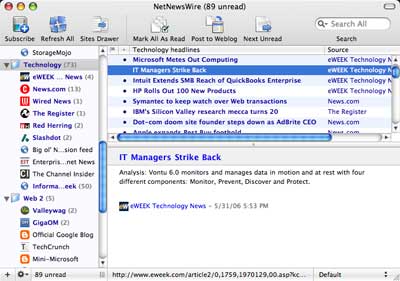
Isn't this cute? (From back in 2006 on NetNewsWire)
While some are debating RSS' role in a new world of real-time information discovery, there is no question that Google Reader has won this specific battle. If I exclude FriendFeed data from my own FeedBurner statistics, the combination of Google Reader and iGoogle accounts for 84 percent of all my RSS readers. In contrast, NewsGator is below 4 percent, and BlogLines checks in at just above 2 percent, with PostRank and Netvibes coming in at just over 1 percent each. Mice nuts.
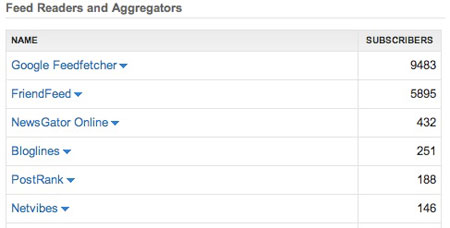
My FeedBurner Stats Show Google Reader and FriendFeed Dominate
That's not to mean the RSS ecosystem is in anything resembling a freefall. The recent launches of My6sense for the iPhone, looking to find the most relevant content, and Lazyfeed for real-time blog search by topic, show me that not only is innovation alive and well, but blogs and RSS are key components in creating new products. And while Caleb Elston has been quiet of late, I am still using Toluu every day to share my OPML, and keep track of new blogs I am adding to Reader. Also, Feedly, which builds upon Google Reader with some very interesting social options, continues to plug away, gaining loyal fans.
But just think of what's happened over the last three years.
In 2006, folks like Jeremy Zawodny reported Bloglines' share at between 30 and 50 percent. Steve Rubel cited a Pheedo report showing Bloglines "slipping" from 37 percent to 30. Go back far enough, and you can see it even had the majority of the market way back in 2004, according to ReadwriteWeb.
By early 2007, Hitwise said that Bloglines had three times the market share of its nearest competitor, which was Rojo. Interestingly, that report mentioned Google Reader in passing, saying "as of the week ending 1/13/07, it had only 1/13 of the market share of visits of Bloglines." That's right. One thirteenth the share of Bloglines. I should mention that not everybody saw the gulf that wide, as others, including Bob Lee reported the two were in a practical dead heat the next month.
The last two years have been all about Google Reader, as the search leader and RSS distribution leader, through the acquisition of FeedBurner, also became the RSS consumption leader. Rojo disappeared in July of 2008, and Bloglines' own stumbles made it that much easier to switch, forcing Marshall Kirkpatrick of ReadWriteWeb to say, "Do you really want Google to nail down complete dominance over the world of RSS? We sure don't."
The onetime debate about whether Google Reader is number one or not is pretty much gone, and Newsgator's turning off their online synching essentially throws in the towel. The once promising Feedeachother.com has turned off its lights. Shyftr and Assetbar aren't coming back. A new entrant called Fever is interesting, but looks more like My6sense than a traditional client. RSS is powering aggregation sites like FriendFeed, which in theory, provides 30 to 40 percent of my feed reader count, but when it comes to stand alone, all must stand in awe of Google Reader, for to do battle is futile.
21 Comments
I see no reason to use a stand alone RSS app when I can use Google Reader from any computer anywhere without having to install any software.
Agreed.
I still think Google Reader could have even greater adoption if they integrated the interface into Gmail. I am hoping someone on the Reader team is working on a lab product.
Google Reader will win when they add item recommendations based on likes.
CharBax: It is interesting to see the evolution of google reader, feels more like FriendFeed everyday
GReader rules! I'm waiting for two improvements: 1. Integration with Gmail (I hate to keep 2 tabs open, and don't want to use a custom script). 2. The Top Recommendations (http://www.google.com/suppo... considers your subscriptions, your web history, and your location. I would rather it consider who I'm following.
Google Reader lacks many of the robust features of NetNewsWire, namely smart lists. Without smart lists, I can't do things like mark all "Twitter Digest" blog posts as read with one keystroke (K) and I can't subscribe to a bunch of feeds but only pull posts containing a particular keyword. (Yes, there's Yahoo Pipes, but setting that up for a ton of blogs takes for-ev-er.)
When you get a lot of feeds, Google Reader is horribly slow. My job is very RSS-intensive (Well, I should say, it's research-intensive, and RSS makes the research faster) and I've got more than 4,000 feeds. Google Reader freaks out on me; NetNewsWire behaviors perfectly. I love NNW and it's definitely not a legacy app, as about 25% of my clients use it actively.
For a small number of RSS feeds, Google Reader is fine, but GReader is painfully lacking in advanced features for power users.
I totally agree. Google Reader doesn't yet have the "pro" level features that NetNewsWire has. Thankfully, with NNW's Google Reader support, I can use NNW on my home and work computers and use the Google Reader interface when I have to.
RSS is in a resembling a freefall.
I like Google Reader a lot, although I use Feedly now which uses Google Reader but has an interface that I like more. I've also tried out LazyFeed which is more like Google Alerts combined with Google Reader. I use it to discover new blogs and sites to add to my feeds. I'm still waiting on My6Sense on iphone to try out (still not out as of right now).
Great data Louis, thank you.
I am curious to hear your opinion on browser RSS readers like Firefox, and how Microsoft could or should make a bigger effort with IE RSS capability and RSS capability within start pages akin to MyYahoo and iGoogle. Google Reader is the winner for power RSS users, but isn't the market wide open for the casual RSS user, even iGoogle beats, MyYahoo and live.com in functionality. I feel like it is a completely underserved market. RSS adoption will grow as it becomes more invisible and more user friendly, the masses adopting RSS is what is needed to affect real change, RSS power users are important (that’s us), but I believe there is a more user friendly approach out there, not sure what it is yet. Any opinions?
Of course, feed filtering is where it needs to go, but we need the right UI/platform to make that happen too.
On the Windows platform, Awasu is far from dead. Although it's reasonably easy to use, it's never been a dumbed-down reader for the masses. In addition to the basic aggregating/reading features, it's very extensible using almost any programming language. "Channel Hooks" are small programs you can write that automatically process incoming feed items. "Channel Reports" allow you to fold/spindle/mutilate various combinations of feed items into any text-based output format you want (HTML, XML, CSV, etc.) using Awasu's templating engine (very similar to ASP/JSP/PHP). "Channel Reports" can be run on demand or on a scheduled basis with results FTPd or saved to a network file (so this provides an RSS republishing capability). There's User/Send To tools that you can configure and/or build to send feed items or selected text to online services (Digg, delicious, twitter, Wikipedia, etc.). Several search features based upon the Lucene, including "Search Channels" which become virtual feeds of the found feed items which can, you guess it, be processed by Channel Hooks.
Take a look at the "Metadata Modules", feeds can contained embedded info such as microformats and geocodes. Awasu has several predefined Metadata Modules, and of course you can create your own if needed.
It's an info junkie's playground! It's more of a feed processing engine that happens to have reading capabilities too.
Oh yea, did I mention that Awasu has sync'd with Google Reader since Nov. 2006?
No I'm not the developer of Awasu, just a user who loves its extensibility. But the developer is very responsive to email and support forum posts.
http://www.awasu.com
Thinking about your personal usage of Google Reader - what would it take for a new entrant to get you to switch? What's your biggest pain point/ unmet desire in your overall reading experience? It seems to me that while GR is a good product, its primitive once you consider what is state of the art in personalized filtering and social browsing today, so there should be opportunity for new entrants to compete.
I see two reasons why GR continues to dominate: 1) the new entrants have interesting features but don't represent a complete reading solution (e.g. PostRank, LazyFeed) and/or 2) they're not sufficiently differentiated (e.g. AssetBar). For any new entrant to win, especially against Google, a single new feature probably won't do it. The solution has to be dramatically better, simpler, and perhaps target a different market. While GR is the market share leader, I'm continually amazed at how many people have never heard of it, even at developer conferences, I find that maybe 20% of the audience hasn't heard of it. Just guessing, but if we assume that in the non-tech crowd maybe only 20% of the population uses GR (anyone know what the actual no. of users is?) there is an opportunity to address the needs of that other 80%.
Louis,
Have you a sense or do you know if Google Reader will integrate or be a part of Google Wave? It would seem a google-like strategy to go social around rss -- could create interesting opportunities for comment and conversation aggregation, not to mention conversational social bookmarking etc.
I humbly disagree, Louis - in fact, I've just gone the opposite direction from cloud apps to rich local ones which sync with cloud apps. http://www.technovia.co.uk/...
Google Reader myself, with a little AllTop thrown in for good measure.
We're certainly not a Google killer (yet) but we do represent niche players that can have an impact and chip away at their base. YomoMedia combines a web-based reader with a Windows Mobile application with tight syncronization. GR may be a better web app (for now) but as a combination service, they can't touch us.
Tried Vienna, Times, and NetNewsWire. I always end up trashing them after 2-3 weeks. I do find myself re-installing NetNewsWire every time they announce something new. But after a few days, off to the trash it goes.
When I read that NetNewsWire now syncs with Google Reader, I said "Yes! Finally." I immediately downloaded the latest version, installed it and had it sync with my Google Reader account. A few minutes later, I quit the application. I was back to using Google Reader.
I don't know why I can't tolerate stand-alone RSS readers. For me, Google Reader is convenient; lets me to read my RSS subscriptions anywhere as long as I have a computer and an internet connection. I also use GMail, and it is convenient to be logged into one service and have the other ready for access. Or maybe I'm just plain lazy.
I'm trying to make sure I understand this post, because I think I'm missing something. By stand alone, my thought was products we could download and read from our computer without needing a browser. All that you mentioned above seem to be within browsers to me; am I misinterpreting what you're talking about?
I use Feedreader as my RSS reader, and I love that it's not a part of my browser. I tend to have lots of tabs open in Firefox, and I have so many other things going, that I like the idea of using an independent program to read my feeds, just like I use an independent program to participate in Twitter (TweetDeck). I might be running with the dinosaurs, but I find them way more convenient.
Actually you can use Google Reader as your rss crawler and have your desktop program download your Google Reader feed.
Believe me, I used to love having a desktop reader right there with everything saved offline but if I ever went more than a few hours without turning the computer on I'd miss quite a few updates.
I would like to see able to export a single feed or folder from Google Reader. One reason I have this desire is for my own programming and research projects. Also there's some interesting blogs out there which don't exist anymore and their feeds' are still there somewhere in the fusion.google.com lalaland (which are still in google reader).