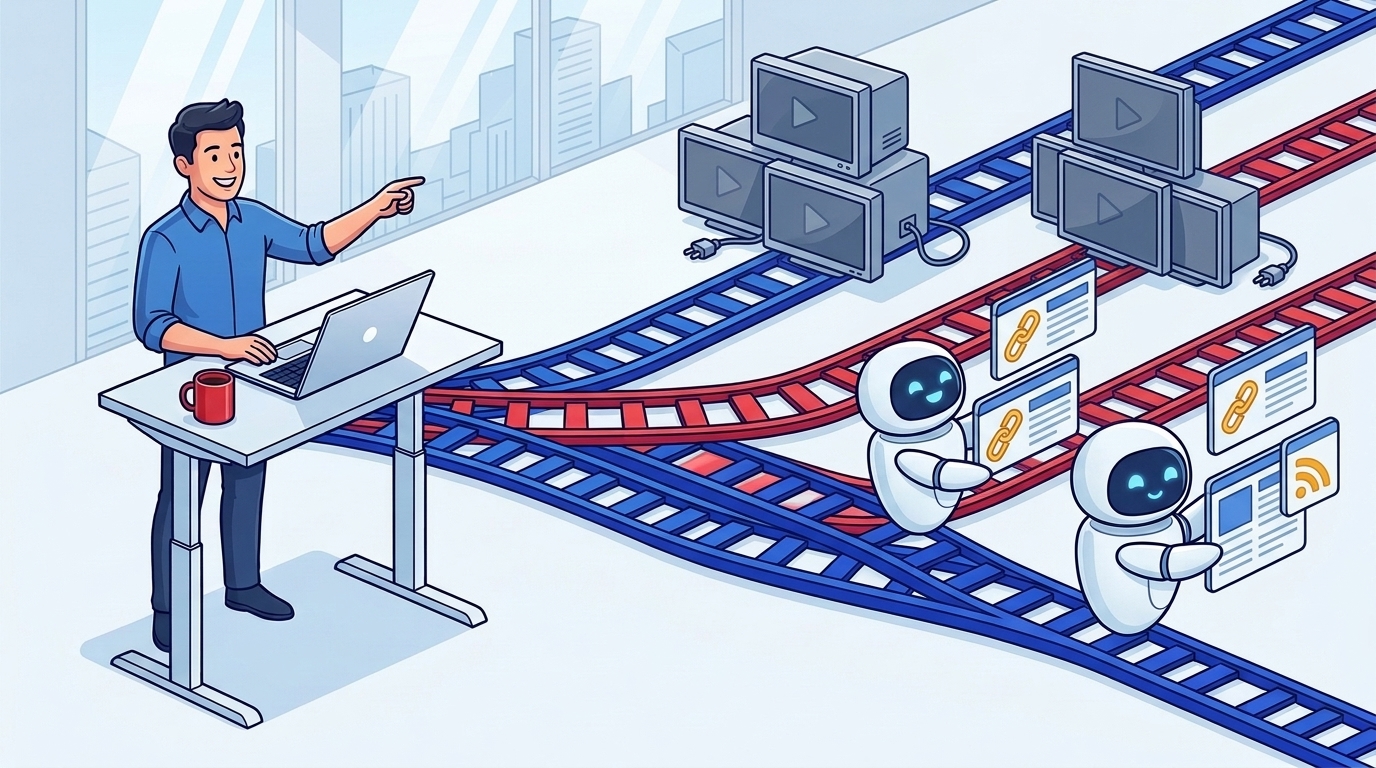
Routing blue links past unplugged TVs [Image via Gemini]
One of my favorite web authors, Ryan Broderick, who I read religiously, dropped another one of his truth bombs today in Garbage Day, decrying the continued decimation of text-based content that once defined the web, only to see it morph into something that is video first, or as he says "officially TV now". As we've observed over the last two-plus decades, Web behavior has rotated from newsgroups and reading full text articles, following links across the web, to short-form video consumption and Netflix-style episodic bingeing, with powerful algorithms suggesting you keep watching -- with sleep as the natural enemy.
Like I've said recently, you can't force old habits on new people who have been raised in a world of infinite bandwidth and infinite choice any more than you can ask kids to turn off the cartoons or put down the YouTube and pick up a newspaper. In today's post, Ryan calls time on the old "internet of libraries, replaced by an "internet of televisions", where, as he puts it, no one is famous, everyone is a celebrity on rented terms, and getting real traction with written words gets harder by the month -- made even more real as the hub and spoke model of RSS readers and centralized discovery lost momentum each year in favor of chasing ephemeral likes and practically non-monetizable "views", whose definition changes regularly to suit the platform.
Just a few weeks ago, I highlighted Garbage Day when saying how filtertainment eviscerated our informed monoculture. Every leap in bandwidth eventually fills the container you give it. We marched from static text sites passed around via links and email, to real-time social streams, to pocket screens pumping high-definition video straight into our earbuds. Not that this really comes as a surprise. In 2010, I warned about accelerating information streams on connected devices with "no off button, ever." When you give a tired population a choice between demanding prose and effortless video dopamine, and the couch wins almost every night.
Video winning the mass-market feed isn't a mystery, if that's the market you want.
What breaks the open web for writers is a simpler mechanical truth: television has no blue links. When someone leans back into an algorithmic Reel, a video podcast on YouTube, or a zero-click chatbot answer, there is no natural exit ramp carrying a curious mind three hops deeper to an unfamiliar blog. I traced the roots of this choke point back in 2018, examining how a decade of silos throttled open content distribution and left the web linking less and talking more.
Publishing has always rested on creation, discovery, and distribution. Once Google Reader, FriendFeed, Digg, and Technorati disappeared, dominant platforms stopped acting as filtered pass-throughs. They actively throttled outbound URLs to hoard watch time, training creators to perform natively inside the silo for instant feedback while an essay on your own domain sat waiting for visitors who never arrived.
Waiting around for algorithmic cable boxes to hand text writers organic reach is a losing game. If the giant social apps want to be television, those of us who still think, build, and connect through reading have to wire up our own switchboard again. That conviction is why I built Webnerd.ai, which I introduced last month as a personal project that has no expectations of millions of users, but rejuvenates that feeling of discovery and sharing.
Do your part by cutting out the broadcast middleman: subscribe directly to blogs, personal newsletter inboxes, feeds and publications in folders you control, backed by practical AI summaries and stream audio that save time while still sending clicks straight to the original author.
Even more important is solving the traction gap where open-web discovery always worked best -- from person to person. Algorithms optimize for passive session length, while human readers vouch for voices worth keeping. Curated starter bundles help newcomers find active blogs on day one, while one-click sharing inside the app or right from the browser toolbar with the Webnerd.ai Chrome Extension turns every reader into a distribution node. When I flag a great piece, it lands on my public shared stream, cross-posts to Bluesky, and feeds its own subscribable RSS stream, keeping those blue underlines traveling across the open web.
Broadcast TV never killed books or independent magazines, and Instagram's binge button won't kill sharp writing either. Let the big platforms fight over the living room. The library is still open -- we just have to pass the good reads around ourselves.
Disclosures, per always: I work at Google and use Gemini and Antigravity tools a lot. I built Webnerd.ai, its Chrome Extension, and this blog's CMS with Antigravity's help. Nobody at Google reviews my posts, ever.