Showing posts from January 2010 (39 posts). Show all posts

January 31, 2010

The Burning Drive to Never Settle: Refuse to Compromise

The Burning Drive to Never Settle: Refuse to Compromise

One of the classic books on many shelves in the Silicon Valley in the mid to late 1990s was Douglas Copeland's Microserfs, a story of former Microsoft programmers slaving away at their own startup, working ridiculous hours, and putting quality of code ahead of quality of hygiene. I often think about one of the main character's musings, saying that you could tell which companies were going to thrive by the hours the cars stayed in the parking lots, and if you could find a company whose lot was full on a Sunday, it could be an incredible investment opportunity.

My initial career experience in the late 1990s came at a time of Web 1.0, amidst the dot-com frenzy. It was a badge of honor to work late, and even after leaving the office, it was assumed you were on call to respond to product ideas, releases or customer issues. With the potential opportunity being so high, the challenge was to see if you could deliver the best possible products and experience, despite having a lean staff, and there was a constant question of whether you were doing all you could. This drive, whether shared by all colleagues, or whether exhibited by keeping near-nocturnal hours or simply outproducing everyone else, is one that I have had a hard time shaking, as I know at times, I can find myself being hyper-competitive. On the occasional times I've talked to jobhunters and recruiters in past years, I've easily handed that over as a weakness, that while I've been "always on", when others are not as committed, it bugs me, and I question their desire and drive to achieve.

I hate losing. I hate not seeing a result be as good as it possibly could be. I hate turning in a project or a product that is not to the best it could be. I believe in executing quickly, but not if it means sacrificing personal responsibility or standards. And I know I am just as competitive out of the office or off the Web, making sure I win at cards or board games, or beat my friends at bowling. If I don't, then I'll know where I screwed up, and remember it the next time I get a chance to redeem myself.

The best companies and people in business and technology refuse to compromise, even in the face of incredible challenges. The ones that are revered do not concede the battle for product quality, scale, reach or speed.

Take for example Don Dodge's solid and transparent description of how Google sets goals and measures success. A recent transfer from Microsoft, Dodge recounts how he submitted quarterly objectives, which he thought were "aggressive yet achievable", and they were rejected. Why? Because his manager said they "needed to set stretch goals that seemed impossible to fully achieve." He adds, "you can’t achieve amazing results by setting modest targets. We want amazing results. We want to tackle the impossible."

I got a picture of a similar discussion this week when I visited FamilyLink.com in Utah for a single-day visit. Without revealing the details of the conversation, one engineer was challenged to raise the target for a key feature's adoption curve beyond his initial estimate. As with Google, the push to meet this high goal would be set to find a way to achieve the impossible. It's no doubt part of why the company was ranked by comScore as the fastest-growing Web site for December of 2009. The high target was not set to guarantee failure, but instead, to enable success - and the culture was configured to help the team members achieve their full potential, not to reach a lower number, and accept mediocrity.

In a week dominated by iPad news out of Cupertino, we gained a window of insight into one of the most driven people on the planet, Apple CEO Steve Jobs, who reportedly characterized software developer Adobe as "lazy", adding, "They have all this potential to do interesting things but they just refuse to do it." Steve Jobs, and his team are notorious for perfecting their products down to the pixel and down to the millimeter and doing things over and over again to get them "right", not just "acceptable". One can imagine the fun and excitement that would take place if he were to get the opportunity to run Adobe for 100 days, cutting the fat and finding people to focus in a way where they are not today.

Part of what keeps me excited about Silicon Valley, and what attracts me to finding out more about the entrepreneurs driving the next generation of startups, or exchanging ideas with fellow writers and curators on the Web, is seeing this drive for greatness and refusal to compromise. It can be pretty easy to tell when some people have the drive, and also easy to tell when others don't. Those that slip deadlines, or ship mediocre products, or don't respond to support issues, or leave the office at 5 o'clock to get home in time for primetime TV are easily exposed.

I'm not 22 years old any more, like I was in 1999, when there was little keeping me from being 100 percent dedicated to the job. Now, staying a few extra hours at the office, or embedded in my laptop at home, takes time away from my wife and the twins. While I wouldn't exchange them for anything, I do sometimes get jealous at the opportunity some Valley leaders have to feed the fire in their belly to achieve and achieve. I dream of finding a team that wants to put sleeping bags under the desks, like Jerry Yang of Yahoo! was always said to have done, and finding a team that is just as excited about talking shop on a Sunday as they are on a Tuesday. (If you've ever seen the reverse, it too can be draining)

It's part of why I often say, "Sleep is a waste of time. And unproductive."

Now that there are so many outlets on the social Web for us to see what people are doing, and sharing, and writing and thinking, we have more and more ways to find out how people are using their work time and their leisure time. There's a good reason that Steve Jobs and his direct reports aren't posting their every nuance to microblogging sites. There's a reason Sergey Brin and Larry Page only surface on rare occasions at corporate events. These guys, and many many others like them, have a drive to succeed and never accept second best or treat failure as an inevitability. It is a lifelong race that has no finish line, and they can never stop. I may not be scoring patents and writing the best code on the planet, but I do not want to be second-best. I want to win on virtue of being consistent, driving quality, thinking in a way that is differentiated, and being active in a beneficial way in as many places as I can to distribute value. If you can achieve, never accept the opportunity to not do your best, and expect the same from everyone.

January 29, 2010

Fabulis Scores $625k In Funding for Gay Community Site

Fabulis Scores $625k In Funding for Gay Community Site


Jason Goldberg's new startup, Fabulis, a new service targeting the lucrative, but potentially underserved, gay male market, announced the raise of $625,000 in seed funding today, the majority of which will be used to "build product". Fabulis' launch comes on the heels of Goldberg's success in building and selling Socialmedian to XING in 2008, which itself followed his work at Jobster, one of the more visible jobs and recruiting sites on the Web. The first round of funding came from the same supporters who invested in Socialmedian, clearly happy with their returns from the 2008 deal.

Following success with Socialmedian and Jobster, Goldberg sees Fabulis as a personal venture, about him and his friends. As he wrote me in an e-mail today, "If we can't get this right, we should just hang it up."

Fabulis' goal, in Goldberg's words, is to establish the site as the "definitive service that gay men around the world rely on to help them connect with amazing experiences." The company is planning to launch its Web site and mobile applications, for iPhone and other platforms, in the Spring, which will help site members to get tailored suggestions on "where to go, what to do and who to meet".

As has been well covered in demographic studies, gay men have a disproportionate amount of disposable income and discretionary time when contrasted to the general population. Goldberg and team look to tap into the $400 billion spent annually in the US alone by this group, and leverage the high amount of activity the demographic participates in for travel, online commerce, and early adoption. Goldberg's stats said that gay men are more than twice as likely to own an iPhone as their straight equivalents, and were also more likely to own laptops or digital video recorders.

Despite all this, Fabulis doesn't believe that there are adequate solutions online that help this market. Traditional travel sites do not target the gay male demographic, nor do restaurant listings, or other marketplaces, making the gay community rely more on word of mouth than any centralized directory.

Fabulis' focus may seem somewhat exclusionary to straight visitors or same sex female couples, but Goldberg thinks this focus will really give the site an advantage.

"Fabulis is intended for gay men and their friends. We are very focused on our target market," Goldberg said. That's not to be exclusionary, rather just to make sure that the site appeals well to our target user. This site is unapologetically for gay men," he added.

With such a massive growth in niche social networking sites focused on specific tasks, be that for credit card sharing, calendar broadcasting or location checkins, the opportunity to focus all the major social elements into a recommendation service for a lucrative demographic looks extremely promising, if it is done well. And unlike many Web services, Fabulis appears to already have a business model in mind that will make money - one that is "not just a straight ad model (pun intended)", Goldberg said.

After the successful launch to sale of Socialmedian, Goldberg is also doubling down on seeing how social relationships form and evolve in a community. He wrote me, explaining one aspect to the social graph that differs between gay men and the rest of the population:

"One really interesting aspect of gay male relationships that we're also spending a lot of time on is how the gay male social graph functions differently than that of the typical straight person," Goldberg said. "For instance, for most straight people, the social graph of who you know is enough. Facebook is really good at helping you share and discover things with your friends. But with gay men, it is often as useful to know what friends-of-friends are doing or recommending or where they are going. And, for gay men, even just knowing what everyone in your city is doing or gravitating towards is very interesting. So, that's an interesting problem to solve, how to make the big gay world seem a whole lot smaller."

And if you think the name is "Fabulis", you can tell the company is looking to have a good time building a "fabulis" product. You can get a "Fabulis shirt" just by explaining how you are Fabulis. The Fabulis blog explains.

January 28, 2010

Google's Mac Mail Uploader Taunts Would-Be GMailers

Google's Mac Mail Uploader Taunts Would-Be GMailers

Tonight, I thought I saw the final missing piece fall into place that would let me take my gigabytes and gigabytes of e-mail off my hard drive and put them in the cloud, setting the stage for a long-discussed, but never fully implemented, move from my decade-old Mac.com e-mail address to a more Web savvy GMail account. An update on Google's Mac Blog introduced a new software option that promises to take all your Mail files from your personal computer, and take them to Google Apps. A free utility, the quick download looked like it was going to get me one step closer to a Web-centric experience, moving to the cloud. But it looks like I am still on the outside looking in, even though the product's release is extremely promising for an eventual solution.

More than two years ago, I talked about the potential attraction of GMail to corporate users who have long been tethered to the world of Microsoft. I said that Importing PST Files, or e-mail archives common to Microsoft Outlook, could be GMail's secret weapon. In the ensuing years, tools have been made to help upload e-mail from Windows, and to migrate Web mail to Google e-mail accounts. But tonight's announcement was the first for Mac users, who, despite the many synergies between Apple and Google, often find themselves last served, behind Windows and Linux users, by the Mountain View company.

101,000 messages to upload over 28 hours. Do it!

So, of course, I downloaded the application immediately. Without any configuration on my end, it found my Mail.app e-mail and the correct hierarchy, looking to move more than 100,000 messages I've been hoarding since the mid 1990s to the cloud, with appropriate labeling. The expected move time for these 100,000 messages? Almost 30 hours. But at least it was something.

Unfortunately, as many good things tend to have, there was a catch. The e-mail uploader "currently can upload only to Google Apps email accounts, and not to gmail.com or googlemail.com accounts", so the planned migration, once again, seems to be on hold.

Curses! No upload to GMail! Can I hack this?

Given the wording of the post, the author, Greg Robbins, seems highly aware of the issue, having called it out, and the word "currently" is promising that a solution may soon arrive. But until that time, I will continue to keep using my Mac.com e-mail and storing my data locally. For me, the archives are almost as important, and in some cases, more important, than my most recent data. If I could upload my 100,000+ e-mail messages, with appropriate labeling, to GMail and have the search functionality and all other great items offered in GMail, I would have started the process tonight, but the restriction to Google Apps keeps us on the outside looking in, still.

The promise of the move is tempting enough to open up a new Google Apps account, but I'm not interested in further forking my e-mail experience with more and more accounts to check. It's already a challenge to get work e-mail with multiple clients, and my various online accounts. I have been wanting a real Mac-friendly E-mail uploader to GMail since shortly after its debut, and almost six years after GMail shocked the world with its invention, I still don't have it. So Greg, I know you want what I want, so how can we make this happen?

iPad Wins On Casual Computing, Content Consumption

iPad Wins On Casual Computing, Content Consumption

Despite my reputation as an Apple fanboy, through the months of rumors and hype around Apple's tablet, I remained relatively quiet. While it may have reduced my page views potential, I've made a cognitive choice not to be the fifteenth person jumping into a dogpile just to say I did it. If you wanted rumors and guesses, they were out there. If you wanted speculation and mockups, you knew where to find it. And when the big day came yesterday, instead of calling in sick and watching Steve Jobs wow the faithful in San Francisco, I was working, taking part in a full day consulting engagement with a new client working on some very interesting things.

But with 24 hours plus after the iPad has moved from rumor to reality, I am as unimpressed with the swarm of armchair quarterbacking that is going on from many corners of the Web pointing out its shortfalls when contrasted to their own dream machines, or trying to find out why feature X made it but feature Y did not as I was with their thin rumors. I've seen people claiming that the debut of the iPad is a big bucket of iFail, that it's a dud, that it's "not for you", or in the reverse, that it means the death of TV, the death of banner ads online, the death of Flash, the death of... yeah, you get it.

Without shooting myself in the foot, this is part of why the blogosphere can at times get a bad name. This is why Apple can afford to keep its eyes closed to the rumors and speculation and suggestions by committee, for if the iPad had been developed by the many who have designed its tombstone over the last 24 hours, it would be too expensive, late to market, too heavy, or simply defy the laws of physics.

To question Apple's decisions at this point, after the success of the iPhone, and the iTunes Store and the iPod before them, on the heels of the iMac, and Mac OS X and the top-quality MacBook Pro and MacBook Air lines, is pretty silly. Put toe to toe with any other hardware and software company on the planet, I think I am going to pick the Apple team every time, because they simply know how to focus and execute.

Today, I finally took the time to watch Steve Jobs introduce the iPad. While some may have derided the iPad as simply a larger iPod Touch, I believe the most important part of what Jobs focused on was the reason for such a device, sitting between an iPod and a laptop. The need for such a product would be obviated if it could not do certain tasks better than an iPod or better than a laptop. Steve said it needed to browse the Web better, to play videos and iTunes better, and to look at photos better. It is also as important to focus on what he did not say it was intended to do. It was not built to "create" content better. Even though it does have e-mail, and iWork is to be soon available also, this device is built to be an amazing content consumption device.

The iPad is not a Photoshop machine. It is not designed to create PowerPoint slides. But it is designed for how many of us are using our computers today - to consume content. We read Web sites and blogs. We watch videos. We look at photos. We update our social networks. What the iPad is is the stepping stone from the laptop to the virtual "cloud machine", with no hard disk at all, which we may all see some day, the true network computer which has been promised for a decade-plus.

The iPad is designed for casual computing. The presentation yesterday did not focus on speeds and feeds. There was not megahertz bake-off with the A4 chip against Intel processors. Instead, we saw Scott Forstall snowboarding from the couch, and checking his Facebook wall. Steve Jobs looked at photos from vacation trips, sent a single-sentence e-mail and chilled to Bob Dylan.

The price of the iPad, starting at only $499 for an entry level unit, is about the same as the first iPods were in 2001 ($399), and they only did one thing - music. But instead of being limited to just one task, the iPad does about 90% of what you have come to expect from a traditional $1,000 to $2,000 laptop. For all the derision of the iPad in the world of business, it could be a fantastic tool for business meetings around round tables, and at home, it could be a fantastic Web tablet for people of all generations. Forget about finding a niche for me to use it, in addition to my iPhone and MacBook Air. Why shouldn't an iPad, version one or version two, become the first computing device for my kids? At its low price, large enough screen for their small hands, and instant access to iTunes apps, that could end up what happens in the next few years.

While the iPad does not run a derivative of Mac OS X, what instant integration with the iTunes App Store has done is turned the old adage of Macs not having enough software titles completely on its head. While more and more of our activity today comes through Web services, the iPad starts with tens of thousands of potential apps, on day one. Contrast this with what will no doubt be a future alternative to the iPad, with Google's Chrome OS, which may be a winner in browsing the Web and having a cheap price point, but won't likely come close to offering such a massive library of apps.

At the beginning of the year, I said that 2010 computing was going to be four things: Lighter, Faster, Mobile and Connected. The iPad is lighter, mobile and connected, three of the four, and it looks faster than the iPhone in terms of loading and processing apps. Reading the tea leaves that showed the MacBook Air line was not going to be updated this week, accurately, I did pick up my MacBook Air refurbished a few weeks ago, and it is already acting as my own cloud machine. Despite getting the 128 gigabyte hard drive, I still have more than 100 gigabytes available, as I continue to work toward a cloud experience. The iPad is another step in that direction, as it doesn't look open to third party software installs, and like the Air, does not have a removable media drive.

The iPad simply makes sense. I don't need to hold one to know how it will work, because I have become so familiar with the iPhone experience. I don't have to carry it from room to room while using the Web as I know I would, or read books or other content on it, instead of the Kindle, as I know it's better from day one, with more functionality, a better screen and real color. I do not care about all the whining that is going on about it missing a camera, or whether it supports Flash, or whether it needs a USB port or two to fit in. This is the first generation, and like the iPod and iPhone before it, the first generation is going to get updated and antiquated in about a year's time, as we continue to see the product evolve. The iPad, despite not being perfect, is the best product on the market at this pricepoint, period. It can make casual computing comfortable, and continue to erode the complexity so long associated with PCs from any source.

Have I purchased one yet? No. Having just purchased the Air, I am plenty happy with it. But I know an iPad, either this version or the next, will make it into my home. And if the twins have their druthers, we'll probably end up with two. So it's time to stop complaining about dream machines and misplaced expectations, and time to start trusting Steve. No other company, Google and Microsoft included, could have pulled off what Apple did yesterday. They are going to sell a ton of these machines, and you'll see them in places you never expected. Casual computing and content consumption are going to drive it.

January 25, 2010

Can You Filter for Quality News Amidst Instant Analysis?

Can You Filter for Quality News Amidst Instant Analysis?

With real-time news and distribution increasingly becoming the norm for many product launches and events, the interpreters of the news who pass their findings your way don't often have additional information that was gleaned as exclusive. As events are live streamed directly to the public, or presentations are mass broadcast to large groups simultaneously, those headlining the news are armed not with inside sources and first person quotes, but instead with immediate analysis of the events to try and put their own unique spin on history, separating themselves from their peers.

Nearly three years ago, I wrote a post titled Launching Products in the Age of Instant Analysis, highlighting the tech media's instantaneous interpretation of products like Google Finance and semi-regular introductions from Apple. You could later see tech bloggers swarm around Cuil and Microsoft's Origami platform, declaring each of them as failures, fairly accurately.

In the ensuing time, news has gotten even more rapid, and even more participants are helping to broadcast events, not just through their blogs and publications, but on Facebook, Twitter and many other social media properties. Those that attend live gatherings get an edge over their competition through speed of publishing, speed of transmission of photos and videos, higher quality videos, a better angle, or through an innovative use of a new Web service. We saw this with the recent Nexus One announcement from Google, and will inarguably see it again this Wednesday, when Steve Jobs entertains a hungry press corp looking for the latest from Apple.

Wednesday's entertainment will be much like many similar events before it, no doubt. Scads of gadget bloggers and Macintosh faithful will be there, flanked by general tech reporters, and the mainstream press. There may be a QuickTime stream, and if not, the absence of said stream will be made fairly irrelevant thanks to near-immediate live blogging, best exemplified by the work at Engadget or MacRumors Live in years past. Other sites will try to do the same, but to choose their work over the seasoned pros should only be done out of compassion by family members or significant others of the writers themselves.

Essentially, as Steve Jobs and his team flip through each successive Keynote slide, or walk through each carefully rehearsed product demo, those waiting and watching will all find out at the same time. The news you see or read through your computer screen will not be substantively less accurate or less speedily discovered than by those who were actually there. The press corp, in an effort to drive home their own relevancy and highlight their value through a key thing called "access", will drive home their recaps of the proceedings. Those driven by the quantity of posts will give each major product or feature its own story. Quotes off the cuff may be spun as insight themselves, and others will simultaneously post how each introduction will place in history, or judge its success or failure relative to the meteoric expectations they drove themselves. Subsequent stories will fawn over the first views of the product at stores, we will see glorious unboxing videos, disassembly of the parts, and estimates to total costs and product margins. Speculation will ensue as to whether the company built too many machines or not enough, if it's taking too long to reach customers, or if they priced the product too high. (They never complain that it's too cheap, after all)

All these angles and all this spin from all these places... While in the past, media properties were judged by their ability to get access to individuals and find things out that were not known by anyone else, or before they were supposed to be aired, the flattening of the media and the measurement of what some would say are the wrong metrics (be it page views, retweets or whatever your favorite statistic of the day is), have delivered a scenario by which there is more noise than ever, and as consumers, we must filter like mad.

Robert Scoble, a peer, and fellow geek and curator, said that he will be skipping out on Wednesday's news, and watching the news ink feeding frenzy as it seeps through our computer screens. His goal won't be necessarily to report on the news, which will be common knowledge as soon as he starts typing, but to find the best interpretations of the news from his favorite sources. He publicly will be doing something we all must learn to do - separating the news discovery artists from the news spin artists. With tools like Twitter and other networks making it ever easier to hit the publish button, our ability to screen, filter and decide what information is good for us is going to be increasingly tested.

Twitter Expands Technical Ops Team for Capacity Growth

Twitter Expands Technical Ops Team for Capacity Growth

If the company's recent hiring practices are any indication, fail whales may soon fade into the Web's memory bank, as Twitter continues to expand its team focused on data center and hosting solutions, or technical operations, hoping to scale the company's capabilities in line with and in advance of future growth. Today's newest hire is Lisa Phillips, who leaves Six Apart, no stranger to the high scale and high activity Web services arena.

As outlined on Lisa's LiveJournal page from earlier this month, Lisa is starting her position as Capacity Planning Manager today, and will be based in Seattle, visiting Twitter headquarters in San Francisco often to work with the technical ops team.

No stranger to spills and crashes, Lisa is also an avid roller derby participant with Bay Area Derby Girls.

January 24, 2010

EdgeTheory: Apple’s Closed Approach in an Open World

EdgeTheory: Apple’s Closed Approach in an Open World

In advance of all the fun and fury that will be sent Apple's way this week, as many are expecting new hardware from Cupertino on Wednesday, EdgeTheory conversationalist Chris Saad and I talked about how Apple can be so successful with its closed, proprietary, approach when we tend to promote and hope for openness from companies we do business with on the Web. In addition to discussing Apple, we talk about Microsoft not getting enough credit for its own innovation, and trip ourselves up on what exactly came first... USB or FireWire.

Listen in below:


Archive:
January 21st: EdgeTheory Conversations: Twitter's New Suggestions

RowFeeder Tracks Twitter Terms In Real-Time Database

RowFeeder Tracks Twitter Terms In Real-Time Database


Two weeks ago, I introduced Searchtastic's ability to search Twitter, and enable the export of any search results to a Microsoft Excel file. While Searchtastic does a good job enabling export of any search on the fly, it doesn't go deep enough for more popular terms, only offering the last few dozen. RowFeeder, one of the many offerings from Damon Cortesi, creator of TweetStats and other programs, is the first volley to launch from the mysterious Untitled Startup, and it too tries to convert Twitter search results to an actionable database. It does so through utilizing Google Docs, and already has a business model, powered by Laura Fitton's OneForty.com.


For $2.49, you can ask RowFeeder to track a Twitter search term and back up all positive hits in the next 48 hours to a Google spreadsheet. Should you need more time, such as for a 3 or 5 day conference, you can send a note to RowFeeder and ask for the time to be extended.


Setting up RowFeeder is really quite easy. You enter the term you want tracked, see if RowFeeder can do it, (The more general or popular the term, the less likely it is to work) and pay your $2.49. Upon payment, RowFeeder sends you a unique Google Docs spreadsheet link for your tracked term, and you have access.


Once this has been enabled, your spreadsheet starts filling up with tweets that match your criteria, with the username, the tweet itself, data on the sender, and time on the tweet. You can export the results, or even push the results to a live Web page, viewable by anyone.


I thought checking out RowFeeder was worth about five bucks, so I did two queries, the first being an obvious vanity search to track mentions online and see who was distributing my content, and the second, a more broad test, was to track mentions of TiVo, my favorite DVR.


The ability to make the spreadsheets public is a big bonus, and as you can see, the trend is to mine Twitter and other social media networks for Marketing or brand tracking potential. RowFeeder offers a solid solution for not a lot of money. It's not free, and doesn't enable databases for every term, like Searchtastic does, but its results are more complete, and are completely automated for future results, not just past results. You can find RowFeeder at http://www.rowfeeder.com.

January 23, 2010

Hard But Smart Decisions: Blogger Tackles The .5% Problem

Hard But Smart Decisions: Blogger Tackles The .5% Problem

One of the most difficult decisions a product manager can make is one that could possibly negatively effect a loyal, but very small, population of users. Whether it be the reaching of a crossroads around supporting a legacy product or feature, or finding far too many engineering resources are spent with little or no return, it can be tempting to refuse compromise and continue foolhardily ahead, trying to be all things to all people. But sometimes, it is smarter to draw a line in the sand, and make a decision. With a proper amount of foresight and communication, the impact can be reduced, and for the most part, the potential tsunami can be reduced to a mere trickle.


Quietly, on Friday afternoon, Google's Blogger division pre-announced the group's plan to phase out support for FTP publishing to the service. The company explained that FTP publishing in Blogger will be unsupported after March 26th, and the service is working in the interim to provide a simplified migration tool for impacted users, as well as a dedicated blog and help documentation, extending beyond what promises to be an "all hands on deck" approach from the team's members.

Blogger, widely considered to be the largest blogging network in the world, has at times been seen to trail competitors in capability and features, even as the service has more recently introduced a comparative barrage of new options in the last few months, coinciding with its ten year anniversary. As product manager Rick Klau communicated, the team has seen a drain on resources which has impacted the ability to improve Blogger beyond its current state, and much of that drain has been from a .5% share of users who have relied on FTP.

Without going too much into detail on the technical side, it is clear that among Google's strengths in its array of services is the ability to scale and have no bottlenecking, including dynamic access to content from an array of servers. As a recently converted FTP Blogger user, I know the experience I had on the FTP site was less robust and less dynamic than the Google experience I've long been used to. Switching, though a non-trivial process last fall, which also saw me migrate from www.louisgray.com to blog.louisgray.com, has been nothing but good news for me since, with greater access to all the new Blogger features, and near-instant publishing without outages that used to plague the FTP service. (See: Google Blogger FTP Publishing: Out for 12+ Hours from June of 2008)

Having worked for the past decade plus with technology companies who have seen significant upgrades from product generation to product generation, there come times when you have to announce the end of life for a first generation product, or make it clear that a specific software release is code complete, and won't move forward with the rest of the family. This can seem like the end of the world as an individual, especially at first, but, as part of the bigger picture, it is almost always the right idea, or else you suffer from a never-ending engineering drain and endless testing for compatibility ahead of feature leadership. A good example of this that most can remember was when Apple announced work on Mac OS 9 was complete, and the rest of the world moved to Mac OS X, laggers be darned.

Klau's post promises "a number of big releases planned in 2010", many of which would no doubt be available only to those users not using FTP. In order for Blogger to move forward, they know they need focus and they are starting the process by talking to a vocal, non-trivial minority of folks who should be learning in the next few weeks how they can make the change and what that means for their future. While some may say they are fed up with Blogger and find themselves staring at a new WordPress install, Blogger is doing the right thing by taking a hard choice and looking ahead to the future. (See also: Rick Klau: Turning Off Blogger FTP)

I hope to be talking a bit more on this with the Blogger team and look forward to seeing their new announcements. If you are a Blogger user on FTP now and see this news as the end of the world, let's talk about it. I survived, and it looks like it should be even easier for you.

January 22, 2010

XING Closing The Door On Socialmedian by January 31st

XING Closing The Door On Socialmedian by January 31st

Just over a year's time following Socialmedian's acquisition by XING, the social news site is going to fade away, as users will find themselves under the umbrella of the European online business network. This comes after the recent news that Socialmedian founder Jason Goldberg, who whipped the site into position for acquisition in just eight months as a public service, had left XING, headed back to the United States to start his new company, Fabulis.


Socialmedian, one of my favorite sites in all of 2008, became a go-to site for many Webheads, helping to surface breaking news on technology, politics and other topics, cultivated by your social graph. Content pulled into the site from Google Reader, blog posts and other Web sites could then be discussed in a centralized forum. One of the best things about the site was that it would scan the incoming data for its topics and automatically assign it to networks you chose to follow, such as Venture Capital, Apple, Mobile or anything else. While you could follow individuals, just like on most social networks, the ability to sign up to a news network on a specific topic meant you could find the best of the Web, cultivated by smart folks, on just the topics you liked.

Coming in a year that also saw tremendous growth in aggregation services like FriendFeed, it was not a surprise that Socialmedian was snapped up so quickly. In the last 12 months, Jason and his colleagues worked to combine the filtered news service with Xing's social network, popular in Europe, but less popular in the United States. In the meantime, traffic to Socialmedian itself dropped to about half where it was at the beginning of the year.


Existing Socialmedian.com users will get a month of XING premium membership, but I don't expect many to make the switch, having since moved to get their news elsewhere. Meanwhile, Jason, who discussed the transition in a blog post at the end of the year, is focused on building out Fabulis, described as "a place where gay men and their gay-friendly friends celebrate life," looking to "produce the ultimate gay guide to living -- all through user generated experiences." The site's blog, already getting updated, is a little sparse on the details, but with Jason's history, it is one worth watching, no matter your preferences.

For more history on Socialmedian.com, check out some of our archives:

January 21, 2010

EdgeTheory Conversations: Twitter's New Suggestions

EdgeTheory Conversations: Twitter's New Suggestions

From: EdgeTheory Conversations with Chris Saad (@chrissaad) and myself, discussing Twitter's incremental changes to the controversial Suggested User List and launch of Suggestions.

Referenced include:
@joshelman, @danielbru, @gregarious, @jesse, @anildash, @rsarver, @scobleizer and @twitter.

Listen in below. Total talk time is about 20 minutes.

Seesmic, Microsoft Team for Mainstream Twitter Tool: Look

Seesmic, Microsoft Team for Mainstream Twitter Tool: Look

Despite Twitter's phenomenal growth over the last few years, many see the microblogging network as odd, for geeks, or difficult to fully embrace, as it can be hard to find relevant content or a challenge to find people to follow or engage with. Seesmic, which has been making headlines on a regular basis over the last few months as Loic LeMeur's company has launched an array of clients for different devices, and even purchased Ping.fm for multi-network broadcasting, has now partnered with Microsoft and the Windows 7 team in Redmond to deliver a new product which brings engaging Twitter content to the desktop, without requiring users to even log in to view content.

The new tool, called Seesmic Look, hopes to make browsing Twitter as easy as selecting channels on a television. Look organizes people and brands, led by many celebrities' accounts, and centralizes an area for brands to communicate to potential customers, much like Facebook Fan Pages today. The product is a Windows desktop application, prepopulated with top users' accounts, by category.


Ellen DeGeneres In Seesmic Look

Instead of presenting the individual's updates on a monchromatic background, ordered from most recent to oldest, as has become the standard in Twitter clients for both the Web and desktop, Look displays the content in floating box windows atop artistically designed pages, featuring artsy Hollywood names for some celebrities and bold logos for participating brands.


Time's Channel on Seesmic Look

Like more traditional Twitter clients, Seesmic Look lets users track words or phrases through the application's search functionality. But as with the dedicated channel pages, the search results are also played back in a more visually entertaining array, more in common with a computer screensaver than flat search results common on practically every other solution.

If users do opt to login to Seesmic Look, it comes as no surprise that one can manage online mentions, direct messages and updates from within the application. Once logged in, you can make replies, favorite updates, view user profiles, post photos and shorten links, just as you can with other clients, but leveraging the unique application's interface.


Searching Twitter in Seesmic Look


Browsing Twitter Lists In Seesmic Look

For longtime Twitter veterans, Look won't add dramatically new functionality that would have them deleting their Seesmic Desktop, TweetDeck or Tweetie, even if you prefer native Windows clients. But for the more casual users who have heard of Twitter and didn't have a great idea as to how they should get started, Look should get them to do just that.

After a slow start in the innovation side that had many wondering when Seesmic was going to stop parroting TweetDeck and following the company's lead, it is clear they have achieved momentum and are looking to find new ways to bring the realtime Web discussions out of the edge and into the norm. Teaming up with Microsoft's Windows 7 team looks to have been a fortuitous relationship that is helping the company deliver a unique interface and new approach to consuming data from the real-time firehose.

January 20, 2010

The Cloud Is Within Reach From the Air

The Cloud Is Within Reach From the Air


At the turn of the new year, I mentioned my current state of thinking around 2010 computing, saying the trends were toward getting lighter, faster, mobile and connected. While many are shaking in anticipation of Apple's announcements next week, spurred even further tonight with news from the Wall Street Journal about Apple's embracing a cloud-powered iTunes, I took a major move myself this week to practice what I project, aiming to live a much more cloud-connected life. The tool? A new (to me) MacBook Air, purchased from the Apple Store online, refurbished, saving me more than a few bucks.

While the Air is not brand new, it's a big step forward beyond the 2007 era MacBook Pro I've held onto the last two years-plus. Despite that machine's slightly-faster CPU power and larger hard drive, contrasted to the Air, its sluggishness grew too much to bear, bogging down from applications and mysterious bugs as time went by. It came to the point I could barely use apps like Microsoft Office without completely stalling. So I'm trying a new experiment, one that gets very close to this promised cloud future that is coming.

First, I am keeping the "old" laptop at home as the home "media" machine. That laptop will stick around and be the computer where I use Photoshop, my 60+ gigabytes of iTunes and our family's photos and videos. (And yes, it's all backed up)

Second, I am going to do the best I can to keep the Air light on applications, with the clear exception being Microsoft Office, out of necessity, not out of love.

When I set up the Air, I did not move over all my music, or my photos or my videos. The Air's 128 GB hard drive, even if it is a fast solid state drive, didn't need to be chewed up with 90 gigabytes of media. And I left more than 90 percent of my applications and utilities on the old machine, including Adobe's extremely demanding family of CS applications, from Photoshop and Illustrator to Reader. If I can help it, I will stay in the browser as much as possible, visiting Office on occasion, and maybe, if I want to, firing up Tweetie, should I grow tired of Web clients.

The goal is to choose Webmail over desktop mail, Spotify over iTunes, and for the most part, live in Safari and Chrome whenever possible.

This is not a full move to the cloud. I am not yet ditching Office for Google Apps (yet), and I still need to find a place to hold all that rich media in the cloud, if I am to do this for real, but it's close, and I am going to make a concerted effort to do as much as I can online rather than off. It's good for the computer, and it's good for me.

Apple & Google are Primary Enemies? At What Cost?

Apple & Google are Primary Enemies? At What Cost?


BusinessWeek has an interesting article that is being passed around the Web tonight talking about potential discussions between Apple and Microsoft to make Bing the default search engine on the iPhone, replacing Google. The reason for this, the article speculates, is the increased competition between Cupertino and Mountain View, with the advent of the Android platform and Chrome OS. The article goes on to quote an unnamed source as saying that "Apple and Google know the other is their primary enemy", leading to the conclusion that working with Microsoft would be more advantageous for Apple than sticking with Google.

So what is this about? The enemy of my enemy is my friend?

I have talked at length previously about the capability of Google to take on Apple on many fronts, highlighted most directly in my "Could A Real Apple Fan Completely "Go Google"?" post last October, looking at the two companies offering competing products at the OS layer, the browser layer, the mobile platform, and many other applications. That the two firms are increasingly overlapping is clear.

But primary enemies? Really? I am not yet sure.

The 1980s saw Apple's primary enemy as Big Blue. IBM and its IBM PC was seen as this monolithic figure that needed to be combatted, made famous with Apple's 1984 ad which introduced the Macintosh. By the 1990s, having been relegated to a minority market share, smacked down repeatedly from Redmond, Apple was going up against Microsoft, which was mocked as "The Evil Empire" and attacked around the world as a monopoly. At times, Apple and Dell were seen as rivals. In the 2000s, Microsoft itself focused on different mortal enemies, from Netscape and AOL to Google, with Apple being a mere thorn in its side.


Jobs' Deal With Microsoft in 1997

Google's rise in the 2000s saw not Apple as a major enemy, but more accurately, Yahoo! and Microsoft. Google eventually grew to the point that it was half-heartedly rooting for Yahoo! to play a larger role on the Web, to reduce anti-competitive discussions, and Microsoft's enterprise dominance has been the clear target for the company's push of Google Apps, and growing Office suite.

In the decade, for the most part, Google and Apple remained friends - with Eric Schmidt's role on Apple's board for the majority of the decade being the most obvious example. Apple made the right decisions through the decade to include Google when it made the most sense, integrating Google search into Safari, and Google Maps on the iPhone.

Even with the increased competition, Google never flipped the switch that Microsoft once did, turning "evil". Whether it's assumed Apple and Google are best friends at this point is not as important as the two companies making the right choices for consumers.

Going back to the BusinessWeek article, the main focus is that Apple is looking to make Bing the default search engine on the iPhone, which would reduce, only mildly, some exposure to Google Search, and would help Microsoft more as their improving search engine is in the hands of iPhone fans everywhere. But this could be a humungous case of sour grapes, poised to no doubt leave a bad taste in our mouths. And we've seen it play out before.

In 1997, Steve Jobs, returning to the CEO position at Apple after his jettison the decade before, struck a deal with Microsoft and his arch-rival Bill Gates, to have Microsoft invest $150 million in the floundering Apple and, ridiculously, make Internet Explorer the default browser for the Mac. He even went so far as to say it was the best out there, dissing Netscape Navigator. It was a huge volley in Microsoft's battle to crush Navigator, and it reeked of backroom shenanigans that defied reality.

In 2010, moving to Bing would be perceived in the same light. While Bing has its fans, and I know some great people who work on the engine, the assumption from users is that Google is the gold standard in search. If Apple sells its customers short in what is perceived as a second class product, it erodes the customers' trust, and perception of quality from what's supposed to be a premium mobile experience. Even if Bing is twice as good as Google, no handful of on-stage demos from Steve Jobs and his team is going to make people think there's more to the story than Apple playing favorites.

From my view, Google is as concerned with Facebook and Microsoft as it is with Apple. If Apple is going after Google with Bing as a revenge play, then we customers are pawns being forced to accept embedding of products we didn't request. That very thing is what was at the heart of the DOJ's case against Microsoft in the late 1990s, and has me feeling less inclined to trust Apple, not more so.

Apple has gained a loyal customer base through focusing on best of breed, even if it costs a little bit more. From Apple, I should be able to assume a higher quality product, and something that reflects real worth. Bing is good, the very best Microsoft has ever offered in search, but backroom shenanigans dealt out due to hurt feelings or assumed alliances is wrong, no matter what. I don't think Apple and Google are going after each other's throats right now, and if so, Google is thinking about Apple less than Apple is thinking of them, so making a move because of enemies' rank is just ridiculous. It's not 1997 any more, and I have alternatives.

January 19, 2010

Abuzz Launches Social Media Search App for iPhone

Abuzz Launches Social Media Search App for iPhone

As social media activity becomes an increasing portion of companies' marketing focus, including finding new clients and tracking company brands or product mentions across the Web, a virtual industry of reputation and analytics firms have sprung up to try and derive value from the noise. A simple application called Abuzz just hit the iTunes store with a goal of making these social media searches simple and mobile. The result is a lightweight client that tracks keywords across multiple outlets and even lets you respond to mentions from within the application.
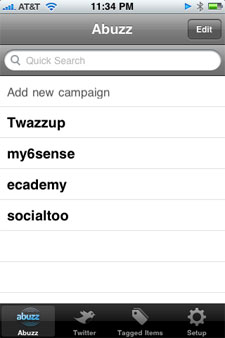

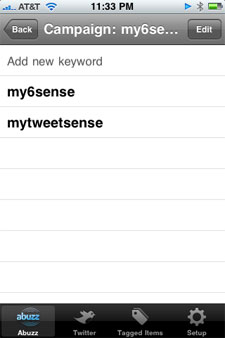
Abuzz Lets You Set Campaigns and Keywords to Track

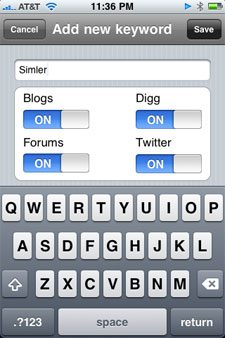
Abuzz's interface is very easy to grasp. Start by creating a new campaign (such as a brand name or product), add keywords to that campaign, and choose what communities to monitor. Abuzz comes standard with the ability to search blogs, Digg, forums and Twitter, and you can select to not search any of those communities if you believe they do not drive value.


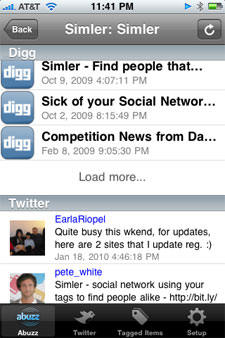
Select Where to Search and Abuzz Delivers Results

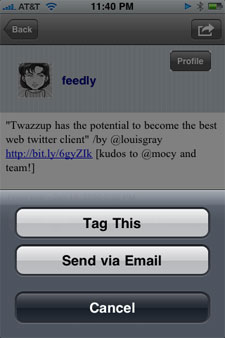
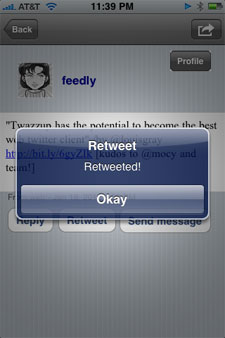
Rather than passively watching the updates stream by, you can click through to any of them, including blog posts, which are displayed within Abuzz, without having to open Safari and exiting the app. Similarly, selecting relevant Tweets puts you into a Twitter stream of sorts. If you have entered your Twitter login information, you can respond to mentions, retweet activity with a single click, tag the content for later viewing, or even e-mail it to an interested party.


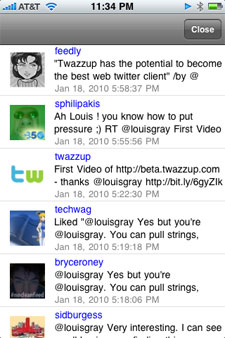
Abuzz Even Tracks Twitter Mentions and Messages

While Abuzz isn't trying to replace Tweetie or whatever your favorite Twitter client is on the iPhone, its integrated client is good enough for most tasks. It knows, once you have registered, how to easily discover your mentions on the service, and brings your direct messages to the fore for easy viewing.


Take Action on Tweets From Within Abuzz

The goal of Abuzz is to let you monitor social media sites with saved searches at any time from your iPhone. Today's Twitter clients tend to be heavy on the updating and light on the searching, but Abuzz makes the process all about finding relevant content and keeping it easily accessible. As you can see from my example screenshots, Abuzz makes it easy to track clients or recent companies I have written about to watch for impact. The application is authored by Shawn Farner, who details the app as "social search, plain and simple". You can find Abuzz here.

Disclosure: The application is $2.99 on iTunes. Shawn passed me a free code to review.

January 18, 2010

The Web's Impact and Looking to the Future: Web 2030?

The Web's Impact and Looking to the Future: Web 2030?

It seems a bit redundant to talk about how much the Web has impacted my life and the way we communicate on a blog, but with the advent of the World Wide Web's recent 20th anniversary, I took some time last week to speak with Stu Miniman of EMC about how the Web has broken down barriers that were traditionally limited by geography or class, and how we as a society are increasingly turning to the Web first for news, business and entertainment. It can be tempting to pull out a crystal ball and project our own desires as to what the Web will look like 20 years from now, in 2030, but I know that any specifics I give would just be wrong, as they were for most guesses back in 1990.

What I do believe will happen is that as the components of the Web improve, from processors to networking and storage, so to will the Web's potential continue to grow. We will see further crumbling of barriers, and gain the ability to have shared experiences that may involve more senses than just sight and sound, which are predominant today.

Stu posted the discussions, as a correlation to ON Magazine, EMC's thought leadership magazine, on his blog earlier today, and you can find that, as well as comments from Hutch Carpenter, here: Celebrating the Web at 20. I have included the CinchCast of our call below, and you can read the full transcription on this page: The Web 2030:

Beyond Search: Twazzup Prepares New Twitter Web Client

Beyond Search: Twazzup Prepares New Twitter Web Client

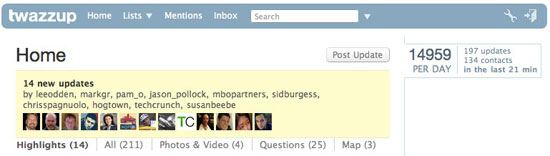
Last April, Twazzup looked to make searching Twitter a more rich experience, one-upping the vanilla Twitter search interface by adding graphics, real-time updates, and influencers of individual accounts, to name a few most obvious improvements. Now, the company looks to be on the verge of shifting gears in an aggressive way, developing not yet another search engine, but instead, a feature-rich Web client for Twitter that looks within the real-time content stream to find different types of updates, and even goes so far as to expand links shared on Twitter, providing followers with a preview of that which you have shared. The result is easily the most compelling Twitter Web experience I have seen since Brizzly, even if it is not yet known when the service will open up to all, or what it means for the company's current search offering.


Twazzup Breaks Out Content by Type, Displays Rich Media, Integrates Search

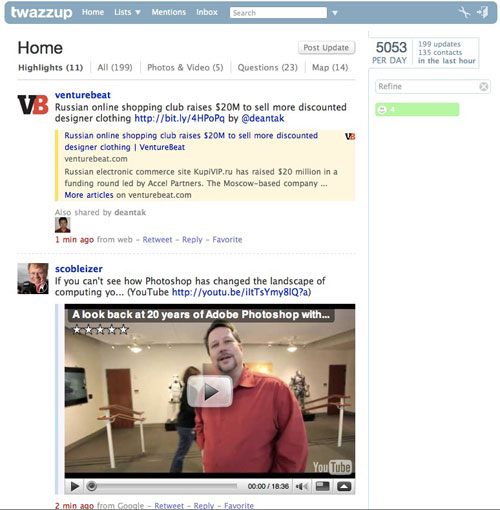
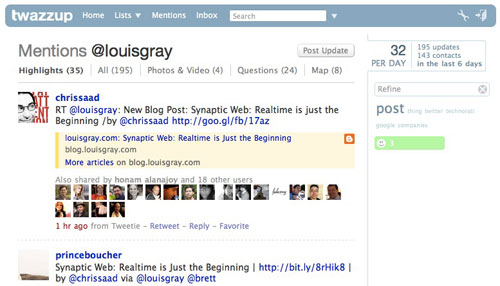
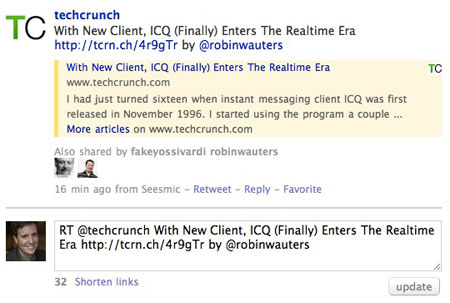
With Twitter's maturation, the service has recently adopted a number of new features, including the much-discussed Lists, addition of geolocation, and integrated retweeting. These additions have led to greater functionality by practically all clients, but few have looked to take the next step, not only integrating the new options, but presenting a new approach to the real-time streams. Brizzly was among the first to debut in-line display of video and images. Twazzup does this also, but in addition, expands links to provide previews of content, like you see on Facebook, and the automated categorization of content by its type, a sentiment analysis of updates, and an associated tag cloud, velocity of updates, and the ability to take action on updates, such as favorites, retweets, or replies in a single click.


Viewing a list shows sentiment analysis and a content cloud

To be honest, the more I played with the beta functionality of the new Twazzup, the more features I uncovered. While not completely baked, it is easily the most feature-rich Web client out there, and when it does debut, it should see people kicking the tires in a big way.

Today, Twitter's standard Web client is functional, if not exciting. You have the familiar "What's happening?" box and a series of updates from those you follow, as well as your own personal statistics on the right. Twazzup focuses less on your own numbers, but those from your stream.


Note the velocity in the top right and new updates on Twazzup


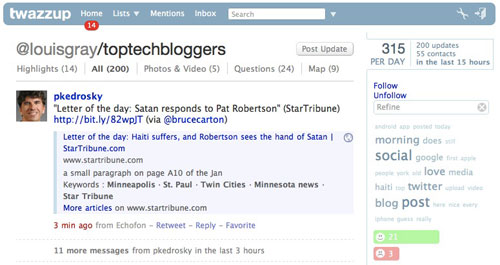
Mentions on Twazzup also show tags, sentiment, who shared the content.

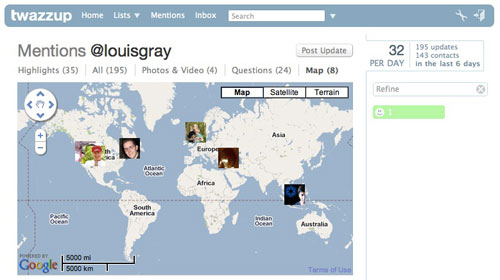
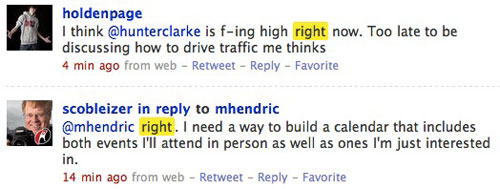
In addition to a simple "Post Update" button, Twazzup's client shows the total number of recent updates from those in my stream in the last hour, selects "Highlights", which includes those I talk to most often, influencers and popular shared links, "Photos and Video" for shares that display rich media, "Questions" for those updates that have questions, and "Map", which highlights updates that feature geolocation, complete with avatars from those Tweeters.


Check Out Twazzup's Map for Where Tweets Originate


Retweets, replies and favorites in line on Twazzup.

The velocity of the tweets can vary from time of day, of course. In my testing, it looked like the nearly 10,000 people I follow were tweeting at a velocity between 6,000 and 15,000 updates a day, on a quiet Sunday. No doubt a weekday, or a big news day, would see higher numbers. Given the high numbers, it can sometimes be hard to find the most relevant data. Twazzup dices these updates with its powerful search roots. A "Refine" search box on the right shows only those tweets in my stream that match keywords, and the search term is highlighted in results.


Searching for a frequent term in the stream on Twazzup

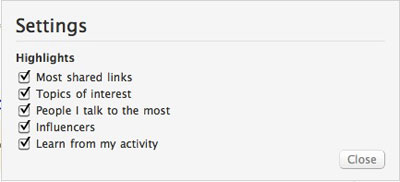
One of Twazzup's big features is a minimalist navigation bar atop the screen, which shows lists you follow, mentions, and an Inbox (where direct messages come and go). On the right side, you also have a "Settings" box which lets you choose what contributes to your "Highlights" on the page. It's much like the right navigation bar on the Twitter page, but the only numbers that populate it are those of how many mentions you have seen, how many new messages are in your in box, or how many new items are on your home stream.


I can choose my Highlights from Twazzup.

In place of the right side navigation, you get details on your stream, from a tag cloud based on included keywords, with larger words being used most frequently, and a smiley face to indicate positive feedback, or frown to indicate negative mood.

Twazzup's new Twitter client shows significant potential, especially when compared to Twitter.com and Brizzly, but it doesn't yet offer some of the more advanced features some clients offer, from what I could tell, including support for Facebook, multiple user support or columns, like Seesmic Web. But it does hint at API integrations, including a connection to LinkedIn, so I will be very interested in seeing what is in store for the very newest of Twitter Web clients. I don't yet have information on when the service will open up, or what this means for Twazzup's current search offering, but there will soon be a new name in town when it comes to Web interfaces for Twitter, and that name is Twazzup.

January 17, 2010

Synaptic Web: Realtime is Just the Beginning

Synaptic Web: Realtime is Just the Beginning

Guest Post by Chris Saad (@chrissaad | Blog)
Vice President, Strategy, Echo


I like the Synaptic Web because it's different. Unlike other projects or initiatives I've been involved with, the Synaptic Web is not an open standard, advocacy group or business. It is not even something Khris Loux, Eric Blantz or I invented. It is not even something we are advocating for or developing. It is simply something we observed and wrote down.

We wrote it down because we needed a framework from which to design, develop and refine our own product. We then shared it at SynapticWeb.org because others seemed interested in learning more about it. Since then we have continued to refine it and collect examples of other people taking our observations and expanding upon them. We hope this post is just another step in continuing the discussion here in the comments, and across the Web.

The Synaptic Web is not new. It is not a recent trend. It is something that started before the advent of HTTP and HTML gave birth to the actual Web and will continue long after the boom of 'real-time' fades away. It is a simple observation that the most interesting aspect of the Internet generally and the Web specifically is not the nodes on the network, but the type, density and flexibility of the connection between them.

We use the metaphor of the Synapse (the connection between brain cells) as a way to try to relate this idea to the real world - a literal mental model if you will, and over the years, we've observed these connections have morphed in surprising ways. Nodes have atomized (i.e. nodes are now more granular and there are more of them) and the nature of the connections are changing at an accelerating rate.

This new-found density of nodes and the rapidly changing nature of the connections between them has made the SynapticWeb easier to observe and document, not to mention more important to pay attention to.

What are the nodes?

Nodes used to be computers on the network. They then expanded to include documents on the web. Then pieces of content became nodes in their own right and now, even pieces of data - people, places, photos, videos, status updates, geo data - can be considered self contained single units.

Every single one of these things now has a canonical URI allowing us to uniquely reference them and to connect them together in new and novel ways.

What are the connections?

Connections used to be TCP/IP connections between computers. They then expanded to include hyperlinks between pages, then 'friendships' between people and now include real-time streams between all sorts of objects. Soon the implicit inferences made from those streams will increasingly become visible and viable connections in their own right.

Synaptic Web

Our premise is that while most have observed the changes in the nodes, the more interesting opportunity for innovation is to observe the change in the connections and how those changes might produce new user experiences.

In the age of social media, we asked ourselves 'what objects can become more social'. The result was vertical social networks that focused on these social objects. Obvious examples include Flickr for photos, YouTube for video, MySpace for Music and Facebook for Friends.

The fact of the matter, though, is that being social is only one kind of connection. An interesting and important one, but not the only one.

Links between 'social objects' and people are fantastic but what about the connection between you and your interests, your interests and products, products and ratings, ratings and pricing, pricing and quality, quality and availability?

These type of connections used to be made in private, carefully curated databases. In some cases there were algorithms placed on top to try to make rudimentary recommendations but the connections rarely spanned these closed systems much less allowed for curation at 'Internet Scale'. The connections were too brittle, controlled and insular.

Now, with an abundance of real-time gesture data, the growing trend to map everything to a URI, the availability of semantic technologies, the game like crowd-sourcing of tags and more, these connections are becoming far more rich and interesting.

An example of a great Synaptic application is Microsoft Photosynth.

Its predecessor, Quicktime VR, allowed one user to create a single continuous photo and then allowed viewers to scroll across that image like being inside a kind of 3D sphere.

Instead, Photosynth allows hundreds of people with thousands of photos (atomized nodes) to, acting independently, automatically generate a 3D mesh of the scene they were capturing. The connections between the photos are totally organic. The authors had no idea about this potential application when taking the photo, the photos were not arranged in a special way and the 3D mesh on which they are placed was totally generated by connecting previously disconnected nodes together and looking for the patterns.

Another very visual example is Augmented Reality. Where once we might have looked at the Yellow Pages, which only connected two types of data (zip code + business type) to create a static list of directory entries. Instead, the latest Augmented Reality app can take Location, Orientation, Directory information, Personal Interests and Business Type to layer meta data on the real world through a camera lense (typically a mobile phone).

As you can see by these two examples, just by adding just a few more nodes to the equation, and connecting those nodes more organically, the result is a dramatically different experience.

These are very real, and very current, examples of the synaptic density of the web becoming far more complex and powerful.

Real-time is perhaps the hyped aspect of the Synaptic Web. To me, the 'real-time web' is analogous to Synapsis firing in the brain. The rate, route and repetition of real-time data between nodes (usually people) has introduced countless new user experiences and content discovery opportunities.

Obviously Real-time is is just one way that connections between our nodes are changing and we have yet to scratch the surface on the possibilities.

What's Next

The goal of this post is simply to introduce the idea of the Synaptic Web and highlight the value of paying attention to the connections between nodes. There are countless ways in which this thinking might impact product design, user behavior and business models so it would be impossible to provide exhaustive coverage in one piece.

I encourage you to read the SynapticWeb strawman and continue the conversation in the comments, on your own posts, at conferences and in your own products. Who knows where it might take us!

Conclusion

So in summary, the Synaptic Web is not something that necessarily needs our support or conscious development - it is happening with or without us. It has been happening for a long time and its continuation is inevitable.

People might refer to it as different things, they might focus on various smaller aspects of the broader theme, but in the end the notion is the same - it is the connection between the nodes - and the way they are becoming more dense, more flexible, more implicit, more visible and more open - that is truly exciting and will continue to make an impact on people's lives through the Web.

I can't wait to see where it goes next.


Learn more about other people's take or to contribute to this theme please check out SynapticWeb.org. You can find Chris Saad at his blog, Paying Attention, and on Twitter. Chris is also Vice President, Strategy at Echo.

January 15, 2010

Forget Oversharing, Blippy Just Proves I'm Boring

Forget Oversharing, Blippy Just Proves I'm Boring

When first introduced to Twitter, I couldn't get over the banality and minutiae people were willing to share. Their food. Their location. Their thoughts. Just mind-numbing half-sentences, LOLspeak and link after link of news I had probably read somewhere else. But over time, the service seems to have evolved, and its success has led to derivatives which provide us new ways to share slices of our lives, even if the revelation proves not to be some dark secret, but instead, the dark truth that we aren't really all that exciting to be following in the first place. Blippy, the service that lets you stream your purchases online, which opened up this week, takes this feeling to a new level.

After first having a mental block on the entire concept of Blippy, I realized it could be interesting to share my iTunes purchases and my Netflix rentals with friends, and see what they were buying online. After all, if we are so willing to share those things that we like (See MyLikes for that) or things we are a fan of (try Facebook), it makes more sense to take a step upward and show what we actually spent money on.

So I joined. You can find me here: http://blippy.com/louisgray


See How Boring My Life Is? Blippy Knows.

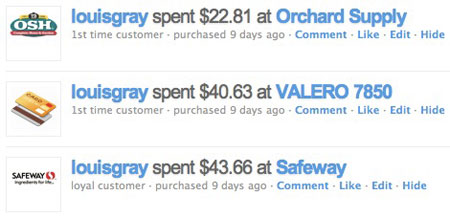
With a goal of erring on the side of transparency, I added iTunes and Netflix and Amazon, and even added the family credit card that both my wife and I use. This way, when I have a mundane task like filling up the car with gas, or she gets diapers at Safeway or buys the kids something new from Toys R Us, you will get the opportunity to know about it. You can follow each update, and I can follow you, or others who have joined, seeing my every purchase, and discussing them. Did I buy the right thing? Do you have this product too?

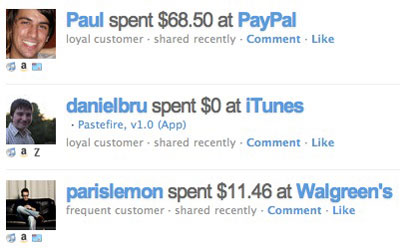
The interface is a lot like Friendfeed than Twitter, to be honest. You can make in-line comments to every purchase, or "Like" items, just as you can in FriendFeed and Facebook. Obviously, this appeals to me, and using the product is self-explanatory.


You Guys Are a Thrill A Minute Too...

But for every so-called "fun" update, where you see I bought an iPhone app that may appeal to you, or a restaurant I visited, or a Netflix movie I rented, you're going to need to sift through my routine updates, like paying Homeowner's Dues on our condo, stopping for fuel at Valero, getting food at Safeway, and on and on. The truth is, it soon becomes as exciting as reading a bank statement. There may be the occasional eyebrow raised as you see someone's update with a big dollar amount, or an amusing venue, but more often than not, at this point, I am simply exposing to you what I've long known to be true. The daily minutiae of my life is not interesting. That's why there aren't blogs dedicated to my comings and goings, and why I am often writing about other people and what they do instead.

Following on to yesterday's post about being "open", am I worried about revealing something I shouldn't? Something that might embarrass me? Not really. It may show that my wife and I go to the dentist or doctor and may have to spend money. And I can always delete individual items at any time if I want them out of my stream, if I remember to. Blippy essentially is a lot like Mint.com, which I also like, but instead of keeping all my data internal to me, it opens it to the world for discussion. The service is actually pretty cool, and can be amusing, if the people you follow are interesting. I just don't anticipate a lot of excitement on my feed.

See also an interview in the Wall Street Journal from today of Philip Kaplan (@pud): Philip Kaplan On Blippy: People Are Loosening Up Online. He's thinking along the same lines I am, adding, "The biggest risk is that their purchases are totally mundane and you’re really super boring." Sorry, Pud.

January 14, 2010

Can We Live In Private and Demand Companies Be Open?

Can We Live In Private and Demand Companies Be Open?

The growth of social services enables us to share an ever-increasing granularity of our lives with complete strangers who opt in to sample our updates. From traditional blogging to Twitter to location sharing services, and now, Blippy (which displays my purchases online and lets me follow others' spending habits), I can live my life open and transparent, letting you know what I like, what I do, where I go, and how I spend my time. In parallel, we are also asking businesses to be more open. Thanks to SEC regulations and Sarbanes-Oxley, as well as best practices, we expect public companies to tell us how much money they have, how much profit they made, where they made that money, how many employees they have, how much they intend to make next quarter, and a blizzard of other things that fall under the guise of information.

Now, we're even asking some companies to open up their kimono and blog themselves, to respond on a personal level with Twitter and other social networks, or open source their code, and let us know who their investors and partners are, lest we find they may have some bias. So yes, it's easy to see that open, open, open, is the word of the day.

This Week's Target: Facebook

Looking at these trends, it seems clear to me that the overriding move in both personal and business is to remove barriers and enable more visibility into activity. Yet, there are still pockets on the Web who see the data they share as needing to be under lock and key. The most recent kerfuffle was flamed by the often independent Marshall Kirkpatrick, who slammed Facebook's CEO Mark Zuckerberg for moving the once-closed social network toward increased openness, and reduction of what he termed "privacy". While others, notably TechCrunch's Mike Arrington, thought that argument to be overblown, Kirkpatrick followed that post with another line of questioning, asking how we would react if, for example, Google revealed our contacts in GMail and our subscriptions in Google Reader.

In the non-connected life, one was always taught that there were a few things one does not ask about in polite company - including politics, one's salary, and sex. Yet, the Web has made finding out most of those things very obvious for public members of society. We know what the vice presidents of many companies make, and we know the dollar amounts on contracts. We can do searches online and discover what political parties people are registered to, and where they put their money in the last elections and fundraising cycles.

Forget Location. Who Have You Slept With?

Although I was only joking, somewhat, I suggested to a friend this week that a new social networking service should be introduced that updates your stream with your sexual partners, and encounters, complete with their partner history and total number of partners. Given some's willingness to post all their data online, and the rising casual nature of some behavior, this isn't so far out of reach to be completely ridiculous. Just think of what message that would send if you were the "mayor" of multiple places on that particular network?

Yet, before that level of debauchery occurs, we still have to recognize that the trend Zuckerberg and his team are recognizing is true. The first rule of sharing things online is to expect that they will be discoverable by search engines and viewable by anyone. Even the closed, secure, password-only sites are usually potential victims for copy/paste, and are always susceptible to screenshots.

From Anonymous to Open. We're Getting There.

I understand the Internet's roots require a level of privacy, and you see many people still clinging to the antiquated hope of anonymity, assuming one can hide behind a user name and avatar to mask their true identity. I understand the concerns some have that the more data which is shared online makes them more vulnerable offline. But I am seeing prominent people talk out of both sides of their mouth when they claim to push companies to get more open and more transparent, while at the same time, clinging to the hope that we can push our content into a safe place on the Web and consider it "private".

During the week's discussions around Facebook and privacy, Marshall had some solid points, in his comments on TechCrunch, saying that people were joining groups and "fan pages" on the social network that had to deal with sensitive personal issues, such as infertility or friends of same-sex couples. His concern was that this data would be surfaced and revealed in a way that was not desired. In a week of drum-banging and emotion, I thought those examples to be the most reasoned. It makes sense, then, that sites like Facebook make the ability to hide certain affiliations from public view if so desired. If I chose to sign up and follow Fox News, and not want my left-leaning friends on Facebook to know, then I should have that option to hide the details from my page. But to fight against the tide of open in our own lives while demanding the tide of open be ever loosened when it comes to the companies we engage with seems bizarrely silly. Let's pick one and stick with it. If you don't trust the companies, then why should we trust you? What are you hiding?

Of note, and I mentioned this in comments to ReadWriteWeb, the notion of Facebook data being private is in itself the exception rather than the rule. You can see my Twitter stream and who I follow or don't, just as you can with FriendFeed and other networks. I have chosen to share my Google Reader feeds with you on Toluu and encourage others to do the same. The world is trending open and transparent, and you can embrace that or you can fight until you are blue in the face. But choose a side.

January 12, 2010

Technorati, Once Near Death, Focuses On Quality

Technorati, Once Near Death, Focuses On Quality

When Technorati CEO Richard Jalichandra joined the company near the end of 2007, he found the blog search engine in "a lot of trouble". Technorati was bleeding cash, with an expensive infrastructure based on "incredibly complicated technologies", and was losing the war on fighting spammers, who were threatening to render the company's deep index and authority measurements completely useless. In parallel, the struggles came at a time when expanded competition from formidable players, including Google, made staying on top almost impossible, even as the company's formidable task to index the fast-growing live Web expanded.

"Please Put On Your Oxygen Mask First..."

The situation looked dire, one Jalichandra compared to when the oxygen masks fall from a depressurized airplane, saying you can't save the passenger next to you, until you save yourself.

"The first thing I had to make sure of was that we didn't go out of business," Jalichandra said in an interview Monday at the company's San Francisco headquarters. "In the fall of 2007, it all came to a head, and we knew we had to do something or there wouldn't be anything left."

Since 2003, Technorati was among the first leaders of the Web 2.0 wave, recognizing the imminent growth of the live Web, encompassing blogs and other social media activities. Not just comfortable with blog search, Technorati also enabled site owners to claim blogs, track backlinks to their content, measure authority, ranked by unique site backlinks over time, to ping the site with new updates, chart changes in content distribution on the Web, and present Technorati widgets on their blogs. Add on a few fun features, including popular pages, and the always quizzical "Where's the Fire", best known as "WTF?", and Technorati had its focuses widely diversified.

Near Death By a Thousand Cuts...

The 2007 crisis forced the company to revisit everything and make some very painful decisions, cutting costs, headcount and features - many of which had been treasured by the blogosphere.

"(Previous CEO David) Sifry came up withe great idea of boiling the ocean of the live Web and it grew like crazy," Jalichandra said. "But there are a couple of problems with boiling the ocean when people are looking for a cup of coffee."

Technorati, once known as the go-to site for data on the blogosphere, had soon found itself eclipsed by more nimble competitors, such as Google Blog Search, and while many bloggers, including myself, grew frustrated with the site's rapidly killing features we liked, and the not too unfamiliar appearance of site downtime, which would happen multiple times a week, for several hours at a time, the site came incredibly close to going away altogether without drastic change.

"The first six months (of my term as CEO) was all about stabilizing the company," Jalichandra said. "At some point you have to keep the lights on, particularly the kind of company that is venture funded. It has to get revenue, and has to make a profit. We had to write the plan for growth, a two-pronged plan, to grow the site and launch the ad network. We are still dedicated and committed to growing Technorati.com."

One Must Have Revenue to Invest Back In the Company

The company's focus on the advertising network seems like a dramatic change in course for what was instead seen as a technology service company, but it was a move aimed to leverage the existing database in the site, while also driving revenue into the company. It was suggested that, as revenue grew, it could be reinvested back into Technorati's site, quite possibly to start replacing some of the lost or deprecated services much beloved by the blogosphere.

In October of 2009, Technorati revamped its Web site, and while gone were many of the dedicated pages for topics and individual blog posts, which I had liked, in its place was a detailed directory with top blogs ranked by category, with a new ranking of authority, and a higher focus on relevancy. While the old Technorati would highlight the most recent updates as they flowed in, the new Technorati tries to deliver recent updates from the most authoritative sources - a move that's not without its controversy, of course.

"Search is not a democracy," said Jalichandra. "There is always an editorial choice in search. It may be an algorithmic choice, but it's a choice."

Look Mom, No Spam and No Downtime!

The new site relaunch led not just to new content and a new look, but the elimination of downtime, as the company says they have not experienced any appearances of the Technorati Monster having escaped since the introduction, adding it is believed the the issue of spam is practically non-existant. Despite so many headaches and a popular perception that the site is irrelevant or archaic, the company's leadership thinks the two years needed to bring the site back to the point where innovation can occur has been both necessary and worth it.

David White, vice president of publishing, says that working for Technorati has been a "really interesting challenge", but one that has changed as the mainstream is not just aware of blogs, but is embracing the live Web in their daily lives, as Technorati plays less of a role as evangelist for the blogosphere, but instead one that focuses on finding quality content.

"Technorati started by indexing all the blogs," White said. "Our job is different now, and that is to find the quality. Technorati is an important site, and it has made an impact on how we interact with the blogosphere, which has had a huge impact on media as a whole."

Will It Be Enough? Can I Have My Widgets Back Now?

As the move to quality infiltrates the company's blog directory, Technorati promises many of the tools that have gone away are coming back. The company fixed blog claiming last week, and promised Monday to bring back authority over time charts, as well as introducing new widgets, which had long since obsoleted.

Many bloggers, including the visible futurist Stowe Boyd, have already given up on Technorati, after seeing the company's early promise seem to crash and burn, through a confusing product strategy, spam-filled results, poor uptime, and bad news followed by no news. It seems the darkest times are behind them, and the company will have to make good on its promises before many bloggers learn to trust them again. But in my meeting with them Monday, they clearly said they're not done fighting.

To hear Jalichandra in his own words, listen to the 8 minute clip I recorded on Cinch:

Thing Labs Reports Brizzly's Growth Exceeded Targets

Thing Labs Reports Brizzly's Growth Exceeded Targets

With such a wide number of Twitter clients out there, from dedicated Web clients to iPhone or Android applications or still others for desktop operating systems, each that has gained traction has done so thanks to its unique features and innovation, which attract loyal users. Brizzly, a popular Web client which supports multiple accounts for both Facebook and Twitter, has gained traction thanks to inline display of videos and images, a new approach to direct messages, and integrated definitions for trending topics.

As interesting to me as the product itself, among my favorite Twitter apps, is Thing Labs, the team behind Brizzly. The majority of those on the company's small engineering team hail from Google, most visibly headed by CEO Jason Shellen and co-founder Chris Wetherell, who were among the creators and champions for Google Reader, the RSS reader where I spend much of my time online taking on the data firehose. With Jason and Chris turning their attention toward social services, the company has been pleasantly surprised by gaining more users than originally anticipated, and is now working to scale the service without the benefits of a massive organization like the one they enjoyed at Google.

In a candid, yet casual, interview I held with Jason and Chris on Monday at their San Francisco headquarters, the pair walk us through Brizzly and its place within Thing Labs, how they view their product, and how their experience growing Google Reader, and in Jason's case, Blogger, prior to its acquisition by Google, have help set the stage for their new startup's growth. After a series of incremental changes in the last few months, it sounds like Brizzly is heading for some large introductions in the next quarter, probably before the SXSW conference, which will have everyone who has ever looked at the product to revisit it and see what's new. The full interview, about 10 minutes in length, is embedded below:

January 11, 2010

In Case of Real-time Clogs, Check Pipes for Stoppages

In Case of Real-time Clogs, Check Pipes for Stoppages

At the conclusion of 2009, I named Pubsubhubbub as the top new Web service to debut in the year, as it best exemplified our rapid adoption of real time technologies to push data from one site to another, and reduce or eliminate the need for downstream aggregation services to repeatedly request updates from source sites. I have configured my blog to be enabled by Pubsubhubbub, share my Google Reader items downstream using a Pubsubhubbub-enabled tool, and recognize the benefits of the protocol by way of fast updates on social networks including Facebook and FriendFeed. So, having grown accustomed to near-instantaneous flow, hiccups in the system rapidly gain my attention.

For the nearly 400 people who follow my @lgshareditems Twitter account, seeing my own personal filter of technology news, it would appear I have taken a hiatus from sharing the best of Google Reader, despite what some might consider a full-time obsession. But this assumption would not be true, as it is simply a symptom of a break in the flow of data.


How Pubsubhubbub Works, More or Less

Similarly, I noticed that my Google Reader shares were not populating FriendFeed in seconds, or even several minutes to hours, after they were shared. To force the updates to make their way into my stream, I needed to force FriendFeed to poll Google Reader and pull down the latest, something I haven't had to do ever since they supported Pubsubhubbub shortly after its introduction. So something was clearly broken.

In parallel, other Pubsubhubbub-enabled items continued to act as they always had. Blog posts flowed as smoothly as ever, and after asking some techies to look into it, they reported the hub itself was fine, but instead, the "Reader/Ping" bridge that updates the Pubsubhubbub hub had found a glitch.


But There Is Currently a Break In One Pipe

While my natural inclination was to wonder if maybe Pubsub had grown to big for its britches, and stretched under load, it was just one of the upstream services that has hit a bump. It'd be worth overlooking, out of deference to the good folks at Google, but given the near-outage of about 48 hours, albeit on a weekend, it's gained awareness, and I have had others ask me what had caused the lags.

The Internet continues to be "a series of tubes", all interconnected to get us our data from one place to another, and even the best, latest, cool toys are interdependent on other sources, and no product, so far, is failsafe. If you've noticed a lag in your shares to FriendFeed and other networks, or you use Reader2Twitter on Twitter, and saw your updates disappear, yes, there is a disturbance in the force right now, and it should be solved soon, from what I understand.

For more on Pubsubhubbub, check out their new video posted last week:

January 10, 2010

Podcast: Infosmack Episode #33, Talking Storage and Social

Podcast: Infosmack Episode #33, Talking Storage and Social

Aiming to show I'm not just a one-trick pony, I gained the opportunity to participate in the Infosmack Podcast this last Friday, with EMC's Mark Twomey, 3Par's Marc Farley, and Greg Knieriemen of Chi Corporation, behind the popular StorageMonkeys blog, which targets enterprise IT folks and other data geeks.

The podcast managed to talk up recent recent acquisitions and rumors of acquisitions in the storage industry, wrapping up the recently-completed CES conference in Las Vegas, and also, how social media is growing in the enterprise, most specifically in network and storage. This isn't the typical startup fan affair, so if you want to hear some geeks talk storage and social, enjoy below. You can also find the podcast at its original URL or subscribe below.


Infosmack Podcast MP3

Subscribe with iTunes

Searchtastic Enables Export of Twitter Search Results

Searchtastic Enables Export of Twitter Search Results


In October, I first introduced Searchtastic, a new search engine for Twitter, whose claim to fame is archiving Tweets longer than the standard database, as well as letting you refine your search through live addition and deletion of keywords. This weekend, the site upgraded with a minor addition that has major potential - the ability to export search results to Microsoft Excel databases with a single click. This opens up significant opportunity for marketing and sales teams alike who are looking to track who discusses their brand or select keywords, and track this data offline.

As social media aware businesses are looking closely at Twitter and other online networks for potential prospects and influencers, it comes as no surprise that it would be desired that these future customers be stored in the company's CRM, or as part of a marketing database, even if not all the information is complete. Also, as third party social media contractors are often hired to find these folks, there becomes a need to compile frequent mentions of your brand and products and report into Marketing or Sales.


Any Searchtastic Result is Now Exportable to an .xls File

Now, I can go to Searchtastic, enter a keyword or string of words, and see the results, powered by standard Twitter search.

For example, I may search for the word Maytag.

On the right side of the search results from Searchtastic, there is a new function that says "Excel Report". If I click that, I am asked to enter a simple number-based Captcha, and the report is downloaded.

Included in the report are all the relevant details around the mentions, including:
  • Login of the individual
  • Name listed on Twitter
  • Homepage provided on their profile
  • Location (if reported)
  • Followers (by number)
  • Following (by number)
  • Total Tweets
  • Tweet Date (of the mention)
  • Tweet (the tweet in its entirety)
  • In Reply To (the URL of a reply, if there is one)
Then, the smart marketer can sort by location, if they have a geographical focus, or by total number of followers, to see perceived "influence" and reach, by total tweets to figure out how frequently the person updates, or by time, if they want to work the list sequentially.

Since our initial report on Searchtastic, the developer has made a number of behind the scenes enhancements, fixing search string bugs, adding the expansion of URLs from URL shorteners, and migrating to more powerful servers to enable a greater number of tweets for indexing. You can check out Searchtastic at http://www.searchtastic.com. It is obvious to me that this new addition could be very powerful and useful. I will absolutely be using this.

January 9, 2010

The Future: Operating System And Application-Neutral Data

The Future: Operating System And Application-Neutral Data

We are now growing accustomed to the concept of the "cloud", where our data will be increasingly stored in Web services, not on local disk, accessible from any computer, operating system or browser. But, despite the adoption of standards from major players storing our personal data, the choice of services causes serious vendor lock-in, as the data suite, be it from Microsoft, Google, Apple or other providers, is not only interpreted by their offerings, but stored there as well. This storage and management of our data makes migration between services incredibly difficult, and still leaves us at the mercy of a large company, whose priorities may not be the same as our own.

The time has come to start on a path to true ownership of data by the individual, reducing applications and Web services to the role of filters and containers, rather than hosts, who can propagate lock-in as these services spread to mobile devices and tablets from their desktop roots.


What makes a digital device mine, be it a laptop or a cellphone or an music player, is the personal content that is stored, and how that data is translated, stored, presented and categorized. Similarly, when we make a choice as to our preferred Web services or technology providers, we are, for the most part, passing our content to them exclusively. While we may have made the data location independent, it is far from being service independent, and any potential future switching will have dramatic impacts on time and productivity, including:
  • Complicated export and import of personal data
  • Differences in the interpretation of data between similar applications
  • Potential loss of metadata between services
  • Reduced backup stability as differing instances of our data is housed at differing services
This headache is a major part of vendor lock-in. Today, when I make a choice as to what brand computer to buy, or what phone to purchase, while I may be committing to a brand or a suite of applications, all I am really doing is asking this product to provide its own interpretation of my data, including:
  • My Contacts and Relationships
  • My Music Files
  • My Videos
  • My Photos
  • My E-mails and Hierarchy
  • My Documents
  • My Bookmarks and Hierarchy
Increasingly more important than the actual data itself is its metadata, or data around data. How is the data structured, meaning... Do I have my e-mails in folders with subfolders and rules? Do I have photos in specific albums? Do I know how often I have played a specific song or genre? When were documents created or last edited?

Today, for the most part, we are choosing from three major service providers, although there are alternatives. We can select Google, who offers Google Contacts, Calendar, YouTube, Picasa, GMail, Google Apps and Google Chrome for the majority of our needs. We can, instead, select Apple and use Address Book, iTunes, iPhoto, Mail, and Safari. Or, we can stick with Microsoft, and leverage Outlook, Windows Media Player, and Internet Explorer. (Or their online equivalents)

Despite standards adoption, not all programs interoperate well. No doubt there remain issues with meetings from Microsoft Exchange being received by Apple Mail, and the integration of Web browser bookmarks and Web history is not shared between Google Chrome and Safari. These minor problems are greatly magnified when you consider the potential for future switching, as you migrate from one platform to another or one computer to another - largely because in every case, the applications themselves, even those that are Web services, are storing our data for us, and interpreting it in their own way.

I think it is time for a change, that lets us own our own data, turning the situation on its head.

Instead of hosting our own data with the service provider of the day, we should host our own data in a standard format, which will be adopted by the leading providers, whose applications will tap into us directly, and pull down our data and its metadata. If I chose to log in with GMail one day, I would authenticate who I was, and GMail would pull down my e-mail stream, complete with e-mail activity history (such as replies and forwards). The data would not be stored on Gmail, but instead be more like a read-only process, whereby changes to data, including sent items, would not be stored in GMail, but written back to my personal "cloud", if you will. Similarly, if I opted to log in to Microsoft Outlook, tapping in to my own, authenticated, account, I could browse my contacts in their application, through their filter, but the data would reside with me.

Hosting one's own personal cloud with our own data is not an end run around large corporations in fear of Big Brother, but instead, for real, true, portability. In this situation, a longtime iPhone user could pick up an Android phone, enter my own personal ID (be it through OpenID or some other standard), and pull down my details into all of Google's native applications. Similarly, I could log in to any Microsoft, Apple or Google powered device and become me, not with my data hosted on the new machine, but with my data being read, like a Web page, on that device, in their own lens.

Even as we on the Web are rallying around these concepts of standards, and the cloud, we are seeing the concept of vendor lock-in be as true as ever. The switching costs from hardware device to hardware device, OS to OS and Web service to Web service remain completely too high, and the way around this problem is to take back our data, make it personal, and enforce standards that get the major players to come aboard. While we may not all have all the broadband access necessary to make this a solution today, it's 2010, and we should be well beyond the same issues we have been facing in computing for the last 20 years.

So how do we make this happen?

January 8, 2010

The CES News River Sends Gadget Blogs Into Overdrive

The CES News River Sends Gadget Blogs Into Overdrive


Google Reader Volume Spikes During CES

Watching the trends in technology news publications is a lot like watching the seasons. It's fairly predictable, and has its ebb and flow. The more sites and stories you read, the greater the value, and the more "liquid" the pace seems to be, as spikes and valleys are smoothed. But no more evident is the acceleration clear from one week to the next as the week of CES, the Consumer Electronics Show, following the hangover doldrums of a post-Christmas holiday. The glut of news from this week, with CES kicking off in Las Vegas, not to mention Google's Nexus One announcement earlier on Tuesday, has most prominently put gadget blogs Engadget and Gizmodo into hyper mode, with many other tech outlets looking to draft behind their lead.

While this is not a huge surprise that both blogs are stepping on the accelerator for this event, the data shows just how much more.

In the last few months, it has not been uncommon for me to scan about 1,000 articles a day in Google Reader - skipping most, sharing a few, and reading others in full. Giving 10 seconds to each story means about 3 hours a day, and 5 seconds a story makes the time needed about 90 minutes.

In the lead-up to Christmas, and the week afterward, my usual forays into Google Reader, as well as FriendFeed and Twitter, were significantly lightened, with news at near standstill, saw fewer items at a pass, totaling about 700 items a day, and half that on the holidays themselves, or on weekends, scraping just over 200. Quiet indeed.


Engadget's Coverage Skyrockets During CES Week


But in the last two days, by themselves, Gizmodo and Engadget have delivered well more than 200 posts per day. While Engadget delivers an already-aggressive 40-50 stories on a given workday, the CES waterfall has pushed them to triple or quadruple output, with about 150 new stories flowing. (Keep in mind they are the official blog of CES, so many stories are no doubt prepared in advance.) Meanwhile, Gizmodo, no slouch at about 70 items a day per usual, is keeping apace with just under 150 items a day. This acceleration with both sites, as well as the padding from traditional tech networks that are also following CES, has pushed my aggregate workload to about 1,300 items a day, double the holiday rate, and 25% ahead of normal.


Gizmodo Doubles Down Efforts for CES

There are other ebbs and flows you can count on from the tech Web. You can always expect spikes around Macworld and other Apple events, and you can expect drops on US-only holidays like Memorial Day and the Fourth of July. But there's nothing like CES for pushing the sheer volume of coverage up to a new level. The coordination required by an editorial team at Engadget and Gizmodo on the week of CES is sure to be intricate, and is something to be impressed with indeed.

Of Note: Chris Saad recommends checking out CNET's CES River as well for CES News and updates.

January 7, 2010

eBay No Bargain for Nexus Ones, Pricing Well Above Market

eBay No Bargain for Nexus Ones, Pricing Well Above Market

In the wake of Google's Nexus One introduction on Tuesday, many tech writers were abuzz not just about the company's new self-branded Android model, but the ease of how the product was being sold, at http://www.google.com/phone, and with the option to select an unlocked model, one with a T-Mobile contract, or soon, bundled with contracts from Verizon or Vodafone. Some saw the move as Google's big step into e-commerce, letting you buy the phone direct from them, and not through a carrier. But this hasn't stopped some aggressive folks from flipping the phones on eBay, where excited buyers are ignoring the sticker price, and plowing well beyond the $529 offering (for an unlocked phone), resulting in no bargain at all.


Google Will Give You an Unlocked Nexus One for $529

It isn't much of a surprise to see Nexus Ones springing up on eBay so soon after the launch. Be they phones from Google employees themselves, from those who attended the press junket, or just fast buyers, it's common to see people send them to the popular auction site in a chance to make a few bucks. But bidders who see the price crest toward $529, should they be savvy enough to know about the Nexus One, probably should be savvy enough to know they aren't getting a great deal.

If you look at Nexus One offerings on eBay, you can see many phones offered to "Buy It Now" for about $750, but those aren't getting a whole lot of bids. In fact, most are at zero. But you scroll a bit lower, to the $650 level, with time remaining, and you can see bids happening, as folks are paying premiums of $100 or more for the privilege of buying on eBay instead of from Google directly.


Just $810 Gets You a Nexus One on eBay

No... it doesn't make much sense to me either. I even found one auction that closed this evening where the final price for a Nexus One soared to $810, a premium of nearly $300.


Or You Could Pay Almost $700 In A Different Nexus One Option...

Google has also made links to the Nexus One phone visible on the Google.com home page. Some are noting the new "ad" on the site, which in conjunction with the Chrome dropdown if you aren't using their browser, makes two house ads. But it looks like even this promotion isn't getting to those who don't know they can go direct and save themselves some cash. That's what happens when a hot product hits a market and people want to get their hands on one fast, to be first in line. Forget rationality. They just want it ASAP.

January 6, 2010

Cliqset Upgrades Aggregator With Groups, Activity Streams

Cliqset Upgrades Aggregator With Groups, Activity Streams

Despite my comments last week on the mainstream's reticence to adopt aggregation sites on a wide scale, there remains a desire by many in the technology community to build a site that pools all one's activity from around the Web while setting a foundation for discussion. Today, Cliqset, which is chomping on the heels of FriendFeed in the features department, if not the activity department just yet, added several new capabilities that make the site very compelling - including my personal favorite, highly customizable streams by service and individual.

Today's announcements include major revisions and a redesign of the product's user interface, the ability to share files natively to the site, a new (for them) groups functionality that lets people talk on specific topics, and the aforementioned activity stream filters.

I talked with Darren Bounds, Cliqset CEO, yesterday, and he said "the biggest problem with aggregation is handling the firehose and being able to manage it in a good way."


Setting Up an Activity Stream Filter on Cliqset

As many users of aggregation sites can find the overall activity intimindating, the new activity stream filters let you granularly create personalized sections of the site which can display specific types of updates, specific services, or even selected users. For example, I could decide to see all blog posts from all Cliqset users in one stream, or make a dedicated stream just for the busy Twitter streams from Chris Brogan and Robert Scoble.


A Filtered Stream of Blog Updates on Cliqset

The additions of file sharing and groups match those from FriendFeed, who similarly lets you share office files, MP3s and PDFs with the community - an interesting but not often used capability. The addition of Groups similarly matches FriendFeed's Groups functionality, once called Rooms.

Like FriendFeed, Cliqset is also making the rapid discovery of data and real-time streaming of content a priority. Last month I highlighted the service's adoption of PubSubHubbub, and Darren reiterated that focus yesterday.

"Every activity that is generated for groups or users gets pushed to the Google Hub," Darren said. "For subscribers, we look at every feed and API we integrate with and look for PubSubHubbub information and look for those feeds."

Today, Cliqset has a relatively small population of users, but as with many sites like these, the potential for more activity through growth provides serious potential. The company is focused on become a highly functional swiss army knife for Web service updates from around the Web, and now, native on the site. You can find me at http://cliqset.com/user/louisgray

January 5, 2010

iPhone Owners Looking Next or Nexus Are In Paralysis

iPhone Owners Looking Next or Nexus Are In Paralysis

Last week, I said one would be nuts to buy a new iPhone at this point in time, given what we have been hearing from Android and from Apple's roadmap. Today, with the confirmation of the long-rumored Nexus One from Google, an upgraded HTC unit running the latest edition of Android, we saw the platform take another step further in become the true alternative to Apple, in a way that Blackberry and the Palm Pre and anything Microsoft powered have been unable to do.

For iPhone owners who are happy with their platform, and think it's amazing, the news of the increased competition may mean very little. They still have access to the most robust application store in the world. They still have excellent integration with their desktop machines, especially their Macs. And they can be confident knowing that the product will continue to be upgraded.

But if you're an iPhone owner who is either tired of the limited carrier choices, or if you're simply curious about Android, or if you prefer Google's applications and approach moreso than you do the Steve Jobs way, today's announcement has to give you immediate pause. Not because it instantly vaporizes the iPhone's lead, but because of the same reason we all should be watching the creep of the Chrome OS - because it's not just about now. It's about next.

Switching smartphones (no superphones for me, thank you) is not as easy as it used to be when one dropped a Nokia for a Sony Erricson or a Motorola with little thought. Now, you're as married to a platform as you are to your operating system. Now, because of the application store, and all those hooks that I warned about in September of 2008, you are going to be giving up a lot more than one unit for another, but literally throwing away tens to hundreds of dollars of applications you may have purchased, which will either have to be purchased again on the new platform, or may have no equivalent at all.

With the cost of data plans and voice plans and hardware and applications, the true cost of a smartphone over the lifetime of the product rivals that of top of the line laptops, so the same kind of thought and shopping around once reserved for a day to day computer is the same kind of thinking now necessary for the unit you're going to clip on your belt and call your parents with.

In December of 2008, I said there are two phones in this world, those that are iPhone and those that are not. That's clearly no longer the case. You either have an iPhone or an Android, or an also-ran, and I believe that BlackBerry's position is niched in businesses, away from the consumer, with Apple and Google in the driver's seat for the foreseeable future. But even if you've run the specs and like the iPhone better, or you have an iPhone and think it's still the best, when it comes time to buy again, you just might take serious pause, and have to go through analysis paralysis.

I talked more about this very real issue this afternoon on a CinchCast, embedded below:

Google Reader Mobile Improves With New Features, Look

Google Reader Mobile Improves With New Features, Look

As Google Reader, the most popular online RSS feed reader, has gained significant functionality over the last year, including new gestures for content and the ability to share items with social networks, the mobile version of the site has lagged somewhat behind. Today, Google, on what has obviously been a big day of news for the Mountain View company, updated the mobile version to be more in line with the Web content. I have been using the new interface for a few weeks, since mid-December, and it is much improved.

Limited to what is clearly a much smaller screen than the rapidly expanding desktops most of us are used to, Google Reader Mobile is trying to accomplish more tasks in a lot less space. Added today include the option to "like" items, tag them and sort feeds from oldest or newest. Previously, the mobile version had two major items: "Mark All as Read" or the simple "Refresh".


Google Reader Mobile (Before on the Left and After on the Right) from December.
Click for Larger Version

The upgrade makes Google Reader mobile much more of an option to get feed items while using any smartphone, but there is still room to grow before it reaches parity with the desktop equivalent. For example, the mobile version is missing the "Sort by Magic" functionality introduced this October, letting you find the best feeds just for you. I've been using my6sense (a company I advise with Paladin) for this functionality, while relying on Google Reader Mobile to view all feeds in total.

Noticeable changes with the new mobile UI include the main header's change, where you can easily get access to Gmail or Calendar with a single click , and larger fonts, in general, to make clicking the right buttons with your small fingers on these small displays even easier.

Also added today, on the Web side, is Reader's move toward "recommended sources", which you can find in the "Explore" section of Reader, under "People you follow" and above "Subscriptions". It's a good way to find new feeds that could be a match for you.

The team summarizes the new features in a blog post on their Web site issued this afternoon.

Disclosure: my6sense, an assumed competitor to Google Reader mobile, is a client of Paladin Advisors Group, where I am Managing Editor of New Media. My comments on the company's product are always independent, and do not pass their way in advance.

January 4, 2010

Ping! Seesmic Expands Update Reach With Ping.fm Buy

Ping! Seesmic Expands Update Reach With Ping.fm Buy

With so many social networks gaining traction, the potential for communities to be split and conversations diversified is a known issue. Aiming to solve the problem and ensure users could update once and populate anywhere, Sean McCullough, along with co-founder Adam Duffy, created Ping.fm, which lets you update 50 social networks at once.

Today, Seesmic, the well-known microblogging client, which to date has focused on Twitter and Facebook, acquired the service, extending the product's reach. In combination with Seesmic's recent inroads to a native Windows client and an Android application, alongside their Web interface and AIR application, the service looks to become ubiquitous, updating any site from anywhere.

In today's announcement, Seesmic CEO Loic LeMeur said that the company's vision recognizes that friends "are not all in one social network, but we want to help you stay in touch with them anytime and from any device." Ping.fm has a reported half a million active users, who post approximately 200,000 updates daily. These updates will contribute to Seesmic's stated goal of one million updates a day in 2010.

At LeWeb, in the Twitter Apps panel I moderated (video here), Sean McCullough of Ping.fm and Marco Kaiser of Seesmic both participated.

Seesmic's array of applications, including BlackBerry, will all soon have what Loic termed "advanced Ping.fm integration very shortly", adding that users could update not just with Seesmic's apps, but also through Ping.fm's e-mail, SMS and chat gateways.

To date, Seesmic has been seen as direct competition to the other major column-based Twitter client, TweetDeck. But while TweetDeck has taken a slower approach to new interfaces, holding on to its AIR installs and iPhone application, Seesmic looks like it is branching ahead, serving more screens and now, more networks.

Twitter Continues Hiring Spree, Adding Ten New Staffers

Twitter Continues Hiring Spree, Adding Ten New Staffers

Twitter's pedigree is getting increasingly rich at the expense of Google and other Silicon Valley tech titans. With the holidays behind us, the microblogging powerhouse is starting the new year with more new faces at its San Francisco headquarters. Among them is Bakari Brock, most recently an in house lawyer for YouTube and Google focused on music, video and syndication.

Brock, whose LinkedIn profile shows him as corporate counsel at Google, starting in 2007, was heavily quoted in late 2008 when the video service introduced e-commerce capabilities enabling customers to purchase from partners including iTunes and Amazon, and his comments were included in publications such as the New York Times and GigaOM site NewTeeVee.


Formerly of Google, Brock Joining Twitter

Brock's LinkedIn biography states a specialty focusing "on negotiation and drafting of music, video and software licenses; and counseling on copyright, ecommerce, and general policy issues." As Twitter grows increasingly visible, and looks to embark on a revenue-generating advertising model which we have been told we will all "love", somebody has got to make sure the contracts and licenses are good to go. Brock was added to the Twitter Team list on Sunday, which likely means he starts work Monday.

Prior to his work at YouTube and Google, Brock was previously an attorney at Kilpatrick Stockton, LLP and he attended Harvard Law School.

Brock's hire is among the most notable as part of a hiring boom at Twitter that sees ten new employees start work on January 4, 2010. The others:

Paul Soals (formerly of Bebo), Ed Ceaser (formerly of TiVo), Dmitriy Ryaboy (formerly of Cloudera), Nancy Broden (formerly of Qik), Tony Wang (also from Google), John Sirois (from VMware), Jinen Kamdar (a second Ning escapee) and Jane Huang.

These new hires are on top of the team gained in the Mixer Labs acquisition announced on December 23rd.

OF NOTE: Twitter was premature in adding some of these people. One hire previously included said their start date was 1/11, and as a courtesy, they have been removed.

We previously noted Twitter's hire of Utkarsh Srivastava from Yahoo! and Josh Elman of Facebook in the fall.

January 3, 2010

Videos: Blogging for Business, Social Media Sales, Strategy

Videos: Blogging for Business, Social Media Sales, Strategy

More videos from my September visit to Ecademy in London continue to flow in from YourBusiness Channel. As you saw from my November post which highlighted videos on social marketing for business, sales and startups and that from October on leveraging social networks to build Web traffic, we tried to deliver a great deal of information in easily-consumable bite size chunks.

Recently published are three more, including sales advice in the world of social media, how to launch a high quality business blog that gets traction amidst all the noise and three steps to a robust social media strategy. All are embedded below.


Three Steps to A Robust Social Media Strategy


Making Sales on Social Networks


Starting a Business Blog that Gains Traction

January 2, 2010

We Apple Fans Are In Mac Tablet Rumors Reruns

We Apple Fans Are In Mac Tablet Rumors Reruns


Although this year seems to be the real deal, the hype around Apple's Mac Tablet being set for imminent debut is "same old same old" to us jaded Cupertino fans who have been watching the company closely for the last decade-plus. While the January 26th date for a presentation no doubt involving Steve Jobs finally moves this long-broiling rumor toward the line for reality, hardly a year has gone buy since the beginning of the last decade when it wasn't expected that Apple would finally get a Web tablet out the door and onto shelves and desks everywhere.

Much of the background for the initial hype around the long-rumored Mac tablet came from Steve Jobs' cancellation of the Newton PDA line upon his return to Apple, with hints that the company would eventually return to the market. Rumors about Apple handhelds on the Cupertino campus were rampant, even as the Palm Pilot took the world by storm, and Handspring came and went. While subsequent stories have quoted CEO Steve Jobs saying he was just as proud of the products they had chosen not to ship as those they did, rumors for a handheld never quite went away, and they eventually morphed into often wild speculation around the tablet - the one that might finally be released in a few weeks.

Did you know these rumors have been going on for a full decade? If you are a Mac rumor afficionado like I am, you would. Observe:
"And just to keep true to those old 'Apple-developing-a-PDA' and 'Apple developing a Mac tablet' rumours, the iWalk contains full PDA functionality."

Apple's ‘breakthrough’ – iPod or iWalk?
The Register, October 23, 2001
Remarkable, even to my jaded eyes, was the fact that the latest name du jour, the iSlate, was suggested as far back as 2002...
"May we speculate that the big item due to set the Macintosh welkin ringing ... next month just might be an Apple tablet computer. Think of a name: iSlate, iNote, iPad (maybe too close to iPod)."

-- Garry Barker, Livewire, December 4, 2002
And when MacWorld San Francisco 2003 didn't see the Tablet debut, rumors continued, saying we even knew factories that were hard at work making plastics. Sound familiar?
Mobile Mac slate device to launch?

"All we know about this piece of plastic is that:
1) it is vouched for by a "previously good source" who has contacts in the factory where it's being made
2) it is almost an inch thick, at 24.6mm; and its other dimensions are 188mm by 132mm
3) the factory where it is being assembled is supposedly under contract to Apple."

-- MacWhispers, March 29, 2003
By the end of 2003, from his pulpit, Robert Cringely said that within the year, Apple would finally deliver a tablet, one powered by Intel, instead of the PowerPC chips at the time running the entire Macintosh line. So yes, a 2004 debut was expected!
"A year from now, I am sure these technical problems will be solved, but by then Motorola will have been shipping DS-CDMA products for 12 months. And some of those products will be going in that Apple tablet computer. Watch TV in your bathroom, access your audio and video collection from anywhere in the house, control your big screen TV and route video to it from your desktop or the Internet. "

Apple's Tablet Computer Might Finally Be That Link Between Your PC and TV
-- Robert Cringely, November 27, 2003
But it didn't come in 2004! A shame! What about 2005 then? And what if it ran full Mac OS X or a derivative, often discussed as Mac OS X Lite?
"Speculation over what Jobs might reveal this year are all over the map ... (including) an Intel-powered Mac Tablet running Mac OS X or a "Mac OS X Lite.""

-- MacDailyNews, May 27, 2005
It didn't happen that year either. A shame! Again! Good thing that the following year, 2006, saw companies in Taiwan working on costs for this product, to be launched in mid 2007. Sound familiar, again?
"Apple researchers have built a full working prototype of a Mac tablet PC and three Companies in Taiwan are now costing a product for a potential launch in mid 2007..."

-- Smarthouse, via MacDailyNews, November 26, 2006
So here we are at the beginning of the new year, 2010, and once again, the Mac faithful, and now the many, many media followers who have piled on to original core of Mac rumormongers, are ready for the Tablet, again. This time, it seems real. Rather than jump in and tell you what I think it is, or whether I think it will be a good fit for my home, I have learned to sit back and trust Steve and his team. They were right about the iPod. They were right about the iTunes Store. They were right about Mac OS X and they were hugely right about the iPhone. Like I said yesterday, in my article on 2010 computing, the entire industry is waiting to see if Apple really is going to make a tablet this time, and what that means for everyone.

But forgive my jaded elder ears if I am not piling on the Tablet bandwagon and arguing who is right and who is wrong. The hubbub isn't that we are bored and out of shiny objects to discuss, what with Android and all matter of iPhone apps. The issue is not that we don't need the tablet, or that some people don't want to be told what to speculate about, but that I know we don't know, just like we didn't know in 2002 or 2003 or 2004 or 2005 or 2006 or 2007.

I hope 2010 is the year that this debuts, if for nothing else that we Mac fans can find something else to speculate about.

How To Let Twitter Be Your Brand's Resume With Widgets

How To Let Twitter Be Your Brand's Resume With Widgets

As more companies, marketers and PR reps wake up to the world of Twitter, the art of discovering what is being said about businesses and their products is hardly a dark art at this point. Most have figured out the basics of tracking customer responses, or individuals are able to set vanity queries to get alerted each time they or their works are mentioned in Twitter streams. But so far, this data has only flowed one way. With the use of Twitter's free widgets, and some creativity, you can let Twitter users' updates speak on behalf of you and your company.

Twitter has what they call a "Goodies' page, which includes code for customized widgets, which can be placed on your Web site and blog, or social networks, like Facebook and MySpace.

The four widgets offered today include a profile widget, which displays your own updates, a search widget, which can track any keywords or hashtags you enter, a faves widget to show off those tweets that are your favorites, or a list widget, which presents outwardly lists that you have created.

Of these, the search widget and the faves widget have the most potential for your business.

The first, a search widget, can be set up to query for your brand or its products. Pretty straight forward. You can see an example below, enabled for Apple or iPhone:


The same script for SocialToo, where I am an advisor:


The above search widget grabs all activity on Twitter that mentions these products. It is great for showing volume, but it has no filter for what is a positive mention or a negative mention, and could include spam.

A better way to create a solid representation of you, your brand or your products, is to use the Faves widget. While some people are using Twitter favorites the same way that I use Google Reader shares, to capture top news as it flows in, others, including me, are using it to track positive mentions. In theory, as you amass significant favorites this way, this faves widget can be presented as unsolicited endorsements of you and your company online.

Take a look:


The above widget, which I have embedded on my About LouisGray.com page, gives a list of recent updates on Twitter that have presented me or my content in a positive light. All it takes is a combination of using the typical vanity searches, monitoring @replies, and favoriting the best of that list.

The process is easy:
1. Search for the desired terms on Twitter. (like this)
2. Mark those you like as favorites.
3. Go to the Twitter Goodies Widget Page.
4. Choose the Faves Widget.
5. Customize the title, appearance and dimensions.
6. Add to your site!

If you don't want to have your individual account (or your corporate account) using Twitter in this way, there is always the option to add a second account just for favorites. For example, you could make an account called "fordfaves" that favorites the top mentions of Ford and its cars on Twitter, and then show that widget on the press mentions page of the Web site.

As I have often said, Twitter is what you make of it. It can be a tool for conversation, or for broadcasting. It can be a tool to talk with friends, or to communicate with brands. But no matter how you use Twitter, a ton of information is being poured into the site, and it's up to you how you can extract value.

January 1, 2010

Fire to the Mortals: Google Prometheus & Game Theory

Fire to the Mortals: Google Prometheus & Game Theory


The story of the Prisoner's Dilemma is no doubt the most widely known example of game theory. In the prisoner's dilemma, it is assumed that when given a choice whether to cooperate or betray someone, people may benefit as individuals more by choosing the latter, as opposed to cooperating and delivering a mutual solution that benefits both parties.

Prisoner's Dilemma In Business

In business, the opportunity to choose one's benefits over those of your customer can come into play with every business deal, with every product introduction or feature change, or becomes especially tempting at the end of a sales quarter.

But as companies choose their own benefits over those of their customers too frequently, any relationship that previously existed can be permanently damaged, to the long-term loss of business. Similarly, as customers look to take advantage of a business, be it through theft of their products, or other bending of the rules, so too can trust and relationship be eroded from the opposite side, despite any short term benefits the customer may have received through free products, unapproved functionality, etc.

The ideal win-win solution is for the company to produce high quality products that bring benefit to customers, and do so in a transparent and trusted fashion, working to put the customers' success in line with their own. It may sound like an unrealistic utopia in a world of capitalism, but as I watch Google closely, I wonder if their "Do No Evil" strategy could be part of the company's game theory that has them siding with consumers in virtually every case, driving up increased success for both parties.

Lest I be accused of seeing through the world through Mountain View donated multi-colored glasses, consider how Google sees their own products.

Google and Prometheus

As with many tech companies, Google uses internal codenames to refer to their products before they have been released to the public.

Although it wasn't widely disclosed, the codename of "Prometheus" referred to Google App Engine, which lets users run Web applications on Google's infrastructure. Introduced in April of 2008, App Engine lets developers use the same tools that Google uses when creating its products, such as Google File System (GFS) and Bigtable, their distributed storage system for structured data. (Background)

For those who know their Greek mythology, Prometheus was known for stealing fire from the Greek god Zeus, and giving it to mere mortals. Prometheus was also known for making people powerful by teaching them valuable skills. For Google, the act of releasing Google App Engine was the equivalent of giving fire to mortals, power to the people.

This delivery of "fire" is a clear win for engineers looking to leverage Google's tremendous infrastructure and tool set. Instead of keeping the advantages close to the vest, as could be dictated by traditional game theory, Google opted to "Not Be Evil" and released Prometheus. You could see this again with their recent release of Closure Tools in November. More fire to the people. More tools and more skills.

Mutually Beneficial Cooperation

Google is a business, not a charity, so they need to compete aggressively in those areas that deliver them significant profits, namely search and advertising. But the company, in parallel, is driving dozens upon dozens of Web services that are speeding up the Web, helping companies know more about their own Web sites and communicate more easily. The company employs many different employees, who in theory, don't directly contribute to the bottom line in a significant way. But what they do is improve the quality of life on the Web. The company can afford to do this because their for-profit businesses are so successful, but when they do get the opportunity to "Do Evil", or at least stop being charitable, they aren't.

I believe that this approach of mutually beneficial cooperation, in the upper left quadrant of the prisoner's dilemma, and consistent execution on this approach, is part of why Google, for the most part, is trusted, while other companies are not, seen for having chosen their own best interests ahead of their customers.

Prometheus gave power to the people. Prometheus delivered fire to the mortals. Google's approach to game theory, playing the role of Prometheus, is part of why I am so bullish on what they are doing.

2010 Computing: Lighter, Faster, Mobile and Connected.

2010 Computing: Lighter, Faster, Mobile and Connected.


The remarkable changes that took place in computing, networking and storage in the last decade finally moved us beyond the battle of megahertz and arguments over Moore's Law, as computers' true speeds are now measured in megabits and gigabits instead. While we continue to need the horsepower to crunch data with PhotoShop, and to run Office, the virtual move to the Web (or Cloud, if you prefer) has realigned our priorities. While I long since gave up desktops, saying I would never buy one again, whatever I get next may not be measured primarily by its processing power or hard disk space, but instead by its form factor and ability to access all my data from anywhere.

Amid all the noise and discussion around whatever Apple has planned with the much discussed and never truly seen Tablet (or iSlate... the current moniker being bandied about), my 2007 era MacBook Pro is getting somewhat long in the tooth. Compared to the MacBook Air line, it seems clunky and thick. Compared to today's leading solid state disks, its serial ATA drive is a slowpoke. Compared to netbooks, it looks expensive. Compared to mockup dreams of tablets real or imagined, it looks archaic.

Every couple of days, I head to the Apple Store online and price the MacBook Air. I roll my eyes at the 64 gigabyte solid state disk models, and scrunch my nose at the seemingly low 2 gigabytes of RAM and 128 gigabyte version, while completely ignoring the SATA alternatives, where the S may as well stand for "Slow". I've even looked at Apple's list of refurbished Macs to see if I can pick up the ultralight, thin, machine for just over one grand and make the move. But I haven't.

Much of what is stopping me from making the switch lies in our current state of trajectory. Just like I said on Monday when I mentioned you would have to be insane to get a new iPhone now, you would have to be similarly blind to get a new Apple laptop so close to next month's promised event when Cupertino shows its cards, and when Google's Chrome OS is being built for the next decade.

As an old hand when it comes to watching Mac rumors, I have learned to ignore the massive amount of noise and predictions about Cupertino. Practically nobody has any insight, even if they all seem to have conjecture. But what we can expect is that the trends that saw advances in the iPhone and introductions like the MacBook Air are going to continue.

The Tablet, as well as Apple's next line of MacBooks and MacBook Pros, will be thinner than today's models. The next machines are going to be designed with ever faster connections to wireless networks, and faster hard drives aimed to reduce wait time. And until the day when all our data is stored in the cloud, our hard drives are going to need to be increasingly large, to hold on to all the rich media, from videos to audio, and photos, we are creating and downloading. My 200 GB hard disk, almost 75% consumed, will need to be replaced with a 256 GB solid state disk or larger, and it will happen in a thinner computing device than the one I have now, one that offers faster access to all my Web services, from anywhere. This will be made even easier with expanded access to metropolitan WiFi networks, MiFi cards, and 802.11n WiFi access.

The last few years saw an incredible move toward mobile in terms of how we consume the Web, and more recently, how we create content for the Web, best exemplified by the video recording capabilities of the iPod Nano and iPhone 3GS. The next few years will no doubt expand this trend, as more efforts are made by hardware manufacturers and software developers to increase our ability to create and consume all our data from any location.

I am waiting for the Tablet, not necessarily to ensure I get my grubby mitts on the first version, as I am still waiting to see how it fits in my electronics ecosystem, alongside the MacBook Pro and iPhone, but to see if this further drives forward the proofpoints of smaller, thinner, mobile and connected. Elements of this Tablet will not only impact Apple's mobile lineup for years to come, but those for the entire industry. And whatever laptop I end up getting, after the Tablet's introduction, it will be impacted by whatever Steve Jobs and team tell as at the end of January. Then, the fun is just getting started, as the Windows minions follow suit in copy/paste central, and Google tries to make inroads to change the game themselves.