Silicon Valley Technology Commentary & Archives · Est. 2006 3,045 Posts · 2006–2026
Showing posts with label My6sense (50 posts). Show all posts

February 11, 2016

February 11, 2016 · 5 MIN READ · BY LOUIS GRAY

We Need Smart and Personal Streams, Not Just The Latest Updates

We Need Smart and Personal Streams, Not Just The Latest Updates


Once again, the tech web is aflutter about a proposed change in Twitter’s timeline — as they have finally made a choice to offer more than a simply chronological feed of updates displayed in the order they were posted. While a chronological order of tweets can be considered a hallmark definition of what Twitter is today, and truthfully, one of its most addictive features as each new Tweet rolls in, it’s also a detriment to those who aren’t ready to be constantly hooked to the information IV drip.


My 2010 Summary of a Personalized Web future

Twitter is 10 years old now. That’s fairly mature from a Web services standpoint. Its peers, LinkedIn and Facebook, are 14 and 12 respectively. The next generation? Pinterest is just over six. Instagram nearly six. Snapchat is five. And yet it often seems as people are still waiting for Twitter to make that big leap forward to properly sit at the adults’ table.

Twitter as a Media Network, not a Social Network


Ex Twitter PR and comms guy Sean Garrett, now running his own firm, commented yesterday that Twitter’s been done a disservice by being labeled as a social company instead of as a media network. Taking that summary seriously, it clarifies one of the major needs for a personal and intelligent ranking of content, rather than a raw feed of the latest updates. Media companies don’t just give you the very latest updates in order, with no external curation. Instead, they sort it, rank it and deliver them from the most important to least important — whether their medium is television, radio, print or online.

For the most aggressive media consumers, like myself, the idea of seeing content out of order may seem like pure heresy. We read every email, read every blog post in Feedly, and generally catch up on Twitter to the point where we left off. Scrambling that up seems abhorrent. But we’re not normal. We’re seeing that from the tippy top 1% of the bell curve, and hoping the rest of the world will catch up to us. But not only won’t they, but they don’t need to, and we should stop expecting it.

A successful network has an obligation to give its users the best possible experience and do it instantly. But surfacing the right updates for the right person at the right time is a tricky Venn diagram to figure out, be it based on the users’ topics of interest, their affection for the person posting the content, the recency of that content, and obviously, a mix of all those signals and more. Just sitting back and showing the latest stuff only solves for one of those qualities: recency — completely ignoring what I like, who I trust and so on.

Personalized Content Leads to Happier Users, More Usage

From 2009 to 2011, I worked with my6sense, first as a third party consultant, and later as the company’s VP of Marketing, before I joined Google. Their app surfaced content from your social streams in a personalized way, just for you, based on your own implicit behaviors — what you clicked on, what you chose not to, how long you read something, etc. The more you used the application, the smarter it got, and eventually, we would know your interest patterns so well, that we could take our user model and apply it to any stream on the web.


my6sense for Twitter

In early 2011, we delivered a Chrome extension for Twitter, which took the smarts we’d developed and displayed the results of that effort on the Twitter website — giving you two options: your standard timeline, ordered chronologically, and a smart, personalized timeline, from my6sense.

By no means were we the first company to try and bring sense to a social stream. In fact, in 2008, FriendFeed (RIP) offered users personalized recommendations as a feature to their service, aimed for those who’d been away and wanted to quickly catch up. But one aspect important to both of these examples is that they gave the user a choice. You could quickly switch between a chronological feed, which was the default, and the smart feed, personalized to your interests. You could always go back.

But as we found out, the more the user visited the app, and the more accurately we could determine their preferences (which we called digital intuition), the less likely they were to ever visit the unfiltered, unsorted feed. If you became accustomed to a curated feed tailored just for you, going back to one that wasn’t seemed unacceptable in comparison.

Quantity Isn’t Quality. Popular Isn’t Personal.

So imagine you’re one of the millions of users of Twitter (or Facebook, etc.) who doesn’t check in every day. On the rare occasion you do visit, you’re not seeing a feed of updates from people who matter to you most. You’re instead seeing a feed of updates from people who post the most. And quantity rarely was quality. When your selling action to those most likely to leave your service is to give them something low quality and off topic, that’s a problem. And yet, for many services, that’s the default.

Going even further, what many services provide as an option is a leaderboard of popular or “Top” content. It’s assumed the most engaged content is the “best”, but this alone is far from the truth. If you seek out a stream for intellectual curiosity and news, you won’t get that from viral videos and memes, jokes and celebrity news. But many people go to these services to turn their minds off or to relax, and their goal may be in direct contradiction with yours.

Twitter’s Success Really Isn’t the Topic of Debate

Now that Twitter has gone public and its financial success is being graded quarter by quarter, and Wall Street’s public vote on their valuation is there for the world to see, its success could be easily measured solely by stock price. Amid the hubbub of whether Twitter could sustain a billion person audience, like Facebook, or if it’s exceptionally valuable due to the role it plays in the world’s news dissemination and communication, the reality is that it has to do better both for its current user base and those yet to embrace it. And that requires change and evolution.

Twitter should be personal just for me. So should Facebook. And LinkedIn. And the web at large. And my phone and car and so on. If a dichotomy is set up between something that’s smart and personal against one that isn’t, I know I’m going to give the service a chance to give me a better experience — and if not, I should always be able to go back.

Disclosures: I work at Google, a partner and occasional competitor to Twitter. I’ve been an active Twitter user for eight-plus years. I was previously VP of Marketing at my6sense, which built a personalization engine.

September 4, 2014

September 4, 2014 · 5 MIN READ · BY LOUIS GRAY

Striving for Streams of Serendipity or Inbox Zero?

Striving for Streams of Serendipity or Inbox Zero?

Nobody really likes spam - those unrequested commercial emails that join your email box. They interrupt you, distract you, mislead you, or maybe worse - trick you into giving up your money or personal information. And over time, most email services have been pretty good at determining just what is spam, and what's not, while we, as consumers, are getting better at refining just what content we want on all our screens, be it our email box, or our social streams.

With this experience, what we've labeled as spam now not only encompasses the obvious scam message, but practically anything that enters our view that we didn't explicitly ask for, or surprises us. Most of us living in a social media powered world have taken a lot of effort to refine our content sources, to the right sets of blogs, and the right friend groups on social networks. When we log in to Twitter, Facebook, Google+ or anywhere else, we pretty much know what we're going to get.

Many of these social networks, dating back to the first blogs, are sorted chronologically, with the newest content at the top. With some effort, you can quickly scan to where you last left off, and feel complete. There's no more to read, and you can move on to the next thing. It's a permuation of the famed "In Box Zero", which says your task is complete.

But increasingly, thanks to pressure to fill streams of less active users, or to increase engagement from regular users, it's become more commonplace to push content that's not explicitly requested into user streams. This can be "Friend of a Friend" content, like we saw back in early 2008 when FriendFeed first introduced the feature, or more recently, items that your friends on Twitter have retweeted or favorited, that Google+ friends have +1'd or Facebook friends have Liked.


It's assumed the more signals given to the network about what your friends like, the more likely it is that this piece of content is also relevant to you. It's not necessarily wrong, but it's a change, unwelcome to people who like to perfectly curate their streams - while possibly exciting to those who do want to take signals from the network - believing they aren't the one perfect arbiter on whether an item is interesting or not.

In 2008, FriendFeed spoke to this change, saying, "Our goal is to make the most interesting shared items more prominent so your FriendFeed has a higher percentage of interesting stuff and active discussions." And it worked. If I believed +Paul Buchheit had high quality interactions, I could be alerted to items on the stream that he had liked. But FriendFeed also gave me the option to turn it off, and many people did.

In 2014, Twitter is a lot bigger than FriendFeed was six years ago. It's a world-recognized stream for real time communication, so their moves get a lot of attention. Every minor change in the stream is especially scrutinized. After already taking for granted the fact that retweets from friends would be sent to my stream, the occasional tweet now appears, simply because someone I follow added it to their favorites. Unsurprisingly, this experiment, which is easy to spot on their mobile app, set the tech blog debates abuzz again - trying to figure out how it worked, and whether it was good or bad.


It's widely assumed putting content in user streams benefits the service provider. Twitter should see higher engagement, higher relevance and more clicks. For the OCD "In box zero" types, these serendipitous pieces disrupt their worldview, and, unsurprisingly, those who write about tech and social media all day are more likely to be of this type than the general population.

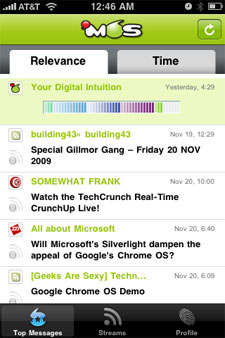
When +Barak Hachamov and I were working on my6sense, we were more than happy to rank social streams based on your activity and implicit interests. The solution, in my view, hasn't seen an equal, even in the three plus years it's been gone from consumer's hands. We offered a stream based on relevance, with your interests playing a huge role, a toggle to view the stream chronologically, and yes, we promised occasional serendipity to deliver surprise - to get you out of a knowledge rut, which can come from seeing the same topics debated and shared by like minded thinkers.

Relevance vs Time in my6sense

What we've learned from the Web is that we tend to gravitate to people who reinforce our own views and agree with us. Debate happens, but we don't actively seek out opinions from those with opposing takes on political, religious or even sports. (I wrote about this in 2006: Blogging Bifurcation - A Web Divided) The Web, despite being especially diverse, leads to us forming cliques, with friends, with what we read, and where we choose to congregate. Our three social pillars are what I called out back in 2009: Technology, Community, Relevancy. Most of us active in social streams have bought into the technology, and crafted our community, assuming the community's thoughts are themselves relevant. And by seeing new content, we immediately question its relevance.

For the 95%+ of people who haven't put hundreds of hours into scanning their streams to never miss a post, and who haven't taken time to set up lists, form circles, or fully understand Facebook sharing settings, the serendipity of surprise is as important as what they've explicitly asked for. While those of us on the tech edges react to the surprise with shock, we should know this is something we give in exchange for participation in somebody else's stream. The only thing I'd ask is that, like FriendFeed, we always have the option to please, kindly, be able to turn something off. Then we'll all be happy.

Standard Disclosures: I work on the Google Analytics team at Google, which provides Google+. Various services from Google partner with or can be assumed to compete with products from Twitter and Facebook. Also, from 2009 to 2011, I had a consulting relationship with my6sense as part of my work with Paladin Advisors Group. Disclosures are fun.

August 18, 2011

August 18, 2011 · 4 MIN READ · BY LOUIS GRAY

Google+ 1 More: I'm Joining Google Monday

Google+ 1 More: I'm Joining Google Monday

In the world of tech, you can make the news or you can break the news. I like to do both.

Never wanting to just play the role of armchair quarterback, I have over the last 12+ years actively played a direct or advisory role to dozens of startup companies, both consumer and enterprise. In the last 5+ years, I have shared with you many of my own experiences here on this blog, be it what I am seeing in the market, new products and services I am enjoying or big trends I think are going to impact the way we interact with tech each day.

Behind the scenes, often with less fanfare, in my various roles with my6sense, Paladin, BlueArc, and other companies, I've worked closely with and learned from some of the top people in the Valley and beyond. Increasingly, I have spent more time with different teams at Google, learning how they work, what they find valuable, and seeing how their goals closely mirror many of my own. Starting Monday, I will be playing an active role in helping bring Google's products to more people, as I am joining the Google+ team in the role of Product Marketing Manager.

The way the world perceives Google and the way I perceive Google has changed a great deal since my first posts on the company's services back in 2006. The company has grown from its initial roots in search and advertising to play a major role in many parts of our online lives, and has been among the most vocal in fighting for standards, data portability, and bringing content to more users, faster. The company's new social effort, Google+, is in its initial stages, and from what I know about the people behind the project and how they are positioning it, this will be a major piece of the company's strategy going forward.

Even My Kids Are A Little Excited About Google

After years of sitting on the sidelines watching various networks get some pieces right and others frustratingly stall or make decisions that seemed contrary to their users interests, I am eager to be on the inside helping make the products better, fighting for users and thinking creatively about how social plays a beneficial role in our increasingly connected and mobile world. I want to help build and promote a product that isn't just more fun, but more intelligent and useful.

Joining Google, a company greater than 100 times larger than anywhere I have ever worked, about 3,000 times larger than my6sense, and 10,000 times larger than Paladin, is daunting, and will bring its own challenges. In the last few months, as I talked with future colleagues at Google, I asked about how one person can make an impact at such a company. I asked about the potential for slowness and bureaucracy, and each time, employees talked about its revitalization under Larry Page and acting like a startup with incredible resources. Many times, through interviews and casual conversations, the company referred to its own youth as being remarkable - just over a dozen years old, and them just getting started, even if we take their pervasiveness for granted. While some may question the company's stretching into new venues with projects like driverless cars, it shows me the company's willingness to experiment and tinker and try new things outside of scope, where others might not.

Obviously, joining Google changes things and I don't honestly know all this means for what you can expect on this blog and elsewhere - but it doesn't change who I am and this blog isn't going anywhere. I remain a major advocate for small startups, niche apps and services everywhere, in addition to my new 9-5 work.

In the coming weeks, I'll learn the best approach to talking about the company and its products and competition, so you know you're still hearing from me in the most transparent way I've always tried to be, while also honoring appropriate confidential activity with the company and its partners - the same way I always have with my6sense and others. It does mean that my work at Paladin is officially on hold, and I'm not taking on new consulting work. It also means that I am wrapping up my dedicated role with my6sense on Friday - still a big supporter of their ideas, their people, and looking forward to some great product announcements they have coming up.

This move to Google is made even more exciting due to the caliber of the people I will be working with, from Chris Messina and Joseph Smarr to Jonathan Terleski, Timothy Jordan, DeWitt Clinton, Don Dodge, Chris Chabot and more. In meetings with Google as a blogger, as a power user or as a partner, I've always been impressed by the insight, integrity and culture of the company and its employees - a different feel than that I have seen when working with others across the Valley.

You know me - I vote with my activity. I push what I like and I advocate what I will actually use. When Google+ debuted, it made sense to me immediately and I've been using it as my primary social destination since, even when it wasn't obvious I'd be heading Google's way. I've been holding back some of my ideas and feedback on the product here as I want to do that from within the core of the project - but I am happy with I've seen so far and eager to help push it to the next level.

You can find me on Google+: http://www.google.com/profiles/louisgray

July 19, 2011

July 19, 2011 · 7 MIN READ · BY LOUIS GRAY

Google+ & Other Social Networks Need Algorithmic Filters

Google+ & Other Social Networks Need Algorithmic Filters

Google+'s entry into the social networking market presents a new slate of opportunity for tech geeks who have been unsatisfied with leading offerings from Facebook and Twitter. The network's initial launch has been intriguing for two major pieces, namely the need to recreate one's social graph from scratch, including manual sorting, and secondly, as noted before, not starting with aggregation of third party content. The clean slate approach presents optimistic participants with a hope to "do things right" this time, and not fall into the limitations of networks past. Given Google's science-driven history, smart folks have also cautioned the company against leveraging algorithmic filters that might surface some content in the place of others.

The most visible argument was that from Tom Anderson, MySpace cofounder, who said, "Can a company so enamored with the power of algorithms and machine learning, let the user take control?", adding "... I'm worried that Google is going to make a misstep and ruin the service," through leveraging algorithms to cut signal from noise. While I have enjoyed Tom's resurgence to visibility and insights into early use of the network, I think the conclusion he reaches needs some work. Where there is signal, there is noise, and what's been missing in all networks to date is the right approach to surface quality content, which no doubt feeds into Tom's comments.

The vast majority of social networking content is consumed in reverse chronological format, with the most recent content being at the top. This is true for Twitter and all of Twitter's clients, it is true for Facebook's "Most Recent" feed, it's true for LinkedIn's news feed, and is mostly true with others like FriendFeed and Google+, which for the most part, sort content by the most recent activity - meaning older posts can be "bumped up" with additional comments. FriendFeed fought this intelligently over time, letting older posts eventually float downstream, while Google Buzz fought a similar challenge as the most visible posters' active threads initially took too much screen real estate.

In contrast to the chronological view, one can find intelligently filtered streams on Facebook, with the service's news feed, and in Twitter's search results, which try to show you "Top" content, and not just "All" content, dependent on the user sharing updates. But Facebook's approach, from my own understanding, relies heavily on your previous interaction with a person, augmented by that post's activity, which can bubble it to the top - independent of context. This means that if, for example, I share two posts, one on Apple's blowout quarterly earnings, and the second showing a cute picture of Braden at the supermarket, the posts may carry equal weight, assuming we are BFF. You can see this all the time in your own news feed on Facebook, as seemingly "random" posts from your friends surface to the top, while friends outside your top two dozen interactions almost disappear.

An algorithm that surfaces personalized content that does not take into account the many multiple factors that indicate interest, from the person sharing the content, to the content source, keywords, headline, author, time of day, time since publishing, the individual(s) commenting on that message, the keywords in the headline in combination with the author and/or the source, etc. simply isn't enough. The truth is that each of us does this automatically, and what the world needs is social networking that thinks like we do. For example, if you like financial news from the Wall Street Journal more than you like it from GigaOM, then similar stories from both should be weighted this way. But if you prefer articles on stock from Om Malik more than you do from Mathew Ingram, that too should be determined. The human brain is a very complex object indeed, but just because something is hard doesn't make it something you don't want to try.

Which brings us back to Google+. Initial content in any network excitedly rallies around itself. Soon following, one finds a backlash against meta posts, a call for the mainstream to enter the site, a fear for what happens when they do, a backlash against top users and so on. But once the fun of that is done, people behave like people and want to see interesting stuff. One person's noise is another person's signal, and unfortunately, very few people can be constantly logged in to a service. This means that when they log back in to a service, they shouldn't be forced to see just the most recent things that have happened, but instead, the best things that have happened - the content that is most important to them as an individual, the pieces of content that they absolutely did not want to miss. Because if something is especially important and relevant to you as an individual, that it came out two hours ago does not render it useless.

The advent of Google's much-discussed Circles delivers bidirectional manual filtering of people. It's bidirectional in that you are consuming from a unique list which you created, and you are sharing to a unique list of people which you created. If you create a list of "My Poker Buddies" and another for "College friends" and another for "Tech News People", the truth is that your poker buddies are going to talk about things other than poker, your college friends are going to talk about new stuff, and your tech news friends are going to talk about whatever they want... all day long. So the circles are porous. Simply naming one "Baseball" won't force people to talk about baseball, and until search is fully implemented beyond Sparks, there is no great way to find that on the site.

Another common fear about filters (which we discussed when responding the filter bubble) was that preferences are reinforcing, and that you see only what you want to see, at the exclusion of all else, that this leads to a dangerous space where you don't get access to alternate opinions. Again, I argue that we are very early in the game of finding high quality algorithm-driven personal filters for news, for social networks, or anything else we use that could benefit from personalized ranking. The solution to a smart algorithm that learns your preferences implicitly, rather than polling you explicitly for what you say you like will mean that you don't have to sift through the dozens or hundreds of posts that you deem off-topic, but instead that you get the best delivered right to you.

Unfortunately, while many companies have talked about this possible panacea, most all of them are cheating through collaborative filtering, and assuming that your social graph is smart enough to determine what is the best content for you. It's simply not true. Your interests are not my interests, and just because I like a specific topic on one day doesn't make it the most important thing the next. What is needed is a strong body of record that is tied to you as an individual, applied to your stream in real-time, helping you avoid the mess and find the best.

Google has traditionally been very cautious, going against conventional wisdom by not leveraging behavioral targeting as much as they could, by going out of their way to not overuse your Web history, your email activity, or in any other way, abusing the relationship you have with them and your content. With Google+, on both mobile and desktop, they have a new opportunity to do this correctly, continually learning more about your interests and activity to serve you the most relevant updates while avoiding much of the cruft that has plagued other networks, specifically Facebook. Having worked closely with my6sense for the better part of two years, I've seen directly how smart algorithms based on implicit feedback can make useful high quality streams out of what would more commonly be considered noise - and I've seen many people on Google+ and Twitter call for the same such filtering engine to be applied.

As Google+ gains visibility with the service opening up to more users, and less geeky users, it is inevitable that the stream content will be diversified and become more "noisy". Initial users will no longer be accepting of the content, excited just to use something new, but they will want the network to provide increased quality and connections than the status quo. While it's expected Google will eventually do a tie-in with casual gaming on a dedicated games site, the general hope from the community is that game-related info with not pollenate Google+. It's well-known that game info is a common polluter of Facebook streams, even if you've done your darndest to block all the services that hit your feed.

Tom's approach is laudable. He sees a new network with great promise, and is scared that Google will fumble it away. But I believe his conclusion is not perfect, for if done correctly, intelligent algorithms can make the network the most personal and most relevant one on the market. What Google+ needs to deliver is not just that it exists, but that it is differentiated and better. Why not use the smarts and information the company has to achieve just that?

Disclosure (as always): I am the VP of Marketing at my6sense, which provides personalization of news and social streams (but not yet Google+).

July 12, 2011

July 12, 2011 · 1 MIN READ · BY LOUIS GRAY

Android AppStorm Reviews my6sense

Android AppStorm Reviews my6sense

Rahsheen Porter did a great job writing up my6sense today in a review on Android AppStorm. my6sense determines your interests and preferences in social media (but not Google+ yet!), helping the best stuff get to the top from Twitter, Facebook, Google Reader and Buzz.

I'm VP of Marketing there, so consider that my disclosure. Great to see fantastic user feedback and insight.

/via my Google+ Profile.

July 6, 2011

July 6, 2011 · 4 MIN READ · BY LOUIS GRAY

Billions of Awesome Pieces of Content Served Daily?

Billions of Awesome Pieces of Content Served Daily?

Mark Zuckerberg, Facebook CEO, and Barack Obama, USA's interim CEO, dueled for attention this morning in what turned out to be an intriguing one-two punch on the state of social globally and then then the state of the nation broadly. Zuckerberg promised us something "Awesome", while Obama dueled with opposing party leaders claiming he didn't keep his own promises. Not bad considering both were completed before noon Pacific.

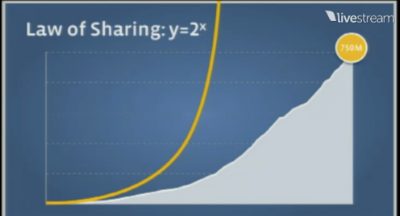
Zuckerberg, possibly feeling a little defensive after a week-plus of early adopters fawning over Google+, possibly the biggest and most direct alternative to Facebook since the network started, focused primarily on the introduction of group chat, anticipated since the Beluga acquisition earlier this year, and the integration of video calling, powered by Skype, also expected. While that particular awesomeness could be debated, more important was the company's shift away from measuring raw user counts - which is mind-boggling at 750 million active accounts, far and away the leader, but pushing more attention on the amount of content shared on the network. Zuckerberg said that number, growing exponentially, ahead of user growth, is now at 4 billion unique items per day.

4 billion. Per day. Just on Facebook.

We know people don't share equally, with a nice 5 or so shares per registered user per day, but as Zuckerberg highlighted, there are more and more ways to update your Facebook stream. It may have started simple, with your interests, but now all manner of application and service can post to your feed, whether you're there or not. You can check in, or tweet in, or upload your photos, or have your blog posted there, and yes, still add status updates, comments, likes and so on. No wonder more updates are happening per person and this number is growing.

Exponential Content Growth on Facebook (Image via TechCrunch stream)

Selfishly speaking, this is why I've highlighted my6sense and teamed up with them for the past year. Zuckerberg highlighted the growth in mobile and the growth in content being shared per person leading to this incredible tsunami of data that shows no sign of decreasing. What this presents to us is, unsurprisingly, a question of quality. Facebook is for many a necessary utility to connect people and act as an online Rolodex. It's a service our parents understand and our little sisters too. Maybe our grandparents and assorted relatives are there too. I know mine are, and I've had to hide a lot of their stuff, trust me.

When Google+ launched, I gave the team kudos for not immediately jumping on the aggregation bandwagon. It is this aggregation and the introduction of so many different ways to update Facebook that has helped power the content numbers, and theoretically decreased your ability to find the best stuff. Google+ is addicting for many of the first users who know that the content was created and shared with them in mind. For Facebook, while they want more than anything to keep you on their site and to keep you engaged, which is working very well, there's a question, especially among the bleeding-edge geeks, as to whether they are spending real time on the network and contributing directly.

Think about two other things Zuckerberg said today. One was that many (he almost said most) people do not make friend requests, but react to them in a passive way. That's been my case as well. Second, he said that groups work when everybody knows who is in the group, typically started by one person who is the ringleader of sorts. This tells me that people, counted in those 750 million users helping post 4 billion items a day, are possibly sleepwalking through the network. They're not working to expand their contact list or to create groups, but reacting to others. This is happening because they're tapped out. They're tapped out on time and on interest. They probably don't want more friends, more connections, more groups because they're already at the point where they're full, and they're often full on the junk food equivalent of content.

Creating new features for 750 million people at once and making it simple enough for your grandparents to use is incredibly difficult, and Facebook made it look pretty simple today in their demos. While not the most advanced, as early comparisons to Google Talk and Google+ pointed out, the goal was simple and successful. Group chat, if it's anything like Beluga, should be a sure win as well. But I continue to worry about the site's ability (and others like it) to accurately discern what the most interesting and relevant updates are for me. They know, just like I've said for a long time, that the amount of content being created and shared is increasing, and is at all time highs. Now, they've delivered to us a number - a new metric to watch, because it's only going to get a lot busier from here.

Billions and billions and billions of pieces of content. Every day. And that's just on one network - a huge one yes, but just one. Impressive.

Disclosure: I am vice president of marketing at my6sense, a Paladin client. Our service supports Facebook streams for relevance.

May 18, 2011

May 18, 2011 · 7 MIN READ · BY LOUIS GRAY

Why The Filter Bubble Is No Bubble and It's Not Bad Either

Why The Filter Bubble Is No Bubble and It's Not Bad Either

Multiple Factors Go Into A Solid Personalization Service
(from my6sense's internal slide decks)

Eli Pariser, former Executive Director of MoveOn.org, is a smart guy who knows the Web very well. His most recent work takes on the movement toward services that adopt algorithm-driven personalization to provide you individualized content - which he calls "The Filter Bubble", matching a book he recently wrote by the same name. His summary, as eloquently stated during a TED talk in March, is that we as Web consumers are going to miss being exposed to information that challenges our views, that we will self-select our sources and content we wish to consume, and the services will comply. The result? A dangerous world, he argues, that is bad for democracy, and no doubt bad for knowledge as well.

Spending considerable amount of time thinking about the impact of machine-driven personalization as VP of Marketing at my6sense, as well as being an early adopter of many other tools that adopt various factors of personalization, from The Cadmus to Zite, Flipboard, Hunch, Cascaad and others, it is important to think about the impact of our efforts to bring personal relevance to the fast-moving Web and if we are indeed pushing people instead to a house of mirrors where most things look the same and the comfortable world agrees with our world view.

First, the argument that people prefer to associate with like-minded individuals and listen, read and watch news and commentary that agrees with their worldview is pretty well accepted. In politics, conservatives may prefer Fox News for their media, while liberals prefer CNN and MSNBC. This is exacerbated dramatically further on the Web with niche discussions becoming even easier to find. Way back in February 2006, when this blog was pretty new, I talked about how people don't usually want to mingle with people of opposing views, but instead that views become polarized as communities flock to the edge, where they are comfortable.

Quoting my 28 year-old self:
"To measure credibility on the Web, visitors are looking for people who already agree with their opinions. They're not so much looking to be changed or to gain information from other viewpoints, but to instead become more hardened in their positions."
(See: Blogging Bifurcation - A Web Divided from February 23, 2006)
No matter the media, be it online or offline, we self-select what we consume based on a vast number of criteria.

We first self-select the source of our content - for example (in a world of dead tree papers) the New York Times, instead of the Washington Post or USA Today. Then, we choose how we are going to consume the content, be it to skim the front page first, or to dive into the business section. Perhaps we always read Sports first and then go back to the front page, and finally settle on the Features section. What we don't do is read every single story from beginning to end starting at the top left and moving to the back. Similarly, on television, we have our favorite shows, and again, we have preferences. We don't tun the TV on to channel one and hit the "up" button on our remote control until we find something we like. Instead, we choose our watching behavior based on our interests, and in a world of DVRs, we watch our favorite shows and limit our options to even be exposed to commercials highlighting other fare on the same network.

Personalization Puts You At the Center of Content

What new tools like my6sense and others are doing is recognizing that this capability of accurately divining the order of your preferences is largely missing in a new world of real-time streams. No man, not even the cyborg tech bloggers among us, can read every single tweet, Facebook update, Techmeme headline or news story that crests The Drudge Report. What my6sense and others like it are trying to do is eliminate the noise which you will never be interested in, while at the same time, surfacing the content which is deemed important to you based on your interests. No two people consume content in the same way, so presenting the content in the same way to each person (as has been done for centuries) doesn't make too much sense any more. It makes more sense, both for the user and for the content producer, to bring the best and most relevant content to the right people who want to see it and engage with it.

The concerns raised by Pariser are absolutely valid if the services being personalized don't offer any way for content that has not previously shown interest to come into your sphere. If the only signals that you've given to a service are that you like Apple computers and NBA playoff scores, and that's all you'll get, you'll have a poor understanding of the 2012 presidential election race and probably might not have noticed the fluctuations in the price of gas.

In my6sense, there are two critical ways that make sure you don't stay in your bubble forever:

1) There is always the option to view your streams sorted "by Time". Always.

Every single application that we have provided, from our iPhone and Android applications, to the NOOKColor application with Barnes and Noble, and even the Twitter extension on Chrome, offers a "relevance" tab based on your interests right next to the traditional chronologically-ordered view. There's no winner take all algorithm that erases the time view, because we know you should always have the option to see what your connections and feeds are saying "right now".

What's being discussed in the "Time" column could be anything. It could directly fall into your interests, or it could be something completely random, and that never will go away.

2) Collaborative filtering, while not the dominant signal, is still a signal.

If I have trained my application to know that I have a strong liking for technology news and consume this most of the day, it's unlikely that I will have previously given information that signals any interest in Osama Bin Laden's death or the earthquake in Japan. That said, if an event occurs that gets the attention of many of my social connections who begin to discuss it or share items on that topic, the system should interpret that as a strong social signal and surface this content in the application, so that alongside my regular Android ecosystem updates, I retain the option for breaking news.

In November, I wrote that "The Third Wave of the Web Will Be Uniquely Personal", as services adapt to my preferences and history to bring me a unique experience. We see this happening with Gmail's Priority Inbox, Google News personalization, the Facebook news feed and many other tweaks to our Web consumption experience. This doesn't mean that we are going to opt ourselves into a bubble by which we are never exposed to opposing viewpoints. Instead, it dramatically hones our signal to find us the best of what we want to see and leaves the door open for the real world to impact us.

As a member of the management team on a service that offers aggregation and multiple sources of a content, we often talk about how it's not a great user experience to deliver many articles in a row from a single source, or many articles in a row talking about the same event, even if it happens to be the event that is most critical for you to know. It is also not a great user experience if you feel that you are isolated, in a place where no other ideas enter and no other viewpoints get a chance to cross your screen.

The trend of personalization is a great thing - not bad at all. Every day you are self-selecting your news based on who you follow on Twitter and Facebook. Every day you are self-selecting your news based on the RSS feeds you read and the social networks you visit. This is something you are already doing. What apps like my6sense and others help to do is get you the best of what you want and free up the time you'd usually spend looking for that great stuff to go off and do something else - maybe start your own product... or even read other viewpoints where arguments are welcome.

For more on Eli's thoughts, see his interview with Time.com here: 5 Questions with Eli Pariser, Author of 'The Filter Bubble'. He is on Twitter at @elipariser, where he has personalized his news feed with 460 hand-picked people to follow.

Disclosures: I am vice president of marketing at my6sense, who delivers personalization of streams. my6sense can be assumed to be competing with multiple services in this piece, including Cadmus, Flipboard, Zite, etc.

April 28, 2011

April 28, 2011 · 3 MIN READ · BY LOUIS GRAY

With Apps, The NOOK Color Is Now A Smart Hybrid

With Apps, The NOOK Color Is Now A Smart Hybrid

Monday's announcement that the Barnes & Noble NOOK Color had launched its application gallery was much anticipated, with leaks and rumors galore over the last few months, as industry watchers have been curious how the eReader would adapt to a world in between the single mindedness of a Kindle and the do-anything catch all of a full-fledged tablet device. Full disclosures up front, due to my role at my6sense, I've known the Barnes & Noble app plans for several months, and our app was included as one of the first to be included on launch day. But as a user who already owns an Android tablet in the Samsung Galaxy Tab and a pair of iPads besides, I was independently eager to get my hands on these apps, and I believe what has been delivered is a smartly curated, less intimidating way to bring the best features of Android to users who don't want to lose the comfort or familiarity of a device centered around reading.


My NOOK home screen with apps and the apps gallery


As was much covered by the mainstream technology press, the NOOK Color app gallery features more than 100 select applications across a broad reach of categories, with an emphasis on those that would be in high demand by the most active readers. For us, it made sense that those reading books might also want to read and engage with their social and news streams. For others, the option to bring to-do lists, email, comic book apps and more make sense in the intuitive seven-inch form factor. And yes, everybody loves games, and if a device has a screen these days, you know Angry Birds is there.

NOOK Color Apps for Sale

Much like Apple's iTunes store, the app store on the NOOK Color adds applications to a marketplace already designed for more traditional entertainment goods. Instead of music and video titles, magazines, newspapers and books are the headliner, with apps likely to play an increasing role over time. Without a full-fledged Android Market, with hundreds of thousands of apps, every app on the NOOK has a chance to be found, and its not amateur hour. Each app was planned for inclusion well in advance and carries the implied support of the NOOK team.

For Android users, the visibility of apps like Pulse, Epicurious and QuickOffice is comfortably familiar. Other titles have never crossed my radar. The addition of a standard email client that supports multiple accounts is also very welcome, eliminating yet another need for multiple devices when I can just close the page on a book (or close an app) and pull up email to both read and send messages, synced with your cloud server. With little fanfare, the NOOK has always also had the option to support your own media, including music files and photos as well, for a light multimedia experience.


Composing and Reading Email on the NOOK Color


Those calling for the NOOK to become even more of a full-fledged tablet are trying to make it something it's not really aimed to be - no more than the iPod is trying to be an iPad. The single homescreen button and lacking hard-wired buttons for "Back" and "Menu", common on Android smartphones, takes some getting used to, but functionality to navigate one's library, content and the store is very easy to pick up. The apps each are intuitive, and if they assume back and menu buttons, as ours has, you can emulate that in software.

I see the NOOK as a serious hybrid. It's both an eReader and a tablet, but like the Prius, it's not going to beat a Porsche in a speed test for going 0-60. It just quietly does its job, has an amazing battery life, and brings the features you would expect. While the app store is only a few days old, I've already seen my interaction with the device change, transforming from one of passivity, mostly consuming content, to a more engaged role, creating emails, and interacting with new apps.

Disclosures: As noted above, my6sense, where I am VP of Marketing, is a launch partner with Barnes & Noble for their app store.

March 30, 2011

March 30, 2011 · 2 MIN READ · BY LOUIS GRAY

The Social Graph Is Not Enough to Find a True Me

The Social Graph Is Not Enough to Find a True Me

Last week, I gave a presentation at the Kynetx Impact conference just outside of Salt Lake City, Utah, talking with the developer audience about the Third Wave of the Web, and my continued belief that true personalization in both the Web and in our mobile content consumption is what will drive the most dramatic changes to the future of the Internet, following on to the first wave (Information Retrieval and Search), and the second wave (Social Networking). Most directly, I believe that the current approach taken by many leading Web companies, to assume that your friends' recommendations and shares constitute personalization for you, is not enough. True personalization is about your own interests and preferences.


The most well known example of recommendation services that rely almost exclusively on your social graph is that of Facebook, where it's generally assumed that if many of your close friends like a topic, that you will as well. My common example is that if your friends like Mamma Mia, it's assumed you like Broadway plays and if many of your friends have given a like to one establishment or another that you would of course be more interested in that. This is extended with tools like Foursquare and others, who give the social connections a big push to bring you new stuff you might like.

There's no question that collaborative filtering brings value. But it's not enough. What's more accurate is that you are driven by your own preferences and just because your friends like something doesn't guarantee that you will. Only you have your unique makeup and interests, and the knowledge of how to rank those interests. For example, you may like both Katy Perry and Depeche Mode, and you might prefer Depeche Mode to Katy Perry, or specifically prefer one song of Depeche Mode or the entire album continuous. That's your preference, and what's needed is the ability to learn from your own behavior. The Web sites and applications that do this in the right way will start to separate themselves from the competition.

So look at the news just from the past few days. Google is now going to personalize your Ad experience based on your activity in Gmail. That's a good move, based on your own implicit history. But in parallel, we have more chances to tap social signals with +1 in the search results (for starters). At my6sense, we talk a lot about the best signals to watch for to deliver a real human experience that's personal. And it takes more than just collaborative filtering. See the embedded presentation to see just what I mean.

Disclosure: I am vice president of marketing at my6sense. I was not compensated by Kynetx for my presentation, but they did cover expenses for the trip.

February 9, 2011

February 9, 2011 · 4 MIN READ · BY LOUIS GRAY

Why We Brought my6sense to Twitter.com via Chrome

Why We Brought my6sense to Twitter.com via Chrome

This morning, as you might have seen from one of the many places that covered the launch, my6sense took its first step beyond the world of mobile, bringing tweets ordered by personal relevance to Twitter.com, in the form of a Chrome Web browser extension. The idea, of course, is to take on the challenge of finding excellent content in your real-time streams and bringing it to the top. More signal and less noise. Working with a team that is small and has limited resources, we have to be smart about our choices, so it's my pleasure to talk about why this is such a big deal, and why we went this way.

Tens of millions of tweets pour through Twitter every single day, according to the company's cofounders, and even through the most valiant efforts, you're bound to miss something, even after carefully hand-selecting those you follow, skimming fast and having great news sources. The idea is no longer a situation where "the news will find me", but instead that you are sipping from the firehose, and your limited time at the fountain means you are seeing select portions of the stream from the time of day you are looking. Meanwhile, in between the best stuff from all your friends and brands, there are a lot of updates that just might personally not be relevant. So something is needed.

Even Twitter says "Our Challenge Is Relevance". We agree and we're hoping to help.
I joined my6sense to help accelerate the third wave of the Web - personalization of streams from all sources, not just to bring apps to consumers. So it's no secret we've been talking since day one of the right way to come to the Web and bring my6sense to where people already participate. We don't want to build a dedicated Web site to compete with our partners and popular Web services, but instead, to bring the magic of our app to where consumers already are.
my6sense in my Twitter stream

There are two ways to bring the intelligence of my6sense to existing streams - one being through their adoption of the Attention API, which some are pursuing, or through other methods that we can initiate, like a dedicated extension that works by service or domain. Twitter, an incredible company changing the way people communicate, has to be selective in how it works with third party APIs, not choosing favorites, so we knew bringing this intelligence via extension was the right move.

Browser extensions now exist for practically every platform - but are most well known for Firefox and Chrome. With the growth of Chrome's browser share, and the browser's overlap with our technology-savvy user base, launching on Chrome was the right idea. Also, starting with Chrome gives us a clear address on the Chrome Web store. No doubt, Firefox will be coming soon, resources depending.

My settings page on the my6sense Chrome extension

But what about the deployment? We knew we needed to make integration into Twitter.com seamless. From the first day we talked about this project, we wanted it to look and feel like Twitter. So our app simply adds a tab to the Twitter.com experience, and tweets are reranked based on user preferences. No fancy UI, just simple integration. Adding on support for URL expansion to preview articles and shared rich media, and we think we've brought real value to existing users without complicating their experience.

If you understand our focus - to implicitly determine your interests based on those items you read and skip, or act on in the Twitter.com interface (such as favorites, retweets, replies, etc.), you know we are trying to reduce the amount of time you spend culling through updates that aren't of interest to you. When people see the difference between the chronologically ordered timeline and the personally ordered timeline from my6sense, the difference is clear. Sometimes the stream may toss up surprises or items that aren't a clear fit, but no software is perfect. The good news is that we're listening to all the feedback, positive and negative, and hoping to make a real impact on the way we all consume and share content.

I hope you'll try our new extension and see how we can improve your Twitter.com experience by bringing the best updates from your friends and brands to the top. You can find the Chrome extension at http://m6s.com/chromeweb.


Disclosure: I am Vice President of Marketing at my6sense.

February 7, 2011

February 7, 2011 · 3 MIN READ · BY LOUIS GRAY

knowabout.it: For The Links You Might Have Missed

knowabout.it: For The Links You Might Have Missed

Solving the information overload problem in the fast-moving world of social media is an incredible task - one that seems to be increasing as we take on more networks, more followers and more places to get impacted, from our PCs to tablets and mobile phones. Even the most focused among us can't get to every great link that gets passed to us from friends, which is why the "news will find me" strategy of years past simply doesn't pass muster any more. In this gap is coming a flotilla of personalization engines, but also services that look deep into your streams and find the best links for you. The newest is a two-man operation called "Know About It" at the simple URL: http://knowabout.it. Their goal? Find the links you might have missed.

One of the company's calls to action is that the noisiest people with the most followers who update with the most frequency can "drown out the ones who are more selective and thoughtful with what they share." With this in mind, the product surfaces recommendations both inside and outside your social streams, and provides a unique wrinkle called "potentially missed" shared from "some of the quietest people" in your network.

Top Items I Might Have Missed from My Social Streams

Unlike some services which require a good amount of explicit information filled out to feed the system, or others who claim to watch your behavior and find the best based on your preferences, Knowabout.it already has recommendations for you when you first enter the site, even if all you brought was your Twitter account.

Top Links Shared from Quieter Folks I Follow

For me, someone who is close to constantly connected in combination with my focus on my6sense, you would be hard pressed to find great stuff from my network I hadn't yet seen, but Know About It's recommendations aren't bad at all. Top links came from Marshall Kirkpatrick about predictions from Quora and Akula talking about more engineering heads at Microsoft, as well as a Hacker News article on Twitter's onboarding process. It wasn't a perfect run on the first try, but a hit rate of more than 2/3rd is very good.

Selecting Sources to Feed Knowabout.it

The site, founded by Kevin Marshall and Will Cole (@falicon and @willcole), doesn't exactly make it clear why some items are selected for you, but a post on the service's blog from January 27th starts to provide hints, saying they are watching popular posts that rise due to frequency of links, retweets, clicks from within the site and bit.ly stats. But their focus on quieter sources promises to go beyond the noise and to find the best from all the streams.

A Top Link Outside My Usual Streams

The site seems to be focused on finding some great links, and leveraging content from friends' streams to see what you might like as well. For example, I can "Peek" and see updates from Atul Arora's collection or Pete Warden, but the refresh rate won't keep you around long. It's not clear that reading an article dismisses it from your stream, and from my looking, my collection takes more than an hour to update, so realtime it's not - at least, not until the founders increase the polling speed.

Of interest, you can also build saved searches to update you on keywords that enter your stream. You can get an email or RSS feed for watched terms, and if aggressive, you can get them up to every 15 minutes, so if you set up monitor for a top keyword like iPhone or Android, prepare for your in box to get hit early and often.

If you have that nagging feeling that even through your usual use of the Web, you're not getting to all the good stuff, knowabout.it might find you some of those missing pieces. It's early days for the service, and it's still not open to everyone, but you should get your name on the list for the time the doors open.

Disclosure: I am VP of Marketing at my6sense, a service focused on providing personally relevant items from your social and news streams. It could be assumed some of our services overlap in the public eye.

December 2, 2010

December 2, 2010 · 2 MIN READ · BY LOUIS GRAY

RSS Addicts Welcome Google Reader to Android

RSS Addicts Welcome Google Reader to Android

Google Reader has long been the gold standard for feed readers on the desktop. It's been a must-stop destination for me practically every day since 2007. As the world of consumption around the service has changed, with people calling for the death of RSS and mass migration to social services, the product has adapted to more social sharing capabilities, and integration with Buzz, Google's social aggregation service. But until yesterday, Reader was conspicuously absent when it came to the Android Market - pushing RSS addicts (like me) to get their feeds another way, be it through the generic mobile interface Reader offered, through an alternate product, or simply just to wait until getting back to the desktop.

Reader's debut yesterday was absolutely welcome. While many people are saying that Web versions of products should be all you need, consumers have taken strongly to the mobile app mentality best exemplified by the iTunes Store and Android Market. Even if you can get to a site via a mobile client, it's often perceived to be a less fulfilling experience. Reader's new app on Android is the full experience its users were waiting for, and it's a great option for mobile feed consumption - especially if you want to do two things: first, synchronize your read/unread data from mobile to the desktop, and second, share to your Google Reader link blog.

     
My Google Reader Folders and an Item on Android


The app (free, of course) asks you to connect your Google Account, or multiple accounts if you have them, and after a quick synchronization, it pulls in all your unread items. This can be those from feeds you subscribe, or friends' shares that you have added to your list.


Sorting and Sharing in the Google Reader Android App


The Reader app does practically all those things the desktop equivalent does. There's the option to sort by newest, oldest, and by magic. There are also the options to view shares from people you follow, or to explore blogs you might like, based on your other interests. And like the main site, you can star items, like them, add notes, or share them downstream. The app integrates with existing social tools you have on your Android phone, so you can click share out to Seesmic, Gmail, Text Messaging, or whatever you like.


People I Follow and Exploring Google Reader Android


For me, the Reader app icon now occupies a valuable home screen space, next to my6sense and Google Buzz. And if you're curious as to any conflict with Reader and my6sense, just remember that Reader is our only default RSS source in my6sense, and they are a valuable partner, supplying the RSS portion of our aggregation service. The more options people have to get to their information on the mobile is a great thing.

You can find Google Reader in the Android Market, and see their post from yesterday here: The Android Google Reader app is here!

Disclosures: Google Reader is an essential source of content to my6sense, where I am VP of Marketing. In theory, the new app is competitive as well.