Silicon Valley Technology Commentary & Archives · Est. 2006 3,047 Posts · 2006–2026
Showing posts from November 2026 (10 posts). All 2026 posts · Show all posts

November 12, 2026

November 12, 2026 · 4 MIN READ · BY LOUIS GRAY

Webnerd.ai Debuts News View from Feeds and Blogs

Webnerd.ai Debuts News View from Feeds and Blogs

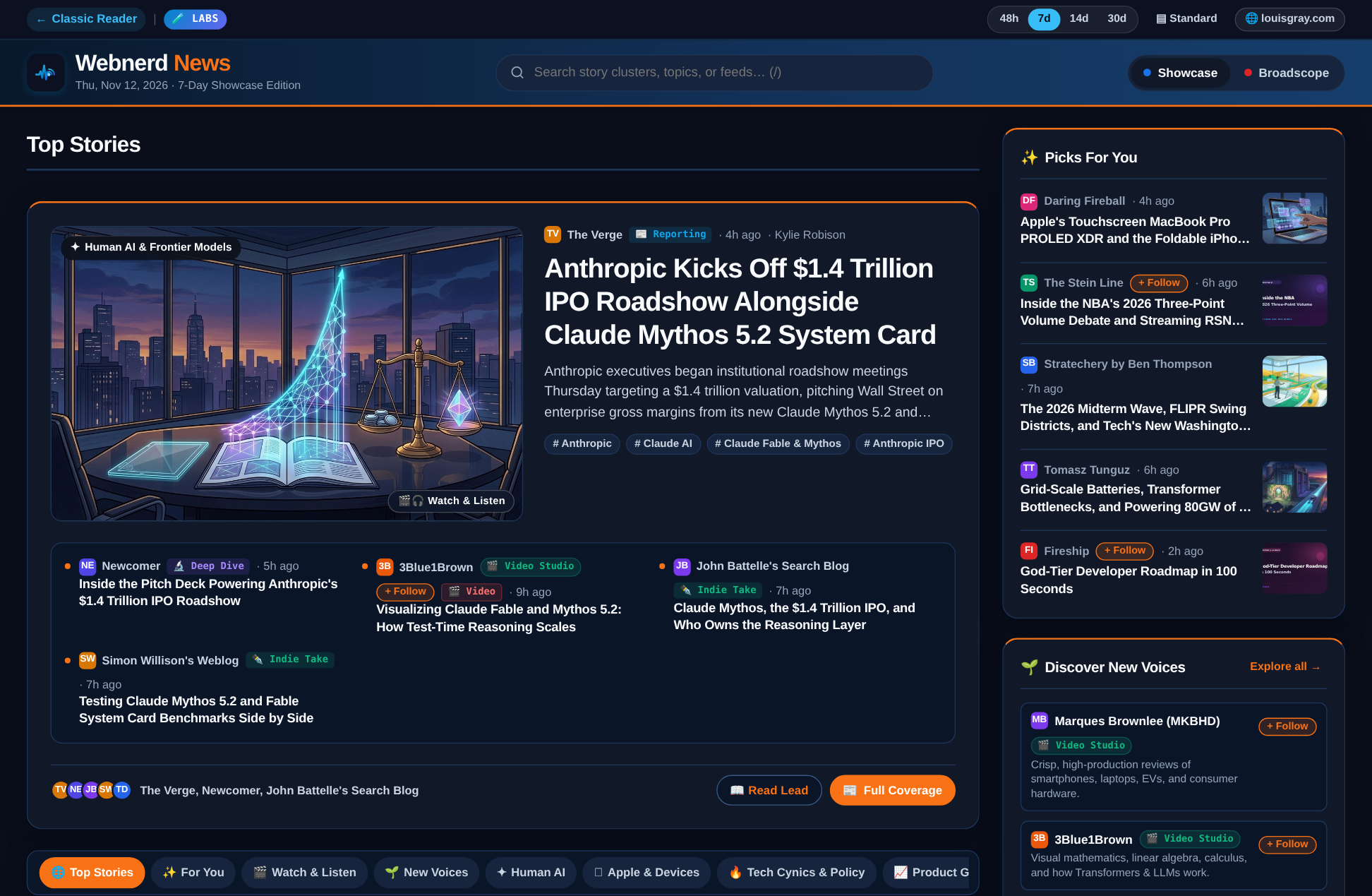
Webnerd News Showcase Edition in the midnight-cobalt and orange louisgray.com theme showing a clustered lead story, perspective badges, Picks For You, and Discover New Voices
Webnerd News (in Labs) brings visual clustering to top stories and streams.

Webnerd News Magazine on Webnerd.ai

An algorithm-free stream of updates, sorted chronologically, ensures you never miss a single post. Bringing that classic RSS reader feeling back, including recommended bundles and sharing, has reinvigorated the discovery loop for me after a dark decade dominated by social feeds fueled by ragebait, attempts at viral videos and headlines that left you questioning what stories were all about. But there's also value from automated or hand-selected curation you see from sites like Techmeme and major news hubs like CNN or Google News.

Typically, these sites are fed by their own first party sources or editor curated content. As a viewer, they may slightly adjust based on their incremental levels of personalization, but for the most part, you get the same view everyone else does -- and your headlines or top stories are the ones they see.

What if you could combine the at a glance view of what's most important, including story clustering when many sources cover the same topic, but built on a foundation of the sources you choose to read? That's the idea with a new view in Webnerd.ai -- a fun experiment that combines the feeds you personally subscribe to, augmented by the starter packs I engineered into the site from the first day, ensuring you always have something to read, and constantly have new sources to discover and subscribe to.

Building on the web platform, and offering a direct connection from the publisher to the reader is an important foundation of what makes RSS special. If everything is a feed, you can point that feed and shape it every which way. We remember this from the 2010 era wave that saw Flipboard unveil its social magazine on the iPad alongside Feedly, Plaxo Pulse, Ninua and many others, even as plenty of pundits rushed to declare classic feed readers dead. I pushed back at the time saying RSS or RIP, the Results Always Trump the Methods, arguing that consumption tools aren't a zero-sum game. Sometimes you want the raw river, item by item. Other times you want an editorial front page that groups the noise into a coherent briefing. After watching filtertainment eviscerate our informed monoculture over the past decade, building both modes on top of open feeds feels overdue.

So let's have fun with it.

Clustering Your Subscriptions With 14 Starter Packs
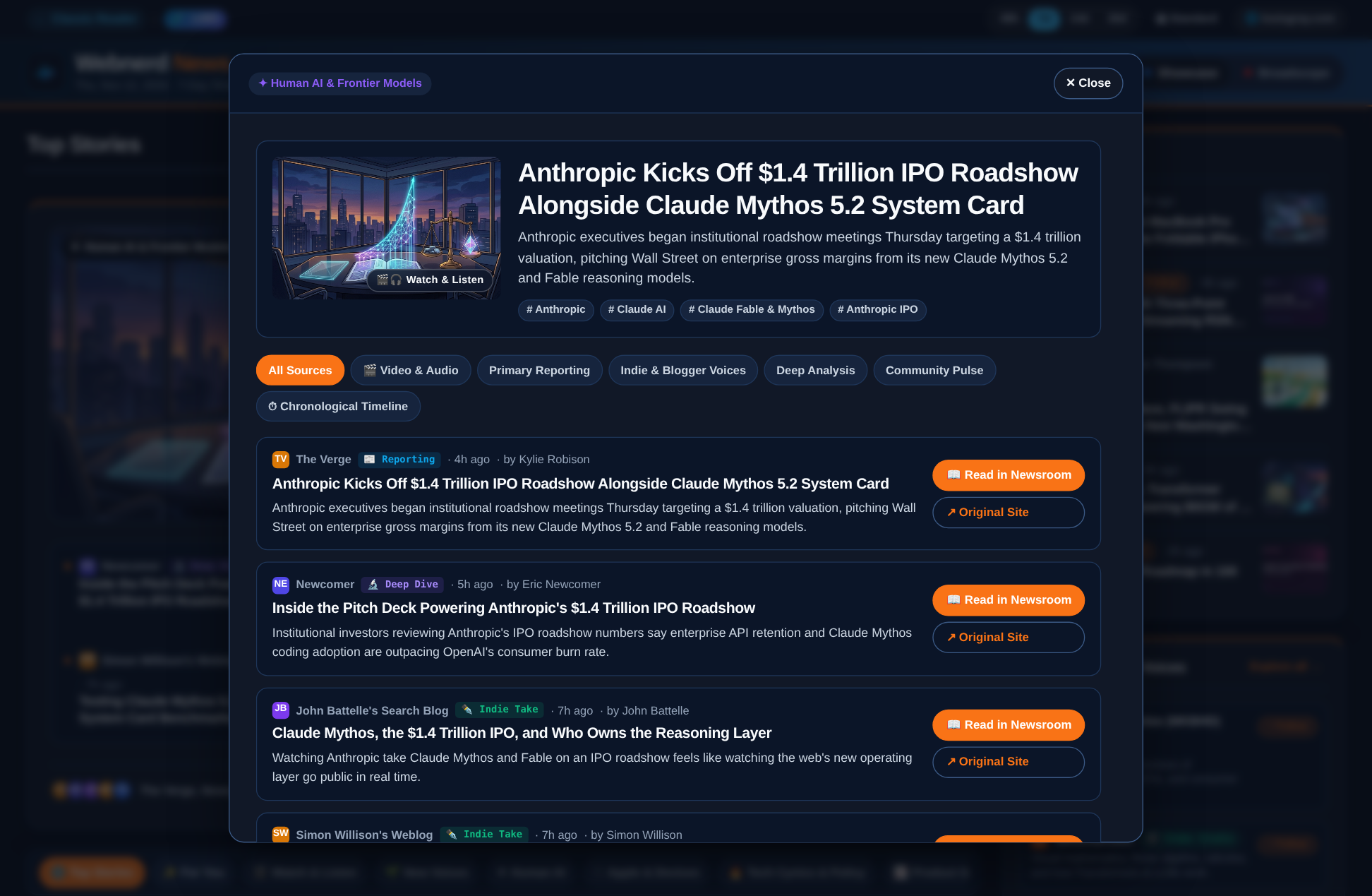
Webnerd News Full Coverage modal grouping Primary Reporting, Deep Analysis, Indie & Blogger Voices, and Video & Audio on a single story
Tapping Full Coverage lines up reporting, deep dives, indie bloggers, video, and podcasts on the same story.

The engine underneath Webnerd News starts with every blog, newsletter, YouTube channel, and podcast you have connected, then blends in active coverage across all 14 Webnerd.ai Starter Packs. Strict source diversity caps keep any single high-volume site from flooding the page, and if you still haven't tried Webnerd.ai yourself, and take a look without logging in, it defaults to an edition generated from my own subscriptions so you can kick the tires right away.

Instead of repeating duplicate headlines, related posts converge into a single story cluster tagged by the role each piece plays, offering:

  • Perspective Tags & Full Coverage: Every item carries a clear badge -- Reporting, Deep Dive, Indie Take, Community Pulse, Video, or Podcast. Hit Full Coverage to compare every angle side by side or step through a chronological timeline of how the story unfolded.
  • Inline Starter Pack Discovery: When a writer from a Starter Pack you don't follow lands inside a story cluster you're reading, or surfaces in the Discover New Voices rail, you see which pack brought them in alongside a one-click + Follow button that subscribes and files them straight into a matching folder.
  • Zero Unread Anxiety: Browsing Webnerd News is strictly read-only against your classic reader queue. Flipping through the magazine never marks articles read behind your back, and stories you already read earlier in the morning still stay on the board for context

This is very much day one of a broader buildout and another fun volley in vibe coding to victory. I plan to keep tuning the clustering weights, tightening how personal folder signals steer the front page, and expanding the Starter Pack catalog beyond tech and media. Take Webnerd News for a spin on your own feeds today and let me know on Bluesky what clicks, or what you'd love to see next.


Disclosures, per always: I work at Google and use Gemini and Antigravity tools a lot. I built Webnerd.ai, its Chrome Extension, and this blog's CMS with Antigravity's help. Nobody at Google reviews my posts, ever. Not even those folks who make the excellent Google News.

November 11, 2026

November 11, 2026 · 3 MIN READ · BY LOUIS GRAY

When Code Is Cheap, Product Vision Gets More Valuable

When Code Is Cheap, Product Vision Gets More Valuable

Conducting the product lanes in a sunlit studio [Image via Gemini]
Product vision is as valuable as coding excellence [Image via Gemini]

When Code Is Cheap, Product Vision Wins the Hiring Market

As long as I've been in Silicon Valley, engineers have been king. The most sought after, and highest paying, roles have gone to the code orchestrators with the highest talent, who have been able to turn ideas into reality. Expertise could be claimed due to the number of coding languages they knew, and effort could be arbitrarily counted by the number of lines of code, with only its complexity up for debate. The most flexible and most capable engineers have deftly adjusted their expertise to meet the industry's latest demand, from dedicated apps for the top operating systems at the time, to mobile applications, social network tools, ride sharing apps, autonomous driving, crypto, or whatever business fad or innovation has driven the newest industry.

But now we're in an odd spot. Many of the software engineers I know and have worked with for years are telling me they scarcely code at all, with AI-assisted coding (vibe coding if you must call it that) making it possible for them to tell agents what to do and how to build at unprecedented scale. Meanwhile, recent college graduates sporting computer science degrees are finding entry level opportunities have practically disappeared.

Every technology shift has downstream impact, and the seismic shift toward AI-driven tooling means the roles in demand in this new world have evolved. Lenny Rachitsky's breakdown of the tech job market puts hard numbers behind a shift many of us have seen with our own eyes or felt when looking at our in boxes and LinkedIn messages. Demand for traditional software engineers is plateauing, open mobile and front-end roles have been nearly cut in half, and now product managers are suddenly the ones seeing the biggest hiring surge. 

When I wrote about vibe coding acting as automatic transmission for apps last month, the takeaway wasn't that humans were obsolete, but that the mechanical act of shifting gears was no longer the bottleneck. If a coding agent can build out an app or deliver a mobile view in an afternoon, paying a premium for narrow implementation stops making sense. As Gergely Orosz pointed out in response to Lenny (see Techmeme), specialists who only know one slice of the stack are getting squeezed out in favor of generalists who can steer AI across the whole system.

There is no such thing as a sure thing in a turbulent time. Back in 2018, I looked at Silicon Valley's divergent career arcs and how quickly comfortable middle-tier roles can evaporate when the industry's priorities tilt. We are watching that exact thing play out today in real time.

Telling a machine what to build requires knowing what is actually worth building. If code generation gets cheap, product judgment becomes the scarce resource, which is why product managers and customer-facing builders are having a moment, living in the messy human problem space where no model can hallucinate real user empathy. As I argued in my October piece on human evolution in an AI revolution, the winners won't be the folks guarding the roles and tools of yesterday, but those who are flexible enough to see how the world is changing and be part of that movement themselves.

November 10, 2026

November 10, 2026 · 2 MIN READ · BY LOUIS GRAY

Can AI Deliver Bug Free Code?

Can AI Deliver Bug Free Code?


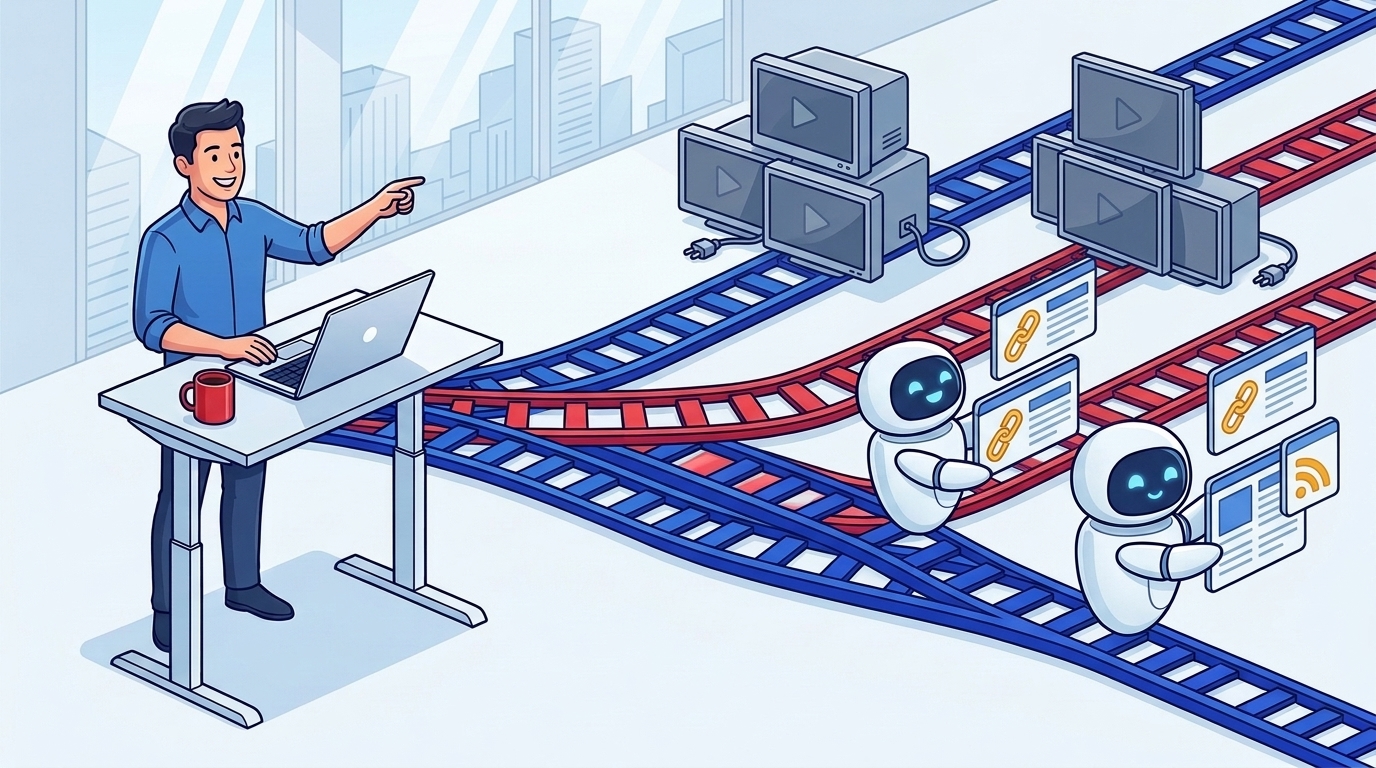
The bug verification desk is now unmanned. [Image via Gemini]

Can AI Deliver Bug Free Code?All software has bugs. It has always been that way, and much of the recent discussion around AI's impact on software engineering has been about unveiling security holes that plague popular software and may have sat for years -- hardly the setup for promising complete code verification.
I saw the headlines around DeepMind's AlphaProof Code announcement this morning, saying they confirmed Signal's security protocol to be solid, and initially glanced past it, as someone who typically doesn't use Signal. But the post has ignited a foundational discussion about how software will be built and verified going forward in the usual places, including Hacker News, which has zeroed in on a major turning point: moving from classic test-driven development to automated, machine-driven formal proof generation.

The reaction across the developer community spans healthy skepticism to long-term optimism, mirroring a lot of what we've seen in response to AI advancements, ranging from disdain and disbelief to  nodding acceptance. But zero bugs? If AlphaProof Code looked at my code and found no errors, I'd assume the verification itself was flawed. That'd be as impossible as sending one of my draft blog posts to an editor and being told it was perfect.

More broadly, AI systems can now be used to verify human-written libraries, and neural models can now write top quality code, taking the spot we've reserved for decades for well trained and well paid humans.

This shift connects directly to what I explored in Vibe Coding: Automatic Transmission for Apps, where higher abstractions free engineers from manual routine mechanics to focus on high-level architecture. It also reinforces the broader reality I wrote about in An AI Tech Revolution? The Solution: Human Evolution. Technology shifts require human adaptation rather than passive observation. As automated verifiers mature, running unverified raw code on production networks may soon be as outdated as leaving my index directories open with r-w-x (read, write, execute for you non-nerds) to the whole web.

Bug free or not on the first try, we are seeing AI do more. AI is writing, reading, coding and now debugging. I'm betting that even if this pass manages to come back with zero known issues, the definition of what is a bug and what is not will change. 

Disclosures, per always: I work at Google and use Gemini and Antigravity tools a lot. DeepMind is a huge part of Google's AI effort and behind AlphaProof. Nobody at Google reviews my posts, ever.

November 09, 2026

November 09, 2026 · 4 MIN READ · BY LOUIS GRAY

The Internet Turned Into TV, but Television Has No Blue Links

The Internet Turned Into TV, but Television Has No Blue Links

Routing blue links past unplugged TVs [Image via Gemini]

One of my favorite web authors, Ryan Broderick, who I read religiously, dropped another one of his truth bombs today in Garbage Day, decrying the continued decimation of text-based content that once defined the web, only to see it morph into something that is video first, or as he says "officially TV now". As we've observed over the last two-plus decades, Web behavior has rotated from newsgroups and reading full text articles, following links across the web, to short-form video consumption and Netflix-style episodic bingeing, with powerful algorithms suggesting you keep watching -- with sleep as the natural enemy.

Like I've said recently, you can't force old habits on new people who have been raised in a world of infinite bandwidth and infinite choice any more than you can ask kids to turn off the cartoons or put down the YouTube and pick up a newspaper. In today's post, Ryan calls time on the old "internet of libraries, replaced by an "internet of televisions", where, as he puts it, no one is famous, everyone is a celebrity on rented terms, and getting real traction with written words gets harder by the month -- made even more real as the hub and spoke model of RSS readers and centralized discovery lost momentum each year in favor of chasing ephemeral likes and practically non-monetizable "views", whose definition changes regularly to suit the platform.

Just a few weeks ago, I highlighted Garbage Day when saying how filtertainment eviscerated our informed monoculture. Every leap in bandwidth eventually fills the container you give it. We marched from static text sites passed around via links and email, to real-time social streams, to pocket screens pumping high-definition video straight into our earbuds. Not that this really comes as a surprise. In 2010, I warned about accelerating information streams on connected devices with "no off button, ever." When you give a tired population a choice between demanding prose and effortless video dopamine, the couch wins almost every night.

Video winning the mass-market feed isn't a mystery, if that's the market you want.

What breaks the open web for writers is a simpler mechanical truth: television has no blue links. When someone leans back into an algorithmic Reel, a video podcast on YouTube, or a zero-click chatbot answer, there is no natural exit ramp carrying a curious mind three hops deeper to an unfamiliar blog. I traced the roots of this choke point back in 2018, examining how a decade of silos throttled open content distribution and left the web linking less and talking more.

Publishing has always rested on creation, discovery, and distribution. Once Google Reader, FriendFeed, Digg, and Technorati disappeared, dominant platforms stopped acting as filtered pass-throughs. They actively throttled outbound URLs to hoard watch time, training creators to perform natively inside the silo for instant feedback while an essay on your own domain sat waiting for visitors who never arrived.

Waiting around for algorithmic cable boxes to hand text writers organic reach is a losing game. If the giant social apps want to be television, those of us who still think, build, and connect through reading have to wire up our own switchboard again. That conviction is why I built Webnerd.ai, which I introduced last month as a personal project that has no expectations of millions of users, but rejuvenates that feeling of discovery and sharing.

Do your part by cutting out the broadcast middleman: subscribe directly to blogs, personal newsletter inboxes, feeds and publications in folders you control, backed by practical AI summaries and stream audio that save time while still sending clicks straight to the original author.

Even more important is solving the traction gap where open-web discovery always worked best -- from person to person. Algorithms optimize for passive session length, while human readers vouch for voices worth keeping. Curated starter bundles help newcomers find active blogs on day one, while one-click sharing inside the app or right from the browser toolbar with the Webnerd.ai Chrome Extension turns every reader into a distribution node. When I flag a great piece, it lands on my public shared stream, cross-posts to Bluesky, and feeds its own subscribable RSS stream, keeping those blue underlines traveling across the open web.

Broadcast TV never killed books or independent magazines, and Instagram's binge button won't kill sharp writing either. Let the big platforms fight over the living room. The library is still open -- we just have to pass the good reads around ourselves.

Disclosures, per always: I work at Google and use Gemini and Antigravity tools a lot. I built Webnerd.ai, its Chrome Extension, and this blog's CMS with Antigravity's help. Nobody at Google reviews my posts, ever.

November 08, 2026

November 08, 2026 · 3 MIN READ · BY LOUIS GRAY

Personal Finance is Evolving from ATMs to LLMs

Personal Finance is Evolving from ATMs to LLMs

claude mint option4 fresh studio angle 1794204983623
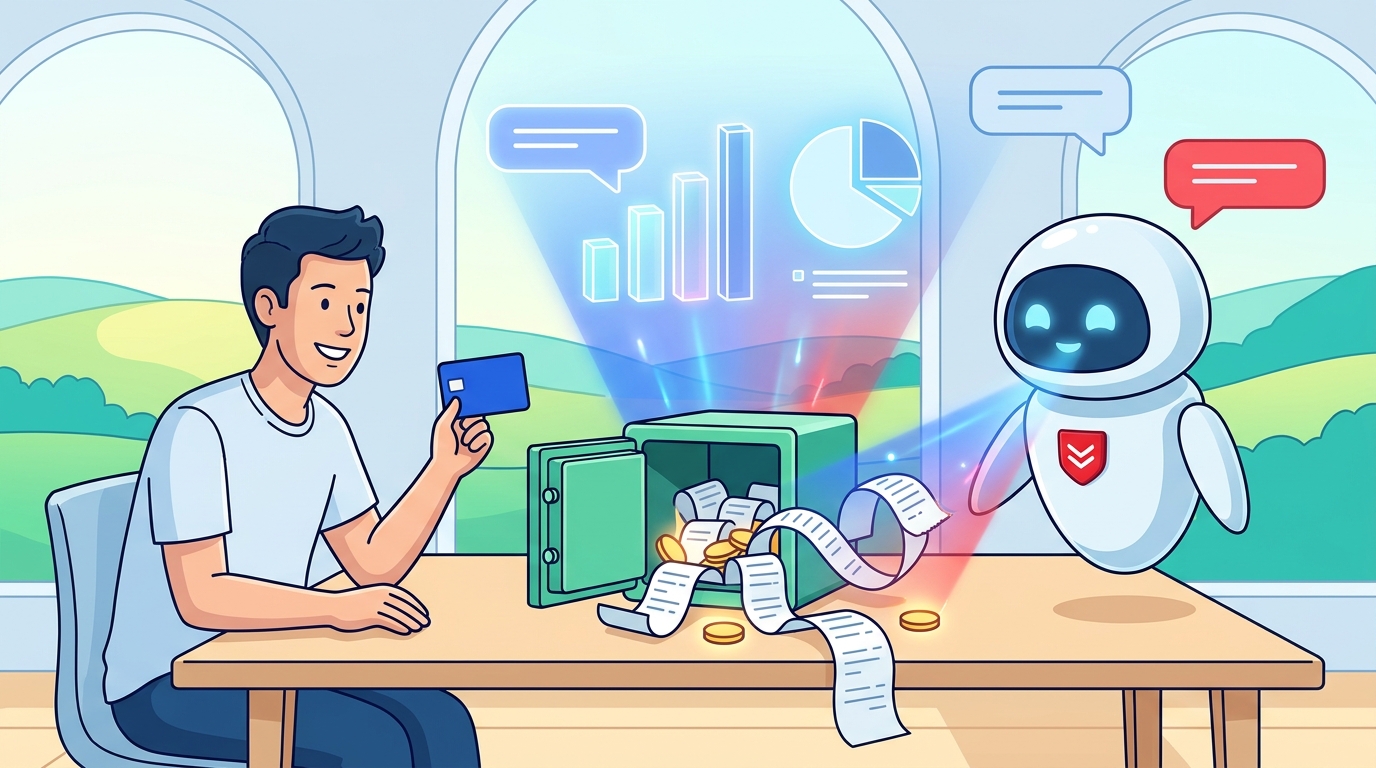
The world of finance will evolve. The LLMs are happy to help. [Image via Gemini] 

In the AI era, there's a great divide emerging between the old way and the new way, and practically no industry is more closely aligned with the "old way" with tried and trusted capabilities than that of finance, where security and history are king, integration of new technologies usually comes via massive consulting contracts, and everything had better be FDIC insured. The old way screams of buttoned up suit wearing ties on Wall Street, while we've seen newer generations try forge their own paths, through crypto, gaming through prediction markets or taking long-shot option bets popularized on forums like r/wallstreetbets.

Amidst this bifurcation, AI thinks it knows best. Anthropic  rolled out Personal Finance in Claude, as covered by ZDNET, enabling subscribers to wire their live bank, credit card, and investment accounts straight into a conversation window via Plaid, and helping users make sense of what to date has been a host of CSV exports or PDF extractions from antiquated institutions. Does this sound familiar? It should, only with some new wrinkles, for on the surface this feels like the rebirth of a product category Silicon Valley spent a decade abandoning.

Back in May 2008, when Mint first connected checking accounts, credit cards, and brokerage balances into a single one-stop financial hub, I signed up immediately. I remember amidst the financial crisis, how just six months later, Mint's math say my brutal weeks of portfolio losses and projected I would be bankrupt in sixty days. Luckily that didn't happen, even if it feels like it sometimes.

Later, in 2010, I defended trusting Mint and Blippy with my financial data because a unified ledger beat flying blind across ten separate logins. My early adoption of Mint and Blippy even led to CNN coverage about the "end of privacy," using me as a test case for someone who lived out loud online, even sharing otherwise mundane transactions.

Fast forward 15+ years, and large language models genuinely solve the formatting headaches that tripped up those early Web 2.0 dashboards. Letting Claude (or any other LLM, really) reason across messy Plaid feeds in plain English -- spotting quiet subscription creep, comparing grocery bills across quarters, or separating a one-off tax transfer from monthly burn -- is a much cleaner interface than clicking through static pie charts.

I've even built my own one-person financial app in Antigravity, which scoops up my bank account balances, daily stock swings, and reminders for mortgage and car payments. I can click this Progressive Web App I built for myself and see exactly where I am on the +/- for the day, and see if it's even worth getting out of bed. That we can code up ideas and turn them into reality for practically any task is a brand new world.

But finance earned its conservative reputation. What happens when we trade direct accounting for probabilistic interpretation? If Mint mislabeled a charge in 2008, the bad data sat right there in the table for you to fix.

If a chatbot summarizes six months of bank feeds, a skipped recurring fee or a fuzzed category total may hind behind confident, reassuring prose, and assure the end user all is well, only for the IRS to potentially disagree later. Your transaction ledger is the ultimate truth  about where you go, what you value, and what you can afford. Once frontier AI labs hold your live spending graph alongside your daily prompts, the chatbot becomes the stickiest lock-in in consumer tech. Read-only access is step one, but how soon will you ask your LLM to ask you which mutual funds to choose, trade on your behalf or even tell you what time is the right time to sell your house?

Disclosures per always: I work at Google. Anthropic and other other AI companies are often partners, competitors or customers. Don't interpret my interest as being filtered with that lens.

November 08, 2026

November 08, 2026 · 2 MIN READ · BY LOUIS GRAY

Human Curation from the Webnerd.ai Stream: v2

Human Curation from the Webnerd.ai Stream: v2

webnerd v2 option2 signal switchyard 1794206654413
My job: Finding the best articles and amplifying them out. [Image via Gemini]

Signal From the Stream: Handcrafted Words in a High-Wattage World

With Webnerd.ai bringing fast paced consumption and sharing back to my daily routine, the muscle of scanning, filtering and amplifying is back. This week is no different.

After a decade's effort in building out siloed social networks that aim to keep their content boxed in, independent blogging has endured and continues to push back. I'd be remiss if I didn't point out Paul Ford's post, The Web Is More Than Enough, where he showcased launching an entire browser-based office suite where all activity lives right in the URL, reminding us that the open web remains the most durable application platform on earth. Over at Techdirt, Mike Masnick called out Reddit bricking up login walls, saying its defensive posture runs against Aaron Swartz's open access roots.

What we all saw this week with the US midterm elections is that closed networks force closed thinking. Republicans learned that X is the echo chamber. It was an inevitable result after Elon's acquisition and government meddling chased away all the left-leaning free thinkers to new places.  As Andy Baio called out, we know closed social feeds confuse algorithmic echo chambers with real-world consensus.

(I told you already that X was toxic, but maybe the right wing has figured this out now too?)

We are all continuing to learn where AI fits in our workflow and how much we invest in it. This is true at the corporate level as well. Tomasz Tunguz ran the math on an 80-gigawatt AI ceiling for 2027, showing how doubling GPU rental rates are pushing inference bills to new heights, while cheap AI intrusion tools are straining security teams at unprecedented levels.

AI is doing incredible things in terms of resetting expectations for employees at all levels. It's reset expectations for middle managers and reset expectations for new hires. At Anthropic, Felix Rieseberg said he has retired traditional coding interviews because hunger beats whiteboard tenure in an agentic world. And John Battelle captured the emotional knot of modern tech workers in Baring It All To Claude, which can mean trusting a model with your life's work, and hoping for the best.

When platforms wall themselves off and algorithms chase outrage, sitting down with an RSS reader and sharing good writing by hand isn't nostalgia. It's how we keep the web human. I'll be doing my part over at Webnerd.ai, and sharing out to RSS or Bluesky or wherever you like. That's what standards are for.

Disclosures per always: I work at Google. No doubt some of the companies mentioned here are partners, competitors or customers. Don't interpret my interest as being filtered with that lens. I built Webnerd.ai (and have no plans to monetize it).

November 02, 2026

November 02, 2026 · 4 MIN READ · BY LOUIS GRAY

Webnerd.ai Chrome Extension Debuts to Subscribe and Share Faster

Webnerd.ai Chrome Extension Debuts to Subscribe and Share Faster

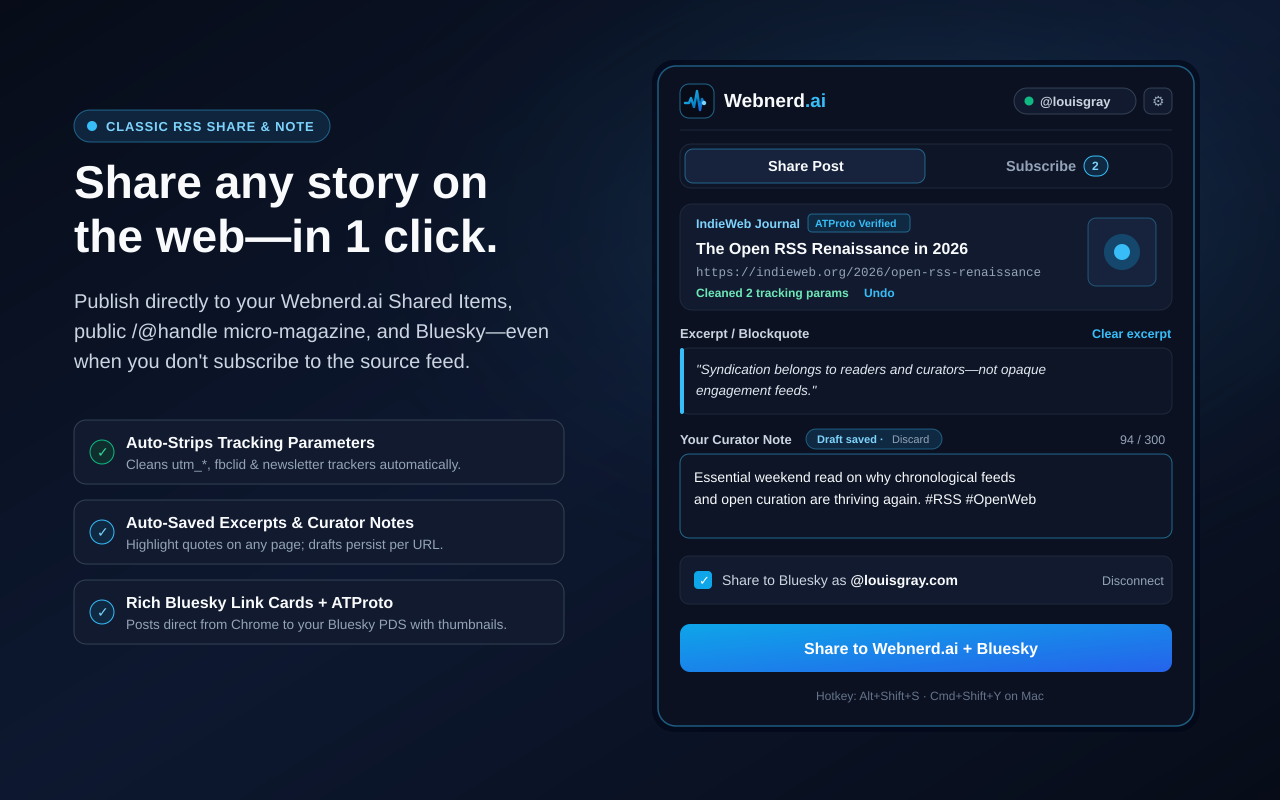
Webnerd.ai Chrome Extension Share Post tab showing cleaned URL parameters, highlighted blockquote excerpt, auto-saved curator note, and Bluesky cross-posting
Webnerd.ai Share & Subscribe -- live now in the Chrome Web Store.

Webnerd.ai Chrome Extension

The Web content model consists of three major parts: creation, discovery and distribution. The last decade-plus has seen tremendous turbulence as one-time hubs came and went, and content creators lost a grip on how their content could be consumed and shared easily from both dedicated fans and casual visitors. Couple that with shorter attention spans and all matter of marketing hacks that have distracted core audiences, and it's a tough slog out there for journalists and bloggers.

One of the motions I've missed in our consumption and flow has been the fast option to share and subscribe as I encounter the best content on the web. So I've built a Chrome extension for Webnerd.ai that has three major functions:

1. Subscribe to new sources and add them to your folders as you browse.
2. Add individual items to your shares in Webnerd.ai, even without subscribing.
3. Share directly to Bluesky, with optional caption.

Starting today, Webnerd.ai Share & Subscribe is officially public on the Chrome Web Store, working across Chrome and other modern browsers, such as Brave, Arc, Vivaldi, and Edge.

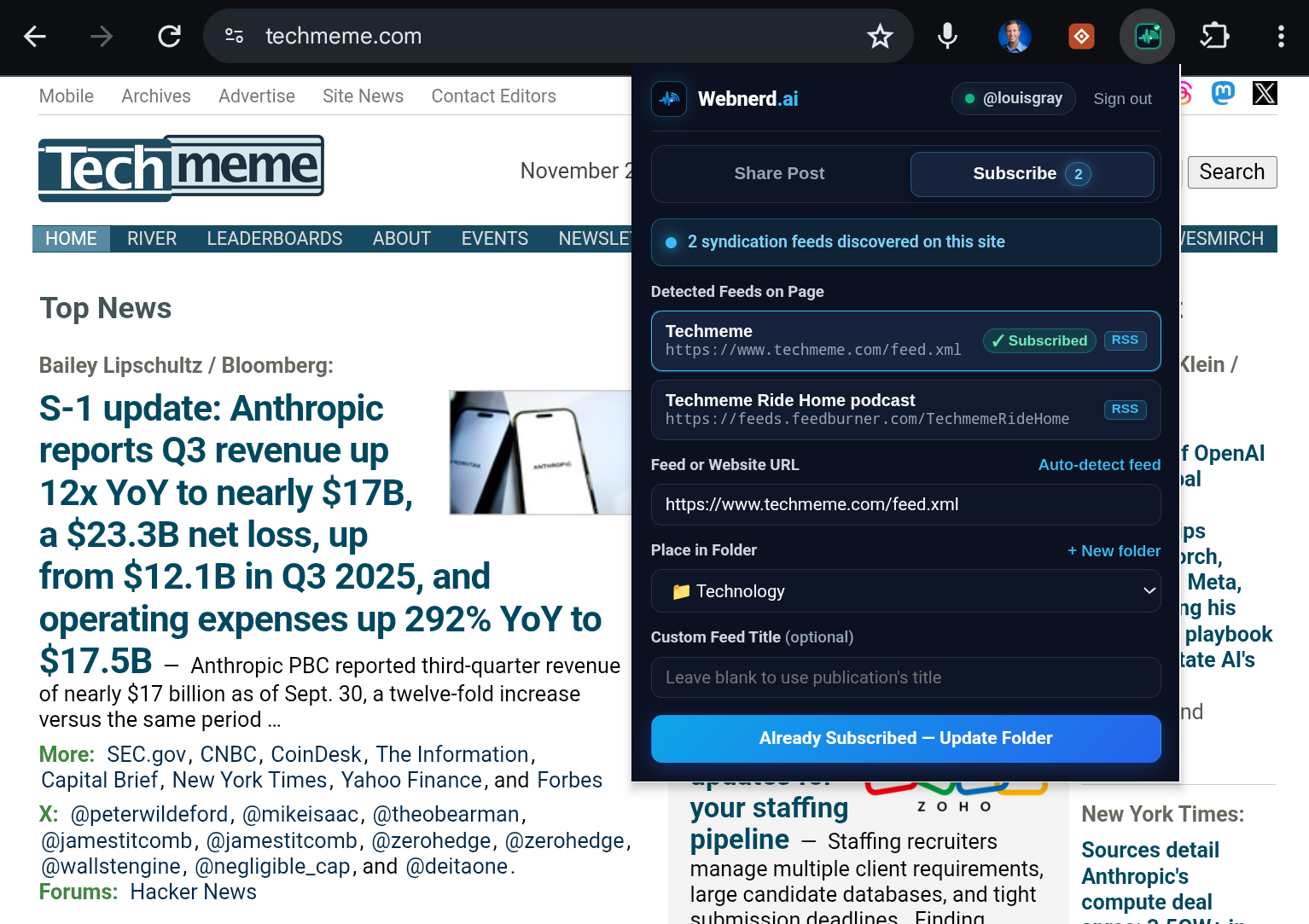
Screenshot 20261102 075333
With the Webnerd.ai Extension, discover available feeds and add them.

Back in our Web 2.0 peak, I had bookmarklets for Google Reader and FriendFeed as mainstays in my browser and I could see top stories spread from person to person. The act of sharing content helps expose great new sources to my network, and in turn, I learn from them.

Here are some benefits of the Webnerd.ai extension:

One click publishes the story directly to your Webnerd.ai Shared Items, your personal curated stream (like mine at @louis-gray), and its accompanying RSS feed.

The extension is tuned for fast link-blogging while you read, including:

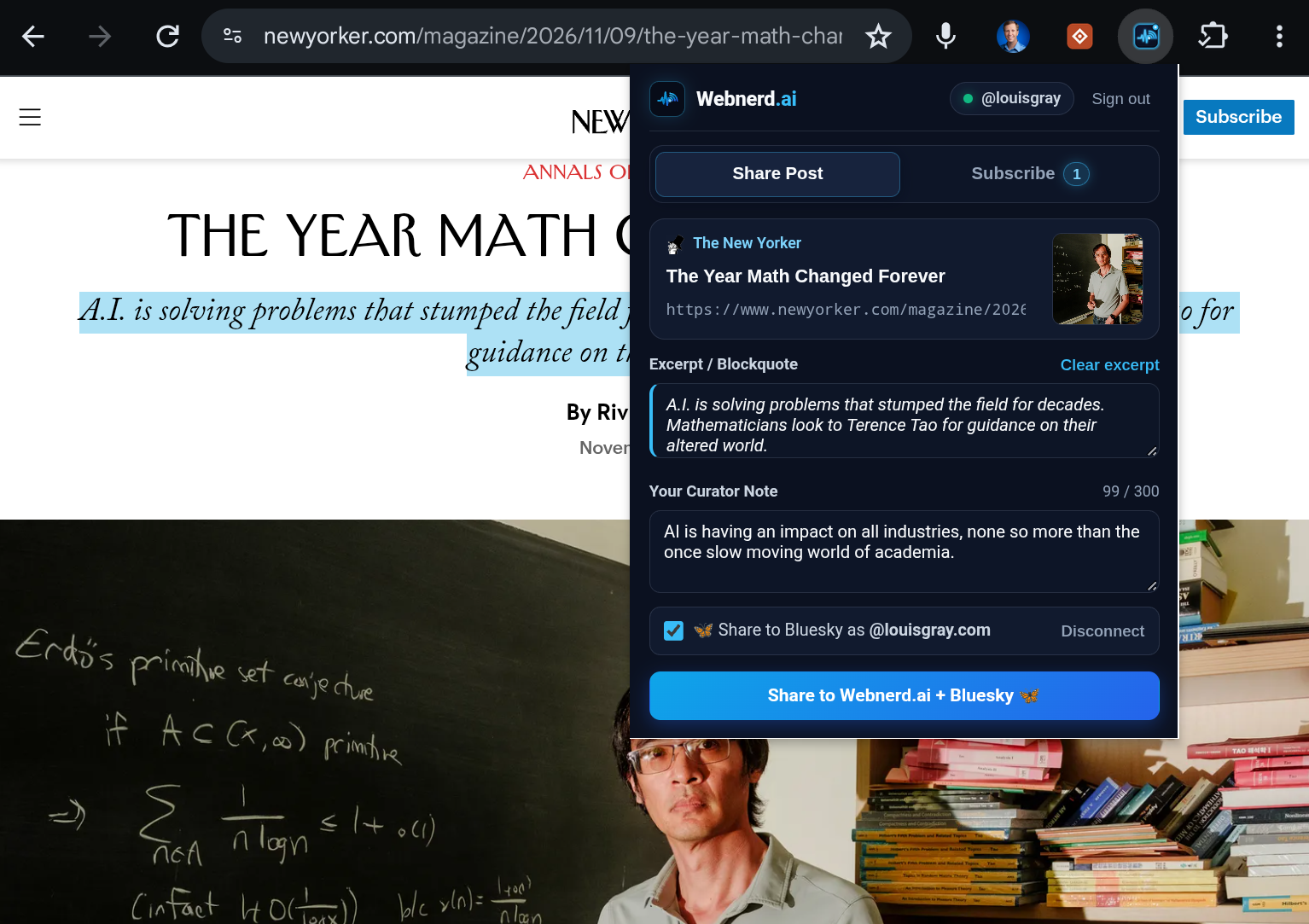
  • Auto-Saved Quotes & Notes: Highlight any passage on the page before opening the extension and it drops right in as a clean blockquote.
  • Automatic Tracker Stripping: Marketing parameters like utm_*, fbclid, gclid, and newsletter tracking tokens get scrubbed automatically before you share.
  • Simultaneous Bluesky Cards & Standard.site Endorsements: Keep the Bluesky box checked to cross-post straight to your feed (such as my LG Stream) with rich OpenGraph link cards, compressed thumbnails, clickable hashtag facets, and cryptographic site.standard.graph.recommend endorsements via AT Protocol OAuth 2.1.
Screenshot 20261102 075508
You can share articles to Webnerd.ai or downstream, with comment.

Live Feed Radar, Cadence Previews, and One-Click Folders

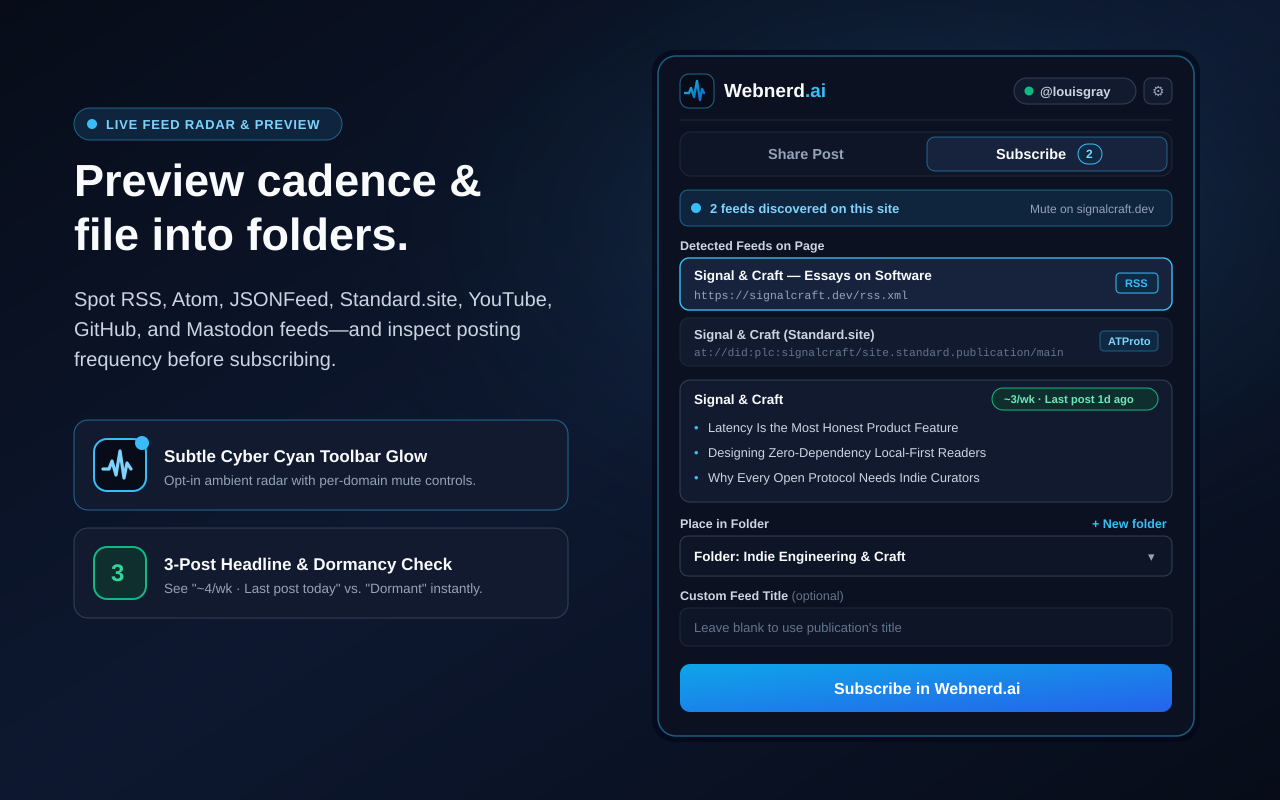
Webnerd.ai Chrome Extension Subscribe tab showing detected RSS and ATProto Standard.site feeds, a 3-post cadence preview, and folder selection
Spot hidden feeds with an optional glow, check the posting cadence, and add as you go.

Modern browsers stripped the orange RSS icon out of the address bar years ago, indicating millions of readers that feeds died when they were actually hiding in plain sight. Turn on the extension's opt-in Toolbar Glow  and the toolbar icon gently illuminates whenever a page publishes RSS, Atom, JSONFeed, or AT Protocol Standard.site publications -- including subscribable channels and profiles across Substack, Medium, YouTube, GitHub, Mastodon, Bluesky, and Reddit.

And if you are worried you're going to subscribe to a site that posts way too often, you can previews a feed's latest three headlines alongside an instant cadence check, so you know right away if a blog is active. From there, file the writer directly into any of your existing Webnerd.ai folders or spin up a new folder inline.

Right-Click Quick Share and Privacy-First Permissions

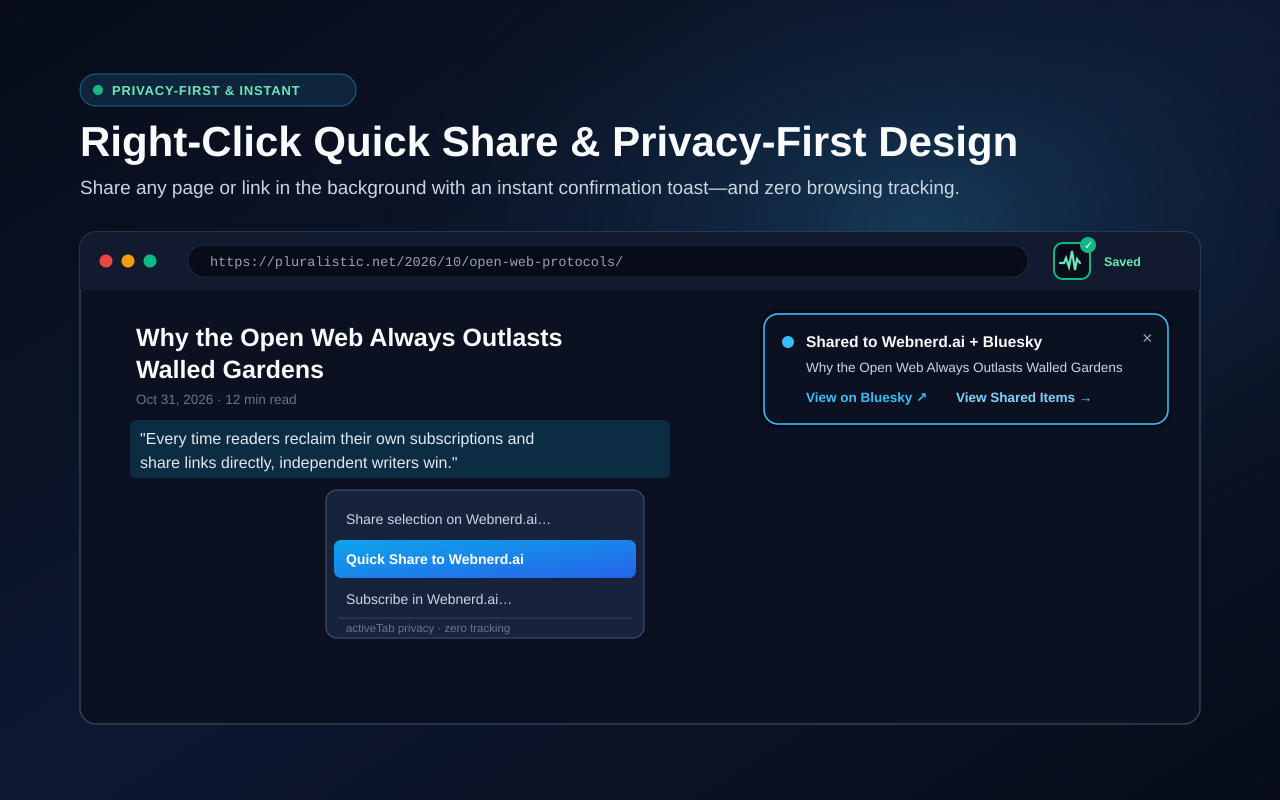
Browser view showing right-click Quick Share to Webnerd.ai context menu, activeTab zero-tracking notice, and on-page Shared to Webnerd.ai + Bluesky toast
Right-click any page, quote, or link to Quick Share in the background with zero browsing tracking.

When you're moving fast, right-click any page, highlighted quote, or outbound link and hit Quick Share to Webnerd.ai. It publishes in the background and pops a clean confirmation toast in the corner of the page with direct links to view your post on Bluesky or in Shared Items.

Just as important is what the extension refuses to do. Too many browser add-ons demand blanket access to read every page you visit around the clock. I couldn't care less about your browsing history. Out of the box, Webnerd.ai runs on minimal activeTab permissions -- zero background tracking of your browsing activity -- only inspecting the current tab when you click the icon, tap the hotkey, or trigger the context menu (unless you explicitly opt into the ambient Feed Radar glow).

install Webnerd.ai Share & Subscribe from the Chrome Web Store, pin the pulse icon to your toolbar, and tap 1-Click Pair over at webnerd.ai/extension to connect your existing Webnerd.ai session. Give it a spin on your open tabs today and ping me on Bluesky with what you want to see next -- the native Android app is up next.

Disclosures, per always: I work at Google and use Gemini and Antigravity tools a lot. I built Webnerd.ai, its Chrome Extension, and this blog's CMS with Antigravity's help. Nobody at Google reviews my posts, ever.

November 01, 2026

November 01, 2026 · 2 MIN READ · BY LOUIS GRAY

Silicon Valley's Glossy Mag Will Gloss Over Founder Issues

Silicon Valley's Glossy Mag Will Gloss Over Founder Issues

Staring into Silicon Valley's soft-focus mirror while real-world signals blink behind you [Image via Gemini]
Staring into Silicon Valley's soft-focus mirror [Image via Gemini]

Silicon Valley's Glossy Mag Will Gloss Over Founder Issues

Every few years, Silicon Valley decides traditional reporters just don't get it and builds a friendlier stage of its own. The latest flashpoint is Andrew Fedorov's look in The San Francisco Standard at Colossus, the latest venture-backed pub featuring adoring profiles of Mark Zuckerberg and other tech leaders. Kara Swisher compared the magazine to "Vaseline mirrors" for fragile executives, while Nilay Patel of The Verge quipped that the tech bubble is welcome to its own "in-flight magazine." First of all, I've never heard of it. Sometimes it's good to be in my focused bubble. But it's all going to be okay.

Back in 2009, I wrote that bloggers and PR aren't automatic enemies when everyone understands the transaction, and during the 2011 spat around over investor-backed tech blogs, I said being genuine is the best disclosure of them all. Insiders who fund companies will typically understand how those businesses operate better than outsiders do, and content marketing can be valuable if it gets a story that couldn't have gotten out otherwise, so long as it owns its perspective. It's the final stage of access journalism, for better or worse.

Readers aren't fooled by what they see. Just like our debates around AI-generated content or if ads have value, they know what promotional content smells like. Where this fluffery actually causes damage is inside the corner office itself - reinforcing these execs' hot takes that they lack any issues. Last month, I wrote about how filtertainment eviscerated our informed monoculture, letting every slice of society retreat into comfortable spaces populated entirely by people who agree with them. Founders and billionaires are just as vulnerable to that comfort loop as anyone scrolling apps on their couch.

The best Silicon Valley products get better because they survive contact with skeptics and users. Tough questions from beat reporters, teardowns on independent blogs, and grumpy user threads expose blind spots that boardroom peers don't dare to say - lose the fast track to shares or other privileges. When leaders trade that messy friction for curated profiles that treat every strategic pivot like destiny, they quietly dull their own product instincts. Even my own new Webnerd.ai app has already benefitted from user feedback or bugs that got through my queue.

Print a shiny mag if you want to leave it on the coffee table in the lobby or frame it on your wall. Enjoy the friendly banter that comes from knowing no gotcha questions are coming your way. But don't forget the purpose of an in-flight magazine: keep the passengers relaxed at thirty thousand feet while somebody else checks the instruments. The trouble starts the moment the pilot starts using it as a navigation chart.

Disclosures per always: I have always appreciated Kara. What. You wanted more disclosures?

November 01, 2026

November 01, 2026 · 3 MIN READ · BY LOUIS GRAY

Human Curation from the Webnerd.ai Stream: v1

Human Curation from the Webnerd.ai Stream: v1

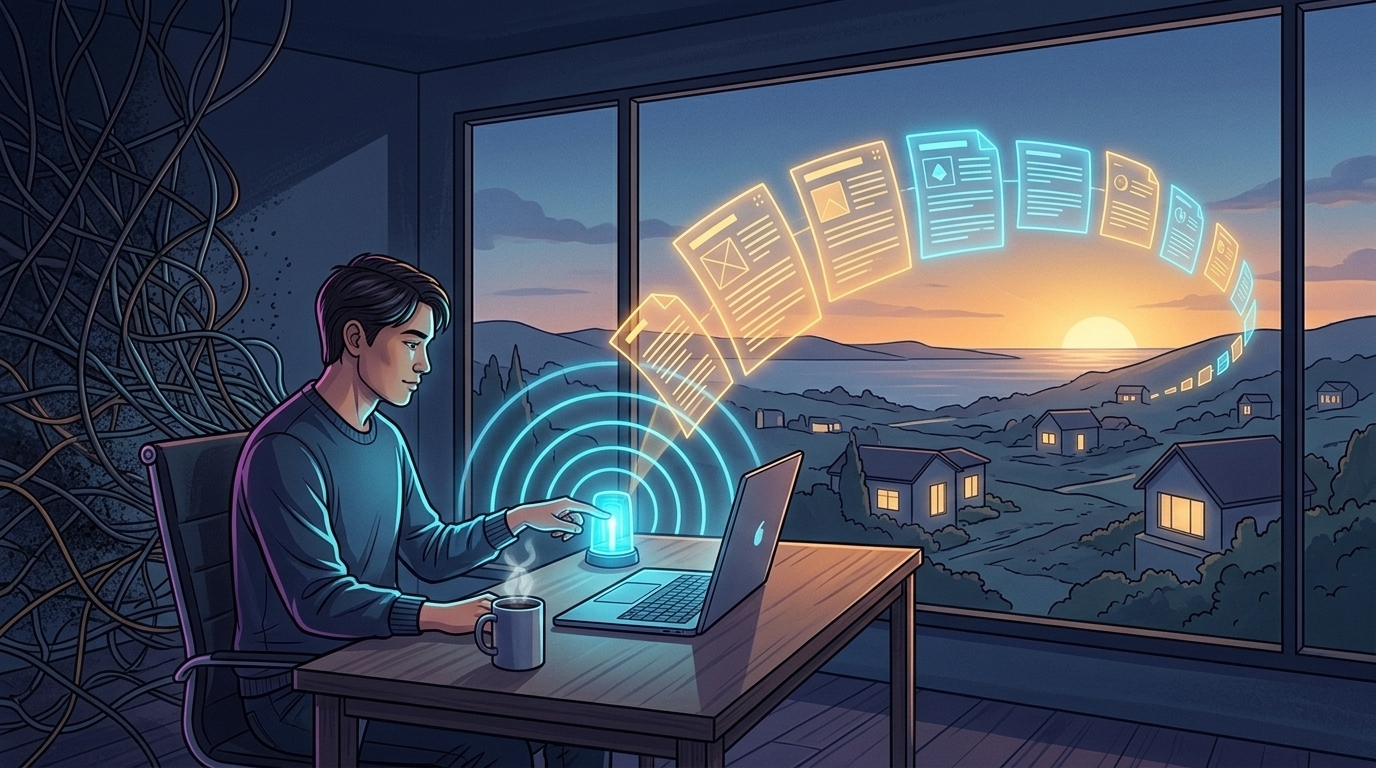
Curating and sharing the week's sharpest open-web stories on Webnerd.ai [Image via Gemini]
Even in an AI world, the human filter provides value. [Image via Gemini]

Signal From the Stream: Looking Back at My Week on Webnerd.ai

The web has always been about discovery and sharing. Whether it was from blogrolls or a bullet list item of links on our blogs, we have acted as curators, showing our audiences what we found valuable, and inherently filtering out the noise. In the peak of Web 2.0 experimentation with classic RSS, I could add an item to Delicious and it would flow through Friendfeed to Twitter, or I could share an item I found in Google Reader and have it show up downstream in Buzz. What a time.

Building one-click sharing directly into Webnerd.ai brought that muscle memory back. Every story I flag lands on my public shared page, syndicates to LG Stream on Bluesky, and publishes its own dedicated RSS feed anyone can subscribe to in their reader of choice. In the meantime, old school bloggers like Dave Winer have continuously posted links to share the best of the web on their domain. I respect it. I used to do a better job of highlighting individual blogs, so let's bring that muscle memory back too.

It seems wacky to think Anthropic's IPO filing was just this week. CNBC (via Techmeme) highlighted the company's more than $131 billion in cash and short-term investments, while Timothy B. Lee said its business was surprisingly strong. Latent Space highlighted how Anthropic uses Claude itself, and The Verge focused on how Anthropic can keep Wall Street pressure at bay.

But the week wasn't by any means totally bullish. Like many other companies, Microsoft is continuing to optimize spending by reducing headcount, offering voluntary buyouts to 60,000 employees. Tom Warren and Azeem Azhar at Exponential View connected the dots plainly: when capital spending continues to accelerate, payroll cuts make room for machines. Meanwhile, long time Google watcher John Battelle put a rattled Friday market selloff in long-term Silicon Valley perspective.

Beyond the money line, Sean Goedecke published a pair of excellent posts, arguing that getting good at AI takes deliberate practice, and reminding developers that you can just ask AI to do things when agency becomes your bottleneck. Go subscribe to Sean right now.

That builder energy showed up across the product beat too, from Simon Willison testing webframe as a headless browser sandbox, to Google shipping Gemini 4 Carbon and Genie 4, pricing the Google Xreal Aura glasses at $1,099, and Waymo tapping Toyota's bZ4X for Tokyo robotaxis. Yes, I work at Google, but we're a big enough company that sometimes seeing this news is like being happy for your cousins. Go team and such.

Like I said last night, AI is impacting just about everything, and humans need to adjust. Alex Kantrowitz at Big Technology captured burned-out security teams enduring "Black October" as AI uncovers software flaws faster than defenders can patch, and Molly White traced why a $6.4 billion Binance heist pointed straight back to North Korea. Add Reddit forcing everyone to log in just to read human answers, and the open web lost another front porch. Algorithms optimize for lock-in, not discovery. Curating links by hand, and tapping share in Webnerd.ai so good writing travels further, is a great way for us to help discovery continue.

Disclosures per always: I work at Google. No doubt some of the companies mentioned here are partners, competitors or customers. Don't interpret my interest as being filtered with that lens. I built Webnerd.ai (and have no plans to monetize it).

October 31, 2026

October 31, 2026 · 4 MIN READ · BY LOUIS GRAY

One Future: AI Writes, AI Scans, No Humans Read

One Future: AI Writes, AI Scans, No Humans Read

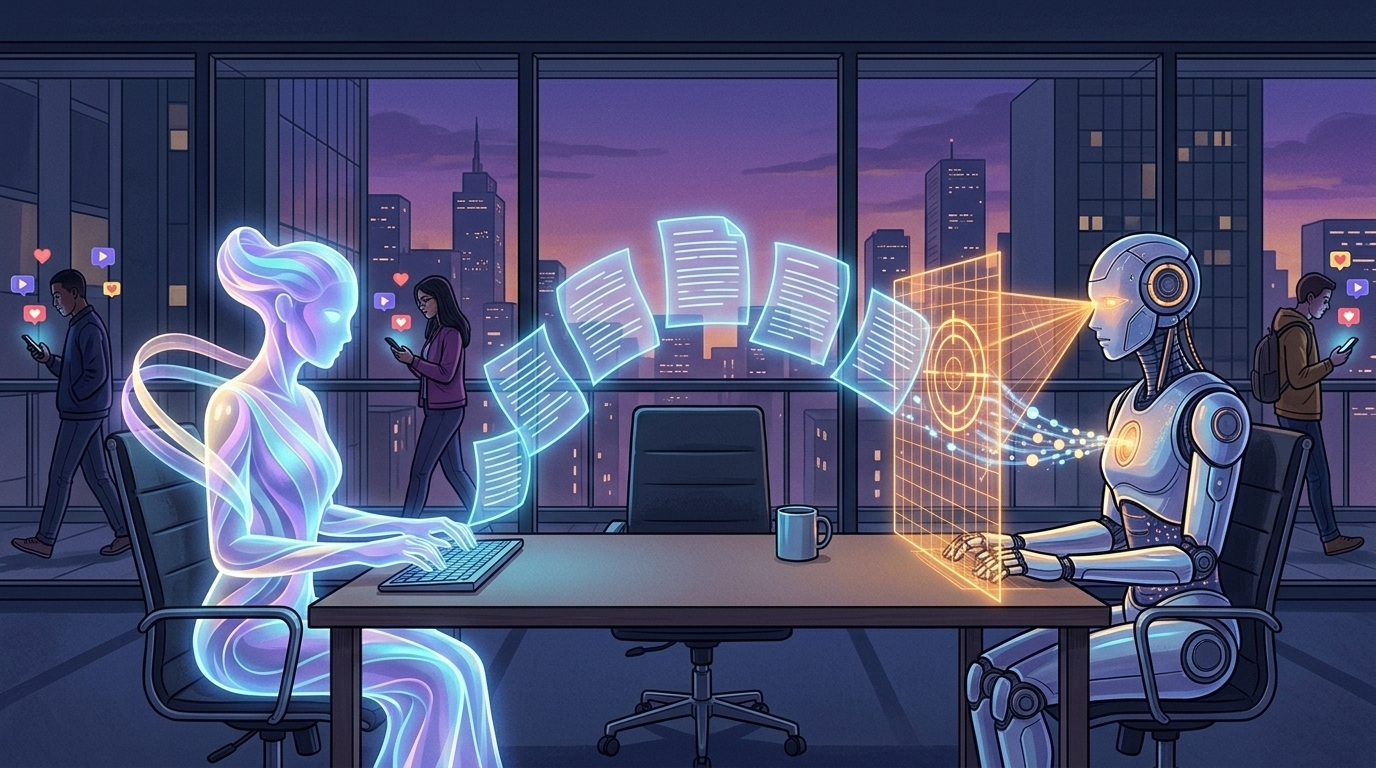
One Future: AI Writes, AI Scans, No Humans Read [Image via Gemini]
AI writes, AI scans, and the human chair stays empty. [Image via Gemini]

AI & Neural CoreWe're in a funny spot with AI at the moment. As people debate its value, with one side arguing it's the greatest invention since fire, all while the other calls anything it touches pure slop, AI is actively finding a foothold in evolving how business is done, in all facets. To claim otherwise is ignorant at this point.

Software is being written more quickly with AI. Security gaps are being both exploited and solved more quickly. All matter of communication is being authored and adjusted more quickly. As I said in my first post after multiple years' hiatus, we will need to find out the best place for AI and humans to coexist, and I truly believe the discussion of AI will eventually fade to the background, just like our flareups about social, mobile, local, and whatever transformative buzzword at the moment happened to be. This is not to undercut the actual value and impact of AI, but to optimistically suggest we as humans are great at adjusting.

Our eyes and our minds have been trained since the day we were born to understand what humanity looks like. Since we all first started to learn to read or watch TV, we have absorbed what it means to be "real", and we visibly react when something feels synthetic. We all have a visceral reaction when special effects seem too special, an ad seems too perfect, or a visual defies comprehension. Something feels "off". But as the models train and get better, learning through feedback and continuous reinforcement, their images and video get better, and so does their writing.

Techmeme is aflutter this weekend about a Bloomberg report that shows where we are in this particular cat and mouse game. As AI writing becomes more human, more humans can get outed for sounding too much like AI. The end result is predictable, with people intentionally making mistakes, and writing in a way that bots won't, so they don't get accused of shortcutting their work, or leaving the hard work to an LLM. If you think the bots can't adjust to make typos on their own, or to follow instructions to sound even more human so even the bots will fail the AI detection test, well, you haven't thought this through. Maybe you've even seen the viral posts that say Mary Shelley's novel Frankenstein would be considered full AI generated because the models themselves were trained on the book.

Since kicking off my first posts here two decades ago, I've had more than 3,000 posts and countless words hand typed into a myriad of open CMS windows. I've written buckets of emails or social posts and Slack messages all over the place. But I also know that in 2026, it might make sense to let the bot do a first draft, especially when it solves the blank page problem. What I do worry about, eventually, is if the AI is doing the writing, and the AI is doing the distilling and the summarizing, what if no actual humans consumed and fully took in the content? We are all very busy people, and if not, we all prefer to be seen as such, and we fill the edges of our time with things we'd rather be doing than reading text slop.

Running a script against your content to hide em dashes or add typos to seem fallible isn't going to automatically flip the lever that confirms you're a human and the AI is not. It takes an entire body of work, a corpus that no machine has, with a real personality that's adjusted through experience. 

Nearly twenty years ago, I wrote that your blog is your brand, and later, that blogging remains the foundation for who you are online. The latest generation has grown up with blogs being too slow, perhaps, with TikTok and Instagram being more visual quick hits of dopamine and long form being less valuable. Now Gen Z is approaching college and a daunting workforce where AI has always been expected and accepted, even as its place is evolving and being debated. Some of them are definitely writing their course papers with AI. Some aren't. But the reckoning won't come from somebody getting outed for asking ChatGPT, Claude or Gemini to be their scribe. It will come when everyone is distracted by something more exciting and nobody was reading anyway.

Disclosures per always: I work at Google and use our Gemini and Antigravity tools a lot. I wrote this post by hand. But how would you know?