Silicon Valley Technology Commentary & Archives · Est. 2006 3,045 Posts · 2006–2026
Showing posts with label PR (24 posts). Show all posts

August 31, 2015

August 31, 2015 · 3 MIN READ · BY LOUIS GRAY

Having a Clear Call to Action Can Drive Real Results

Having a Clear Call to Action Can Drive Real Results

As a member of the Google Analytics team, I regularly field questions at events or on our social channels about how online and offline activity can drive results, and what metrics have value. As no two businesses are the same, it's critical to determine the status of your company and find if your activity can bring impact to results that matter, be they clicks, leads, registrations, opportunities or real revenue. When the goals are determined, and you have stakeholder buyin, then you can start your work. (See: Measure What Matters Most)


Among the most common questions I see are those around driving visitors to a specific call to action. Most websites have many different routes for visitors to take, and the many choices can be overwhelming. But in some other cases, only one outcome is required, and all efforts should be taken to get the user there.

Nearly 15 years ago, I held a role with the inconspicuous title of eMarketing Manager at a company whose product line was in stealth mode. As we approached the launch date, our small marketing team debated how we were going to handle the first version of our website, and just what our calls to action were going to be.

Most Sites Have Many Calls to Action, Which Distracts Visitors

We knew our product would have a long sales cycle of more than six months, and the average sales price would be north of a hundred thousand dollars per unit. We didn't yet have any customer success stories, and our target markets were an educated guess, based on how we thought the product would perform, and colleagues' experience selling competitive products. We didn't even really have photos of the hardware we expected to sell, as that too was a work in progress.

But what we did have was a launch date, to coincide with the announcement of our product and corresponding news coverage. We had to ship a site with our new company name, and it had to give just enough information to keep people interested, even if we couldn't deliver all the details.


The BlueArc product page in February of 2001 (via Archive.org)

After some debate, we decided to make the website a massive demand generation tool, with every page driving us to a single call to action: Sign up for our newsletter. Every page had a button on the sidebar encouraging new signups, and where data was scarce, we had links to the newsletter. Even before we'd sent out a single issue, we had thousands of registered emails, ready to be updated.

Our Solution: A Single Call to Action from All Pages


Our monthly newsletter, which shipped with my name as the sender for more than eight years, gave us a consistent customer database to talk to for years, and was responsible, in the long run, for prospects, ongoing communication to soft leads, and updating the press and analysts.

This result was from keeping our mission simple. Instead of trying to dazzle visitors with things to download, an array of phone numbers to call, or videos to watch, we just took the casual visitor coming from the New York Times and Wall Street Journal, and gave them the chance to hear from us again, so that when our message was ready for them, we would have that channel in place.

When you know what to measure, driving toward a goal becomes easier. And if you don't, not only are you confused, but so are your users. This is a lesson I learned firsthand a decade and a half ago.

Disclosures: I work at Google on Google Analytics, and worked at BlueArc from 2001-2009.

September 22, 2014

September 22, 2014 · 3 MIN READ · BY LOUIS GRAY

I Heartily Endorse This Event Or Product

I Heartily Endorse This Event Or Product

Everyone's a cynic. Or at least it can often seem that way, when the concept of 'balanced' reporting means to find the gray cloud for every silver lining, giving equal weight to unequal issues or looking for ulterior motives from well intended people who genuinely find value from products, groups or communities.

Many years ago, I made a decision to use my blog for good and not evil, per se. I recognized there was little value in tearing things down, and that my readers and I would benefit more from a series of highlights than a trolling muckery through half-finished products and half baked business models. (See: Does Negativity Deliver Credibility? If So, That's Nuts.) There are enough good companies and good products that you can showcase the very best - something I've gotten even tighter at since reducing my regular posts here to something less frequent.


But when I do find something I really enjoy, and use regularly, I want to tell you about it, and that position is a genuine one. I want you to see the same benefits I do, and give the company or service more users, improving their chance at success, and extending the network effect, which often brings me value. As +Mark Hopkins said back in 2008, regarding my consistency: "Forget product evangelist. When he likes something, he's a one man crusade."

This weekend's Twitter discussion about sponsored posts.

In a world where many people are using their streams to promote self interests, be it their companies, their stock investments, or pimping their latest book, I'm hyper aware of being trusted. My posts aren't sponsored. So this weekend, after highlighting MightyText, a personal favorite app I helped unveil and have since covered regularly, one Twitter user snarkily suggested the update was an ad, or sponsored. And that's annoying. With Twitter being at times overrun by self-promoters and shillers, it's no good to be lumped in with the dreck.

I use MightyText daily because it's an exceptionally fast way to text from my computer or tablet. I switched to Android more than four years ago because I was very happy with the product's direction and the wealth of choices available compared to iOS, let alone Blackberry or Palm. My preferring one over the other doesn't mean that your choices are bad or that I wish ill on anyone who has selected an alternative. It's just what I prefer, and I'm more than eager to tell you why.

If you're pushing products you don't actually care for, you're in danger of losing the trust earned with those in your community. Sonos and Spotify made sense to me right away. ChromeOS was alluring and is now my go to OS all the time. I've been a happy eTrade user for 15 years. Sunrun and Rachio are saving me money and helping the environment at the same time. The list of brands I've interacted with that I can point you to are many. But it's not because I have hollow self interest. If I did, you could wait to see my disclosures. That's what they're for.

Disclosures: I work at Google, which in some ways competes with Sonos in hardware, Spotify in software and MightyText for messaging. But I still love those products. And Sunrun has a great referral program. But that's not the point.

April 24, 2013

April 24, 2013 · 1 MIN READ · BY LOUIS GRAY

Devoxx France Video: Early Adopters, Press and Social Media

Devoxx France Video: Early Adopters, Press and Social Media


Last month, I had the opportunity to travel to Paris, France and speak at Devoxx 2013, with a focus of helping startups raise their "visibility seed round". Often, companies focus on their product, and yes, to raise money - but there's a missing piece, gaining the first customers and first press. Before stepping on to the stage, I sat down with fellow Googler +Alexis Moussine-Pouchkine to talk about mistakes company often make in reaching out to first users and press, and how they can leverage social media.

We also talk a bit about Google Developers Live (+GDL), the program I manage, helping Googlers interact with developers directly, worldwide. Hope you take a look and find this quick video valuable.

February 24, 2012

February 24, 2012 · 2 MIN READ · BY LOUIS GRAY

Adam Singer of Future Buzz Going Google

Adam Singer of Future Buzz Going Google

Since 2008, when I first ran into Adam Singer (author of the Future Buzz) online, via his blog and other social circles, I have been trying to find a way for him and I to work together. I was immediately impressed with his analysis of search engine optimization (SEO), digital media, public relations and finding real value in social activity all of us, as individuals or brands, were doing.

Every time my partners and I at Paladin (from 2009 to 2011) would talk about expanding, and I would draw up a future organizational chart, I would write Adam's initials on the board, because from our interactions, I knew he bridged the gap between social media worship and real analytics-driven work. But I couldn't lure Adam all the way from Minnesota to join us and eventually my own efforts changed. But as Adam joined us in the Bay Area just over a year ago, the stage was set to bring him to wherever I was headed next. Today, I am excited to announce that Adam is joining Google in a product marketing role in what I think is a perfect spot for him - Google Analytics. So my dream of working together (even if not in the same group) is finally realized.

Longer-term readers of the blog may remember I opened up for guest posts for an extended period, and of course, Adam's work was highlighted. He wrote fun posts like Social Media Topics That Have Jumped The Shark and Face It: Facebook Needs A Facelift, and I've always enjoyed his regular posting on The Future Buzz. As someone who has worked multiple angles on the media front, from pitching stories in the world of PR, to being pitched, to working on a highly-watched product that has media looking for regular news, seeing someone like Adam who understands the entire process and works toward metrics is exceptional.

So this is a huge day for Adam and a cool day for me too. Pretty exciting. And yes, I referred Adam in to Google. The company's hiring some of the best people, and I look forward to bringing some of the best of you in to do incredible stuff. Check out http://www.google.com/jobs and let's talk if you want the next "joining Google" post to be about you.

February 27, 2011

February 27, 2011 · 7 MIN READ · BY LOUIS GRAY

In Defense of Marketing, Polish and Geek Translation

In Defense of Marketing, Polish and Geek Translation


It is with pleasure I can say I never got an MBA and I didn't get a marketing degree. I never even took a marketing class, and when first told I should go into Marketing, I was concerned about having to go door to door to get customers. So don't throw me in a big pile of suit-wearing glad-handing shiny smiling hucksters trying to spin lead into gold.

But as someone who has a dozen years in Marketing roles in the Silicon Valley, I have been watching this weekend's skirmish about the value of Marketing (or lack thereof) for technology companies, spawned by Union Square Ventures' Fred Wilson, (who is a great blogger besides) with considerable interest. I know that we are in an industry that makes rockstars out of code jockeys, and who values warehouses and incubators full of entrepreneurial engineers who site side by side at long tables encumbered by little more than computer terminals and close access to shared cafeterias. But for every company that has managed to subsist primarily on word of mouth from customer to customer, growing without any marketing push, there are many more who would value greatly from the help, and others who actually do make marketing a key component of their efforts. Seeing the difference is obvious.

In Fred's first missive against Marketing, since followed on by two more posts, he stated simply, "I believe that marketing is what you do when your product or service sucks or when you make so much profit on every marginal customer that it would be crazy to not spend a bit of that profit acquiring more of them." He argued headcount dollars should be exclusively focused on product development and engineering, to encourage social hooks, leverage industry events, avoid outsourcing PR, deliver focused SEO and above all, build a great product. Despite the leading quote, which I disagree with, he makes some solid points which parallel my view as well. (His comments in the second post also outlined some of the shortcomings in the first post)

The issue is this. Many engineers have great ideas and are very bad at explaining these ideas. They may have smart ideas and can't get the point across to customers, partners, press, VCs, or any influential folks. Often, engineers are so heads-down in their code they don't adequately understand the competition and their strengths and weaknesses. They don't know what people are saying about their products or those of the competition and don't know the backgrounds of people making comments.

Marketing is not about jumping in to save a sucky product. God help those marketeers who have to work with sucky products. That cannot be fun. Marketing is about translating geeks' efforts for human beings, reducing sales cycles and translating intrigue into value.

Marketing is often called in to help analyze the product to determine its benefits, to collaborate on the feature roadmap, to influence the influencers, and make the many tweaks in the product and the way it is described to graduate it from a good product to an amazing one.

The most valuable technology company in the world today is Apple and they do incredible marketing in practically every respect in how their products are designed, executed, sold and discussed. Wilson's argument could match Apple's, saying their profit per customer is so high that they should spend more, but the company has achieved a cult-like status through delivering through traditional Marketing efforts a way to make you think something which is possibly marginally better than the competition is dramatically so and has no equal. Nike, Sony, BMW and many other household names deliver panache that enables them to drive higher profits and premiums by making equivalent seem extraordinary.

Silicon Valley (and its ecosystem, not geographically limited) seems tilted against marketing as a discipline now thanks to the high profile successes of a handful of companies that let the network effect drive them. Google's product leadership practically all have engineering backgrounds. Twitter and Facebook, LinkedIn and Foursquare all relied on viral mechanisms to grow astronomically with relatively imperceptible marketing. Google famously avoided traditional advertising for most of its life. It's got geeky marketers often feeling like they are on the outside looking in, unable to make an impact at some of the industry's top startups. But have you ever seen the typical cofounder describe their product or give a presentation for any more than ten minutes? Have you seen a product manager sit down with an eager reporter asking more than softball questions, cringing at what they might say, or how their personal oddities could submarine the company's reputation? I have. Many times.

And besides, think of all the many products Google does have that should get a Marketing push that you've never heard of. Google Code? Web Elements? HotPot? Buzz? Sometimes I am tearing my hair out watching companies that should market this stuff sit relatively idle.

My first real marketing job came in 1999, when I was tasked with running a consumer Web company's Web site, writing product descriptions, FAQs, customer support interaction, press releases, etc. At a nine or ten person company, basically anything that wasn't code came my way, made extra challenging by the development team being Russian. So I was constantly translating Russian English into real English and hoping it made sense on the other side. We had a great product for online conference calls, faxing, Web meetings, which was arguably comparable to WebEx. But WebEx had a $35 million marketing budget, including budget for a Super Bowl commercial starring Ru Paul, and we got eaten alive. Working relatively for free, we were lucky enough to be covered in TMCNet and others and attract thousands of customers to our low-end plans before Oracle came calling in mid 2001 to buy the company.

More recently, in my Marketing role with my6sense, there is some of the same element - translating Israeli English to "real" English (they'll forgive me for saying so), and again, being challenged with a fantastic idea with real value, and translating it to customer benefits, finding new opportunities for partners and discussing future roadmap plans. Our recent launch of a Chrome extension for Twitter.com, the first step beyond mobile, gained coverage from practically all the top tech blogs in our space, and pushed significant new customers. We clearly lack some of the social elements in our application for virality today, and have more work to do on the Web site, messaging, etc, but without efforts to expand our customer base directly and through influencers, we would be much further behind.

Marketing often gets a bad rap in today's world because it is seen as a cost center. In my 8 1/2 years at a network storage startup from 2001 to 2009, I started in a role of eMarketing Manager and grew into the role of Director, Corporate Marketing, seeing all parts of the marketing, PR and business development craft - good and bad, through high times and recession. When budgets were eviscerated in 2001 to 2003 following the 9/11 attacks and global economic slowness, I violently made sure I was not part of the problem, but part of the solution,finding ways to bring new customers for free or inexpensively, avoiding high-cost advertising and maintaining high visibility for the company when others were going out of business.
An Engineer's View of the Typical Marketing/Sales Guy

Smart marketing does not have to be expensive - and smart companies would not invest in high costs with low return. I do not believe in high priced sponsorships for trade shows. I do not believe in run of site banner ads and sponsorships. I do not believe in demanding flashy collateral or Web demos when simplicity rules the day. I do not believe in valuing one's success based on Facebook fans and Twitter followers but in real deals, customers and dollars. Smart marketers will adjust to the new world of communication, partnerships and PR instead of digging in their toes and getting outflanked by those more flexible.

What's needed in Marketing for these changing times is for the average Marketeer to get more technical. One must grasp the venues where your products can be distributed, must know how to speak the customers' language, and must be working hand in hand with the product development team to deliver a top-quality experience. We're not rated by how much we spend. We're rated by how much we deliver, and there are too many products out there today - many I get pitched on - that could use a little retouching by somebody who knows something about Marketing.

November 11, 2010

November 11, 2010 · 3 MIN READ · BY LOUIS GRAY

Leak Corporate Data, Get Caught, Get Fired.

Leak Corporate Data, Get Caught, Get Fired.

After an "anonymous loyal reader" tipped Business Insider on Tuesday to an internal memo from Google saying the company was rewarding employees with both a cash bonus and a raise, news broke Wednesday that the leaker, a Google employee, had been tracked down within hours, and fired. With all proper sympathies to somebody who just lost their job, there can be little flexibility in this regard - for if the person cannot be trusted with information deemed confidential and secret, they shouldn't have a home in a place where strategy and secrets are required. This becomes especially true at a public company like Google, a company that works on many future projects at once in a competitive market.

While the impetus to the reported pay increases is being debated, you can see Google (and other companies that face the same issue) really has little choice.

Unlike Yahoo!, which is leaking like a sieve to smart journalists like Kara Swisher, who seems to have every internal memo that leaves Carol Bartz' desk, Google traditionally has been very good about keeping most of its internal news under wraps, with few exceptions. Their launch of the Google Chrome Web browser caught practically everyone by surprise two years ago, as did their introduction of robot cars just last month. Other projects, like their next iteration of social, and the Nexus One, are discovered, but usually, details are few and far between. So the full-on e-mailing of an internal memo to a blog was a big breach indeed.

The practice of sniffing out rumors around Apple's future announcements has practically spawned an industry. Just prior to Steve Jobs' arrival, leaks were so common that the actual news was boring and anticlimactic. Since Jobs' return, official leaks have practically been extinguished, and violating blogs and anonymous commenters have been sued. The absence of leaks adds to the showmanship and impact the official unveiling of new products and strategy can have, and can help companies avoid the Osborne Effect, which can happen if new products are discussed before the old ones are done shipping.

As a veteran of corporate communications and PR teams at tech companies in the Valley, the usual process for speaking to press is handled by a select few people who know their roles and range. Those found speaking out of turn are challenged and, if necessary, removed, if they cannot be reigned in. During dark days at one startup where I worked, we were under siege from anonymous commenters who trolled industry Web sites saying we were days or weeks away from going out of business. Rumors of layoffs were mentioned, with little merit. But amidst the negative BS, there were elements of truth, with clear insider knowledge that had to be coming from people inside the company - directly or otherwise. At an all-hands meeting, our CEO addressed the anonymous attacks and warned that if anyone were in the room participating in the practice, they would be asked to leave. Eventually, the posts stopped.

As someone who also covers tech companies, I can understand the intrigue of happening on a big story, or an "exclusive" that can raise headlines, have people discussing your scoop, and rave about your access. Access to key people is a major reason why some blogs get traction and others don't. Access to information that is made available without permission can be fun too, if you know where to look. But forwarded internal memos from public companies are cheap - and the people sending them out to the press have a misguided perception of their own importance ahead of loyalty for the company. Leaking internal salary bumps endangered the company in terms of possible disclosures to the SEC, and immediately alerted competitive companies in the Valley that they too may need to adjust their hiring approach to job seekers. This lost element of surprise negates much of the benefit and simply can't be tolerated.

The good news is that the person who made this clear mistake has not yet been outed. For their sake, I hope they stay anonymous, learn from the error and find a new place quick where they don't find the need to play the part of press quite so inviting.

February 25, 2010

February 25, 2010 · 1 MIN READ · BY LOUIS GRAY

Advisory Update: BuzzGain Acquired By Meltwater Group

Advisory Update: BuzzGain Acquired By Meltwater Group

Just a quick note to mention that BuzzGain, the "do it yourself PR" service started by Mukund Mohan and others, was recently acquired by Meltwater Group, a media monitoring company I have used at multiple companies. PaidContent covered the story yesterday following a press release from Meltwater announcing the acquisition, and that company's reaching $100 million in bookings.

I covered BuzzGain's launch in early 2009, and since March of 2008, regularly met with Mukund to talk about product development, strategy and networking.

Although I wasn't as closely involved with BuzzGain as I have with other advisory roles, such as my interaction with Jesse Stay's SocialToo, I appreciate Mukund reaching out to me, as BuzzGain was my first advisory opportunity, and now, the first exit. It should be interesting to see how Meltwater brings the social media monitoring prowess of BuzzGain to its lengthy client list.

Disclosure: As an advisor to BuzzGain, I held a small equity stake in the company. I will be marking the change in ownership for BuzzGain in my "About" page and LinkedIn profile.

January 2, 2010

January 2, 2010 · 4 MIN READ · BY LOUIS GRAY

How To Let Twitter Be Your Brand's Resume With Widgets

How To Let Twitter Be Your Brand's Resume With Widgets

As more companies, marketers and PR reps wake up to the world of Twitter, the art of discovering what is being said about businesses and their products is hardly a dark art at this point. Most have figured out the basics of tracking customer responses, or individuals are able to set vanity queries to get alerted each time they or their works are mentioned in Twitter streams. But so far, this data has only flowed one way. With the use of Twitter's free widgets, and some creativity, you can let Twitter users' updates speak on behalf of you and your company.
Twitter has what they call a "Goodies' page, which includes code for customized widgets, which can be placed on your Web site and blog, or social networks, like Facebook and MySpace.

The four widgets offered today include a profile widget, which displays your own updates, a search widget, which can track any keywords or hashtags you enter, a faves widget to show off those tweets that are your favorites, or a list widget, which presents outwardly lists that you have created.

Of these, the search widget and the faves widget have the most potential for your business.

The first, a search widget, can be set up to query for your brand or its products. Pretty straight forward. You can see an example below, enabled for Apple or iPhone:


The same script for SocialToo, where I am an advisor:


The above search widget grabs all activity on Twitter that mentions these products. It is great for showing volume, but it has no filter for what is a positive mention or a negative mention, and could include spam.

A better way to create a solid representation of you, your brand or your products, is to use the Faves widget. While some people are using Twitter favorites the same way that I use Google Reader shares, to capture top news as it flows in, others, including me, are using it to track positive mentions. In theory, as you amass significant favorites this way, this faves widget can be presented as unsolicited endorsements of you and your company online.

Take a look:


The above widget, which I have embedded on my About LouisGray.com page, gives a list of recent updates on Twitter that have presented me or my content in a positive light. All it takes is a combination of using the typical vanity searches, monitoring @replies, and favoriting the best of that list.

The process is easy:
1. Search for the desired terms on Twitter. (like this)
2. Mark those you like as favorites.
3. Go to the Twitter Goodies Widget Page.
4. Choose the Faves Widget.
5. Customize the title, appearance and dimensions.
6. Add to your site!

If you don't want to have your individual account (or your corporate account) using Twitter in this way, there is always the option to add a second account just for favorites. For example, you could make an account called "fordfaves" that favorites the top mentions of Ford and its cars on Twitter, and then show that widget on the press mentions page of the Web site.

As I have often said, Twitter is what you make of it. It can be a tool for conversation, or for broadcasting. It can be a tool to talk with friends, or to communicate with brands. But no matter how you use Twitter, a ton of information is being poured into the site, and it's up to you how you can extract value.

September 2, 2009

September 2, 2009 · 4 MIN READ · BY LOUIS GRAY

Social Media Is Infrastructure: PR, Marketing, Ads Safe

Social Media Is Infrastructure: PR, Marketing, Ads Safe


Practically the only thing guaranteed that social media will kill is your free time. Maybe it will kill your real-world social life too, but that's only if you choose to have an intimate relationship with your computer, at the pure neglect of the world outdoors. While it's popular and tempting to say that social media is poised to eliminate core business elements, such as marketing, public relations, or advertising, the truth is that the latest Web tools are simply infrastructure, to be used well. More traditional departments in business, and the third party vendors who provide their services, will need to adapt to a changing world, but they aren't going anywhere.

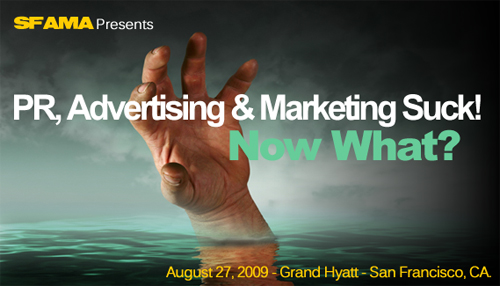
On Thursday, the refrain that PR, Marketing and Advertising "Suck" was debated in a panel I participated in, featuring Loic Le Meur of Seesmic, Guy Kawasaki of AllTop (as moderator), Steve Patrizi of LinkedIn and Renee Blodgett of Magic Sauce Media.

Loic's experience of having hired and fired an expensive (to him) PR firm in his first years promoting in the Valley, combined with his visibility and success that has largely been self-led, as well as a general sense that quality is missing from much of the industry, has seen him question the entire process. In a detailed blog post, Loic cites bad practices including fake reviews and press releases, and contrasts that with how major Web services, like Twitter and Facebook, have largely relied on word of mouth to bring their message to new users. And it was with this background that we participated in Thursday's discussion.

Guy Kawasaki asked each of us how we could successfully market our products if we had no budget, or a very small one - which fell below a typical retainer for any reputable PR firm. Most of us, myself included, recommended utilizing your personal relationships and network if you had no cost. I also recommended reaching out to second-tier bloggers, who can be your product's biggest advocates. Loic said you should get a community manager for low cost to see what people are saying online and respond quickly.


Tap Into Your Personal Network to Save Money

Much of the conversation was framed in terms of listening to services like Twitter, and blogs. It was debated what constituted spamming on Twitter. Renee said that listening for keywords and reaching out to potential customers was a major part of how her clients found prospects - which I agreed with, but others questioned. I said that sending somebody an unsolicited note on Twitter to gauge interest was just fine the first time, and spam the second time. Meanwhile Steve Patrizi kept asking his board of directors for more money.

For as much fun as I have talking about new and cutting edge applications on this site, I recognize that the actual penetration for many of these tools is very small. While some services have started to go mainstream, many other tools, including traditional public relations and advertising, tools as basic as Google AdWords and customized landing pages, are absolutely necessary, especially as you travel up the approval foodchain in the enterprise - trying to convince C-Level buyers to acquire what could be six-figure products. So I tried to discourage some of the over reliance on social media tools for those companies who are trying to reach all their customers.


This Panel Is Going to "Suck" If I Hear Twitter Two More Times

When change happens, people tend to get nervous. It's a fact of life. When you hear examples of bad behavior, it can be easy to assign an entire industry or group of people all the blame.

It is my belief that smart public relations firms, smart marketers and smart advertising firms will not shrink away from the challenges that come with reaching potential influencers and buyers in new places, which require a breadth of awareness, and rapid responses. Those that embrace tools, and recognize them to not be scary - taking to blogging and tweeting and social networking as quickly as they did e-mail and phone calls, will be leaders for the next five to ten years.


What If You Get Negative Feedback?
Practice "Truth In Marketing"

Do PR firms screw up and do ads get ignored? Absolutely. We can each probably think of many cases where that has been the case. But Web sites didn't put those firms out of business, and neither have blogs. Social media won't do so either, unless these firms and individuals are closing their eyes and pretending the tools don't exist. That Loic and others are thinking about the major changes that are underway in our industry is fantastic. That Loic has been able to listen well and leverage his personal brand to help raise visibility for his products has no doubt been very effective. But saying an entire industry "sucks" or is unnecessary is overdoing it. These are tools to be leveraged, and I look forward to each of these industries growing with these tools and delivering new best practices that benefit us all.

See Also:
Loic Le Meur: PR, Marketing and Advertising suck, now what?
Kosmix Blog: Advertising, PR, and Marketing Suck! Now What?
Down the Avenue: Advertising, Marketing and PR Suck: Now What?
Shari Sax: Is Social Media THE ANSWER when traditional marketing “sucks”?

Videos Courtesy: Shari Sax's YouTube Channel

August 20, 2009

August 20, 2009 · 1 MIN READ · BY LOUIS GRAY

Do PR, Advertising & Marketing Suck? Find Out In a Week.

Do PR, Advertising & Marketing Suck? Find Out In a Week.


Criticism of public relations, advertising and marketing is everywhere. Seesmic's Loic Le Meur has been giving a presentation over the last few months saying that they "suck". And agencies need to adapt quickly to be ready for the changes that are seen in social media, the economy and traditional word of mouth.

Next week, on Thursday August 27th, I will be taking part in a panel with Loic, Guy Kawasaki, Steve Patrizi of LinkedIn and Renee Blodgett of Magic Sauce Media, hosted by the San Francisco American Marketing Association, discussing:
  • Is Loic overstating his case?
  • Where are the traditional Advertising, PR, and Marketing agencies failing?
  • What new tools and methods are being used to bypass the need for traditional agencies?
  • What’s next for agencies? What’s next for businesses?
Want to attend?

Ticket Info: SFAMA Members – $35 Non-members – $45
Event Info: SFama.org

For those out of the area, I have it on good word that a UStream video is being prepared as well.

August 6, 2009

August 6, 2009 · 2 MIN READ · BY LOUIS GRAY

Won't Be Long Before These Future Marketers Major In New Media

Won't Be Long Before These Future Marketers Major In New Media

Sometimes, it doesn't seem all that long ago that I myself was in college. On other days, it seems like I am talking about somebody else, when looking back on my time at UC Berkeley. With my 10 year graduation anniversary having passed a few months ago, I found myself back on a college campus this afternoon, with the opportunity to speak to a roomful of students at San Francisco State University, focused on a rapidly changing world of Marketing. And what I encountered was a class of future-thinking young adults trying to grok a fast-changing world where social networks are potentially more impactful than traditional media outlets.

Invited to speak by the class' professor, Shari Weiss, I hoped to illustrate my dual role - both in terms of being a technology blogger, but also my real world decade of experience working in public relations and corporate marketing, and how, finally, these two worlds are colliding, as I help companies get a bigger voice in the social media space.


I Don't Go Too Long Without Mentioning Google Reader

The gulf between what was considered "new media" when I was at Cal and what is "new media" today for these students is tremendous.

As I recalled this afternoon, in 1998 I was excited to see my Journalism professor approach how the Internet was affecting reporting and publishing, only to see my excitement dashed when she rolled in a projector and showed us a feel-good documentary on the founding of Yahoo!, featuring Jerry Yang and David Filo. My disappointment in the lack of forethought in this course was so great that I did not attend lecture the remainder of the year, dropping in only on discussion sections and for the final, which I somehow passed.


Initial Feedback on the Discussion Looks Pretty Good

In contrast, the array of topics challenging the students at San Francisco State brought a smile to my face. In quick presentations, teams tried to tackle the future of advertising, the world of Facebook applications, how to utilize Twitter for business, and I saw future topics spanning such sites as YouTube and LinkedIn.


I Swear I Could Have Talked For Hours On This Stuff

Some part of me was jealous, but I also felt a bit like an unofficial teacher's assistant, sitting in on the presentations, and trying not to correct small mistakes or provide answers. It was clear, that for the most part, the students see real potential from these new networks, where others of us are just coming up to speed. As I showed them, you don't have to be a traditional cool company selling to consumers to get new media. But it's becoming a requirement, to act and engage with your customers as peers. That the future marketers and message-shapers of the world are already getting the message bodes well.

I was glad to get the opportunity to drive up to The City and share my position on the changes I have seen, and hope I was able to make an impact. Thanks to Shari for inviting me.

June 25, 2009

June 25, 2009 · 1 MIN READ · BY LOUIS GRAY

The Marketing 2.0 Revolution: Who Is Driving?

The Marketing 2.0 Revolution: Who Is Driving?

This evening, the San Francisco American Marketing Association put on a panel featuring the just departed from Google Kevin Marks, Jeremiah Owyang, Mark Silva and Robert Scoble. I took notes on the panel and posted them to FriendFeed. These notes are embedded below. The topic was billed as how tech bloggers are pushing the new version of Marketing 2.0, and strayed away from the core topic, bouncing to PR, social media, and how marketers and advertisers can take advantage of these new tools.

In a month, I will be back up here, participating with Guy Kawasaki, Scoble and others, discussing the potential demise of Marketing and PR, hosted by Mark Evans, who just so happens to be the president-elect of the SFAMA and father to triplets.