Silicon Valley Technology Commentary & Archives · Est. 2006 3,045 Posts · 2006–2026
Showing posts with label Scoble (56 posts). Show all posts

September 25, 2014

September 25, 2014 · 4 MIN READ · BY LOUIS GRAY

Blogs Still Trump Streams for Longform Content With a Long Shelf Life

Blogs Still Trump Streams for Longform Content With a Long Shelf Life

Five or so years ago, the idea that one of the most visible bloggers would walk away from their website and completely move their presence to a third party network would have been a step short of scandalous. In fact, when top bloggers even took a month or two off before rejuvenating, that in itself was news. (See from 2007: Are Leading Bloggers Getting Blog Fatigue? and Robert Scoble's response) When the well-read and highly networked Jason Calacanis exited the blogging game in 2008, we all talked about it. When PR lead Steve Rubel deleted his blog in 2011, I was not happy.

For many, the allure of instant feedback on social networks, and simple quantifiable levels of engagement are enough to call in quits on longer form content. When a much labored blog post can only score a handful of comments (if any), and a fun tweet gets dozens of retweets and favorites in minutes, or a Google+ or Facebook post has a deep conversation, the return on investment can have you wondering if blogging is even worth the effort.

Last month +Robert Scoble finally abandoned his blog, which, like mine, used to be a lot more active and engaged than it is now. Yet few people noticed. His choice is to primarily engage on Facebook, and continue a presence on Twitter and Google+. And it's no longer controversial. In parallel, ten years into +Charlene Li's blogging, she writes, "You just can’t beat the engagement that social media platforms provide, something that blogs on their own can’t do."

It's not as if this is a sudden change, obviously. Blogging was (after bulletin boards and newsgroups) the first deep channel one could have to report news, talk to peers and engage with brands on the Web. But when Facebook, Twitter, LinkedIn and so many other social streams emerged, people learned to communicate in real time. By the time blog posts were published, and traveled via RSS to your attention, you might already have seen the news somewhere else. In effect, social media decimated blogging in the same way that the Internet decimated newspapers. Speed wins practically every time.

Just a few years ago, it'd be easy to say "Your blog is your brand (2007)", or, later adjusting, that "Blogging is the foundation in a world of streams (2009)". I still believe deeply in the second part, that all those tweets and social streams have to point somewhere, and if it's not an ad, then it's back to your blog. The rest is just real time noise that is interesting one minute and gone the next. The blog is the place where you can exchange deeper discussions, and the posts live on forever.

Blog posts I made years ago still get thousands of visits a month.

So what of the perceived decline in readers to blogs that once saw incredible attention? Like in the TV world, where one now has hundreds of specialized channels catering to every interest, which has dramatically impacted traditional network market share, the Internet has many more content outlets to choose from, for practically anything you want. You name a topic, you can find a community for it. And entertainment and soft content are winning, just like they do on TV. People love to be entertained, so even the purported news networks like Business Insider, Mashable and Buzzfeed take a tabloid approach and cater to the lowest viewer - tantalizing and teasing their way through your day.

My good friend and colleague on the +Google Analytics team, +Adam Singer, recently took on the disappearing blogs topic in a column for ClickZ, responding to a Marketing Land post on declining blog use for the first time in seven years. His takeaway echoes what I will constantly report: The best analysis is done for your own domain, you don't have to fight with social networking algorithms on whether your content will make it to viewers, and you own your space - the way it looks, your template, and your message.

In 2011, when Google+ just started, some high profile people said they were walking away from their own self-hosted domains and just redirecting to their Google+ profile, which was flying with comments and +1s. I warned against this move, saying "I Gave Away My Web Identity. All I Got Was a T-Shirt." Even when the product you're pointing to is high quality, it's very unlikely a stream-oriented product can match the quality and depth of longer form content that belongs to you.

Having a choice in destinations for your content is important. But it's not just enough to engage in other places. You have to tailor your message for each media, and the blog is still your best container to own your brand and your content for the long term. I regularly end up citing stories I wrote 6-8 years ago, and they still hold up. But good luck trying to find a tweet of yours or another social post from 4+ years ago and saying it has the same solid validity. So while I respect +Robert Scoble and others for adapting to a new world and making a tough call, I think we've lost a lot of good voices and deep thought for a quick fix.

Disclosures (per usual): I work at Google, who is behind the Blogger platform (which I use), Google+ and Google Analytics. I do have active profiles on Twitter and Facebook and LinkedIn, of course.


March 9, 2011

March 9, 2011 · 4 MIN READ · BY LOUIS GRAY

Is The Web's Focus on "Now" Losing How to Find "When"?

Is The Web's Focus on "Now" Losing How to Find "When"?


Our attention spans are getting shorter. While being constantly interrupted or distracted by new toys, new sites, new things, new messages, new people, and new ideas, we're delivering a stream of consciousness into a void which quickly gobbles it up and waits for more. Scads of sites are helping us find out what is trending in real time, and deliver us the "now". What's hot now. What's peaking now. What's being said now. But the focus on the cutting edge of time, combined with reduced capability to search our history is making finding what happened "when" a lot harder.

Consider for a moment some simple questions that pertain to the social Web, blogging and lifestreaming - and our lack of great tools to discover the answers. I'll start with some real examples.
1. What was the first blog to cover the service backtype.com? 
2. When was the first time Denton Gentry left a comment on my blog?
3. When was the first time Robert Scoble mentioned the word Twitter in his blog?
4. Who mentioned FriendFeed on Twitter first? MG Siegler or me?
I use these specific questions with real people to help consider questions that may pop up from time to time. Substitute your own curiosities.

There are a few places we've trained ourselves to look for such answers, namely Google Web Search (and its competitors like Bing), Google Blog Search (and IceRocket, my favorite), and Twitter Search. For individual blogs, we have to hope they have integrated blog search tools, such as that from Lijit, or Google's Custom Search Engine (CSE), a subset of results from one domain. But each of these has some weaknesses.

First, Twitter Search. Two years ago, when I was a more grumpy person, I targeted the search engine for being quite broken, only going a few days deep and failing in more specific searches. The archive hasn't been built to go deep in the last two years, and the accelerated volume of posts isn't helping the issue.

Second, Google Blog Search. You can search by date, and even set custom ranges, but the archive of blogs is both incomplete, but overly full of low-quality content. So finding out a question like the first blog to mention BackType requires you to visit their own blog and hope they mentioned it, or to just know they were funded through Y! Combinator, and thus, got started with TechCrunch, back in August of 2008. Peeking at Crunchbase helps too in this regard. Icerocket offers search by date, but I didn't find any results in August of 2008, so that's a miss.

The Web has collectively accepted these sites inability to accurately deliver on archive search, with an expectation that questions such as this are only done by a small few.

For the second question, one I posed to Denton last night out of curiosity, I would have to hope one of two things - that Denton had used Disqus.com with my blog and that I could somehow see all of his comments on my domain through Disqus. But looking at his profile there only shows how many comments he's made on my blog, and that's not clickable. If Disqus has the data, it's not easy to find. In fact, the only way we arrived at the answer is that I'm enough of an information hoarder to have every comment he's ever made tucked away in my email and was able to search locally on my laptop to find his July 2008 comment on a guest post by Jesse Stay. He finally posted on an entry from me in August of that same year.

So what about Mr. Scoble mentioning Twitter? I tapped Google Blog Search, went to Advanced search, entered scobleizer.com as the domain and the keyword of Twitter and chose 2007 as the year. The results nicely omitted his URL as part of the query - so that had no value. I searched his own site, using Lijit, but there is no sort by date. One of the first results included mention of an earthquake on Twitter in 2007, but knowing Robert, there's no way that's the first mention. Just can't find it.

As for who mentioned FriendFeed on Twitter.com first, MG or me? That's something of a trick question. We already know Twitter search won't find it - nor will its realtime search partners Google or Bing. But I can guarantee that MG mentioned it first because I didn't even join Twitter until early 2008, several months after I had been using FriendFeed. By that point, MG was very active on Twitter and had no doubt mentioned FriendFeed several times. But this all requires knowledge outside of the search engines.

Wikipedia and Quora and Crunchbase are all human-powered knowledge bases that are being built to answer questions such as these that capture more than the "right now". That we have access to things like Google and Bing and Icerocket that find answers to so many things is fantastic. There are even archival sites like MemoLane (which is beautifully done) to capture your history, but the when is becoming a footnote in history. Will the big engines let the flow of social media and blogs outrun the ability to capture it?

December 26, 2010

December 26, 2010 · 5 MIN READ · BY LOUIS GRAY

The iPhone Fanboys Can't Handle the Truth On Android

The iPhone Fanboys Can't Handle the Truth On Android

The big news in this weekend's blogosphere circles around predictions that 2011 will be even more dramatic a success for Android than 2010, and unsurprisingly, the iPhone-aholics are coming out of the woodwork to tell us that this is a terrible thing, cornering the discussion into one where we are supposed to believe Google's march into smartphones is only winning due to price, and that the iPhone 4 (and its successors) are dramatically "better", however that is measured, than Android alternatives. This position is no better exemplified than by Robert Scoble's post saying Fred Wilson and Fortune are Right About Android (but I hate it). This follows onto Fred's position that entrepreneurs and VCs need to get ahead by investing in Android and not iOS. This mirrors my comments from July when I said mobile app developers should look to Android before iPhone and iPad.

The differences between Apple and Android this time around are not like Apple and Microsoft of 1995, even if this is the lazy man's way out to compare the two battles. Scoble says, pleadingly, "I sure hope Steve Jobs has one of those moments where he shocks the world again and keeps this game interesting." I'll tell you what, this game already is interesting, and not because the rest of the world is waiting to see what Cupertino develops in an effort to copy its innovation extremely quickly.

I once felt the same way about my iPhone and still feel the same way in many regards to my MacBook Air (even though I am currently typing this on the CR-48). But the reality is not that Apple has held the exclusive to innovation in this space over the last 12-24 months or even longer. Android led the way in true multitasking on the phone, offers a superior GPS experience with top-notch places and maps, and is years ahead of Apple on voice search, it seems.

On Christmas, a friend of mine asked if I had ever shown my kids "Ivor the Engine" on YouTube, similar to Thomas the Train who is well known here. Even though I was uncertain to the pronunciation, I simply clicked the voice search button on my Samsung Epic, said "Ivor the Engine YouTube" into the phone, and I had a video playing in full color in seconds. Android made that happen, and while I am eager to see Apple integrate Siri, who it purchased at the beginning of 2010, I believe the tremendous investment Google has made in search and voice search specifically will keep them ahead here.

The truth is that Android can go feature by feature against iPhone now. iPhone is not yards ahead of the competition, and while there may be some clear places where Apple is ahead, it comes down to an individual's preference now, including their choice to have a keyboard (which Apple seems not interested in doing), their choice of carriers (still limited here, even if Verizon comes to the party), or many other factors. This is not like the Microsoft of the 1990s, where Apple's lead was obvious and Windows 95 was arguably the first usable OS on that platform to be considered Mac-like.

The way you can tell when tech connoisseurs have crossed the line from data to emotion is when they use blanket phrases like "In my usage of the Android-based Samsung Nexus S, I’ve found it’s still behind Apple’s iPhone in almost every way," which Scoble drops in his post. If you strongly believe a high pixel density Retina Display is demanded, great. If you think FaceTime is something you use all the time and it trumps Qik, great. But blanket statements don't work for the true nature of the mobile landscape today. Android really is that good.

When I first took the plunge into Android after Google I/O, I was almost as wary as when I had to sit down with a Windows NT box for my first Valley job. I was sure it would be terrible or I would be lost. But I kept being surprised by how the device just made sense, and how the device in many ways was better than my experience on the iPhone. In the six months since, we've only seen Android phones improve, with the expansion of Samsung's Galaxy S series, the Droid Incredible, and the introduction of Android tablets like the Galaxy Tab and Barnes and Noble's NOOKColor. I voted again on Android this Christmas when I bought my wife the NOOKColor, which she'll be using to read voraciously at the expense of her iPad use, with a slimmer form factor and reduced weight.

What was wrong about Microsoft's monopoly position in the 1990s was that they used their market strength to thwart innovation and win with business muscle and side deals rather than through value. That is not what is playing out here again. That Apple has opted out of some business relationships and reduced its potential routes to market while Android hasn't is their choice, and it's making them a ton of money. Apple is still winning as a company and will be a strong #2 in this market, and #1 in profit, as that's their focus.

If the assumption is true that Android is expanding primarily due to low-end handsets, we should be asking Apple for an iOS compatible option at a lower price point. Where is the MacBook or Mac Mini of iPhones? If the company ends up being niched at the top in price while others are providing more options, that can't be a strike against Android, but instead a business decision on the part of Cupertino.

The world of mobile is better with a strong and smart Apple in it. But don't get blinded by the Apple fans trying to define Android as a cheaper, inferior solution. It's not. Get your hands on any high quality Android device at a Sprint store or a Verizon outlet or an AT&T store or a Best Buy to try them out. Even an open minded Apple fan can respect what's happened and should be able to see innovation taking place as well as serious market momentum.

December 20, 2010

December 20, 2010 · 2 MIN READ · BY LOUIS GRAY

Don't Fear Being Fireballed or Slashdotted if on Blogger

Don't Fear Being Fireballed or Slashdotted if on Blogger

It can be difficult to plan for an unanticipated spike in Web traffic. One of the most amusing parts of reading Macolyte John Gruber's Daring Fireball blog is the near certainty that at least once per day, one of the poor saps he links to goes down due to the resulting crush of curious onlookers. It happens so frequently that it's practically second nature to see him update a post saying the link has been "Fireballed", opting instead to point to Google's cache of the original. This phenomenon, of course, is not a Gruber exclusive. For years, otherwise innocent bloggers have been Slashdotted, TechCrunched or even Scobleized, seeing their sites crack under pressure. But from what I can tell, if you're hosted on Blogger, this isn't an issue at all. The company was just recognized for perfect uptime during a survey by Royal Pingdom, and I've seen my own site spike in traffic following controversial posts with no ill effects.

Blogger was not always known for a stellar uptime record. In late 2006, the service practically had to write "a novel" about continued outages. In fall of 2007, I railed against Google for ignoring users during another major outage. But services mature and times change.

Royal Pingdom's Downtime Report. Blogger Scores a Zero.

With the backdrop of Tumblr's highly-publicized downtime of more than a day earlier this month, Royal Pingdom also spotted occasional outages at WordPress, TypePad and Posterous, each of whom looked great compared to Tumblr's unfortunate blip, but not as spotless as the often overlooked Blogger.

Getting Slashdot, Scoble and Spiegel Bumps Simultaneously


While escaping system-wide downtime is a major win in itself, that doesn't speak to the services' ability to scale under pressure. Gruber recommends the WP Super Cache Plugin for WordPress, letting users serve more than a page a second, as it's self-hosted WordPress blogs that often get crushed with one of his links. But I've been linked from Daring Fireball a few times and lived to tell the tale. Same for Slashdot, Techmeme, Hacker News and the Huffington Post, all of which are capable of sending solid and sustained traffic on good days.

Techmeme, Hacker News and Scoble Don't Bring Down Blog

Similar to how Google is well known for its Web site never going down, I have to assume Blogger has mastered Google's distributed architecture, and makes no single blog, or its hotspotting, an instrument for failure. This blog didn't slow or go down when tens of thousands of visitors dropped by this July to tell me I was an idiot for switching from iPhone to Android. It also didn't go down when I questioned the usefulness of Google Wave last year, or when the Huffington Post liked my recap of David Kirkpatrick's Facebook Effect.

Not Even Daring Fireball Could Take the Blog Down

Even the largest services have occasional downtime. Facebook was down last week, intentionally, due to a code push ahead of schedule. Twitter has had its share of bumps, though the site has gotten much better in the last year, and even Facebook subsidiary FriendFeed went down this weekend. But Blogger users are sitting pretty knowing their blogs are going to be up and responsive, even under pressure.

February 13, 2010

February 13, 2010 · 4 MIN READ · BY LOUIS GRAY

Filter, Unfollow Or Get Out of the Way

Filter, Unfollow Or Get Out of the Way

Go Ahead and Filter Me Out of Your In Box.

The recent launch of Google Buzz has once again surfaced an undercurrent in the social Web - where a small number of active accounts can gain the lion's share of activity, either through their own interactions, or those of an active follower base. Whether earned through years of consistent activity on their blogs or parallel networks, or having volume thrust upon them through celebrity or suggested user lists and bundling, there are brand name individuals who command a greater share no matter where they go, and if you choose to follow them, your stream runs the chance of being overwhelmed.

Buzz, evolutionary but not revolutionary, has not yet made it simple to follow very active accounts, such as those from Robert Scoble, Jason Calacanis, Pete Cashmore or me, as updates on our threads bounce to the in box by default - almost as a penalty for anybody who has chosen to engage, or who may have seen their ID added to a thread through the service's @Reply feature.

A Common Complaint. But A Wrong One.

Busy accounts can be a nuisance on practically any network, whether that's Facebook, FriendFeed, Twitter, Buzz or any other. But in services where active feeds are resurfaced or pushed to the top, such as FriendFeed and Buzz, the impact is not actually from the originator of the content, but from their community. Comments on active feeds push the items back to the in box, or back to the top of the feed, and if you are following some of the more prominent accounts, you'll no doubt see the same names at the top.

Engagement is Not the Problem. It's Bad Filtering.

That said, if this is getting in your way, and you are seething with rage at these social media power users, you're not using the tools well. Practically every network gives you tools to solve the problem.

1. On Twitter, you only have to see the updates from those you follow - with the exception of items retweeted by those you follow, from their connections, which you can opt out of on an individual basis. If an individual is too noisy, you can unfollow them at any time. Some innovative applications, including Brizzly, let you even "mute" a user for a short time so you can have them disappear during particularly busy times.

2. On Facebook, you can hide an individual's updates from your News Feed if they are too talkative. You can also hide all updates from specific applications (like Farmville or Mafia Wars) if you never want to see those updates. And yes, de-friending or blocking is available.

3. On FriendFeed, you can hide individual posts, block individual services (like Twitter or Disqus), block specific service updates by user, or, most successfully, you can put noisy people in their own lists, to sequester them from the rest of your feed. If worse comes to worse, again, you can always unfollow them, or block them outright.

4. With Buzz, you don't yet have the option to hide specific service updates or updates by user. But you can mute any thread just my using the "m" key, and as Buzz is integrated with GMail, you can use the same kind of filters available to any other e-mail. For example, I have set up a rule to move all Buzz entries into a mail box I call "social", taking them out of the in box.

Buzz Never Hits My In Box On My Mac

If you want to quiet the impact of busy users, like Tom Foremski did by unfollowing Robert Scoble and me in Buzz, you can use GMail filters to your advantage - taking them to a dedicated folder and out of your in box.

For example, set up a filter where the Subject is "Buzz from Louis Gray", "Skip the Inbox (Archive It)" and "Apply the Label" of "Noisy", or whatever you like.. Then do the same for Robert and Pete and Chris Pirillo, Jason Calacanis, or anybody else who is swamping your Buzz experience.

Should we be blaming the noisy folks?

Like I mentioned last night, in sharing my social media data flow, I know there are people who have chosen to stop seeing my updates because of their frequency. But I don't plan to change my activity because of a new way it is interpreted and displayed by a new social network.

Part of the reason I am among the more active and visible people on Buzz is because over the last few years, I have promoted and cultivated the use of Google Reader and having active conversations there. I took the time to connect to and talk with more than 1,000 people in my shared items, and Buzz has taken advantage of that social network, moving it to a new place. Where others have not optimized for sharing, they are starting with less of a community.

1,300+ People Can Comment On My Shared Reader Items

But because of this, the community is also very comfortable talking on my feeds, as they are with other engaged folks. It is the ensuing conversations that bump them to the top, not the frequency that I share. I have been sharing 20-30 items a day in Google Reader every day for years, and it is filling Buzz the same way it has filled Reader and Facebook and FriendFeed.

If it's too much for you, use the tools that are there. Mute. Filter. Unfollow. Block. But there will always be discrepancies between the average users and those most active. Go ahead and make mine more active.

October 7, 2009

October 7, 2009 · 1 MIN READ · BY LOUIS GRAY

Sitting With @Scobleizer and @Jesse As Part of a Big Silicon Valley Day

Sitting With @Scobleizer and @Jesse As Part of a Big Silicon Valley Day

With friend and fellow blogger Jesse Stay in the Bay Area for the day, I played the part of chauffeur and sidekick, hitting a number of key Silicon Valley landmarks this afternoon. After he finished a lunch at eBay/Paypal, the two of us drove up Highway 101 to meet with the API team at Twitter. Then we headed south and caught up with our mutual friend, Robert Scoble, who true to form, turned on the video camera and engaged with us in a discussion around social networking applications, product development, and our thoughts on Twitter, Foursquare, Google Wave, etc. The video is about an hour long, so buckle your seatbelts.


Afterward, Jesse and I made a quick stop at Apple headquarters in Cupertino and then got dinner at home in Sunnyvale, where he met the twins, and then I took him back to pick up his car, after swinging by Cisco HQ just for show and tell. In the eight hours I dragged Jesse up and down the Peninsula, we managed to see or visit eBay, Yahoo!, EMC, Cisco, Twitter, Apple, AMD, Extreme Networks, TiVo and National Semiconductor, to name a few. All part of the Silicon Valley experience.

If you're a die-hard who can't get enough of our repartee, there was more of the discussion that tripped into a "part two", which you can catch here.


FTC Disclosure: I got a free t-shirt from Twitter AND a free t-shirt from Robert that says Building 43 on it. Oh yeah, Jesse also runs SocialToo where I am an advisor. Also, at one time, I visited TiVo headquarters and got a grab bag of goodies. Also, a TiVo employee paid for lunch that day. :)

September 14, 2009

September 14, 2009 · 3 MIN READ · BY LOUIS GRAY

Automated Tweets Don't Always Mean Less Genuine Tweets

Automated Tweets Don't Always Mean Less Genuine Tweets

With the introduction of an updated terms of service last week, Twitter once again had people buzzing about what was accepted behavior on the fast-growing microblogging site, and what crossed the line. In one of the site's frequent list-based articles dedicated to the San Francisco company, Mashable claimed one of the targets of the update was what they termed "bots", which were updated by RSS feeds moreso than by humans. In the post, Jennifer Van Grove specifically used the popular IMDB account as an example of one that should "live in fear of death". But all drama aside, I don't think that's Twitter's intent, nor do I believe that the sole delineation of whether an account is pulled by RSS instead of through text, for example, calls for the label of "Spam".

The truth is that a significant number of news-based accounts are clearly automated, very often by the use of RSS, because Twitter has become more than just a place to send updates. It's infrastructure. And even if these accounts aren't automated through RSS, practically all of the top accounts are full of a stream containing only headlines and links, with Mashable being no exception. (See also: TechCrunch, Techmeme Firehose and ReadWriteWeb for example)

It's clear that while "The Twitter Rules" say that "If your updates consist mainly of links, and not personal updates" is one criteria for being labeled spam, it cannot be the only criteria. We must believe, and I do, that Twitter would know how to separate the good from the bad in this type of a case.

The truth is, and I have said this many times, that you should participate and make your data available where your audience may be. And often, even if you are initiating content in one place, the audience may be somewhere else - like Twitter. As a result, it makes sense to move that content to Twitter to give them access.


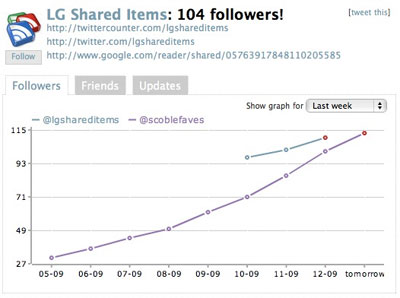
TwitterCounter Shows Growth for @lgshareditems and @scoblefaves

A recent experiment I kicked off on Wednesday was creating a dedicated Twitter account for my Google Reader shares and Delicious bookmarks at @lgshareditems. This combination has always been available on FriendFeed (and Facebook), but not Twitter. In parallel, Robert Scoble, also a guy well known for trying new things with social networks and data, has been tracking favorite tweets from those he follows with a dedicated account called @scoblefaves.

I have watched both accounts creep past the 100+ follower stage, even though both accounts are new, and both are exclusively feed-based. Each is a new way to try and utilize human filters and pass the results to Twitter, with the difference being that I am betting on content from outside of Twitter, and Robert is betting on other Tweeters. I bet both have strong value to separate audiences looking for news and tech updates - even though our data sets are different.

My shares to @lgshareditems are equally as genuine as my posts to @louisgray. While I may have more personal updates at the @louisgray feed, I do also post my new blog updates there, as well as my Delicious bookmarks, to give those authors additional exposure. And as noted above, practically every self-respecting blog and news source can see their Twitter feed to be extremely link heavy. So I expect it will take a lot more than you seeing a lot of blue underlines in my feed to be in danger of getting the big boot from Twitter, no matter what their TOS says.

August 6, 2009

August 6, 2009 · 3 MIN READ · BY LOUIS GRAY

To Jump on the Massive Unfollowing Trend Would Be a Mistake

To Jump on the Massive Unfollowing Trend Would Be a Mistake

For weeks, in my ever-increasing list of potential future blog post topics, I have had one titled, "What If I Purged My Twitter Followers?". Trust me, the option has crossed my mind on the rare occasion I log in and try to use Twitter or any of its 3rd party apps in the way the Twitter team had intended - as I watch update after inane update swim in a sea of half-baked offers and hashtaggery. But even as I see some notable folks talking about taking apart their list of connections with the subtlety of Jack Nicholson wielding an axe in The Shining, I'm still ignoring the temptation to join them. While I may weed out some clear spammers now and again, I think to massively prune my list would introduce more problems, real and emotional, than it would present solutions.

Since I started using Twitter in early 2008, I have somehow amassed more than 12,000 connections. Thanks to my employing an auto-follow capability from SocialToo, a company run by Jesse Stay who I advise, those who add me as a connection in Twitter gain a reciprocal move almost instantaneously, without my lifting a finger. While some may think this is "disingenuous", doing so saves me the time of reviewing each new follower one by one to gauge "worthiness", and it also enables them to send me direct messages - as Twitter will block the capability otherwise.


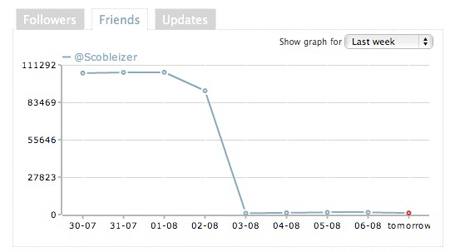
Scoble's Unfollowing Is Easily Seen Via TwitterCounter

I recognize there are problems with spammers on Twitter. I get my fair share of automated direct messages. I see ridiculous accounts that look more like robots than people. But if I set an artificial standard that required me to have a personal relationship with an individual in order to follow them on Twitter or any network, I would be selling myself short in terms of getting to potentially know the person, and I would be selling them short by not giving them a chance when it is likely they just wanted to be connected in an environment where they were comfortable.

Assuming I were to abstain from using an auto-unfollow service (SocialToo does this also), and I took 10 seconds to review each of the 12,000 accounts, it would take more than 33 hours to adequately cleanse my feed. And I know if I did use an unfollowing service, a lot of great people would be thrown out with the bathwater. I saw Scoble's experiment, only to have it impact friends of mine like Drew Olanoff and Kent Newsome, who are both real humans who contribute on Twitter and other networks. I know, without question, that there are many future peers on the Web that I just haven't had the luck to meet yet.

Benjamin Franklin, once paraphrasing Blackstone's formulation, said, "It is better [one hundred] guilty Persons should escape than that one innocent Person should suffer." So too do I see it better that 100 spammers fill my feed than I lose access to the innocents who remain. I am not so self-centered as to believe I know the full set of people who I can learn from and derive value. So don't look for me to start shaking my numbers down on any of the networks - even if it is getting more popular.

Also see: Twitter is for Following Topics and Listening, Not for Following People from February 26th for more background on this.

July 10, 2009

July 10, 2009 · 2 MIN READ · BY LOUIS GRAY

FriendFeed Plans Features to Stem Conversation Flare-Ups

FriendFeed Plans Features to Stem Conversation Flare-Ups

After a testy exchange with Leo Laporte during a taping of the Gillmor Gang last month, Mike Arrington of TechCrunch saw a boom of negative reactions across the Web, from pointed YouTube mashups, comments on TechCrunch, and a flurry of conversations on FriendFeed, where the live conversation for the Gillmor Gang was scheduled to take place. In the aftermath of the blow-up, Arrington closed his FriendFeed account, later blaming what he called "mobs" for having congregated and piling on. During a panel today at TechCrunch's real-time CrunchUp, Mike talked with FriendFeed co-founder Bret Taylor and Robert Scoble about the situation, and Bret promised changes were being worked on at the service, which would help stem future flare-ups from happening.

While Arrington aggressively tried to position FriendFeed as encouraging mob mentality, Bret touched on an interesting point that helped explain the scenario. Essentially, most conversations are decentralized across social networks. But on FriendFeed, conversations are centralized. While not threaded, all of the site's users have the ability to make comments on any open public conversation - meaning those people with extremely popular accounts can have a high amount of comments, and as comments come in, these items are pushed to the top, making them visible again.

Bret said that new tweaks are going to soon come available on FriendFeed that would enable users to stop comments on particular entries, or on the person's entire feed itself. This means that if Arrington were to re-enable his account, as he said he would do today, he could opt to mute threads that got out of control, or simply post his feed and make it unavailable for interaction. Interestingly, Bret said that the conversations on those accounts that had either a small amount of followers or a large amount were of the lowest quality.

Scoble, the most-popular person on FriendFeed, who had trouble getting his audio into the conference from London, actually agreed with some of Mike's assertions, saying "there is a mob mentality, and we caused it". He added. "We brought a huge crowd... and people are going to get in the bleacher seats and throw rotten tomatoes every once in a while."

Bret did not give a timeline for the new features, but if FriendFeed's speed of feature improvements thus far is any indication, they won't be too far away.

You can also see a timeline of this panel here: Mike Arrington, Bret Taylor and Robert Scoble starting the "Online Mobs" discussion.

June 25, 2009

June 25, 2009 · 1 MIN READ · BY LOUIS GRAY

The Marketing 2.0 Revolution: Who Is Driving?

The Marketing 2.0 Revolution: Who Is Driving?

This evening, the San Francisco American Marketing Association put on a panel featuring the just departed from Google Kevin Marks, Jeremiah Owyang, Mark Silva and Robert Scoble. I took notes on the panel and posted them to FriendFeed. These notes are embedded below. The topic was billed as how tech bloggers are pushing the new version of Marketing 2.0, and strayed away from the core topic, bouncing to PR, social media, and how marketers and advertisers can take advantage of these new tools.

In a month, I will be back up here, participating with Guy Kawasaki, Scoble and others, discussing the potential demise of Marketing and PR, hosted by Mark Evans, who just so happens to be the president-elect of the SFAMA and father to triplets.

June 4, 2009

June 4, 2009 · 3 MIN READ · BY LOUIS GRAY

The Rumors Are True - I Bought Robert Scoble's BMW

The Rumors Are True - I Bought Robert Scoble's BMW


What Was Once Scoble's... Is Now Mine

I don't consider myself a car person - and on both occasions where I have had to replace my car, it has been only after a mechanical problem's repair costs look to far outstrip the true value of the vehicle. That was true in 1999 when I returned my used 1991 Ford Escort GT, picking up a used 1998 Mercury Tracer, and true again this week, as I leave the Tracer behind, trading up to a used 2006 BMW 325i. The Tracer, with more than 140,000 miles on it, has served me well for a decade, but with its transmission toast, it was time to let go.

But, as with most things we've discussed on the blog over the last couple years, we turned to the Web to solve our issue, when it presented itself, starting back on March 28th.

Upon hearing I needed to pay upwards of $4,000 to fix my broken Tracer, my tendency would be to walk down the street to the nearest dealer and find something, anything to replace it. But instead, this time, I posted a note to FriendFeed, explaining the situation, and asking the vibrant community for feedback. In the discussion, seeing more than 80 comments, I explained I wanted to be more like my peers in Silicon Valley, but honestly didn't want to go in debt for the privilege.

In the middle of our back and forth, Robert Scoble swooped in with an offer I had to pay attention to. He posted, "Louis: we are selling our 2006 BMW 325i with 56,000 miles. Make me an offer. Well maintained and fun to drive."


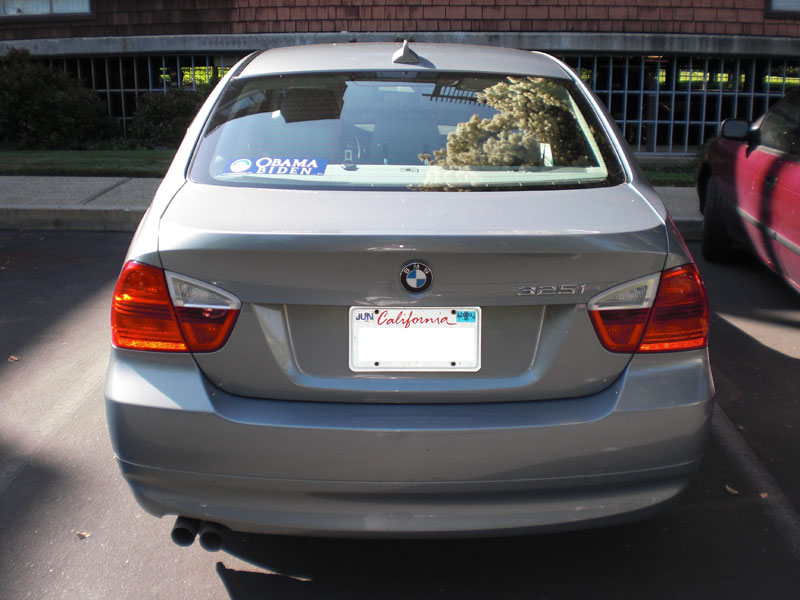
The "New to Me" BMW Safely In Our Parking Lot

56,000 miles sounded a bit high, but considering Robert's visibility, it'd be bad for him to pass along a lemon. I was definitely interested. In April, I saw the car at an tech meet-up in Mountain View, and was even more convinced it was the right way to go, even after independently looking at alternatives throughout the Bay Area, to see if I could get a newer, better, car for the price Robert was offering.

In the meantime, Robert and I said we would target the end of May for a purchase. He was awaiting the delivery of a new Toyota Prius, and on Monday, it arrived. This put everything in motion, so on Tuesday night, we packed up the twins, headed to Half Moon Bay, and made the deal. Now, the car that was once Robert's is now mine (assuming my check clears the bank, and I have no concerns).

By Friday, a charity will come pick up my Tracer, and give me a tax deduction of a mere $500.


The Obama/Biden Sticker is From Robert. Should I Ditch It?

That I bought my BMW from Robert instead of a random car salesman or third party advertiser on Craigslist, eBay or the San Jose Mercury News speaks volumes in terms of how we can leverage our connections forged online. Though I've grown to know Robert well over the last few years, I learned of him through blogging, and he found out of my situation using FriendFeed. Much of our discussion about the transaction has been public, in fact, leading from the first offer, to his later posting, on April 15 that he was still planning to sell it to me.

Robert is happy that he has his new Prius, and no doubt happy he was able to pass along his car that he enjoyed to a good friend. Our family is happy because we managed to find a respectable, nice car without having to sell one of our kids or mortgage their future. And both of us are no doubt happy that we used the social networks we both have been promoting for years. Unfortunately for me, the BMW doesn't have any aftermarket enhancements that tap into the real-time Web. I was hoping Robert would have made the car one of a kind. But it's still a great deal and I'm glad I could leverage the Social part of the Social Web to get it done.

April 18, 2009

April 18, 2009 · 2 MIN READ · BY LOUIS GRAY

Once You Start, You Can Never Stop

Once You Start, You Can Never Stop

Ever run into friends who tell you they want to start a blog, or are thinking of signing up for LinkedIn, Twitter, Facebook or some other network, and you just know it's doomed to failure, because they won't commit to it? Starting is easy, but maintaining a pace can be hard. Whether for business or for pleasure, the number one thing I tell people about blogging is that once you start, you can never stop. Blogging is not something you do on a whim, or start and then abandon for the search engines of tomorrow. You must find a pace and always keep going - so if you start, be sure you've got a topic or ideas that are sustainable.

This week, thanks to work, family and other items hitting my schedule, I went a little light, not just here on the blog but on most of the networks - after a strong Monday. And while previously, I've told bloggers to "relax" as "nobody is keeping score", once you have established a pace, absence gets noticed. Today, while still at the office, I got a call from Robert Scoble, just checking in to see if all was well. And yes, it is. Just working and making sure everything is done before being out of the area all next week thanks to an upcoming tradeshow.

That Robert noticed shows how in tune he is on all the networks. I hadn't gone completely silent, but I did slow down my pace for a few days, and he caught me.

But while this was a mere blip in my usually regular posting schedule, it's one that happened well into my fourth year of blogging on this site, after nearly 2,000 posts, added on to tens of thousands of actions on FriendFeed, Twitter, Facebook and everywhere else. I'm not stopping. I'm not anywhere near done. But if you know folks who you think would walk away, see if you can stop them before they start, especially if how they present themselves has a chance to impact how your company or your project are perceived.