Silicon Valley Technology Commentary & Archives · Est. 2006 3,045 Posts · 2006–2026
Showing posts with label TechMeme (63 posts). Show all posts

September 6, 2011

September 6, 2011 · 7 MIN READ · BY LOUIS GRAY

Being Genuine Is the Best Disclosure Of Them All

Being Genuine Is the Best Disclosure Of Them All

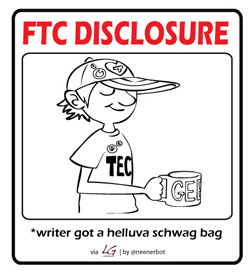
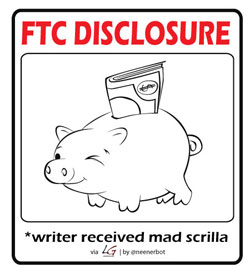
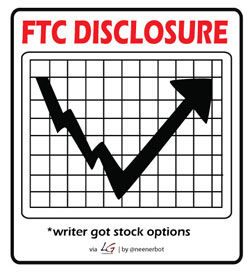
Even with the purest of intentions, people have bias, which can rise from an infinite number of sources, be they financial, personal, emotional, career-oriented, or any other. The topic of bias and disclosure flares up often in the increasingly complicated world of blogging and journalism, and as many of us both participate and cover the world in which we work, new rules are being adapted, usually with some push back by those for whom the existing set of rules worked well. In 2009, the Federal Trade Commission (FTC) tried to step in and provide guidelines for bloggers with conflicts, asking those who received compensation for their efforts to disclose it. But even if you assume they intend to eliminate bias, they're not even close to answering for all potential bias cases. Not even my gimmicky and fun set of disclosure icons, put together at the end of 2009, can correctly anticipate every situation.

With this weekend's flareup over TechCrunch founder (and AOL employee) Mike Arrington's CrunchFund making headlines again, more lines are being drawn in the sand about what is appropriate for a man of Mike's position to do. His employees have explained they operate independently of his activities. His employer says the rules are different for his organization. His critics have called him names and penned him as having crossed the line. But this topic isn't a new one. It's just got an intriguing name behind it, someone that many of us watch, who draws attention good and bad, depending on your view, thanks to his being visible and arguably, on top, in his field.

More than three years ago (In August 2008), I wrote that "If you look hard enough, conflicts of interest are everywhere." The first topic I brought up back then was if bloggers should cover companies they invest in, and at the time, I said "Investors in a company usually know it very well, especially if it's an early-stage situation, where they will know it better than the general public. It's no secret they'll likely be more positive on the company, but if they're fair and disclose the relationship, you may learn a great deal." In this post, I also said "disclosure is needed" if bloggers joined boards, took day-job positions with a company, or participated in starting or buying a company. It's always good, at least for me, to have the body of work to point to when issues like this come up, as they do regularly. At the end of 2008, again discussing bias, I said, regarding my own preferences, "Even though I like these products, these people, and their ideas, the idea is to continue to be trusted. What liking a product doesn't do is force me to make up things that they don't do, or gloss over clear issues."

It's not my place, as a mere tech blogger and Silicon Valley marketeer, to assess the appropriateness of Mike's new fund. I am not involved, had zero knowledge of it in advance, and don't believe I am impacted by its existence. The story is interesting, and that's it. But the tumult over the discussion is really all about detecting bias and trying to divine one's intent out of their writing - to see if their words can be less trusted due to their outside interests. And that's the crux. Being genuine, transparent and truthful, despite any perceived bias, will always win. Being honest and direct and overdisclosing to the point of amusement, is always better than having to disclose after the fact.

Maybe I should disclose to you that despite never having worked for Mike (we're still talking about Mike Arrington), and having minimal contact over the years, I have never had a bad experience with him. Every experience has been good, be it in person face to face, be it in conversations on the phone, by email, or even Twitter DMs and Facebook messages. The last time I saw Mike was at a swanky Los Altos gathering where we talked briefly. He shook my hand (not something he likes to do) and said it was good to see me. We even talked a bit about Seattle and how he's writing less at TechCrunch. Mike previously invited me to TechCrunch headquarters in Palo Alto (when they were located there) and even gave me the scoop (by a few days) that he had hired MG Siegler away from VentureBeat. You might even try really hard and say that I am biased in favor of TechCrunch because I've previously worked for a company that was covered by the site (when I was working at my6sense), that TechCrunch covered my joining Google, and maybe it's in my best interests to be nice to Mike and the TechCrunch family if I ever want products I am associated with in the future to be viewed nicely. But this points out how hard it is to really determine what's in the author's head. You can't tell me why it is that I wrote something when I did, and you can't know what prompted me to do it.

Enough about Mike. He's a great firestarter for topics though, right?

At the end of last week, there was a quick story on Mashable that listed a few tips on how you could score your next job using social media. It's a pretty typical story for the site - a list style post that has a small number of things you can do to improve your life using the Internet. In the post, the author referenced my joining Google by saying, "take a tip from Louis Gray, whose demonstrated love and dedication for Google+ got him hired as a product evangelist."

With all due respect to the author, whom I don't know, his fast summary was balderdash. I didn't ever say in my post that my love and dedication for Google+ was the reason I was offered a job with Google and he didn't ask. It should be noted I underwent the same hiring process as any other candidate looking to join Google. The same 10+ interviews you have read about, and the interview process started months ago - before Google+ existed. The way I found out Google+ launched was by way of a tweet from Matt Cutts. I didn't get any early look at the product, and didn't get tipped as to when it was launching. The process for my being hired into the social team at the company was well under way before Google+ launched, and I would like to think that reasons I was hired were more tied to my body of work and job history than any excitement about the project itself. (I also haven't cleared this post with Google PR or anyone at Google, and don't plan on making that a habit)

That leads to another level of bias to discuss. After Google approached me late this Spring about possibly joining the company, I was cautious in terms of what I would say about their products or planning. I was cautious not in the perspective of making sure not to say anything that would talk them out of hiring, but in fact, the reverse. I made sure to be just as fair as I always have been, calling out issues that made sense, and praising where it made sense, so that if I were hired or not hired, readers of the blogs would not see any change in my approach. For example, in the months after our discussions began, I said it would take several days to move my music library to Google music and continued to praise Spotify. I even said in mid-July, after more than a half dozen interviews, that I thought Google+ should leverage smart algorithms to personalize the content. I also railed against people pointing their own domains to Google+ instead of their own content, saying "I am hesitant to endorse forwarding your identity to a third party domain you do not control."

But where could I have disclosed "I am currently in the interviewing process at Google"? I couldn't, of course.

Similarly, in the past, I could not disclose if a company I was working with was seeking a venture capital round, an acquisition, a partnership or any number of things where the guarantee of non-disclosure, by agreement, trumped the request for disclosure here. What's more important than seeing if you need every single potential source of bias listed out on the page, as I often do, is if the author has established a record of being truthful, genuine and open to their biases. My posts here and elsewhere are biased, and the number of potential biases that impacts my choices of what I use and what I write about is legion.

Maybe Mark Zuckerberg was really on to something when one of the hallmark statuses available to Facebookers was that of "It's complicated." Life is complicated. It becomes more complicated based on who you know, what you do, who you interact with, what value they provide you, what they say to you and all who impact you and so on. I am confident that even though I am working hard to impact a great project at a visible company, my body of work stands for itself and I stand for something. Bias is complicated and the best way to classify bias is if you can find a direct link to an action that delivers another action which would not have happened without the first. You can try all day to divine the intent of the source, but you can't read their mind. Them being genuine first and always clears it all up.

July 25, 2011

July 25, 2011 · 1 MIN READ · BY LOUIS GRAY

Techmeme Leaderboard Features Google+ Users

Techmeme Leaderboard Features Google+ Users

The content being created and shared on Google+ is quite good. So much so that many posts that have originated here have been featured as leading articles on Techmeme, the much-watched technology news curator led by +Gabe Rivera. While Gabe and team have had Twitter activity play a role in the site as well, no other social network (Facebook, FriendFeed, Google Buzz, etc.) has previously gotten this level of visibility.

Google Plussers +Paul Allen and +Danny Sullivan have seen their content shared on Techmeme frequently enough that both are listed on the Techmeme leaderboard, which tracks the most frequently carried sources on the site over the last 30 days.

You can see all Google+ stories that have entered Techmeme here:
http://techmeme.com/search/query?q=sourceurl%3A%22plus.google.com%22&wm=false

I would not be surprised to see +Vic Gundotra and +Bradley Horowitz be listed at other times on this list in the future.

/via My Google+ Profile.

December 20, 2010

December 20, 2010 · 2 MIN READ · BY LOUIS GRAY

Don't Fear Being Fireballed or Slashdotted if on Blogger

Don't Fear Being Fireballed or Slashdotted if on Blogger

It can be difficult to plan for an unanticipated spike in Web traffic. One of the most amusing parts of reading Macolyte John Gruber's Daring Fireball blog is the near certainty that at least once per day, one of the poor saps he links to goes down due to the resulting crush of curious onlookers. It happens so frequently that it's practically second nature to see him update a post saying the link has been "Fireballed", opting instead to point to Google's cache of the original. This phenomenon, of course, is not a Gruber exclusive. For years, otherwise innocent bloggers have been Slashdotted, TechCrunched or even Scobleized, seeing their sites crack under pressure. But from what I can tell, if you're hosted on Blogger, this isn't an issue at all. The company was just recognized for perfect uptime during a survey by Royal Pingdom, and I've seen my own site spike in traffic following controversial posts with no ill effects.

Blogger was not always known for a stellar uptime record. In late 2006, the service practically had to write "a novel" about continued outages. In fall of 2007, I railed against Google for ignoring users during another major outage. But services mature and times change.

Royal Pingdom's Downtime Report. Blogger Scores a Zero.

With the backdrop of Tumblr's highly-publicized downtime of more than a day earlier this month, Royal Pingdom also spotted occasional outages at WordPress, TypePad and Posterous, each of whom looked great compared to Tumblr's unfortunate blip, but not as spotless as the often overlooked Blogger.

Getting Slashdot, Scoble and Spiegel Bumps Simultaneously


While escaping system-wide downtime is a major win in itself, that doesn't speak to the services' ability to scale under pressure. Gruber recommends the WP Super Cache Plugin for WordPress, letting users serve more than a page a second, as it's self-hosted WordPress blogs that often get crushed with one of his links. But I've been linked from Daring Fireball a few times and lived to tell the tale. Same for Slashdot, Techmeme, Hacker News and the Huffington Post, all of which are capable of sending solid and sustained traffic on good days.

Techmeme, Hacker News and Scoble Don't Bring Down Blog

Similar to how Google is well known for its Web site never going down, I have to assume Blogger has mastered Google's distributed architecture, and makes no single blog, or its hotspotting, an instrument for failure. This blog didn't slow or go down when tens of thousands of visitors dropped by this July to tell me I was an idiot for switching from iPhone to Android. It also didn't go down when I questioned the usefulness of Google Wave last year, or when the Huffington Post liked my recap of David Kirkpatrick's Facebook Effect.

Not Even Daring Fireball Could Take the Blog Down

Even the largest services have occasional downtime. Facebook was down last week, intentionally, due to a code push ahead of schedule. Twitter has had its share of bumps, though the site has gotten much better in the last year, and even Facebook subsidiary FriendFeed went down this weekend. But Blogger users are sitting pretty knowing their blogs are going to be up and responsive, even under pressure.

December 16, 2010

December 16, 2010 · 2 MIN READ · BY LOUIS GRAY

OneTrueFan Adds Personalized Hot News From Your Friends

OneTrueFan Adds Personalized Hot News From Your Friends

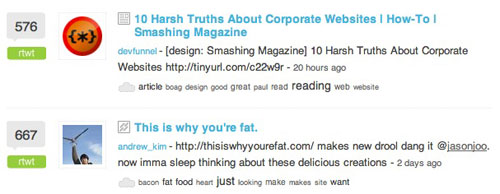
OneTrueFan is looking to be more than a badge-creating Web surfer tracking toolbar gimmick. The site, already extremely compelling to me due to the ability to discover new networks and stories from my social connections on Twitter, is adding an intriguing feature today that essentially brings each user their own Hacker News-like top stories summary, pulling from shared pages by one's friends in the network. The concept, a social newspaper, is one used by other sites including Paper.li, but in this case, taps into the power of the toolbar which follows registered users around the Web, and surfaces the most shared stuff in an effort to be sure you don't miss a thing.

Quietly launched at the end of last week and being publicly unveiled today, OneTrueFan has added a "Your Hot News" tab to every user's profile, showing items that are popping throughout your network of connections. Interestingly, not only do the items display the avatars of the people who distributed the shares in their network, but it gives each avatar a weight, as evidenced by size, to show how much downstream impact the sharer had. The bigger, the better.

The Hot News Story On My OneTrueFan Page

OneTrueFan gives site users 'points' for sharing items to Twitter and Facebook, and tracks the number of clickthroughs to their URL shortner, otf.me. One recent share I made of Micah Baldwin's "It All Changes When the Founder Drives a Porsche" article gained more than 1,000 clickthroughs, passing the points to me and making me the OneTrueFan of Micah's blog - which I was already, but now is confirmed by irrefutable science. This clickthrough data contributes to the Hot News section, but in the event other URL shorteners are used, ones Twitter reach comes into play.

Another Top Story Shared By Many Folks In My OneTrueFan Stream

In the days I've tracked my Hot News on OneTrueFan, I've found it to accurately find top stories of the day that are frequently shared. It's not personalized based on my interests, but does a solid job of becoming a more personal Techmeme or Hacker News. Of course, seeing just who shared an article gives me more data to choose whether I want to engage in the item as well.

Like Blippy, I believe OneTrueFan's full potential has yet to be discovered. If I look at what the team is developing, essentially it is a horizontal social network that you can take from site to site with you around the Web, without requiring a centralized login. In fact, you just log in with your Twitter account. I believe in the model of sharing and discovery, and Hot News will make OneTrueFan (or OTF) an even bigger player as a destination site. If you're not on OneTrueFan already, you haven't been listening to me and should go register now.

July 18, 2010

July 18, 2010 · 2 MIN READ · BY LOUIS GRAY

KickPost Predicts Popular Posts for Top Tech News

KickPost Predicts Popular Posts for Top Tech News

As technology news sites have proliferated in the last few years, so too have technology news aggregators looking to find the best of the Web and surface it quickly - either through social voting mechanisms, insightful editorial picks, or complicated algorithms. In addition to the Diggs and Slashdots of the world, one finds Hacker News and Techmeme as the gold standards offering the front page of today's tech news. Now, there is a new site that has entered the fray - though minimalist for now - armed with what the founder calls a predictive algorithm which just might find top stories faster than anybody else.

The site is called KickPost (http://www.kickpost.com) and it comes from the hand of Caleb Elston @calebelston, the vice president of products at Justin.TV, who is also known to frequent blog readers here as the man behind Toluu, the RSS discovery site, and the gift recommendation site, Kallow.

One Item from KickPost Shows The Time of Post, Source and an Excerpt

In a discussion on Hacker News about the launch of KickPost, Elston describes the site as a "new tech news aggregator that uses a predictive algorithm based on historically popular stories to predict which stories will be popular in realtime." He adds, "We are about 20min faster at predicting hot stories than Techmeme."

Another Top Story on KickPost

The site displays the headlines of predicted top stories, as well as a short excerpt, the author's name and the post source - with the headline linking to the original story and the source to the blog's main page. Stories are ordered chronologically, with the most recent at the top, and older ones below, with a time stamp showing how recently the posts entered KickPost's index, and the page automatically refreshes when new stories enter the index.

From a quick perusal of the site, it's clear that top tech stories are making it into the index - and they are being found fast. But the site sources are very common to so-called A-List blogs that dominate many other sites, including VentureBeat, Gizmodo, TechCrunch, and Lifehacker. Where more editorially-driven sites, including Techmeme, have an advantage is through manual discovery - something a purely algorithm-driven site like KickPost can't catch. The one-off top stories from new sources will have a tough time making the index, from what I can tell, even after scrolling back 2 days into past KickPost content.

Given Caleb's history for parsing RSS feeds and finding how your own likes intersect with those from the community, I would anticipate where KickPost would really gain value over the competition is through personalization and building the top stories in near real-time based on individual's preferences, not just through beating Techmeme and others by a handful of minutes with headlines from top blogs. But it's a site we'll be watching.

Find KickPost at http://www.kickpost.com/ and on Twitter at @kickpost.

February 7, 2010

February 7, 2010 · 1 MIN READ · BY LOUIS GRAY

EdgeTheory: The Battle for Real-Time Reporting, Curation

EdgeTheory: The Battle for Real-Time Reporting, Curation

The issue of real-time news reporting and curation is becoming increasingly visible and important as news breaks on blogs, Twitter, Facebook and other social media properties. Tonight, Chris Saad and I talked about how the mainstream media can adapt to involve content curation in addition to their content creation, and how it still makes sense to have some investigative reporting in addition to real-time reactions.

The discussion weaved from curation tools like Cascaad and my6sense to the recent news of Teens In Tech Networks CEO Daniel Brusilovsky leaving TechCrunch, and how the news was interpreted.

Original Post Here: ET Conversations

Listen in below:


Disclosures: my6sense is a client of Paladin Advisors Group, where I am Managing Editor of New Media. In addition, I am an advisor to Teens In Tech Networks.

December 19, 2009

December 19, 2009 · 8 MIN READ · BY LOUIS GRAY

Growing Grumblings on Tech News Don't Address Incentives

Growing Grumblings on Tech News Don't Address Incentives

If you are the subject of the news, people will judge your actions and how you react to being in the spotlight. If you are the distributor of the news, how you message that news, and how accurately you report that news, will also be dissected. On the Web, especially in our sliver of Silicon Valley, where real time is becoming the standard, analysis of said news is itself happening in real time. From many corners, often from the more technically-oriented folks on the Web, I am seeing discussion around the tech news industry's alleged failings, inaccuracies, and usefulness (or lack thereof). While some of the feedback no doubt has merit, it too comes in simplified form, without offering potential solutions, taking into account how the creators and publishers of this tech news blogosphere are incentivized and rewarded.

On Sunday, Mike Arrington of TechCrunch, as he often does, started a discussion around what he termed "fast food content", saying that "hand crafted content is dead", summarizing a piece that lamented sites which steal content without attribution, and more darkly, sites that employ people to rewrite others' content, without adding anything new or doing "real reporting", the kind one learns in journalism class, or is required to do when working for a "dead tree" newspaper or magazine.

Given Mike's focus, running one of the more widely read tech news sites on the Web, his concerns lie around those who borrow much of his and his writers' content and publish it as their own. But I have also given a lot of thought, especially of late, to the vast number of tech news sites and blogs that are out there covering the same stories, and are jostling amongst each other to beat their competition by a few minutes - opting not to win on quality, but instead, on time. In this case, it's often not another tech blog's news that is being borrowed, but official announcements from companies.

One of the easiest things for tech blogs to do is repeat updates from the official blogs of interesting companies, add a few internal links to previous coverage they have done on that topic, add a paragraph or two of analysis, and hit the post button. I've no doubt done it myself over the last few years, even with this self-awareness, but you can see the process unfold practically every day. Watch for phrases like "According to a post on the official Twitter blog..." or "In an update on Google's blog this morning"... as many of the better-known sites all post their own interpretations of the news that came from the top.

This, in my opinion, is the very definition of the "fast food news" Mike is talking about, and time spent both producing it and consuming it could be put to better use - as in these cases, links could serve just as well as full articles.

I am by no means an ombudsman for tech media and the tech news consumer. I am but one person who takes in a lot of content, and produces a little on my own. But I see a few other areas where the tech news engine is falling short for news consumers, news makers and the news authors themselves.

I believe "fast food news" also can refer to the mass hysteria over making sure every site posts the news that a major browser or a major operating system has issued a point release, or when a popular site has an outage, that the incident becomes front page news for every blog. At some point, given the vast multitude of interesting tech stories, individuals and companies out there, one must take a deep breath and realize that being the 10th site to report that Twitter got hacked last night didn't really add a lot of value to readers.

In fact, when Twitter did get hacked Thursday night, Mike (again) had a solid post that added information, and, as he gained more knowledge of the incident, he updated the same post multiple times throughout the night. Because he was the first to the scene, with real data, his post had meat, while many, many others that followed were just echoes of the obvious.

So why is this happening? There are a few reasons:

First, the advertising model that forces many sites to drive page views and social interactions, through Digg, StumbleUpon, and Twitter retweets, is turning many tech news sites into post mills, staffed largely by inexpensive writers and freelancers. Instead of deep analysis posts that require interviews, backgrounds, and research, these sites are instead home to excerpts from YouTube, polls, user surveys, and whatever happens to be trending on Twitter that day. Quality is exchanged for quantity.

Second, many of these sites operate under the guise that they are the only site their readers see. Just because one major tech site covered a story 30 minutes before doesn't mean they should assume their readers already know. That is why if you do subscribe to many technology blogs, as I do, you can expect the vast majority of them to report the same story around the same time - instead of choosing a specific focus that can set them apart from the competition.

Third, thanks to competition and personal interactions, not every site likes the others. Years of infighting and annoyances, thanks to individual posts, personalities, or business priorities means that some sites really dislike each other. They won't link to one another. They will ban the competition from their user conferences, and when they aren't taking potshots, they will act like the other doesn't exist. Thus, if the competition "breaks" a story, the other will post it anyway, or try to find a wrinkle that makes their own version of events "improved" or invalidating the other.

Fourth, the rise of aggregation sites makes piling on to the news something that is rewarded. If all competitive blogs have covered a major story, many others will follow suit, be it to get into "discussion" on Techmeme, to see TrackBacks on the originating posts, or to come up when the popular terms are searched for on Twitter, Google and other engines.

In essence, the incentives, for the most part, do not tilt in favor of writing unique stories or doing the required research necessary to get a full story, to get quotes from a source, or find data points that back up analysis.

That's why you see people like Alex Payne (of Twitter) complain, saying "Rarely does technology journalism produce informed, correct, relevant, and readable content. This is a sorry and damaging state of affairs." in his rant from March (Towards Better Technology Journalism), and why Marco Ament, the lead developer of Tumblr and Instapaper creator, this week, wrote: "Over the last few years, I have unsubscribed from nearly every tech-news feed. I have never regretted the decision afterward, and I haven’t missed anything important. Tech news needs help. Badly. It’s truly terrible."

Keep in mind that it's not unexpected for the more technical among us to dislike the way their works are interpreted. Engineering distrusting marketing is practically a requirement and a religion. But we know they are somewhat right. As much as we can complain about the public relations industry as a whole, many flaks often find that their offers for reporters to speak with the CEO or an official representative of the company go without interest, either due to time issues or a lacking skill set. It's always a lot easier just to ask for the press release ahead of time, and an embargo date.

In an ideal world, those who are acting as our news filters would take the extra time necessary to ferret out news before its time, would ask those making the news the questions they didn't want to answer, would understand competitive landscapes, and wouldn't worry about getting a post up in a few minutes to hit a quantity threshold, without it first passing a quality threshold.

Lest we think Alex and Marco are the lone cries for help, you can see other comments this week from The Angry Drunk, and from Google's DeWitt Clinton, who posted to Twitter, "Don't worry. Save some time. Your story doesn't need a shred of truth to it. It will be retweeted just the same." in response not to a tech blog story, but a mainstream media piece that had missed the mark. (He later, in contrast, praised Marshall Kirkpatrick of ReadWriteWeb for solid reporting)

Content producers need to make choices in terms of what it is they cover, and where their field of expertise lies. If not breaking the news, or having access to the technology elite, there are many other ways to make your voice heard, through analysis and personal use cases, as well as the option to find new stories. Content consumers too have the choice as to where they get their news. I would hope that those people who are being spoon fed repeats of others' original reporting, or are waiting, jaws agape, for recaps of company blog posts, recognize what it is they are really missing.

Given the low cost structure needed to create content, it doesn't look like there is going to be a painful consolidation any time soon. In the meantime, the system is set up to reward those who publish quickly and pile on - for extra effort doesn't bring home the page views. There are going to be pockets of the Web that harbor original ideas, a focus on quality and data, and there are going to be other places where copying, scraping, and shortcuts are going to rule the day. I know what I hope to be. The question is, can we do our part, as publishers and consumers, to somehow reward those that do things right?

April 11, 2009

April 11, 2009 · 2 MIN READ · BY LOUIS GRAY

Are You Writing Your Headlines for Google or for Twitter?

Are You Writing Your Headlines for Google or for Twitter?

While RSS still plays a very important role for practically all online publications to get their news out to subscribers, and Google plays a critical role for the stories to get picked up by casual visitors, Twitter is playing a middleman role and growing in the minds of many publishers, who see the microblogging service as a significant traffic driver. Now, instead of using the catchy headlines we once saw in print, or keyword-laden headlines that make Google giddy, we're now seeing headlines truncated to less than 140 characters, or even as low as 125 characters as the standard, assuming a short URL follows.
For me, practically the only driver for the length of a headline is whether it easily fits in one deck for somebody using standard fonts in a browser. I don't tend to think about SEO benefits down the road and don't consider if the headline will "play well" on Twitter or other social networks, but do recognize that a good headline can be "make or break" for those seeing the story downstream, be it through RSS, or on aggregation sites, from FriendFeed to Techmeme or even Digg. (See my post from last year on this topic)

Given that practically every blog is publishing to Twitter in parallel with their RSS feed, the drive to keep headlines short is very real. In my short visit to TechCrunch headquarters on Friday, their tech team said they are very much making sure the headlines play well with Twitter. Their Twitter account now not only shows a headline and a bit.ly URL (for stat tracking) but also the author's Twitter handle, similar to how I've called out posts from other writers on this site with their own IDs.

As Twitter's impact on immediate traffic expands, it should be interesting to see how many blogs change their approach to headlines, and to see if they are in any way reducing longer-term traffic benefits from SEO for instant returns.

February 11, 2009

February 11, 2009 · 1 MIN READ · BY LOUIS GRAY

Tweetmeme Adds Leaderboard, Tag Clouds to Tweet Links Tracker

Tweetmeme Adds Leaderboard, Tag Clouds to Tweet Links Tracker

As Twitter grows in use, so grows its influence, and the total number of times the most popular items are shared and retweeted from user to user. As with Techmeme, Digg, RSSmeme and other sites that try to find the most interesting shares of the day based on user votes, Tweetmeme crawls the vast Twitter network and watches for frequently popular shared links, images and blogs. (See our initial coverage in July.)

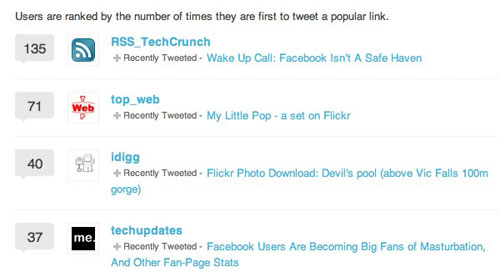
Today,Tweetmeme expanded its offering with a pair of new features aimed at making the site more sticky. The first is a tag cloud, which analyzes the shared content, finding other words that Twitter users have included in their tweets, and displaying them below the items in their "popular links" page. The second is a leaderboard, which highlights those Twitter accounts which have most frequently been the first to share the most popular links.


In terms of determining influence and popularity, you've always seen a push/pull between enabling a gatekeeper with the power to move items up and down, and letting the crowd decide. Tweetmeme believes solely in the crowd - even featuring the total number of times the item was shared. Today's top shares are in the 400 to 600 range through all of Twitter.


Accounts on the leaderboard aren't much of a surprise - including RSS feeds for TechCrunch, Digg, popurls and ReadWriteWeb, for example. Additionally, the cloud below each item is tempting to click, but not functional. In theory, it'd be good to click on an item in the tag cloud and see other shared links that have the same tags. Maybe that's coming, but it's not yet here.

You can catch up on the most popular items, as determined by Twitter, at http://tweetmeme.com/.

January 9, 2009

January 9, 2009 · 6 MIN READ · BY LOUIS GRAY

10 Ways to Maximize Your Google Reader Link Blog

10 Ways to Maximize Your Google Reader Link Blog

I've been sharing articles I've read in Google Reader for the better part of two years. I don't know exactly when I started, but I'm fairly sure I'm nowhere near finished. And while I admittedly started sharing to a link blog without having a clear goal in mind, I'm finding that this massive shared items repository is becoming an incredibly versatile information hub that benefits me, the authors of articles I've shared, and the consumers, be they friends in Google Reader, or in many other locations.

I believe that while Google Reader has grown in visibility, arguably becoming the most popular RSS reader on the Web, the utility of shared link blogs is less known. Here are ten ways you can maximize your Google Reader link blog - most of which I'm doing, and probably didn't anticipate when I first started sharing items into the ether.

1. Act as a trusted information filter.

Regardless of how fast a reader you are, there is no possible way you can read every single news source and blog on the Web. Neither can anybody you know. And regardless of how closely your feed match percentage is on Toluu, there are feeds you read that your friends don't. By sharing the best items of what you read every day from Google Reader, you are hand-selecting the best of the Web and "endorsing" those items to your link blog subscribers.

Do so with some regularity, and you might be surprised as to how people come to rely on your manual intervention and news discovery. I first became cognizant of this in February when "SeekGround" reported "I discovered that I had shared more of louisgray's shared items than anyone else's in the last 30 days". In May, Duff's Device similarly wrote: "I saw another article that I received from Louis Gray'sGoogle Reader Shared Items again. Thanks for keeping on top of the world for me Louis. :-)"

As of tonight, ReadBurner reports I have nearly 8,500 articles shared on my Google Reader link blog. While there are others who have shared more total items, I know that I have shared those items I believe are most interesting to me, and others I believe are following along.

2. Share your items with Google Friends.

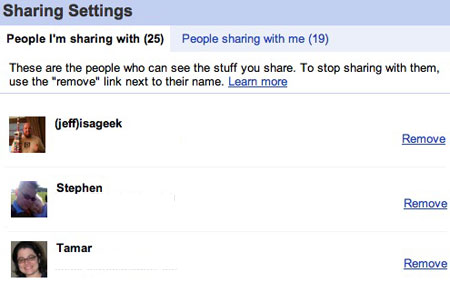
Though Google hasn't nailed the "what is a friend" issue, you can add friends through GMail and Google Talk. If they are also Google Reader users, and share items, you can opt in to seeing their Google Reader shares, and they can see yours. If they subscribe to your shared items, your shares are mixed in with all the other feeds on their list. Of course, if you don't want to see their lists, click "Hide" next to their name, or "Show" to bring them back.


3. Embed your Google Reader link blog to your own blog or Web site.

When I first started sharing to my link blog, I had this odd feeling I was sharing posts and nobody knew about it. After all, the link blog URL isn't the most intuitive on the planet. But you can embed a widget on your blog to display a subset of your recently shared items, and visitors to your blog can click out to items you've shared.

4. Add your Google Reader link blog to your Google profile

Your Google profile is a fairly blank slate, for you to add or delete as you please. While it's very common for people to add links to their Twitter page, their blog or their LinkedIn profile, I'd suggest it's just as important to add your link blog to the page. Mine is here.

5. Share items to Facebook, FriendFeed or Socialmedian.

2008 was the year of personal news aggregators, which took updates on your services from around the Web and put them all in one place. While this trends was best exemplified by FriendFeed, Facebook also offers the option to feature your Google Reader shared items, and Socialmedian will pull them in as news, going so far as to check the shares by topic to place them in the right categories.

You can see my Google Reader shares on FriendFeed here. And to avoid duplication of items, if I share items from louisgray.com, I manually delete them from FriendFeed. Takes seconds, and reduces the noise. (My Socialmedian page is here...)

6. Add your share count to ReadBurner, RSSmeme or Feedheads.

Feedheads, the pioneer in tabulating popular Google Reader share counts, was joined by ReadBurner and later RSSmeme, in early 2008. As some people are turning to ReadBurner and RSSmeme as a democratically sorted Digg or Techmeme, sharing items you like will add your vote to the list.

Be sure to add your feed to ReadBurner here.

7. Replace your bookmarks with Google Reader shared items.

At the end of the year, I said that RSS Has Practically Eliminated My Need for Browser Bookmarks. As I thought about it more, it's my Google Reader Link blog that is essentially my rolling bookmark list, highlighting those items which are the best, and which I will want to return to. While Delicious is also a good Web-based bookmarking system, the link blog is a good way to find recent items of interest.

8. Expand the visibility of lesser-known sources.

Sometimes, I get in a routine of reading my RSS feeds and then sharing, without thinking about how the shares are effecting the downstream author. But I've gotten e-mails saying the shares have generated attention beyond what I expected. Last month, one blogger wrote, "When you pop an article on (the linkblog), I'll get 60-70 hits and get pumped to the first page, that is pretty averge for the support you give me." Earlier this week I got a similar e-mail from a second author, who wrote an e-mail titled "Thanks yet again", adding "Your Google Reader share really lit up that discussion."

In a tech blogging world where there are so many different sources of news, and so many people writing about the exact same thing, you can make a difference by choosing lesser-known sources of news, and highlighting the best content, not just the loudest. I've tried to share items from those who have done original reporting or are thinking differently than the echo chamber, and it in turn can deliver greater visibility.

9. Use your linkblog as your "to comment" list.

As part of my online new year's resolution, I said I would be making more time to comment on other blogs through the year. But as you know, my full-time job doesn't work all too well with browsing the Web and making comments throughout the day. Instead, I've found I'll go back to my own Google Reader linkblog, and open the items in a new tab, and go through to add comments one by one, left to right, so I've given the authors feedback and participated.

10. Create your own leaderboard of news sources.

Google Reader tracks statistics on what your most-shared news sources are over the last 30 days, which can report on who you've found most interesting in the last month. Given each person's individual tastes, the results can be very different than more public leaderboards which tend to feature those who are most popular and have a deeper subscription base. While my own link blog does tend to feature popular sites like TechCrunch, Scobleizer and ReadWriteWeb, I can see that I've also shared a high number from lesser-known sites, including TechWag, Regular Geek, The Future Buzz, Andy DeSoto and Chuqui 3.0. And if you're stat-oriented like I am, you can check in and see how this changes over time. (See my blog leaderboard from last July)

So... are you sharing your Google Reader items? I am. You can find mine here. For the betterment of the community, it'd be great to see your shared item links in the comments.


DISCLOSURE: I am an advisor to ReadBurner.
January 9, 2009 · 2 MIN READ · BY LOUIS GRAY

Does Your Ethical Stance on Rumors Change in a Down Economy?

Does Your Ethical Stance on Rumors Change in a Down Economy?

By Cyndy Aleo-Carreira of Shakespeare I Ain't (E-mail / Twitter)

Tech blogging is just as competitive, if not more competitive, than mainstream news. Nearly every blogger salivates over the tiniest little rumor that could turn into the scoop that lands you the top spot on Techmeme or the front page of Slashdot or Digg. It's practically become acceptable to run with the unconfirmed rumor in order to make it out of the gate first.

Should that codicil to a blogger's code of ethics be removed in a down economy?

Two notable stories have "broken" so far this year that lack confirmation. The first, making its appearance on Gizmodo this past Monday, had Steve Jobs passing on the Macworld keynote because he's allegedly on his deathbed. The second, also breaking on Monday, had SD Times claiming Google would put Juniper out of business by coming out with a hush-hush router to end all routers.

Apple still had a new 17" MacBook Pro and some sexy software upgrades, but Juniper didn't fare so well, dropping steadily throughout the week with a huge dip this morning as the story about the stock falling and the alleged Google router hit the mainstream press.

Are either of these stories true? Looking at past history and the companies involved, I think it's pretty safe to say that Steve Jobs is sick. That's been apparent since the rumors of his imminent demise started swirling after his appearance last year. However, Steve Jobs is not stupid. I don't think he would let things get to the point where he's on his death bed before taking some steps to turn over control of the company, and speculating that he's got one foot on a banana peel over a grave is gossip, not news.

As for Google and Juniper, it's no big secret that Google wants things Google's way. Is Google going to go into the hardware business and compete against companies like Cisco? Never. It's simply not going to happen. If they weren't willing to do it for a consumer device like the rumored Gphone we were all salivating over the idea of years back, they certainly aren't going to do it on a scale like routers, where failure would be catastrophic. But they have Android, and they've shown a desire to apply their software acumen to existing hardware issues. Is it conceivable they are planning to (or already are) working with a hardware company, much as they did with HTC on Android? I might bet a few pretzel sticks on that.

Based on the evidence, however, Google isn't going to topple Juniper, and we aren't going to see Cupertino shrouded in black crepe any time in the near future. And in a climate where tech jobs are on the chopping block and companies are scampering to drive their stock back up to appease shareholders, going for the big dramatic story rather that looking at the facts is going to end up with all of us out of work. If the tech companies go under, so do the jobs writing about them.

Read more by Cyndy Aleo-Carreira at Shakespeare I Ain't.

January 3, 2009

January 3, 2009 · 5 MIN READ · BY LOUIS GRAY

Armchair Quarterbacking and Why I Talk to Companies Using the Blog

Armchair Quarterbacking and Why I Talk to Companies Using the Blog

Whether it's due to the fact it's another 'slow news' weekend, or due to the fact I was more bare in my recommendations for how FriendFeed, a service I am constantly using and like a lot, could improve in yesterday's post than I usually am, there was quite a bit of feedback from around the Web, which both echoed the comments I had made, and questioned the reason for my making them in the first place. Interestingly enough to me, despite a full year or so of being called a FriendFeed addict, apologist, or what have you for my consistent favoring of the service, several people tried to construe my direct suggestions as somehow interpreting the site would fail - which I don't believe I ever came close to saying. But what they missed was I have a history of offering suggestions to companies, both new and established. Sometimes, I can do this 1-1 with the developers, but often I use the blog.

A person's blog can be whatever they want it to be. It can be your brand. It can be a megaphone that allows you to speak to many at once. It can be a personal diary. I've chosen to make mine about services I find interesting, and to a lesser extent, about me. The posts I make are about services I encounter and usually care about. I tell you how I feel or what I saw, and make it personal. And when I give feedback about companies, it comes from my thoughts and usually is spat out top to bottom as I was thinking about it, with little organization - just raw.

And given the blog's relative obscurity in 2007 and 2006, it's likely few saw my original set of feedback I offered FriendFeed more than a year ago - and how it mirrored other occasions where I've done similar posts for other services.

For example:And I haven't always been nice. See: Fav.or.it Beta Effort is Not My Favorite. Not Even Close. and After Monkeying Around, I'm Not Going Bananas for Chi.mp, for example.

On August 29th of 2007, I wrote that you should Use Your Blog To Talk To Companies, and I've been doing that. I do it because as consumers we are often the silent party in the buyer and seller relationship. The company controls the product, the message, the delivery method, and tells you how you should use it. As a consumer, you can buy it, and you can be satisfied, or not. I tend to believe that as a consumer, I may have some ideas that the company either didn't think about, or didn't think were as important as other items. By using the blog, I can make my opinion clear, and also act as a sounding board for other people who might have shared the same opinions, but didn't know where to start, or thought they were alone.

Just look at some of the comments I saw on Twitter following yesterday's post:
@elizabethsosnow: "I am one of the stale accounts."
@spinko: "Louis Gray talks about friendfeed and how it's not intuitive for new users like myself. Amen, I still don't get FF."
@maryhodder: "just read the Louis Gray article myself.. agree. FF is overwrought and makes me feel like i'm drowning."
@jayrosen_nyu: '"Simply put, people aren't getting it." Louis Gray on FriendFeed's barriers to intuitive use. I'm one of those people.'
Sarah Lacy said she is one of those people I described in yesterday's post who pipes their data in and gets a lot of followers, but doesn't participate. For whatever reason, FriendFeed hasn't won her over, and she says the company didn't try to engage her inactive account (one of the suggestions I had yesterday).

I mention these not to pile on, but to show the post started a discussion of people who weren't thinking about the issue, and might possibly have extended the visibility of the issue to others who thought everything was "just fine". As Duncan Riley of the Inquisitr said, FriendFeed Isn’t Dying, and I never said it was.

What I chose to do with yesterday's post, and the many before it was to speak up where the above examples had chosen to be silent. Mark Trapp called it 'Armchair Entrepreneuring' and said I could collect more flies with honey than vinegar, adding, "Offering feedback is one thing: but the sheer hubris of tech bloggers that they know how to run a company better than the ones actually running it is entirely different." But I wasn't aiming for hubris, nor was I aiming for linkbait, as my cranky Canadian friend, Steven Hodson, suggested I might be. What I was doing was sharing my candid thoughts about a service I really like and one I want to get better and better.

I use the blog because it is public. It is searchable and others with similar issues can find it. I use the blog to talk to companies because very often, they listen. Many of the suggestions I've given to LinkedIn, to Google Reader, to FriendFeed and others have happened. I'm not naive enough to think it was because I recommended they would, but it tells me I occasionally am on the right track.

I will armchair quarterback and keep talking to companies, as Dave Winer says, to help them, not to hurt them, and to help others. And sometimes, companies really do value the feedback. That's part of why I'm working with ReadBurner, SocialToo and engaging with others informally. It's about pushing people who make products to make them even better than they are now, and potentially, being part of that process.