Silicon Valley Technology Commentary & Archives · Est. 2006 3,045 Posts · 2006–2026
Showing posts with label TweetMeme (14 posts). Show all posts

December 10, 2009

December 10, 2009 · 1 MIN READ · BY LOUIS GRAY

Talking With TweetDeck and Tweetmeme at LeWeb

Talking With TweetDeck and Tweetmeme at LeWeb


At LeWeb 2009 here in Paris, France, I participated in a panel on Twitter applications and the Twitter platform, featuring TweetDeck, Seesmic, TwitterFeed, OneForty.com, my6sense, Ping.fm and Microsoft. Following the panel, I sat down with Iain Dodsworth of TweetDeck and Nick Halstead of Tweetmeme, getting the opportunity to talk with each of them about the origins of their product, how they are working with Twitter, and what's next. In these free-form podcasts, we also talked about competition, business models, and their approach to innovation.


Talking With Tweetmeme's Nick Halstead


Talking with TweetDeck's Iain Dodsworth


Both podcasts were recorded using CinchCast on the iPhone from BlogTalk Radio.

November 7, 2009

November 7, 2009 · 2 MIN READ · BY LOUIS GRAY

TweetMeme to Soon Offer Individual Channels for Top Links

TweetMeme to Soon Offer Individual Channels for Top Links

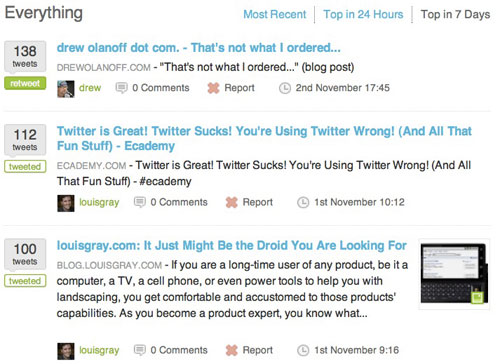
TweetMeme, the popular site that highlights the hottest links distributed on Twitter, is working on a new feature that will soon be opened up to all users - a dedicated channel that shows the links you have posted to your Twitter account, how often they have been retweeted, who the original sender was, and the most popular items you've sent out over the last 24 hours or seven days. Essentially, the service follows your updates, crawls your links, and produces a single page just for your activity. While the service is not yet live for everyone, it has gone into limited testing.


To date, TweetMeme has divided top links by categories, including comedy, horror, climate change or tech topics including Google and Firefox. The new roll-out treats each user like their own category, so you could expect to see pages with user names instead.


Top Links from My TweetMeme Channel in the Last Week

An early example of such a dedicated page, for my activity, can be found here: http://tweets.louisgray.com/. In the future, TweetMeme hopes to make it easy enough to "skin" the page to look like your Web site, and will even offer widgets to highlight your most retweeted tweets. To make mine listed on "louisgray.com" instead of on "tweetmeme.com", I set up a change in my blog's CNAME record.

Should you want to, you can subscribe, via RSS, to all links distributed from these dedicated channels, or you can subscribe to a subset of the items.

For example:
Top items from the last seven days can be found here, while those from the last 24 hours are on this page.

The page is a preview, but will be made available to the world soon enough. TweetMeme has a lot of news planned over the next month, and will be presenting at TechCrunch's Crunchup on November 20th, so watch their blog for more on this and other new features.

November 4, 2009

November 4, 2009 · 1 MIN READ · BY LOUIS GRAY

TweetMeme Goes Mobile for iPhone, Android, BlackBerry

TweetMeme Goes Mobile for iPhone, Android, BlackBerry

TweetMeme has rapidly become the most popular and practical default engine for content authors to enable their Web sites and blogs to be forwarded on to Twitter (in the form of a Retweet). The company is now serving more than 100 million Retweet buttons across the Web each day, and is aggregating the statistics of most popular items on its Web site. Today, the company jumped forward, introducing a new capability that lets users retweet from their favorite Twitter apps - as many people, including me, do not use Twitter's standard Web interface when unchained from the laptop.

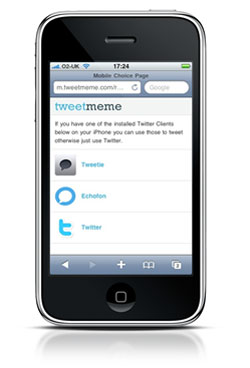
The new functionality essentially tracks if you are viewing a site through your mobile phone, be it iPhone, Android or BlackBerry, and then prompts you to select your preferred application - including those from Tweetie, Echofon and others. And if you don't yet have a mobile application on your handset, TweetMeme will provide some suggestions.

I spoke with Nick Halstead, creator of TweetMeme, this morning, and he said the new mobile functionality is yet another reason the product has stayed ahead of competition and copycats. "We want to respond by being as far ahead as we are, and creating more functionality," he said. "Not many people use mobile Twitter. When you hit the retweet button, it opens the application you have selected and it will do the retweet from there."

The new functionality will be available very soon. You can see their official post on the TweetMeme blog: Mobile Retweeting

October 3, 2009

October 3, 2009 · 5 MIN READ · BY LOUIS GRAY

It's Twitter's World: The Second, Parallel, Internet

It's Twitter's World: The Second, Parallel, Internet

It's Twitter's world. We all just live in it. I just looked out the window from my home north toward San Francisco and saw the sky tinged with a teal blue that spanned the horizon. While at this time last year, you could only see the faintest blue with a telescope, over the last several months, the blue light has grown ever brighter - almost blinding, to the point I can't even see Moffett Field from my condo in Sunnyvale. I've heard that SFO has even had to divert flights from landing on its North-facing runway after sundown thanks to this radioactive-like glow emanating from Twitter headquarters, as it has proven distracting to pilots who more than once have fallen into a trance-like stare, unblinkingly gasping in 140 characters or less. And I fear even with these precautions, it's only a matter of time before something bad happens. You can retweet that.

Try as I might to not be in this Silicon Valley bubble, I can't practically go anywhere or talk to anyone without hearing the word Twitter. "I've got to Tweet that!", one person exclaims. "Overheard!" cries another. "Hold on - let me check into Foursquare," says another guest at dinner, with the white artificial light glowing from his iPhone to his chest, tucked away behind the dinner menu. A phone call comes... "Did you see my tweet? Isn't that cool?" Even my iPhone apps, which I invited into my home, want me to tweet my high scores.

Sigh.

And if that weren't bad enough, many people practically expect that I have reserved Twitter user names for my 15 month-old twins. They can't yet talk, and their excitement around a laptop is practically limited to smashing the keys and being fascinated by the green light on the Caps Lock, but I am supposed to have secured their Tweeting future. Negatory on that geek rite of passage.

To be honest, it's not as if I am a hundred percent opposed to this change. If my life is to be "live tweeted" for the rest of my days, and future marital contracts will include a clause on whether one's twitter handles will change on the day of matrimony, so be it. I can accept the fact that this product, bluer than Viagra, which makes you type out messages as if you were stoned on marijuana at the speed of a crack addict, is habit forming. It's infrastructure - the new e-mail. It's the social networking glue that connects my phone and my RSS to various downstream networks. It is home to a community of people who have made their own "tweetspeak", who engage in "tweetups" and read books made "for dummies" to use Twitter - since clearly, it's so hard.

Regardless of whether you think Twitter is worth a billion dollars or a bazillion dollars, or think it's just Monopoly money, I can't help but think Twitter is running an end-around play on Google. While Google has the broadest horizontal index of pages, and is busy scouring an amazing mountain of sites to get their every word, Twitter, in a vertical approach, is getting the world's updates, and a similarly overwhelming number of links being shared. While I don't have the numbers behind me now, it would not surprise me if at some point soon, the absolute number of links (including duplicate links) shared via Twitter exceeds the net new URLs discovered by Google each day. And you can forget about linking instead of retweeting. That's the old way for Web 1.0 dinosaurs.

Twitter is practically becoming a parallel Internet. It may live on HTTP, but don't let that fool you. Over time, most folks may tell you the T's in HTTP stand for "Tweet Tweet".

In February, I said Facebook's success made it the social media prism, through which other activity would be referenced and measured. But the sheer volume of updates from Twitter is drowning all the downstream networks. If you have an aggregation service, be it the Facebook news feed, FriendFeed (now part of Facebook) or Ecademy's NetNews, you almost have to seek out posts that are NOT Twitter to find the diamonds in the rough.

Twitter is a firehose, not just for those who have glued their eyelids open, working hard not to miss a single update in TweetDeck or Seesmic, Tweetie, Brizzly, Hootsuite or a million other apps, but in terms of its sheer mass being able to render competing networks irrelevant. Facebook may be bigger today by a large margin, but it is Twitter that has the buzz. It is Twitter that is forcing the change in language, and making our LOLspeak the new standard.

Twitter was supposed to be simple. Update me what you are doing. But the community saw beyond that, helping make this product, best defined by its limitations, something else entirely. Products like TwitPic were made which helped users easily share images and videos. Users found ways to use hashtags to rally around events and causes, introduced retweeting to forward interesting items, and @replies to talk directly with one another. Directories like WeFollow were set up, without Twitter's help, to more easily discover like-minded users, and sites like Tweetmeme debuted to show the most popular links out there.

Like it or not, Twitter has become the standard for short communication. For the many of us who liked our own favorite service which we believed did more and had more flexibility or options, we were vastly outnumbered by the masses who are drinking the bright blue Kool-aid. Even as I, and others, may drag our feet reluctantly, we know we don't have a choice. Businesses who scoff at the usefulness of "The Big T" now recognize it is just another marketplace, and everybody is selling something - be it a real product, or a personal brand. Spammers love it. And that's a sure sign that you're on to something big.

To question if Twitter is going to crash and burn now under its newfound publicity and ridiculous expectations is like saying Bing's decision engine is going to make Google go bankrupt. You might as well rail against e-mail and hope it dies a quick death. Twitter owns you. Just check their recently updated terms of service. It's in there. And I promise you that you are a nobody until you've been selected to join the Suggested Users List. That's where all the cool people are. It's Twitter's world.

August 24, 2009

August 24, 2009 · 3 MIN READ · BY LOUIS GRAY

ReTweet.com's Rip-off Of TweetMeme Is Embarrassing and Wrong

ReTweet.com's Rip-off Of TweetMeme Is Embarrassing and Wrong


I thought it was a bad sign at the end of 2008 and first half of 2009 when practically every new service or application that came my way was simply an extension to or enhancement of other already-popular social networks, almost always for Twitter, Facebook or FriendFeed. Even then, the cacophony of noise around Twitter practically drowned out all of it. Amid an unrelenting flurry of Twitter clients for desktop and Web and Twitter tools for unfollowing, grouping, analyzing and reporting, we also had a rush of Twitter-related sites, all aiming to find their own special niche. Among the most successful, after a slow start, was TweetMeme, the brainchild of Fav.or.it founder Nick Halstead, who managed to repurpose the company and ride the wave of Twitter and retweeting at the perfect time. Seeing his success, a new challenger with a killer domain name (ReTweet.com) is looking to unseat him, by essentially doing the same thing - tabulating the most popular shared items on Twitter.

Scratch that. They're doing the exact same thing, and the complete copycat style is insulting to anybody who deigned to take them seriously. While I had seen complaints about copyright infringement and code borrowing, I had no idea how terrible the attempt had been until tonight, when it became crystal clear how much ReTweet.com stole from TweetMeme before hitting the publish button.

On first glance, both sites display what you would expect - popular articles from often retweeted sites like Mashable.com and the comic XKCD.com. Popular post titles have very similar numerical scores, as you would also expect - varying as little as just over 1 percent on articles that have more than 1,000 retweets. And yes, both let you dice and slice the data by one day or seven (although ReTweet.com calls it one week instead of 7 days and TweetMeme.com calls it 24 hours instead of 1 day. You get it...).

I've seen Digg and I've seen Digg clones. I've seen popular aggregators and their clones. I've seen social networks and their clones. And I recognize that sites that serve similar functions are yes, going to look similar. But once you move past the similar front page, the blatant stealing is jaw-dropping.


TweetMeme has a top level navigation bar, which read from left to right, says:
  1. Home
  2. Comedy
  3. Entertainment
  4. Gaming
  5. Lifestyle
  6. Science
  7. Sports
  8. Technology
  9. World&Business
In remarkable non-contrast, ReTweet.com features this:
  1. Home
  2. Entertainment
  3. Gaming
  4. Lifestyle
  5. Science
  6. Sports
  7. Technology
  8. World&Business
  9. Everything
Wow. Did they really think we were so dumb as to not notice they had the exact same title headers in the exact same order? Even down to the ampersand in "World & Business"? Really?

I don't even want to begin to understand why people think this is okay. While Nick and I once disagreed about his first product's direction and how well that beta was prepared, I never questioned his company's trying to do something different in a competitive landscape. But what ReTweet.com is doing is upsetting. While a service like TweetMeme.com was practically inevitable, and competition is healthy, this kind of stealing and underhanded non-innovation is troubling. If this is what is acceptable from engineering teams these days, then innovative services have got to be worried about protecting their intellectual property.

When, at last month's Lunch 2.0 panel, I asked Bret Taylor of FriendFeed how he felt about services like Facebook and Google Reader borrowing aspects of FriendFeed, such as the "Like" feature, he said he felt "good" because he was making an impact on the Web and it showed alignment between differing Web properties, adding he didn't feel the company could patent words on a Web page. But I am sure the level of copycat dunderheadery on the part of ReTweet.com is not something any of us should "feel good" about. If you want to compete in this space, and you want to take on a market leader, you have got to make sure you offer real differentiation based on different source data, different splicing, different display or different intent. This attempt is a sorry gimmick that has got to have the TweetMeme.com team seeing red, and rightly so.

I'm done linking to ReTweet.com now. The next time I want to be writing about them is if they get sued or when they close down. Not impressed. This kind of launch is bad for innovation and bad for the Web.

August 13, 2009

August 13, 2009 · 2 MIN READ · BY LOUIS GRAY

Twitter to Embrace Retweeting, Releases Developer Preview API

Twitter to Embrace Retweeting, Releases Developer Preview API

For many people using Twitter, the act of retweeting is a major part of how they help share information. Popular Web sites, such as Tweetmeme, have developed to show the most popular tweeted items each day, frequently highlighting the largest Twitter accounts. And while the act of retweeting hadn't always had official blessing from Twitter, who has literally watched the system develop underneath their feet, the company looks to be fully embracing the activity - promising to make it natively supported on the service's Web site, and today, introducing a preview to developers that will help them take advantage of the new functionality.

In a posting to the Twitter API Announcement Google Group, Marcel Molina, a member of Twitter's Platform Team, explained that not only is the company only "weeks away from being ready to launch" support on their end, but they want developers to have enough time to prepare their apps to launch alongside Twitter when that day comes. It's a great move in light of frequent developer complaints that have said Twitter often makes changes without giving them advanced notice.

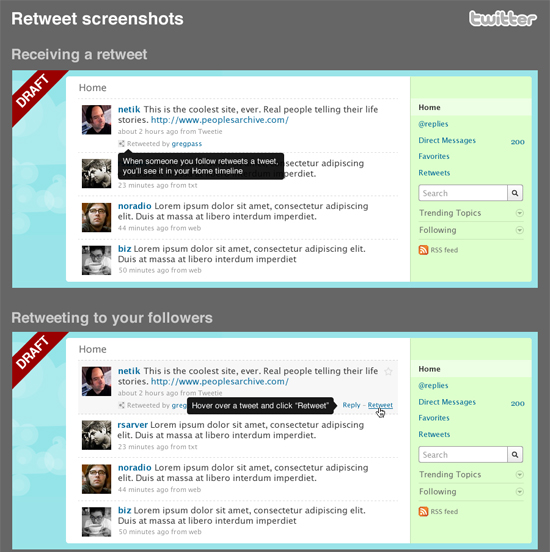
Screenshots accompanying the note show that not only will you see that items have been retweeted, but you will now have language that makes "Retweet" as easy as "Reply", just by hovering over the individual message.


Interestingly, the screen capture shows that if an item has multiple retweets, that you can see the IDs of who has retweeted the individual message. That could get very busy for the most popular accounts, so I assume Twitter has considered what would happen if a note gets a dozen or even hundreds of forwards.

Not only is Twitter embracing the retweet, something I personally have avoided for the most part, but they have done so in a way that makes the retweets visually different than standard notes, so you don't wonder about the originator, or if you did "RT" correctly. The new process should be available in a few weeks, and in applications around the same time, if developers get busy.

The company has also added a note to their blog:
Project Retweet: Phase One

August 8, 2009

August 8, 2009 · 1 MIN READ · BY LOUIS GRAY

Favorit Shuts Down As Company's Focus Turns to TweetMeme

Favorit Shuts Down As Company's Focus Turns to TweetMeme

At one time, I thought Favorit was going to be the application that weaned me from Google Reader to consume all my RSS feeds. After Robert Scoble speculated it could be a serious challenger, thanks in part due to aggressive pitching from its author, Nick Halstead, I waited four months, as the product incubated, before I got my hands on it, and when I finally gained access, I was significantly underwhelmed, writing up one of the most negative pieces I've done here on the site - which, in retrospect, wasn't very nice.

Following my write-up, Nick was understandably frustrated, saying he didn't know why he gave me "the time of day", following on with a post titled "Missing the point".

While possible, some things changed after our exchange. First, Favorit came under fire from Duncan Riley and the Inquisitr for what he called "splogging". Second, Nick felt RSS was "dead for the mainstream market" later in 2008, and third, and likely most impactful, his follow-on project, TweetMeme took off like wildfire, riding the bullet train that is Twitter.

In a post issued today, saying "Fav.or.it is Dead, Long Live Favorit", Nick expands, saying:
"TweetMeme became our focus for several reasons, firstly the trend towards status messages (micro-blogging) meant that access to real-time news was becoming a reality and that our aggregation + filtering technologies could be very quickly leveraged to take advantage of it. Secondly, our simple approach to delivering what websites desired in the form of a retweet button very quickly got traction..."
The combination of one product becoming less than everyone anticipated in parallel with one becoming a recognized leader in the real-time search and ranking space made the decision clear, and largely anticipated. That Nick and I tangled over our interpretation at the beginning was unfortunate, but I think we've both learned from it and have grown from the experience.

May Tweetmeme live and see a much better fate.

July 17, 2009

July 17, 2009 · 1 MIN READ · BY LOUIS GRAY

TweetMeme Rolls Out RSS and E-mail Buttons, Statistics

TweetMeme Rolls Out RSS and E-mail Buttons, Statistics

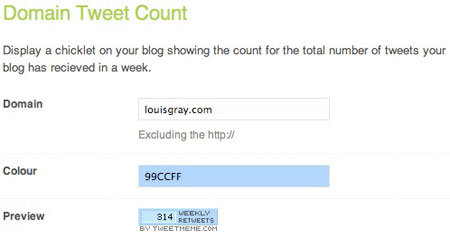
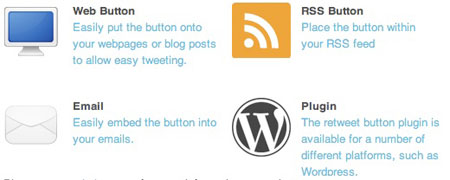
As promised earlier this month, TweetMeme, the leading site tracking the most popular shared links on Twitter, has introduced a number of new tools that help publishers and bloggers encourage readers to distribute their stories through the popular microblogging network, all while tracking their statistics. The new tools include a FeedBurner-like chicklet that tabulates the total number of shares in the last week, and new buttons that can be embedded in your RSS feed or E-mail.


TweetMeme's New Retweet Chicklet Counter

Earlier this year, I added TweetMeme's standard "Retweet" button to posts, recognizing visitors often may want to share content they have just read with their friends on Twitter. But running standard Javascript doesn't work on RSS and E-mail, so many of my downstream readers didn't see I had done a thing. The new version operates as a standard clickable image, making this retweet functionality available to people visiting sites natively, or through Google Reader, Feedblitz or any other similar solution.


TweetMeme Tabulating Statistics By Domain On Their Site


The Four Ways You Can Integrate TweetMeme Into Your Content

TweetMeme also continues to offer a WordPress plugin for those blog authors on the platform.

In parallel with today's introductions, TweetMeme is aggressively making sure they don't undercount your sharing numbers. With today's introduction, they have added support for 11 different URL shorteners, aggregating all of these shortened URLs back to the original source and giving the author credit for the share.

TweetMeme is seeing incredible growth, having jumped on the back of the fast-accelerating Twitter at the right time, and today's introductions will no doubt further cement their role in the sharing and counting ecosystem. You can see the new chicklet in the right side of my blog, next to FeedBurner stats.

July 12, 2009

July 12, 2009 · 6 MIN READ · BY LOUIS GRAY

What Is This Real-Time Thing, And Where Is It Going?

What Is This Real-Time Thing, And Where Is It Going?

The final panel at Friday's CrunchUp focused on the phenomenon of real-time, featuring a high-profile panel complete with representatives from Google, Microsoft, TweetDeck, TweetMeme, Seesmic, FriendFeed, Stanford University and a pair of venture capitalists. The discussion ranged from the opinion that real time was simply yet another feature, or a revolution in terms of application and Web service development, while the panelists discussed revenue opportunity or how large companies would try and control the data from being shared with competition.

Iain Dodsworth of TweetDeck said that his own experiences using his Twitter application had a dramatic impact on how he was using the Web. "I was using TweetDeck more than anything else," he said. "I wasn't using e-mail or RSS and this to me was a massively big deal. I wasn't going to Web pages any more. I was going to stream data and that was what I was consuming now."

And while Dodsworth and many of us early adopters may have gotten to this stage before a more mainstream audience, the trend seemed to be recognized across the board. Google and Microsoft representatives talked about how they were working to best harness the real-time phenomenon, with the advent of Google Wave, and in Microsoft's case, trying to find ways to improve the user experience for hundreds of millions simultaneously, all while maintaining a stable infrastructure.

David Hornik of August Capital Venture Partners said he believed the advent of real time was "an important piece of the evolution", harkening back to what he called the "dark days of RSS" where that was considered real-time. He said that the problems faced in the early days of RSS, around sorting and filtering, had only escalated since, saying "we have that problem in spades".

A relative newcomer in the shadows of monoliths like Google and Microsoft, FriendFeed has helped push the envelope on the world of real-time as much as practically any other service, spurring on social networks like Facebook to do the same. Representing the company, co-founder Bret Taylor said real-time was no longer becoming an oddity, but instead a core aspect of the Web experience.

"Real time is an important feature of every site. It can now be said that every product evolves until it has e-mail, a social network and real time. It is something that all products will incorporate," Bret said, adding that one of the biggest challenges in this new realm was how to display the stream of data. "There is a tension between the simplicity of chronology and the need for filtering and ranking. You don't want to lose the feeling that you know something when it comes out. You need a mix of things that recently happened with things you need to see, and get a sense of both. If something is missing, users get an uncomfortable, anxious feeling."

And it is the user experience that will likely make or break services, in terms of how they can master the flow. Kevin Marks, who recently left Google, and announced that he will be joining British Telecom to work on standards, said it is about finding value in the data.

"It is about the flow and sense of flow," said Marks. "Real-time is one piece of that dimension and preserving history, so it can be found again and discovered later. This is something that FriendFeed is doing better than Twitter. Those things that used to be real time are now stored."

And storing the data for later consumption is getting increasingly difficult as the total volume continues to skyrocket. Andreas Weigend of Stanford noted the total volume of data had increased an order of magnitude just in the last five years.

"The real-time aspect is one way to incentivize people to make actions with their data," Weigend said. "It is not just about the data, but what question you ask, and the experience. It is how fast it is for me to get a question answered. The real-time aspect is the timescale of innovation being an order of magnitude faster."

But while everyone on the panel clearly recognized that real-time was being integrated into many services, and users were looking to make sense of the data explosion, there were clearly concerns about interoperability, and having services communicate well with others. Often, the current situation was compared to the wars that once were rife in the Instant Messaging world, where different providers simply did not communicate - such as from AOL to Yahoo! or MSN. Not surprisingly, much of that debate was on the two largest providers - Twitter and Facebook.

Bret Taylor hoped that the battle would be different this time around, pointing specifically to the work Kevin Marks and others have pursued around standards.

"Users will demand interoperability," Bret said. "If your friend uses Twitter for broadcasting shared links and if you use Facebook, it is reasonable to be frustrated about that. If (somebody like) Yahoo! wanted to compete, they wouldn't need to compete, they would have to set up ad hoc or formal standards and it would just work."

Daniel Lewin of Microsoft agreed, saying, "As long as you adhere to core standards, which we are committing to, there is an evolution of use cases. People experiment, interesting things will happen, and as time rises, there will be capabilities where end-users will program what they want."

In many cases, the move to real-time came as developers and users grew tired with slowness elsewhere. As we have discussed a few times, in terms of the speed of RSS versus that of Twitter, FriendFeed and other networks, there can be a gulf between what was previously acceptable and what is expected now. It's a major reason why, for instance, Nick Halstead and the team at TweetMeme started to focus on their current product more, and less on their original site, Favorit.

"Real time is about collecting news in real time," Nick said. "The slowness of Feedburner is quite well known and we didn't realize it until we ran TweetMeme and we would see it two seconds later. We would go fetch it and find it 20 minutes later on Google. The important thing is instant. You press the button and it goes back to Twitter. It is fun for me to watch FriendFeed. I push retweet and it shows up on seconds in FriendFeed. The trends we see appear and something might get retweeted 50-60 times in 20 seconds and we can bubble it up in front of users interested in those things, get the content in front of people who want to see it."

And it's not just Twitter that's pushing the gas pedal. Loic Le Meur of Seesmic said the company is pushing more than 4 million API calls to Facebook per day. Just yesterday, Loic added the number of active users on Facebook had doubled in a single week.

Loic added, "It's not about the tool. It's about the people, realizing they have communities around themselves. It will go from tool to tool. In a few years, it might be our tools, and it might not. What matters is how it transfers to real life."

The conclusions? We are at the very beginning, still, of determining how to best harness the firehose of real time data. Tools like Twitter Search, FriendFeed, TweetDeck, Seesmic, TweetMeme and others are working to parse the signal from the noise. It's suggested that real-time will become a major part of many applications going forward, and users are still going to be in the experimentation phase of how they imbibe the data, or in terms of what kind of interfaces they will use to be best satisfied. There remain concerns about openness and how companies will play well with each other, especially if they are in a leadership position. And it's very likely that in five years, many of the names we consider household names today may be gone, replaced with others. It's all going to play out in real-time in front of our eyes.

July 4, 2009

July 4, 2009 · 3 MIN READ · BY LOUIS GRAY

As Retweeting Rises, Linking Continues to Decline

As Retweeting Rises, Linking Continues to Decline


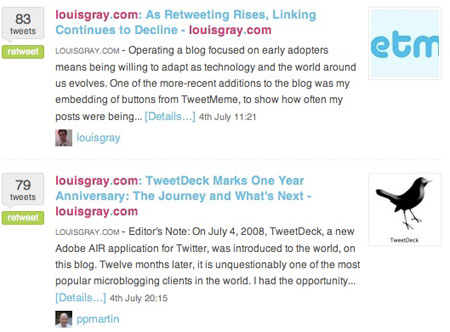
Operating a blog focused on early adopters means being willing to adapt as technology and the world around us evolves. One of the more-recent additions to the blog was my embedding of buttons from TweetMeme, to show how often my posts were being linked to on Twitter, and making it easier for others to retweet these items, even thought I've already gone on record as not being a big fan of retweeting myself.

I made the change not because of a change in my own practices, but due to recognition that many people are turning to Twitter to share links and find new links from peers. While most of my posts only get a few dozen tweets, some have numbered over a hundred. And as this occurs, in parallel, the total number of links back to the Web site from other blogs is decreasing.

Not too long ago, one of the most common items to see featured on a blog was one's Technorati Authority, showing the number of unique blogs that linked back to you in the previous six months. Looking back at some of my "State of the Blog" entries I used to post monthly, I can see that approximately one year ago, that number stood at nearly 1,000. (See: here) Now, that same measure is only slightly above 500, a decrease of nearly half, despite my posting schedule being fairly regular, and the site's visibility rising over the same period.


Just Over a Year Ago, Technorati Had More Traffic Than Twitter...

Discussion of Technorati Authority used to be a big topic on this blog as recently as 2007. (See: Why My Technorati Ranking Is Slip-Sliding Away, Technorati Needs to Stamp Out Viral Tag Spam Now, Is Technorati Going After Spam Blogs?, and My Technorati Link Stats Make No Sense) But now, not only is Technorati largely overlooked, but so is linking, for the most part. It's easier to send a link via Twitter, or to share a post on Google Reader or FriendFeed.

This change is why in July of 2008 I said The Importance Of Blog Linking Seems to Be Declining, and why Steve Rubel is now saying his stats reflect the way the Web is changing. Not only are people turning to social sites instead of blogs to share links, but often, many blogs do a lot more linking to themselves than they do in linking to other sources, whether set by editorial policies, inertia, or just simplicity. Not surprisingly, we talked about that back in 2007 as well. (Internal Linking On Some Tech Blogs Is Out of Control)

TweetMeme, which started out as a secondary project by Nick Halstead and his team at Favorit, now looks like a real winner, having gained significant visibility after rebooting last July after Twitter API issues had killed the service following initial launch. The company just announced new ways to display statistics by domain, and it will now enable the ability to retweet items no matter where they are found, including on RSS feeds. Once that gets posted, you can be sure I will find a way to get that button in my RSS feed, and if done well, I will post the chicklet of domain activity alongside my FeedBurner number in the blog's sidebar.

I may still prefer to write long blog posts and link out, but I can't force everyone else to swim upstream. Retweet away.

May 12, 2009

May 12, 2009 · 1 MIN READ · BY LOUIS GRAY

TweetMeme Launches Real-Time Search, Digging Retweets and Links

TweetMeme Launches Real-Time Search, Digging Retweets and Links

TweetMeme, the aggregator of popular microupdates that have been sent around the Twitterverse, launched a major update today, adding the ability to search more than 15 million links, including not just the tweets themselves, but also the text from the Web pages, blog posts, videos and images, delivered in real time. The new search capabilities greatly enhance the index, which tracks "the hottest stories on Twitter", and goes head to head with today's announcements from OneRiot, and planned updates from Twitter itself, due soon.

You can find the new TweetMeme search engine here: http://search.tweetmeme.com/


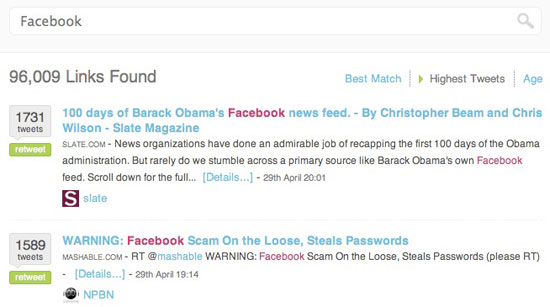
Searching TweetMeme for Popular Facebook Tweets


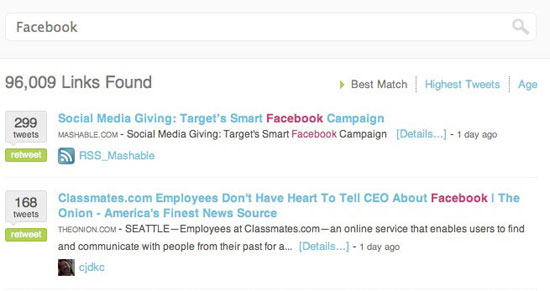
Updating the Same Search for "Best Match"

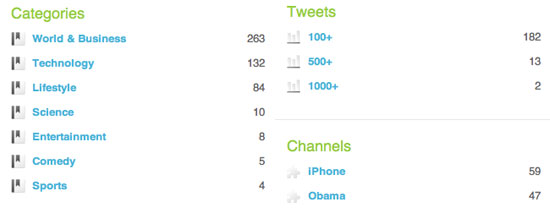
The search engine indexes new stories as they are found in Twitter, and offers a great deal of filtering and customization. You can sort results by "Best Match", "Age" and "Retweet Count", showing the most popular forwarded tweets. Meanwhile, the results display categories for each update, and you can even filter by the media type, including news, images or videos.


You Can Filter Results In a Number of Ways on TweetMeme

Like any good search engine for monitoring the new world of real-time updates, TweetMeme even lets you sign up to get search results by RSS.


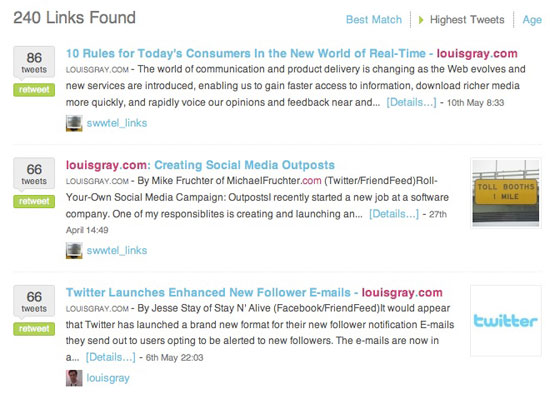
Searching TweetMeme for louisgray.com Shows Most Popular Posts on Twitter

For site owners, like me, the ability to search TweetMeme for your own name or domain name, and sort results by category or popularity in retweets is a great improvement, letting you determine what stories were deemed most popular on Twitter, and you can dive down to see who is getting to the data first and has the most influence, or ability to get their updates redistributed through their network.

TweetMeme is a product built by the team behind fav.or.it, headed by Nick Halstead. You can, of course, also follow TweetMeme on Twitter.

February 11, 2009

February 11, 2009 · 1 MIN READ · BY LOUIS GRAY

Tweetmeme Adds Leaderboard, Tag Clouds to Tweet Links Tracker

Tweetmeme Adds Leaderboard, Tag Clouds to Tweet Links Tracker

As Twitter grows in use, so grows its influence, and the total number of times the most popular items are shared and retweeted from user to user. As with Techmeme, Digg, RSSmeme and other sites that try to find the most interesting shares of the day based on user votes, Tweetmeme crawls the vast Twitter network and watches for frequently popular shared links, images and blogs. (See our initial coverage in July.)

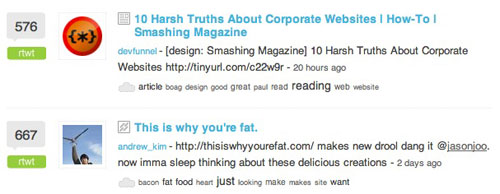
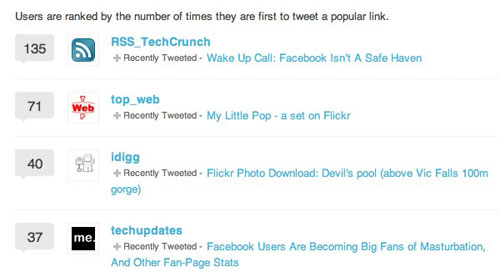
Today,Tweetmeme expanded its offering with a pair of new features aimed at making the site more sticky. The first is a tag cloud, which analyzes the shared content, finding other words that Twitter users have included in their tweets, and displaying them below the items in their "popular links" page. The second is a leaderboard, which highlights those Twitter accounts which have most frequently been the first to share the most popular links.


In terms of determining influence and popularity, you've always seen a push/pull between enabling a gatekeeper with the power to move items up and down, and letting the crowd decide. Tweetmeme believes solely in the crowd - even featuring the total number of times the item was shared. Today's top shares are in the 400 to 600 range through all of Twitter.


Accounts on the leaderboard aren't much of a surprise - including RSS feeds for TechCrunch, Digg, popurls and ReadWriteWeb, for example. Additionally, the cloud below each item is tempting to click, but not functional. In theory, it'd be good to click on an item in the tag cloud and see other shared links that have the same tags. Maybe that's coming, but it's not yet here.

You can catch up on the most popular items, as determined by Twitter, at http://tweetmeme.com/.