
Even as I've changed technologies, blog providers and structures, I make extra effort to not lose historical archives and keep comment streams intact, not for ego purposes or for SEO, but because it's the right thing to do.
Steve Rubel, an executive vice president of global strategy for Edelman, a longtime blogger who was among the first to espouse the benefits of blogging, social media and was often at the leading edge of tech only a few years ago, has more recently swayed to and fro based on the hot startup of the day, leaving thousands of broken links in the process. After running out of time to update his blog regularly, back in 2009 he ditched the blog to run a lifestream, based on Posterous. (Google cache). Last month, he pivoted again (another hot thing to do in the Valley these days for those with unsuccessful ideas) and now is the proud owner of a Tumblr-powered blog.
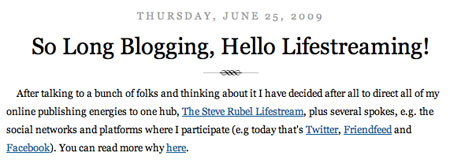
Pivot Number One Saw Steve Go to Posterous
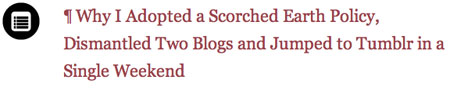
Pivot Number Two Saw Steve Go to Tumblr, and Delete Everything
"With just two clicks of a mouse I rid the web of literally thousands of blog posts, some of which I am proud of - others less so - and redirected the URLs to the new site."While no doubt many of his older posts (like mine) have limited or no value to today's readers or those in the future, they are an insightful historical record of one of the more visible bloggers of a specific period, one who is now in the process of erasing his tracks.
With more than five years of blogging myself here, the blog archives now take on their own role as a personal reference desk. When Kevin Rose left Digg, I was able to go back to my comments on Digg in 2006 to see my thoughts at the time. When TweetDeck was sold to Twitter, I could go back to 2008 and see my first thoughts on the service. With PostRank selling to Google yesterday, I found a post I made two years ago that had comments on it from people who now work at Google. If I didn't manage to keep the posts alive and the comment threads as well, this would not be possible.
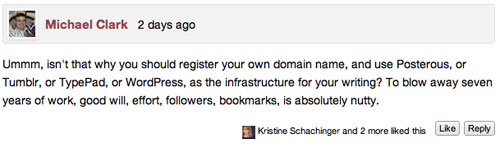
Steve's Community Is Very Unhappy With the Deletions, Calling it "Nutty"
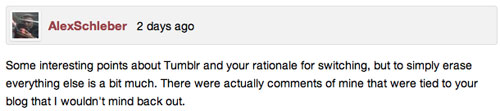
Others Say Erasing "A Bit Much", Want Their Comments Out
Of all the Web content I have produced or managed in the last fifteen years, one of my biggest regrets is the complete void from my time in college, both from my own personal home page, and from the student newspaper where I was the online editor and also wrote hundreds of posts, most on the front page. Current Valleywag editor Ryan Tate, who picked up the online editor job at the paper after I had left, struggled with a series of malicious hacks, and all our collective work was gone, erased from the Web like a bad memory. Whenever we trade emails or talk in person, we both lament this loss.

Steve's Original Micro Persuasion Blog, Pre-Deletion
This data obliteration is something that really is avoidable now, and yet, we let it happen on a near-constant basis. Most newspaper stories from the terrorist attacks in 2001 come up as 404s, beyond the reaches of the Archive.org project, or Google's search engine cache.
What I would like to see is a proposal from Google, or some other well-intended Web entity, such as Amazon, to offer a solution, embedded in today's modern browsers, as an option, that solves for intentional or unintentional content deletion. All those links that I provided back to Steve Rubel's MicroPersuasion blog from 2006 to 2009 should automatically be detected as dead, and then presented, to the best of the tech's ability, as they originally were, using Google cache or S3, Archive.org or something. And yes, I'd love it if somebody like Google or Microsoft would also give Twitter or Facebook a helping hand to get their own search archives into something useful.

Steve Thinks The World Won't Care About His Old Posts.
The issue I have with Steve's approach to pouring gasoline on his past and then lighting it on fire is not one of a choice of platforms. While seeing him join Tumblr is about as hip as your dad trying to snowboard with the cool kids, the more important part is that it eliminates the choice for readers, present and future, to ever get that data, and fill in the blanks. It's not his call to decide what has value for others, even if he sent me a tweet saying "we're foolish if we think the world really cares."
The world should care about walking through the historical record - be it on Steve's blog, or Dave's blog, or Robert's blog, or Mike's blog, or Penelope's, or any of the people who have been chronicling the world they see around them. I wish we had full archives from newspapers for years and decades backward, or the personal journals of people famous and ordinary from centuries past. What they might have found mundane is intriguing to others of us - maybe not massive populations, but to one person, they could contain serious insight. The Web is supposed to cater to the long tail, and the history of what we've produced should be there when they come looking for it.
26 Comments
Yeah, I didn't really understand why it was considered a good idea.
Oh - and a new blog design, Louis? Hmm, could use more gray....
What's with the new OneTrueFan thing?
WoH, the new blog design needs more design. :) And I've had OTF on there for a while.
I know you've had OTF on for a while, but now there's no popup at the bottom, just text that doesn't link anywhere? I mean, I prefer the minimalist approach to those things, but not sure what it is doing for you. Do you get stats from them?
WoH, I think OTF is broken. :) I can delete and re-add. They're working on it. I don't get stats from them yet, but will when they introduce new features.
I archive lots of things. Web pages not so much, so my blog has lots of broken outbound links.
:) I've been waiting to hear when their replacement for MyBlogLog stats is going to hit. I even blogged about it but I've heard nothing. A hiccup in the workflow, perhaps.
Louis, thank GOD you blogged this. It's amazing how much some people are willing to sacrifice at the alter of some unhealthy conception of SEO. Mr Rubel couches this as the opposite of egotism, but that's the irony—it's "what I said in the past doesn't matter because what I'm saying right now is SO important." Anyway, I can see emotional freedom in a clean slate reboot, it's his right etc. etc. , but the announcement with trumpets should elicit a response, so I'm glad posted some sense into the blogosphere.
I agree with this blog post 100%
Well said Louis. I felt the same way when I read about Steve's latest mid-blog crisis and even commented on his post about it. You addressed it best. I always thought the way back machine recorded everything forever but it doesn't. These types of moves are done in order to direct new readers to the new platform when doing searches on search engines (as Steve has admitted). This leaves the web full of deadlinks sort of like tree stumps in the rain forest. ok not anywhere near as important as that...just went with the poetic reference. Oh and Steve said wordpress is too heavy.
Thanks Paisano® . If WordPress is too heavy, I can promise Blogger is not too heavy. I've been using it for most of the five years. It even handles short posts well, like many I did back in 2006 and 2007.
Examples:
http://blog.louisgray.com/2...
http://blog.louisgray.com/2...
http://blog.louisgray.com/2...
Just because I tend to be long-winded doesn't mean I can't use this platform the same way others use Tumblr.
Agree.. blogger (which I used to use) and wordpress continue to evolve and understand that less is more in this mobile media age... their platforms might support ever growing list of new features but they also improve when it comes to loading time and the way they appear on different types of screens. I love the new apps for wordpress, for example, on the iphone and ipad...allowing us to become mobile micro-bloggers in the truest sense of the word. Yes, we can share a simple sentence or two or (God forbid, anything longer than a paragraph!) and include photos from our mobile devices and even video and audio streams too.
I think it's up to the writer to choose his tools wisely. Pick a platform that will be around a long time and one that can evolve with the times as blogger and wordpress have done. Of course you can stick with posterous or tumblr too... I guess it would be cool if there were a library of congress for all web content... time capsules if you will. Perhaps including links to the new home for the content's owner/author if they ever do decide to jump ship to different platforms.
This is a thoughtful piece. I've lurched through a couple of sites in the past two years, and decided this week to consolidate both at a single address. I've scorched a little earth in the past, but this time I was careful to move every post and every comment. Which made me glad, incidentally, that I've been using DISQUS. All the conversations were right there in my native databases.
So -- for me -- back to blogging soon. You're right: The potential durability of what we create is a large part of its value. Not everything is evergreen, but I'm going to leave it to future readers to decide its worth. Even the stuff I kinda wish I hadn't posted. ;-)
I have been disappointed by Steve's moves the past two years. Jumping to Posterous and now Tumbler just looks like shiny-object-syndrome. You can have short posts on WordPress and Blogger as well, they just have more power than that.
By the way, I like the upgraded design. Still looks like your blog, but looks updated.
Thanks, Rob. I don't want to criticize Steve's moves from platform to platform. I understand the interest and theoretical testing for clients. What bothers me more than trying new stuff (which I do all the time) is intentionally erasing history that may have value.
Appreciate your comment. It is my blog, and I haven't done much to the background, obviously. :)
You've got our mutual mourning down accurately, but what actually killed our content wasn't the hacks. In fact, after the hack I re-uploaded all the content and we were fine. In fact, when I left, old URLs still worked as before. In the years after I left, though, the content was first moved to a new subdomain, 404-ing all the old links. And then eventually the old stuff was taken offline, the files (presumably) forgotten.
You were, of course, still a better online editor. Etc! :-)
Thanks for clarifying. All I know is that neither of us can get to it and there was some bad hackery that gave you headaches for sure. :)
Another benefit of an archive is as a backup of last resort, like what befell Jeff Atwood: http://www.codinghorror.com...
Couldn't agree more with your headline. Yet another reason I save everything of interest to Evernote. I also don't buy Steve's rationale:
"I want to make it easy for Google. The only way to do so was to scorch the earth. Anything more will confuse it. I want one site to earn the +1s, not three."
Really? Unless he deletes years of blog posts, Google is going to wander the internet dazed and confused?
Survey says...no.
He could always just remove his site from Google and provide an on-site search engine. Or nofollow all the internal links on those two sites. Or wait for Google to provide some kind of option to opt-out of +1. Etc, etc.
Occam's razor says: You completely delete years of writing because YOU DON'T WANT PEOPLE READING IT.
Written simply and tastefully. It’s pleasant to read. Thank u.
Thanks for clarifying. All I know is that neither of us can get to it and there was some bad hackery that gave you headaches for sure. :)
Louis - I'd wager a guess that this goes a touch further to a Social Media policy, (either upcoming or existing), or possibly even a policy change period. I'm sure you remember when Forrester changed their policy so that people could no longer brand themselves (IE: Jeremiah and Co.). Many policies are getting stronger and stronger, and frankly, with people overdoing Facebook, I honestly can't blame some of these companies. Some have called it 'limiting free speech'. I beg to differ. You can always ghost write (or blog).. BTW .... Hope you're doing well!
Great post Louis, and yes this goes much further than merely Steve's deleted blogs.
As you saw from my comment on his post, I am right there with you on the issue of the deleted comment threads (his posts we can still find through Google Cache for a good while I suspect).
That is a weakness in Posterous actually IMO, I should be able to view my comment history from my account on a page somewhere, even if someone deletes some underlying post(s) of theirs. Comments are OUR content we contributed. Something like Disqus helps, so at least Steve wont be able to do this to us again when he jumps to the new new thing in a year or so...
Also, funny since Tumblr really isn't all that social at all from what I've seen, it's more like anonymous copying/repeating of stuff, even more so than on Twitter etc. I've been pretty active on Amplify, and while the community there isn't huge in numbers, it does have a very tight-knit feel. Better curation tools than on Tumblr as well.
Well, it's a free world and he can do what he likes. That said, if someone deleted a blog on which I had made a lot of comments, I would feel ill used. But hey, that's life.
The other side of the coin is the wisdom of trusting all your hard work to a platform you do not control. Therefore, I would not put all my eggs in a Posterous/Tumblr/Flickr/Whatever basket.
Cost of storage is practically zero? They don't charge us bloggers, but the environment pays in energy to run the storage facilities. And if the environment pays, we will, one day.
You've heard that old quote - those who do not remember history are condemned to relive it. We bloggers are working thru that issue now.