Showing posts with label Blogs (22 posts). Show all posts

October 20, 2018

Comments as a Platform, Or Silencing the Trolls

Comments as a Platform, Or Silencing the Trolls


Web content has typically divided into three camps - those who create, those who react, and those who just watch. The lurkers, if you will. From the very earliest days of blogging, those first posts awaited the inevitable comments, and, given a clear revenue stream, you would see early participants like Fred Wilson say that "comments are how bloggers get paid."

[Source: https://vanelsas.wordpress.com/2008/06/02/the-real-value-of-social-media-interaction/#comment-2531]

The earliest engagements we had with people who read our site gave us incredible discussions, and spawned more posts and even, in rare cases, changed minds. Sites like Digg, Reddit, Slashdot and others became known for their diverse threads, and those in the comments are why you showed up.

But we've also seen the pendulum swing the other way. Everybody knows to "never read the comments" on popular news sites, as the most aggressive vitriol and ignorance floats to the top. YouTube comments have long been notorious for their lack of quality (though I feel this has improved of late). And Twitter, for many who should be able to use the platform, their every move can attract trolls who have a vendetta to take them down - but somehow don't get banned.

As social media sites eclipsed the momentum of blogs, conversations moved. We adapted by integrating social discussions from FriendFeed, Facebook and Twitter and appended them to our blogs. We would all share our posts on social, and then engage where the content landed. The best bloggers would find their readers wherever they were. But others simply turned comments off. Maybe it is because they were full of spam (they were) or the quality wasn't there (often true), but also, because the total quantity declined.

Let's go back to talking about Twitter. Twitter drives me nuts because it's fantastic and so poor at so many things. They seriously have real-time on lockdown. There is no better place to see what is happening right now. If there's a calamity, search Twitter. A breaking news event? Search Twitter. A sporting event? Twitter.

But Twitter has this awful habit of giving all users an equal voice. Now hear me out what I mean.

If you tweet publicly, anybody who you haven't blocked can reply, and their content is appended to your tweet. It follows you around. If a Republican politician posts, left-leaning posters race to take down their message, while the MAGA crowds prop it up and try to gain eyeballs. If the Kardashians say something, the crowds pounce on the valuable real estate quickly to show their adoration or pimp whatever link they've got going.

And down the publicity food chain, if you're a woman, especially a visible one, you get awful men saying foolish things. I guarantee it. They may call you names or question your ability. You block one and ten more pop up. If you're black, or Jewish, the racists will find you. They all know how to tweet.

So what I recommend above all other Twitter changes is the ability for people to reclaim their space. Hillary and Trump should both be able to post information without the crowd's replies being appended. Just like blogs and YouTube stars can turn comments off, Twitter users should be able to as well. The thing about social networks (and most products, to be honest) is that you should give the users control. But they haven't done it, and I think it delivers a great disservice to the platform, which has become a hotbed of harassment and hate - as Reddit and others have too.

If you can trust your commenters enough to give them a voice, by all means, amplify their voices. But when they have shown you time and again that they cannot be trusted, turn it off.

September 5, 2013

Shared Items Might Be Gone, but the LG Stream is Back

Shared Items Might Be Gone, but the LG Stream is Back

Longtime blog readers and social connections know that for years, one of my most fulfilling actions on the Web has been the ability to act as a human filter, passing through hundreds of feeds a day and sharing the best with you, with Google Reader as my workbench, and my shared items being my finished product. With a simple share, followers within Reader, but also those subscribed on FriendFeed, Google Buzz and Twitter, could see my hand-selected picks.

When Google Reader changed its sharing model back in October 2011, not to mention the general demise of most aggregators, this stream came to something of a stop. Reading feeds became a solitary act, and with Reader now retired, one could easily expect the old way of sharing was gone for good. But with a cobbling together of a few products, and thankfully, the continued support for standards like RSS, I was able to reboot the "LG Stream", as friend +Thomas Power has long referred to it, and you can once again subscribe to follow the posts I pick from my journey on the Web, getting a hand-curated selection from the land of tech blogs and beyond. And again, you can follow the stream in your favorite RSS reader or on Twitter.

In a post Google Reader world, here's how it works, and how you can do the same, should you be interested.

First, I, like many others, moved my RSS feeds (via OPML) to Feedly. I've had a more than five year relationship with Feedly and the team behind it, and have found it quite useful, with the same familiar keyboard shortcuts I liked in Reader, and a fast interface.

Feedly Brings My Feeds Through As They Happen

Second, I created a Pocket account to essentially bookmark the top stories I found as they happened. This can be both through the built-in integration Pocket has with Feedly Pro, which I purchased, or through the Chrome Extension. Given I use ChromeOS all day, I've got Pocket a click away all day.

Pocket Captures All My Select Favorite Items

Third, one benefit of Pocket is that it automatically creates an RSS feed for your account. All I had to do was enable the feed to be a public feed to start treating it like any other stream. (Here's how to do it)

Feeding my LG Stream to Twitter is Twitterfeed.

Fourth, I took that RSS feed, and connected it to Twitterfeed, and told Twitterfeed to regularly poll the feed for updates, and push new items to Twitter at my new account, at @lgstream.

Practically the only downside is the non immediacy of posts being shared with Twitter, as Twitterfeed defaults to updating every thirty minutes. This can mean that it sends updates in batches of 2 or 4 or however many new items I've Pocketed in the last half hour, corresponding, typically, with my last sync-up with Feedly. But as with Google Reader's shared items, the delivery of the human filtered stream is there.


For those who don't know my filtering behavior, my goal's not to push any corporate agenda, and my biases are clear. Compared to popular aggregators, I won't be sharing rumors and spy pics and salacious gossip. I especially don't plan on sharing rumors about Google, and confusing everyone who might thing my share implies endorsement or confirmation. That'd be a bad idea, obviously. But what you will find is the top 1% of items that flow through what I see, and what I find interesting - a mix of tech innovation, news, social best practices, and thought leadership. My bias is intrigue and quality. For years, in the Google Reader days, I heard people say they didn't have the time to read through all their feeds, but they always read those I shared.

So we're back, thanks to Feedly, Pocket, FeedBurner and Twitterfeed. You can subscribe to the new LG Stream on RSS or via Twitter. And for those asking about Google+ integration, the service doesn't support feed imports, so there is not yet an equivalent. 

Usual Boring Disclosures: I work at Google on Developer Relations. That may or may not, and probably doesn't impact, any of my comments related to real or perceived competition or partners for any of our products and services.

April 7, 2011

Ninua Launches Social News Reader on Android

Ninua Launches Social News Reader on Android

As I've discussed many times, finding the right news from your news streams and social streams is an increasingly difficult challenge - and for most people, traditional RSS readers have proven too difficult for mass adoption, despite my own feverish feed religion. Into the void steps a new reader, launching first on Android, to try and connect readers and writers through social news exploration, tapping into three main news reading pillars to try and deliver a high quality, polished news reader, competing with people like Pulse and Flipboard, but unique in its own right. The new product is called Ninua News Reader, and it's from the team behind NetworkedBlogs, the most popular tool for posting your blog entries to Facebook.

Ninua's approach to the world of news, as demoed at the 500 Startups Demo Day in Mountain View on Wednesday, is centered around three major news reading pillars, including:
  1. Headlines and Mainstream News
  2. Blogs
  3. What Friends Read
Founder and CEO Waleed Abdulla said the company was "trying to do news in the right way", by helping users follow friends who share your interests and learn new sources through their own reading lists. Unlike other news readers, including Flipboard, Ninua does not pull in social stream content from Facebook or Twitter, but it does use that increasingly-important social graph to help provide guidance for your eventual reading list. Abdulla said, "The Facebook stream is social, but it's not news. See what your friends are reading, and if you like it, you can follow them. The app is tailored to you based on the sources you follow and the friends you follow."


Selecting Topics and Sources in Ninua for Android


If it sounds simple, that's because it pretty much is. Upon installing and launching the app on Android, you're asked to select three topics of interests from a pre-selected handful. Dependent on your choices (for example: Technology, Startups and Sports), you are then presented with a list of matching blogs and news sources to follow - all of them prechecked to be added to your reading list. Deselect those you don't want, and then you're asked to connect to Facebook to match the social side of things.


Following Friends and Their Recommendations


Once you've found your friends using the app and what they follow, the app taps its NetworkedBlogs roots and finds other sites your friends may not just be reading, but writing. There's a good chance you'll want to add those to your reading list as well. Now you've got a healthy list of sources based on your interests, and a list of sources based on your friends' interests.


My News Front Page and One Story In Ninua


With this array of sources in tow, complete the setup and you can read the news from those sources you've selected, or you can add new sources. There's no mention of the word RSS, the word Feed, or anything remotely as scary as big words like Pubsubhubbub or acronyms like OPML. The resulting articles are laid out with social signals to show other upvotes, and you can share the articles you like best to other services.

Ninua is a new wrinkle on the social-centric reader, mashed up with your own interests. Unsurprisingly, the app debuts with a strong user experience, and it's calm enough to not make you feel like you're missing something on the next page or next refresh. It's a solid approach to simplifying the news reading process, especially on mobile. You can find it on Android Market here: https://market.android.com/details?id=com.ninua.android

Disclosure: I am vice president of marketing at my6sense, which offers a personalized social and news reader for Android, iOS and the Web. It can be assumed that Flipboard, Pulse and Ninua can be seen alternatively as competitors or potential partners.

March 9, 2011

Is The Web's Focus on "Now" Losing How to Find "When"?

Is The Web's Focus on "Now" Losing How to Find "When"?


Our attention spans are getting shorter. While being constantly interrupted or distracted by new toys, new sites, new things, new messages, new people, and new ideas, we're delivering a stream of consciousness into a void which quickly gobbles it up and waits for more. Scads of sites are helping us find out what is trending in real time, and deliver us the "now". What's hot now. What's peaking now. What's being said now. But the focus on the cutting edge of time, combined with reduced capability to search our history is making finding what happened "when" a lot harder.

Consider for a moment some simple questions that pertain to the social Web, blogging and lifestreaming - and our lack of great tools to discover the answers. I'll start with some real examples.
1. What was the first blog to cover the service backtype.com? 
2. When was the first time Denton Gentry left a comment on my blog?
3. When was the first time Robert Scoble mentioned the word Twitter in his blog?
4. Who mentioned FriendFeed on Twitter first? MG Siegler or me?
I use these specific questions with real people to help consider questions that may pop up from time to time. Substitute your own curiosities.

There are a few places we've trained ourselves to look for such answers, namely Google Web Search (and its competitors like Bing), Google Blog Search (and IceRocket, my favorite), and Twitter Search. For individual blogs, we have to hope they have integrated blog search tools, such as that from Lijit, or Google's Custom Search Engine (CSE), a subset of results from one domain. But each of these has some weaknesses.

First, Twitter Search. Two years ago, when I was a more grumpy person, I targeted the search engine for being quite broken, only going a few days deep and failing in more specific searches. The archive hasn't been built to go deep in the last two years, and the accelerated volume of posts isn't helping the issue.

Second, Google Blog Search. You can search by date, and even set custom ranges, but the archive of blogs is both incomplete, but overly full of low-quality content. So finding out a question like the first blog to mention BackType requires you to visit their own blog and hope they mentioned it, or to just know they were funded through Y! Combinator, and thus, got started with TechCrunch, back in August of 2008. Peeking at Crunchbase helps too in this regard. Icerocket offers search by date, but I didn't find any results in August of 2008, so that's a miss.

The Web has collectively accepted these sites inability to accurately deliver on archive search, with an expectation that questions such as this are only done by a small few.

For the second question, one I posed to Denton last night out of curiosity, I would have to hope one of two things - that Denton had used Disqus.com with my blog and that I could somehow see all of his comments on my domain through Disqus. But looking at his profile there only shows how many comments he's made on my blog, and that's not clickable. If Disqus has the data, it's not easy to find. In fact, the only way we arrived at the answer is that I'm enough of an information hoarder to have every comment he's ever made tucked away in my email and was able to search locally on my laptop to find his July 2008 comment on a guest post by Jesse Stay. He finally posted on an entry from me in August of that same year.

So what about Mr. Scoble mentioning Twitter? I tapped Google Blog Search, went to Advanced search, entered scobleizer.com as the domain and the keyword of Twitter and chose 2007 as the year. The results nicely omitted his URL as part of the query - so that had no value. I searched his own site, using Lijit, but there is no sort by date. One of the first results included mention of an earthquake on Twitter in 2007, but knowing Robert, there's no way that's the first mention. Just can't find it.

As for who mentioned FriendFeed on Twitter.com first, MG or me? That's something of a trick question. We already know Twitter search won't find it - nor will its realtime search partners Google or Bing. But I can guarantee that MG mentioned it first because I didn't even join Twitter until early 2008, several months after I had been using FriendFeed. By that point, MG was very active on Twitter and had no doubt mentioned FriendFeed several times. But this all requires knowledge outside of the search engines.

Wikipedia and Quora and Crunchbase are all human-powered knowledge bases that are being built to answer questions such as these that capture more than the "right now". That we have access to things like Google and Bing and Icerocket that find answers to so many things is fantastic. There are even archival sites like MemoLane (which is beautifully done) to capture your history, but the when is becoming a footnote in history. Will the big engines let the flow of social media and blogs outrun the ability to capture it?

May 3, 2010

Regator Revamp Adds Blog Trends, Monitoring, More

Regator Revamp Adds Blog Trends, Monitoring, More

In the last few years, much of the Web's focus has trended toward social networks and microblogging, and away from more traditional blogging. Twitter and Facebook are on the tips of most people's tongues, even when those sites often serve as much to link to news and blogs elsewhere, in addition to the much-lauded status updates. Regator, the blog search engine which debuted in mid 2008, and introduced a solid iPhone app one year later, is poised to revamp its service while keeping blog content front and center. The result, in preview now, is a solid data mine for content, trends and topics. In theory, the site could outright replace Web 1.0 engines like Technorati, and it looks to be significantly more useful - no matter your focus of interest.

Regator still presents itself as surfacing the world's best blog posts from the world's best blogs. Not all make it in the highly selective network, but there are many quality sources that do in practically every subject, from Academics and Arts to Politics, Religion and Tech.

Regator's new preview steps up its blog coverage by showing trending topics, as Technorati never got quite right and Twitter and Google News have for their own properties. From global trends (such as Times Square and the Gulf of Mexico) to topical trends (such as Steve Jobs and the iPad 3G), Regator quickly updates you at a glance on what the blog world is talking about.

As the site does now, you can still see popular and new stories by topic, as well as those with audio or video. But you can take a step further with two new sections, including trends and monitoring.

How is iPhone Trending in Blogs? Regator Knows.

With Regator's deep archive of blog topics, you can compare up to three keywords, and see how they are spiking over time. Not unsurprisingly, Gizmodo spiked well beyond Engadget around their iPhone 4 coverage, and Apple dwarfs almost anybody else during Steve Jobs keynotes. You can see first day launches of products like Google Buzz, and the ensuing fade of coverage, or you can see consistent updates on more broad terms, such as "laptop", which only shows dips every weekend.

Monitoring some Interesting Topics In Regator

Should one-time visits to the site not be enough, you can tap into Regator's blog monitor to follow keywords and send you updates on these keywords - much like Google News alerts and TweetBeep.

You Can See Which Blogs Mention Specific Topics Most

Regator may have started out as a way for the community to help find the best of the Web through up arrows and down arrows, but its upcoming revamp, which you can gain access through via invites, looks solid enough to be the highest quality blog search available, with deep trendspotting. I will keep using Icerocket search for finding all mentions from all blogs, but Regator has trimmed the fat and returned with the best.

Just go to http://preview.regator.com with the invite code: "louisgraysentme" and check it out for yourself.

January 12, 2010

Technorati, Once Near Death, Focuses On Quality

Technorati, Once Near Death, Focuses On Quality

When Technorati CEO Richard Jalichandra joined the company near the end of 2007, he found the blog search engine in "a lot of trouble". Technorati was bleeding cash, with an expensive infrastructure based on "incredibly complicated technologies", and was losing the war on fighting spammers, who were threatening to render the company's deep index and authority measurements completely useless. In parallel, the struggles came at a time when expanded competition from formidable players, including Google, made staying on top almost impossible, even as the company's formidable task to index the fast-growing live Web expanded.

"Please Put On Your Oxygen Mask First..."

The situation looked dire, one Jalichandra compared to when the oxygen masks fall from a depressurized airplane, saying you can't save the passenger next to you, until you save yourself.

"The first thing I had to make sure of was that we didn't go out of business," Jalichandra said in an interview Monday at the company's San Francisco headquarters. "In the fall of 2007, it all came to a head, and we knew we had to do something or there wouldn't be anything left."

Since 2003, Technorati was among the first leaders of the Web 2.0 wave, recognizing the imminent growth of the live Web, encompassing blogs and other social media activities. Not just comfortable with blog search, Technorati also enabled site owners to claim blogs, track backlinks to their content, measure authority, ranked by unique site backlinks over time, to ping the site with new updates, chart changes in content distribution on the Web, and present Technorati widgets on their blogs. Add on a few fun features, including popular pages, and the always quizzical "Where's the Fire", best known as "WTF?", and Technorati had its focuses widely diversified.

Near Death By a Thousand Cuts...

The 2007 crisis forced the company to revisit everything and make some very painful decisions, cutting costs, headcount and features - many of which had been treasured by the blogosphere.

"(Previous CEO David) Sifry came up withe great idea of boiling the ocean of the live Web and it grew like crazy," Jalichandra said. "But there are a couple of problems with boiling the ocean when people are looking for a cup of coffee."

Technorati, once known as the go-to site for data on the blogosphere, had soon found itself eclipsed by more nimble competitors, such as Google Blog Search, and while many bloggers, including myself, grew frustrated with the site's rapidly killing features we liked, and the not too unfamiliar appearance of site downtime, which would happen multiple times a week, for several hours at a time, the site came incredibly close to going away altogether without drastic change.

"The first six months (of my term as CEO) was all about stabilizing the company," Jalichandra said. "At some point you have to keep the lights on, particularly the kind of company that is venture funded. It has to get revenue, and has to make a profit. We had to write the plan for growth, a two-pronged plan, to grow the site and launch the ad network. We are still dedicated and committed to growing Technorati.com."

One Must Have Revenue to Invest Back In the Company

The company's focus on the advertising network seems like a dramatic change in course for what was instead seen as a technology service company, but it was a move aimed to leverage the existing database in the site, while also driving revenue into the company. It was suggested that, as revenue grew, it could be reinvested back into Technorati's site, quite possibly to start replacing some of the lost or deprecated services much beloved by the blogosphere.

In October of 2009, Technorati revamped its Web site, and while gone were many of the dedicated pages for topics and individual blog posts, which I had liked, in its place was a detailed directory with top blogs ranked by category, with a new ranking of authority, and a higher focus on relevancy. While the old Technorati would highlight the most recent updates as they flowed in, the new Technorati tries to deliver recent updates from the most authoritative sources - a move that's not without its controversy, of course.

"Search is not a democracy," said Jalichandra. "There is always an editorial choice in search. It may be an algorithmic choice, but it's a choice."

Look Mom, No Spam and No Downtime!

The new site relaunch led not just to new content and a new look, but the elimination of downtime, as the company says they have not experienced any appearances of the Technorati Monster having escaped since the introduction, adding it is believed the the issue of spam is practically non-existant. Despite so many headaches and a popular perception that the site is irrelevant or archaic, the company's leadership thinks the two years needed to bring the site back to the point where innovation can occur has been both necessary and worth it.

David White, vice president of publishing, says that working for Technorati has been a "really interesting challenge", but one that has changed as the mainstream is not just aware of blogs, but is embracing the live Web in their daily lives, as Technorati plays less of a role as evangelist for the blogosphere, but instead one that focuses on finding quality content.

"Technorati started by indexing all the blogs," White said. "Our job is different now, and that is to find the quality. Technorati is an important site, and it has made an impact on how we interact with the blogosphere, which has had a huge impact on media as a whole."

Will It Be Enough? Can I Have My Widgets Back Now?

As the move to quality infiltrates the company's blog directory, Technorati promises many of the tools that have gone away are coming back. The company fixed blog claiming last week, and promised Monday to bring back authority over time charts, as well as introducing new widgets, which had long since obsoleted.

Many bloggers, including the visible futurist Stowe Boyd, have already given up on Technorati, after seeing the company's early promise seem to crash and burn, through a confusing product strategy, spam-filled results, poor uptime, and bad news followed by no news. It seems the darkest times are behind them, and the company will have to make good on its promises before many bloggers learn to trust them again. But in my meeting with them Monday, they clearly said they're not done fighting.

To hear Jalichandra in his own words, listen to the 8 minute clip I recorded on Cinch:

August 25, 2009

No More Beta Codes: Lazyfeed Is Open for Everyone

No More Beta Codes: Lazyfeed Is Open for Everyone

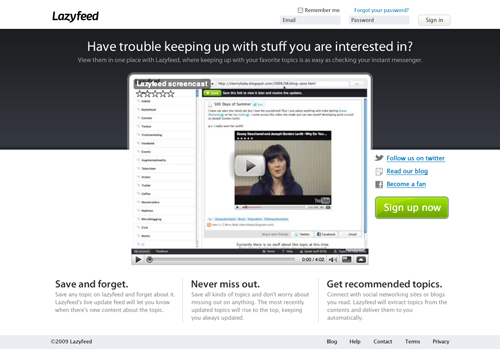
Almost two months ago, we first introduced Lazyfeed, a real-time blog search and feeds engine, which has grown to be a big part of my information gathering process, following topics which I like, rather than people, or specific RSS feeds. The product's uniqueness is one of the more innovative services I have seen in 2009, which was a big part of why I practically have had a part-time job as a beta code broker, trying to gain people access to the site. As of today, that unpaid gig is done, for Lazyfeed has removed the beta wall, and opened the site to all who want to enter. If you didn't get access to the site, I strongly recommend you go and try it, as you will find the wave of interesting news and blog posts from around the Web addicting.


Topics for Lazy Me from Lazyfeed

As I've mentioned in my previous coverage of Lazyfeed, including a quick how-to video on the service, the site does two major things - first, finding blog posts and news articles relevant to me based on topics I have provided, and second, find related items to those entries I have added to my own social sites, including this blog and my Twitter account. Blog posts that have tags will generate new items, while hashtags on Twitter will do the same. This second portion is what Lazyfeed says gets you the lazy portion of the name, because in "Topics for Lazy Louis", I haven't even had to enter the topics into Lazyfeed - it just happens on my behalf.


The New Lazyfeed Home Page Is Open for Business


Ethan Gahng, CEO of Lazyfeed, uses his own product in a much different way than I do, leveraging the search engine for entertainment, sports, TV and other things, where as I just continue to feed my tech obsession like a bright orange RSS-powered IV drip. But that's what makes a site like Lazyfeed so powerful - it can be whatever you want it to be, and hopefully, without too much work. Stay lazy.

July 31, 2009

Five Blogs Under the Radar: July 2009 Edition

Five Blogs Under the Radar: July 2009 Edition

Seventeenth Edition Of a Monthly Series

As we wrap up July, it comes time again to highlight some enterprising bloggers who are practicing their craft with little attention - or at least a lot less than some of the brand names we frequently run up against. This month's edition, like the others, brings new voices into the sphere who you may want to start reading and follow. Each month, I try to find five new ones that you may not have heard, who are working hard in obscurity. Most are interested in a lot of the same things I am - including technology, information gathering, gadgetry and social networking.

To get on this list, bloggers need to post regularly, cover something resembling technology, and have less than 1,000 subscribers or so, with very rare exceptions. We are more than happy to take nominations as well, either here, by e-mail, FriendFeed or Twitter.

The July 2009 blogs are:

1) In the Mind of Damond Nollan (damondnollan.com)

Focus: IT Management, Education, Software, Internet Services
Three Recent Posts:RSS Feed: Subscribe Now

2) Victus Spiritus by Mark Essel ( victusspiritus,com)

Focus: Investment, Technology, Social Networking
Three Recent Posts:RSS Feed: Subscribe Now

3) Adam Sherk (www.adamsherk.com)

Focus: Publishing, SEO, Public Relations
Three Recent Posts:RSS Feed: Subscribe Now

4) TrendsSpotting (trendsspotting.com)
(This violates my rule of 1,000 or fewer subscribers, but I bet it's new to many of you)

Focus: Statistics, Trends, Social Media
Three Recent Posts:RSS Feed: Subscribe Now

5) Social Squared by Jess Sloss (socialsquared.com)

Focus: Social Media, Marketing, Lifestreaming
Three Recent Posts:RSS Feed: Subscribe Now

Want to be on this list? You can catch my eye by posting great information in the field of technology, social media, blogging and the Web. I'll be more likely to highlight you if you blog almost every day, and bring new stories to the table that don't repeat discussions launched elsewhere. And if you have more than 1,000 subscribers, you're usually too big for this.

To see even more new blogs I'm adding to my reader, or get a sneak peek for next month's highlighted blogs, follow my activity on Toluu. If you don't have a login to Toluu, send me an e-mail to [email protected] and I'll get that set up right away.

July 10, 2009

JS-Kit Declares the Death of Comments, Launches New Echo Platform

JS-Kit Declares the Death of Comments, Launches New Echo Platform


There is no question that as activity on social networks has broadened, conversations have become decentralized and distributed. Only a short few years ago, bloggers could anticipate their posts would rile up deep conversations on their blogs, through comments below each post. But for many people, the trends have been for conversations to happen elsewhere - on Twitter, FriendFeed, Facebook or practically anywhere people wish them to be.

As a result, new tools have cropped up to monitor the conversations, or to unify them, regardless of their source. Among the most visible has been BackType, which offers comment search, as well as a tool called BackType Connect, which centralizes reactions for Wordpress-powered blogs.

Today, one of the most popular comment engines, JS-Kit, says they too are moving to this model, and not just halfway. Their old platform is dead. Period. Starting today, users will be presented with a new platform called Echo that integrates reactions from around the Web, including those from these diversified, decentralized conversations, alongside standard comments. Existing users of JS-Kit will be upgraded to the Echo platform.

"We are here to announce the death of comments," said Khris Loux. "What's interesting about these new forms of communication is that they are parallel channels away from your blog. We are discontinuing JS-Kit comments because it no longer reflects the conversation around the blog."

Echo is a drop-in comment replacement platfom. Now, they say, references to your original content will be automatically displayed in real-time.

"Echo-enabled content is now the richest source of the conversation. They can go to your blog and see the entire live stream," Loux said.

Loux and Chris Saad, also of JS-Kit, said that bloggers who are using alternative platforms, like Disqus, could use the tool for future conversations, and they could import and export comments from platforms like Blogger.

June 30, 2009

Five Blogs Under the Radar: June 2009 Edition

Five Blogs Under the Radar: June 2009 Edition

Sixteenth Edition Of a Monthly Series

Even as many people are debating the importance of blogging, the number of active bloggers is still growing. And even if we have grown comfortable with the number of people we are reading, there are voices we are no doubt missing. Each month, I try to find five new ones that you may not have heard, who are working hard in obscurity. Most are interested in a lot of the same things I am - including technology, information gathering, gadgetry and social networking,

To get on this list, bloggers need to post regularly, cover something resembling technology, and have less than 1,000 subscribers or so. We are more than happy to take nominations as well, either here, by e-mail, FriendFeed or Twitter.

The June 2009 blogs are:

1) Jungle G by Jorge Escobar (jungleg.com)

Focus: Social networks, Influence, Technology
Three Recent Posts:RSS Feed: Subscribe Now

2) Spatially Relevant by Jon Gatrell (spatiallyrelevant.org)

Focus: Product development, Social media
Three Recent Posts:RSS Feed: Subscribe Now

3) Sticky Figure by Steve Woodruff (brandimpact.wordpress.com)

Focus: Social Networking, iPhone, Marketing
Three Recent Posts:RSS Feed: Subscribe Now

4) OwenGreaves.com (owengreaves.net)

Focus: High Tech, Business, Social Media
Three Recent Posts:RSS Feed: Subscribe Now

5) Twittercism (twittercism.com)

Focus: Twitter, Microblogging
Three Recent Posts:RSS Feed: Subscribe Now

Want to be on this list? You can catch my eye by posting great information in the field of technology, social media, blogging and the Web. I'll be more likely to highlight you if you blog almost every day, and bring new stories to the table that don't repeat discussions launched elsewhere. And if you have more than 1,000 subscribers, you're probably too big for this.

To see even more new blogs I'm adding to my reader, or get a sneak peek for next month's highlighted blogs, follow my activity on Toluu. If you don't have a login to Toluu, send me an e-mail to [email protected] and I'll get that set up right away.

May 31, 2009

Five Blogs Under the Radar: May 2009 Edition

Five Blogs Under the Radar: May 2009 Edition

Fifteenth Edition Of a Monthly Series

One of the more fun things I get to do on this blog is highlight other voices from around the world who crave tech or have insight into the Web we're all weaving. I recognize others made sure to give me airtime on their own sites, and the right thing to do is to return the favor. For the last year-plus, we have hand-selected five new blogs for you to review and, hopefully, subscribe. By following these new voices, you can get additional viewpoints outside the common echo chamber. And who knows, maybe some of these people will eventually become household names?

To get on this list, bloggers need to post regularly, cover something resembling technology, and have less than 1,000 subscribers or so. We are more than happy to take nominations as well, either here, by e-mail, FriendFeed or Twitter.

The May 2009 blogs are:

1) Almighty Link (almightylink.ksablan.com)

Focus: Social networks, hyperlinking, media, search
Three Recent Posts:RSS Feed: Subscribe Now

2) Advocate's Studio (advocatesstudio.wordpress.com)

Focus: Legal, Blogging, Technology
Three Recent Posts:RSS Feed: Subscribe Now

3) Blind Five Year Old (blindfiveyearold.com)

Focus: Google, RSS, Technology
Three Recent Posts:RSS Feed: Subscribe Now

4) Techgeist (techgeist.net)

Focus: Google, Web Browsers, Search
Three Recent Posts:RSS Feed: Subscribe Now

5) Deliberate Ambiguity (deliberateambiguity.typepad.com)

Focus: Search, Microsoft, Technology
Three Recent Posts:RSS Feed: Subscribe Now

It's amazing how more than a year after starting this process, I am still impressed by the high quality writing by some of these lesser-known blogs. Some of those highlighted this month are among the best I've seen in a long time. Want to be on this list? You can catch my eye by posting great information in the field of technology, social media, blogging and the Web. I'll be more likely to highlight you if you blog almost every day, and bring new stories to the table that don't repeat discussions launched elsewhere. And if you have more than 1,000 subscribers, you're probably too big for this.

To see even more new blogs I'm adding to my reader, or get a sneak peek for next month's highlighted blogs, follow my activity on Toluu. If you don't have a login to Toluu, send me an e-mail to [email protected] and I'll get that set up right away.

March 31, 2009

March to the Beat of Five New Blogs You're Probably Not Reading

March to the Beat of Five New Blogs You're Probably Not Reading

Thirteenth Edition Of a Monthly Series

As the month of March fades with only a few hours remaining, there's still time to highlight five blogs that have recently entered my Google Reader and become regular visits for me. This feature, one I look forward to each month, almost escaped me, but don't think it's not a priority! For last month's collection, start here, and find links to all of the previous 12 months.

Having wrapped around a full year, I thought I would take a different approach this round, and I openly called for submissions, using FriendFeed (which mirrored my request to Twitter and Facebook). You can see that discussion here, and can find more than the five I've selected, should you choose to do so.

This month's entries...

1) #comments (comments.deasil.com)

Focus: Technology, Software, iPhone, Browsers
Three Recent Posts:RSS Feed: Subscribe Now

2) Joe Blogs (Joe Dawson's Blog (www.joedawsons.com)

Focus: Facebook, Family, Social Media
Three Recent Posts:RSS Feed: Subscribe Now

3) Creative Capital (creativecapital.wordpress.com)

Focus: Finance, Technology, Entrepreneurs
Three Recent Posts:RSS Feed: Subscribe Now

4) Black Web 2.0 (blackweb20.com)

Focus: Technology, Blogging, Startups
Three Recent Posts:RSS Feed: Subscribe Now

5) Lost In Technology (www.lostintechnology.com)

Focus: Technology, Software
Three Recent Posts:RSS Feed: Subscribe Now

Want to be on this list? You can catch my eye by posting great information in the field of technology, social media, blogging and the Web. I'll be more likely to highlight you if you blog almost every day, and bring new stories to the table that don't repeat discussions launched elsewhere. And if you have more than 1,000 subscribers, you're probably too big for this.

To see even more new blogs I'm adding to my reader, or get a sneak peek for next month's highlighted blogs, follow my activity on Toluu. If you don't have a login to Toluu, send me an e-mail to [email protected] and I'll get that set up right away.