 When first introduced to Twitter, I couldn't get over the banality and minutiae people were willing to share. Their food. Their location. Their thoughts. Just mind-numbing half-sentences, LOLspeak and link after link of news I had probably read somewhere else. But over time, the service seems to have evolved, and its success has led to derivatives which provide us new ways to share slices of our lives, even if the revelation proves not to be some dark secret, but instead, the dark truth that we aren't really all that exciting to be following in the first place. Blippy, the service that lets you stream your purchases online, which opened up this week, takes this feeling to a new level.
After first having a mental block on the entire concept of Blippy, I realized it could be interesting to share my iTunes purchases and my Netflix rentals with friends, and see what they were buying online. After all, if we are so willing to share those things that we like (See MyLikes for that) or things we are a fan of (try Facebook), it makes more sense to take a step upward and show what we actually spent money on.
So I joined. You can find me here: http://blippy.com/louisgray
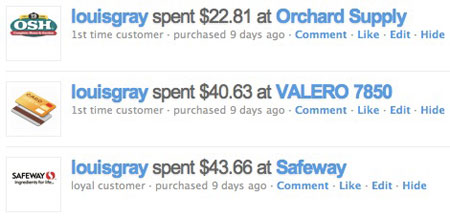
See How Boring My Life Is? Blippy Knows.
With a goal of erring on the side of transparency, I added iTunes and Netflix and Amazon, and even added the family credit card that both my wife and I use. This way, when I have a mundane task like filling up the car with gas, or she gets diapers at Safeway or buys the kids something new from Toys R Us, you will get the opportunity to know about it. You can follow each update, and I can follow you, or others who have joined, seeing my every purchase, and discussing them. Did I buy the right thing? Do you have this product too?
The interface is a lot more like Friendfeed than Twitter, to be honest. You can make in-line comments to every purchase, or "Like" items, just as you can in FriendFeed and Facebook. Obviously, this appeals to me, and using the product is self-explanatory.
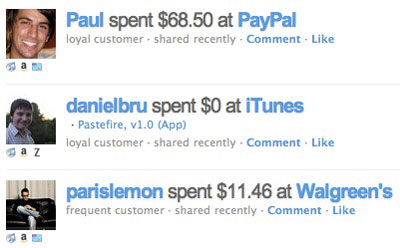
You Guys Are a Thrill A Minute Too...
But for every so-called "fun" update, where you see I bought an iPhone app that may appeal to you, or a restaurant I visited, or a Netflix movie I rented, you're going to need to sift through my routine updates, like paying Homeowner's Dues on our condo, stopping for fuel at Valero, getting food at Safeway, and on and on. The truth is, it soon becomes as exciting as reading a bank statement. There may be the occasional eyebrow raised as you see someone's update with a big dollar amount, or an amusing venue, but more often than not, at this point, I am simply exposing to you what I've long known to be true. The daily minutiae of my life is not interesting. That's why there aren't blogs dedicated to my comings and goings, and why I am often writing about other people and what they do instead.
Following on to yesterday's post about being "open", am I worried about revealing something I shouldn't? Something that might embarrass me? Not really. It may show that my wife and I go to the dentist or doctor and may have to spend money. And I can always delete individual items at any time if I want them out of my stream, if I remember to. Blippy essentially is a lot like Mint.com, which I also like, but instead of keeping all my data internal to me, it opens it to the world for discussion. The service is actually pretty cool, and can be amusing, if the people you follow are interesting. I just don't anticipate a lot of excitement on my feed.
See also an interview in the Wall Street Journal from today of Philip Kaplan (@pud): Philip Kaplan On Blippy: People Are Loosening Up Online. He's thinking along the same lines I am, adding, "The biggest risk is that their purchases are totally mundane and you’re really super boring." Sorry, Pud.
8 Comments
Louis,
I buy into the sharing nature of social media but Blippy is over the top. Really, how much value is there in people getting the details on the purchases you made. I'm sure Blippy has some value but do we really need to know about what other people are buying? What's next, a social media service in which we disclose our how much money we make? If Blippy actually catches on, I'm not sure what it says about our willingness to keep anything private.
Mark
Haha so you got sucked into this also? They sent me a group invite on Wakoopa - but didn't send me an invite code - weird that it looks like it's open for public now. Awesome. :)
My problem is that it doesn't like to give my transactions 'friendly' names, i.e. "Eftcoles Devonport Tas Au" should be "Coles"
Just reading through you list, Louis, is pretty fascinating. I can see this data being cut and improved in a lot of ways. Fun.
I haven't tried Blippy but I see tremendous value in this type of information sharing. I'm not sure that Blippy has nailed it quite frankly, but we'll see a big push towards sharing this type of "real" information from a bunch of different startups in the near future. I just wonder if Blippy's Twitter-like stream of an interface is the best choice? What do you think?
Blippy sounds like something major brands should be monitoring. To me that would be the most important use. If people are buying an overpriced item and other people are "liking" it, that could be useful information for them. I'd join just to go around "unliking" products that really need improvement hoping the brands are watching. Verizon High Speed Internet would be my first victim.
Thanks for the scoop.
My thoughts parallel ileane's. While your Blippy feed may be interesting to you or your friends, it could be REALLY interesting to data miners and data aggregators.
Assume for the moment that current Blippy users are early adopters (a reasonable assumption). Aggregate their data and you can find all sorts of things. Some data uses are obvious - if a particular iPhone app shows up a lot in Blippy, perhaps that app is destined for success. Some data uses are less obvious - if a particular Valero gas station is patronized by a lot of early adopters, then perhaps that Valero could be convinced to buy some online ads.
Of course, Blippy has its downside, just like any other online sharing application. If a company is checking out a candidate for hire, perhaps the HR people will check the person's Blippy feed to make sure that it aligns with what you said in the interview. For example, if you were to interview somewhere and say that you enjoy gardening, the HR person would see the Orchard Supply Hardware entry and think, "Yes, he does enjoy gardening." By the same token, if you were to proclaim in the interview that you are 100% dedicated to the Zune, but your Blippy feed shows iTunes store purchases, an eyebrow may be raised. Again, this is not unique to Blippy - people can mine information from Facebook, Twitter, or wherever - but it's just another data point that people can use to check your claims.
Personally, I prefer Foursquare over a service like Blippy. While Blippy lets you delete a post after the fact (if, as you noted, you remember to do so), Foursquare lets you choose whether or not the fact should even be shared in the first place.
ileane and Louis, the day after I wrote the response above, I happened to catch Steven Hodson's post about online services and information sharing. Hodson, as usual, has some interesting thoughts. His focus is Facebook, and his assertion that Facebook's business model demands that Facebook users share information about themselves. Here's part of what Hodson said:
Facebook, and other services like it, can’t afford privacy. Its business model is built around us all being mindless blabber-mouths. It needs us to believe that privacy is an archaic ideology.
I'm mulling over the ramifications of Hodson's statement.