 It's tempting to go back to the age-old line of there being lies, damn lies, and statistics. On the Web, where practically everything is measured and big numbers are almost always better, counting up one's followers, friends, subscribers or authority is practically a pastime. But with each metric comes a question of validity - how did they approach that data, and is that process consistent with the world view of what is factual?
Today, for reasons known only to their team, FriendFeed started to display subscriber counts to those FriendFeed users who are importing blog posts alongside all other subscribers, displayed in FeedBurner or any other blog analytics tool. With this change, popular FriendFeed users have seen a dramatic jump in their feed subscriber counts, even if actual traffic or readership to their sites has not changed.
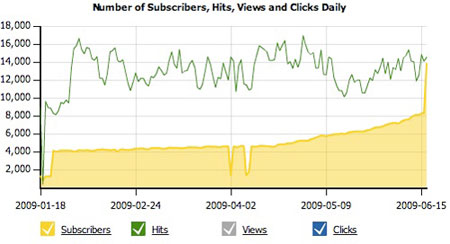
BlogPerfume Shows My Stats Spiked Today
A clear beneficiary of this move, my own statistics ballooned from a possibly accurate count of just over 8,000 subscribers on this blog to more than 13,000. And in parallel, thanks to my importing my posts on my wife's blog, her count catapulted from just over 50 to more than 9,000. (For a site that gets only dozens of visits a day)
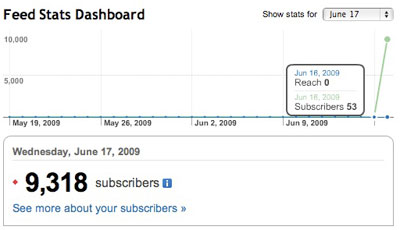
My Wife's Blog Stats Are Through the Roof
Coincidentally, my RSS subscribers had already been jumping, starting in late April, for reasons largely unbeknownst to me. In the last two months, I organically saw the subscriber counts pass the 5,000 barrier and crest to the more than 8,000, as I poked through the stats and tried to find out why - considering both Google Reader bundles and possibly a part-time inclusion on the Techmeme leaderboard as factors. But now, pointing to that growth seems silly, given FriendFeed flipped the switch and gave me a big, albeit likely false, foundation.
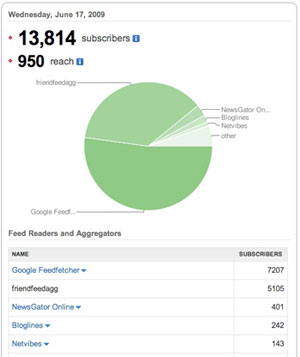
FriendFeed's Impact Rivals that of Google On This Site
The company's comments on this change state that "you are putting your words in front of a lot more people", so theoretically, they should be counted. But I believe it is less-intensive to follow someone on FriendFeed than it is through standard RSS, and I have no idea how this handles duplicates, though I can guess it's somewhat controlled, given my own stats jumped by a mere 5,000 when my wife went up by more than 9,000.
Rob Diana of Regular Geek clearly made his comments understood, when he said, "Subscriber Counts Now Mean Nothing".
Since you don't have admin access to my FeedBurner stats, you can see the jump by taking a look at Blog Perfume's Feed Analysis tool here.
So the question is - why? Did the FriendFeed team just want to extend the visibility of how much impact their service has with bloggers? This move makes them a clear rival to Google in my own statistics. Or did they really think this was a way to show, accurately, how many people you were exposed to? Either way, as I said on a thread in the site, what's done really can't be undone. I hate upward spikes as much as I hate downward spikes, as we've seen when FeedBurner and Google FeedFetcher miss each other in the night. But it's not accurate, especially when it comes to small blogs hiding on big accounts (like with my wife's blog on my ID). I just hope Twitter, Facebook and other sites don't choose to do the same thing, or we can call the whole tracking bit a wash.
39 Comments
The blog entry on the Friendfeed blog left me with more questions than answers!
Paul's follow-on note, saying that we shouldn't assume that because somebody is subscribed, that they read the RSS feed, leads to a new set of questions. Should we also then assume that while somebody may be following us on FriendFeed, they are not following our updates there either?
(And yes, I understand how to fake follow using lists)
You do have to wonder why they have done this and why now. Something must have changed for them to think it was a good idea. Any chance Paul or someone else will tell us why, and why now? The fact is that since the 'beta' became the norm, many users are now implementing lists and searches that make subscriptions in FF less relevant than before. It is now much more likely that you could be subscribed to someone and never see any of their content.
Well, you have to admit this is a great way to get Arrington back on FriendFeed. If you want TechCrunch talking about you, it's always good to have them using your service.
Although it's gutsy too because it could likely tick him off - waiting until after he closes his account to add something that would have given him more subscribers.
Great post Louis.
Congratulations! but it needs minimum 200 subscribers in friendfeed and I don't have enough so this is the problem with me.
I don't know if congratulations is the right word. I was excited about reaching 5,000 subscribers in FeedBurner, and then rapidly hitting 6,000, 7,000 and 8,000. But this artificial bump means I have disclaimers all over it.
Louis, I do not know if I should worry about this, or not. It seems to me they could have given everyone another "guestimate" of blanket coverage without "harming" the aggregate and the "solid" numbers for active data. Thank You I enjoyed your piece.
It can be undone. Just unplug your blog from FriendFeed. That's what I did.
They are throwing apples in with oranges. If you take FriendFeed's approach, then all of my Twitter followers should be added as well.
Subscribing to an RSS, especially a full RSS feed like yours is very different than subscribing to your friendfeed or twitter stream.
Doug, I have no interest in removing my blog feed from FriendFeed. While it is fun to share other items and post baby pics, the blog is a big part of what I am there, and FriendFeed is a significant traffic driver for me - helping bring the conversation back.
My blog posts still get into Friendfeed since I publish blog posts to Twitter. I am not removing the content. I get very little traffic from FriendFeed to my compliance blog, so the near doubling of subscribers due to the friendfeedagg feels very artificial. That's artificial even for FeedBurner.
Is there a way to push selected twitter updates to friendfeed? I recently stopped pushing my tweets there, but I also push my blog posts to twitter with specific keywords...
Jesse, who said anything about TechCrunch? Also, TechCrunch has about 2 million RSS subscribers. The 30k or so bump they might get from FriendFeed (max) would be small.
This doesn't only affect popular FriendFeed users. Even slightly popular FriendFeed users can see dramatic effects, especially if their FriendFeed accounts are more popular than their blogs. In my particular case (top 300 in FFholic, with four blogs with a Technorati ranking no higher than 700K), I had an order of magnitude increase in my FeedBurner subscriber statistics.
If I may amend Rob Diana's post title, perhaps it's more accurate to say that "Subscriber counts now mean nothing, but reach counts may now be more important." That may be the more meaningful statistic anyway, since this shows a higher level of commitment.
The reach count in theory shows how many people actually saw your feed through its distribution each day, and that is a subset of the total visitors to a site. People have been raised to look at the shiny FeedBurner chiclets and guess a site's authority as a result. This just bumps up our numbers. And my wife's blog might as well just remove it altogether.
I don't get the logic behind doing something like this. It seems to me that this move pollutes the value (whatever is left of it) of Feedburner stats. Those stats are supposed to be tied specifically to people whom subscribe to someones RSS/Atom feed. I might follow someone on FriendFeed for a variety of reasons, one of which might not be that persons blog. FriendFeed evaluating the action of someone following someone else, and making assumptions against that action, introduces a huge grey cloud. This ultimately dillutes the value of the Feedburner stat. The Feedburner stat is tied to 1 thing. Someone subscribing to your blog. It's either true or false. There is a huge cloud of greyness baked into that number now. Not that Feedburner has done a great job of showing reliable data. But you can pretty much kiss goodbye any real understanding of how many people intended to subscribe to your blog. I'm wondering why FriendFeed felt the need to inject themselves into this position. Seems like a very awkward decision to have made.
Dave, the value of FeedBurner stats has been questionable for some time, but it seems this move stomps on it. It's almost as if they were saying that they didn't matter, and then they wanted to go out and prove it. I don't agree with the move any more than I think that the Google search index spider should count as a unique visitor.
Why not also take all page views of my items on FriendFeed and count them on my stats too?
I agree. I referred to the fact that Feedburner stats are unreliable. You might as well remove it from your blog all together. It's just an unreliable number.
Louis, I follow your blog via FriendFeed -- why should that count differently from blogs that I subscribe to in iGoogle, Reader, etc? (and in particular, if your blog weren't in FriendFeed, I would most likely subscribe in Google Reader, so the counts are interchangeable for some of us at least) WorldofHiglet, this feature has been on the TODO list forever, but some recent infrastructure changes finally made it easy to implement since the feed fetchers have access to the subscriber counts.
Paul, it just requires a different way of thinking. To date, all of us have been "trained" to assume that a subscriber has access to the feed (usually the full feed) in an RSS reader. FriendFeed offers links to my blog posts, but not the full content. I believe that the percentage of posts read by those who subscribe in a reader is greater than the percentage of posts read by people who follow me here, given I offer more than just the blog.
As the blog is not income for me, I don't rally too much around page views, visitors, etc., so at some level, the FeedBurner number offered a close measure of influence and credibility. I recognize that often the # of subscribers I have exceeds the number of unique visitors per day, etc., but I believe the problem this presents is even more great for my wife's blog than my own. She jumped from 52 to 9300 or so and she only gets a few dozen visitors a day - so her number is completely invalid.
Not that I used Feedburner much, but at this point their numbers are even more bogus than they were before. Fortunately, it's easy to subtract out the Friendfeed "subscribers".
Louis, I think we all know how you got from 5000 to 8000 in the last 2 months. ;)
How, Josh? FFundercats?
But of course!
Oh, great, now I killed your thread too? :p Of course, I'm kidding! You're the one that gave US a bump, and by bump I mean "shot out of a trebuchet".
I think the numbers should be included. IMO numbers do mean something about your influence and credibility, and if they don't people will figure out very quickly. Now the question becomes how does Feedburner differentiate between someone subscribed to your blog in Google Reader that is also subscribed to your FriendFeed? I think those should be counted as one, not two.
Paul, as Jesse Stay shares posts he writes from my blog, do his subscribers also count on mine, as my subscribers count on my wife's blog?
Louis, that would have to be tracked on a per-post basis, but assuming that were possible, it would certainly be an interesting number. The example of your wife's blog is an interesting one since your followers didn't necessarily intend to subscribe to that, but I think it's a bit of an edge case. As for your subscriber numbers being a measure of your influence, I don't think you should under-estimate your influence via FriendFeed :)
Paul, just as an example: my analytics referral logs show that I get 97 visitors from friendfeed every 2 weeks, but the subscribers on my feedburner charts show 200+ subscribers from friendfeed. I definitely have to discount those friendfeed subscribers quite a bit! I think folks subscribe to my blog to read stuff I wrote, while folks subscribe to my friend feed (or google reader stream) to read what I read. :-)
Piaw, however, how do you know everyone subscribed in Google Reader actually reads the content? You can skim by title there as well.
It turns out that I get the item use numbers from feedburner about which items actually get visited (i.e., clicked through on), so I do know at least what content gets read. (I also get some information from analytics on the blog itself)
Piaw, in Google Reader you don't have to click on it to read it. There's no way to track that.
Feedburner provides view counts too, but since there's no intent expressed there (people could be jus skimming), I ignore it. A click through is the only reliable measure of intent.
Piaw, and I imagine FriendFeed gives higher click-throughs than Google Reader
1000's of subscribers for everyone! It's sort of like monopoly money...
I doubt it. It takes effort to actually subscribe on Google Reader, and most of my traffic comes from Google.
Thanks for writing about it! I saw this yesterday in feedburner and I thought it was some sort of yet another temporary glitch.