 Skimming many of the leading technology outlets, you would think RSS had given up its ghost, making way for new services, like Twitter. Just this week, ReadWriteWeb claimed the RSS reader market was in "disarray" and continued a "decline". This came after a summer in which TechCrunch IT's Steve Gillmor declared RSS dead and suggested that it "rest in peace" and others ditched RSS for microblogging lists. With the world watching Twitter's top names and their Suggested User List-boosted following counts cross well into seven digits, data from FeedBurner and other sources shows RSS counts climbing - in some cases dramatically - for nearly all blogs, and a number of them also sport reader counts in the millions. While the independent market for RSS readers may be in bad shape, having ceded ground to Google Reader, RSS as a utility is actually growing. It's not going down, not by a long shot.
Prior to ReadWriteWeb's alarmist article, back in August, I arrived at similar conclusions, when I said "stand-alone feed readers are collapsing", highlighting the fact that Google Reader, and followers on FriendFeed, dominated my personal statistics.
That Google Reader and iGoogle have reached a dominant position in the market does by no means indicate the technology's death, but instead its maturity - something that, beyond aggregate reader counts, does not take in to account the fact that RSS is the mechanism for getting data between sites practically everywhere, even if it is not called out as such.
In January of 2008, I highlighted the debut of a new service called Rating Burner, which aims to display the most subscribed to blogs that utilize FeedBurner. The site shows not only a leaderboard, but also the change in subscriber data from day to day.
Data from Rating Burner shows green, positive growth across the board for feeds. And while total counts can always be debated as to their accuracy, sites including TechCrunch (with 4 million subscribers), the YouTube blog (with 2.4 million), Smashing Apps (with 1.5 million) and Simply Recipes (1.5 million) are into seven digits. This parallels the top Twitter accounts, who crest in the 4 million range, crowned by screen celebs Ashton Kutcher, Britney Spears and Ellen Degeneres.
Yes, statistics are statistics. The high numbers for these well-known personalities is suspect, thanks to their inclusion on Twitter's Suggested User List, and it is also expected that some top blogs here are bundled and not read every day - adding to their counts. Also true is the fact that not every blog uses FeedBurner, and thus cannot be tracked as well. Many sites point instead to a raw XML file, keeping control. That said, regardless of the data's perfection, the growth in 2009 for RSS subscribers cannot be questioned.
Using BlogPerfume's Feed Analysis tool, I took many top blogs and plugged in their statistics, to see how they grew in 2009. Running their query for the last 12 months provided 11 months worth of data. (Not perfect, but good enough)
For the charts below, I used three data points to show blogs' subscriber trends:
- January 22, 2009
- June 22, 2009
- December 22, 2009
To run the numbers yourself, simply plug in any FeedBurner enabled feed. (Examples: TechCrunch, Mashable, louisgray.com and I Can Has Cheezburger)

ProBlogger Nearly Doubled Subscribers in 2009 to ~140k
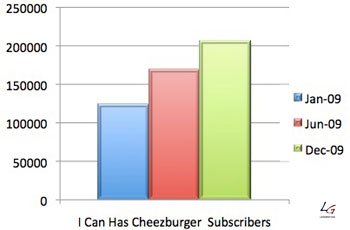
LOLCats Added 100,000 Readers to 200k+
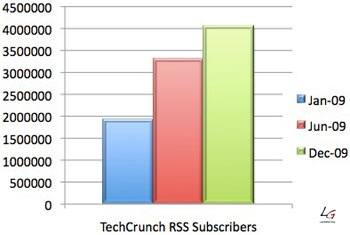
TechCrunch Doubled from 2 million to 4 million
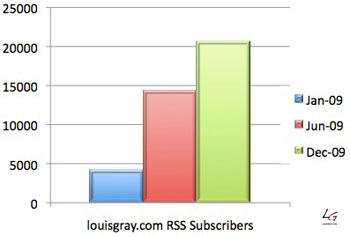
My Own Stats, Aided by FriendFeed, Quintupled
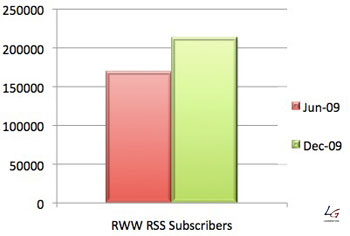
ReadWriteWeb added 40k from June (Jan. data flawed)
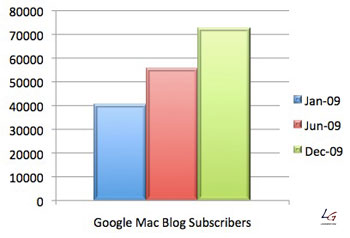
Google's Mac Blog Added 30k Subs to Top 70k.
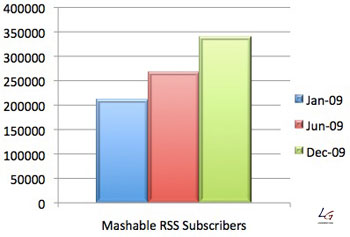
Mashable Added Almost 150k Subs to Near 350k.
Also - keep in mind that my own personal numbers are inflated thanks to FriendFeed, but most non-personal blogs are not.
So what is the point? The point is that while some services (read: Twitter and Facebook) may be getting many people's attention, and while it is also true that Google Reader has the lion's share of the RSS reader market, the current discussion around RSS being less useful, or less important, than in years past, is flawed, period.
Lest this early adopter sound too much like a curmudgeon, just because something is newer does not automatically make it better, nor does it mean that there will be a rapid mass exodus from the previous technology. Just like Twitter can drive good traffic to a Web site, so too can RSS. Just like Twitter can pass along top content, so too can RSS. Just like top followed accounts can get million-plus audiences, so too can RSS. And both are growing in terms of connections, with no reversal in sight. Both are tools to be used well, and both are being used more than ever. The only "disarray" is in the current thinking.
22 Comments
you might want to include a note that Google Reader's "suggested user list" helps pump up at least one of those blogs - i'm not sure of the others.
I did mention that "it is also expected that some top blogs here are bundled", but I did not specifically mention Google Reader. It has been a long time since I looked at what they have in their bundled feeds. Worth a review though.
aah thanks - once again one wonders where these blogs would be without the pumpings.
excelent post and analysis Louis. Since most people seems to agree that the "staganation" in the rss market is due to GReader dominance, what do you think it will happen on the next years, you see any new app gaining significant share? Are you completely satisfied by GReader or think it still have room to improvement?
I am very happy with Google Reader, but I think saying I am "completely satisfied" is a stretch. I believe in the product and the team. I would very much enjoy seeing faster pickup of stories, as through Pubsubhubbub to the service on an inbound basis, not just outbound. I would like to see an easier way to share public conversations instead of in a walled garden. But on the whole, it's a fantastic product.
What I think may happen in the next few years is that folks will start to pull in more of their content in a diversified way to networks such as Facebook, and its possible that Facebook could be as dominant in discovering RSS as Reader is today. And... why not build a Google Reader facebook app? Just an idea.
"folks will start to pull in more of their content in a diversified way to networks such as Facebook"
This is a similar approach to what Mozzler is doing. Aggregating Facebook and Twitter streams into one, and providing an RSS-like display of twitter lists. See http://beta.mozzler.com/ for an example.
This "RSS is dead" discussion is totally flawed. We in our little corner of the world are perhaps tired of RSS and are using other curators, but believe me, my non-technical friends have not even discovered RSS yet. Every week someone tells me they've started to read feeds with Google Reader. And many more still subscribe to me by email. If you're not in the know, you become overwhelmed by the amount of content on the internet, and sooner or later you discover curation, whether your own or someone else's.
I hesitate to call an as-yet unadopted technology dead, unless it is killed by aggregator sites like Huffpo, which may perform somewhat the same function. As newspapers die, I think RSS will grow.
I agree that the "is dead" camp is flawed. I don't mind forward-looking thinking and trying to push things further than they are, but to follow this path is a disservice.
I am one of those new founders of RSS and so far, I like it better than Twitter since it's easier to add a new subscription of something cool that I just found. On Twitter, I click a tweet, go read whatever it was, go back to find the tweet, and it's gone (actually lost). Then, I search for it and sometimes get lucky.
And that is how I feel. Also, now that Google Reader has made RSS
social I am sending things to Twitter that my tweeple haven't read.
Like health care info for example
Francine Hardaway, Ph d
GV: 816-WRITTEN
Twitter: @Hardaway
Http://blog.Stealthmode.com
I am consistently confused by this RSS v. Twitter debate. Both serve different purposes. Twitter, for example, serves up the currently hip "real-time Web" wonderfully, but if I go away for a couple of days, I miss things. My feeds give me a chance to do that catching up.
Perhaps it's just that RSS has become successful enough to be "invisible" to many people now. It's become a core technology that sits behind many Twitter accounts and many Web services. I mean, I used to have to write custom scrapers to parse HTML content--they broke every time the design changed -- now I can whip stick RSS content onto a Web page in 10 minutes.
Perhaps it's true that RSS reader innovation is dying off (for the moment), but RSS isn't going anywhere, and Twitter hasn't replaced it.
All factual statements. I believe RSS and Twitter serve different purposes. I assume that if one were to draw up a Venn Diagram, you could see overlap, but for the most part, they are non-competing.
One problem: RSS subscriptions ALWAYS go up. Why? Because people like me, who don't use Google Reader much anymore, have NOT unsubscribed from anything so our accounts are still counted.
What's more interesting is to measure clicks on links, or other engagement. I will be willing to bet that those numbers have headed down overall on RSS feed readers (my referer logs are showing a downward slide, even though my numbers of subscribers are growing).
Two notes - 1. I agree with Robert in general. 2. I thought that FB only counted "active" subs - meaning you must have loaded the feed during that day to be counted?
I am not sure I agree completely that RSS always goes up - it only does for those who have defaults somewhere.
Same with twitter - take most accounts and you will see no growth - most on a decline.
I agree that RSS numbers go up due to a lack of unsubscribes. I also believe that Twitter followers go up due to a lack of unfollowing. In terms of engagement, the short-term data I have shows that engagement is flat. Not up or down. Long term data is up, but up less than total count.
Louis,
while I totally agree with your post, I think that the analysis of the growth year over year is a little tricky if taken out of the context.
For example, Mashable RSS subs grew, but how does that compare vs their readership's growth?
I fully agree with all that's been said. The problem is that RSS is a crappy tool for consumers, Twitter is much better.
Yet, Twitter (or Facebook) publish a lot of content that's coming directly from RSS feeds, like Twitterfeed, but they also are closed environment in a way that on Twitter, I can just follow people with Twitter accounts..; and there is probably not a lot of flexibility on the way to consume this feed... I want less coupling between the place where I consume feeds (or streams of whatever) and the place where they're published!
Well stated, Louis. I thought about writing another entry on the topic, since RSS is apparently becoming less popular, but I doubt I would have had the ammunition to drive it home the way you have. So, for those of us that still believe in RSS as a reliable source of information, I say "Thank you for a job well done!"
Keep up the good work.
Preach Louis! I may be a little off here but why are people trying to put RSS in a deadpool and compare it to other platforms/startups like Twitter? Yes RSS is a tool but I look at RSS as a fabric of the www like IP addresses. It's just needed to make the web work. That's just my 2cents and your last sentence summed the RSS is dead conversation well. "The only "disarray" is in the current thinking."
RSS4Life
You also need to figure in RSS to email subscribers. The content may be pulled via RSS, but the delivery method is email.
For example, Copyblogger shows 84,000+ subscribers via Feedburner, but 17,000 are actually receiving content via email. The email numbers are growing proportionately faster than the feed reader numbers, likely due to the mainstream breakthrough of social media and the lure of online marketing to less "techy" folks.
I think we've lost sight of the fact that RSS is a transport/delivery protocol; how you use that protocol is completely separate and apart from the implementation detail known as the "RSS spec". While blogs popularized the use of this transport specification, "social media pundits" demonstrate a fair degree of ignorance when they make broad and sweeping claims about "RSS". Indeed, they make these claims about RSS without giving any consideration to the hidden uses of RSS or for what it is - a highly useful and widely adopted means for information exchange.
Pundits are quick to point out that RSS is dead because they're discussing it less and focusing on other (seemingly more infectious) topics such as real-time services. Be careful of your pundit selection criteria.
The fact that that RSS is discussed less, is a key indicator that it is slowly blending into the background; - the more it blends, the greater the adoption and the less we realize it is being utilized. Here in pundit-land, we used to talk about topics such as blogs, USB ports, and ODBC [alot], but we stopped. Why? - because they're fully adopted and deeply integrated into the products and services we use every day; hardly the subjects of death predictions. In fact, I'll predict that RSS will be around far longer than USB ports. ;-)
When my 80 yr-old mother started using RSS she didn't know she was using it (and she didn't care to know) - another key indicator of maturity of applications that leverage RSS without forcing users to deal with the implementation details many of us are familiar with.
The conceptual idea of a web that polls for information changes was (and remains) flawed. This is an idea that should die. However, suggesting RSS is dead because time-to-awareness is slow with RSS, or there are more interesting things to talk about, is nonsense. There are probably other content use cases that rely on RSS that should also die - certainly the independent RSS "reader" market has run its course. It was a bad idea to build an RSS reader in 2004 when there were 300 of them; today a handful remain and it's still a bad idea to get into that business.
But just because certain ideas that seem central to RSS (like news readers) are struggling to keep a pulse, its unreasonable to assume the underlying implementation detail (i.e., the RSS spec) should be written off. There's simply no evidence to support this claim and nothing has emerged (or is poised to emerge) that will provide a better implementation approach to meet content syndication requirements. Okay... maybe Atom. ;-)
Bill, and what about AM? Seems to me that old radio technology must be a thing of the past because its been decades since the popular science pundits were raving about "amplitude modulation". ;-)
Just today, I heard someone commenting about the new, solar powered parking meters in Ann Arbor where you can pay for parking with a credit card. They were impressed that "electronic devices" that could read a credit card, print receipts, and display digital output could "be powered by pure sunlight" and not use any electricity. I just kept walking.