 About a year ago, I put forth a theory I called "The Five Stages Of Early Adopter Behavior", chronicling how we, as self-proclaimed early adopters, like to find cutting edge products and services, but can go from the most vocal proponents to their most visible detractors in a short amount of time, sometimes putting something in its grave even before the rest of the mainstream has found it exists. A corollary to this theory is that once an acceptable service or product is found, eventually the early adopter group will slip into a comfortable malaise, looking around for the "next shiny object" that will take their attention away from what to them has already become old hat. And this quest, this desire to find what is next, is what drives many of us to sign up for everything under the sun, kick its tires, and debate its worth with our peers. But just because we look for something new doesn't mean everything we use today will eventually be discarded.
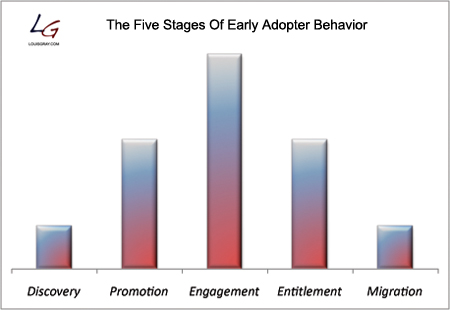
The Five Stages of Early Adopter Behavior (June 2008)
Back in June, I wrote:
"One month's golden boy can be next month's afterthought. One week's addiction can be next week's memory. For a service to succeed, it needs to attract those early adopters who can help propel a strong population, but it needs to do all it can to keep those adopters feeling like partners and mainstream users, before letting neglect fire up their egos so much that they leave you altogether."You can sit on the sidelines and see this happening everywhere. In fact, much of the backlash against Twitter of late has been from the early adopter community who has been largely ignored, in favor of the celebrity of the week, making those who pushed the service initially feel like they are unwanted.
This lust for the next big thing, and the desire to be first to find it, is much of the reason you see online media write bigger and bolder headlines for products that are fairly incremental to activity, and not game-changers. Be it yet another search engine, a new location awareness tool, or a widget that combines multiple previous offerings, there are presumed "bonus points" for being the first to call it a "Killer".
Amidst this, the truth is that some of these products do take hold and become part of our everyday activity - including Google Reader, Facebook, LinkedIn, FriendFeed, the iPhone and others for me, of course, and if they continue to please customers, they don't end up seeing even the most-aggressive users moving from what I called "Engagement" to "Entitlement" and eventually, "Migration". As FriendFeed's Paul Buchheit slyly asked of me last year, "I hope this doesn't mean you're moving on to stages 4 or 5 Louis...", prompting me to say that "some sites have the potential to be a permanent 3," referring to "Engagement".
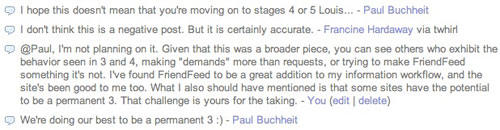
Can Sites Be a "Permanent 3"? I say, Yes.
And yes, it can be tempting at times to stomp my foot and expect some of the apps I like and use the most to behave a way I want them to, but for the most part, I think I've held off, even as I continue testing any and all newcomers.
In a thread this week, perennial early adopter Robert Scoble jokingly told one commenter, after they asked what "the next shiny object will be", that "Louis Gray hasn't figured that out yet, so we have at least six months." As if I had that much power...
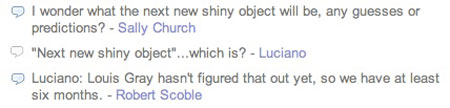
Looks Like It's Up to Me, Then?
As I see it, we have been lucky enough to find some shiny objects very early that have become active sites for a good number of people. We were the first to report on TweetDeck back in July of 2008, and TweetDeck is arguably the most popular desktop client for Twitter. Its success can even be seen in the development of competitors, such as Seesmic Desktop. We were also the first to report on Socialmedian, which was acquired by XING in December for a cool 7.5 million after seeing strong momentum. We were the first to really dive into the world of shared item aggregators, and were the first to report on ReadBurner, RSSmeme and other competitors. We were the first to highlight the launch of Toluu, a place to share your OPML and discover new feeds. We were the first to talk about Feedly, which is reshaping the way you organize and find data in your Google Reader stream. We were also the first to report on Twazzup, a new search engine for Twitter, as well as other tools.
So what am I saying with all this? Aren't these shiny objects? Didn't TweetDeck change the game? Aren't early adopters enjoying these services that haven't yet been absorbed by the mainstream and celebrities? They are.
Early adopters can do more than just discover new tools. Our job, as it were, is to help take something that's undocumented, and discover its potential and its use. What are we already doing that these new tools make better? What can I do that I couldn't do before? Does this new tool make anything I already do easier, or is it executed in a more clear way? It's not about finding new tools just for the sake of getting one more blog post on the chart. It's about hopefully rewarding developers for their efforts, rewarding early adopters and readers here by their getting early access to things that make a difference, and rewarding ourselves by building out the community in a new place. We are always on the look out for shiny objects. We find them all the time and are happy to share with you. But if I've found one that works for me, you can expect me to latch onto it like a barnacle.
12 Comments
oh NO!
I'm hideously in the middle of entitlement, I hate it when I see myself in this stuff and it's not flattering.
Great post.
You knew I'd have to drop in on htis one :).
One of the things that I think that as it is important that early adopters need to find the new and shiny I think it is equally important that we also provide a realistic (and critical) point of view about the things we work with and talk about.
If all we end up doing is giving the proverbial pat ion the back about everything we do a bigger disservice to our readers than if we were to write Pay-per-post or sponsored posts.
Do you ever sleep? :)
I try not to sleep too often. I find the practice unproductive.
And that makes it so much harder for the rest of us to close our eyes.
For me, it's not so much a rush to be the first with a shiny object. Instead, I just want a better way of doing things, believing that a solution must be out there and I just haven't found it.
Actually, I just realized that if you're up and watching for the shiny objects, I can sleep and just wait for your sharing. Perhaps I should send you my list of challenges :)
Wow, excellent read. It seems obvious to imagine that system being, and it's obviously those who care about the details right up front that are those who shape its mainstreaming adopting effectiveness and vision.
I was enlightened by the reference to which you way that the twitter backlash is made by the early adopters community. It would also be logical to assume it as the shiny object is always theoretically external to us, but attainable in seconds as in months.
Reviewing, turning around the subject, tracking and announcing loud and clear for referencing, clouding the situation making those services react by sharp decisions, deciding on a change without the public knowing it was a situation tracked in the first place. Sometimes it's in its internal policies, sometimes it's in functionality.
All of these steps create the mechanics behind their developments and later success. And those who listened to the underlying unknowns gets even more recognition. Thanks again for those words of wisdom. ;p
Louis, I think this syndrome is now clustering around "real time streams". Everyone is writing posts and real articles about the messianic coming of real time updates; when it is hardly proven that real-time steams are advantageous or not.
I always thought that relevant and contextual was the real need, but now that everyone and the brother is streaming real time updates, that is the shiny new thing. ech.
Tools like Feedly and Toluu are nice but the real score is finding the large gold nuggets first or at least close to first. Keeping your ear to the ground and listening for the buzz across all of your networks so that when the next Facebook or Twitter sprouts its green shoots, you are there early to gain the advantages that come with early adoption ie knowledge, position, experience...
Spotting these green shoots has become pivotal in determining ones continued online prosperity. Like you wrote back in June "One month's golden boy can be next month's afterthought."
"You can sit on the sidelines and see this happening everywhere. In fact, much of the backlash against Twitter of late has been from the early adopter community who has been largely ignored, in favor of the celebrity of the week, making those who pushed the service initially feel like they are unwanted."
This part of your post deserves a post on its own. There are many cases thinkable where keeping the early adopter crowd satisfied ends up leading to alienation of the service towards the users it was intended for.
In the case of Twitter I believe that they have fallen for a fundamental web 2.0 flaw. They have chosen to make growth more important than user value. The result of this choice is that when Twitter "left" to go mainstream, they got occupied with spammers and accounts "gaming the system" (i.e. 30K followers and 5 updates). Twitter could protect users from these practices, but seems not willing to do so as it would severely hurt their traffic figures.
Awesome post Louis!!
YOU are my favorite scout for finding the latest and greatest new shiny objects :)
Ok whatcha hidin' up your sleeve now?