 Early adopters serve an important role in the world of Web services and technology gadgetry, helping to act in a multi-pronged position that can blur the line between journalist, customer and partner.
The best early adopters not only help spread the word about a new product, but they can help argue its features, they are eager to offer feedback to its developers, and at times can be indistinguishable from the service's PR or Marketing team. But with time, if not coddled, this crowd can often turn against the very service they helped champion, as they move on to the next new thing, sometimes taking an army of followers with them.
This relationship between service and early adopter is a healthy one, assuming the Web service has, in the interim, grown to the point they no longer need the initial proponent's efforts, having expanded to a more mainstream audience, or achieved sustainable organic growth. But if this doesn't happen, it's a very short trip from promotion to abandonment indeed.
With not too much research, you can see evidence for five major stages of early adopter behavior, as I've summarized below.
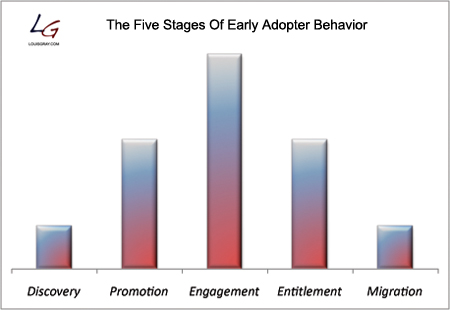
1. Discovery, QA and Spreading the Word
The first weeks and months of a service can be very exciting. The early adopter often works with the developer behind the scenes to learn as much as they can about a product, often posting a new story that introduces the site. If there are any bugs with the product, they are easily glossed over as ones which will undoubtedly soon be fixed. If the site doesn't seem all that useful without a multitude of users, this too can be ignored, as the early adopter hopes everyone will see the service's full potential, and will use it the way they expect to.
In this phase, the early adopter has what can be construed as a personal interest in the success of the product, as he or she has gone out on a limb to associate the name with the third party brand. The adopter will not only be a frequent user of the service, but will track other posts or comments about it everywhere, and repeat the agreed upon talking points. Should they actually find a major issue with the product, they will e-mail or call the developers directly, rather than making the issues public.
At times, everything on the Web can be seen through the lenses of just how this new product will be affected, or how it could change everything else. All of a sudden, what may have been a hammer is proclaimed to be a Swiss Army Knife.
2. Promotion and Collaboration
As the service gains momentum, the early adopter befriends the first users of the product, who may have nothing in common except that they share interest in that product. At times, the product may be used only to discuss the product itself.
The early adopter, as new voices discover the service, will push follow-up posts, giving public suggestions to the company, in an extremely positive way, on how they believe the service should change and grow, showing themselves, in front of the world, to be an integral part of the product's development. Should the product incorporate any of these suggestions, whether due to the adopter's input or not, the early adopter will either take credit, or follow up and show how they were "right".
Now using the product a great deal, at the exclusion of others, the early adopter will openly mock those people who haven't jumped aboard yet, pointing them out as being stuck in the past, or married to clearly inferior products.
3. Mainstream Use and Engagement
Having grown tired of the part-time job of delivering free PR for the service, at this point the early adopter no longer feels the need to architect every story and every product through the lens of the service. Instead, having felt vindicated that the masses are now seeing the potential he always knew the product had, he or she remains engaged, trying to act as a "model citizen" for the product, engaging with newer users, but keeping in mind the higher visibility and trying to act as an example.
At this point, follow-on users have now picked up the ball in terms of promoting the product, announcing each of its aspects in the same breath-taking manner the early adopter once did for the service itself. At this point, the early adopter already knows his or her readers and peers know they like the product, and the need to constantly remind people they are using it is no longer necessary.
4. Sense of Entitlement, Nitpicking and Reduced Use
At this point, often in part due to favorable feedback from the service's authors, the early adopter feels a sense of entitlement, that the product absolutely must be architected in the way they say so, even if to move in that direction wouldn't serve the larger installed base. Now, instead of suggesting quick ways the service could update, the calls are more like ultimatums, and if not quickly seeing a response, the early adopter can get extremely frustrated, at times, seeing this annoyance bubble up to the same degree their first comments on the product reeked of praise.
Now disgruntled, the early adopter can be seen using the product less frequently, with less enthusiasm, and will even take consecutive days off, hoping the remaining audience notices the change.
5. Migration to Something New, Call to Move Followers
Having come full circle, from the exciting discovery stage, where the adopter considered themselves a team player, helping a threadbare company grow on the back of continuous praise and promotion, to a high-profile user role, the individual can come crashing down, lashing out at the product, the company's leadership or the product direction. The adopter often finds a tangential service that now draws their eye, and is seen as a replacement for the original product.
The adopter will, at this point, start heaping lavish praise upon the new product, in a quest to assert their dominance, and prove that they can, again, make a service successful, and to prove that all their belly-aching in the preceding months was valid. The adopter will use their blog and both the new and old service to call followers to migrate as a group, both helping the new shiny toy, and in turn, damaging the old one, out of spite and frustration.
On the Web, this process can be extremely fast. One month's golden boy can be next month's afterthought. One week's addiction can be next week's memory. For a service to succeed, it needs to attract those early adopters who can help propel a strong population, but it needs to do all it can to keep those adopters feeling like partners and mainstream users, before letting neglect fire up their egos so much that they leave you altogether. Making a successful Web service is more than writing the best code. It's also about relationships. And while the early adopter crowd is notoriously fickle, they're not going away all that soon.
Take a tally in your head of some of the services you use each day. If you're an early adopter, what stage are you in? If you're not an early adopter, but you know someone who is, what products do they make themselves part of? And do you see these stages progress? I know I do.
47 Comments
Very Cool thinking. Thanks for the post Louis.
A minor nit to pick with the post though. You make the early adopter process seem very negative. Essentially, the reasoning being the early adopter gets "tired" of the site or its users. I can understand the decreasing excitement as you start using something more and it goes more mainstream, but part of that is due to the site not "needing" the early adopter as much.
Love the writing, love the wit. An excellent post!
I guess all early adopters are closet egomaniacs?
Agree on all
Is there a 12 step process to stop?
If there is, I certainly don't have any intentions of attending. I like this process. It's just worth knowing where you are in that process. Self-awareness is key.
One of your best to date Louis. Every so often, a 'real' service, with 'sticking potential' comes along that can make a huge difference in a variety of ways. Friendfeed is indisputably one of them (so far). Your independent evangelism helped a lot of people discover it.
@ Rob Diana- The question is wether this really is a negative process or not? Its negative because the service in question might be brilliant in and of itself but still be left in the dust by the early adopter. The point should be that early adopters are focused not on the staying power of the service but on its geekiness. Those that follow join not because of its geek cred, but because they find it useful based on said reviews by the early adopted crowd.
This post was really thought-provoking for me and made me look at some posts over on my blog, and I noticed that I do go through exactly these phases with services like HubDog, BluePulse, SakiMobile, and more recently ceTwit. It's definitely made me think twice about my approach.
In my mind, it's not intended to be a negative process. But you can see the word FriendFeed throughout the post without having to say it, right? I often read here that XX% of all content on FriendFeed is about FriendFeed. So if you look at these five stages, you can see stages 2 and 3 for sure. Do I feel the need to announce FriendFeed Rooms or Personalization or Search? No. People already know I'm here. But others (Rubel, Loic, Thomas Hawk, Hutch, Jeremiah, Scoble) are still banging the drum.
Very insightful article. I recognize many of these traits myself, especially related to the sense of entitlement when it comes to bugs or missing features.
Keep up the great posts!
I'm impressed by your analysis, certainly given the fact that you're an early adopter yourself.
However, I question your idea that there are different (e.g. self-serving) motivations other than the (justified) excitement and hope of something better. I think services pushed by early adopters always deserve the excitement, but the creators can't always live up to the (infinite?) hopes of the early adopter, either because of lack of flexibility on their part or the commercial interests of shareholders in a later stage of the service.
For example: Maybe Facebook sucks (in 2008, "post-FriendFeed" terms) because of the fact that Mark Zuckerberg is not as smart as we thought he would be, or maybe because he can't open it up because of the interests of shareholders. (I'm being explicitly harsh against Facebook for the sake of the argument)
Also, a company like Apple shows that you can keep users being excited for one brand. It could mean that the main problem is that early adopters think company founders have some kind of infinite creativity, while in fact they just had one or two well-executed ideas.
In this case, I think there's nothing wrong to cheer for someone who decides to take over the lead. Even if the can't sustain that lead. Improving up on others is hard enough, always being the best is even harder.
Right now, I think Friendfeed has taken the lead in a certain dimension, so I think they deserve the cheering. But this doesn't perse means that they'll always have the lead. It is yet unclear if they have someone as adaptive as Steve Jobs. Of course I don't mean to say Apple will always have the lead in consumer electronics - one could argue about if they have right now - but, again, it's nice to use as an example.
I hope this doesn't mean that you're moving on to stages 4 or 5 Louis...
I don't think this is a negative post. But it is certainly accurate.
Insightful and convicting
@Paul, I'm not planning on it. Given that this was a broader piece, you can see others who exhibit the behavior seen in 3 and 4, making "demands" more than requests, or trying to make FriendFeed something it's not. I've found FriendFeed to be a great addition to my information workflow, and the site's been good to me too. What I also should have mentioned is that some sites have the potential to be a permanent 3. That challenge is yours for the taking.
We're doing our best to be a permanent 3 :)
dude. This is fantastic. We are often thinking through the progress of the user base and shifts that occur as we (and they age). Brad Feld has a great post called: http://www.feld.com/blog.... I think yours a great compliment to this concept.
For me #1, #2, and #3 apply. I felt that way about Apple and the Mac. Once the company went mainstream I felt like I had served my purpose and was no longer needed. I didn't feel resentment as is implied in #4 and #5. I just disappeared.
I think the 5 stages of Death applies here as well. example (where X is some new service, gadget, etc.) 1) DENIAL: "I don't next X. X is lame. X still has issues." 2) ANGER: "What do you mean 'it's a closed beta?' How come so-and-so got one?" 3) BARGAINING: "Someone please send me an X invite/beta/demo unit!" 4) DEPRESSION: "Is that all there is? Shouldn't there be more to life than this?" 5) ACCEPTANCE: "I occasionally use X, but not every day. Meh."
these stages are absolutely positive
any personal examples of products you've gone through this cycle with?
I can't say I've gone through all five stages, as I tend not to have enough pull to migrate an entire group of people along. A few years ago, this behavior could be seen on stock bulletin boards, as we moved from Yahoo! to Raging Bull to Investors Hub, for example.
More recent examples would be prioritizing FriendFeed over Twitter, or you could see people flock to Facebook and later, fall away from it. You can even see people telling FriendFeed what they should or shouldn't do, or saying it needs to play out the way they want.
Regarding Shanmac's comment, I would be a big Apple promoter, for sure, but now that they're in the leadership position, I don't feel the need to liveblog every keynote or wave the Apple flag. It's actually a very relaxing mode... like in #3, where we were vindicated as being right. I hope not to get to stage 4 or 5 with them.
Curious what the ratio of comments here vs Friendfeed were ??
So far, including this one, there are 20 comments here, and 16 on the post entry in FriendFeed.
Now, if you use FriendFeed's advanced search for the headline vs. Everybody and all services...
http://friendfeed.com/searc...
You see 14 more from where I "tweeted" it. There were other postings and bookmarkings of it, but none got any comments in the main feed. The Social Media Room got one or two.
What strikes me Louis, is that some sites, like Facebook didn't go through that early adopter phase. The early adopters were Harvard students and Ivy Leaguers. I"m trying to understand your article in the context of sites like Facebook, who didn't necessarily attract the generic early adopter.
That's absolutely right as Facebook controlled who could use the service for a long time. But when they did open up, it enabled the "true" early adopters to jump in, and the site further accelerated with the API. You can see people like Scoble embrace the site, and then get frustrated by the limits or the uselessness of apps. Now he's not talking much about Facebook at all. TechCrunch memorably said Facebook could challenge Microsoft.
So the early adopter cycle happened. But it happened later in the site's lifespan, after it had opened up.
Don't forget "Recovery"
Who is Louis Gray?
Interesting post. I definitely agree with the cycle as it pertains to leading early adopters who do carry a great weight with followers, and to a lesser degree with all early adopters. I tend to be an early adopter just because I'm fickle and want to test the next new thing; if the next new thing is really close in concept to the last new thing, the last new thing may suffer. But there's not a sense of resentment or revenge - I just got distracted by New! Shiny! And I have zero pull with zero followers.
This is precisely why I've joined fewer and fewer sites over the past few years... why I didn't get excited about FaceBook, why I'm not terribly thrilled about Disqus or FriendFeed. There's always going to be something new, and the time I have to take to migrate mindsets is not always worth it.
ah, wisdom, it's wonderful isn't it? has such strategic value too.
Outstanding post. For anyone launching a technology this should be mandatory reading. Plan to link to it from my own blog, with props of course.
Louis ... this is incredible. I think you're part techno psychologist! Very in-depth analysis and rich details on each of these 5 stages. I think your model of 5 Stages of Early Adopter Behavior is right on point! I've seen this happen with twitter, FriendFeed and now Plurk, just as you called it! wow, creepy!
Louis Gray is King Midas. He touches you and you turn to gold.
Great post and well stated. Not to turn this into a rant, but there have been a couple times in the past where those early adopters exhibiting stage 4, "Sense of Entitlement, Nitpicking and Reduced Use", behavior have driven me away from using a service for a while/forever because:
a. It gets annoying to watch the bickering
and
b. When you try to get away from the bickering, you can't find any normal people who are using the service yet because it's still in the early stages of life.
I definitely like it when everybody hangs out in stage 3 or decides to leave peacefully.
Reminds me of Geoffrey Moore's "Crossing the Chasm", with a twist.
Louis, you're assuming one thing: that early adopters are always members of the Bored Generation: the one that has short attention spans, a slight tendency towards autism, and is brutally biased towards everything that is bright and shiny, always jumping on the "next best thing" once it's released.
Now this certainly describes a large part of the early adopter population, but certainly not all of it. After all, if it weren't otherwise, the 1969-born Unix and the Internet would have never continue to be around — pretty much what we have nowadays was developed and deployed four decades ago, although certainly there has been further development and innovation. However, eager "early adopters" of both Unix and the Internet are still heavy promotors of both technologies — definitely on stage 3, and not stepping down from it.
But there are lots of similar examples. In fact, I would boldly claim that truly disruptive technologies (in the sense that they really dramatically change the way we think, feel, work, and use them) never leave your stage 3. Let's get a few examples... Linux ("Unix on the desktop PC for the masses"), Apache, MySQL, PHP (ten years and still going strong!), blogging (as a concept, not tied to any software platform), and of course the concept of portable music readers (iPod and variants) and — why not? — mobile phones.
So the point that you're trying to make is that most technology is not "disruptive" at all — it's just a fad, a fashion, something "cool" to have for a while, and like most of fashion, it peaks and fades away into nothingness. The industry — even in the most innovative area — prefers to capitalise on existing "concepts" and relaunch the same idea over and over again. We've seen that happening with Hi5/Ringo/Friendster/MySpace/Facebook/Ning — nothing new with each new platform, the concept might be sticking, but people just move to the next one launched, as they go through each of the 5 stages. So, are "social networking sites", as a concept, a disruptive technology? I might consider that they are not if there is no clear model emerging out of the mess... but just successive re-inventions based on the same concept (OpenSocial might be the way out of the mess) without any model sticking around for long. Amazon and eBay are definitely disruptive technologies, as anyone running a publishing company or a distribution company knows.
On the other hand, disruptive technology will never leave the 3th stage. And — surprise, surprise! — it's going to be always around in some form or other. Nobody can imagine that one of these days all Unix vendors will pack and go and say: "so! We had 40 years of Unix! Enough is enough; let's try something else" or "Let's get rid of TCP/IP and build a new Internet from scratch". No — disruptive technology stays around forever, even if it gets changed, improved, and re-developed as time goes by.
And there will always be people around doing the promotion of disruptive technology.
Speaking strictly for myself, I'm quite the early adopter on a lot of technologies, Web sites, and everything that attracts my attention... but I hardly ever leave phase one, and probably won't even enter the "promotion" stage of that! In fact, I believe that I'm currently just on Stage 3 of the following technologies: the Internet, Unix and its myriad clones, anything that comes out of Steve Job's head, and Second Life.
Seesmic video reply from Disqus.
So now the question is just how to get the early adopters to notice you...
This is a gem that bears repeating. Great observations here...
Quite insightful Louis.
Very astute observations Louis. I too see these stages in play. I saw myself going from championing Seesmic to recently grumbling about the service and venting my frustrations all within the span of about a month.
Many of these services are free. I don't know why I let myself get all wound up about them sometimes. After all, they don't owe me anything.
Thanks for this post, though i have read it ages after it had been posted, but useful nonetheless.
Interesting article, I refered to it in my last post
http://reboltutorial.com/bl...
Hello, my name is Gearhead Gal and I am an early adopter, and a product development exec. I enjoyed reading this post, and it got me thinking about the mainstream users and laggards towards whom we often target new products, in order to drive large scale adoption.
First, I believe technologists tend to build products for themselves and use the influential early adopter as a gauge of their future success. But for the average consumer, collaboration isn't likely unless he or she attaches to the product, which only happens after engagement. Consumers should have a rightful sense of entitlement - that a product just works - and when it doesn't they tell more people about it then they do when it works as merchandised.
Second, I believe today's digital generation not only has shorter attention spans, but because of easy access to the infinite world market of goods, substitutes are readily available as is information about the alternatives.
What I conclude from this is that the notions of how an early adopter and the mainstream consumer behave are starting to merge.