People have been speculating on how Twitter is going to make money for what seems like forever. This slideshow from Fred Wilson, a venture capitalist with Union Square Ventures (which has invested in Twitter), features a screenshot that may signal how it's actually going to happen.
Slide 22 simply reads: Where We Are Going
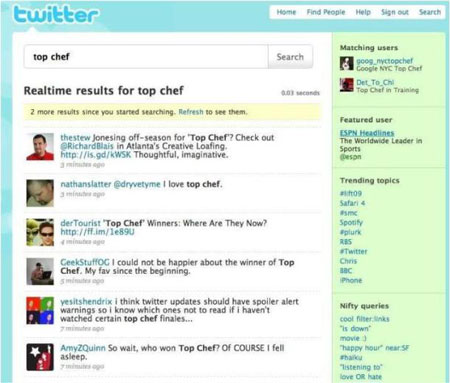
And from what I can see, I like the direction that Twitter is going in here, and think it makes a lot of sense.
Making the profile experience central
Bringing Twitter search into the profile experience is a huge no brainer, and something long overdue stemming from the acquisition of Summize in July, 2008. Twitter search is a fabulous way to pick up trending data about what people are chattering about right now, amongst many other uses, so it makes all kinds of sense for Twitter to base their monetization strategy around this killer app within their community's midst.
Adding value, not just adding ads
I think I've probably screamed louder than anyone else for two years that Twitter should simply (for starters, mind) throw a 728x90 ad banner at the top of every single Twitter profile page. Even at a ridiculously low CPM, or so my argument went, you're at least paying for some bandwidth at that point.
Well, Twitter ignored me, and maybe that's okay. (I said maybe!) I really like that the emphasis – at least on this slideshow presentation – is on bringing relevant and trending data to the user through Twitter search in real time.
Featured/matching users
Having an Adwords-like system that lets advertisers pay to insert featured and matching user profiles based on keyword searches is a great idea. (And just maybe that's why Google CEO Eric Schmidt dropped some snarky comments today about Twitter being a "poor man's e-mail system?) I've always felt that ads stop being annoying and negative exactly at the moment and time when you're delivered something that you actually want, and this is an opportunity to do just that.
Trending topics and nifty queries
It will be interesting to see how or if Twitter will attempt to make money off of featuring "trending topics" and "nifty queries." This could be an opportunity for advertisers to partner with Twitter for creative integrated campaigns. Think "win a Honda by tweeting your favorite thing about it," with associated campaign hashtag, except more creative!
Harrison Hoffman at Webware notes:
We have known that integrated search has been coming for some time, and Biz Stone even wrote that it Twitter would start testing integrated search in February, so this is no shocker. It is interesting to see how the microblogging service might be going about implementing it, though.While the page design and UI may get fiddled with before final deployment, I think we're finally starting to see Twitter's revenue model come into focus. And in this current economic climate, you'd think they'd want to get started on the making of the money sooner rather than later!
I have to note that in comparing Biz's small screen capture in the Twitter Blog post linked above to this one from Fred Wilson's presentation, it appears that Wilson's shot might be older, so Twitter's integrated search might look different in its current state.
Read more by Eric Berlin at Online Media Cultist
23 Comments
Post by Eric Berlin: http://www.friendfeed.com/e...
And skeptics said Twitter did not have a business model, the model has always been there, now it more clearly being realised. I always believed this was the gameplan.
Twitter users are all helping to create a powerful and more robust search solution. We get to tag our own information categories, Q&A's, that we want to refer back to through (#hastags), automatically defining the search behaviour of real users. We choose who we want to connect with and filter out those we choose not to interact with (robot users) . At the end of the day every person we assign as a friend we are defining social groupings and this make the community a rich dimension in a social environment.
What other service on the internet allows the end user to fully interacting with 'search index'. All Twitter users on a daily basis, by the minute are creating valuable usable information.
Google search model is too prescribed and rigid. User are expected to search through reams of pages to find information that is sometimes hit/miss, the best search results ranked highest on the page through a paid SEO, and even it may not be relevant. From a business experience having used SEO - there are no guarantees that the a click is converted in to a new customer.
Twitter has the commonsense approach, real-time collaboration: they ask the user what they want, and the user shows them what they need (win/win)
the "we" in where we are going is aimed at the television business as this talk was for a private group of TV execs. and i was showing that tv shows generate a lot of chatter on twitter. i did not intentionally show them the new twitter search results page that i, and a lot of others, am testing and will roll out to everyone soon.
so where we are going in no way applies to twitter. but i think you've made some good points here anyway.
fred
Fred, thanks for your comments here and on your blog as well:
Suggestion: Talk To The Source
http://www.avc.com/a_vc/200...
As I commented on the blog, there is no question that speculation around Twitter is running high. As you are a trusted advisor to the company, it can be easy to jump to the logical conclusion that Eric and others reached. The UI displayed in this slide clearly differs from Twitter's current model, and many are eager to see what the company is up to next. Sometimes, our guesses will be wrong.
Thanks for the comments Fred, and thanks Louis. Yes, looking back I don't think I could have / should have done anything differently with this piece. You'll note I carefully noted that this is a direction that Twitter *might* be going in, and that in fact this was probably not the final design / UI that will eventually be deployed.
I think the fact that you have ties to Twitter, and chose to present a new look search page to signal how Twitter will continue to provide value for users, important partners, and (presumably) advertisers is, in itself, newsworthy. :-)
Just read through Fred's piece and responded over there. My overall takeaway is that I stand behind this piece but will be more conscious of reaching out to people on the web for reaction and perspective going forward.
One of the main missing features on Twitter is a "real" search engine which can show you results according to a rank associated to users. If I'm searching for "nokia 5800 phone" maybe I don't need the last tweets only but: 1) I prefer tweets where there is a link 2) I don't care how old are them, so I don't care whether those are realtime or not.
great post Eric. On a retweet i accidentally wrote that the article was from Louis Gray, sorry
Um, Fred Wilson has a bone to pick with this blog. http://www.avc.com/a_vc/200...
Responded both here and on his site. Thanks for the note.
Robert, thanks for linking to Fred. I responded on his site and mine. Absolutely respect his position.
Taking this away from the drama between you, Fred, etc - let's get back to speculation (that's more fun than blogging drama)
I love the idea of Twitter adopting an AdWords style recommendation engine. They have talked about "charging business" to use the platform. Well this would be a great way to do so - that benefits both the user and the advertiser. If businesses could bid on keywords to have their account contextually "featured" on a user profile screen - that's a great way to make money while still adding value to both parties.
Suggestion: The content you publish needs to speak for itself. Fred writes "[A] phone call (or even an email) from these bloggers would have clarified why I was showing that slide and what it means.." Does he honestly expect that anybody who is going to interpret what he published (i.e. his slides) is going to get in touch with him first? Is that realistic? How in the world does it scale? If the slides that accompany your presentation don't make sense out of context, don't publish them out of context.
Good point Ken. It's the problem with the accepted wisdom about PowerPoints that they need to be minimalist. That doesn't translate well to SlideShare. No one is narrating the SlideShare for the reader. SlideShares really need to stand on their own, forget the 10-20-30 approach espoused by Guy Kawasaki.
Louis: Speaking of out of context, I notice my comment above [which I made on FriendFeed] was pulled into Disqus as a comment on your blog. What system are you using to do that, and do you know if there's something I can do so that those comments are properly attributed to my Disqus account rather than some unclaimed FriendFeed profile? Alternatively, is there a way for me to turn it off?
Ken, I use (and recommend) FF2Disqus, which pushes FriendFeed comments to the Disqus thread. https://ff2disqus.appspot.com At this point, it goes to the FriendFeed profile, and not your Disqus profile. I am unsure if plans are to unify the two.
Louis - was looking for that myself - thanks
BTW Louis - Eric's FriendFeed link above isn't right. He's "ebrage" here. http://friendfeed.com/ebrage
Thanks Hutch :-)
I was included in the trial and so have quickly adjusted to the integration.
Though, I'm mostly app based (various) and so generally use the Search there anywhere.
I'm not sure I agree that this really gives us real answers to what the monetisation plans are, I'm still more inline with the recent hype up and down around some comments from Biz Stone.
e.g.: http://www.marketingvox.com...
Though, I still feel this comment on RWW is the best about what monetisation plans are:
http://www.readwriteweb.com...
Instead of saying featured users they should just say users that pay them the most money.
Now I can see why Eric Schmidt is a little miffed at Twitter.
One thing that would be cool is if the "Nifty Queries" were relevant to the search keywords (I don't see the connection in this screen shot). For example, "Top Chef" would kick off searches related to food or cooking.
Good analysis..It will be interesting to see what new social networks are spawned or created over the next two years. Some may be out there and transform into something new that meets our needs. Will be cool.