 Over the weekend, more than one exploit, sent by way of Twitter's Direct Message feature, has made it around the Web. As Twitter's growth has continued, the microblogging service looks to be a new domain for scammers and spammers, previously contained to traditional e-mail. And as the shenanigans gain in momentum, so too does the call for Twitter to implement OAuth, the open protocol that allows for secure API authorization, which has become popular among many Web tools in use today. But Twitter employees' postings in the service's development group, and their own notifications on the site, show a shifting roadmap, while they also try to divert criticism by separating the need for OAuth from the weekend's incidents.
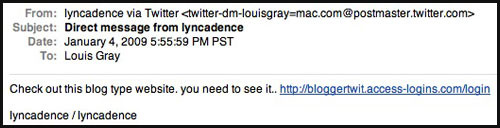
An example of one Twitter phishing attempt.
Twitter's success has seen a groundswell of applications being developed that require users to enter their user name and password on third party sites. Given Twitter's lack of OAuth support, Twitter users have grown used to posting their data whenever they are asked, and in the rare case a site has been found to be malicious, it forces them to once again change their passwords to protect their account.
The OAuth Web site spells out the reason behind the project's development, saying: "If you're storing protected data on your users' behalf, they shouldn't be spreading their passwords around the web to get access to it."
The weekend's activity featured a mock Twitter login page, where users were prompted to enter their credentials. (See: CNet: Twitter phishing scam may be spreading) While this specific attack would not have been solved by OAuth, but instead by users simply paying attention to where they were logging in, you can see Twitter's attitude on the current process.
Alex Payne, a lead developer of Twitter told one user on Saturday: "Right now, you can't see which apps are using your requests. You can change your password, though.", and later told another user, "We're trying to discourage against clicking on the link." Pretty basic stuff.
When pressed on whether Twitter was going to implement OAuth, and reduce users' growing too comfortable with posting their passwords everywhere, Alex said, "OAuth isn't a panacea against phishing and other web security issues. We're still going to support it," and following on, echoed the OAuth site by saying, "A main benefit is that OAuth limits the scope of activities that can be done with a user's credentials," while also linking to a post from April of 2008 that showed how phishing scams could not be stopped by OAuth. See: Phishing Fools?
So, we get that the phishing problem won't get solved through adding OAuth, but we do see more and more applications getting your password. As the New Year came in, Twply managed to get many passwords, and then was sold the same day. (See: Scobleizer: Twitter spam, effective or idiotic?)
Alex mentioned Twitter is going to support OAuth. But when?
In the Twitter Development Talk forum, you can see the target continues to move.
Alex, on November 24th of last year, wrote: "We're currently waiting on our User Experience team to put the final touches on a BETA release of our OAuth support. It's going to have bugs, to be sure, but we should have it out there soon. "
On November 26th, after being pressed for a date, he said, "As I don't know the entire schedule of our UX team, I can't. I would say less than a month and closer to a week by far, but please don't hold me to that."
On December 8th, Alex gave more specific timing: "It won't be available for testing this week, but should be available before the end of the month. I'd definitely encourage you not to launch on it, though, as it will be a beta."Now more than a month from the first comment, amidst more developer pressure, Alex says the next major version of the API will be OAuth-only, but deflects some of the criticism by pointing fingers at other services that have not yet jumped on the OAuth bandwagon.
This afternoon, January 4th, Alex said:
"Of course, once we offer OAuth, it would be nice to see the same community pressure that's been applied to us put towards companies like Amazon. The Amazon.com iPhone app collects my username and password, and that account is actually tied to my credit card information. Where are the blog posts about their anti-patterns?"Now, there's no question I'm no security expert. Don't forget that on November 12th, I once wrote, Twitterank Can Have My Password, No Questions Asked, and Alex looks to be feeling the strain of other non-experts, like me, pushing the team to get more robust. He commented on Twitter this evening, "It doesn't help that web folks generally have next to zero security/crypto education," a bucket I'm no doubt in.
The groundswell of demand on Twitter to improve its security measures, to get to OAuth as quickly as possible has no doubt reached a crescendo in the wake of this week's exploits - both those solvable by the project and those that are merely phishing scams. But it looks like Twitter developers' confidence has been shaken by so many promises being out there, and the deadline continuing to move.
20 Comments
I don't use the Amazon iPhone app, but Alex's argument doesn't hold water. The app is distributed by Amazon, it isn't a 3rd party app, I don't see anything wrong in it asking for the password from within the app. Of course it'd be a real wtf is the app sends the username & passwords unencrypted over the internet, which seems unlikely.
Jeethu that's a great point. I'm not sure what he's saying there - you should respond on the dev list. Alex's entire argument doesn't make sense, and I have yet to see anyone propose a solution that doesn't make more sense than OAuth.
Twitter should adopt something like the Friendfeed's remote key as a short-term solution. Of couse, it's not as complete as OAuth, but it's simple enough to implement and does the job.
Exactly, Fred. I have an unreleased API for one of my apps, and it took me only 2 hours to give users a way to authenticate. And if they abuse the system (aka phishing), it takes one database query and their entire app is shut down.
How would OAuth APIs protect against today's phishing scam? This is complete red herring.
But regarding the quote from Alex-- is there more context to it? Clearly there's a significant security difference between the Amazon iPhone app storing the Amazon password locally on the phone and the many third-party twitter services storing users' Twitter password in their databases. Surely Twitter understands the issue and the need for OAuth despite this quote?
I believe the only person who can interpret Alex's comments perfectly is Alex. It's good to see they are looking at OAuth (finally) and sounds like the release is coming, but there have clearly been a series of delays after the promised date windows got missed.
It is a red herring in terms of saying the phishing issue isn't 100% linked to OAuth as a solution, but it's got people thinking again about Twitter and security in general.
Mason, I don't think Louis said OAuth would protect against it. However I do. OAuth provides a mechanism for providers to shut off the developers using it. With OAuth, and a manual approval process on apps (similar to how Facebook does), it wouldn't be hard for Twitter to track down the violating developer sending out these dms, and shut down their access to the API. OAuth provides a single point to kill the offender. Without it you're stuck chasing IPs.
@Jessestay Neat! Except in this case, isn't the attack viral rather than app-based? Get one person's password, DM to phish all their friends' passwords, recurse. Would you suggest that Twitter abandon passwords all together?
@Louis Gray Well, anything to get people talking about security, I suppose. I care about this stuff, too, so liked the post. Before Twitter recently enabled SSL apis, I used to frequently answer "What are you doing?" with "Sending my twitter password in base-64 encoded plaintext!" :)
Mason, the users aren't the ones sending the DMs. Something else is, on
behalf of the users. That would make it an app, not user-propogated. The
only thing the users are doing is logging into the site, giving the app
their passwords to further spread the worm. The app is the thing doing the
spreading though. It's doing so via the API, which currently Twitter has
little control over.
Great post - well documented and poignant.
This Alex person is really showing his/her true qualities with that last quote. I would imagine that person is probably under a lot of pressure.
Honestly, I have no clue what OAuth is and I don't really care. What I DO know is that I use many applications across the web. Most of these have an API in place so that they can interface with 3rd-party apps.
As popular as Twitter is, it seems to be the only app out of these that requires me to tell 3rd party apps my password. I don't even have a secondary password or API key. I'm sure these guys are under pressure, but from a user standpoint, this just doesn't make sense.
so.... no phone then?
It was Twitter's simplicity, a large infusion of cash to make it stable, and then the hyper multi-media play (CNN, etc.) that increased activity on the service many called 'dead' last year at this time. There are lessons to be learned here. Once a product reaches a very high level of users, there will always be security concerns along the way
OAuth is over-complicated. You could do the same thing by validating specific domains to use your existing credentials. Twitter already does this when throttling apps to 100 requests per hour per IP address. Only realized this today when I got throttled.
OAuth is designed to let you choose what permissions you give to which domains, so you need per-user, per-domain tokens. It's also designed to be revocable
Kevin, exactly the same can be done using domains w/o the complexity for apps.
This issue of passwords is not an uncommon issue. I support many line of business applications that have moved to a web enabled platforms to improve customer applications. As many are built on COM, .Net, or other Microsoft platforms, it was a natural extension to build out of IIS.
While IIS has improved it's overall performance, many of the configuration scripts hosted on servers hold both user name and passwords to the secure database - where A LOT of customer information resides.
While it is harder to penetrate this type of setup, properly executed code can in fact expose this. What saves the applications for the most part is that they are typically very niche and as such have a very low profile user community.
With Twitter becoming more popular, they have discovered that many of their lesser-liked architectural issues become very apparent to the user community at large - just like Microsoft experiences and Apple is beginning to feel.
The bottom line of this article is well taken, though. Users having to plug in their passwords is laughable, but a great work around for development companies on a shoestring budget.
Who knows, but your point about being a great time to talk about security is true... in fact - EVERY time is a great time to circle back around and ensure you are doing a little house cleaning.
Nice post - As a new twitter - phishing happens to every site - so no foul there - the difficulty I see in this posting is two fold:
1. Twitter is such a sensational site and business plan - that most thought it would fail and wouldn't be as popular as it is - so there are those that want to see it fail in order for them to "be right"
2. It is a real-time site which no other site has been able to accomplish - so phishing hits it harder than any other site - my take is that since it is a real time site - phishing actually has a greater impact for those twitters not to open mail from people they don't know or they shouldn't click on links they know nothing about . In essence, it teaches people in real-time, very quickly the positive and negative lessons - so the phishers will no longer be effective on this site....next! Bitch about something else - people twitter is good
'nuff said.
any links on where you found it?
i hate giving twitter password to any other sites or apps, so to track which twitter apps using oauth i created http://twitoauth.com which shows any twitter apps that provide login using oauth