
As comments on the Web become fragmented, conversations that occur on downstream aggregation sites often are taking place in a silo, disjointed from parallel discussions on the originating Web site. Over the last two years, many people have found this evolution controversial, hoping to unify the conversations in a central location - and some services, including JS-Kit's Echo and Disqus, have taken the first step by pulling external discussions to the source. But a brand new proposal, authored by John Panzer of Blogger, called the Salmon Protocol, is looking to take advantage of Pubsubhubbub to unify the conversations in all places, both upstream and downstream. And yes... the name of Salmon comes because those fish manage to swim upstream, just like the comments.
An Initial Presentation on the Salmon Protocol
As discussed in Friday's panel at Blog World Expo on technology and the real-time Web, Pubsubhubbub essentially works as a middle-man conduit, taking information from a data's source passing along changed data to downstream destination sites. The proposed Salmon Protocol would similarly watch both source and destination sites for comments, and upon discovering new comments, it would send the new comments to the site which is lacking the full conversation. If multiple downstream destinations are designated, the Salmon Protocol will also populate these multiple sites.
In conjunction with Pubsubhubbub, the Salmon Protocol leverages the newest iteration of webfinger, enabling publishers to receive comments and verify subscribers - as a form of true identity recognition, similar to how both Disqus and JS-Kit have you register for individual accounts with either service. An additional side benefit to leveraging Webfinger would be to dramatically reduce the potential for spam, assuming each individual has a unique ID.
The debate over fractured conversations has risen and fallen over the last two years. In September, I essentially said I was done listening to people complain about the issue after hearing complaints regarding Google SideWiki - as I believe people will want to have conversations where they are comfortable, and that they shouldn't be forced to come back to a single source. This is a point I have been hammering since the first major flareup back in April of 2008. (See: Should Fractured Feed Reader Comments Raise Blog Owners' Ire?)
Many people believe that transporting comments from one site to another and making the conversations one could cause confusion, or even make potential commenters uncomfortable. With this in mind, John has suggested that users "be made aware of the publishing scope of the comments they leave," adding "For some aggregators, this may be implied (all data is public), for others a warning or a checkbox may be necessary." (See: Salmon Protocol (Draft) Protocol Summary)
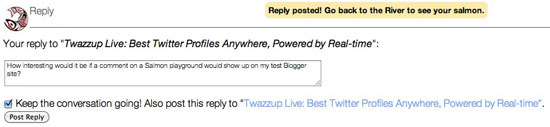
A Test Comment from the Aggregator Via Salmon

The Resulting Comment Back On the Blog Via Salmon
There is a test playground for the Salmon Protocol, and I can verify that it already works. If you want to test it, one option is to take a testbed Blogger account and point the Salmon Protocol your way. It occurs automatically, and comments that happen on the downstream aggregator will make it back to the blog immediately, thanks to Pubsubhubbub. Now, the quest becomes to turn this brand-new protocol into a new standard - one that could pose a serious challenge to services like JS-Kit Echo and Disqus, even including threaded replies. If done well, the long debate over unified conversations could soon be over.
Learn more at: http://www.salmon-protocol.org/.
9 Comments
Louis,
Salmon protocol is a step in the right direction. I'd be interested in your thoughts on this far more ambitious proposal for a platform/portal called Metamee (http://bit.ly/ipRDG). Warning: 7-part blog post. Written over a year ago, but the needs all remain.
Whilst I think this is a great step forward, the trail here shows a problem that occurs - how to differentiate between real comments and reshares. It'll be very easy to lose any useful conversation in a sea of retweets. Maybe we need some simple heuristics to filter out pure reshares from real reactions/comments.
VERY interesting.. I've always agreed with your "people should have conversations where they are comfortable" argument but a single comment aggregator/notifier would certainly make things MUCH easier. It will be interesting to see how/if all the various systems integrate.. Single comments will obviously work fine but the comments-on-comments (conversations) and threaded vs un-threaded systems might cause a hiccup (or two).
It also raises some questions for tool developers.. When does an object (content) get split (share in FF, and share with note in GReader)? What impact does/should this have on the down-stream and up-stream comments? The content owner might want to see everything but the commenter _may_ only want to see their thread and sometimes the follow on comments.
Ha.. just tried your "sample post" and one IMMEDIATE issue appears.. my email address appears as my link (at the bottom). I know you publish yours everywhere but I have tried to keep mine protected. The other strange side effect is that YOU (your blog) owns the comment, so I can't delete it (or edit it)..
Any chance you could delete it for me?.. Thanks I'll give John the heads up
I'll fix that - until then, please use a test account for commenting. This is a bug in the demo code, not the protocol. Note that this is demo code and there will be hiccups. Thanks for kicking the tires!
no worries.. that's why it's test playground instead of production. I'm very excited to see what comes out of this. Ever since I started playing around with friendfeed I've wanted a single location to monitor my conversations around the web. Thanks for your efforts!!
Thanks for the comments. I've done a quick update to obfuscate anything that could be an email address -- will do something more thorough a bit later.
Great to see what I what I termed Google 'ReWriter' three years ago (google it) finally becoming a reality.
Echo t0rx's comment. If I understand this right, it would become the tower of babel unless the shares etc are ignored.