
Silicon Valley Technology Commentary & Archives · Est. 2006 3,045 Posts · 2006–2026
Showing posts from August 2009 (40 posts). Show all posts

August 31, 2009

August 31, 2009 · 1 MIN READ · BY LOUIS GRAY

Feedly's RSS-Powered Start Page Includes Reader Conversations

Feedly's RSS-Powered Start Page Includes Reader Conversations

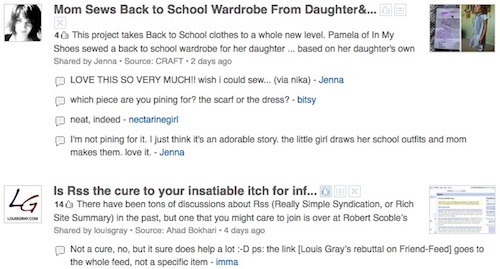
As I've mentioned a few times on the blog, the conversations in Google Reader are playing an ever-increasing role in my information consumption workflow. The RSS reader's enhancements have not been lost on the makers of Feedly, who have been working on a magazine-like start page for the better part of a year, gaining loyal users who appreciate its enhanced interface for subscriptions. This weekend, the company added support for friends and comments that you have in Google Reader, meaning you are not missing the conversation by using Feedly instead.

As introduced back in June of 2008 (See: Feedly Brings New Social Experience to Start Page, Leveraging RSS), Feedly operates as a start page or magazine hybrid, consisting of a cover page, a digest, the latest information, and now, "friends" and "comments".


Comments in Google Reader Shares Display in Feedly


Items that are "Liked" In Google Reader are Highlighted in Feedly


Selecting "friends" shows you items recently liked and shared by your contacts, while "comments" exposes the conversations taking place within shared items on Google Reader from your friends. While not every single share spawns a conversation, many of them are, including those on my shared items feed, where I have frequently seen items gain more comments than the original blog post itself of late.

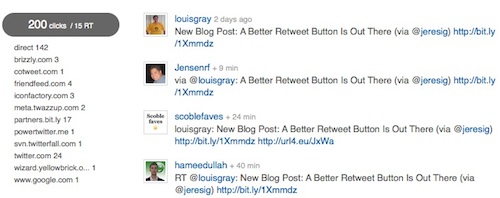
Feedly has also done more than clone Google Reader's utility. They have interestingly added a tool called "Karma", which, if you enter your Twitter ID, will tap into bit.ly, seeing how many clicks a tweet you posted received, as well as how many retweets. It's a good way to see if your activity on that social network is gaining a following.


You Can Gauge Your Twitter "Karma" In Feedly

You can find Feedly at http://www.feedly.com/. For now, the service relies on Firefox, but we've been promised support for Chrome, and maybe other interfaces, is coming.
August 31, 2009 · 3 MIN READ · BY LOUIS GRAY

Fry's Electronics: A Silicon Valley Legend With Legendary Flaws

Fry's Electronics: A Silicon Valley Legend With Legendary Flaws

Despite the fact both retail outlets sell computer equipment, including hardware and software, Fry's Electronics superstores and Apple's retail stores could not be more different. One offers a specialized set of products, and packs its stores to the gills with helpful employees, while giving customers free reign to use their products, and can approve customer purchases through the use of a handheld scanner device. The second offers a dizzying array of products, from vacuums and office chairs to iPod headphones and copper wiring, and its employees haven't won any awards for their product knowledge - while checking out items requires an usher, while your bags are rudely inspected - as if you had the forethought to take on the role of a shoplifter. It's clear which one is which, if you have ever stepped foot in either one - which makes me wonder sometimes why I keep revisiting Fry's, hoping each next experience will trump the last.

Fry's failings are at times comical - including my most recent trip this Saturday. I stopped into the store that afternoon for a simple task, finding Apple's Mac OS X 10.6 (Snow Leopard), which had released the day before. I was unsure whether Fry's in Sunnyvale would have it, but if they did, it would be a longer trip down to the Apple Store at the Valley Fair Mall in San Jose.

Upon entering this geek warehouse, I made a beeline for the Mac area, where Apple products are isolated in a special setting that makes the computers seem more like they belong in a zoo than in the jungle of PC parts and widgets just outside the enclosing aisles.


Mac OS X 15.6. From the Future!

To my surprise, there was no banner, or even a sign, announcing Snow Leopard had arrived. I looked to and fro, and didn't see Apple's famous boxes. I asked one employee, who was in the Mac section, for help and she pointed me to a manager, behind a nearby podium. I asked the manager, and she said that she didn't know where Mac OS X 10.6 would be, and maybe her boss would.

After flagging him down, and explaining, he pointed back to his subordinate, saying Mac OS was her department. She said, "Oh! I thought you meant Mapquest!"

Right. Why would I buy software from Mapquest at Fry's?

With renewed vigor around her newly-reminded knowledge, we turned back to the Mac section, and found Snow Leopard cases quietly hiding on the shelf. Below the DVD cases was a simple descriptor: "Mac OS X 15.6 Snow Leopard", for only $27.99. Of course, that would mean the operating system software was five generations into the future, which is outstanding. Or it was a typo. You decide. And that doesn't even go into the label failing to mention it is a DVD install, not a CD-Rom install.

Did Fry's have what I was looking for? Yes. Did it have it at a cheap price? Yes. Was it nearby? Yes. And that's about all I can say in favor of why I continue to return to this geek mecca of annoyance. I know that if I took the time to drive down to the Valley Fair mall, not only would they be posting banners of Mac OS X 10.6's imminent arrival, I would have gotten somebody to help in minutes, scanning me out right away - without trying to upsell me on a warranty, or walking me through an impulse buy section stock full of electric razors and bulk candy.

Fry's is no doubt a mecca for the do it yourself gadget geek. But the contrast between the warehouse mentality shown at Fry's, versus the personal touch felt in Apple Stores has me wondering if next time I'll just make the extra drive and reward their effort.

As for Mac OS X 15.6, I came home disappointed with merely owning Mac OS X 10.6, so I don't get any early adopter cred.

August 30, 2009

August 30, 2009 · 2 MIN READ · BY LOUIS GRAY

Who's to Blame for Snow Leopard Disabling My Adobe CS4 Licensing?

Who's to Blame for Snow Leopard Disabling My Adobe CS4 Licensing?

Yesterday, like many other Mac geek faithful this weekend, I got my hands on a copy of Snow Leopard, the name of Apple's latest operating system upgrade, Mac OS X 10.6. Though I knew it reportedly had few major feature enhancements, all signs online pointed to it being a harmless upgrade. Even comments around Adobe CS3's having issues pointed to clean sailing with CS4. But my experience, so far, has been anything but clean, and it's not exactly sure what caused the issue, or what will be needed to solve it.

As you may recall, in May, we had to do a little song and dance with Adobe's tech support team to download the full version of the company's CS4 product. But since then, I've been using the product suite practically every day. In fact, practically every blog post you see here features screenshots or graphics that have gone through CS4. But this one won't, unfortunately, and it's like I am operating with one hand behind my back.


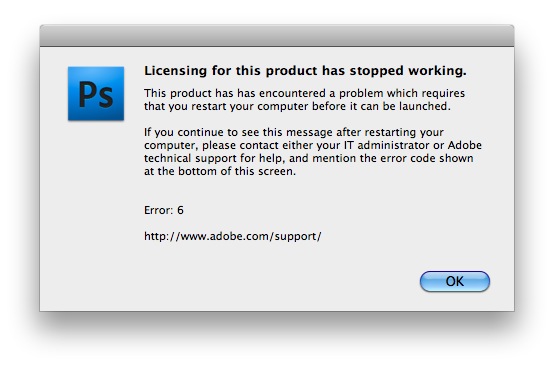
My Photoshop CS4 Forgot I Had Permissions to Use It

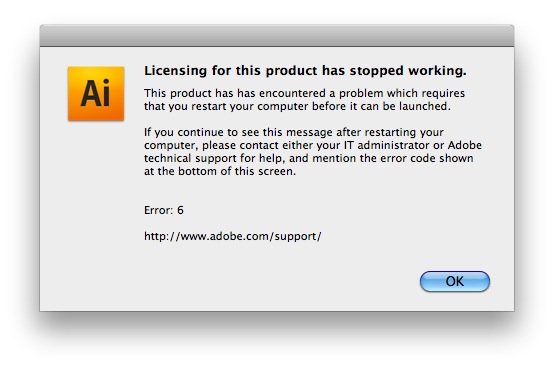
The issue is an odd one. When trying to start up any of the CS4 products, be it PhotoShop, Illustrator, In Design, or the others, I am simply told that "Licensing for this product has stopped working". The error encourages a restart, and yet, following restarts (plural), the issue remains - suggesting I tell tech support, which I will, but am not extremely excited about, especially after May's fun.


Illustrator Mocked My Trying to Launch It As Well

I have to assume that the issue has arisen as a result of Snow Leopard clawing its way on to my Mac. After all, Photoshop worked before the install, and doesn't work after, and nothing else changed. So far, online repositories aren't much help, and it's not clear which of the three players is at fault - Apple, Adobe, or me. (It could always be the user's fault). I have seen others say their CS4 apps are working great with Snow Leopard, but mine sure aren't. Maybe it's because they had the retail boxes, and going for the download version is coming back to bite me. I sure hope not.

I sent a note 1-1 to an Adobe rep who wrote me back in May, and look forward to seeing if she responds Monday. I'd be curious to see if this is a "Louis-only" issue, or if this is more widespread, and see why this is happening. Until then, get used to text only, or big juicy screenshot images with no resizing and cropping.

August 27, 2009

August 27, 2009 · 2 MIN READ · BY LOUIS GRAY

A Better Retweet Button Is Out There (via @jeresig)

A Better Retweet Button Is Out There (via @jeresig)

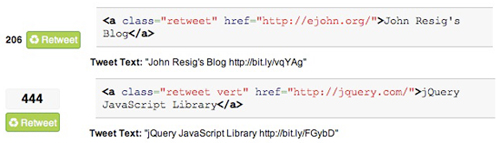
Regardless of what side you are taking in the Retweet.com vs. TweetMeme skirmish I noted on Monday, if you are hosting a button on your blog that encourages readers to send your stuff to Twitter, and count the number of times it has been retweeted, you are probably using one of those two services. Both do a good job, no doubt, but there's an alternative which you can host on your own site, and is powered by bit.ly, the officially "Twitter blessed" URL shortener, which tracks total clicks on your share, not how many individual people have sent it around.


Two Examples of Code And the New Retweet Button

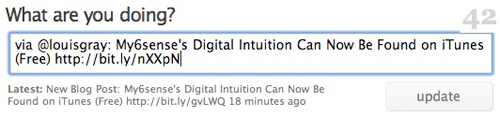
This week, I made the switch, after seeing it shared by Ben Golub of FriendFeed. Now, regardless of which post the button is on, it accurately shows the number of clicks I've gained through Twitter, and I have even configured it to say "(via @louisgray)" when you click the button to share a story.


What It Looks Like When You Click to Retweet from LouisGray.com

The script is very easy to edit and can be themed to match your site, says John Resig, the author of the button. He also says, "The number of retweets may be interesting to some but it's a poor indicator of actual traffic. Instead, the number of clicks coming in is shown instead (a much more useful number)." (Article) And I agree. Not all retweeting is created equal, after all, and for those of us not on the Suggested User List that Twitter has built, we don't have a built-in retweeting army.

I am keeping my TweetMeme ticker on the right side, to show total retweets in a given week, but for each new post, I'd rather own the code myself, and John's made a great alternative. You can get started by visiting his site at http://ejohn.org/blog/retweet/, or in case the site is down, as it was earlier today, at the Google Cache.
August 27, 2009 · 2 MIN READ · BY LOUIS GRAY

My6sense's Digital Intuition Can Now Be Found on iTunes (Free)

My6sense's Digital Intuition Can Now Be Found on iTunes (Free)

A month ago, I introduced you to a new iPhone application designed to find the best of your information intake, while hiding the less-important news. My6sense's approach at utilizing what it knows about you in an effort to tackle information overload spurred a discussion around digital intuition, and now sees the company talking about where they can take their technology - including services like Twitter. But while they were working on this, there was some bad news - the product wasn't even available for download on the iTunes Store! This was due to a small issue on their part, which they took responsibility for, but it still took a month to get the revised app back through the queue and into waiting customers' hands. Yesterday, the app showed up in the iTunes store (for free).

As the founder Barak Hamachov promised last month, the application is not posted in the same area as RSS feed readers or social networking sites, but instead in "Productivity" - as he and the company believe if you can find out all the pertinent information to your industry or hobby while spending less time searching and browsing, you will be more productive.


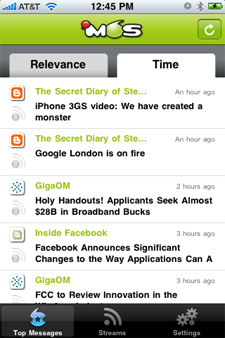
Browsing New or Best Entries In My6sense

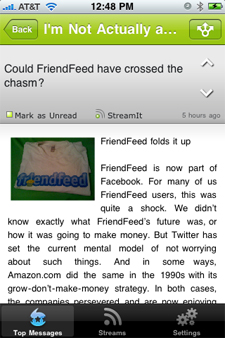
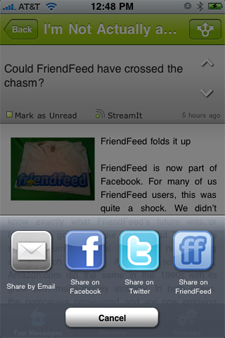
The core elements of My6sense have not changed since my initial review. I have used the application for the better part of six weeks now, and can rely on it to cut through the hundreds of feeds I read each day, finding the few dozen top articles that I won't want to miss. Along with some UI enhancements, the product makes it even easier to share out to Facebook, Twitter, FriendFeed or by e-mail.

While the product's algorithm is not 100% in the open, the application learns from your own behavior, including what sources you are most likely to read, what topics you are most interested in, what topics you tend to skip over, how likely you are to "stream" or "share" a post, and how much time you spend reading a specific story. And as you read more stories, the precision of My6sense improves.


Sharing an Item I Like In My6sense is Simple

While I haven't turned away from sites like Google Reader or Lazyfeed for being my initial source for data, My6sense does a great job of accurately knowing what I like. If I am visiting the product after I've seen Google Reader, often those items I had just shared are atop My6sense. If I am seeing it first, it's a good reminder of what to share when I hit Reader.


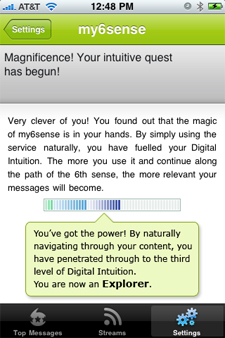
I'm Moving Up the My6sense Intuition Chain

If you don't already have My6sense, I advise you go grab it. It could make you a lot more productive.

August 26, 2009

August 26, 2009 · 2 MIN READ · BY LOUIS GRAY

Twitterfall Launches Twitter Reply Search Engine

Twitterfall Launches Twitter Reply Search Engine


As Twitter develops, the service's users are pushing the envelope beyond the company's initial expectations - taking what was supposed to be vanilla status updates to a small group of friends, and extending it to include features that are practically standards at this point - including replies from one account to another, and retweets. But some of the discovery to find related items from one tweet to another can be very hard. Individual users can see mentions, and with some work, Twitter Search can be useful, but for the most part, individual updates are disjointed pieces of conversation.

Twitterfall, a project undertaken by a pair of 19 year old students in the UK, already seen as a potential news discovery engine, has now extended their prowess to include capturing all data around replies - to one individual, or any specific tweet.


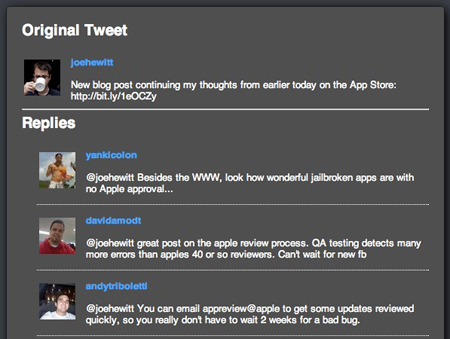
Replies to Facebook Developer Joe Hewitt on Twitterfall

The new Twitterfall Reply Search gives you two ways to find replies.

The first is to enter the ID of the specific tweet. Each tweet has a unique identifier, which is the number at the end of each tweet's specific URL. For example, a tweet with a URL of http://twitter.com/ev/status/3538745942 has the ID of 3538745942. To find replies to that tweet, you would enter "3538745942" in the first box. (Results displayed here)


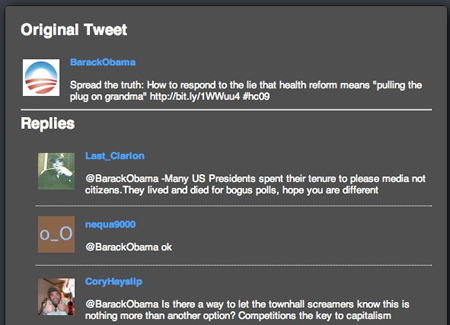
Replies to President Barack Obama on Twitterfall


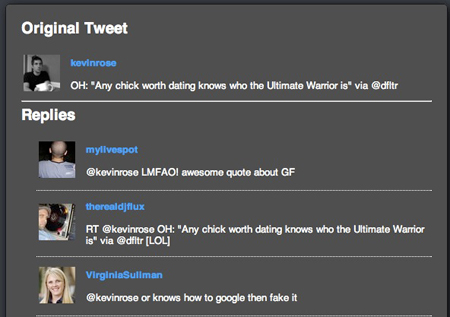
Replies to Digg's Kevin Rose on Twitterfall

The second way is to search for an individual user, which will show you their most recent tweets. Click on any result and you will see any replies in the database for those tweets. Fun ones would include popular accounts, from tech leaders, to yes, celebrities, who have highest engagement on Twitter.


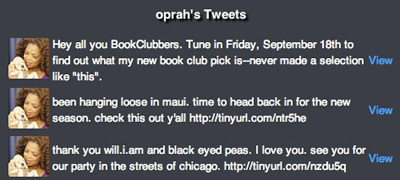
You Can See Replies to All of Oprah's Tweets By Clicking on Twitterfall

The results display the original tweet, and each successive reply, in the order it was delivered. Twitter Search, in contrast, may find you each individual reply by finding the user's @alias, but even then, "show conversation" is hit and miss. Assuming the Twitter API doesn't fail us, TwitterFall's new approach is an interesting research tool for concatenating responses. In parallel, the company also launched their own API to access the replies database.

See also: Twitterfall's posterous: See who's replying - right now.

August 25, 2009

August 25, 2009 · 2 MIN READ · BY LOUIS GRAY

No More Beta Codes: Lazyfeed Is Open for Everyone

No More Beta Codes: Lazyfeed Is Open for Everyone

Almost two months ago, we first introduced Lazyfeed, a real-time blog search and feeds engine, which has grown to be a big part of my information gathering process, following topics which I like, rather than people, or specific RSS feeds. The product's uniqueness is one of the more innovative services I have seen in 2009, which was a big part of why I practically have had a part-time job as a beta code broker, trying to gain people access to the site. As of today, that unpaid gig is done, for Lazyfeed has removed the beta wall, and opened the site to all who want to enter. If you didn't get access to the site, I strongly recommend you go and try it, as you will find the wave of interesting news and blog posts from around the Web addicting.


Topics for Lazy Me from Lazyfeed

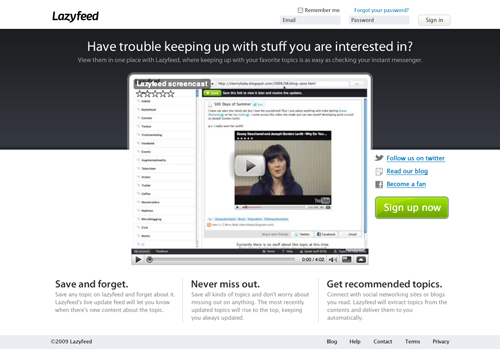
As I've mentioned in my previous coverage of Lazyfeed, including a quick how-to video on the service, the site does two major things - first, finding blog posts and news articles relevant to me based on topics I have provided, and second, find related items to those entries I have added to my own social sites, including this blog and my Twitter account. Blog posts that have tags will generate new items, while hashtags on Twitter will do the same. This second portion is what Lazyfeed says gets you the lazy portion of the name, because in "Topics for Lazy Louis", I haven't even had to enter the topics into Lazyfeed - it just happens on my behalf.


The New Lazyfeed Home Page Is Open for Business


Ethan Gahng, CEO of Lazyfeed, uses his own product in a much different way than I do, leveraging the search engine for entertainment, sports, TV and other things, where as I just continue to feed my tech obsession like a bright orange RSS-powered IV drip. But that's what makes a site like Lazyfeed so powerful - it can be whatever you want it to be, and hopefully, without too much work. Stay lazy.
August 25, 2009 · 1 MIN READ · BY LOUIS GRAY

Disqus Launches Version 3 Of Comments, Adds Profiles

Disqus Launches Version 3 Of Comments, Adds Profiles

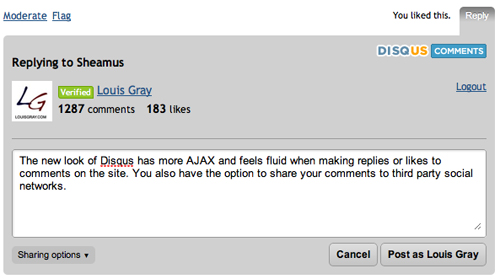
The world of comments on blogs has changed quite a lot just in the past few years. Once the central discussion point for all activity around posts, comments have become distributed, floating to a myriad of social networks and RSS feed readers, while still others are simply retweeting the items they like. The changes were enough to see one comment provider, JS-Kit, say that comments were "dead". Meanwhile, amidst the noise, Disqus has rolled out version 3 of its product today, providing a new, smoother look and feel, and most-importantly for today's Web, real-time updating and greatly improved "reactions" that pull in activity from around the Internet.


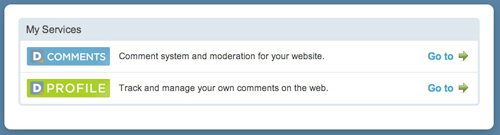
Disqus Has Now Split Into Two With Profiles and Comments

In parallel with the company's revamp of its comments engine, Disqus has also added a separate product, called your Profile, which lets users add or delete comments, without impacting the original site, and also presents yet another place to add your third party services, so you can tie all your activities on a post through your profile. Other benefits include a personal URL, such as http://www.disqus.com/louismg for me.


My New Disqus Profile


The New Look of Disqus Comments

Disqus's improvements are coming none too soon. With a great deal of comments taking place elsewhere, as I mentioned with my recent post on Google Reader, and have seen with various sites trying out JS-Kit's Echo platform, the world of comments on the blog has to adapt. I just wonder how the real-time aspect of comments can keep people on the site instead of venturing somewhere else, where they may have established a community. I am looking forward to seeing Disqus 3 play a more connected role to the social ecosystem.
August 25, 2009 · 3 MIN READ · BY LOUIS GRAY

Parse.ly Spices Up the News Based On Your Interest Filters

Parse.ly Spices Up the News Based On Your Interest Filters

I am enjoying seeing the growth in Web services tailored to finding the very best news just for me. From My6Sense's attempt to only show me the best news, and hiding the less-important items, to Lazyfeed's topics-based blog search engine, we've recently seen two interesting approaches to cutting through information overload and finding the best data. A new invite-only beta service, called Parse.ly, claims to offer "fresh content" with "minimal garnish", and, leveraging my interests, gives me the highest-ranked stories, derived not just from my leanings, but how strongly I find myself aligned with specific topics. The result is another news source with an outstanding signal to noise ratio.

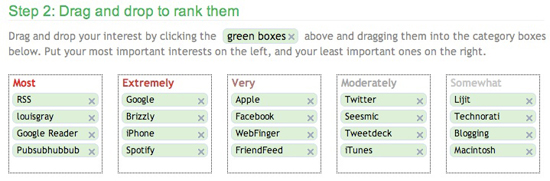
If you are among the lucky few who has thus far obtained access to Philadelphia-based Parse.ly (I am betting the best way is to follow their Twitter account), you start by entering terms you want to find news on, and dragging them to boxes that signify your intensity of interest. The five boxes range from "Most" to "Extremely", "Very", "Moderately" and "Somewhat", in descending order.


Prioritizing My News In Parse.ly

Per my usual approach, I filled the boxes with tech terms, and deigned to see if Parse.ly could find me new, interesting stories about the topics I am most interested in. And it came through - no question.

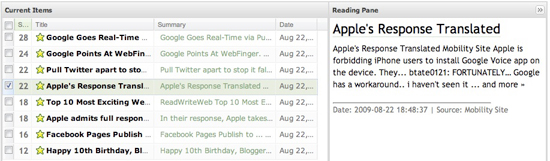
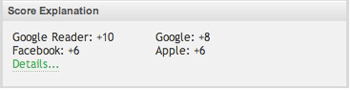
Each of the buckets ("Somewhat" to "Most") gained a numerical score, from 2 to 10. As a result if a blog post had two of my "10 point words" in its title or excerpt, it would have 20 points, and be pushed to the top of the results queue. Higher yet would be a story on Google around Pubsubhubbub and RSS, which weighed in at 28 points, sporting two 10 point words and an 8 pointer. Like traditional feed readers, Parse.ly shows the title of the story and the date, but it also includes a short summary and, yes, the post's numerical score. Sorting by score shows the highest ranking results.


My Starred Items In A Parse.ly Reading Pane


How Stories Got Scored Based On My Preferences

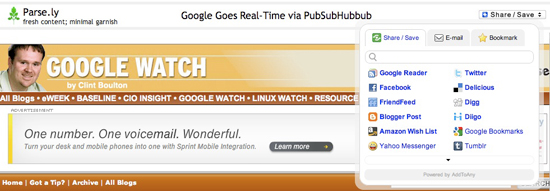
If you click on a story in the standard view, an excerpt is displayed in the reading pane, which also features a "Score Explanation". And if you click on the story itself, a new window will open with a Parse.ly share bar, prompting you to either save the story for later viewing, or share it to a myriad of other social networks.


The Parse.ly Sharebar In Action on eWeek

Parse.ly clearly states that its focus is all about the content and minimal when it comes to garnish (or design). That's absolutely the case. The product is reminiscent of GMail and Google Reader with its simple interface and the ability to star items, or show only read and unread items. You can also archive old items or delete them, just like you would for old e-mails and RSS feeds.

I am eager to see Parse.ly open up and let people get into the product, for while I have plenty of places to get news, Parse.ly has among the best I've ever seen in terms of quality. The company even says it could be a solid alternative to Google Alerts. Not a single spam blog was found, a testament to Parse.ly's selection from 50,000 different sources. The option to share out to other networks will also make it an interesting part of the social ecosystem.

August 24, 2009

August 24, 2009 · 1 MIN READ · BY LOUIS GRAY

SocialToo Status Extends Facebook Updates to Twitter

SocialToo Status Extends Facebook Updates to Twitter

Last week, many people were surprised by Facebook releasing a utility that let Fan Page owners update Twitter from the popular social network. But some thought Facebook did not go far enough - as individuals could not utilize this tool to broadcast their own update from their profiles. This morning, Jesse Stay's SocialToo launched a feature which will let users update both Facebook and Twitter - not just for their fan pages, but from anywhere on the site.

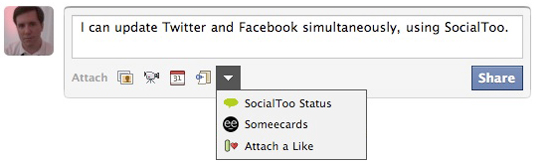
Using the SocialToo Status application, you can share your personal status from Facebook to your personal news feed, as well as Twitter.

If you are already a SocialToo user, go to http://www.socialtoo.com and click the "Facebook App" link to activate SocialToo Status. Once the application is enabled for your account, you will see a SocialToo Status icon in the "attachments" section of Facebook, which you can update from the home screen, or your personal profile. If you have already associated your Twitter account with Facebook, it will ask for permission to publish, and following this, you're all set. You can even grant the application permission to publish from fan pages you may run as well.


If enabled, my posts from Facebook can flow to Twitter as well.


For a long time, power users of social media tools have found ways to bring their Twitter updates into Facebook. But now, you're seeing the first tools start to take data the other direction. You can also find the SocialToo application on Facebook here: http://apps.facebook.com/socialtoo/status.


Disclosure: I am an advisor to SocialToo

August 24, 2009 · 3 MIN READ · BY LOUIS GRAY

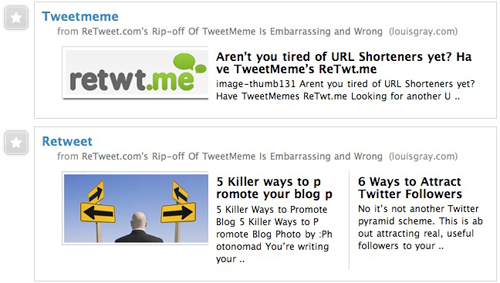
ReTweet.com's Rip-off Of TweetMeme Is Embarrassing and Wrong

ReTweet.com's Rip-off Of TweetMeme Is Embarrassing and Wrong


I thought it was a bad sign at the end of 2008 and first half of 2009 when practically every new service or application that came my way was simply an extension to or enhancement of other already-popular social networks, almost always for Twitter, Facebook or FriendFeed. Even then, the cacophony of noise around Twitter practically drowned out all of it. Amid an unrelenting flurry of Twitter clients for desktop and Web and Twitter tools for unfollowing, grouping, analyzing and reporting, we also had a rush of Twitter-related sites, all aiming to find their own special niche. Among the most successful, after a slow start, was TweetMeme, the brainchild of Fav.or.it founder Nick Halstead, who managed to repurpose the company and ride the wave of Twitter and retweeting at the perfect time. Seeing his success, a new challenger with a killer domain name (ReTweet.com) is looking to unseat him, by essentially doing the same thing - tabulating the most popular shared items on Twitter.

Scratch that. They're doing the exact same thing, and the complete copycat style is insulting to anybody who deigned to take them seriously. While I had seen complaints about copyright infringement and code borrowing, I had no idea how terrible the attempt had been until tonight, when it became crystal clear how much ReTweet.com stole from TweetMeme before hitting the publish button.

On first glance, both sites display what you would expect - popular articles from often retweeted sites like Mashable.com and the comic XKCD.com. Popular post titles have very similar numerical scores, as you would also expect - varying as little as just over 1 percent on articles that have more than 1,000 retweets. And yes, both let you dice and slice the data by one day or seven (although ReTweet.com calls it one week instead of 7 days and TweetMeme.com calls it 24 hours instead of 1 day. You get it...).

I've seen Digg and I've seen Digg clones. I've seen popular aggregators and their clones. I've seen social networks and their clones. And I recognize that sites that serve similar functions are yes, going to look similar. But once you move past the similar front page, the blatant stealing is jaw-dropping.


TweetMeme has a top level navigation bar, which read from left to right, says:
  1. Home
  2. Comedy
  3. Entertainment
  4. Gaming
  5. Lifestyle
  6. Science
  7. Sports
  8. Technology
  9. World&Business
In remarkable non-contrast, ReTweet.com features this:
  1. Home
  2. Entertainment
  3. Gaming
  4. Lifestyle
  5. Science
  6. Sports
  7. Technology
  8. World&Business
  9. Everything
Wow. Did they really think we were so dumb as to not notice they had the exact same title headers in the exact same order? Even down to the ampersand in "World & Business"? Really?

I don't even want to begin to understand why people think this is okay. While Nick and I once disagreed about his first product's direction and how well that beta was prepared, I never questioned his company's trying to do something different in a competitive landscape. But what ReTweet.com is doing is upsetting. While a service like TweetMeme.com was practically inevitable, and competition is healthy, this kind of stealing and underhanded non-innovation is troubling. If this is what is acceptable from engineering teams these days, then innovative services have got to be worried about protecting their intellectual property.

When, at last month's Lunch 2.0 panel, I asked Bret Taylor of FriendFeed how he felt about services like Facebook and Google Reader borrowing aspects of FriendFeed, such as the "Like" feature, he said he felt "good" because he was making an impact on the Web and it showed alignment between differing Web properties, adding he didn't feel the company could patent words on a Web page. But I am sure the level of copycat dunderheadery on the part of ReTweet.com is not something any of us should "feel good" about. If you want to compete in this space, and you want to take on a market leader, you have got to make sure you offer real differentiation based on different source data, different splicing, different display or different intent. This attempt is a sorry gimmick that has got to have the TweetMeme.com team seeing red, and rightly so.

I'm done linking to ReTweet.com now. The next time I want to be writing about them is if they get sued or when they close down. Not impressed. This kind of launch is bad for innovation and bad for the Web.

August 23, 2009

August 23, 2009 · 1 MIN READ · BY LOUIS GRAY

Blogger Quietly Turns Ten, Plans Slew of Feature Upgrades

Blogger Quietly Turns Ten, Plans Slew of Feature Upgrades

Sunday, August 23rd came and went without a peep from Google's Blogger Team, despite the service celebrating its tenth anniversary from its initial founding at Pyra Labs. Cynically, you might construe this silence as Google's not making the product a top priority, or maybe, you could even think that Blogger is ceding the visibility game to other challengers, such as WordPress. But that's far from the case. While WordPress might have a higher level of geek cred, Blogger has many more users, and the company has prepared a slew of updates that should roll out in the next few weeks - which will be welcomed. Don't expect a mass revamp on the level of a "2.0" moniker, but instead, many smaller iterations, either catching up to the competition, or taking advantage of the service's large installed base.

Interestingly, Blogger mentioned their upcoming 10-year mark back on June 18th, and again, this last week, on August 17th, when they said: "we wanted to give you some presents to commemorate this milestone and thank you for letting us be part of your story. Over the next several weeks we will be releasing a number of new features..."

In a given day, I get the opportunity to publish to WordPress, TypePad and Blogger, assuming I update blogs here, at work, or make an addition to my mom's site - still going strong since 2004. Each has its unique differences and challenges. I know that by sticking with Blogger, I've gained some benefits with ease of publishing, and some downsides as advanced widgets make their way to other platforms first. But if I thought the platform were standing still, I'd have jumped, and I know it's not. I'm looking forward to the new releases, as they happen, and congratulate the team on their hitting the big 1-0. Expect more news soon.

See also: Google's Blogger Challenge: Win the Marathon and Don't Bonk.

August 20, 2009

August 20, 2009 · 1 MIN READ · BY LOUIS GRAY

Do PR, Advertising & Marketing Suck? Find Out In a Week.

Do PR, Advertising & Marketing Suck? Find Out In a Week.


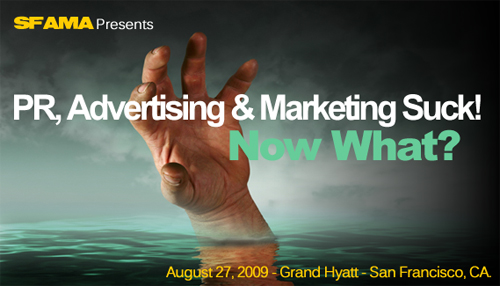
Criticism of public relations, advertising and marketing is everywhere. Seesmic's Loic Le Meur has been giving a presentation over the last few months saying that they "suck". And agencies need to adapt quickly to be ready for the changes that are seen in social media, the economy and traditional word of mouth.

Next week, on Thursday August 27th, I will be taking part in a panel with Loic, Guy Kawasaki, Steve Patrizi of LinkedIn and Renee Blodgett of Magic Sauce Media, hosted by the San Francisco American Marketing Association, discussing:
  • Is Loic overstating his case?
  • Where are the traditional Advertising, PR, and Marketing agencies failing?
  • What new tools and methods are being used to bypass the need for traditional agencies?
  • What’s next for agencies? What’s next for businesses?
Want to attend?

Ticket Info: SFAMA Members – $35 Non-members – $45
Event Info: SFama.org

For those out of the area, I have it on good word that a UStream video is being prepared as well.
August 20, 2009 · 4 MIN READ · BY LOUIS GRAY

Conversations on Google Reader Shared Items Are Booming

Conversations on Google Reader Shared Items Are Booming

For the world's leading RSS reader, integrating social functions hasn't always been drop-dead simple and easy. With each new addition, be it the recent "Send To" features, the addition of "likes", or the ability to selectively enable friends to make comments on your shared items, the service needs to scale in a way that has brought many other Web-based feed readers to its knees - compounded by Google Reader's accelerating user base. And while the company works to make sharing and engaging simpler, I am already seeing a rapid rise in conversations within Google Reader, both on my own posts, and on those from others I share. Recently, the total number of comments on some posts has even eclipsed those natively here on my site, or on FriendFeed, Facebook or anywhere else.


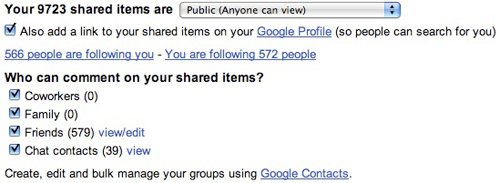
Almost 600 people can comment on my Reader shares.

Since starting my shared items link blog in Google Reader a few years ago, I've passed along almost 10,000 links (a point I may pass by the end of the month). I recognize my pace of sharing between 20 and 30 items a day is on the high end, but these selections represent the top 4 to 5% of all articles I see online, with the intent of passing on only the best to those who consume the shares downstream. I've even had some people say they have unsubscribed from reading feeds directly, trusting me to be a human filter. That's a little daunting, but a task I can take.

You might remember that back in March, Google turned on comments on these shared items. Though activity was initially slow, I have seen increased velocity, especially after reorganizing my contacts.

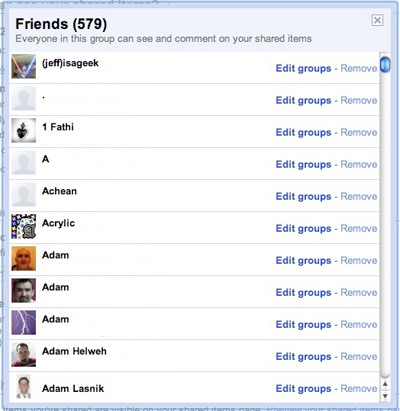
As Google Reader does not have public comments on shared items that are visible to everyone, they have taken the middle road - showing these comments to those who are also subscribed to the shares, and only enabling those people to comment who have been added to a specific group by the sharer. After several hundred people had signed up to follow my shares, and I was seeing only a little activity, I realized the problem was mine, so I took some time to organize all my contacts, and enable everyone who follows with the ability to comment, just like in FriendFeed or Facebook. This part is critical, so if you do have a lot of people following your shares, go to your sharing settings in reader, and make sure that they are in a folder that has access.


Each of My Friends Is In a Group that Has Access to Commenting


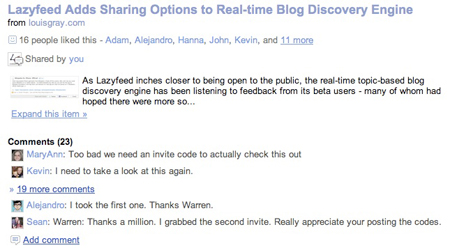
This Article On Lazyfeed saw Dozens of Comments In Google Reader

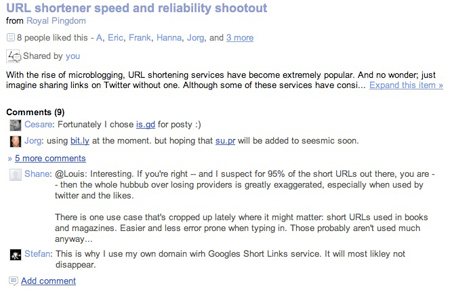
With that change, people who may previously have been watching the shares go by, but couldn't comment, now can - and the results have been very interesting. Some of the more popular threads on shares from me have seen on the order of dozens of comments, even when the original post may only have shown a handful on the original blog.


Another Popular Topic of Discussion Within the Reader Shares

While a few years ago, this could have been considered the end of the world by some bloggers, the social Web has grown to understand that distributed conversations are taking place. By Google Reader enabling conversations to happen through their application, readers can act on the news immediately, without having to open a new window and participate there. It's also had me rethinking whether I should be self-sharing, in effect sharing my own posts when they get into Reader. I've personally tried to share only a subset of what I consider the best, but now that I have seen people engage right from within the app, it makes me think I should just share them all and enable the comments to take place where my readers are comfortable.

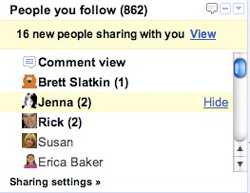
Now, every time I log into Google Reader, not only do I see new feed items to read, but I see new follower requests looking to see the shared link blog - and also, in bold, a "Comment View" which takes me to see all the comments, not just on items that I have shared, but on items shared by people whose shares that I follow. Google Reader, in a matter of months, has become a very serious part of the conversation. In light of the uncertainty around FriendFeed and how that company will integrate with Facebook, I am betting that some people are looking back at their RSS reader for information consumption and now, social discussion.

So go ahead, comment on my items in Google Reader. I don't need all the comments here. To find my shared items, head to: http://www.google.com/reader/shared/louisgray, and let's get connected.

August 19, 2009

August 19, 2009 · 2 MIN READ · BY LOUIS GRAY

Google Alerts Gets PubSubHubbub, Real-Time Programmable Hooks

Google Alerts Gets PubSubHubbub, Real-Time Programmable Hooks

The Web is speeding up, and Google is playing a big role in making how we get our information faster - no matter its type. Recently, a pair of the company's engineers, Brett Slatkin and Brad Fitzpatrick, have teamed up to roll out a new protocol, PubSubHubbub, to accelerate just about every major part of the Google sphere in which I play - from Google Reader shared items to FeedBurner, Blogger and today, Google Alerts.

If you thought Google Alerts was fast before, it's like Google went out and gave it an entirely new engine. Now, if I Google comes across a term I am tracking, I can expect to get near-instant updates saying it has been found. In a blog post today, Slatkin says its more than just about getting these terms faster and quicker, but also to help developers create tools and write Web applications that take advantage of this functionality. He writes, "Think of it as an AJAX search API that tells *you* when it finds new results. Acting upon these notifications your app could update your website, email friends, send an SMS -- the possibilities are endless."

Thus far, I've never really considered Google Alerts as a potential development platform, but as Slatkin suggests, the opportunity is now there to create an entire family of applications pointed at Alerts, much like others have pointed to the company's Maps product to make interesting mashups.

Anything that can help the Web get quicker, aid discovery, and enable even sharper apps is exciting, and I've been watching the developments with PubSubHubbub very closely. If I were a developer making a news discovery product based on topics (like Technorati or Lazyfeed, for example), I would check and see how I could tap into this real-time firehose for Google Alerts.

Google has been dinged, relative to Twitter and others, for not owning the real-time search race. But as the PubSubHubbub religion gets propagated, I think it is pretty clear where this is all headed. Not only will Google get this real-time space and lead again, but they are helping developers by enabling access to quality code and the best data faster than ever before.
August 19, 2009 · 1 MIN READ · BY LOUIS GRAY

Lazyfeed Adds Sharing Options to Real-time Blog Discovery Engine

Lazyfeed Adds Sharing Options to Real-time Blog Discovery Engine

As Lazyfeed inches closer to being open to the public, the real-time topic-based blog discovery engine has been listening to feedback from its beta users - many of whom had hoped there were more social elements from the potential feed reader replacement. This morning, Lazyfeed will incorporate the ability to share found items to Facebook, Twitter or by e-mail, alerting your followers to interesting news you may find through the product.

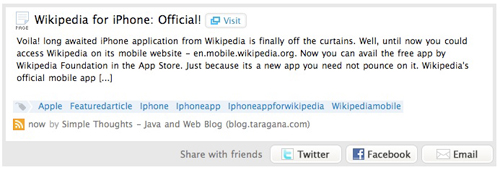
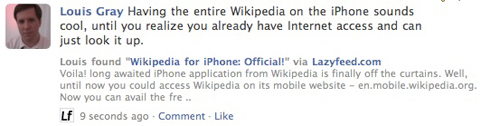
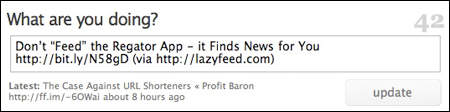
Now, every item that you see flow through Lazyfeed can be shared, levering a bottom bar that says simply "Share with friends". The service leverages both Twitter OAuth and Facebook Connect to simplify the process, letting you post a link to your Facebook Profile, or on Twitter. Both actions highlight the discovery took place on Lazyfeed.


This Item About Wikipedia On the iPhone Can Be Shared


Here Is the Item Posted to My Facebook Profile


Sharing An Item From Lazyfeed to Twitter

In addition to this feature enhancement, Lazyfeed CEO Ethan Gahng has cooked up a not-so-lazy YouTube video introducing the service, backing up my short screencast I posted last month.


Most interesting to me in the video is how Ethan uses Lazyfeed to find music, entertainment, and TV shows, branching out from my own tech news obsession. It just shows how versatile the product can be. Check out the new options at http://www.lazyfeed.com.

August 18, 2009

August 18, 2009 · 3 MIN READ · BY LOUIS GRAY

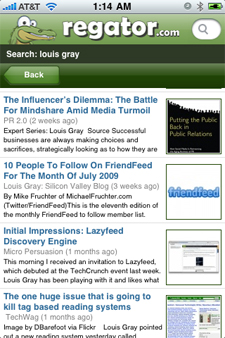
Regator's New iPhone App Offers News On the Go With Bite

Regator's New iPhone App Offers News On the Go With Bite

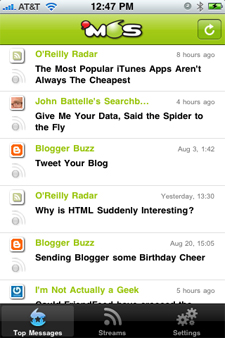
For as much content as I might be creating, with new blog posts, and social media updates scattered across a myriad of networks, I am still far from satiated when it comes to data flowing the other way. My days are spent embedded in Google Reader and FriendFeed, with TweetBeep, LazyFeed and BackType filling in the gaps I may miss. But when away from the laptop, it's my iPhone that keeps me connected to the world wide publishing machine. With the introduction of a new application from Regator (www.regator.com), I now have three solid options for finding relevant data when I am praying to the duopoly of Apple and AT&T. Added on to MeeHive (review) and My6Sense (review), I am getting dangerously close to knowing I won't miss anything, even when I clip my laptop leash.

The three applications (My6Sense, MeeHive and Regator) have slightly different goals. My6Sense looks at data you have imported and tries to learn from your behavior what is most relevant to you as an individual. MeeHive not only offers general news, but also, personalized data based on its knowing what I like, thanks to my answering a series of survey questions. Regator plays more of an editorial role, having hand-selected the best of the blogosphere (in their mind) and offering it to you in easy to navigate sections.


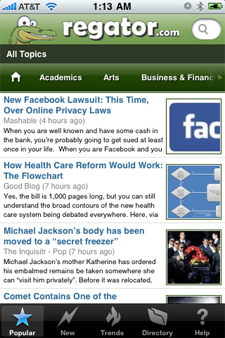
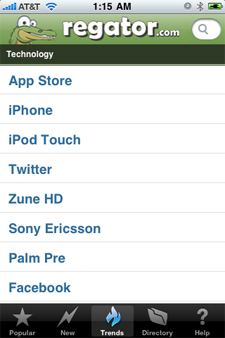
The Main Regator iPhone Page (and Technology Trends)

Upon opening Regator, you get a popular news overview from the Web, which, depending when you look, could offer you a mix of technology, celebrity news, politics, healthcare or sports. To find the newest updates, click the New button at the bottom, or, more interestingly, you can click Trends to find what topics are gaining momentum in the blogosphere. (For example, top trends today include Robert Novak, Brett Favre, and the iPhone)


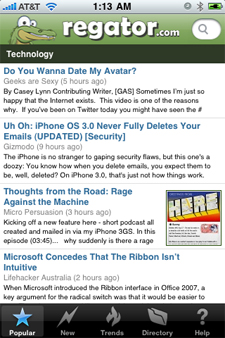
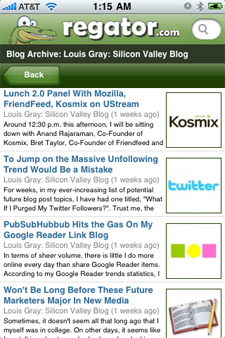
Regator's Technology Section and My Blog Archive

But more specialization takes place when you look at the bar below "All Topics" at the top of the Regator app. You can find subsections from Poltiics, Religion, Sports, Local Interest and others. Of course, being a techno-focused media consumer, that's where I expect to spend the most time. Regator lets you "swipe" through the lists left to right and right to left to drill down on your topic, and you might be surprised as to how deep their data goes. If you click too many times in the wrong place, you just might find yourself in Architecture under Construction under Occupations, for example. Regator has all the data, and is just waiting for you to find it. And yes, should you get lost, just click home to go back.

Of the three applications, Regator has the smoothest, most colorful, interface. It has its smiling gator atop each page, features thumbnail graphics and large colorful buttons. Just about the only thing it doesn't do which I wish it did is clearly offer full-text of the stories (now, you have to click a second time following the excerpt). On My6Sense, I can read a full story and go back to my list, as it pulls from the full RSS feed. On Regator, I initially only see the headline, a thumbnail and an excerpt. Meanwhile, Meehive just clicks through to the original story as if I had opened a new browser window.


Regator: Searching for iPhone and Vanity Search Results

Regator also offers the option to search by keyword, or to browse the product's very-deep directories. Should you find an individual blog that you like, you can choose it, and scroll down to see more entries, going back for several months at least. It aims to offer what it calls the Web's Best Blogs, and it does a great job finding high-quality content from a wide variety of sources. The new app is available for free on the iTunes store. Don't be thrown by its 17+ rating. That's just Apple being confused.


Disclosure: Kosmix.com, author of MeeHive, is a client of Paladin Advisors Group, where I am General Manager of New Media. I have no relationships with other companies or services mentioned in this article.

August 17, 2009

August 17, 2009 · 2 MIN READ · BY LOUIS GRAY

Progress Being Made On Twitter's Network After 10 Days of Attacks

Progress Being Made On Twitter's Network After 10 Days of Attacks

After an initial wave of attacks brought the popular micromessaging service to a standstill, as well as a host of other social networking sites, on August 7th, the Twitter team has been fighting to turn the tide and restore access for the service's customers and developers to near-normalcy. Ten days into the attacks, they have not disappeared, according to postings from Twitter, but it looks like the company may have turned a corner in dealing with the additional stress from the distributed denial of service.

In a post to the company's Twitter Development Talk forum titled "Platform Status Update" entered at 4:30 this afternoon, Twitter's Ryan Sarver said:
"Over the past ten days we have been dealing with a lot of stress on our network and that has caused a number of our partners to be knocked offline for extended periods of time. This is obviously not something we want to happen and the platform and ops teams have been working hard throughout that time to address the needs of our ecosystem while protecting the system as a whole. We have made some great progress today in tuning the system to a point that should allow our partners to operate as they were before the recent issue began."
He added "the system is still under stress", and asked developers who might be continuing to have issues to work with them and provide information around what IP addresses their machines use to access the Twitter API, the method they are using to make requests, and any other information - including data as granular as their host operating system, browser, cookies and network connection.

Ryan's comments followed a note from earlier in the afternoon by Alex Payne, the company's platorm lead, where he also said the company continues to "fend off" the attack, saying that without specifics from developers (like those listed by Ryan), they could not adequately troubleshoot any issues.

While the majority of Twitter users are not experiencing the widespread outages that we saw a week and a half ago, it is still not uncommon for applications utilizing the Twitter API, and specifically OAuth, to see failures. There's also no doubt the ongoing attacks have led to a fair share of fail whale sightings. (I've encountered a few myself) Twitter posted a note to the company's status blog Sunday acknowledging the problems, and said they are "working to resolve it".

It has been tempting at times to poke at Twitter for its struggles during this period, but as I mentioned on August 7th, when the troubles first arose, the company is being much more visible and fast to respond to developers and to provide status, as they show signs of maturing. Their operations teams look to have been busy around the clock for the last two weeks, and they will need to keep fighting - as it looks like this battle may go on for some time.

August 16, 2009

August 16, 2009 · 2 MIN READ · BY LOUIS GRAY

Google Engineer Tests WebFinger Client for E-mail Identity Lookup

Google Engineer Tests WebFinger Client for E-mail Identity Lookup


More than a decade ago, I could open up a simple program that tapped into the Finger protocol, and see individual's information, or their status, such as the last time somebody had logged into their e-mail account, or if they had new messages. Whether it bordered on stalking or was simply informational, it was a good way for me to figure out why people hadn't responded to e-mails I had sent - deducing whether they were just ignoring the account, or if it was, in fact, me, they were ignoring. But over time, as people became more connected, and less comfortable with this, the protocol fell away.

Last week, some enterprising engineers at Google, including those behind the very cool Pubsubhubbub protocol, announced they were looking to bring back the Finger protocol - but in a modernized way. First, the new protocol would leverage HTTP instead of TCP, and second, the goal would be to provide user-defined identifiable information based on public profile data. The project's name: WebFinger.

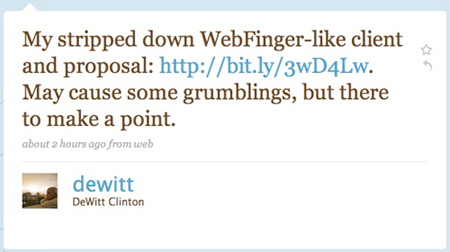
A scant two days later, we already have the first test client, authored by DeWitt Clinton, which shows how WebFinger could work. (Update: He followed up on Twitter to clarify that this is "WebFinger-like", not an implementation of the official protocol itself.)


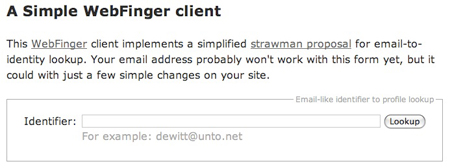
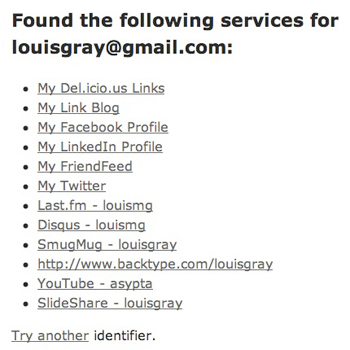
While DeWitt says "Your email address probably won't work" yet, it does work for GMail accounts, most likely those where you have enabled a Public Profile. For example, here are the results when you search for me.


DeWitt's First WebFinger Client Search Box


WebFinger Results On My E-Mail, Using DeWitt's Testbed

The results in today's WebFinger-like client vary quite a bit from what we used to see in Finger back in the last decade. In one e-mail I sent a friend in February of 1997, I wrote: "The last time you logged into your e-mail here was at 5:40 pm Sunday. Right? You got mail at 7:07 from somebody else. Check the time." Not too unsurprisingly, I got this response the next day: "I've never felt the need to protect myself....and you're making me doubt my security." Twelve years later, WebFinger is supposed to help find less about data you don't want people to see, and more about helping your e-mail become your true identity, shaping just what they would find.

DeWitt's implementation is just a first step in what we can expect to see from WebFinger. Dewitt also spells out in a post on the site's Google Group that he wants to make sure the project is not overcome with complexity - outlining what he called an even simpler proposal for discovery and response formats. He notes both @gmail.com and @friendfeed.com e-mail addresses work with his trial, but more may soon. I won't even pretend to say I get the rest. That's why he does what he does and I do what I do.

So the project is in its earliest stages - just getting under way. To check it out, go to http://webfingerclient-dclinton.appspot.com/.
August 16, 2009 · 2 MIN READ · BY LOUIS GRAY

Sharein.com: Share to Twitter, Facebook, E-mail With Popular Items

Sharein.com: Share to Twitter, Facebook, E-mail With Popular Items

You can hardly walk through a few pages on the Web these days without bumping into some variety of URL shortener, sharing bookmarklet, or aggregation site that tries to show the most popular data. Bit.ly has become the shortener of choice for Twitter, with StumbleUpon and Digg having their own offerings in sharebar land. A lesser-known alternative is Sharein.com, which launched a while back, and hasn't had a whole lot of pickup, so far as I can tell. But in looking at the service, I see that ShareIn.com combines the information I've always liked about bit.ly, including statistics, with benefits I've liked on other sites, including individual user history and total share popularity across the network.

ShareIn.com's goal is to make it easy for you to share items you find online with your friends, and it offers three ways to do so - via Twitter, via Facebook, and through e-mail. Like other bookmarklets, you just add the "Share via Sharein.com" bookmark to your browser, and can share any link from the Web to your connections.


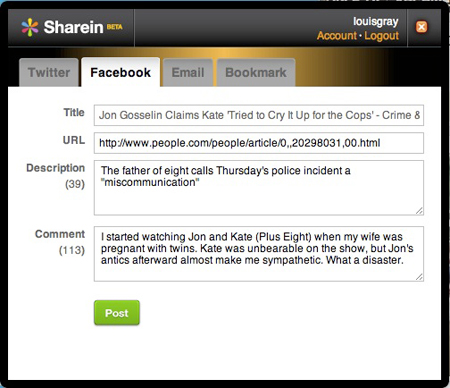
Sharein.com Posts Links to Twitter, Facebook or E-mail


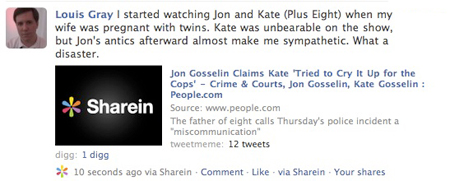
The Resulting Share On Facebook

As you can imagine, I have tried a lot of different services like this. That Sharein sends your info to Twitter or Facebook is not ground-breaking, but it is convenient. The bookmarklet even autopopulates your share on the headline and a short description, which you can customize.


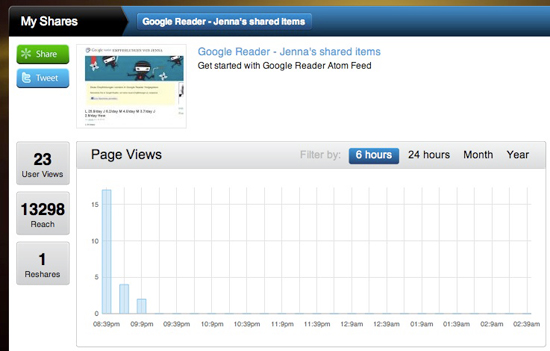
You Can See Views On Each Share Over Time, Like Bit.ly


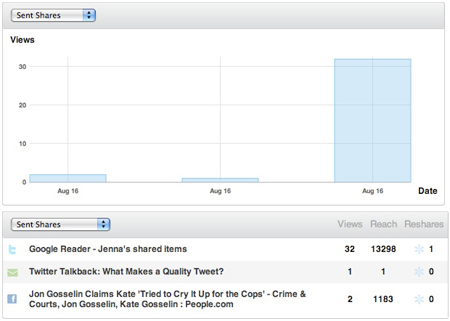
I Can See Previous Shares on Sharein.com, With Stats

What's most interesting about Sharein is what happens after the share takes place. All shares are tracked by individual, so you can see how many views each share got, or how often they were reshared (much like retweeting). Each share can also be tagged, and you can find other shares in the network that have similar tags, as well as see how often they are shared.


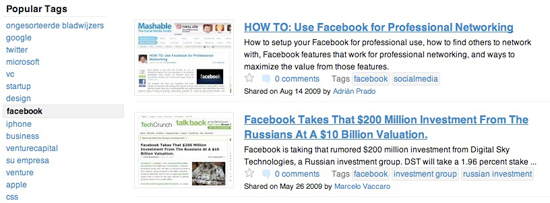
Sharein.com Items Shared With the Tag of Facebook


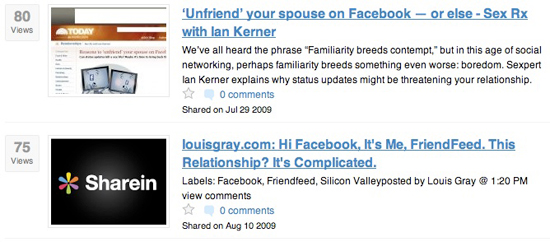
Popular Shared Items on ShareIn.com, With Total Views

All this data feeds into Sharein's "Shares" page that tracks the most popular shared items in the last day, 7 days, 30 days or 365 days. And the site also highlights the most popular sharers. I have seen Paisano share with the product, and he is in the top 5 overall, according to the site's stats.

Today, if I am not sharing via Bit.ly, I share my items with the FriendFeed bookmarklet, and pass those updates to Twitter and Facebook. But ShareIn.com gives the option to bypass Twitter (or FriendFeed) altogether, sending right to Facebook or e-mail and delivering the same type of click-through data. It's a very interesting mashup of solutions that typically have required separate sites.

August 15, 2009

August 15, 2009 · 7 MIN READ · BY LOUIS GRAY

FriendFeed's Not Dead. While Not Clear, Its Future Could Be Very Big.

FriendFeed's Not Dead. While Not Clear, Its Future Could Be Very Big.


Monday's news that Facebook had acquired FriendFeed for an undisclosed sum took many people by surprise, not the least of whom were the site's most-active users, many of whom have made the social sharing and aggregation platform their central nervous system for online activity and community. Initial reactions to the announcement had many people asking questions, extremely concerned that the site - as we know it - was doomed to close, and a lack of immediate denials from the company's leadership was seen by many as an implicit acceptance that yes, the end was near. But in the days following, from what I've seen and heard, it is clear to me that FriendFeed is not going away, that the company's being part of Facebook isn't the end of the world, and that after nearly two years of going it alone, the time had come to make a change.

Since the site launched in beta in October of 2007, and opened up in February of 2008 to the world, FriendFeed has become known for many things. The company's sharp engineers have promoted the site to be at the forefront of innovation on the real-time Web, showcasing advanced search functionality, information discovery and an active, loyal, community. But with the site's wide array of features came a not to be unexpected downside - complexity, which had many wondering how it could attract a user base on the scale of less sophisticated but more popular competitors, like Twitter and Facebook. While even as recently as January, we saw the company's leadership advising us that growth "takes time", this week's move was a clear recognition that in order for FriendFeed to achieve its vision, it needed to team up with a bigger partner - one that had been courting them for years - and it was Facebook who filled the dance card.

FriendFeed Was Always Pursued

Not too long after FriendFeed launched, Facebook called, as did many other companies over time. And while Facebook is known by many as a closed walled garden, where you find yourself reconnecting to people long since forgotten, in sharp contrast with FriendFeed's open nature where you connect to people you've just met, the two companies, through conversations over the last two years, found that they shared a common vision and direction. While the company's dozen or so employees could have kept saying no, stubbornly going it alone, they came to realize that teaming with Facebook made the most sense - giving them an opportunity to take the vision they had and push it within a company that had users in the hundreds of millions, not the hundreds of thousands, which would have been practically impossible given their slow growth rates and other companies' encroaching on their feature set.

More Than Just a Talent Grab

Following news of the acquisition, some have labeled the buy as a "talent grab", with Facebook looking to gain a dozen or so respected engineers. But it was not a talent grab just for the sake of getting good people, but instead, getting good people who were focused on the exact things Facebook needed - including real-time search, aggregation, community, and social messaging. And while it's not exactly clear what the two companies have in mind over the next six, twelve or twenty-four months, as a combined team, the first steps don't involve blowing up the existing community, which should come as a relief to many who thought that was imminent. FriendFeed's leadership has expressed the desire to not only keep the site open and active, but to preserve all the data that has been posted. In fact, just in the last few days, FriendFeed saw the addition of new features, including customizable backgrounds, and small UI enhancements around comments.

Some of the reticence for FriendFeed to loudly proclaim the site and its users' data is safe has come down to the fact that in a sale like this, the acquired company won't always have full say over the future roadmap. Just take a look at any number of recent acquisitions by Yahoo! and Google to see how that has evolved. But the company will soon start to talk about the future of the site, and these announcements will hopefully assuage some of the concerns and fears voiced by many FriendFeed users, who either despise the idea of Facebook, or just expect to be deleted.

So What Happens Next?

The truth is that not even the FriendFeed team has a perfect roadmap in front of them, saying what is next, as part of Facebook. And that has got them nervous too, of course. It took a long time for them talking with Facebook to become comfortable with the idea of an acquisition, and the same gut-level reaction many FriendFeed users had to the news, myself included, was shared at the company's Mountain View headquarters, and their families, or at least it was until they moved out by the end of the week. Their long-discussed plans of developing a unique engineering team and environment at FriendFeed, and about "not being for sale", as we often heard when they were asked, were up-ended, as reality set in, with them turning off their computers, packing up boxes and moving into Facebook headquarters in Palo Alto.

Incredibly, even as many declared the site dead, or swore they were leaving FriendFeed forever, on the news, this past week has seen a renewed spike in terms of new signups and user activity. As the Facebook and FriendFeed news flowed through the Web and got mentioned on the radio or TV broadcasts, user mailboxes have been pummeled with a wave of new connections. And it practically goes without saying that the people who have left FriendFeed due to the announcement are not any more than the number that would have left had FriendFeed needed to dramatically change its focus to finally get that hockey-stick user growth seen by networks like Twitter and Facebook, just like there was a wave of people who left the network when they revamped their user interface this spring to make real-time the default view.

In February 2008, in an e-mail exchange I had with Bret Taylor and Paul Buchheit, two of FriendFeed's cofounders and the public faces of the network, I was eager to let them know a high-profile user had signed up. Paul responded, simply: "One down, 6,652,865,239 to go :)" keeping with his belief that FriendFeed was for everyone, not just the relatively small number of users who made the site their home on the Web. As many of the employees at FriendFeed hail from Google, it's not unlikely they see Facebook's current position as they did Google at an earlier age - having both significant momentum and share, but also much more room for growth, letting them bring FriendFeed a lot closer to that elusive 6,652,865,239 user number.

As the Dust Settles...

In the last two years, I have optimized my online activity for FriendFeed. I have used FriendFeed as my information filter and distribution channel, as it both takes in my activity around the Web, but spits out a subset to Twitter and Facebook. While I don't know if all this information will be on friendfeed.com per se for the rest of eternity, I am confident in saying that all my existing links, data, photos, and files are secure. I believe that the vast majority of things that have attracted FriendFeed's users to participating on the community will start to show up in Facebook as well - if not taking over the site, but being shown in different areas of the network. And while over the years, Facebook has gained a not-so-spotless reputation on the Web for being closed (among other things) partnering with FriendFeed could have a major impact on the company's ability to adjust on the fly and keep growing.

For those people who are very concerned about their data and preserving what they have invested into the site, activity on FriendFeed, like Twitter, is centralized, and therefore, there is not yet a perfect solution to extracting the data and moving it elsewhere. But a new project called CloneFeed is looking to help, and FriendFeed's founders have always trended toward standards and openness. Meanwhile, if you expected them to stop using the site, they haven't. After a few busy days following a practically sleepless weekend prior to the deal's completion, the founders have started posting again. They're not going away, and neither are we. Hopefully, they will talk a lot more about what the acquisition means - as much as they are able - soon. But for now, I'm going to keep using FriendFeed, while also expanding my use of Facebook (just in case), and would welcome that you do also - for now, the little company that could just got some tremendous financial backing and a huge endorsement from one of the leaders on the Web who is growing faster than anyone else.

As always, you can find me at http://www.friendfeed.com/louisgray, or on Facebook at http://www.facebook.com/louisgray.

August 13, 2009

August 13, 2009 · 2 MIN READ · BY LOUIS GRAY

Twitter to Embrace Retweeting, Releases Developer Preview API

Twitter to Embrace Retweeting, Releases Developer Preview API

For many people using Twitter, the act of retweeting is a major part of how they help share information. Popular Web sites, such as Tweetmeme, have developed to show the most popular tweeted items each day, frequently highlighting the largest Twitter accounts. And while the act of retweeting hadn't always had official blessing from Twitter, who has literally watched the system develop underneath their feet, the company looks to be fully embracing the activity - promising to make it natively supported on the service's Web site, and today, introducing a preview to developers that will help them take advantage of the new functionality.

In a posting to the Twitter API Announcement Google Group, Marcel Molina, a member of Twitter's Platform Team, explained that not only is the company only "weeks away from being ready to launch" support on their end, but they want developers to have enough time to prepare their apps to launch alongside Twitter when that day comes. It's a great move in light of frequent developer complaints that have said Twitter often makes changes without giving them advanced notice.

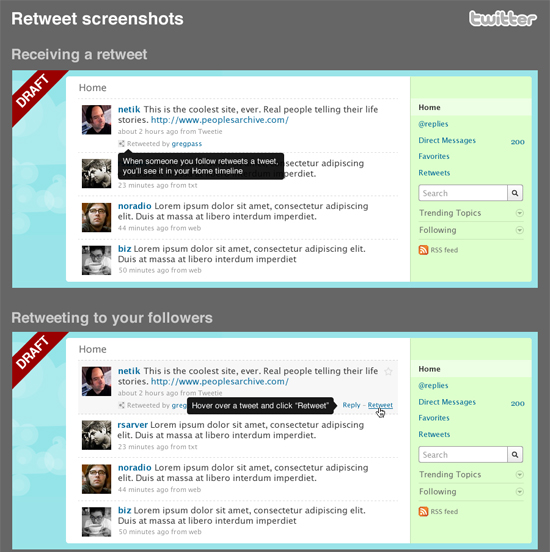
Screenshots accompanying the note show that not only will you see that items have been retweeted, but you will now have language that makes "Retweet" as easy as "Reply", just by hovering over the individual message.


Interestingly, the screen capture shows that if an item has multiple retweets, that you can see the IDs of who has retweeted the individual message. That could get very busy for the most popular accounts, so I assume Twitter has considered what would happen if a note gets a dozen or even hundreds of forwards.

Not only is Twitter embracing the retweet, something I personally have avoided for the most part, but they have done so in a way that makes the retweets visually different than standard notes, so you don't wonder about the originator, or if you did "RT" correctly. The new process should be available in a few weeks, and in applications around the same time, if developers get busy.

The company has also added a note to their blog:
Project Retweet: Phase One

August 12, 2009

August 12, 2009 · 1 MIN READ · BY LOUIS GRAY

Google Reader Wants Me to Send My Shares Everywhere

Google Reader Wants Me to Send My Shares Everywhere

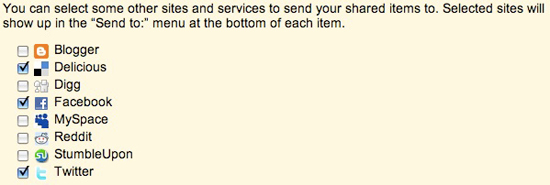
My favorite RSS feed reader and jumping off point for information discovery and sharing, Google Reader, has caught the social bug. Fresh off their big push last month that saw a spike in the number of people exchanging shared items and finding contacts, Mountain View issued a code bump this evening that lets you take your shared items and send them to a myriad of social networks, including Delicious, Facebook, Twitter and others.

In their blog post tonight, Reader said they have been "thinking about ways to help our users better share, discover, and consume content in Reader." Share is the big word with this move. Now, each item I share, and I share about 20 day, can be sent to one of my favorite social networks.


Now I Can Send Shares To Multiple Networks


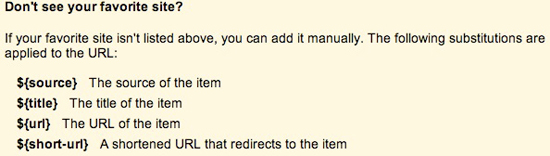
If My Favorite Is Not There, I Can Make My Own

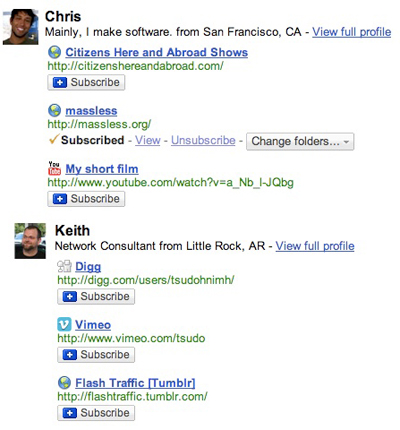
In addition to this move, Reader made it easier to find more feeds from people you are following, by leveraging their Google profile. Now, if I have feeds on my blog, and my Twitter and my Facebook or any other network, Google will find it and make it available, through the "People You Follow" area. At this point, following almost 400 people, I should be able to find a few hundred new things to consume.


One Person: Many Feed Opportunities

Another thought is ... with Facebook gobbling up FriendFeed, I could now follow all my friends' updates here in Google Reader instead. Google Reader could be a master aggregation service even if not all the community functions are there. Who knows?

The last major update from the Reader team today? More capability to mark items read, including options older than a day, week or two weeks. Considering I never mark all as read, I'll skip this "feature" but for those of you who embrace information consumption failure, you might find it tempting.
August 12, 2009 · 1 MIN READ · BY LOUIS GRAY

Seesmic Web Upgrades, Adding Favorites, Hashtags, Previews

Seesmic Web Upgrades, Adding Favorites, Hashtags, Previews

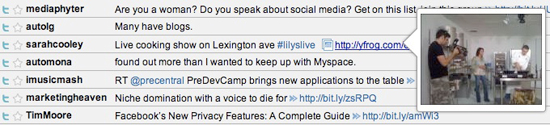
Last month, I told you that I thought Seesmic's newest offering was the best Web interface for Twitter I had ever seen. In just the last month, I've seen new introductions from HootSuite, and a new entrant, Brizzly, continues to incubate. But amidst turmoil at Twitter, following a week of DDos attacks and downtime, Seesmic has bumped up its Web offering, adding inline previews for some links, Internationalization options, a new timeline for favorites, and hashtag support.
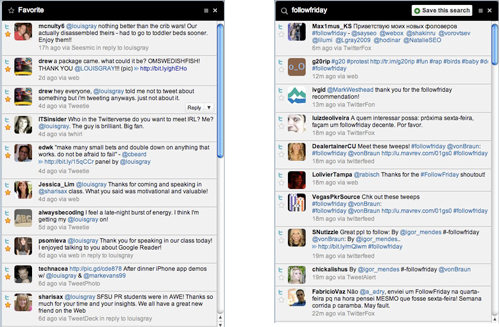
The updates are welcome and help to make the product be a more valuable tool in the social media portfolio.


You Can Preview Some Links In Line


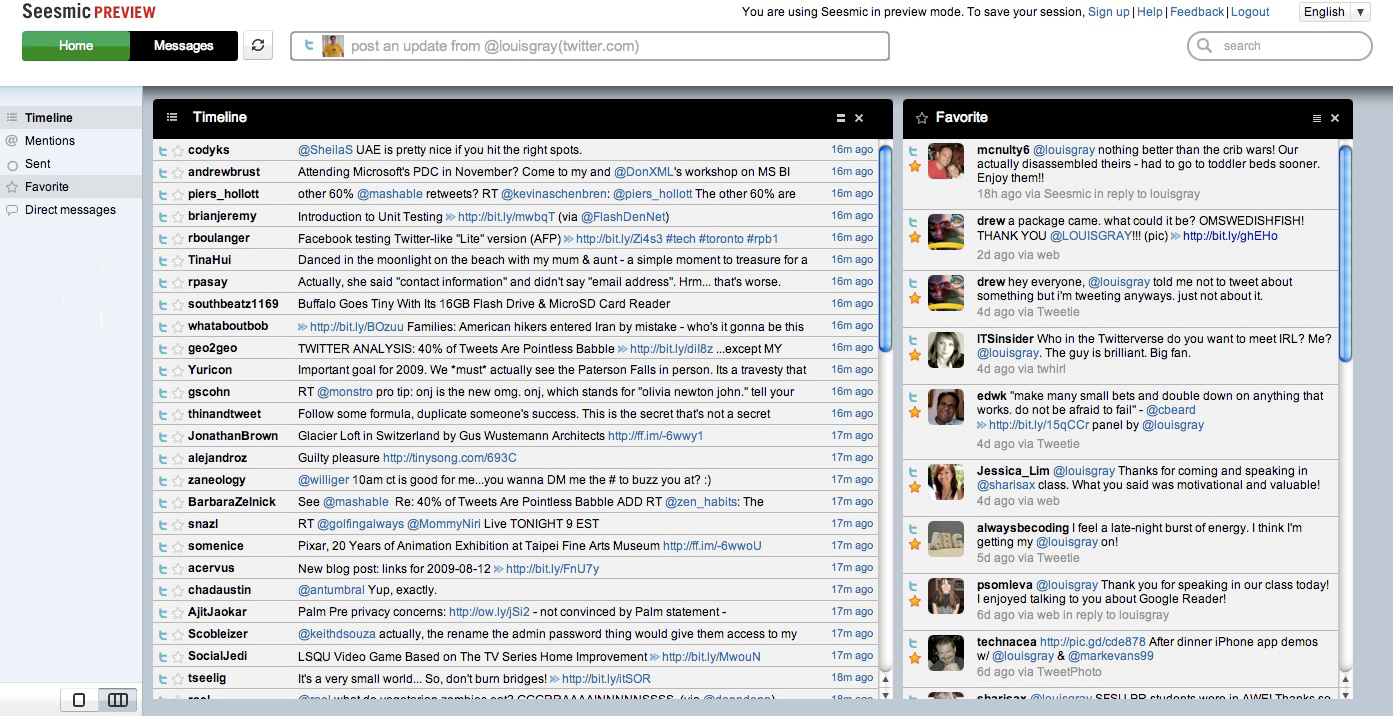
Note the New Favorites Column and Hashtag Search

Seesmic's Web interface caught my eye initially due to its flexibility with adding multiple columns, having the option to display updates in single-line mode, much like GMail, and for its thoughtfulness in having direct messages outside the line of fire - no doubt reducing mistakes. Adding internationalization for Chinese and French users will no doubt help those folks, while adding more options, like a favorites column, is nice - especially for those who use favorites as bookmarks for later viewing.


The New Seesmic Web Service - Click for Full Version

Thanks to problems with Twitter's outages and OAuth failing much of the last week, it has been a difficult last few days for Seesmic, who had to close the Web version a good deal of the time over the weekend, and no doubt impacting this release. But with things looking like they are returning to normal, it's back to pushing new code.

See more about the new launch on the official Seesmic blog

August 11, 2009

August 11, 2009 · 2 MIN READ · BY LOUIS GRAY

PostRank Real-Time APIs Deliver Relevant Data Based On Engagement

PostRank Real-Time APIs Deliver Relevant Data Based On Engagement

PostRank, formerly AideRSS, is well-known on the social Web for its tabulation of "hot" blog posts and influential authors, based on social activity, including total number of comments, links within Technorati or Google, and postings to news sites, such as Digg and Twitter. The idea? Finding the best blogs and best stories from the mountains of information posted each day - finding experts and posts "that matter". Recently, the company turned on what I find to be a very interesting tool, essentially a group of APIs that third party companies can tap into, leveraging PostRank's information for themselves - to use any way they wish.

According to PostRank, fully 97 percent of all content published online doesn't have any audience engagement at all. For companies looking to find the most active, relevant content, PostRank can essentially scrape the cream off the top, and deliver companies, via the new APIs, that content which matters, with as much or as little as they would like.

Different data cuts available to PostRank customers accessing the Real-time API include engagement thresholds, topic and keyword filters, and of course, timing. Potential feed sources only will include those that have gained audience interaction over the last 30 days, for example. In parallel, with the release of Data Mining APIs, PostRank customers can go back into two years' worth of the company's data, searching by level of engagement, topics or themes.

The goal, according to the company's Web site? "Socially relevant content, delivered in real time." One of the company's case studies includes Advertising Age, who is now leveraging PostRank metrics to help determine the "Power 150" list, relying much less on Technorati and Yahoo! - relative dinosaurs from the Web 1.0 era.

AdAge's post, from back in April, explains why they selected PostRank:
"Why's PostRank so great? For one, unlike other metrics, they provide real-time data. We'll only be grabbing it once a day like any other metric, but you can be reasonably sure that your recent hot post will be accounted for."
Another partner is Gnip, who leverages PostRank to send relevant data to its own customers.

This release, while unlikely to land me the highest levels of social engagement I've ever seen, fulfills what many are saying is missing from Web services - a legitimate business model to enterprises that can deliver value. And PostRank is tapped in to all the right buzzwords. Real-time. Social. Engagement. While I tell you I have no fear of information overload, and can take the time to read all the blogs I do, others don't, so PostRank does the dirty work to only send the best ones through.
August 11, 2009 · 1 MIN READ · BY LOUIS GRAY

Podcast: TheSocialGeeks: FaceFriend or FriendBook?

Podcast: TheSocialGeeks: FaceFriend or FriendBook?


In the latest edition of The Social Geeks, Chris Miller, Wayne Sutton, Jeff(isageek), Sarah Perez, Corvida Raven and I talk about the big news from yesterday of Facebook acquiring FriendFeed, and what impact this could have the community and your data. You can also find the original copy on Mevio.com.

August 10, 2009

August 10, 2009 · 1 MIN READ · BY LOUIS GRAY

Steven Hodson and I Talk FacebookFeed: Our Initial Reactions

Steven Hodson and I Talk FacebookFeed: Our Initial Reactions

In my small little world, the news that Facebook had acquired FriendFeed has been the equivalent of a social news tsunami. No sooner did the news break then did I get a swarm of phone calls looking for my response - with people asking if their data would be safe, if I would delete my account, if I could handle acting the same way on Facebook as I have done on FriendFeed for almost two years.

You saw my initial thoughts, as I compared Facebook to the sweaty lunkhead who somehow attracted the perfect girl, which were part tongue in cheek, but fun to write. In parallel, I've seen posts fly from many people around the Web, some deeply invested in FriendFeed, and others, not so much. One of the guys who I respect, and have traded ideas with for the better part of four years, is Steven Hodson, the often-cranky author of Shooting At Bubbles and writer at The Inquisitr.

He and I connected this evening and talked about the deal. He thinks the selling of FriendFeed was inevitable, and I'm not so sure.

With the goal of keeping the call crisp, it times in at less than 20 minutes. Hopefully, it will be the first of many. Enjoy.

August 10, 2009 · 3 MIN READ · BY LOUIS GRAY

Hi Facebook, It's Me, FriendFeed. This Relationship? It's Complicated.

Hi Facebook, It's Me, FriendFeed. This Relationship? It's Complicated.


Alright Facebook. I didn't want it to be like this, so let me tell you in a way that you'll understand. You know how you started out as a program for nerdy college boys to rate the best ladies, find which ones were available, and see if there was a way to hook up? You know how you've grown up to now be much more than that - maturing into a platform that routinely sends me Mafia Wars invitations, and wants to poke me every so often to make sure I'm around? Well congratulations. Because just like in high school, sometimes the sweaty jock who doesn't wash his hands after using the john still gets the best girl - while those of us who carried her books and wrote her poetic love letters and timed our walking to go by her locker at just the right time find ourselves on the outside looking in again.

Yeah. I get it. I get how I could BS and say "I'm happy for you." "I only want what's best for you." "Take good care of her." But look. I know your reputation. You're not trusted. I know about the other girls. I know they change - and not in a good way - after you've been with them. So yeah.

Today, you announced you were buying FriendFeed - in what looks like it might have just been a two-year-long job interview for a dozen of Google's brightest minds (courtesy of Drew Olanoff, who called immediately after news broke). It's not like we didn't really know something was up, after all - you could see in the way the FriendFeed team rolled in all giddy this morning at a time well before when they usually rise, waiting for the other shoe to drop. You could see in the way they collectively had a heart attack when I walked into their offices last week unannounced and caught them in what was called "a company meeting" - which practically needed bouncers out the door for how quickly I left.

Here's the thing. FriendFeed is the good girl. FriendFeed is the one that has a 4.0 GPA and had big dreams of an Ivy League diploma. And yet, she ends up with you - the Silicon Valley equivalent of your local state school. When you come rolling in with your heavy car, big wheels and pumping bass, we don't care how much money you say you're worth - we still don't trust your grin when you open the door and say "hop in".

So what's happening to this Valley? Is it as dire a situation as it sometimes seems? Are we really going to end up with four mega-companies: FaceBook, Google, Microsoft and Apple? Because if Google or Microsoft can weasel their way into acquiring Twitter, that's sure how it will seem. If the IPO market continues to be closed, and innovative companies can only knock on doors 1 through 4, that's not a good thing.

I don't claim to have any inside scoop on how big the rock was on that ring you got FriendFeed. I don't know whether you want to keep her a good girl, or lock her away in your closed dungeon. But all I know is that her friends are very scared for her - and we're watching you.

August 9, 2009

August 9, 2009 · 2 MIN READ · BY LOUIS GRAY

iPhone Call Recording: It Makes Too Much Sense Not to Do

iPhone Call Recording: It Makes Too Much Sense Not to Do

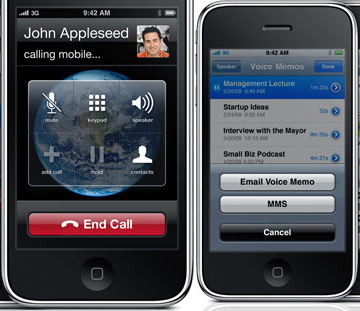
The introduction of the Voice Memos capability on Apple's iPhone was a nice touch. Now, in theory, if I am out and about and don't want to type in a note, I can speak into the Voice Memo and save a short audio clip. The process is also good for recording short snippets of music, or even the babies babbling, if I want to save it as an MP3 file and send it somewhere. But I've been thinking that Apple could be sitting on a much bigger use for this functionality - doing podcasts and interviews, which would take money out of the pockets of services like WebEx and Skype, and into its partner, AT&T.

Apple's iPhone already features a number of calling options once you are connected - including adding a third line, hitting mute, putting the call on speaker, and putting calls on hold. Given the iPhone's parallel option to record audio, why not add a red "Record" button alongside the conversation?

Before privacy and security advocates call foul, I assume it is very simple to have a mandatory introductory audio phrase, like "this call is being recorded", as well as beeps along the way.


Marrying Voice Memos With Phone Calls Should Be Easy

Today's world of podcasting usually deals with a third party hosting service, like Talkshoe, or gathering all parties on a Skype call, while one person manages the process. I think it would be dramatically easier to use the same way you make any other call, and just have Apple do the work of gathering the call into an MP3 file, and making it available in your iTunes for later listening, so you can upload as you please.

In theory, if Apple could enable this "Record" calls functionality, we would only be a few steps away from what could be seen as a panacea, not just for podcasters, but anybody conducting interviews. It shouldn't be too hard for a phone call to take place and to identify words and phrases by phone number (or the Address Book contact) of the person speaking. At that point, you could run the information against a new application, and have the call automatically transcribed. While this may sound like fantasy, the world we live in isn't that far from delivering excellent speech to text functionality. Pointing that tech at a recorded phone call you make on your iPhone shouldn't be that much more difficult.

Let's just turn on the record button and go.

August 8, 2009

August 8, 2009 · 1 MIN READ · BY LOUIS GRAY

Favorit Shuts Down As Company's Focus Turns to TweetMeme

Favorit Shuts Down As Company's Focus Turns to TweetMeme

At one time, I thought Favorit was going to be the application that weaned me from Google Reader to consume all my RSS feeds. After Robert Scoble speculated it could be a serious challenger, thanks in part due to aggressive pitching from its author, Nick Halstead, I waited four months, as the product incubated, before I got my hands on it, and when I finally gained access, I was significantly underwhelmed, writing up one of the most negative pieces I've done here on the site - which, in retrospect, wasn't very nice.

Following my write-up, Nick was understandably frustrated, saying he didn't know why he gave me "the time of day", following on with a post titled "Missing the point".

While possible, some things changed after our exchange. First, Favorit came under fire from Duncan Riley and the Inquisitr for what he called "splogging". Second, Nick felt RSS was "dead for the mainstream market" later in 2008, and third, and likely most impactful, his follow-on project, TweetMeme took off like wildfire, riding the bullet train that is Twitter.

In a post issued today, saying "Fav.or.it is Dead, Long Live Favorit", Nick expands, saying:
"TweetMeme became our focus for several reasons, firstly the trend towards status messages (micro-blogging) meant that access to real-time news was becoming a reality and that our aggregation + filtering technologies could be very quickly leveraged to take advantage of it. Secondly, our simple approach to delivering what websites desired in the form of a retweet button very quickly got traction..."
The combination of one product becoming less than everyone anticipated in parallel with one becoming a recognized leader in the real-time search and ranking space made the decision clear, and largely anticipated. That Nick and I tangled over our interpretation at the beginning was unfortunate, but I think we've both learned from it and have grown from the experience.

May Tweetmeme live and see a much better fate.
August 8, 2009 · 3 MIN READ · BY LOUIS GRAY

Spotify: The Best On Demand Music Library I've Ever Experienced

Spotify: The Best On Demand Music Library I've Ever Experienced

You might have read some of the recent coverage around Spotify's potential inclusion (or lack thereof) into the iTunes store. You might also have seen the company's term sheets floated about the Web, as the music streaming startup gears up from its limited release to one that could take the globe by storm. But if you live in the US, there is a fairly good chance you haven't actually gotten to try the application, unless you cheated and used a proxy, because to date, it has been limited to European audiences. Well, despite my years-long allegiance to iTunes, and recent signup to Sirius XM satellite radio, I got my hands on a press beta for the US version of Spotify, and it is amazing.


Spotify's Promise: Legal, Free and Instant. All 100% Valid.

Using Spotify is like having hundreds of thousands of crystal-clear music tracks on demand. After downloading the application tonight, I've closed my iTunes and have been powering through Spotify, finding hundreds of tracks from all my favorite bands, including Depeche Mode, Underworld, and Daft Punk, but I was also able to dial back a few decades, uncovering Jesus Jones, INXS, and The B-52s. You name the song, I found it, including rare remixes. And cheating by looking at songs I really liked on Sirius Radio, I even found more obscure artists, including Deadmau5, Kaskade, Kaz James and Kristinia Debarge.


724 Tracks from Armin Van Buuren In Spotify


Drilling in on The B-52s In Spotify

The promise of instant access to seemingly any song on the planet is apparently here. It's jaw dropping.

Like iTunes, Spotify displays the track that is being played, its length, the album name, and artist, and clicking on any of those items displays information about the track, or the artist, including biographical history. Like iTunes, you can hit shuffle and repeat. And like iTunes, the search capability is very good. But unlike iTunes, you don't have to download the music and you don't have to pay for the music - making it more like the subscription services, including Rhapsody and Napster, that have been slaughtered by Apple's iTunes colossus.


Information Society on Display In Spotify


Jesus Jones In Spotify. (Remember them?)

Spotify's service is not "free" per se. The "free" version displays advertising between songs, and to get an ad-free experience, you would need to pay (at least in the UK) a British pound for a 24-hour day pass, or 10 British pounds for a month. I haven't seen what the US rates will be, but the version I'm using (no doubt the 'press' version) hasn't encountered an ad yet - just pure, clear, music.

If I'm Apple, and I see the Spotify application heading for me like a freight train, I would try to say the application competes with existing features of iTunes. You don't want to let a huge potential competitor in the front door. But if you look at Spotify like they did Sirius XM Radio, which was approved, it's essentially the same story, only instead of dedicated radio stations, you've got individual songs and artists by the bucketload.

I wish, similarly, that I had a "bucketload" of invites to hand out to get you into a theoretical Spotify beta, but I don't. All I have is my copy - and it's fantastic. When it lands here in the US, it's got the potential to be an amazing hit. I just hope people aren't so cheap as to not pay if presented the opportunity. I'm always willing to pay for quality, and that's exactly what we've got here.

August 7, 2009

August 7, 2009 · 2 MIN READ · BY LOUIS GRAY

Twitter's "Harsh and Cold" Honesty Tells Devs No ETA for Fixes

Twitter's "Harsh and Cold" Honesty Tells Devs No ETA for Fixes

The much-discussed distributed denial of service attacks over the last two days which hobbled Twitter and also impacted a number of other sites, including Facebook and LiveJournal, has also had a tremendous negative impact downstream, bringing many third party applications and services to a halt. With the sluggishness and non-responsiveness stretching into what will be the third calendar day tomorrow, Twitter told developers, heading into the weekend, that not only was the attack ongoing, and not lessening, but they had no ETA for anything to get better.

While many developers are understandably sympathetic toward Twitter's troubles, even as the popular microblogging service's network architecture is being analyzed for weaknesses, the strain many of them were feeling without receiving answers started to be on display this evening as hours went on without an update - while at the same time, key Twitter employees happily updated that they were going out for sushi or enjoying tonight's Underworld concert.

One developer, in the company's Google Groups forums, wrote:
"There's been lots of posts from Twitter saying they plan for better communication. Okay, cool. But it's Friday night and I am pulling my hair out with no new information. I am sure they are doing all they can... but many third-party apps have been broken for 2 days now. And just as Twitter is getting bombarded with emails from developers... developers, too, are getting bombarded with complaints/questions from customers."
After the same developer noted that employees had gone out to catch dinner, he exclaimed frustratedly, "While food is important, would be helpful to also update devs what's going on, too, before a night on the town?!?!?!" This led to another developer's stating he too agreed with the outrage, adding:
"Thanks for your outrage. I thought i was one of the only few that have issues with how things are being handled."
But shortly after the conversation threatened to get ugly, Twitter's Chad Etzel posted an update, around 8 p.m. Pacific time, catching up the community, and he didn't have much good news.

His major points:
  • "The DDoS attack is still ongoing"
  • "the intensity has not decreased at all"
  • "interaction with the site and with the API will continue to be shaky"
  • *There is no ETA on fixing any of this* (repeated twice)
He told developers that the situation at Twitter will "continue to be rocky" and may actually get worse, but also said that the company's operations team will be working "around the clock" this weekend, adding, "as much as you want it to be fixed, we want it to be fixed more."

With past outages, Twitter has had a mixed bag in terms of communicating to the developer community. Had the initial complaints gone unanswered, it's likely Twitter would have transitioned further away from being the victim to being seen as part of the problem. Yes, applications are broken. Yes, access is still slow, and as the site has become a major piece of infrastructure in today's social Web, its downtime is more than trivial. But this isn't a situation of the company's employees partying on a sinking ship. It sounds like the team is strained, and being realistic about what will continue to be a long process of restoring normality.
August 7, 2009 · 1 MIN READ · BY LOUIS GRAY

Lunch 2.0 Highlights Video: Mozilla, FriendFeed and Kosmix

Lunch 2.0 Highlights Video: Mozilla, FriendFeed and Kosmix

Lunch 2.0 with Kosmix, Mozilla and FriendFeed

As mentioned yesterday, I had the opportunity to moderate a panel featuring representatives from three forward-looking Web companies looking to push change and compete with established market leaders. You can watch the full hour-plus long video recording on UStream, or catch five minutes of highlights above. It was a pleasure to participate, as it was my first time moderating, and I hope I get the chance to do so again. Thanks to the 200 plus people who attended, the panelists, and for Kosmix, putting it together.

August 6, 2009

August 6, 2009 · 1 MIN READ · BY LOUIS GRAY

Lunch 2.0 Panel With Mozilla, FriendFeed, Kosmix on UStream Today

Lunch 2.0 Panel With Mozilla, FriendFeed, Kosmix on UStream Today


Around 12:30 p.m. this afternoon, I will be sitting down with Anand Rajaraman, Co-Founder of Kosmix, Bret Taylor, Co-Founder of Friendfeed and Chris Beard, Mozilla's Chief Innovation Officer to talk about how these three small companies are driving change online. If you can't be one of the more than 150 expected to attend in person today, I hope you will get a chance to follow along on the live Ustream coverage.

To join us, start here around noon: http://www.ustream.tv/channel/lunch-2-0-with-kosmix-mozilla-and-friendfeed

More information on the panel was included in my post: Join Mozilla, FriendFeed and Kosmix for Lunch 2.0 on August 6th

Disclosure: Kosmix.com is a client of Paladin Advisors Group, where I am General Manager of New Media.
August 6, 2009 · 3 MIN READ · BY LOUIS GRAY

To Jump on the Massive Unfollowing Trend Would Be a Mistake

To Jump on the Massive Unfollowing Trend Would Be a Mistake

For weeks, in my ever-increasing list of potential future blog post topics, I have had one titled, "What If I Purged My Twitter Followers?". Trust me, the option has crossed my mind on the rare occasion I log in and try to use Twitter or any of its 3rd party apps in the way the Twitter team had intended - as I watch update after inane update swim in a sea of half-baked offers and hashtaggery. But even as I see some notable folks talking about taking apart their list of connections with the subtlety of Jack Nicholson wielding an axe in The Shining, I'm still ignoring the temptation to join them. While I may weed out some clear spammers now and again, I think to massively prune my list would introduce more problems, real and emotional, than it would present solutions.

Since I started using Twitter in early 2008, I have somehow amassed more than 12,000 connections. Thanks to my employing an auto-follow capability from SocialToo, a company run by Jesse Stay who I advise, those who add me as a connection in Twitter gain a reciprocal move almost instantaneously, without my lifting a finger. While some may think this is "disingenuous", doing so saves me the time of reviewing each new follower one by one to gauge "worthiness", and it also enables them to send me direct messages - as Twitter will block the capability otherwise.


Scoble's Unfollowing Is Easily Seen Via TwitterCounter

I recognize there are problems with spammers on Twitter. I get my fair share of automated direct messages. I see ridiculous accounts that look more like robots than people. But if I set an artificial standard that required me to have a personal relationship with an individual in order to follow them on Twitter or any network, I would be selling myself short in terms of getting to potentially know the person, and I would be selling them short by not giving them a chance when it is likely they just wanted to be connected in an environment where they were comfortable.

Assuming I were to abstain from using an auto-unfollow service (SocialToo does this also), and I took 10 seconds to review each of the 12,000 accounts, it would take more than 33 hours to adequately cleanse my feed. And I know if I did use an unfollowing service, a lot of great people would be thrown out with the bathwater. I saw Scoble's experiment, only to have it impact friends of mine like Drew Olanoff and Kent Newsome, who are both real humans who contribute on Twitter and other networks. I know, without question, that there are many future peers on the Web that I just haven't had the luck to meet yet.

Benjamin Franklin, once paraphrasing Blackstone's formulation, said, "It is better [one hundred] guilty Persons should escape than that one innocent Person should suffer." So too do I see it better that 100 spammers fill my feed than I lose access to the innocents who remain. I am not so self-centered as to believe I know the full set of people who I can learn from and derive value. So don't look for me to start shaking my numbers down on any of the networks - even if it is getting more popular.

Also see: Twitter is for Following Topics and Listening, Not for Following People from February 26th for more background on this.
August 6, 2009 · 2 MIN READ · BY LOUIS GRAY

PubSubHubbub Hits the Gas On My Google Reader Link Blog

PubSubHubbub Hits the Gas On My Google Reader Link Blog

In terms of sheer volume, there is little I do more online every day than share Google Reader items. According to my Google Reader trends statistics, I have shared 743 separate items in the last 30 days, at a rate of just under 25 a day, including weekends - no doubt adding up to more individual updates than all my blog posts, tweets, Delicious bookmarks and Smugmug updates combined.

There's no question that Google Reader plays a big role in how I both consume and share data. So when I heard the PubSubHubbub team had turned their attention to these feeds, that was big news. The move, which was announced Wednesday, means that updates to the link blog will propagate in near real-time. As I share items one by one, they will hit FriendFeed, as well as those who have subscribed to the feed, using RSS, in Google Reader or other feed readers.


My Google Reader Sharing Activity Is Accelerating

Interestingly, it looks like the move was not an official Google project, taking place in engineers' "20% time", pushed forward by Google Reader engineer Mihai Parparita, Brad Fitzpatrick and Brett Slatkin. I for one am glad the techie trio teamed up, as this means yet another one of my key outposts on the Web is now powered in realtime.

As I've discussed before, I share what I do on Google Reader because I know there are a good number of people connected who rely on me to be an information filter. Similar too is the position that Rob Diana holds, as he dictates in his own coverage of the story, "Google Decided Reader Will Be The Real Time Hub" Rob shares about 35 items a day, and shows no sign of slowing down - which is awesome. Now, with PubSubHubbub, if there is any slowdown, it's clear it's with me, because Google has the gas pedal pushed all the way to the floor.

See also: PubSubHubbub: Real-Time Feeds and Real-Time Feedback Too? from July 17th.
August 6, 2009 · 2 MIN READ · BY LOUIS GRAY

Won't Be Long Before These Future Marketers Major In New Media

Won't Be Long Before These Future Marketers Major In New Media

Sometimes, it doesn't seem all that long ago that I myself was in college. On other days, it seems like I am talking about somebody else, when looking back on my time at UC Berkeley. With my 10 year graduation anniversary having passed a few months ago, I found myself back on a college campus this afternoon, with the opportunity to speak to a roomful of students at San Francisco State University, focused on a rapidly changing world of Marketing. And what I encountered was a class of future-thinking young adults trying to grok a fast-changing world where social networks are potentially more impactful than traditional media outlets.

Invited to speak by the class' professor, Shari Weiss, I hoped to illustrate my dual role - both in terms of being a technology blogger, but also my real world decade of experience working in public relations and corporate marketing, and how, finally, these two worlds are colliding, as I help companies get a bigger voice in the social media space.


I Don't Go Too Long Without Mentioning Google Reader

The gulf between what was considered "new media" when I was at Cal and what is "new media" today for these students is tremendous.

As I recalled this afternoon, in 1998 I was excited to see my Journalism professor approach how the Internet was affecting reporting and publishing, only to see my excitement dashed when she rolled in a projector and showed us a feel-good documentary on the founding of Yahoo!, featuring Jerry Yang and David Filo. My disappointment in the lack of forethought in this course was so great that I did not attend lecture the remainder of the year, dropping in only on discussion sections and for the final, which I somehow passed.


Initial Feedback on the Discussion Looks Pretty Good

In contrast, the array of topics challenging the students at San Francisco State brought a smile to my face. In quick presentations, teams tried to tackle the future of advertising, the world of Facebook applications, how to utilize Twitter for business, and I saw future topics spanning such sites as YouTube and LinkedIn.


I Swear I Could Have Talked For Hours On This Stuff

Some part of me was jealous, but I also felt a bit like an unofficial teacher's assistant, sitting in on the presentations, and trying not to correct small mistakes or provide answers. It was clear, that for the most part, the students see real potential from these new networks, where others of us are just coming up to speed. As I showed them, you don't have to be a traditional cool company selling to consumers to get new media. But it's becoming a requirement, to act and engage with your customers as peers. That the future marketers and message-shapers of the world are already getting the message bodes well.

I was glad to get the opportunity to drive up to The City and share my position on the changes I have seen, and hope I was able to make an impact. Thanks to Shari for inviting me.

August 3, 2009

August 3, 2009 · 1 MIN READ · BY LOUIS GRAY

AustinLifestyles SXSW 2009 Video: Blogging, Apps and Tech Trends

AustinLifestyles SXSW 2009 Video: Blogging, Apps and Tech Trends

While at the South by Southwest conference in Austin, Texas this spring, I tried to make myself available to not only attend as many panels as I could, but also to participate in video interviews for those who wanted to talk about blogging, tech, social media and lifestreaming. While I already got the chance to publish the one on one discussion I did with Morgan Brown a while back as part of his "100 interviews" program, another video, from AustinLifestyles, had lagged, making me wonder if it would ever show.

But today, I found it had, indeed, published. The video, taped in two parts, is embedded below, via YouTube, and shown back to back. It's already interesting to see how my answers might be a little different just four months later, especially when I hear myself saying Matthew and Sarah are only 8 1/2 months old. (They are now 13 months.)

August 2, 2009

August 2, 2009 · 3 MIN READ · BY LOUIS GRAY

RSS Is Doing Great, But Stand-Alone Feed Readers Are Collapsing

RSS Is Doing Great, But Stand-Alone Feed Readers Are Collapsing

Three years in technology can be an eternity. I marvel that just over three years ago, I was telling you that "RSS Is a Demanding Mistress", showing off a screen capture of my NetNewswire application, powered by Newsgator. At the time, as I complained about having nearly 100 articles to read, I didn't anticipate the impact Google's entering the market with Google Reader would be, and my screenshot now seems quaint. By 2007, I had switched to Google Reader, and despite multiple assaults on Reader in the ensuing two years, you can tell most challengers apart by their epitaph.

In the past few years, I've helped champion more than a few new approaches to the RSS feed reader market, each with its own approach to making the stand-alone process more social. First there was Assetbar, who had tremendous technology, but a clunky interface, and never really got off the ground. Not too long afterward, we saw Shyftr debut, but following a highly visible controversy over shared comments on full feeds, the company eventually shut down their interesting product as well, moving instead to RSS filters. Even last week we saw NewsGator turn off their synching functionality, pointing customers to Google Reader. Yes, NetNewsWire is still around, and now points to Google Reader, but it's pretty much a legacy app at this point. (In my opinion, of course)


Isn't this cute? (From back in 2006 on NetNewsWire)

While some are debating RSS' role in a new world of real-time information discovery, there is no question that Google Reader has won this specific battle. If I exclude FriendFeed data from my own FeedBurner statistics, the combination of Google Reader and iGoogle accounts for 84 percent of all my RSS readers. In contrast, NewsGator is below 4 percent, and BlogLines checks in at just above 2 percent, with PostRank and Netvibes coming in at just over 1 percent each. Mice nuts.


My FeedBurner Stats Show Google Reader and FriendFeed Dominate

That's not to mean the RSS ecosystem is in anything resembling a freefall. The recent launches of My6sense for the iPhone, looking to find the most relevant content, and Lazyfeed for real-time blog search by topic, show me that not only is innovation alive and well, but blogs and RSS are key components in creating new products. And while Caleb Elston has been quiet of late, I am still using Toluu every day to share my OPML, and keep track of new blogs I am adding to Reader. Also, Feedly, which builds upon Google Reader with some very interesting social options, continues to plug away, gaining loyal fans.

But just think of what's happened over the last three years.

In 2006, folks like Jeremy Zawodny reported Bloglines' share at between 30 and 50 percent. Steve Rubel cited a Pheedo report showing Bloglines "slipping" from 37 percent to 30. Go back far enough, and you can see it even had the majority of the market way back in 2004, according to ReadwriteWeb.

By early 2007, Hitwise said that Bloglines had three times the market share of its nearest competitor, which was Rojo. Interestingly, that report mentioned Google Reader in passing, saying "as of the week ending 1/13/07, it had only 1/13 of the market share of visits of Bloglines." That's right. One thirteenth the share of Bloglines. I should mention that not everybody saw the gulf that wide, as others, including Bob Lee reported the two were in a practical dead heat the next month.

The last two years have been all about Google Reader, as the search leader and RSS distribution leader, through the acquisition of FeedBurner, also became the RSS consumption leader. Rojo disappeared in July of 2008, and Bloglines' own stumbles made it that much easier to switch, forcing Marshall Kirpatrick of ReadWriteWeb to say, "Do you really want Google to nail down complete dominance over the world of RSS? We sure don't."

The onetime debate about whether Google Reader is number one or not is pretty much gone, and Newsgator's turning off their online synching essentially throws in the towel. The once promising Feedeachother.com has turned off its lights. Shyftr and Assetbar aren't coming back. A new entrant called Fever is interesting, but looks more like My6sense than a traditional client. RSS is powering aggregation sites like FriendFeed, which in theory, provides 30 to 40 percent of my feed reader count, but when it comes to stand alone, all must stand in awe of Google Reader, for to do battle is futile.

August 1, 2009

August 1, 2009 · 4 MIN READ · BY LOUIS GRAY

Will The Mac OS X Dial Go All the Way to Eleven?

Will The Mac OS X Dial Go All the Way to Eleven?

Apple's Mac OS X operating system is almost a decade old. After having gained access to the Mac OS X Public Beta for a cool $29.95 way back in 2001, and followed Apple through all the point builds in the ensuing eight years, from Cheetah (10.0) to Puma (10.1), Jaguar (10.2), Panther (10.3), Tiger (10.4) and now Leopard (10.5), with Snow Leopard (10.6) on the horizon, I've seen Apple meticulously add features, improve functionality, introduce new applications, and redraw the user interface more than a few times. But I am honestly wondering what Cupertino has in their mind for what's next. Why is nobody talking about how the company could follow up with an encore, Mac OS XI (or Eleven), that could change the game again?

An Already-Long Life for Mac OS X

That Mac OS X has survived as long as it has is remarkable already. Mac OS 9, its predecessor, debuted in October of 1999, and its last bug fix release (9.2.2), was issued in December of 2001. Similarly, Mac OS 8 debuted in July of 1997 and got its last update, to OS 8.6, in May of 1999, another two-year stint. Only Mac OS 7's six year run comes close.

Now, while it's true that the long tenure of Mac OS X could be as much related to a new approach to version numbering on Apple's part as anything else (for example 10.5 could have been renamed 11...), part of me thinks the OS is getting a little long in the tooth. Nothing in Snow Leopard excites me, though I no doubt will upgrade to that as well, just to stay current (and some apps may require it). And some of the same major market forces that made the iMac a success are the same ones that are changing the game for what we will expect in an operating system just a few years from now, no doubt.

Somewhere deep in Cupertino's R&D labs, I hope there are some extremely talented engineers thinking long and hard about what's next, and what kind of aggressive changes Apple can take to leverage technologies that simply were not around in 2001, the last time they had to tear down the old and build up the new.

The Desktop Is Giving Way to the Browser and Cloud

Google's Chrome OS and the rumors around Crunchpad's browser-only interface (with no hard disk space) are two volleys into the abyss of what's next. Apple was smart to grasp onto making the iMac one of the easiest ways to get onto the Internet. Apple was a fast follower, debuting the iTunes store as a massive Internet-powered e-commerce site for digital media. But Apple and Mac OS X is still very much driven by the same framework that has existed for decades - utilizing the desktop metaphor, with a Finder, and applications, which run independent of the browser or "the cloud". And the very media we are buying from the iTunes store, be it music, video or applications (for the iPhone) is stored locally on hard drives.

Mac OS X Eleven (or Mac OS XI, whatever they call it) is going to need to compete in a new world that will likely have a grown-up version of Google's Chrome OS, a successor to the already-respected Windows 7, and all matter of other operating systems from netbooks and mobile alike. And while the world does not yet have the ubiquitous high speed broadband needed for always-on mobile cloud computing, more people will, and more companies are working to make that a reality.

What Will the Future of the OS Be?

In the early 1990s, we saw plenty of hype from companies like AT&T who rallied around the idea of a virtual assistant, who would monitor your data and your appointments - someone with whom you could ask, using natural language, a question, and expect a familiar reply. A fun fantasy, people haven't yet realized this dream, and it's not clear that's the way we want to interact with our computers. In addition, Apple's approach to search has not always been the best. Sherlock is long-forgotten, and the company has turned to Google for search on the desktop and iPhone browsers.

The next operating system, from Apple or anybody else, will not be about even fancier, cooler, graphics, or wearing virtual reality glasses, or seeing your file folder structure in 3D. But it will have to see the same kind of metamorphosis and dramatic step changes that the Internet has seen over the last decade. While the Web has grown up, from flat gray backgrounds and purple text links, to full streaming live video and interactive multi-lingual conversations, the desktop is waddling alongside - Steve Jobs' baby who nobody has the heart to tell him has gotten ugly.

I've ridden this ride on Mac OS X to 10.5.7 where we stand today. 10.6 is coming. But I want to start hearing about the future. I want to hear about leadership and authority. And I am very curious if Apple can lead the way in a world where Google is king.