Silicon Valley Technology Commentary & Archives · Est. 2006 3,034 Posts · 2006–2026

October 3, 2026

October 03, 2026 · 5 MIN READ · BY LOUIS GRAY

An AI Tech Revolution? The Solution: Human Evolution.

An AI Tech Revolution? The Solution: Human Evolution.

Silicon Processor Chip
The tech industry, and Silicon Valley specifically, has long set out to 'change the world'. The clear eyed idealists will tell you the long hours and dreary social lives they espouse are a worthwhile exchange for making lives easier, helping people achieve more, connecting with one another. Discovery. Invention. The cynics will tell you it's a smokescreen - a sprint for riches, to aid the most greedy to take an even bigger share, all while diminishing opportunity for those with less. Advancements and progress for some may come at the expense of others, who encounter reduced job opportunities, stagnant wages, increased commutes and pollution.

Apple cofounder and one-time CEO Steve Jobs famously said, "We're here to put a dent in the universe. Otherwise, why else even be here?" Google cofounder and one-time CEO Larry Page, perhaps a little less famously, said we should have "a healthy disregard for the impossible." Those are massive goals, but many find themselves a little skeptical.

In our extremely partisan world, it can be tempting to just pick a side and get entrenched. Are you with us, or are you against us? Are you the good guys or the bad guys? Is big tech bad? Is AI going to kill us all? Should we be buying backup property in New Zealand or throwing our smartphones into the closest lake? Are we all going to become subservient to the machines and live unsatisfying lives of uncomfortable mediocrity?

celebrate_800.jpg
Will the machines deliver a future of perfect harmony? [Graphic via Gemini]

Every evolution, every wave of progress, requires adaptation. It was true in the Industrial Revolution, it was true when the Internet evolved our businesses and our interactions, it was true again more recently when we all started carrying smart phones (and almost never putting them down), and it's again true with AI. It can absolutely be uncomfortable -- forcing us to question our own strengths and capabilities, and even whether what we see or hear actually happened, or was it just AI?

AI actually isn't that particularly new. In 1983, the very same Steve Jobs took questions about AI a full year before the debut of the Macintosh, contrasting the human's consciousness with the computer's ability to do simple things, while forecasting scientists would look at the human brain and teach computers to think. Alan Turing brought the ideas of machines learning to the public in the 1950s, and the Turing Test remains the benchmark for measuring if a computer is human enough to make you think it's an actual person. What is new is the velocity and the accessibility of AI-powered technology to everyone - helping students with homework, composing documents and emails, answering multi-turn questions, and even performing creatively, for better or worse.
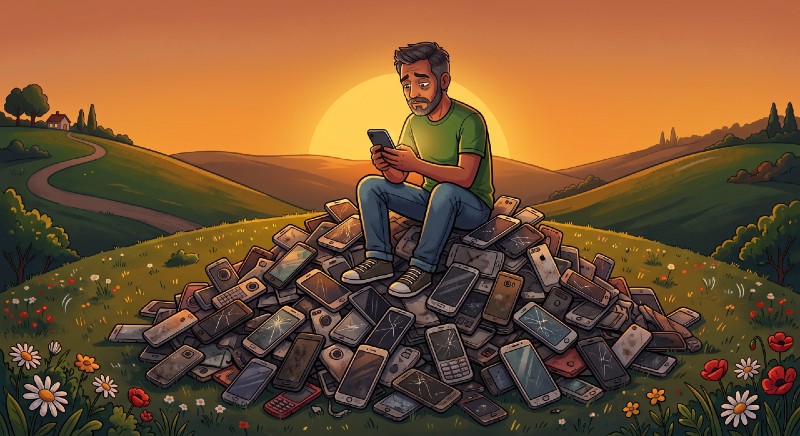
dismay_800.jpgTechnology marches on with benefits, and drawbacks too. [Graphic via Gemini]

Despite my sometimes bot-like behaviors, I am human, and this onslaught of AI tools can be daunting, even for a self-proclaimed early adopter. What value is being able to write well if everyone can? What value is knowing history if everyone can look it up? What value is being able to code if the AI can code faster and better? It can be humbling and scary. When faced with this challenge as AI tools increasingly marched from recommended to required, my initial reaction was just no... no, I don't want to do that. I'm perfectly comfortable doing things the way I always have, with the tools I know well. But I also know my 2026 workflow is vastly different than it was in 2016, and even more so than it was in 2006. New entrants to the workforce will have grown up with these tools, be comfortable with them, and could run circles around me. So I've adapted, and found new ways to automate, reduce friction, and just do more.

To remain relevant, we have to evolve and we have to rethink our role. Engineers and product managers can now use AI tools to build creative presentations and handouts in moments. Marketers can now build complete working demos and products from scratch instead of just describe them. Colleagues who once studied hard to be awarded readability in various computer languages now tell me they don't write code, but instead load up prompts in their IDE and instruct the AI to build what they used to do by hand. I can now spin up working arcade games in the web browser in minutes that used to require entire teams. It's wild. But it's also exciting -- in a good way.

Vast adoption of the Internet hasn't yet led to the downfall of civilization. It has led to challenges with communications in some ways, helped spread misinformation, broken down people's attention spans, and enabled isolation for some, but it's also enabled a steady evolution of how we live. Our constant attachment to smartphones has changed the way we engage with one another and are entertained, and yes, it too comes with downsides. AI will no doubt do the same. It will find its lanes where its use makes the most sense, and also try and show up in places where it's not welcome. We will know the difference. Our responsibility is to reaffirm what makes us human, taking the best of technology and using it where beneficial, and celebrating our individuality in all other places. It's going to be bumpy.

Disclosures per always: I work at Google and use our Gemini and Antigravity tools a lot. I wrote this post by hand.

November 17, 2018

November 17, 2018 · 4 MIN READ · BY LOUIS GRAY

Technology Designed to Help You Breathe More Easily

Technology Designed to Help You Breathe More Easily


Silicon Valley has been the leader in many things for decades, but rarely has the region's first place position been for something as undesirable as air quality. Following the record-setting disaster that has wiped out my one-time hometown of Paradise, Bay Area residents are choking on the resulting downwind smoke, seeking answers as to how unsafe it is, and how they can gain relief. And while I know that a week-plus of uncomfortable air is hardly the worst outcome of these climate change fueled infernos, it's something that needs to be addressed.
After last year's record-breaking California fire season that saw unthinkable damage burn through Napa county, I expected we would have bad air days this summer. Planning ahead, I bought two sleeves of N95 air filter masks from Amazon and stowed them in my garage for a not so rainy day. After a summer that saw fires rack up acreage, but air quality stay within range, I wondered if it was another foolish purchase just taking up space. But in the blink of an eye, with the Camp Fire in Butte County, the masks seemed inspired.


With the sun's eerie glow as a backdrop and smoke where fog or blue sky should be, I found myself at the Google campus, expecting to be the only one looking like I intended to rob a bank. But, while I was in the minority, contracted employees including security vendors and valets, who spend much of their day outside, wore them as part of uniform, and many of my colleagues showed up with them as well. By this week, it was rare to see a group of people walk by mask free, as estimates said sucking down Bay Area air was the equivalent of a dozen cigarettes a day.

As for those who took their masks off to smoke? Well. I admire your dedication.

Traffic to EPA sites on Friday, November 16. (via @googleanalytics)

As we all saw our skylines and views mucked by gray and brown bits of my past, area residents everywhere flocked online to sites like AirNow.gov and PurpleAir.com, marveling at how our Air Quality Index (AQI) levels were deep into the unhealthy range. So many people flooded the government's AirNow site that they had to reverse a heavy website revamp, and individual city pages were among the most trafficked government sites all week.

On Thursday, after a week of fashionable awkwardness with my mask, I made some quick buys from the Google bus, aimed to help our air quality at home and contribute our AQI to the crowdsourced data. My first purchase was a pair of Molekule air purifiers that promised to cleanse our dirty and polluted air at home. The second was for a PurpleAir sensor, so I'd know just when we should leave the house with masks, or if we should hole up indoors.

Luckily, b8ta had Molekule devices locally, and the company's general manager made a home delivery to my front step by Thursday evening. They'd promised free overnight shipping to California, but same day was beyond expectations. I set up one device downstairs and the second upstairs, and they've been plugging away at removing toxins from the air so my family can breathe easily. Unsurprisingly, it even comes with a spartan app, so I can move the filters from silent mode to most aggressive, remotely.

This morning, my PurpleAir sensor came.

Like Rachio's smart sprinkler system or the Nest outdoor cameras, these new Internet of Things devices come with the smallest set of instructions. Power them up, connect to Wifi and you're essentially on your way. It even came with a Nest branded power supply, which surprised me, but made immediate sense. With the minimal amount of effort, I registered my PurpleAir device and am now broadcasting the AQI from our house to the shared map.

There's no PurpleAir app (at least that I could find) which would make tracking AQI and our personal data easier, but the website works, and mobile site works well enough on my phone. Still seems like a minor oversight for 2018.

Clearly, the avalanche of attention toward hourly AQI levels and scramble for air filters is going to spike and fall with the latest wildfire or other pollution disaster. I may feel in the future that telling the world my air is just fine isn't world changing. But I've always been delighted in being able to see the data and make decisions. That's why Fitbit works. That's why Nest makes sense. That's why I went solar with Sunrun.

The tragedies that have hit California, and are nowhere near done, are going to have impact on families and our entire region for years to come. We should adapt to a world that acts on data and protects those things we can control.

November 15, 2018

November 15, 2018 · 6 MIN READ · BY LOUIS GRAY

When the Hometown You Always Knew Could Burn Gets Erased from the Map -- Paradise is Lost to the #CampFire

When the Hometown You Always Knew Could Burn Gets Erased from the Map -- Paradise is Lost to the #CampFire

Let's talk about the Camp Fire for a second. My family moved to Paradise in 1991, as I was starting 8th grade. I lived there through high school, until heading to college. The family stayed until all kids had graduated high school - the last in 2004.

(This story is adapted from a thread I initially posted on Twitter)


This was us at home in '91.

While news has referred to Paradise as isolated, we actually were moving from an even smaller town. I'd spent elementary school in Brownsville in Yuba County. When my dad got a new medical practice in Paradise, we were blown away by the McDonald's and "all those power lines".

The route from my elementary school home to Paradise.

I only spent one year in the Paradise school district, before my mom got a job teaching at Chico Jr. High. Through high school, I spent every early morning at church in seminary, and then driving down the Skyway to Pleasant Valley High School.


(Here's us in front of our house)

Paradise was always a retirement community. My dad's work was primarily elder care - geriatrics. Sometimes they died. More than once, I accompanied my dad to the coroner's office while on rounds. As he said, either their heart stopped, or they stopped breathing. Circle of life.

But that didn't mean death by other means was impossible. Fire was by far the top concern for the community. Paradise is located on a ridge in the foothills, placed squarely between two canyons. When fire would light, it would often head for the city.

In 1992, my sophomore year of high school, we evacuated twice. See the @ChicoER's coverage of those fires. Notice one of those started -- you guessed it -- at the Skyway. The problem with this, of course, is that was the main road out of town.

Fires have always been common in Paradise. We evacuated in 1992.

In 1992, even as we had yet to unpack from evacuating the first time, ash started to fall on our driveway and house. Thick, black smoke loomed above us, and the fire was closer than ever. Some firebug, in copycat mode, had lit a blaze near city limits. We left again.

Luckily, as with every other time, the fire crews did an amazing job stopping the flames from getting deep into town. We marveled at the burn scars that approached neighbors' property, but didn't take any homes or casualties. Some have argued Paradise is a woodsy town that had no business building where it did. But it's not all the thick forest you may have in your mind.


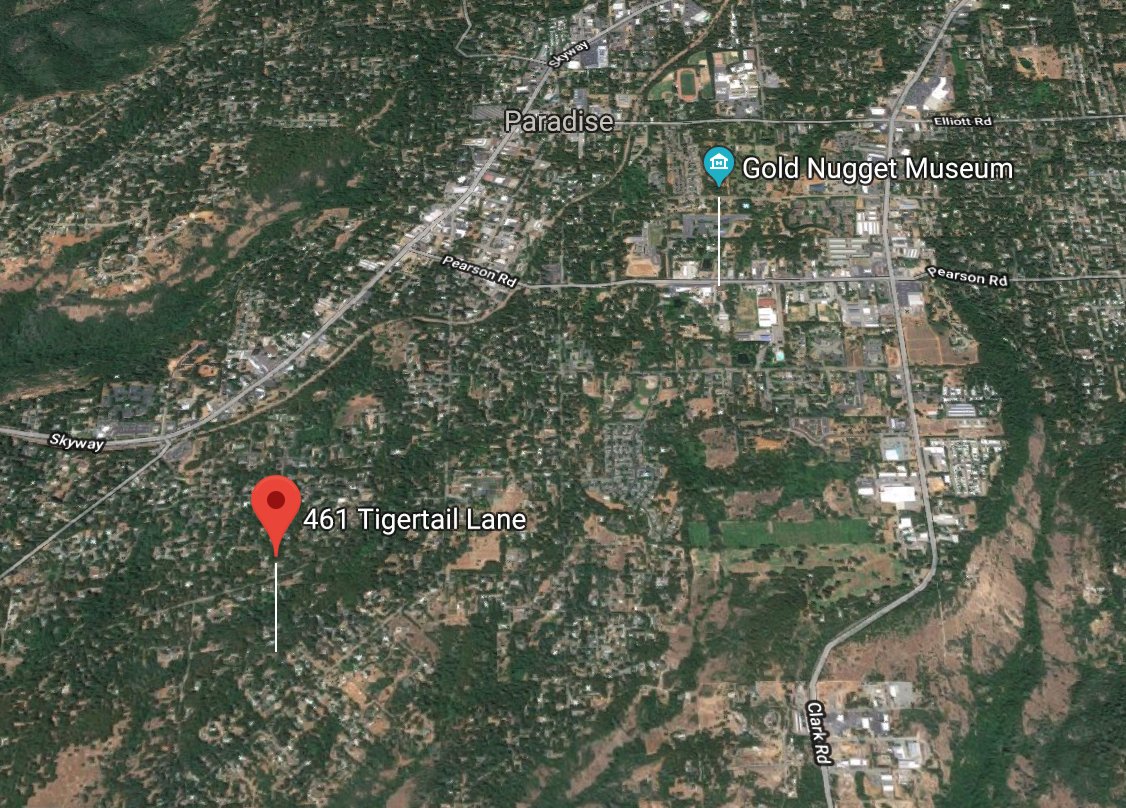
This is the entrance to Tiger Tail Lane from Foster Road (via Google Street View).

Long after I left to college and embedded in Silicon Valley, there have been other fires. As with those in the early 1990s, most were stopped. And as @Weather_West and others have reported, there were many plans in place to protect residents if worst-case happened.

Our home's position in a terrain map, clearly in the fire zone.

So what made the Camp Fire different? How did the above map turn into this scar on the North state? In addition to the exceptionally low humidity and the high winds (which can't be discounted), I'd say the origin of the fire played a huge part.

The fire's position (and all the closed roads), as of this week.

Previous fires, which started by Skyway or the canyons, and slowly meandered their way to the city, gave residents and firefighters warning. People had time to pack and leave, and routes were not frantic. The Camp Fire was a sneak attack with brutal force.

The Camp Fire didn't start on the lower Paradise side. It started in Pulga, an even tinier community. It started in the more woodsy side, where topology made it nearly impossible to stop, in starved fuel-laden forests, powered by ferocious winds and drought.

Instead of starting at the bottom of the above photo, it started at the top and right.

The winds pushed the fire into the main part of town, to all the people and all the businesses, and it hasn't stopped. Adventist Health Hospital, where my dad worked, was among the first to go.

When @Weather_West shared a tweet from @Gloria2marie, showing fire South and West of Paradise, I immediately realized the town was gone. In a Slack message to a friend, I wrote:

"This means, if true, it's going to F--- up the whole town. Bye."

Classy, I know. But not wrong.

The casualty totals, surpassing all records in California, have not been a surprise. Knowing the aging, slow, immobile population, many who don't drive, and the speed of this fire, we're lucky thousands did not perish. But the loss is still stunning.

That an entire town can be zapped off a map is practically unprecedented. And for those who want to go back... to what exactly? No infrastructure. No power. No water. No cell service. And possibly human remains waiting for you.

Chico, where I went to high school, has for the most part escaped the direct flames. But now the refugees from Paradise are encamped at the town Walmart, a drier, more outdoor version of the Lousiana Superdome during Katrina. Thousands have nowhere to go.

More than 52,000 people have been evacuated since the Camp Fire erupted in Paradise on Thursday, packing parking lots, shelters and hotels across Northern California, and straining the housing stock.

There are still hundreds missing. So many are unaccounted for that law enforcement is releasing names in batches to avoid overload. Imagine that. The fire was so intense, many people may never be found -- incinerated and returned to the dust.

The Camp Fire is not just another news story or a set of headlines, or an unfortunate reason the Bay Area is smoky. It's a remarkable human and modern disaster.


This was our Christmas photo our first December in our Paradise home.
It's almost certainly gone now, but we're alive.

I've read some ridiculous tin foil hat conspiracies on Twitter that you wouldn't believe about how the Camp Fire started. You could say this type of fire was inevitable, but also preventable. Of course climate change played a role. Of course the town makeup played a role.

Either way, this is a conversation we are going to keep having in California, and throughout the Western US and beyond. Is Lake Tahoe safe? Is Sunnyvale? Last year Napa found out the hard way. My grandparents' home in Redding was threatened in the Carr Fire.

It's reality.

This isn't a "feel sorry for us" thread. It's been a while, and my whole family is safe. But they are active in connecting with those who stayed. The woman who prayed her way to safety in a firey ride you may have seen on @Gizmodo was a high school friend I've heard pray before.


This was the last photo I took in Paradise, in May 2015, when I took my boys to a party for my brother's child - their cousin. The home that looks like it was under construction a few short years ago... it's gone now, to dust and ash.

As you lament the bad air and see the numbers rise ever upward, I hope this helps remove the abstract from what seems like a tiny town far away. Like the Woolsey Fire and the Carr Fire and all the others, your home could be the next hashtag. Have a plan.

October 20, 2018

October 20, 2018 · 3 MIN READ · BY LOUIS GRAY

Comments as a Platform, Or Silencing the Trolls

Comments as a Platform, Or Silencing the Trolls


Web content has typically divided into three camps - those who create, those who react, and those who just watch. The lurkers, if you will. From the very earliest days of blogging, those first posts awaited the inevitable comments, and, given a clear revenue stream, you would see early participants like Fred Wilson say that "comments are how bloggers get paid."

[Source: https://vanelsas.wordpress.com/2008/06/02/the-real-value-of-social-media-interaction/#comment-2531]

The earliest engagements we had with people who read our site gave us incredible discussions, and spawned more posts and even, in rare cases, changed minds. Sites like Digg, Reddit, Slashdot and others became known for their diverse threads, and those in the comments are why you showed up.

But we've also seen the pendulum swing the other way. Everybody knows to "never read the comments" on popular news sites, as the most aggressive vitriol and ignorance floats to the top. YouTube comments have long been notorious for their lack of quality (though I feel this has improved of late). And Twitter, for many who should be able to use the platform, their every move can attract trolls who have a vendetta to take them down - but somehow don't get banned.

As social media sites eclipsed the momentum of blogs, conversations moved. We adapted by integrating social discussions from FriendFeed, Facebook and Twitter and appended them to our blogs. We would all share our posts on social, and then engage where the content landed. The best bloggers would find their readers wherever they were. But others simply turned comments off. Maybe it is because they were full of spam (they were) or the quality wasn't there (often true), but also, because the total quantity declined.

Let's go back to talking about Twitter. Twitter drives me nuts because it's fantastic and so poor at so many things. They seriously have real-time on lockdown. There is no better place to see what is happening right now. If there's a calamity, search Twitter. A breaking news event? Search Twitter. A sporting event? Twitter.

But Twitter has this awful habit of giving all users an equal voice. Now hear me out what I mean.

If you tweet publicly, anybody who you haven't blocked can reply, and their content is appended to your tweet. It follows you around. If a Republican politician posts, left-leaning posters race to take down their message, while the MAGA crowds prop it up and try to gain eyeballs. If the Kardashians say something, the crowds pounce on the valuable real estate quickly to show their adoration or pimp whatever link they've got going.

And down the publicity food chain, if you're a woman, especially a visible one, you get awful men saying foolish things. I guarantee it. They may call you names or question your ability. You block one and ten more pop up. If you're black, or Jewish, the racists will find you. They all know how to tweet.

So what I recommend above all other Twitter changes is the ability for people to reclaim their space. Hillary and Trump should both be able to post information without the crowd's replies being appended. Just like blogs and YouTube stars can turn comments off, Twitter users should be able to as well. The thing about social networks (and most products, to be honest) is that you should give the users control. But they haven't done it, and I think it delivers a great disservice to the platform, which has become a hotbed of harassment and hate - as Reddit and others have too.

If you can trust your commenters enough to give them a voice, by all means, amplify their voices. But when they have shown you time and again that they cannot be trusted, turn it off.

October 17, 2018

October 17, 2018 · 5 MIN READ · BY LOUIS GRAY

How 23 Year Old Me Got a Job at a Stealth Company With a Fake Website

How 23 Year Old Me Got a Job at a Stealth Company With a Fake Website

My first two years in Silicon Valley were spent in Burlingame at a dotcom that hoped to revolutionize telecommunicatons online - with Web meetings, conference calls and even faxing from the Web. They had great services, but not enough customers, and eventually ran out of funding in early 2001, jettisoning marketing, sales and business development folks, before selling for scraps to Oracle.

Being in Marketing myself, this meant it was my first trial to try and find a full-time job, in a world where online job databases were taking over. I'd polished the resume and started applying at anything that sounded close to what I thought I did...

Web Marketing Manager... E-Marketing Manager... Marketing Manager... Internet Marketing Manager...

Keep in mind this was a time when companies knew the Internet was a humongous deal, but were still trying to figure out where the money was coming from. The dotcom stocks had gone to the moon and crashed down. E-Business firms were raising tens of millions to figure out how put supply chains on the Web, and it could be hard to separate the real from the fake.

Meanwhile, with the crush of aspiring gold-seekers flooding to the Valley, hoping to win the stock option lottery, traffic was a mess. I used to compare driving 101 South to parallel parking at 70 miles an hour -- just a zoo. So very quickly, the location of where I could start was just about as important as the starting salary. Belmont was better than Palo Alto. Mountain View better than San Jose. Maybe I could even walk.

I tweaked my CV as best I could and threw it on Monster and Dice.com and all their clones, hoping to break through the noise. Here's what Dice.com looked like back then.


One of my job hunting volleys reached a company who so obviously needed my help. Their website was this hideous reddish purple and their icon looked like a squished crow. But they promised big things with revolutionary shock waves. I applied for the role of eMarketing Manager, to aid with promotion and copy, and redo their Website.

They asked me to come in for an interview and I pored over their site, ready to talk about how they needed to tailor their content for who their visitors would be -- investors, partners, analysts, and yes, customers. I studied the site in and out and felt prepared.


That Monday, sure their headquarters was in some garage somewhere, with like maybe 5-8 guys who couldn't write, I rolled in ready to tell them the ins and outs of marketing and publishing on the web. I pulled into the parking lot on Bernardo in Mountain View. Across their lot was Placeware, the Web meeting company eventually purchased by Microsoft. And one building down -- Handspring, the exciting handheld company run by Jeff Hawkins and Donna Dubinsky in their follow-on from Palm.

Instead of less than a dozen people, Synaxia had a quiet swarm of folks. About 50 were in Mountain View, and they'd raised two rounds of funding, for about $35 million. I still didn't really know what they did.

The first interviewer, a director of product marketing, and I went back and forth as I kept sounding confused as to their promise. He said they made the Web faster with specialized network servers. I thought they competed with Akamai. He said no. Maybe Akamai would be a customer? No. I felt a little stuck, as he talked about host bus adapters, raid arrays, and fibre channel.

So I went to what I knew - Web sites. As I began my spiel, he shook his head and stopped me.

"Louis, the Web site is a fake. The company name is a fake. In two months, we're going to rebrand and launch our product, so none of this matters."


I felt like my legs had been pulled out from under me, that I may as well just leave, but I was young enough (and likely cheap enough) that they didn't give up on me, even as I got through two more people.

My final interview was a friendly, older, and heavier guy, with short cropped white hair, folded arms resting on his belly, and an ability to talk your ear off. He was the vice president of marketing. I had 30 minutes with him, and for 20 minutes or so, he yammered on about the state of Catholic high school athletics, and told me about his kids, or told me stories about his career. He seemed very nice, but I was scared he wouldn't get a chance to learn about me at all - let alone figure if I was worth hiring.

Before I had felt like I even had a chance to get a word in edgewise, he interrupted, and said, "Look, if you got to me, you'll be fine," and just as quickly, he was gone -- off to the next meeting.


Years later, he would constantly tell me how he had been the reason I was hired, that I had been his discovery, and he took all the credit for my accomplishments. A fantastic boss, but an even better story teller.

A few days later, I got a call that offered me the job. I had no idea, really, what kind of salary to ask for, but, having just finished my double major from Berkeley, and getting two years under my belt, I was looking at a 50% raise over my last job. It seemed like so much money -- commensurate with being able to deliver a brand new website in about 30 days (which my designer and I managed).

I agreed to the job, and the pay bump, and my excitement lasted almost a full workday.

On the first day, HR asked me to sign papers to complete my employment, and I added my signature with enthusiasm. I walked back to the HR manager's desk, and she opened a folder titled "E-marketing manager". The first page in the folder was a job description (mine) with a salary range.

The bottom of that salary range was above where I had signed, and the top of that range went a full $30,000 higher. I immediately felt like I was underpaid, and I'd have to work a decade before I felt like I'd caught up. But I managed to get the job at the stealth company, and their fake website -- lasting 8 1/2 years, until I left in 2009.


Above is one of the last real ones I published, after multiple generations of product and many hundreds of customers. (And eight bosses. I outlasted everyone I interviewed with)

January 30, 2018

January 30, 2018 · 5 MIN READ · BY LOUIS GRAY

Real Valley Stories: Search Marketing With the Open Directory Project

Real Valley Stories: Search Marketing With the Open Directory Project

Editor’s Note: Part 12 in an irregular series of stories from my many years in Silicon Valley. Part 11 talked about the time I got called into HR's office to meet with lawyers over industrial espionage. This time, a story involving gray hat search engine marketing in the early days of the Web.

DMOZ is now closed. 

Believe it or not, before the world of automated spiders that crawled the entire Web and ranked the results for your searches, much of the way we found content on the Internet was thanks to manual updates from an invisible army of directory editors. Yahoo! defined the initial dot-com era, with its hierarchical oracle making or breaking traffic downstream, as sites were organized and shuffled into categories by unseen text tweakers, much like the editors of Wikipedia try and keep its tens of millions of article pages up to date, with a seemingly fluid mass of edits to keep the live encyclopedia current.

But Yahoo! wasn't the only Web directory. Rich Skrenta and others, also behind Web 2.0 efforts Topix and Blekko, introduced the Open Directory Project, referred to as DMOZ, for it was hosted on the directory subdomain of the Mozilla.org site, with an objective of harnessing contributions from around the world (like Wikipedia), to build a directory, similar to Yahoo!, that could plug into any site that wanted to host one. In a time when many sites were seeking Internet traffic and riches by acting as the front page for the Web, attaching the open directory project to your portal could give you an edge and not require you to bring on a ton of staff.

As with Yahoo!'s directory, a company's inclusion in the DMOZ directory could act as a binary gate as to whether or not potential users would find you. In 1999, working as a Web marketing manager for a Web startup that offered internet faxing and conference calls, I found myself irked to see that our services were not included in DMOZ. Making things worse, the categories I would expect to see us listed in seemed slapped together and without an official owner. Given my understanding of the space and knowing our many competitors, I registered an account and requested to moderate the relevant category.

The DMOZ Internet Fax Listings from 1999 (via Archive.org)

Not too long afterward, I was given the option to update the category, including those of our competitors. As it was nearly two decades ago, I honestly don't remember if I used my company email or a Yahoo! email or equivalent, but I didn't try and disguise where I worked. My application had gotten through.

FaxCube from the year 2000.
When I did log in, I found the content in a state of abandonment. There wasn't much you could do with a site's listing. Give it a title, a link, and a short description, literally about a dozen words. It was fairly impossible to differentiate services from one another, especially in a commoditized space where the core function was pretty straight forward. But I cleaned up the descriptions for all the entries, including our competitors, to accurately display their offerings. Some offered email to fax services, while others offered the reverse. Some offered broadcast faxing. Some required a proprietary fax viewer, and others were completely Web based. That kind of thing.

When content was edited in DMOZ, edits would later propagate downstream. Sure enough, my colleagues noticed a spike in Web traffic to our main sites, with referrers coming from all the places DMOZ was set up. For no cost, I had a clear impact in our customer acquisition funnel, and maintaining the DMOZ became part of my ongoing work.

Later, DMOZ added the option to highlight two entries in the group, which were solely up to the moderator. This, of course, gave me the option to expand from a gray area, to clearly going over the line into promotion. It went without saying I thought our service was the best, and highlighted it at the top. I also chose to highlight a partner site (the Netscape Fax Center) that was white labeling our service, essentially the 1 and 1A positions.

This got even better when we soon realized DMOZ was fueling search results for AOL. The more people who searched for Internet Faxing on AOL, the better we were to see results.

DMOZ listings for Internet Telephony in early 2000. (Via Archive.org)
In early 2000, we introduced a new Web based conference call and meeting product. Addicted to the free traffic from DMOZ, my team asked me to see if I could get our content similarly included on whatever the equivalent was for Internet conferencing. I poked around, and, again, applied to be an editor for the Internet Telephony page. It wasn't a perfect fit, but it was pretty good.

Again, I got approved, and again, I added our sites, and again, I promoted our main site and a partner site to be included as the pair at the top of results. Again, we started to get plenty of Web traffic from DMOZ and its downstream partners, accounting for more than double digit percentage of our traffic to both properties. But this time, it wouldn't last long. Maybe it was the clear marketing copy promoting both services, but one day, I logged in and saw our service demoted to the standard results, with another in its place. I reversed the change, and it wasn't too long until there was a debate upstream as to whether these listings were in good faith.

PhoneCube, in all its glory, from 2000.
Not too long afterward, my moderation rights had been removed from both sections. I'd essentially been fired from my side job of gray hat SEO, long before most of us knew what that meant. And yes, my engineering peers lamented the loss of traffic, as our more organic listings, on AOL search and elsewhere, didn't carry as much weight, once we became one of the fold.

Had I just stayed content to include our services in the listings, or even just to stay a moderator of the less exciting Internet faxing space, it's possible I could have been editing text descriptions for our sites and our competitors indefinitely. But pushing our own products and our partner sites turned out too good to be true. The "Wild West" Internet traffic rush didn't last forever, and, as it turns out, neither did our products. I was laid off after we couldn't get a funding round closed at the beginning of 2001, and a few months later, the company was parceled off to become part of Oracle (see 2006 post). Some of my colleagues still work there nearly two decades later. As for DMOZ, it too shut down a few years ago, a relic in the world of Google and Facebook.

Disclosures: This whole post is a disclosure! I worked at 3Cube during this time. I work at Google now, a perceived competitor to whatever Yahoo! and AOL call themselves now. And as I work on Google Analytics, this is not a post about SEO to all you SEO/SEM folks.

January 18, 2018

January 18, 2018 · 4 MIN READ · BY LOUIS GRAY

With Web at the Core, Chromebook Options are Strong, Plentiful

With Web at the Core, Chromebook Options are Strong, Plentiful

This looks like an ad. But it's just a few recent Chromebooks.

In 2011, on my first day at Google, I was asked to pick out a laptop. The choices were slim - a thin Apple MacBook Air or the larger MacBook Pro, a forgettable Windows equivalent, or a Linux device more suitable for engineers. While I had the company's first foray into Chromebooks, the CR-48, at home, in addition to my own personal Mac, picking a Chromebook wasn't even an option. The Web-centric OS, which focused on keeping all data in the cloud, and leveraging Web apps, wasn't ready for my every day use.

A few months later, I ran into then SVP of Chrome Sundar Pichai, in the office stairwell as we were on to our respective meetings. Pointing to my MacBook Air, I told him I couldn't wait to turn it in and go completely ChromeOS at home and at the office. In his usual humble and understated way, he said the team was working on it, and to stay tuned. Not too long afterward, in another unplanned hallway conversation, he introduced me to a VP on his team developing hardware, and offered me up as a willing beta candidate.

The 2013 Chromebook Pixel (version 1)
I didn't think much of the choice encounter until early 2013, when I saw Sundar take the stage and unveil the Chromebook Pixel, a high-end Chromebook with a touchscreen, and promised faster speeds and memory.

As I recounted a few years ago on Google+, I saw Sundar as available on IM shortly after the event and congratulated him on the exciting launch. His IM came moments later... "Do you have one yet?" Surprised, I said I didn't, and it was no big deal. I had no such illusions of self-importance. But he answered directly, "I'm so sorry. You were supposed to be on the list." Fast forward, less than an hour later, I had a brand-new Pixel - and I haven't seen a need to use a Mac since.

That a Googler is using a Chromebook isn't newsworthy, obviously. Water is wet. But I remember a time when betting on a Web-centric device like a Chromebook was a real leap of faith. There were always excuses not to make the switch, be it a specific piece of software, some concern about printing, or general distrust of the unknown. Maybe we were worried about moving local storage to the cloud, or editing photos, or losing access to some premium software on Mac or Windows we'd already paid for - often at a cost even higher than a new machine.

Chromebooks have proven exceptionally popular in schools, thanks to their versatility and low cost. And as people become more mobile-centric, their data also becomes more portable and Web centric. Just as you expect to have your data follow you from phone to phone, moving from device to device should be seamless. Like I'd said in 2012, the future of local storage is practically none at all.

This summer, I got my wife a touchscreen convertible Chromebook for less than $100.

Watching the many different options for Chromebook hit the markets feels a lot like the same momentum we saw when Android's many partners took imaginative approaches to new handsets. While we essentially knew the rigid details coming from Cupertino for both computers and phones, Google partners built big and small and with any number of differences to set each apart, from brands as diverse as Acer, Asus, Dell, HP, Lenovo, Samsung and Toshiba.

Now the decision process is one of plenty, not scarcity. So many options, pretty much all of them good. You can get small screens or big screens. You can get touchscreens and convertibles that act like a tablet. You can run Android apps, or even mark up the screen with a digital pen. All very cool.

This summer, while on a family vacation in Chicago, after seeing so many positive reviews for Samsung's Chromebook Pro, I figured it was time for an upgrade from my two year old Acer 710. I quickly bought one on Amazon, had it delivered to an Amazon Locker down the street the next day, and after entering my Google credentials, I had made an incredible upgrade, with no data migration needed. It was almost too easy. (And yes, that's the laptop I'm on now)

Having seen the Pixelbook, the successor to that 2013 Pixel and its 2015 follow-on, and even more good reviews, I'm already getting that itchy feeling and have added the newest device to my shopping cart more than half a dozen times, desperately wanting it, but knowing the Chromebook Pro has a long life left.

Meanwhile, my wife's slim Asus Chromebook I picked up this July gets constant use, and my 9 year old twins bang away on inexpensive Acers to do work in Google Docs. They do the work of machines that cost 10 times as much, without coming bundled with the worry that you lose your data in the event of a disk failure. And the gaps that may once have been there in 2010, 2011 or 2012... they're gone.

If you're an elite creative software wizard who has a custom setup, then keep it up, but for the rest of us who use our devices to create, engage, consume and share, the Web is the most powerful device there is, and Chromebooks were designed for it. They've come a long way.

Disclosures: I work at Google. You knew that. But I still pay for my Chromebooks, except for those provided for me to use at work, obviously.

January 17, 2018

January 17, 2018 · 3 MIN READ · BY LOUIS GRAY

Smartphones Have Virtually Eliminated Boredom from the Modern Life

Smartphones Have Virtually Eliminated Boredom from the Modern Life

People are constantly on their phones. All day.
There's a flurry of debate over whether smartphones and their apps have become too addicting. While there is no complete agreement over how often smartphone users access their phones each day, estimates put the number at anywhere from 80 to 150 times. If you're a typical human who is awake about 16 hours a day, that's five to ten accesses per hour. Every hour. You might even put your own estimate much higher, or, instead, see it as one long continuous touch that consumes the entire day.

Independent of the discussion of whether this is a "good thing" or not, the ability to constantly engage with one's phone, checking messages from different apps, getting the latest news instantly, window shopping or achieving a new high score, the device has virtually eliminated the opportunity to be bored - acting as the glue that connects times when you're otherwise active. The smartphone acts as a space filler and a constant alternative for whatever else you might be doing.

Not too long ago, there was something we recognized as a quiet space between activities. Mental breaks. Whether that was standing at a corner for the light at the intersection to go green and allow us to cross the street, or taking an escalator at the mall, or waiting for the bus, we recognized those gaps as something like boredom. Was there nothing on TV? Bored. Forced to wait in line at the supermarket? Bored. Finished your book? Bored. Is the baseball season over? Bored for four months.

Think people aren't constantly on their phones while driving? Think again.
But this isn't the case now. If you look around at people, everyone is seemingly in a state of constant engagement with their phones. Drivers at intersections waiting for red lights to turn are waiting for cues from the cars next to them to indicate the signal has changed. Pedestrians are walking with their feet slightly askew to avoid unseen stumbles, and draft behind the people ahead of them, one hand holding the phone at an angle, looking up every few steps for potential surprise. Those waiting for the bus only interrupt their phone use to glance up and see if their ride is on its way.

Many a word has been spilled about how smartphones have invaded daily lives. Couples go to restaurants and read their phones instead of talking to one another. Colleagues may glance at their phones and tweet while you're talking to them, looking up on occasion to see if whatever you're saying is more interesting than whatever popped up on their screen. It's no longer a challenge to find something to do. Instead, it's a battle to see who can be the most sensational or carry enough weight to trump the alternative that is constantly available on a 4 or 5 inch screen.

Often, when presenting to rooms full of people at events, I see attendees on their phones. It's been years since you could authoritatively demand a 'laptops down' meeting and expect to get everyone's full attention. That people are going to try and deliver continuous parallel attention is a reality, and you are in a constant battle to earn their mind share, in a hope that your engagement will be more lasting and more significant than what their phone has selected to bring to the fore.

In the last decade plus, more of what we used to depend on full sized computers, cameras, televisions, maps and more has been miniaturized and made portable in our pocket. This has allowed our entertainment, learning and communications machines, our commerce engines... to be constantly with us. People meet their soulmates on their phone. They get paid on the phone. They can order food and have it delivered, all from their phone. If life's every important value, to consume, to share and to survive, can be designed and managed from your phone, it really begs the question of whether the world within the screen is less valuable than the one on the outside of it.

My own kids, still under 10, don't yet have phones. It's already challenging as a parent to provide them the structure they need to learn independently and prioritize work over entertainment, without giving them a magic device that does it all in their pocket constantly. But they do know they live in a world where boredom is a practical impossibility, and where everything is practically a request away.

Life moves faster now, and it isn't boring. That's no longer an option.