Silicon Valley Technology Commentary & Archives · Est. 2006 3,045 Posts · 2006–2026
Showing posts with label 3Cube (6 posts). Show all posts

October 17, 2018

October 17, 2018 · 5 MIN READ · BY LOUIS GRAY

How 23 Year Old Me Got a Job at a Stealth Company With a Fake Website

How 23 Year Old Me Got a Job at a Stealth Company With a Fake Website

My first two years in Silicon Valley were spent in Burlingame at a dotcom that hoped to revolutionize telecommunicatons online - with Web meetings, conference calls and even faxing from the Web. They had great services, but not enough customers, and eventually ran out of funding in early 2001, jettisoning marketing, sales and business development folks, before selling for scraps to Oracle.

Being in Marketing myself, this meant it was my first trial to try and find a full-time job, in a world where online job databases were taking over. I'd polished the resume and started applying at anything that sounded close to what I thought I did...

Web Marketing Manager... E-Marketing Manager... Marketing Manager... Internet Marketing Manager...

Keep in mind this was a time when companies knew the Internet was a humongous deal, but were still trying to figure out where the money was coming from. The dotcom stocks had gone to the moon and crashed down. E-Business firms were raising tens of millions to figure out how put supply chains on the Web, and it could be hard to separate the real from the fake.

Meanwhile, with the crush of aspiring gold-seekers flooding to the Valley, hoping to win the stock option lottery, traffic was a mess. I used to compare driving 101 South to parallel parking at 70 miles an hour -- just a zoo. So very quickly, the location of where I could start was just about as important as the starting salary. Belmont was better than Palo Alto. Mountain View better than San Jose. Maybe I could even walk.

I tweaked my CV as best I could and threw it on Monster and Dice.com and all their clones, hoping to break through the noise. Here's what Dice.com looked like back then.


One of my job hunting volleys reached a company who so obviously needed my help. Their website was this hideous reddish purple and their icon looked like a squished crow. But they promised big things with revolutionary shock waves. I applied for the role of eMarketing Manager, to aid with promotion and copy, and redo their Website.

They asked me to come in for an interview and I pored over their site, ready to talk about how they needed to tailor their content for who their visitors would be -- investors, partners, analysts, and yes, customers. I studied the site in and out and felt prepared.


That Monday, sure their headquarters was in some garage somewhere, with like maybe 5-8 guys who couldn't write, I rolled in ready to tell them the ins and outs of marketing and publishing on the web. I pulled into the parking lot on Bernardo in Mountain View. Across their lot was Placeware, the Web meeting company eventually purchased by Microsoft. And one building down -- Handspring, the exciting handheld company run by Jeff Hawkins and Donna Dubinsky in their follow-on from Palm.

Instead of less than a dozen people, Synaxia had a quiet swarm of folks. About 50 were in Mountain View, and they'd raised two rounds of funding, for about $35 million. I still didn't really know what they did.

The first interviewer, a director of product marketing, and I went back and forth as I kept sounding confused as to their promise. He said they made the Web faster with specialized network servers. I thought they competed with Akamai. He said no. Maybe Akamai would be a customer? No. I felt a little stuck, as he talked about host bus adapters, raid arrays, and fibre channel.

So I went to what I knew - Web sites. As I began my spiel, he shook his head and stopped me.

"Louis, the Web site is a fake. The company name is a fake. In two months, we're going to rebrand and launch our product, so none of this matters."


I felt like my legs had been pulled out from under me, that I may as well just leave, but I was young enough (and likely cheap enough) that they didn't give up on me, even as I got through two more people.

My final interview was a friendly, older, and heavier guy, with short cropped white hair, folded arms resting on his belly, and an ability to talk your ear off. He was the vice president of marketing. I had 30 minutes with him, and for 20 minutes or so, he yammered on about the state of Catholic high school athletics, and told me about his kids, or told me stories about his career. He seemed very nice, but I was scared he wouldn't get a chance to learn about me at all - let alone figure if I was worth hiring.

Before I had felt like I even had a chance to get a word in edgewise, he interrupted, and said, "Look, if you got to me, you'll be fine," and just as quickly, he was gone -- off to the next meeting.


Years later, he would constantly tell me how he had been the reason I was hired, that I had been his discovery, and he took all the credit for my accomplishments. A fantastic boss, but an even better story teller.

A few days later, I got a call that offered me the job. I had no idea, really, what kind of salary to ask for, but, having just finished my double major from Berkeley, and getting two years under my belt, I was looking at a 50% raise over my last job. It seemed like so much money -- commensurate with being able to deliver a brand new website in about 30 days (which my designer and I managed).

I agreed to the job, and the pay bump, and my excitement lasted almost a full workday.

On the first day, HR asked me to sign papers to complete my employment, and I added my signature with enthusiasm. I walked back to the HR manager's desk, and she opened a folder titled "E-marketing manager". The first page in the folder was a job description (mine) with a salary range.

The bottom of that salary range was above where I had signed, and the top of that range went a full $30,000 higher. I immediately felt like I was underpaid, and I'd have to work a decade before I felt like I'd caught up. But I managed to get the job at the stealth company, and their fake website -- lasting 8 1/2 years, until I left in 2009.


Above is one of the last real ones I published, after multiple generations of product and many hundreds of customers. (And eight bosses. I outlasted everyone I interviewed with)

January 30, 2018

January 30, 2018 · 5 MIN READ · BY LOUIS GRAY

Real Valley Stories: Search Marketing With the Open Directory Project

Real Valley Stories: Search Marketing With the Open Directory Project

Editor’s Note: Part 12 in an irregular series of stories from my many years in Silicon Valley. Part 11 talked about the time I got called into HR's office to meet with lawyers over industrial espionage. This time, a story involving gray hat search engine marketing in the early days of the Web.

DMOZ is now closed. 

Believe it or not, before the world of automated spiders that crawled the entire Web and ranked the results for your searches, much of the way we found content on the Internet was thanks to manual updates from an invisible army of directory editors. Yahoo! defined the initial dot-com era, with its hierarchical oracle making or breaking traffic downstream, as sites were organized and shuffled into categories by unseen text tweakers, much like the editors of Wikipedia try and keep its tens of millions of article pages up to date, with a seemingly fluid mass of edits to keep the live encyclopedia current.

But Yahoo! wasn't the only Web directory. Rich Skrenta and others, also behind Web 2.0 efforts Topix and Blekko, introduced the Open Directory Project, referred to as DMOZ, for it was hosted on the directory subdomain of the Mozilla.org site, with an objective of harnessing contributions from around the world (like Wikipedia), to build a directory, similar to Yahoo!, that could plug into any site that wanted to host one. In a time when many sites were seeking Internet traffic and riches by acting as the front page for the Web, attaching the open directory project to your portal could give you an edge and not require you to bring on a ton of staff.

As with Yahoo!'s directory, a company's inclusion in the DMOZ directory could act as a binary gate as to whether or not potential users would find you. In 1999, working as a Web marketing manager for a Web startup that offered internet faxing and conference calls, I found myself irked to see that our services were not included in DMOZ. Making things worse, the categories I would expect to see us listed in seemed slapped together and without an official owner. Given my understanding of the space and knowing our many competitors, I registered an account and requested to moderate the relevant category.

The DMOZ Internet Fax Listings from 1999 (via Archive.org)

Not too long afterward, I was given the option to update the category, including those of our competitors. As it was nearly two decades ago, I honestly don't remember if I used my company email or a Yahoo! email or equivalent, but I didn't try and disguise where I worked. My application had gotten through.

FaxCube from the year 2000.
When I did log in, I found the content in a state of abandonment. There wasn't much you could do with a site's listing. Give it a title, a link, and a short description, literally about a dozen words. It was fairly impossible to differentiate services from one another, especially in a commoditized space where the core function was pretty straight forward. But I cleaned up the descriptions for all the entries, including our competitors, to accurately display their offerings. Some offered email to fax services, while others offered the reverse. Some offered broadcast faxing. Some required a proprietary fax viewer, and others were completely Web based. That kind of thing.

When content was edited in DMOZ, edits would later propagate downstream. Sure enough, my colleagues noticed a spike in Web traffic to our main sites, with referrers coming from all the places DMOZ was set up. For no cost, I had a clear impact in our customer acquisition funnel, and maintaining the DMOZ became part of my ongoing work.

Later, DMOZ added the option to highlight two entries in the group, which were solely up to the moderator. This, of course, gave me the option to expand from a gray area, to clearly going over the line into promotion. It went without saying I thought our service was the best, and highlighted it at the top. I also chose to highlight a partner site (the Netscape Fax Center) that was white labeling our service, essentially the 1 and 1A positions.

This got even better when we soon realized DMOZ was fueling search results for AOL. The more people who searched for Internet Faxing on AOL, the better we were to see results.

DMOZ listings for Internet Telephony in early 2000. (Via Archive.org)
In early 2000, we introduced a new Web based conference call and meeting product. Addicted to the free traffic from DMOZ, my team asked me to see if I could get our content similarly included on whatever the equivalent was for Internet conferencing. I poked around, and, again, applied to be an editor for the Internet Telephony page. It wasn't a perfect fit, but it was pretty good.

Again, I got approved, and again, I added our sites, and again, I promoted our main site and a partner site to be included as the pair at the top of results. Again, we started to get plenty of Web traffic from DMOZ and its downstream partners, accounting for more than double digit percentage of our traffic to both properties. But this time, it wouldn't last long. Maybe it was the clear marketing copy promoting both services, but one day, I logged in and saw our service demoted to the standard results, with another in its place. I reversed the change, and it wasn't too long until there was a debate upstream as to whether these listings were in good faith.

PhoneCube, in all its glory, from 2000.
Not too long afterward, my moderation rights had been removed from both sections. I'd essentially been fired from my side job of gray hat SEO, long before most of us knew what that meant. And yes, my engineering peers lamented the loss of traffic, as our more organic listings, on AOL search and elsewhere, didn't carry as much weight, once we became one of the fold.

Had I just stayed content to include our services in the listings, or even just to stay a moderator of the less exciting Internet faxing space, it's possible I could have been editing text descriptions for our sites and our competitors indefinitely. But pushing our own products and our partner sites turned out too good to be true. The "Wild West" Internet traffic rush didn't last forever, and, as it turns out, neither did our products. I was laid off after we couldn't get a funding round closed at the beginning of 2001, and a few months later, the company was parceled off to become part of Oracle (see 2006 post). Some of my colleagues still work there nearly two decades later. As for DMOZ, it too shut down a few years ago, a relic in the world of Google and Facebook.

Disclosures: This whole post is a disclosure! I worked at 3Cube during this time. I work at Google now, a perceived competitor to whatever Yahoo! and AOL call themselves now. And as I work on Google Analytics, this is not a post about SEO to all you SEO/SEM folks.

October 13, 2015

October 13, 2015 · 8 MIN READ · BY LOUIS GRAY

Layoffs and Loyalty in a Liquid Valley

Layoffs and Loyalty in a Liquid Valley


Layoffs Are Painful. Even if the X Doesn’t Land on You
(Image: Dreamstime)


In seventeen years of work in Silicon Valley, I’ve only left a job by choice once — in 2011, when I made the jump from being a partner at my own consulting group to join Google. The other three times, my employer informed me my time was up, and at that my services were no longer needed, loyalty be damned.

In two cases, the startup I worked for ran out of funding, and once, the new VP wanted to change things up, bringing in somebody they previously worked with instead of going with the team they inherited. When it comes to a debate between the company succeeding versus your being comfortable, the CEO will never pick you.


Layoffs Suck.

Layoffs initiate feelings of numbness and outrage, fear and self-doubt. People cry at almost every layoff, even if their jobs were spared. Others yell or curse under their breath as they are escorted out of the building, having already handed in their security badges and seeing their work files, along with hundreds or thousands of email threads, no longer relevant, slip from their view.

I’ve seen companies hire armed guards to patrol the building, in case of retaliation, and once arrived at work the morning after a reduction in force to find a brick had been hurled through the HR VP’s office window, making the premises a crime scene.

Layoffs suck. Getting laid off sucks. Seeing coworkers lose their jobs sucks. Laying people off.. sucks. When a company cuts staff, they are admitting something has failed and needs to change. They’re not growing fast enough. Too many people were hired to do not enough things. Something isn’t working. Today, Twitter laid off 336 people. That’s a lot. Not the 30,000 reported layoffs at HP, but a significant number, one that wasn’t supposed to happen at one of the tech industry’s most discussed companies.

In recent months, gallons of digital ink have been spilled on the frothy technology market we see today. Talk of unicorns and skyrocketing Bay Area housing prices focuses a microscope on the top one percent of success, while many on the outside look in wonder why they haven’t joined the vaunted three comma club. Effort and skill aren’t enough. You need luck too.

I’ve been lucky enough (so to speak) to be present at a number of layoff rounds in my near two decades in the Valley. Let’s talk about it. It’s human.


May 1999

After eight months as an E-commerce analyst at a low-revenue startup during the dotcom heyday, my boss rolled up to my desk in his chair, and in halting English, crowned by his Russian accent, told me the lead investor was done with his little experiment, and we, in two weeks, would no longer have jobs.

His crowning quote: “You and Ferris (my colleague) are laid off. I am fired.”
More: Real Valley Stories: You Stay, Your Boss Has to Go


January 2001

Somehow I escaped that layoff with my desk intact. I took a different role with the sister company in the same building. While that was unusual, and I put in nearly two solid years at the company, it too fell on hard times.

Our $1 million in seed funding (at a $10 million valuation) was running dry. By the end of 2000, we were asked to work without salary, waiting for a follow-on round that never came.

A few weeks into the new year, my boss, the VP of Marketing, called me into a meeting to say he was laid off. In fact, all of sales, business development, and marketing, myself included, were done. Only the engineers would stay behind to clean up the mess.

I lingered around the full workday, wasting time on the Internet, until a friend flew into the San Francisco Airport, as we were set to go to MacWorld Expo the next day. He helped me lug my PowerMac G4 and monitor to my car, and I was done. The next day we saw Steve Jobs introduce iTunes.


November 2001

After a brief three weeks out of work, which seemed like an eternity, I landed at a fast-talking hardware storage startup with $30+ million in the bank, en route to a 72 million Series C round that May, which valued us above $300 million. But our gaudy goals, combined with product slips, ruthless competition and a shocked economy after 9/11 meant we just weren’t meeting expectations.

With rumors buzzing in the hallways for weeks, we cut 15–20% of staff on a Friday after Halloween, said goodbye to our crying coworkers, and were battered by a huge reality check. Our charismatic CEO swore up and down in a mandatory all hands meeting that afternoon in the company breakroom that we would never have to experience this again. He was wrong.


April 2002

Five months later, we had another all hands meeting. But our CEO was missing. In his place, the chairman of the board, who informed us that he, not kidding, was the new CEO and that our previous CEO was visiting family, in Italy.

There was no mob hit, but the following week, we browsed the Active Directory from our Windows machines at the office, and quietly sat shocked as we saw red minus signs on dozens more of our coworkers, whose accounts were immediately made inactive.

I looked up to see two of my best friends in the hard working Inside Sales team grab boxes at their desk, and punched the cubicle wall.

That afternoon, our Marketing Communications Manager, on his honeymoon, called me at my desk to ask about the rumors. I couldn’t tell him that by the time he got back to the office, he’d be without a job. The next Monday, he packed up and joined the ranks of the unemployed.


June 2005

Having somehow lived through the post 9/11 recession, raising money when we needed it, and delivering a product that just enough customers liked for us to keep the VC checks flowing in, we were on our third CEO, fifth head of marketing, and fourth sales lead. Or something like that. Our stock options had been reverse split twice, first at a 550–1 exchange, and later, 40–1. They were worthless. So there was a lot of grumbling.

Amidst the grumbling, some things were working. The product was starting to find a niche. A few verticals swore by it. And we were able to raise a series AA - a recapitalization that essentially rebooted our financial valuation, and trashed the cap table, wiping out previous investors.

One of the requirements to the raise? Another reduction in force. But this time, instead of sacking the underperforming or most-recently hired, the company excised the bad apples who talked badly about leadership and expected failure.

When their pink slips came, they were happy to get them, and the company was happy to see them go. My old boss, and the IT manager, who closed his own account, literally had tee times set up at the golf course that afternoon, and groused about how long the layoff was taking, so they could make their appointment.


February 2009

As I pored over the tech newswires, I saw news that our chief competitor,NetApp, had missed earnings, and cut hundreds of jobs. Our newest marketing VP, the sixth to hold the role, had joined us from the NAS storage giant, so during our sales meeting, I tapped her on the shoulder and gave her the news. Her eyebrows shot up. She got up from her laptop, grabbed her phone and went to the hallway to start making calls.

One of those calls was to an ex-colleague of hers who had been impacted. The new marketing VP’s vision? Bring her old friend in as someone she knew, and give me the gift I’d watched play out in front of me many times — the layoff.

By April, I too got pink slipped and was on my own. My running clock of eight and a half years of loyalty got reset to zero.


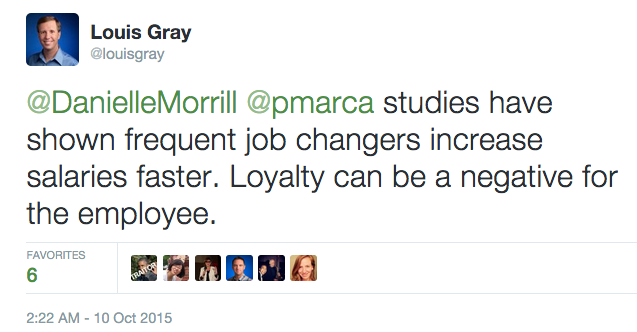
You can lament the frequent job changers,
but the company doesn’t have loyalty to you.


In business, and particularly in the insular, navel gazing, Silicon Valley, it’s easy go Pollyanna and only talk about good news. The billionaires. The parties. The VC funds and App Store rankings. On the flip side, it can be easy to demonize the bad actors or complain about traffic, and the ripples of corporate decisions. But the truth is always in the fuzzy middle.

Loyalty is wonderful when you find a passion and team you can believe in. But it can all be discarded in an instant, through a fight with a manager, or a merger or acquisition that sees you as redundant. A stock market crash. A change in heart. A bad quarter.

Layoffs happen. They can make you question everything you worked for. All the thousands of hours you put in caring about the little things that got you to where you are. All the conversations and debates that made the product you own.

You have to reexamine what’s important and decide on a new trajectory. And it’s okay to take time to both feel and to heal. Being emotional is part of what makes us human, even in a data-driven world being taken over by robots. So yes, it hurts, and you are going to be angry. Furious even. But being laid off in 2015, in an active tech job world is a much different event than in the tighter, pessimistic environments of 2001 and 2008.

Twitter’s job losses today won’t be the last we’ll hear from current and past unicorns. Those who ride the highest, like Icarus, can be burned by the sun.

Disclosures: I work at Google, which is an occasional partner to Twitter, and assumed competitor in some ways. I have friends at Twitter. And any examples I use here related to my previous work experience are intended to be accurate, even if I missed a date or anecdote.

August 2, 2012

August 2, 2012 · 5 MIN READ · BY LOUIS GRAY

All Hands Meetings: Good, Bad and the Ugly

All Hands Meetings: Good, Bad and the Ugly

Whether at a startup or a Fortune 500 company, culture and communication with colleagues can have an incredible impact on morale and the bottom line. Amass enough naysayers, and the negative inertia can drag down the optimists. Similarly, a well-timed rallying cry can spur troops to close out the quarter on an up note, and help others be willing to work extra hours for a shared goal.

One of those opportunities for shared discussions is the company-wide all hands meeting, led by management, typically starring the CEO. In my dozen-plus years in the Valley, from the tiniest of startups, to my current role at Google, as you can imagine, I've seen a variety of ways a company's culture was approached, and how these all hands meetings could take on a life of their own. A recent story by All Things Digital's Kara Swisher regarding rumored changes at Yahoo! following Marissa Mayer's joining the company as CEO has had me thinking about some of the crazy things I've seen since the end of the '90s in such meetings, both good and bad.

The first company I worked, Internet Valley, didn't ever grow to the point where All Hands meetings made sense. We had 3-4 employees, and our boss simply had to scoot his chair back and speak to the two of us worker bees to have a discussion.

After that dalliance came and went, at my second company, 3Cube, I was one of about a dozen people, mostly engineers, we had All Hands discussions to announce good news on product, business development or in fund raising. I remember when we raised $1 million in seed funding back in 1999, at a valuation of $10 million, and spoke of plans to get the next round at $10 million with a $100 million valuation, if our goals were met. Our CEO, and the rest of us, were excited. As drinks were poured, we joked that the million bucks, split about 10 ways, would be a fun run to the Mexican border, if nothing else. We also used the All Hands format to discuss new partners, and ready product rollouts.

I joined BlueArc in 2001, and initially, during our glowing phase when we came out of stealth and made our first customer shipments, our All Hands meetings rallied the company for a common good.

But almost immediately afterward, due to our own issues and economic uncertainty, those disappeared. In a year's time, the three All Hands meetings we had were to discuss two separate rounds of significant layoffs, with a CEO change in the middle for good measure - on April Fools' Day, no less. We knew that if an All Hands meeting popped up on our calendar for the upcoming Friday, there was a good chance you should back up all your email on Thursday. All Hands meetings were brutal and scary.

As those of us left behind muddled through, we gained a new Marketing VP in 2002, and we survivors recounted the situation. Unsurprisingly, he was appalled, and helped us restart semi-regular meetings, where we didn't fear for our jobs or the company's livelihood. For the most part, the meetings, held once a quarter or so, recapped the last three months of sales, and highlighted our pipeline. But even those meetings started to take on a Twilight Zone feeling, as it seemed our CEO would talk about how we had not met sales expectations for the quarter, but we would still get some bumbling engineer to ask how his stock options were doing - seemingly oblivious to the fact that we were going nowhere fast.

Those meetings were also memorable for the inevitable sales guy calling in to the conference line in the car with the top down, and not being muted. Nothing like the entire company waiting around while the CEO barked into the Polycom for whoever it was to "PLEASE MUTE YOUR PHONE."

After a few years of this nonsense, and a few Marketing VPs later, I previewed to the latest guy exactly how the quarter's All Hands meeting would go down, with specifics on the CEO's nuances, the sales guys' excuses, the engineers' begging for stock updates, and more. When he viewed his first All Hands meeting in person and watch it unfold in front of him, just as I had told, he swore to me it was all he could do to stop from laughing. How could it have been allowed to be so bad for so long? Such a great opportunity to communicate transparently and freely with the whole company wasted.

From that day forward, we took ownership of the All Hands meetings, working with the CEO and management, to make sure the content was planned in advance, that there was a variety of speakers, and value to everyone who joined - not just a droning on of excuses that had little bearing on employees' day to day. The results were clear, as employees felt better informed, understood product roadmap and big sales opportunities, and, when appropriate, what was needed to keep the company funded or solvent. It was a remarkable change from the three straight doomsday All Hands meetings and the cries for options to mute phones on the conference line.

Google's TGIF experience is well documented on the Web. It's open to the employees and closed to the outside world, to protect the discussions and keep people informed and engaged. That Yahoo! would now be getting the same kind of regular updates and visibility into management they deserve is something that should be exciting to their team, for those who have suffered after wave after wave of bad news, in the same way our 2001-2003 All Hands seemed to flow.

Meetings for meetings' sake don't make a lot of sense. Meeting as a company, in the spirit of updating, discussing and enriching employees does, and having seen well intended executives fall flat, and others do quite well, I know there's value to getting the All Hands meeting regular, open and engaging, even if your company is small.

Disclosures: Yes, I work at Google. No, I won't tell you more about details of TGIF. Yes, Yahoo! is an assumed competitor. No, this is not an endorsement of any rumors by ATD or any official commentary on Marissa or Yahoo!.

July 20, 2011

July 20, 2011 · 4 MIN READ · BY LOUIS GRAY

Real Valley Stories: Nearly Quitting Over URL Structure

Real Valley Stories: Nearly Quitting Over URL Structure

Editor's Note: Part 4 in an irregular series of stories from my 12 years in Silicon Valley. Part 1 discussed interviewing for my first job. Part 2 discussed the role. Part 3 talked about my boss getting let go while I was retained by the sister company.

At my second job in the valley, I had the title of Web Marketing Manager. It meant I owned the company's Web sites, including content, look and feel, search engine optimization, and more. Beyond that, given it was a startup, I did my unfair share of quality assurance, product planning, including my first marketing requirements document (MRD), which was terrible, and even picked up the phone to answer support calls when they cascaded to me. The company initially started out selling a web-based fax service, which was the majority of revenue for the entirety of my two-plus years there, but that line wasn't particularly sexy, and it wasn't the end goal, as we later rolled out a Web-based phone conferencing service, with Web meetings and advanced desktop sharing. The eventual goal was a suite of Web-based office products for remote workers and Web-centric employees. We were probably ahead of our time, and understaffed, but in the later stages of the dot-com boom, we were scrappy and we tried to do a lot with miniscule budgets.

After much testing, we readied the launch of our Web conference calling product in January of 2000, called PhoneCube. The application had gone through all manner of review on all the top browsers of the day, and it was good to go as far as version one was concerned. So too was all the copy for the Web site, including frequently asked questions, product overview, pricing tiers, and all manner of screenshots, complete with fake names and phone numbers. As we readied launch, my colleagues and I uploaded the new content to a test server and started clicking around to make sure all the links worked, images displayed and so on.

Immediately, as I clicked through to the product page, something caught my eye. The page loaded as it should, but the URL structure was not what I'd expected. I anticipated that clicking on Products would lead to a clean URL like www.phonecube.com/products or at worst, www.phonecube.com/products/index.html. Instead, the URL had an additional directory which looked like www.phonecube.com/phonecube_site/products/index.html. What was this "phonecube_site" deal? So I went to my boss and asked, saying we could easily make a soft name alias to hide the unnecessary and ugly directory. The two of us then went to the lead engineer on the project, who, folding his black and gray beard upward toward his lower lip as he talked, explained that this was impossible.

What had happened was that our Web site and our application were running on the same server, in parallel directories, with the phonecube_site directory showing the Web site and the phonecube_app (or some other similar name) directory powering the application itself. All of the calls to images and other code in the application had hard-coded URLs, so masking the phonecube_site directory would require dramatic work to the app itself, and delay the project.

I was incredulous. I thought the new URL structure was ugly, and it was something all our visitors would see as they clicked around our site. It would be ugly to link to, ugly to share via email, and made us look bad. In response, my boss (the VP of Marketing) said that many popular Web sites on the Internet, with Amazon being the clearest example, had ugly URLs, and yet they were successful. I thought the excuse that other sites were worse didn't really make us better. As far as I was concerned, the URL was as important as the words on the page, and as I argued my case, I started to feel that if the Web Marketing Manager who theoretically owned the Web site couldn't even have impact to how the URLs would be displayed, that my role was pretty much toothless.

After much discussion, with my viewpoint clearly being in the minority, I had to cede the position. My vain request for clear URLs that were as human readable as machine readable didn't persuade my team, and I was going to have to live with it. This realization that I could not even convince my boss to back me up on something I thought was so clear and obvious was incredibly frustrating, and I remember driving home that night, late, fuming, thinking I should just quit if I couldn't even stand up for our users and common sense. But, luckily, I decided to display a rare moment of maturity, and I came back the next day and went to work. I don't know that my boss or colleagues realized how seriously I took the fight and how I had seriously considered leaving, my powerlessness being made so transparent.

Since that time, URLs have clearly gotten uglier, and most folks have survived. I've had other conflicts at other companies, and haven't always gotten my way. Sometimes the frustrations are short-term and others long term, but what the episode did show me is that no matter of ranting and raving can push people who are certain they are right, especially when the benefits of change don't outweigh the drawbacks. I've seen other people try to hold fast to a hard line on other little things like fonts, graphics, logos, splash pages and more, where exercising a little flexibility and respect for the other person's point of view can do wonders. But back when I was only 22, getting shot down and losing a product decision I thought critical was demoralizing indeed.

May 11, 2009

May 11, 2009 · 2 MIN READ · BY LOUIS GRAY

Skype Hates Me. Maybe That's Because I Treat It Like Net2Phone?

Skype Hates Me. Maybe That's Because I Treat It Like Net2Phone?

When I worked at 3Cube nearly ten years ago, we helped design one of the most feature-rich and well-designed online conference calling and Web meeting products out there, with a service we called PhoneCube. You could, from your Web browser, initiate a conference call to up to 32 participants, and manage the entire conference, including putting people on mute or hold, from your Web browser. You could also invite them, on the fly, to a Web meeting, and share a presentation or your desktop. But as a small startup, we ran into two major issues. The first was that WebEx had raised scads of money and was spending tens of millions on marketing, including a Super Bowl ad featuring RuPaul. The second was that pricing the product, no matter how we did it, seemed expensive, as users were not comparing our 15 or 25 cents per minute per line rates with that of traditional conference call services, but instead, with the pennies on the dollar VoIP alternative, Net2Phone.


The old PhoneCube.com Web site, Circa 2000 (via archive.org)

Rising in the era of Napster and Web browser bars, like AllAdvantage, that promised to pay you money just for surfing the Web, Net2Phone's dirt cheap, but awful quality, got significant use, especially for those folks making international calls - many of whom thought we should drop our rates to basement levels found only online or on gift cards picked up from 7-11. And thus were my feelings cemented about what this cheap PC to landline connection represented. So you can imagine my hesitancy when it comes to Skype.

After finally giving in and getting a Skype account last year, to participate in the occasional podcasts, I have dealt with frequent bugs that have me wondering if the Skype application has a personal grudge against me thanks to our history. Whether I have participated on the ReadBurner Weekly podcast, the FFundercats podcast, or yesterday, when I was a guest on This Week In Tech with Leo Laporte, I always get dropped, without warning, around 20 minutes into the call, like clockwork.

And I hate looking like a tech fool. My Mac is up to date in just about every respect. I have the latest version of Skype downloaded. I have a headset which works. But regardless of what time of day or who I'm talking to, I know that I should keep my calls to 15 minutes, or you can expect me to have to dial in about 3 to 4 times an hour. (See yesterday's TWIT, episode 194 for a great example)

So, community of Skypers... you tell me. Should I relegate Skype into the same bucket of ugly 1999 quality Net2Phone, or should I give it another try? Is it my fault? Is it Comcast (my ISP)? Or is it Skype? Reasonable responses and suggestions will be tried.