Silicon Valley Technology Commentary & Archives · Est. 2006 3,045 Posts · 2006–2026
Showing posts with label Inquisitr (8 posts). Show all posts

January 15, 2009

January 15, 2009 · 3 MIN READ · BY LOUIS GRAY

The Global Recession Is Crushing Web Ads. Expect it to Get Worse.

The Global Recession Is Crushing Web Ads. Expect it to Get Worse.

That I am not a fan of Web advertising on Web services and blogs is not a big secret. I was roundly pummeled for my over the top comments in April that tried to divorce authors from the idea that they could publish a blog, add AdSense and then wait for the money to roll in. But recent developments make it look like the Web advertising crunch is becoming critical. Inventories are not being sold, prices are dropping dramatically, and it's very likely more and more services reliant on ads are going to feel the pinch, forcing them to rapidly change their business models or close altogether. And they won't be alone. I'd look for many multi-author blogs you've grown to rely on to start thinning the ranks of reporters as ad returns weaken, and some have already started to make such cuts.

Back in December of 2007, I expressed my concerns in a piece called "The Web Advertising Bubble Has Got to Pop", where I said:
"The more I think about it, the more obvious it becomes to me that the ad-driven economy, both offline and on, could soon be in dire straights, and companies hoping to cash in need to think of new revenue targets - quick."
The reasons I gave for decreasing ad revenues, at the time, stemmed largely from audiences learning to avoid ads, or to use software to block them. I mentioned that even the mighty Google would be susceptible to a crunch, if was to happen, in the online ad market. Like others, I didn't forecast a massive global recession, but as the financial markets have spiked lower, and public markets have been closed to innovative companies, the drive to reach a profit, and do so without relying solely on ads, is stronger than ever.

Last night, Duncan Riley of the Inquisitr summed it up in what had to be a tough piece for him to write, "The Web Ad Apocalypse". He, being one of those bloggers who is heavily reliant on ad revenue, said advertising inventory at his providers has dramatically dropped. He adds, as I did more than a year ago:
"Advertising in blogging and 2.0 services/ apps is on the downward march, and companies that rely on advertising that were marginally profitable, or running at a loss are about to find life that much harder."
Duncan's comments are not in isolation. TechCrunch reported today that video ad rates dropped 25% in the last quarter. Be it in video, in banners, or in text ads, the trend is downward.

It is my belief that this problem, while exacerbated by the financial downturn, has been a long time coming. While Google made money hand over fist by pushing sponsored ads alongside native search results, their AdSense product, beloved by many bloggers, is often way off the mark when it comes to contextual advertising - and practically the only memorable online ads are those polluted by nonsensical dancing and misleading graphics that make you think you have a computer virus, or lie to you and say you've won an iPhone by being the 1 millionth visitor. I'd say we've come a long way from the late 90s when we were asked to "Punch the Monkey", but we haven't.

Online ad successes in Web services and blogging are not non-existent, but they are incredibly rare, and they are going to get rarer still. If you're trying to make money on the Web, it's time to think of a different way. If you have a service, get users to pay for it. Find a way to deliver value through premium offerings. Charge monthly fees. But the whole "free plus ads" mantra is going to get worse - and not worth the effort in many cases. That's a major reason I've never run ads here. I knew the trade-off for mucking up the site wasn't going to be worth the pennies. Now it's clear that's likely all I'd ever get.

December 17, 2008

December 17, 2008 · 4 MIN READ · BY LOUIS GRAY

The Best Solution to Embargo Angst? Write Something Else.

The Best Solution to Embargo Angst? Write Something Else.

As blogging approaches the traditional role of journalism, traditional elements of journalism, including public relations firms, embargoes, briefings, and bias are going to surface, as they have with traditional marketing, media and business for centuries. Today's flare-up, kicked off by one of the best discussion starters on the Web, TechCrunch's Michael Arrington, isn't the first time embargoes have been slammed, and it certainly won't be the last time. Back in August, I discussed why I believed the embargo process was both broken, but necessary, and Marshall Kirkpatrick of ReadWriteWeb followed on with a great take of his own.
I think the bigger issue is not that embargoes are being broken - which they are by blogs both big and small - but instead, that there are a large number of sites who act like they are the only game in town, and that they must cover every single story.

To those guys, please stop. Seriously.

In the tech blogging sphere, there is a serious echo chamber. While I look forward to banging through my Google Reader feeds every day, I can pretty much bank on seeing the same story, spun a different way, a good dozen or two dozen times by every single tech blog - even if it's clear that they are just reporting that someone else reported the news. If you see a story has been covered already and you have nothing to add - leave it alone.

Given the ease of news distribution, let's now write with the assumption that everybody reading your site is reading a few others as well. If you see a story broken by TechCrunch, or ReadWriteWeb or Mashable or VentureBeat or CenterNetworks, there's no need to pile on and become story number 18 on the topic. Let it go and write about something else - unless you have unique insight, unique quotes or access.

In my day job, I work with press releases and embargoes and reporters on a frequent basis. There is a need to be sure announcements go out when the products and partners are ready, or the customer is ready to take press calls. But Arrington is no doubt right that, as king of the hill, which TechCrunch is, some companies and PR teams are making coverage on the site practically mandatory, and near harassment of him and his team is no doubt occurring.

When trying to get coverage elsewhere, memorably one time in 2006 in Computerworld, I know I aggressively called the feature reporter every few hours until they finally picked up. After berating them for covering a competitor, and not our story, I got hung up on (no doubt deservedly so). I can only imagine being a TechCrunch reporter getting hit over and over by desperate firms, begging for coverage and honoring of their embargo.

A suggestion to those PR teams, please stop. Seriously.

Take your story somewhere else, to one of the many other tech blogs who write well, and will give your company or service its due. There are many new writers who have posts to file, and they want your story - and they will honor your requested embargo.

On this site, when I was running the whole thing myself, and now, with the great team of writers we have here, no embargo has ever been broken. On one occasion, I prematurely posted the Seesmic/Disqus integration news, having forgotten the day it was due, but I promptly deleted and reposted the next day. But one of the major reasons I haven't broken an embargo is because I strive, and ask my cohorts the same, to write things that are new. Cover new stories and new angles and be unique. If it has been covered somewhere else, let it go. We're not TechCrunch, and we're not trying to be.

TechCrunch doesn't have time for stories like Gawkk.com, which we covered last night. They probably aren't interested in stories like the one today on Resume Donkey, or Monday's announcement of Twit Or Fit. TechCrunch also doesn't have the leisure anymore of introducing great new blogs, as we do every month, or highlighting how to better use FriendFeed and Twitter, as we can. That's because they have taken on a new role, as a very real media company, and with their focus on Google, Microsoft, Facebook, Yahoo! and other big companies, there's room down at the bottom for us small fry to find the stories that are in the cracks.

It takes a different mentality to find new companies and new angles that nobody else has written before, that doesn't require a PR firm's input or embargo. And it takes strength from the PR firms to turn away from their top target and take the story somewhere else. While I don't think today's missive from Arrington will do just that, it might make some think different about the way they blog and distribute stories.

October 13, 2008

October 13, 2008 · 2 MIN READ · BY LOUIS GRAY

Duncan Riley's Inquisitr Teams Up With ReadBurner for Web's Best

Duncan Riley's Inquisitr Teams Up With ReadBurner for Web's Best


Since he launched The Inquisitr just under six months ago, Duncan Riley has taken some innovative approaches to sharing news on the Web. (See: Duncan Riley's First Week at The Inquisitr Is Inspiring) Not content to simply repeat "the news of the day" and hash over the same tired subjects, Riley has added spice to the mix, covering celebrity news, and taking new approaches to finding new ways to present hot topics outside of his own site - through QMeme, which tracks popular items on FriendFeed, and Inquisitr IQ, which, in a fashion similar to AllTop, features posts from some of Duncan's favorite blogs.

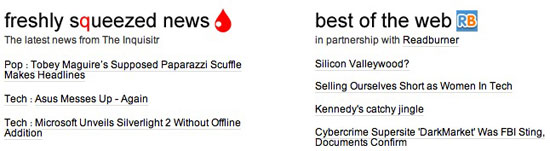
Today, Duncan took another innovative step, becoming the first to harness the new ReadBurner platform by integrating the service's top stories within his site as content - not by embedding the full content on the Inquisitr, but instead, letting his readers click out and find new sources for top tech news, at their original source.


You can see ReadBurner headlines alongside The Inquisitr news

The ReadBurner partnership is part of a new, revamped, look for The Inquisitr, which now features the tagline "a better mix", hinting at the breadth of coverage available.

Clearly, in my advisory role at ReadBurner, I was aware of Duncan's plans to incorporate the service's content, but one of the most intriguing pieces of the partnership is that Duncan proactively reached out to our team rather than us asking him if he was interested in carrying the content. Duncan, looking at the options on the Web, selected ReadBurner, and presented us with an innovative way to get the best of the Web and make it portable.

You can see the new look for the Inquisitr here: http://www.inquisitr.com/

Also, the official blog post by Adam Ostrow, ReadBurner CEO is here:
Introducing the ReadBurner Platform v0.1 with The Inquisitr!

I'm both looking forward to more innovation from The Inquisitr and, of course, more developments at ReadBurner. I bet there is more to come from both sites.
DISCLOSURE: I am an advisor to ReadBurner.

September 5, 2008

September 5, 2008 · 1 MIN READ · BY LOUIS GRAY

Get the Google Chrome Comic Book, Support Two Great Charities

Get the Google Chrome Comic Book, Support Two Great Charities

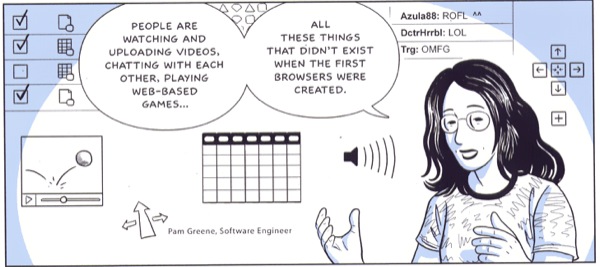
Earlier this week, Google launched their new Web browser, Chrome, in a unique way - explaining what's a very technical product in the most user friendly way they could, by using a comic book. While the Web version of this book has been linked to time and again, print copies of the book are very rare, distributed to those who Google determined were top press targets, both online and off. The Inquisitr's Duncan Riley received one, and rather than put the book on his mantle, he's auctioning off the potential collectors' item for charity, in what has to be seen as a win/win scenario.

You can bid on auction yourself via eBay, and Riley has offered the full proceeds to be split between Beth Kanter and Beyond Blue.


A frame from the Chrome comic

More details can be found on Riley's post on the subject, but he has said he'd be delighted if the two charities could split proceeds greater than $1,000. It's an interesting opportunity to get your hands on a piece of Web history and provide aid to those who need it. And if you're not interested enough to bid up the auction, maybe my own initial bid will stand up. You see... I'm not big enough for Google to have sent me one, so I'm headed to eBay for Duncan's copy. See if you can outbid me here: http://bit.ly/ebaychrome.

August 25, 2008

August 25, 2008 · 4 MIN READ · BY LOUIS GRAY

If You Look Hard Enough, Conflicts of Interest Are Everywhere

If You Look Hard Enough, Conflicts of Interest Are Everywhere

Cyndy Aleo-Carreira, contributing editor at The Industry Standard and professional guest poster in a number of Web sites, including this blog and Duncan Riley's The Inquisitr, has a great discussion starter this evening on bloggers and their conflicts of interest. The piece, titled Out of the Navels and Into the Mirrors, asks specifically if bloggers should talk about companies where they have a financial investment, any kind of part-time or full-time role, or if they should become friends with those they cover. Though broad, her questions likely resonate with many of us involved in blogging and reporting in general, and it's very likely you'll find a wide array of answers, depending who is polled. But each of us comes in with specific likes and dislikes, or personal history, which impacts everything we do, and displays our underlying bias, financial or not.

First, she asks, "Should bloggers cover companies they invest in?"

I almost immediately want to say no. But in actuality, investors in a company usually know it very well, especially if it's an early-stage situation, where they will know it better than the general public. It's no secret they'll likely be more positive on the company, but if they're fair and disclose the relationship, you may learn a great deal.

Good examples of people who talk about companies they are invested in include Fred Wilson of AVC, and Mark Cuban of Blog Maverick.

Second, she asks, "Should bloggers continue blogging once they join boards, take day-job positions with a company, or start/buy a company?"

Again, disclosure is needed. There are many official company blogs that are written by employees, openly. There are other blogs, like Mini-Microsoft, written anonymously, by an employee who is not an approved representative of the company who has unique insight as a full-time employee.

In a more close to home case, Adam Ostrow, CEO of ReadBurner, stopped blogging about ReadBurner on Mashable when he helped acquired the site. (See also: Did ReadBurner Acquisition Cause Conflict of Interest for Mashable?) When I joined the team to help as an advisor, I spelled out my hope to be transparent, and will disclose the role any time I get close to talking about the space.

Finally, she asks, "Should bloggers make friends with people from the companies they cover?"

I think this is absolutely human nature. I have a tendency to be positive on this blog. I talk about companies I like, services I use, and others I have big hopes for. In the process of investigating these services, often I trade a lot e-mails and phone calls with entrepreneurs, which can get to knowing them well or considering them friends. Most of the time, it's not the same kind of friend you can watch a baseball game with or catch a movie, but you do end up rooting for them and may at times gloss over some bugs in hopes they'll suceeed. (See also: My Double Standard for Web Services and Does Negativity Deliver Credibility? If So, That's Nuts.)

Being friendly can lead to a more collaborative environment, where you can both get information early, but also lend a helping hand to those who need it. I've never shied away from playing an informal QA role for services that need aid, and I want to instill a level of trust with those I do engage so they know they can trust me with confidential data.

Beyond these questions, my biases are everywhere, and they impact how I write and my opinions, which do show up. I happen to prefer Apple Mac OS X to Windows, even with the occasional glitch that impacts my Apple experience. I happen to be LDS and wasn't too excited about the rumors spread last week. I like sports, I tend to think Cal is better than Stanford at just about everything, even when it's clear I'm wrong, and I do have friends in the blogosphere - some of whom I've done podcasts with or traded e-mails with or phone calls. I will link to them more often, I will interact with them on social sites more often, and I will comment on their posts more often. (Cyndy and Duncan included)

On rare occasions, interactions with people behind services also results in free stuff, which for some, could lead to bias. I have free t-shirts from Disqus, FriendFeed, and Browzmi, for instance, all which came after I wrote about them a few times. I have a world-famous CenterNetworks sticker, and my babies have schwag from ReadBurner, Shyftr, NewsCred and other places (largely because I asked for it). I also represent standard demographics. I'm male in my early 30s. I live in California, in the Bay Area specifically. I work in the tech sector for a private company, and have since 1998. I have two young kids. Each of these things impacts my view of the world and what I like or don't like.

Rather than setting hard and fast rules about bloggers going out of their way to avoid topics they likely know well, or asking them to be friendless automatons, we should ask them to be more transparent and clear if they are acting with real bias. It's that which will make the difference between trusted and untrustworthy - and enable bloggers to look in the mirrors comfortably again.

July 26, 2008

July 26, 2008 · 3 MIN READ · BY LOUIS GRAY

Roll Your Own Blog Leaderboard With Google Reader Trends

Roll Your Own Blog Leaderboard With Google Reader Trends

Tech bloggers and readers are quite familiar with Techmeme and the site's accompanying leaderboard, which tracks the top 100 sources to the popular news-tracking site over the previous thirty days. Since the leaderboard was initiated, Michael Arrington's TechCrunch has held the top position, accounting for between 5 and 8 percent of all stories. As of Friday night, TechCrunch represented 7.03% of Techmeme's stories in the last 30 days. As a subscriber to the Techmeme Firehose feed in my Google Reader, I see 3,162 items reached Techmeme in the last 30 days, meaning TechCrunch's share was somewhere north of 200 items. But Google Reader does more than show me the items I've received, it also shows me the items I've shared, and the most often shared sources, in effect, giving me the option to record and display my own leaderboard of the top 40 sources that I've shared on my Google Reader shared items blog.
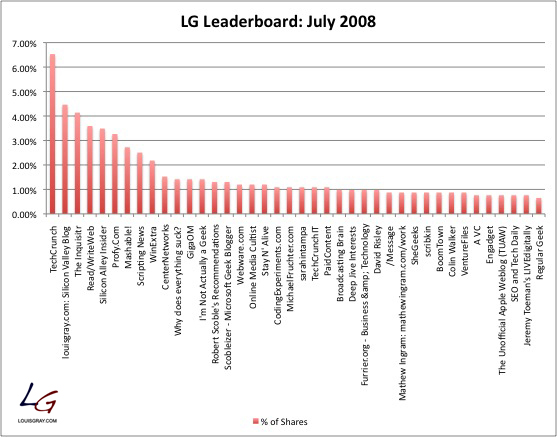
Anybody who uses Google Reader as their RSS feed reader of choice, and who shares items to a link blog can make their own personal leaderboard. While I won't be updating mine multiple times daily, as Gabe Rivera does on Techmeme, and I can only show 40 items, instead of 100, I will, starting tonight, be posting my own LG Leaderboard, for the previous 30 days, and will update this list every month, on the 26th of the month.


First, the dataset:

According to Google Reader, from my 336 subscriptions, over the last 30 days I read 16,386 items and shared 919 items.

Second: The leaders for July of 2008:

Like Techmeme, my #1 shared blog was TechCrunch, thanks to their frequent posting and high number of stories I believe those who follow my link blog would be interested in. Similarly, given my own bias, this blog is in the #2 position. I'd remove it from the leaderboard, but don't want to skew the statistics. Duncan Riley's The Inquisitr has made a strong showing at the #3 position, followed byRead/Write Web at #4 and Silicon Alley Insider at #5. All percentages shown are the result of taking the number of shares in the month per source, divided by the total number of shares. (In this case N/919)

PositionBlog% of Shares
1.TechCrunch6.52%
2.louisgray.com4.46%
3.The Inquisitr4.14%
4.Read/Write Web3.59%
5.Silicon Alley Insider3.48%
6.Profy.com3.26%
7.Mashable!2.72%
8.Scripting News2.50%
9.WinExtra2.18%
10.CenterNetworks1.52%
11.Why Does Everything Suck?1.41%
12.GigaOM1.41%
13.I'm Not Actually a Geek1.41%
14.Robert Scoble's Shared Link Blog1.31%
15.Scobleizer1.31%
16.Webware.com1.20%
17.Online Media Cultist1.20%
18.Stay N' Alive1.20%
19.CodingExperiments.com1.09%
20.MichaelFruchter.com1.09%
21.Sarah In Tampa1.09%
22.TechCrunchIT1.09%
23.PaidContent1.09%
24.Broadcasting Brain0.98%
25.Deep Jive Interests0.98%
26.Furrier.org0.98%
27.David Risley0.98%
28./Message0.87%
29.Mathew Ingram0.87%
30.SheGeeks0.87%
31.Scribkin0.87%
32.BoomTown0.87%
33.Colin Walker0.87%
34.VentureFiles0.87%
35.A VC0.76%
36.Engadget0.76%
37.The Unofficial Apple Weblog0.76%
38.SEO and Tech Daily0.76%
39.Jeremy Toeman's LIVEdigitally0.76%
40.Regular Geek0.65%


All told, these top 40 sources accounted for 595 of the 919 shares over the last 30 days, or 64.7% of the total, meaning the other 296 sources accounted for 324 total shares, or 35.3% of the total. Everybody's leaderboard will be vastly different, for sure. Contrasted with the Techmeme leaderboard, the flagship for measurements like this, I lack a number of more mainstream feeds, like the New York Times, Wall Street Journal, Reuters and Forbes, but in its place, you see a lot more individual bloggers who bring me the news I find interesting. I'll be posting these regularly, and if you would do the same, send me a link in the comments to your list. Could be a great way to find new blogs and news sources. Also, if you think you belong here, add your blog in the comments, and there's a chance you'll be on the leaderboard next month!

You can find my Google Reader shared items link blog here, or see them included in my FriendFeed.

May 18, 2008

May 18, 2008 · 3 MIN READ · BY LOUIS GRAY

Blogging 2.0 Causing Friction With 1.0 Bloggers

Blogging 2.0 Causing Friction With 1.0 Bloggers

Duncan Riley is on a roll. After a multitude of posts from around the Web this weekend once again debating whether comments away from the blog were a good thing, or if new Web services like Twitter and FriendFeed were useful or were instead creating too much noise, Duncan checked in from The Inquisitr and came to the conclusion I'd reached long ago but not said as eloquently: "It's All About the User".

Duncan, as I have, argues also that those bloggers who embrace changes will leap ahead of the competition, by being more visible in more places, and finding engagement where it has ended up, rather than trying to force it back the way it was.
See Also:
Coding Experiments: The Blogosphere’s Changing Opinions on FriendFeed
Hutch Carpenter: The Noise About FriendFeed Noise
ReadWriteWeb: Don't Be So Naive: Friendfeed Adds to the Noise
Scobleizer: Why Google News has no noise
Scobleizer: Why FriendFeed won’t go mainstream (Part I)
Scobleizer: Why FriendFeed will go mainstream (Part II)
Blogging 1.0 centered around who could:

* Amass the most page views
* Display the most ads
* Get the most comments
* Attract the most RSS subscribers

But then came along some inconvenient wrinkles to the mix:

* Full RSS feeds took page views away from the blog
* Readers installed ad filters, and didn't click
* Comments started to live elsewhere
* Every blogger in an industry covered the exact same stories

This change has caused serious strain for those living in Blogging 1.0, as they've seen their page views fluctuate, and as comments moved to third party sites, be they RSS readers, social networks, Twitter, FriendFeed and others. You can spot those living in Blogging 1.0 as they're the ones railing about keeping all their comments on their blog, and they're the ones saying that FriendFeed or Twitter have absolutely no value, and complaining about the noise.

Some bloggers, like Robert Scoble, have successfully made the transition to Blogging 2.0. Robert has embraced the new noise of Twitter and FriendFeed, and worries less about where the conversation is taking place, but more about whether it's taking place at all. I've similarly engaged the new places to hold conversations, including Shyftr and a new host of social media sites, like Assetbar, SocialMedian, BlogRize and Yokway.

Since adopting FriendFeed and Twitter, both sites have enabled the conversation to be in new places, and each site refers more activity to my blog. Others, including Charlie Anzman and Hutch Carpenter, have publicly said FriendFeed ranks among their top referrals. And now, Duncan Riley can be counted firmly in that camp. He writes:

"I’ve come to the conclusion that what is happening in blogging 2.0 is something that I can’t stop nor change, so it is something I’m going to fully embrace, for all the inherent risk part of me is telling me it represents. I accept that others will rally against this: it’s human nature to do so, but no amount of protest will change the evolving reality of blogging 2.0. My advice to others: embrace it, or miss out."

My position, repeated a number of times here, and elsewhere, including today's Elite Tech News podcast, is that the world of blogging has changed. Those bloggers who accept the changes will have a natural advantage over those who do not. The additional time it takes to engage on FriendFeed, Twitter and other social media sites will absolutely pay off in the end, even if it's hard to understand for those who've always accepted things for what they are.

May 16, 2008

May 16, 2008 · 4 MIN READ · BY LOUIS GRAY

Duncan Riley's First Week at The Inquisitr Is Inspiring

Duncan Riley's First Week at The Inquisitr Is Inspiring

When news first hit that Duncan Riley had left TechCrunch, I thought his departure might see him theoretically fading into something like the proverbial sunset, as one of the blogosphere's most notable characters could have declared "Enough", put down his keyboard and gone home. On the news, I publicly wished him well, and hoped he would keep "staying aggressive". (See my comment.)

Not only has Duncan Riley stayed absolutely relevant, but he's captured the "aggressive" piece as well. Now, arguably, I'm reading Duncan Riley's news with more interest than I had been when he was at TechCrunch, and a week in, his transition to The Inquisitr, his new home, seems perfectly natural. Just one week in, the new site is getting about ten times the page views as I am, and he reports subscribers have already eclipsed my number, rocketing upwards to the 2,000 mark (myself included). Not shabby at all.

Part of the intrigue posed by The Inquisitr is Duncan's mix of both tech news, which makes sense, and more spicy celebrity news, which can also be interesting, even to us jaded geeks. And the reduced stress through no longer posting at the grindstone of TechCrunch has clearly lightened Duncan's mood. Virtually gone are the f-bombs that would be a common sight on his Twitter feed, replaced instead with a plethora of smiley-face emoticons. And in the midst of his move, Duncan has even opened up to reconsider his stance on a few things where we had locked horns back in March.

To those unfamiliar, in mid-March, amidst unprecedented hype around FriendFeed, Duncan took a look at the service for TechCrunch, and came away unimpressed. Responding, I said, undiplomatically, that he had missed the point, and argued a response. As I wrote Duncan in an e-mail earlier this week, at the time, I had used his name in the headline to differentiate from TechCrunch, who has multiple authors, and had previously written some positive notes on the service, but my write-up hit him quite personally. Making matters worse, my response stayed atop Techmeme virtually all day that Friday, which I was monitoring from my sun-drenched seats at Spring Training in Arizona.

The unexpected exposure definitely had gotten under Duncan's craw, as the next morning, I awoke to a follow-on note from Duncan on his personal site, that bluntly questioned my goals and credibility. Uninterested in fanning the flames further, and gaining an enemy for life, I stayed quiet, but others made plenty of comments on my behalf.

Knowing this is a small industry, I hoped Duncan and I could reconcile the differences. After all, who knew when we would see each other at an event? What if we were on the same panel or even were asked to speak on the same podcast? But as the rift had been very public, I thought it unfortunately might not ever happen - until this week. Now at The Inquisitr, Duncan sent me an e-mail on Monday asking if I could help him understand why I supported FriendFeed. He said he was even open to reconsidering his stance and would listen to opposing viewpoints. So, not only did I send him a lengthy note with my answers, (See: The Inquisitr: Why You Should Use FriendFeed), but I also gave him more background on the March flare-up. I have always respected Duncan's efforts, and see him as a good writer, but if there was ever an example of getting off on the wrong foot... this had been it.

Monday night, I opened up the laptop, and saw that not only was the story published, but Duncan had re-signed up to FriendFeed, and was talking up his renewed relationship with the site via Twitter. It's a wonder what the combination of reduced stress, a little communication, and time can do. Now, you can find Duncan on FriendFeed, and he's doing more than using it as a broadcast medium, but he's engaged. He's commenting, and liking and giving tips to fellow users.

I'm liking the content I'm seeing from The Inquisitr. It's a fun read, and there's a good pace of new articles coming in through the RSS feed. But I'm more pleased (and relieved) the public rift with Duncan is over. As with the back and forth I had with Mashable back in January, there are definitely things I would change about the words I wrote, and the way things were portrayed, but in the end, we're stronger for it. I get along excellently with the team at Mashable, from Adam Ostrow to Mark Hopkins, and now, I feel I know Duncan better than I would have otherwise. Given the industry's size, it makes sense we try and avoid these battles that tear us down, and instead work to prop each other up. I'm glad Duncan's at a place where he can contribute to the tech blogosphere and stay stress-free. We're all better for it.