Silicon Valley Technology Commentary & Archives · Est. 2006 3,035 Posts · 2006–2026
Showing posts with label BackType (16 posts). Show all posts

June 17, 2013

June 17, 2013 · 1 MIN READ · BY LOUIS GRAY

Video: How Startups Can Raise Their Visibility Seed Round

Video: How Startups Can Raise Their Visibility Seed Round

Startup success takes more than sharp vision and smart code. Early adopters of your product, along with excited press, bloggers and engaged social users spreading the word can mean the difference. In late March, I gained the opportunity to present to Devoxx France, in Paris, and talk about how startups can find these early first users, how to gain a relationship with top press and use all channels possible to get your word out.

Many of the examples are familiar to longtime readers of louisgray.com, highlighting companies launched here, from Feedly, TweetDeck and Toluu, to some of my own favorite products, like FriendFeed, BackType and Google Reader. The video just came online today. Hope you find it useful.

July 5, 2011

July 5, 2011 · 2 MIN READ · BY LOUIS GRAY

BackType Buy Latest Boost for Twitter Search, Analytics

BackType Buy Latest Boost for Twitter Search, Analytics

This morning, news broke that Backtype, the SF-based, YCombinator founded startup that emerged in 2008 as a blog comments tracker and later pivoted a few times into a professional Twitter analytics company had "gone blue" and joined the mother ship, acquired by Twitter itself. The acquisition is another divider in the haves and have nots for Twitter developers - some who find themselves competing with the realtime short updates giant, and others who find themselves now sporting Twitter badges - TweetDeck included.

The addition brings some a small team of sharp engineers to the growing offices, and expands the company's focus on two pieces that need a lot of help - both search and analytics, though it's most likely the BackType team will be focused on the latter.

Twitter Follower Activity on BackTweets Pro Including Ups and Downs

The company's initial phase, as a comment tracker which let you follow people's engagement on blogs around the Web, was well chronicled here. They were actually listed as the #3 overall new Web service of 2008, and I aggressively predicted they were going to be acquired by the second half of 2009. I even listed Twitter as one of the potential buyers, although my prediction ended up being two years off.

Search Results for "Caylee" Spiking Earlier Today With Influencers, Other Data

After that initial move didn't get the company the traction and/or revenue they hoped, they drafted on the sails of fast-growing Twitter and rebooted with their BackTweets product. In May of this year, they upped the ante with BackTweets Pro, offering detailed analytics for search and user statistics. This appears to have finally been the product offering that gained Twitter's attention. While Twitter has gained a lot in the last few years in stability and UX, the core offerings of the service have been fairly static. Users have had to go to other services to watch individual statistics and see trends on keywords for anything more than a few days. It's surely not a matter of not having the resources or the interest, but it seems to have played a lower priority - something which may change following today's news.

Longtime Twitter watchers also remember 2008 was the time of another acquisition, when they acquired Summize, the basis for today's Twitter search engine, much maligned, but often used. What Twitter has done is learned what pieces of the developer community they can take out like a sniper, and which ones they'd rather not do themselves. Search has never seemed their strength, and we haven't seen many words on making it more fully-featured in a very long time - outside of a lapsed agreement with Google and ongoing relationship with Bing. Considering users aren't making too much noise about it, they've either accepted these shortcomings as long-term realities, or they just don't care. The BackType guys know that companies care about the way their brands are being mentioned or followed, and they just may get their fix from Twitter itself when the products resurface.

March 9, 2011

March 9, 2011 · 4 MIN READ · BY LOUIS GRAY

Is The Web's Focus on "Now" Losing How to Find "When"?

Is The Web's Focus on "Now" Losing How to Find "When"?


Our attention spans are getting shorter. While being constantly interrupted or distracted by new toys, new sites, new things, new messages, new people, and new ideas, we're delivering a stream of consciousness into a void which quickly gobbles it up and waits for more. Scads of sites are helping us find out what is trending in real time, and deliver us the "now". What's hot now. What's peaking now. What's being said now. But the focus on the cutting edge of time, combined with reduced capability to search our history is making finding what happened "when" a lot harder.

Consider for a moment some simple questions that pertain to the social Web, blogging and lifestreaming - and our lack of great tools to discover the answers. I'll start with some real examples.
1. What was the first blog to cover the service backtype.com? 
2. When was the first time Denton Gentry left a comment on my blog?
3. When was the first time Robert Scoble mentioned the word Twitter in his blog?
4. Who mentioned FriendFeed on Twitter first? MG Siegler or me?
I use these specific questions with real people to help consider questions that may pop up from time to time. Substitute your own curiosities.

There are a few places we've trained ourselves to look for such answers, namely Google Web Search (and its competitors like Bing), Google Blog Search (and IceRocket, my favorite), and Twitter Search. For individual blogs, we have to hope they have integrated blog search tools, such as that from Lijit, or Google's Custom Search Engine (CSE), a subset of results from one domain. But each of these has some weaknesses.

First, Twitter Search. Two years ago, when I was a more grumpy person, I targeted the search engine for being quite broken, only going a few days deep and failing in more specific searches. The archive hasn't been built to go deep in the last two years, and the accelerated volume of posts isn't helping the issue.

Second, Google Blog Search. You can search by date, and even set custom ranges, but the archive of blogs is both incomplete, but overly full of low-quality content. So finding out a question like the first blog to mention BackType requires you to visit their own blog and hope they mentioned it, or to just know they were funded through Y! Combinator, and thus, got started with TechCrunch, back in August of 2008. Peeking at Crunchbase helps too in this regard. Icerocket offers search by date, but I didn't find any results in August of 2008, so that's a miss.

The Web has collectively accepted these sites inability to accurately deliver on archive search, with an expectation that questions such as this are only done by a small few.

For the second question, one I posed to Denton last night out of curiosity, I would have to hope one of two things - that Denton had used Disqus.com with my blog and that I could somehow see all of his comments on my domain through Disqus. But looking at his profile there only shows how many comments he's made on my blog, and that's not clickable. If Disqus has the data, it's not easy to find. In fact, the only way we arrived at the answer is that I'm enough of an information hoarder to have every comment he's ever made tucked away in my email and was able to search locally on my laptop to find his July 2008 comment on a guest post by Jesse Stay. He finally posted on an entry from me in August of that same year.

So what about Mr. Scoble mentioning Twitter? I tapped Google Blog Search, went to Advanced search, entered scobleizer.com as the domain and the keyword of Twitter and chose 2007 as the year. The results nicely omitted his URL as part of the query - so that had no value. I searched his own site, using Lijit, but there is no sort by date. One of the first results included mention of an earthquake on Twitter in 2007, but knowing Robert, there's no way that's the first mention. Just can't find it.

As for who mentioned FriendFeed on Twitter.com first, MG or me? That's something of a trick question. We already know Twitter search won't find it - nor will its realtime search partners Google or Bing. But I can guarantee that MG mentioned it first because I didn't even join Twitter until early 2008, several months after I had been using FriendFeed. By that point, MG was very active on Twitter and had no doubt mentioned FriendFeed several times. But this all requires knowledge outside of the search engines.

Wikipedia and Quora and Crunchbase are all human-powered knowledge bases that are being built to answer questions such as these that capture more than the "right now". That we have access to things like Google and Bing and Icerocket that find answers to so many things is fantastic. There are even archival sites like MemoLane (which is beautifully done) to capture your history, but the when is becoming a footnote in history. Will the big engines let the flow of social media and blogs outrun the ability to capture it?

March 8, 2010

March 8, 2010 · 1 MIN READ · BY LOUIS GRAY

BackType Launches Labs, BackType Me, for Social News

BackType Launches Labs, BackType Me, for Social News

BackType, the best comments search engine on the Web, which launched in 2008 and has since morphed to act as a "real-time, conversational" search engine, today announced the introduction of BackType Labs, an "in progress" look at some of their newer projects. The first to debut is a service called BackType Me, which aims to find out what content is being shared by people you follow on Twitter.

Funded by Y! Combinator, BackType has grown from its two cofounders to a team of three, and is actively looking to hire two more engineers, focused on software and search. In the last few months, the threesome has evolved the site to display news by category, such as "Technology", "Politics" or "Entertainment", and has grown closer to Twitter, displaying topics that are "Hot Right Now", much like Twitter's trending topics.


Shares from Within My Social Circle on BackType Me

Now, searching BackType displays shared items from friends as well, which feeds the BackType Me product. Search BackType for a specific term (for example, the Oscars) and if logged in, you can see which of your connections shared a specific article on Twitter. The core BackType Me service displays all content shared in your social circle, and highlights the individuals who have shared it.

BackType Me could be a quick way to scan important items shared on social sites from friends in your network, and I assume we can expect more to come from BackType Labs. The team is already hinting at something called "BT.IO", which could be yet another URL shortener or something else entirely. We'll be watching them at work in the Labs when it debuts.

November 25, 2009

November 25, 2009 · 1 MIN READ · BY LOUIS GRAY

BackType Feeds Partners Faster, Thanks to PubSubHubbub

BackType Feeds Partners Faster, Thanks to PubSubHubbub

BackType, the most robust and feature-rich comments tracker on the Web, has expanded its services over the last few months to include a number of new items, including the launch of BackTweets, to find shared links on the microblogging service, a TweetCount plugin to highlight the number of times items have been retweeted, and a BackType Connect plugin for WordPress to show related conversations around the Web attached to your blog. The company's API is also used by popular services including Bit.ly and Disqus, who leverage the service to find external links and related tweets. Today, these downstream partners can expect updates to happen in near real-time, thanks to BackType's jumping on the PubSubHubbub bandwagon, in a partnership with Superfeedr, providing practically instantaneous updates downstream.

Superfeedr, one of the more aggressive services promoting PubSubHubbub, is providing the legwork for BackType, acting as a hub, pushing updates automatically as they are discovered. In today's post, BackType says the move reduces load on publishers by sending feed updates to all potential subscribers, without requiring multiple polls, and avoiding the arbitrary nature of clients' periodic requests.

If you subscribe to BackType to follow individuals' comments, or if you simply use Disqus or BackType connect on your blog, the move will ensure updates reach your content faster than they ever have before. In a Web world that is getting increasingly real-time, the name PubSubHubbub keeps popping up, and BackType is staying on the leading edge of innovation.

July 10, 2009

July 10, 2009 · 1 MIN READ · BY LOUIS GRAY

JS-Kit Declares the Death of Comments, Launches New Echo Platform

JS-Kit Declares the Death of Comments, Launches New Echo Platform


There is no question that as activity on social networks has broadened, conversations have become decentralized and distributed. Only a short few years ago, bloggers could anticipate their posts would rile up deep conversations on their blogs, through comments below each post. But for many people, the trends have been for conversations to happen elsewhere - on Twitter, FriendFeed, Facebook or practically anywhere people wish them to be.

As a result, new tools have cropped up to monitor the conversations, or to unify them, regardless of their source. Among the most visible has been BackType, which offers comment search, as well as a tool called BackType Connect, which centralizes reactions for Wordpress-powered blogs.

Today, one of the most popular comment engines, JS-Kit, says they too are moving to this model, and not just halfway. Their old platform is dead. Period. Starting today, users will be presented with a new platform called Echo that integrates reactions from around the Web, including those from these diversified, decentralized conversations, alongside standard comments. Existing users of JS-Kit will be upgraded to the Echo platform.

"We are here to announce the death of comments," said Khris Loux. "What's interesting about these new forms of communication is that they are parallel channels away from your blog. We are discontinuing JS-Kit comments because it no longer reflects the conversation around the blog."

Echo is a drop-in comment replacement platfom. Now, they say, references to your original content will be automatically displayed in real-time.

"Echo-enabled content is now the richest source of the conversation. They can go to your blog and see the entire live stream," Loux said.

Loux and Chris Saad, also of JS-Kit, said that bloggers who are using alternative platforms, like Disqus, could use the tool for future conversations, and they could import and export comments from platforms like Blogger.

June 17, 2009

June 17, 2009 · 1 MIN READ · BY LOUIS GRAY

BackType Takes On TweetBeep With BackTweets Alerts

BackType Takes On TweetBeep With BackTweets Alerts

Two of the most valuable tools I have been championing over the last several months are BackType and TweetBeep. The first searches through all comments around the Web for keywords you define, while the second watches Twitter search and delivers results to your e-mail. In tandem, the pair can essentially run on auto-pilot, giving you a real-time look into what the world is saying about you, your company, or your product.

Today, BackType extended its service to let you monitor Twitter, searching for links on Twitter that contain keywords you define. Like with its core service, and with TweetBeep, the new BackTweets Alerts system will pass on mentions from within Twitter to your e-mail, as quickly as you like, from immediate, to daily or once a week.

As I told John McCrea from Plaxo when I met him for Social Web TV last week, TweetBeep has made it so I don’t have to sit in TweetDeck all day and monitor keywords. Similarly, BackType doesn’t have me chasing through comments and reading every post, but I don’t miss much because I let these strong search tools do the work. (That's also a big part of why I said there is no information overload)

Will BackTweets Alerts be so good that I can do away with TweetBeep and turn to BackType for everything? I'm going to sign up and find out.

March 27, 2009

March 27, 2009 · 2 MIN READ · BY LOUIS GRAY

New FeedFlare Displays FriendFeed Likes and Comment Counts

New FeedFlare Displays FriendFeed Likes and Comment Counts

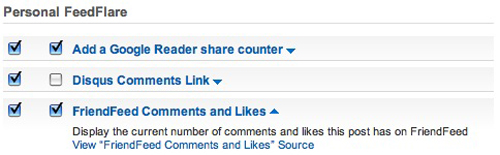
Bloggers who are tied into social media sites have long used FeedBurner's FeedFlare functionality to help promote their blog posts, from pushing visitors to Digg or Stumble posts, add them to Delicious, or e-mail them to friends. But increasingly, information from external social networks is being fed back to the blog itself - from the number of retweets a post may have received to the number of Google Reader users who shared the item, for example. A new custom feedflare, designed by Kevin Fox, the lead designer of FriendFeed, and the artist behind popular sites such as GMail and Google Reader, is now available to display the likes and comments your post might have gotten on FriendFeed. It's already running on this site, and can be seen on his RSS feed as well.


FriendFeed Activity Displayed on My Site

The FeedFlare can be displayed on your site, on your RSS feed, or both - and clicking on the comments and likes statistics takes you to where your blog post is shared on FriendFeed, bridging visitors of your site to the conversation there.

Setting up the FeedFlare for FriendFeed likes and comments is not a one-click process, so if you are interested, here's how you do it:
  1. Download this compressed .zip file. It contains the three documents you need, and an "About" file. Unzip the file and you will see a folder titled "friendfeedflare".
  2. Open the file "flare.php". Next to where it says USERNAME, replace "notlouisgray" with your FriendFeed user name.
  3. Open the file "friendflare.xml" and replace the pathname of "http://www.yourdomain.com/directory/flare.php" with where you will host the flare.php file. For example, I host mine at http://www.louisgray.com/feed/flare.php.
  4. Upload the files "flare.php", "friendflare.xml" and "friendfeed.php" to a directory on your site which matches the path you provided in step 3.
  5. Log in to your FeedBurner account, and go to the "FeedFlare" section in the "Optimize" tab.
  6. At the bottom of the page, where you have the option to add a "Personal FeedFlare", paste in the URL of your XML file. (e.g. http://www.louisgray.com/feed/friendflare.xml)
  7. Hit "Add New Flare" and then "Save".

The FeedFlare Displayed In FeedBurner

At this point, the likes and comment counts on your items will be displayed on your blog or RSS feed. They will continue to accrue until you have 30 newer items in your blog feed.

A year or so ago, the blogosphere lit up around how social sites were stealing the conversation away from blogs, and operating in silos. With tools like this, and Disqus and BackType's integration of FriendFeed comments, the disparate conversations are becoming ever more unified.

If you like this FeedFlare, be sure to check out Kevin Fox's FriendFeed here, or his personal blog at fury.com. And if you get it up and running, it'd be great to see it on your site, so post your blog URL in the comments.

February 26, 2009

February 26, 2009 · 2 MIN READ · BY LOUIS GRAY

Don't Speak the Language? You Can Still Participate.

Don't Speak the Language? You Can Still Participate.

If you watch your referral logs and search alerts closely enough, there will come times when blog posts, tweets or other social media activity will point your way, but not be in your native language. And while it may be intimidating to try and engage in a tongue where you are not comfortable, translation tools have reached the stage where you can respond, in best effort, in the poster's language of choice, and participate. And that little bit of effort is absolutely recognized.

While we keep hoping for a panacea where every person in every continent can share information in real time, language barriers are still very real. Even after four years of high school Spanish, three childhood years in Mexico and my entire adult life in California, I'm no native speaker of Spanish - and there's no way I have enough time to try and pick up another language or two to participate with other Web users, be they in Europe, South America, the Middle East or elsewhere.

But if I see a blog post that mentions me or something I'm interested in, or if I get an alert from BackType or Google, I do try to respond. A quick analysis from Google's Language Tools, or even online services that go between English and Farsi, can get me a good idea as to what they are saying. If it makes sense, I will usually also leave a short comment, even it's as simple as "thanks for reading, I appreciate it," but in their language, not mine.

For example, earlier today I got an alert via BackType from this post: La fiebre de twitter “incluso amenaza a google”, where a commenter wrote, "Totalmente de acuerdo con Louis Gray: Twitter es un radar estupendo de actualidad."

Loosely translated, the comment reads: "Totally agree with Louis Gray: Twitter is a great radar for now."

Google's Translation tools are good enough that you shouldn't be ignoring posts from other parts of the world. And if you're concerned that your words could be misconstrued thanks to bad translations, try to use short sentences and avoid slang at all costs.

Online translation services have enabled me to have quick conversations in Farsi on FriendFeed, or to browse articles as uniquely titled as Google naikintuvai ir kitos naujienos, which translates as "Google fighters and other news" from Lithuanian.

There is no question the tools are not yet perfect. Go ahead and try any phrase and convert it to another language, and then back, to see if it stays the same. But the combination of BackType Alerts and Google Translator has me participating without boundaries. Give it a shot.

Coincidentally, earlier this morning, Google announced you can now translate up to 41 different languages with their service.

February 10, 2009

February 10, 2009 · 1 MIN READ · BY LOUIS GRAY

BackType Adds FriendFeed Support to Comments Tracker

BackType Adds FriendFeed Support to Comments Tracker

BackType, the one-stop destination to track comments by people you follow, across the Web, has announced a big addition today, with the integration of comments from FriendFeed, the popular social aggregator. And before I get the usual smattering of comments labeling me a FriendFeed fanboy, recognize that companies and individuals are looking to find out where topics and products are being discussed on the Web, no matter where they are. With the strong growth of FriendFeed, Twitter and other social services, BackType's extension to include the service is logical.

BackType, as you likely already know, offers not just the ability to follow people (like me) on the site, but you can also set up keyword alerts to get updates by e-mail when the topics are mentioned in comments online, and you can even see trends of these keywords over time.

Since signing up for FriendFeed about 16 months ago, I've logged nearly 8,000 comments (about 500 a month, apparently), so for BackType to tap into this rich content archive will be beneficial, not just for the FriendFeed power users, but for those who want to improve the monitoring of social media. BackType, one of my favorite new services of 2008, has stepped up its game and gotten even more useful. You can follow my activity on BackType here: http://www.backtype.com/louisgray.

December 9, 2008

December 9, 2008 · 10 MIN READ · BY LOUIS GRAY

10 Top New Web Services of 2008 and Their 2009 Forecast

10 Top New Web Services of 2008 and Their 2009 Forecast

2008 has been both an exciting year and a very trying year for the world of Web innovation.

When the year kicked off, we were still in the middle of Web 2.0 fever. We were just two months removed from Microsoft having invested $240 million in Facebook at a stratospheric $15 billion. In the first week of January, Yahoo! CEO Jerry Yang made his first appearance at CES and promised the company was "ready and excited". By mid-month, Pownce launched to the public to offer an alternative to Twitter. And by the end of January, Twitter crashed hard - for the first time.

It turns out that Twitter's crash might have been the canary in the coal mine. Even looking at January 2008, and considering what has happened to Facebook's valuation, Jerry Yang's reign as CEO of Yahoo!, and the eventual extinguishing of Pownce in the ensuing months and it almost seems unbelievable. Of course, as you know, Twitter crashed again and again throughout the year, and in parallel, so did the fortunes of many Web companies, from the smallest startup looking to raise funds, to the monoliths, including Google and Yahoo!, who have had to rapidly make changes as the economy changes under their feet. Meanwhile, as business conditions deteriorated, the public markets were closed and valuations were decimated.

But before the doom and gloom hit, a good number of Web services pushed and shoved their way out the door in the first half of the year, and look to be here for at least the near term. Even as the second half of the year saw a drying up in new services and very little innovation, as we start to look toward 2009, there are new brands that many of us know were but a glimpse in an engineer's eye when 2007 finished and 2008 took over. And while no list is complete, here are some of the best that can claim 2008 as their birth date. I expect this will miss quite a few, so please make sure to nominate your favorites and tell me why I'm wrong!

1) Summize (Twitter Search)

Search is still king, and real-time search is having a huge impact on the way people find news, share ideas, and see trends. Summize built its business around being a search engine for Twitter, and soon became more stable, and theoretically, more useful, than Twitter itself. The Twitter team, in desperate need for more engineering help, acquired the company and absorbed into the microblogging service.

Expected Exit: Acquired - Already Complete

Twitter's acquisition of Summize was a smart move, considering how real-time search is becoming critical in times of breaking news. Many, including myself, are turning to Twitter search instead of Google, Yahoo! and the traditional news wires to hear reports from people on the ground, unfiltered.

2) Socialmedian

While many different sites have conquered the online activities aggregation space, Socialmedian went about the process in a different way than all the others, letting people not only follow friends and pipe in their shared content from a wide variety of 3rd party sites, but organized it in terms of categories. The category feature was so successful, CEO Jason Goldberg has been able to showcase specific events, including the 2008 election, and the financial crisis, and make Socialmedian a go to site to interact with "newsmakers". The site, starting from scratch in the Spring, has risen up to challenge FriendFeed, Digg and other sites for social news - and continues to grow at a rapid clip.

Expected Exit: Acquisition by First Quarter of 2009

With Goldberg and team having raised so little capital to get the product off the ground, and having kept costs very low, with the development team in India, the bootstrapped Socialmedian looks to be a ripe target for an acquisition, in my opinion. Without strong revenues and the public markets the way they are, Socialmedian would be smart to find a strong content or media partner, to join forces and enable the service to continue its growth.

3) BackType

Technorati and Google Blog Search, as well as many other directories and search engines have typically focused on the blog as the central nervous system for their offering. But as many would agree, it is the comments and conversation, no matter where they are, that have real meaning to blog authors and participants. While everyone was busy trying to see who could land on the Techmeme leaderboard or break new ceilings in Technorati Authority, BackType debuted a site that tracks comments by individual, lets you follow individual commenters across a wide variety of sites, be alerted when comments with keywords take place, and see charts that display keywords' momentum.

Expected Exit: Acquisition in Second Half of 2009

The BackType founders are working together on their second startup, having abandoned the first when it didn't gain traction. While BackType doesn't yet have an amazing market presence, they have forged a unique foothold that so far looks unchallenged. With any luck, I would expect the BackType team to deliver more enterprise-capable brand and identity management tools that would enable the service to gain revenue and exposure, letting the service to remain independent through the majority of 2009 before finding a place within WordPress, Six Apart, Google or Twitter.

4) TweetDeck

TweetDeck isn't a Web service, but this Adobe AIR application introduced new functions to Twitter usage that changed the game in terms of how people use the service. By introducing a multi-columned app that features groups, integrated search, direct messaging, and replies functionality, many are swearing by TweetDeck, and it looks like it may soon overtake Twhirl as the most popular Twitter application. Busy Twitter addicts including Guy Kawasaki swear by it.

Expected Exit: Remaining Independent through end of 2009

Iain Dodsworth is continuing to upgrade the product, and it's widely rumored he may soon integrate multi-account support, as well as integration with additional services, outside of Twitter. If he can get enough people to donate or pay for the application, there's no question he could make a full-time living from the resulting revenue. The question is, will people who expect a free service to have 100% uptime spring for the app that gets them there?

5) Strands

While FriendFeed, Profilactic and others were first out the gate in 2007 with their lifestreaming and social activity aggregation tools, Strands has worked on their own social news and lifestreaming site, in beta, since mid year. Focusing on delivering a clean interface for their Web, mobile and iPhone application versions, and keeping a strong emphasis on tracking musical preferences, Strands has developed a loyal following who find the site less noisy than some services and cleaner than others. Strands, instead of marketing to early adopters, like me, has given a great deal of focus to converting the more mainstream user, and acting as an evangelist for other third party applications, ranging from Pandora to Twitter.

Expected Exit: Remaining Independent through end of 2009.

Strands' history both bodes well and plays against them. Their VC funds offer them a strong balance sheet, but may also force the company's investors to seek a return that would be unavailable, given current market conditions. The company will need to find a better way to differentiate against FriendFeed and others, and hope that appealing to mainstream America works.

6) ReadBurner

A service that would tabulate the most frequently shared items from Google Reader was high on my list of sought-after sites in 2007. The catch is that I always thought Google would do it themselves. When ReadBurner debuted in January, it was a delight, and the simplicity of the service bred many clones, including RSSmeme. Later in 2008, its older cousin, Feedheads, broke out of the Facebook garden and entered the general Web. ReadBurner, and others like it, serve as having the potential to unseat less-democratic popular news hierarchies, such as Digg, assuming they execute well. As an advisor to the service, I'd like to say they are on the right track, or rate the service higher on this list, but development has been slow of late, and needs to get going again.

* Not Listing an Expected Exit Due to Assumed Bias *

7) Feedly

Like many other smaller services this year, especially those around the Google Reader and Twitter ecosystems, Feedly takes an existing popular product and makes it better - giving a news magazine feel to what previously had been a standard RSS reader. Feedly launched as a Firefox plugin in the middle of the year, highlighting recommended articles from friends, popular feeds, and integrating with Google Reader, so when you made changes to your Feedly, those changes tracked back to Reader.

Expected Exit: None

Feedly's founder recently noted his excitement over earning the service's first dollar, after a user Tweeted that she'd gotten distracted by an ad within Feedly and clicked through. Given most other RSS based apps haven't found any revenue yet, a single dollar is a lot more than zero, but Feedly doesn't look like it has any kind of mass that would push it to the mainstream, let alone turning into a viable business. For now, it's just an interesting twist on data consumption. The site will only go away if its developers get bored of it.

8) Gnip

With sites like Twitter, Facebook, Flickr, Delicious and others getting pounded all day by third party services tapping into their API and sucking down their users' updates, Gnip recognized these external sites might soon see backlash from the data sources, as too much of their own infrastructure was being used to power other programs. In light of Twitter's up and down summer, Gnip debuted to act as the middleman, essentially making data portability easier, reducing one-offs between services.

Expected Exit: Acquisiton by end of 2009

It's hard in life to be the middleman, trying to play equal with every service. Should Gnip really start to become the Akamai of data portability, it's likely that one of the biggest data producers would want to snap up the service for themselves, and either limit competitors' access to it, or start charging fees. In a world when VC money is hard to come by, Gnip would be smart to take the offer.

9) Toluu

You'll note two major themes regarding hot services in 2008: RSS and friends. Finding out what your friends were reading and sharing were key facets of most of the new products that gained my attention this year. Toluu, developed by Caleb Elston, offers a site where you can upload the OPML file of feeds you read, mark your favorites, and see how compatible you are with other users of the site, helping find new feeds, and new people. Over time, the service enabled me to see new blogs my friends were subscribing to, and you could even notify Twitter if you had added a new blog to your reading list.

Expected Exit: None

Toluu is a geeky hobby for Caleb. He's recently also gotten behind Kallow.com, a gift recommendation service. Toluu hasn't been monetized in any way, and is unlikely to develop into an acquisition target, unless another service wants to use his recommendation engine.

10) SocialToo

Twitter and Facebook have become such a part of the blogging ecosystem, that new services have sprung up to make it more useful and intuitive. Among them is fellow louisgray.com author Jesse Stay's SocialToo. The service looks to act as a bridge between multiple social networks, including Twitter, Identica and Facebook, letting you automatically follow those users who follow you, offering a black list of people you never want to follow you, setting up an automatic message to those who choose to follow your account, and recently, the addition of surveys that can be distributed by Twitter and tabulated on the site, much like SurveyMonkey and PollDaddy.

Expected Exit: Remaining Independent through end of 2009.

SocialToo contains some advertising, and if I were to guess, it may offer premium features, as the survey functionality could be improved a great deal, possibly even going head to head with sites like SurveyMonkey. While Jesse is unlikely to get rich off SocialToo, it's smart in that it's not tied just to one service (Twitter), but has the flexibility to add on new networks as they rise in prominence.

Also on the list but outside of the Top 10:
12seconds.tv, BlogRize, Identica, LinkRiver, OneSpot, PeopleBrowsr, Plurk, Rejaw, RSSmeme, Shyftr, Yokway

November 16, 2008

November 16, 2008 · 3 MIN READ · BY LOUIS GRAY

Brand Reputation Management Is Not a Monday-Friday Gig

Brand Reputation Management Is Not a Monday-Friday Gig


The concept of a workweek starting at 8 a.m. on Monday and concluding at 5 p.m. the following Friday is cute, but not all that realistic in most cases. Whether you're in sales or engineering, marketing or technical support, there seem to always be tasks that need your attention outside of the listed business week in the company handbook. With the rise of the Web and realtime response and discussion across social networks, managing a brand's reputation is absolutely a 24 by 7 operation. Sometimes, as a groundswell takes on your company, or your products, waiting until Monday to react is simply not an option, for the damage will already have been done.

Today's victim is the pain reliever Motrin, who posted a condescending ad that had many parents seeing red. The ad, posted on their main Web site, essentially stated that carrying one's baby in a sling or backpack would cause undue pain, requiring their product. While delivering a need and solution makes sense, they unnecessarily mocked babywearing as being in fashion, and making you appear like a real mom. The condescending ad ignored the reality of needing to go "hands-free" simply to function, fashion be darned. As a father of twins, I may not be a mom, but I often carry one of the kids around in a sling or a baby carrier, whether to do dishes, or just to type without having to go one-handed. And Motrin's ad was misguided. After my wife viewed it, she said she was surprised the ad got through a series of reviews and passed.

(See the video archived on YouTube)

While not incensed as many mothers said they were, and in a household that didn't have Motrin in the medicine cabinet anyway, we discovered the ad through the power of Twitter, which was ablaze with mommybloggers slamming the campaign. (See: #motrinmoms)

On a weekend not dominated by major news, Motrin's brand got stomped on, and waiting around until Monday to pick up the pieces would be too late. After almost a day of getting dissed, the Web site finally went down tonight, either through exceeded demand, or by way of the company's intervention.

When I talk to brand managers about social media, I recommend three clear steps:
  1. Understand
  2. Observe
  3. Act
They need to understand that your brand is at the mercy of its constituents. And you need to be using monitoring tools to rapidly discover and act upon how it is being used or mentioned - no matter what day it is.

Some basics to get started:These alerts will be automatically sent to you around the clock, even if the doors to your office are closed and the lights are off. Be aware of these services, monitor what is being said, and after all this, act. Don't just react, but do so thoughtfully.

And if you were curious to see just how I look wearing a baby carrier, check out the photo on FriendFeed.

See also:
Marketing Mystic: In Motrin moms debacle, the winner is Twitter
The Standard: Motrin learns there's a downside to viral advertising