Silicon Valley Technology Commentary & Archives · Est. 2006 3,034 Posts · 2006–2026

October 5, 2007

October 5, 2007 · 1 MIN READ · BY LOUIS GRAY

Our Intel Mac Is Back

Our Intel Mac Is Back

My first week with my Intel-based Apple MacBook Pro is a bit of a misnomer. After all, for just about the full duration of the week, it spent some quality time in the repair shop, not with me at all, after the laptop bizarrely stopped responding to any of my keyboard or trackpad input. (See Prior Post | The Apple Blog) But this evening, as I was wrapping up at the office, I got a call from the Apple Store saying Cupertino had resolved the issue - after replacing the keyboard, the trackpad, and mysteriously, dabbling with the machine's internals.

The good news? The repairs cost me nothing. So, all I was really out was 4-plus days of MacBook Pro goodness, and the annoyance of once again synching up my data between the new machine and the older PowerBook G4.

Now, after a second, more complete, migration from the old machine to the MacBook Pro, we've managed to reduce the available hard drive space to a mere 125 gigabytes - which I'm looking forward to consuming with all sorts of new applications and virtual machines on VMWare Fusion - enabling me to run both Mac and Windows programs side by side.

The bad news? I don't exactly trust the machine at this point. It's fast. It's responsive. It's bright, and the keys feel great. But I'm just a little less secure, knowing we already ran into a major issue with the hardware in the very first day. Now, I'll be absolutely sure to routinely back up my most important data, and just maybe, I won't sing Apple's praises for hardware quality all that much for a while.

October 3, 2007

October 3, 2007 · 2 MIN READ · BY LOUIS GRAY

Who Can Build an Inverse Technorati?

Who Can Build an Inverse Technorati?

With all the hubbub earlier this week around the introduction of the new TechMeme Leaderboard, the fading aura of Technorati was once again brought to the fore, as TechMeme's new offering was seen as challenging the longtime blog search engine's hold on who owns the most "Authority" on the Web - best indicated by the number of unique sites provide direct links to their blogs.

In the last 12-18 months, Technorati has seen more than its fair share of bad news and bad karma. From consistent bouts with downtime and sluggish responsiveness, an all-out assault from Google to own the blog search space, bloggers' gaming of the site's ranking index, and the loss of CEO David Sifry, many don't see the Web 2.0 pioneer pulling out of the spiral and reclaiming share - especially as its latest forays into innovation, WTF and Topics, are more confusing than useful.

Despite all the above, Technorati still performs an excellent set of functions - tracking who has linked to your blog, sorted by date, or "Authority", and giving you your own "Authority" count, based on the number of individual blogs pointing your way in the last six months.

But, partly due to our recent thoughts around internal links, and the work of Yuvi Panda, showing how some of the biggest sites link outwardly, I've been thinking we need a spider-driven search engine that will index blogs, and provide reports on who we link to the most frequently. The question is, who builds it?

Ideally, the service would:

1. Provide aggregate reports on how many internal and external links were created, and in how many posts, over a given period.
2. Provide a ranking of the most-frequently linked-to sites or pages in a given period.
3. Recognize links from blog posts, and could exclude both "sidebars" and "action" buttons, (i.e. for Digg, Ballhype, StumbleUpon, etc.)
4. Be able to display subsets of data, such as the ranking of most-frequently linked-to sites in which I had a specific tag (i.e. Sports, Technology, Media).
5. Show me which bloggers have similar sites in my "Top 10 Linked", for example, which might indicate people who have similar interests, who I would undoubtedly want to read.

Yuvi Panda has created a statistical engine that crunches a single site at a time, reporting back on internal and external link frequency. Could this service be expanded to crawl the entire blogosphere, like Technorati, and provide individual bloggers with their own statistics? And could this service ever be marketized? I know I'd love to use it.

October 2, 2007

October 2, 2007 · 3 MIN READ · BY LOUIS GRAY

Tech Blog Link Power: Spiky Visitors or Sticky Visitors?

Tech Blog Link Power: Spiky Visitors or Sticky Visitors?


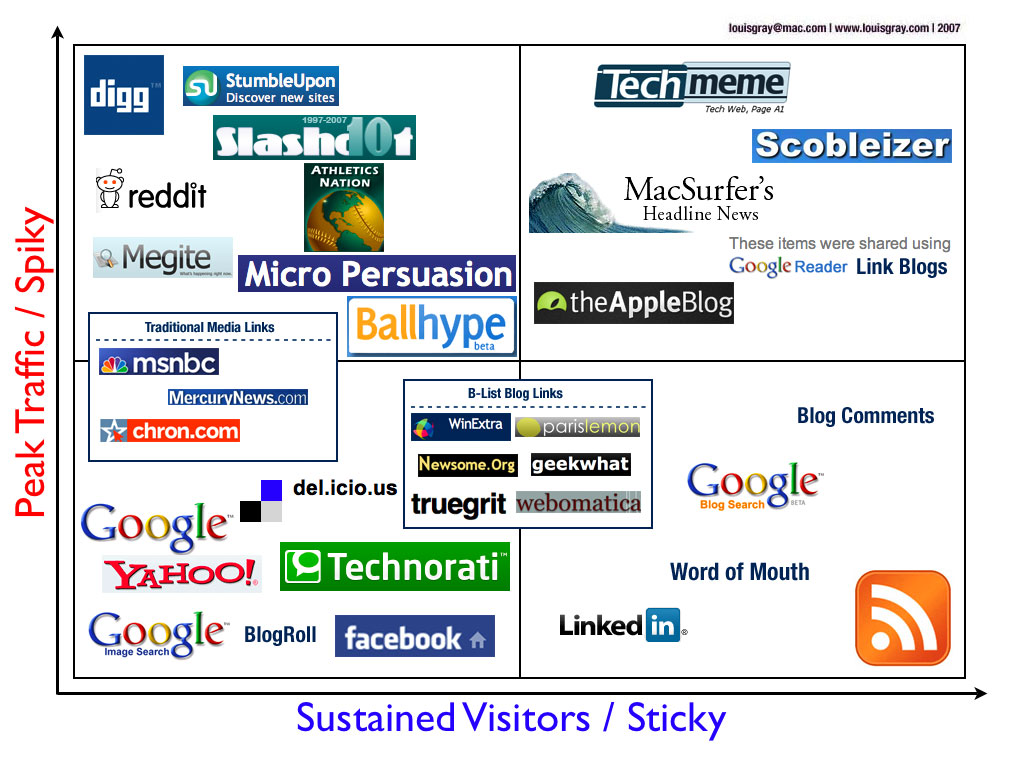
Download the Full-Size Image


While many tech bloggers live for the instant, drug-like satisfaction of hitting the Digg front page, or getting picked up by StumbleUpon or Slashdot, that rush of one-time visitors doesn't last long, and they won't come back again. A Digg visitor is usually one that won't comment, won't bookmark, and won't remember your URL.

Repeat visitors to tech blogs usually aren't forged by traffic spikes from well-known news hubs. Nor are they from search engines. It's a rare blog or Web site that can drive both high levels of both one-time visitors and repeat visitors. In fact, in my experience over the last two years of technology blogging, the very best sources for repeat, engaged visitors are:

1. Robert Scoble / Scobleizer
2. TechMeme
3. My own comments on similarly-focused blogs
4. Links from other B-List Bloggers
5. Shared Link Blogs (such as those from Scoble, Webomatica and others)

In fact, while I don't want to give Robert all the credit here, I have seen his hand in some of my highest-traffic posts. Often, his addition of my posts to his shared link blog or his own blog later leads to other bloggers linking, which pushes my post to TechMeme, in turn, leading to more follow-on posts and residual traffic.

But I can't just sit around and "write for Scoble", hoping he'll throw pixie dust my way. In order to engage with the crowd and encourage return visits, I need to link to others, make comments on other similar blogs, and make tools for engagement, like my RSS feed and MyBlogLog, easily accessible.

Thus, I've broken the Link Power Index into four sections:

1. High spikiness, low stickiness (Digg, StumbleUpon, Reddit, Megite, Slashdot)
2. Low spikiness, low stickiness (Google, Facebook, Technorati, Yahoo!)
3. Low spikiness, high stickiness (RSS, word of mouth, comments, LinkedIn, B-List linking)
4. High spikiness, high stickiness (Scobleizer, TechMeme, Shared Link Blogs, MacSurfer)

Last month, "BeachBum" asked, in regards to some of my less-desirable visitors from Google Images, "Do you find that the porn traffic converts or do they just come and go?". The answer is no. None of them convert. Unless I start writing about porn full-time, they're not coming back, and that's okay. While a one-time visitor may have found a keyword sequence on Google that had your blog listed #1 overall, it's unlikely they're your demographic.

In fact, surprisingly, links from B-List and A-List bloggers have been more useful to me than links from more mainstream media. While I was flattered to see coverage of one of September's posts on MSNBC.com and the Houston Chronicle, they didn't drive the traffic of a strong link aggregator, and their visitors, as far as I could tell, were one-offs.

If you want a one-time spike of traffic, go ahead and write to make the front page of Digg (Yuvi Panda's Round 2 analysis of Digg's front page shows how...) or get a group of friends to Stumble your content. But to cultivate readers and engage with the blogging community, you should comment often, share ideas with your peers, and hope somebody with real pull, like Scoble, or MacSurfer, notices your effort.

The above image is how I've interpreted sticky traffic vs. spiky traffic to louisgray.com in the last year-plus. Do you have any comments or insight? Am I off the mark, or have you seen similar behavior? Please let me know, and feel free to use the image yourself. Links back are always appreciated.

Also on this topic: Chris Brogan: Scoble Effect Better Than Digg and Search Engine Land: December 2006 Statistics Review

October 1, 2007

October 1, 2007 · 1 MIN READ · BY LOUIS GRAY

State of the Blog: September 2007 Recap

State of the Blog: September 2007 Recap

September 2007 In Summary (Archive Page)

Total stories published: 983

Total stories published in September: 41 (About 1.4 per day)
Total stories with comments: 18 (44% of all stories)
Total comments on September posts: 64 (About 1.5 per post, 3.5 per commented post)

Technorati Authority Ranking: 97 (down 20)
Feedburner Peak in Month: 124 subscribers (up 21)
Feedblitz E-mail Subscribers: 13 subscribers (No change)
MyBlogLog Members: 31 (up 2)

Monthly Traffic Rank in Last 12: 2nd (Behind only April)

Blog Value Estimator: $54,760.38

Top Five Most Visited September Stories (According to Summary)

1. Internal Linking on Some Tech Blogs Is Out of Control
2. Could Cal Football's #6 Ranking Be All Wet?
3. PlugandPlay Expo Highlight: Spokeo
4. Early Reaction to PlugandPlay Expo
5. Adding Movie Rentals to iTunes Would Save the Apple TV

Others receiving votes: A's 11-9 Win Kicks Off Big Sports Weekend, Slingbox Going Corporate Before I Get One!, Information Society Brings New Music to Old Band

Top Five Visited Archive Stories (According to Summary)

1. Soft-Core Porn, Sex Themes Power Google Video
2. Watch Every Episode of The Simpsons Online - Free
3. Google Video Still Peddling Soft-Core Porn Smut
4. BitTorrent Bails Me Out on TiVo's Simpsons Miss
5. 10 Suggestions to Improve Google Reader


The top four results here are unchanged from last month's report on August. Sex and the Simpsons, though not necessarily together, will always be hot topics.

September's biggest highlight, by far, was the Web-wide discussion of internal linking and its practice. We also enjoyed giving Molly two opportunities to give away Ballhype t-shirts to fans, attending the PlugandPlay Expo, and seeing the A's baseball season transition to Cal football. On to October!