Silicon Valley Technology Commentary & Archives · Est. 2006 3,034 Posts · 2006–2026

October 7, 2007

October 7, 2007 · 2 MIN READ · BY LOUIS GRAY

Weak 49ers Offense Doesn't Spoil My 1st NFL Game

Weak 49ers Offense Doesn't Spoil My 1st NFL Game

Somehow, I managed to make it to the old age of 30 before ever going to an NFL game. Today, I crossed that barrier, taking in the San Francisco 49ers' 9-7 loss to the Baltimore Ravens (Recap), in what was likely the best possible weather for a sunny Bay Area afternoon game at Monster Park.

I grew up a 49ers fan in elementary and junior high school, seeing San Francisco march to Super Bowl after Super Bowl in the 1980s to 1990s on the backs of legendary players like Joe Montana, Jerry Rice, Roger Craig, Steve Young, Ronnie Lott, John Taylor, and others. But as the team fell apart following Young's retirement, and my focuses were more in line with fantasy football individuals, rather than the teams they played on, I stopped caring - even as some part of me knew I was still a 49ers fan somewhere.

While I've attended more than 100 A's games, a few dozen Cal games, and a smattering of San Jose Sharks, San Francisco Giants, Golden State Warriors and Sacramento Kings games over the years, I'd never taken the trek to old Candlestick Park to see the 49ers play - likely a combination of the fact they play on Sunday, a suspected high price, and nobody else pushing to go. Today, that changed as some colleagues from the office offered up the chance for me to see the 49ers play, in their seats, which they gained by benefit of 4 season tickets. Donning the unfamiliar red and gold, we rooted for the 49ers to take over the game early, and put some points on the board, but they didn't do much at all on offense for just about the entire game.

In fact, the game turned out to be a defensive battle, as both teams put up goose eggs in the first quarter, and the 49ers went to half time trailing 6-0, on a pair of Ravens' field goals. While we yelled at the 49ers to take some chances and throw the ball downfield, they were a complete vacuum on offense, choosing instead to run the ball straight ahead for no gain. In fact, the MVP of the team's offense was likely the punter, who kicked 7 times for more than 300 yards, including three balls that were downed behind the 20 yard line.

After falling behind 9-0 in the 3rd quarter, the 49ers posted their only score and only real excitement of the game on the back of two passes from backup QB Trent Dilfer, making the game 9-7 to enter the final frame. 15 minutes and one missed field goal later, the team was all done, and so were we.

Was the visit a disaster just because the 49ers lost? No. Was it boring because they didn't score much? No - although I wouldn't have minded a 34-31 shootout, to be honest. Attending today's game with good friends was a lot of fun, and as annoyed as I was as to the outcome of the game, it's much more likely now that I'll be paying more attention to the 49ers, and I just might be willing to once again admit to being a fan.

October 6, 2007

October 6, 2007 · 1 MIN READ · BY LOUIS GRAY

Google Reader Chokes On Scoble Shared Items

Google Reader Chokes On Scoble Shared Items

Robert Scoble has been one of the most vocal advocates of both Google Reader, and the "Shared Items" feature within Google Reader, and I wholeheartedly share his enthusiasm. I'm currently subscribed to 216 RSS feeds. According to Google Reader trends, over the last 30 days I read 16,515 items and shared 280 items to my link blog.

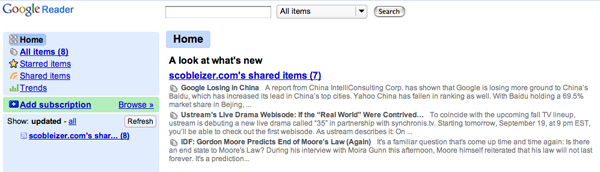
But it seems, like Facebook's 5,000 friend limit, Google Reader can't handle the sheer mass of shared items Robert shares. I added Robert's shared items to my Google Reader some time ago, and while I've found his selections strong, it's not uncommon for Google Reader to tell me I have new items from that feed, but have them unable for me to see.

For example, in the below screenshot, all my items, with the exception of 8 shared items from Robert, are read.


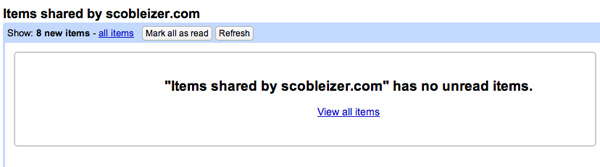
Yet, clicking on his feed, I am told that, in fact, there are no new items in his feed.


Even going directly to his shared link blog URL doesn't display the new items, but instead marks a point frozen in time, likely the last time Google resynched his feed.

I've never seen the Google Reader team mention a limit as to the total number of feed items in a shared link blog, or any feed. But while I'm subscribed to other link blogs, I've only experienced this behavior with that of Scoble. Could he be running up against an unwritten rule?
October 6, 2007 · 1 MIN READ · BY LOUIS GRAY

LDS Church Streaming Conference Live Via the Web

LDS Church Streaming Conference Live Via the Web

The LDS Church, commonly known as the "Mormon" church, has long been an adopter of technology to further the religion's message. Now with 15 million members worldwide in 176 countries, the church is the 4th largest Christian demonination, and among the fastest-growing worldwide. One of the vehicles for the church's growth has been openness. This weekend, the church's twice-annual general conference is streamed over the Web to viewers around the globe, to their homes and meetinghouses.

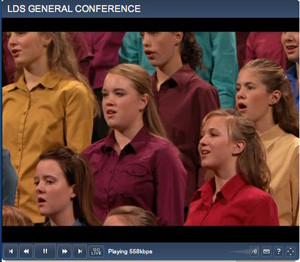
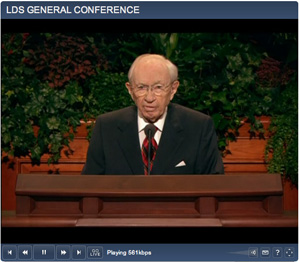
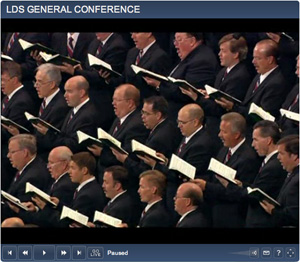
Available free to all via the church's university TV network, on BYU.tv, the conference's proceedings are streamed seamlessly with some of the clearest video I've ever encountered. No buffering, no jerkiness, and crisp sound.


Click to Enlarge Each Image

I get questions all the time about the church - whether at work, or from friends and acquaintances. While I can try and give my responses to the best of my ability, I am elated to see the church's adoption of new technology to embrace transparency and bring the message to all who care to hear. For a religion commonly dismissed as a cult by people who don't understand, it sure is open, available and inviting.

Previous Post: BYU TV Is Great Web Video Resource
October 6, 2007 · 2 MIN READ · BY LOUIS GRAY

How to See an iPod Touch Your Web site

How to See an iPod Touch Your Web site

Not too long ago, in June, we had the novelty of seeing Apple's pre-release iPhones surfing the Web, either from early adopters, Apple employees with early access, or simply in testing. Now, as Apple has also introduced an iPod capable of browsing the Web, in the iPod Touch, I thought it would be interesting to see how the iPod identifies itself to Web logs.
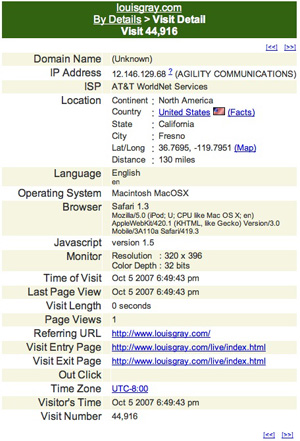
While at the Apple Store yesterday to pick up my MacBook Pro, I set upon a displayed iPod Touch, fired up Safari, and headed to louisgray.com. As I would expect, the site loaded in full, though it was drastically skinnied down to fit the iPod Touch's miniature screen.

Logging on to SiteMeter, you can see this visit as having come through AT&T WorldNet Services. Oddly, it registers as being from Fresno, California (though I tested from San Jose). All else is familiar to most Web site owners. The Operating System is displayed as MacOSX, and the Browser is Safari 1.3 - even though all Macs ship with Safari 2, and Safari 3 beta has been out for some time.

In fact, in June, the iPhone reported a later version of Safari:
Browser Safari 2.0 Mozilla/5.0 (iPhone; U; CPU like Mac OS X; en)

Unique to the iPod Touch, however is the machine's identification, of (iPod; U; CPU like Mac OS X; en). The iPhone, in contrast, identifies itself as the iPhone, simply enough.

As with most hardware manufacturers, the browser detail doesn't identify the model number or revision, by any means. When an Intel-based Mac visits my site, I just know it's an Intel-based Mac, not whether it's a tower or a laptop (unless I geek out into screen resolution detail), and if a Dell visits my site, I can't distinguish it from an HP or a Gateway computer. In that same vein, the iPod Touch doesn't say it's an iPod Touch, just an iPod, and going forward, the iPhone will likely continue saying its an iPhone, even if Apple went nuts and released new models, like an iPhone Nano or an iPhone Extreme, as is occasionally rumored.

So, if you want to know if an iPod Touch has been browsing your Web site, look for the browser detail and the keyword iPod. With the Web reaching well beyond computers, to handhelds, TVs, and mobile phones, we can expect to write once, publish anywhere, and hope the Web standards will display well for all.