
Silicon Valley Technology Commentary & Archives · Est. 2006 3,033 Posts · 2006–2026

August 22, 2008

August 22, 2008 · 2 MIN READ · BY LOUIS GRAY

Apple's "Ease of Use" Fails Me Again, Time Capsule the Culprit

Apple's "Ease of Use" Fails Me Again, Time Capsule the Culprit

Two of the major reasons I've been an Apple Macintosh fan from just about my first introduction to computers have been the systems' ease of use, and product quality. There was a time when I would be happier using a decade-old Mac than the latest-generation Dell or HP, and that I felt absolutely sure buying AppleCare would be a waste of money. But over the years, it seems product quality has slipped, and I'm almost as likely to get a bum product as one I can expect to be perfect.
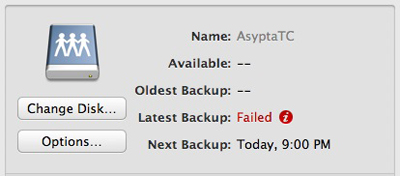


This most recent Saturday, I was delighted to pick up the long-awaited iPhone 3G, and also, a 500 Gigabyte Time Capsule, for backup. Now that the twins are here, I've been thinking to back up all their photos and videos would be a good idea.

So far, the iPhone 3G experience has been outstanding. I returned my Blackberry to IT today after transferring my phone number yesterday evening. Now that a friend of mine passed along a Bluetooth-enabled Jawbone headset, I can even make all those calls in the car without violating California's hands free law and being one of the thousands ducking below the dashboard to dial.


But the Capsule is an entirely different story. I unpacked it yesterday evening, installed the necessary software on my laptop, and plugged in the Capsule to my cable modem, as expected. Then I told Time Machine to find it, and start my first backup to the device.

It failed, saying, "the backup disk image could not be created".


So I checked out the settings and tried different things. I had the Capsule run the wireless network. I even tried plugging into the device directly, using Ethernet. No dice. And if I tried to drag and drop any files to the Capsule from my laptop over the network, they failed too. So, I took a paper clip, reset it to factory settings and started over. More shades of fail.

Try after try... failed.

Today, a friend on FriendFeed suggested that maybe the Time Capsule wasn't to blame, but instead, that my hard drive might have some permission issues. So, I tried that too. Why not?


Trying again this evening, I thought I had more luck, as the backup was "Preparing" for some time. But it too failed, saying "An error occurred while creating the backup directory."

Wandering through Apple's support forums shows I'm not the only person who has had issues like this, but after years of expecting Apple's product quality and simplicity to be a cut above the rest, I'm, like others, growing a little fatigued by products that don't just work right away, or making one of many trips to the Genius Bar to replace batteries, frayed power adapters, or laptop hinges.

I haven't yet decided how long I'm going to keep pushing to try and make this product work, but if it doesn't end up working out, and I end up returning it to the Apple Store, I'm not so sure I'm getting another one. I'm on Apple products all day long, so getting the entire experience down right is a must. I'm geeky enough that just getting an Apple product to work for me shouldn't be this hard.

August 20, 2008

August 20, 2008 · 5 MIN READ · BY LOUIS GRAY

The LDS/Facebook Rumor Didn't Pass the Common Sense Test

The LDS/Facebook Rumor Didn't Pass the Common Sense Test

In the absence of news, there's nothing the blogosphere loves more than an unfounded, nonsensical rumor, especially if two visible, but often misunderstood, parties are involved. I was amusingly dumbfounded this afternoon to find that today's rumor du jour settled on the idea that the LDS (or Mormon) Church had made an offer to acquire the hot social networking site, Facebook. While some, knowing only a mote of data about the church, suggested Facebook's strong database of familial interconnects would fall in line with the Mormon's well-known efforts in family history, the rumor was laughable on its face, which had me going from blog to blog saying it was complete bunk - which it of course, turned out to be.

See the nonsense here:As a life-long Mormon, I've grown used to people coming to conclusions about what the church does, stands for, or how its members behave. And despite the church being more open and active on the Web than almost any other faith out there, that I can think of, there are still pieces that remain mysterious, leading people to speculate well beyond reality. And today's rumor was just too juicy for people to pass up - and was more reminiscent of the Twitter-fed rumor that Subway's Jared had died than anything smacking of real journalism.

Whether it's a religious group, a person's country of origin, their race, their age or their gender, people have a tendency to make generalizations based on what they've seen through interacting with others, through what they've learned through the media and books, or been told about from friends or family.

When I tell people I'm Mormon, I'm often assumed to have a short haircut, wear a white shirt and tie, avoid cigarettes, coffee, tea, alcohol, drugs, and caffeine. Taking it a step further, people guess I probably spent good time in Utah, that I probably have 8 to 12 brothers and sisters, that I served a two year mission, that I likely graduated from BYU, married early and would have more than one wife if the laws were just a little more flexible.

At other times, I'll get the "You're Mormon? Really? But you're so normal!", which both gives me a sense of relief, but makes me feel somewhat guilty that I wasn't so exemplary a church member that it would have been obvious.

But while I can take the one by one issues with people who are ignorant, or just curious, today's rumor that the church would use a good portion of its estimated $30 billion cash horde to acquire a social networking site best known for poking and sending zombies to bite you was completely off the wall, and anybody who had any real knowledge about the church's mission had to have been giggling, knowing it had no basis whatsoever.

As a tithe-paying member, 10% of my total take-home income is donated to the church. While I don't dictate how the church uses my money, any more than I tell the government how to spend my tax dollars, I know that the funds are used to build new chapels and temples worldwide, to support the church's extensive welfare program that helps families in need, and to provide service in times of disaster. The church was extremely visible in aiding victims of the 2001 terrorist attacks, in responding to the South Pacific tsunami, and was instrumental in responding to Hurricane Katrina. In fact, the church's well-orchestrated service arm is so strong, that other faiths will often work with the LDS church while encouraging their own members to provide donations in times of strife.

And this has nothing to do with buying any social network.

In regards to the intimations by some that this was some scheme to lop a massive database into the church's genealogical archives, that too made no sense. As members, we are encouraged to pursue our family history and look backward to our ancestors, but we can only submit names of those with whom we are relatives. We don't submit friends' or celebrities' data, and we're certainly not out there buying lists to do a mass import.

But, clearly, not everybody knows this, and that can only be due to a lack of trying to understand.

The LDS church, whether you believe their doctrine or not, has done an amazing job at providing materials for visitors to understand their goals, their current events and their curriculum. Not only do they provide every word of their scriptures, including Book of Mormon, the Bible and all cross-references and footnotes online, and make them searchable, but they stream their semi-annual meetings online, they provide all church magazines going back to 1971, in full text, online, and all curriculum materials. This means any Web surfer can know this week's Sunday School lessons or see the church leadership's comments on world events. And all texts available to rank and file church members are visible to any site visitor.

Yet somehow, the church is seen as mysterious. Even though the church is among the fastest growing worldwide, and all these resources are available, the fact there are denominational differences and behavioral differences between the church and its members, makes people wonder if there's more to the story. That's partly why today's rumor took off like it did. Eric Eldon of VentureBeat wrote, "It got legs because it was so ridiculous, yet intriguing."

It was at least ridiculous. The good news is that, as church members, we've seen this kind of annoying misunderstanding before. It's the same kind of herd mentality that associates the church with the HBO series "Big Love", the same ignorance that linked the church with the odd polygamist sect in Texas earlier this year, or those who forced Mitt Romney's hand, making him do a pronouncement on religion earlier this year. It seems that no matter how many questions we answer, or how open we are, people would prefer not to understand and recognize that the church and its members are not secretly plotting to buy out the Web, and we aren't trying to take over the world. While Duncan Riley of the Inquisitr was good enough to have a little fun with it, many of his sources were of course from anti-Mormon sites or incorrect material, which he's not faulted for finding. And others didn't even do the basics of a simple Web search to understand how to contact church authorities and find the truth.

As one fellow member wrote me on e-mail today, "These guys are not drunk, they are smoking something really strong. It may be a slow day, but that does not mean they need to break the word of wisdom. If they are not smoking it they should at least not inhale."

See Also:
Being Mac. Being Mormon. It's Quite Similar.
Mormon. Liberal. Not Conflicted.
August 20, 2008 · 5 MIN READ · BY LOUIS GRAY

Why the Embargo Process Is Broken and Why We Still Need It

Why the Embargo Process Is Broken and Why We Still Need It

In the world of public relations, press management and blogging, an embargo sets a date and time by which a story can be written. Often, the embargo date and time coincides with a press release from the company, a Web site refresh, or the product's availability. Assuming all goes well, an embargo restricts all outlets from publishing a story until all is ready, and assuming multiple parties have been briefed, you can expect a waterfall of stories and press coverage to flow in a short period of time.


But, as you know, any time humans are involved, things can go awry, especially, as you see often in the blogosphere, you have a large number of media outlets that cover similar spaces, and a scarcity of topics. The resulting clamor to be heard amongst the noise, when so many different people are writing very similar stories, makes for an environment where the slightest bit of mistrust can turn into a simmering feud, or outright frustrating and finger-pointing, be it at a competitive blog, or the people behind the service being launched. Add in to the mix a rising number of inexperienced writers, prone to mistakes, with high levels of visibility, and this can happen with some regularity.

To start, why would a company ask for an embargo?
    1. To be sure a product would not be pre-announced before it was ready.
    2. To prepare and have enough time to brief all interested parties.
    3. To ensure no favoritism was shown to any media outlet.
Why would media/press/bloggers agree to an embargo?
    1. If they wouldn't agree, the company might not give them the story.
    2. Because an embargo often comes with news ahead of time, allowing time for writing.
    3. The service might have given them an interesting non-standard angle.
At an enterprise company, a media and analyst tour typically consists of a series of face to face meetings, plus conference calls, with an agreed upon date for a press release that coincides with the product's launch. Reporters often are looking for customer references and analyst references to validate the company's claims or add a wrinkle to the story.

For more bare-bones operations, including startups focused in the Web space, face to face meetings are less necessary. Sometimes, a series of e-mails, with potential for a phone call, is all that's needed. That's why you, on most blogs, rarely see quotes from a company's executives or customers, even if they had an extensive beta. Most bloggers, even if they have tested a product themselves, are echoing a press release or e-mail introduction from the service's founder. Again, a date is usually referenced in the e-mail to "go live".

Sounds good. Right? So why do these nicely laid plans fall apart?

On the company side:
    1. Sometimes an embargo is for "everybody except one or two publications", who are allowed to break it.
    2. Sometimes the Web site or company blog can go live before the embargo, in effect, scooping themselves.
    3. Sometimes a story isn't all that much of a secret, and things leak to the point there's no reason for an embargo.
On the media/blog side:
    1. Going first is seen as being "special", even if it's a matter of minutes.
    2. Being first can make the originating blog get more attention and linkage, or prominence on sites like Techmeme.
    3. Some blog management systems aren't fool-proof, enabling stories to go "before their time".

Clearly, you have some juxtaposed issues. The company launching an announcement would benefit from being covered by the most publications as possible, seen by the highest number of people. This is augmented by a need to be seen by publications with a high level of prestige. (Think Wall Street Journal, News.com, eWeek, TechCrunch, etc.) But there's something of a magnetic pull on press or blogs to go early, whether that's at midnight on the day of launch, or by posting five minutes before an embargo is lifted, and simply moving the timestamp, as has been known to happen. Blogs and press publications get a lot of visibility through gaining exclusives, and even if the same announcement has been sent to a wide audience, to hit the "post" button a little early, getting the word out first makes you appear more "in the know".

Whether intentional or not, blogs are rewarded for breaking embargoes, even if it hurts the launching service. And there's rarely any level of repercussion, as competing blogs in the know of the embargo are not naming names.

Of late, I've seen a healthy dose of complaining by some bloggers that other blogs have willingly or unwillingly violated an agreed-upon embargo. Yet, interestingly, it's a rare person who will name the offending party, even after their activity has clearly irked them.

See for instance:
    Svetlana Gladkova of Profy:
    "Very-very angry. Is it impossible to run a blog without breaking embargoes these days???"
    08:23 PM August 18, 2008

    Allen Stern of CenterNetworks:

    "wtf is up with the broken embargoes this past week - 3 today, 5 in the last week - im feeling like busting out a video tonight"
    06:32 PM August 18, 2008

    Marshall Kirkpatrick of ReadWriteWeb:
    "PR just called to say that mainstream media guy broke embargo, lol. you can't trust those mainstream media types with embargoes!"
    02:18 PM August 15, 2008
Notice how even though they claim frustration and anger, nobody says who the offending parties are...

Embargoes serve a real purpose for the company making the announcement. They are there to build time to polish the product, to enable true beta testing, to set up press activity with multiple targets, and to get one's message distributed. Embargoes serve a purpose for the blogging community, for those who choose to follow them, to help guide an editorial calendar, or to be sure you're also talking about a story on the day of its debut. And while some people might wish they disappear, it's not going to happen, so long as companies look to synchronize their internal and external activity.

As we see a rise in the total number of bloggers writing on the same topics, the issue of some sites trying to get out a step ahead of others isn't going to go away. Those that play by the rules and follow the agreed-upon embargoes, are on occasion, going to get burned. But what doesn't help the situation is that nobody is making a list and checking it twice. Why complain if nobody is going to name names? If there are one, two, three or ten blogs that regularly break an embargo, and it's clear there is a pattern, it should be visible, and these sites should be avoided by companies like the plague.

I believe in and honor embargoes. I also love exclusives, and think that there is more than one way to launch a product. But this practice is tried and true, so long as we have more transparency. What disincentive is there for bloggers who break embargoes if nobody steps up?

August 19, 2008

August 19, 2008 · 1 MIN READ · BY LOUIS GRAY

NewsCred Launches With Two Critical Supporters

NewsCred Launches With Two Critical Supporters

NewsCred, a site aimed to bring "all the world's credible news in one place", went live today, offering news junkies the ability to not only catch up with the day's events, but also to select their sources of information, and rate their credibility. In theory, one could grade a media outlet up or down, and the crowd's input could highlight whether a source for news was trustworthy or not.

The service has already gained substantial coverage, including from TechCrunch, Profy and Mathew Ingram, for starters, but more importantly, the service clearly values not only the community's opinion, but the community at large.

Witness their outreach to two of the world's future newsmakers, Matthew and Sarah Gray:


As Shafqat of NewsCred wrote me earlier today, "WOW. That is possibly the best thing to happen to us all day. Thank you for putting everything in perspective - they are adorable and we're thrilled to be able to share our launch with your kids!"

So it is possible to launch new products and make friends with the community at the same time, by having fun and stay credible too. Now go check out NewsCred or one of these babies will have a tantrum!