
Silicon Valley Technology Commentary & Archives · Est. 2006 3,033 Posts · 2006–2026

August 26, 2008

August 26, 2008 · 5 MIN READ · BY LOUIS GRAY

The Following/Listening Ratio - Are Your Followers Actually Listening?

The Following/Listening Ratio - Are Your Followers Actually Listening?

By Jesse Stay of Stay N' Alive (Identi.ca/FriendFeed)


Let's face it. One of the main reasons you and I, and almost anyone, are on social services is that you want to interact with new people and expand your current network of connections. There's no doubt about it that there's power in this concept - as you grow your network with quality people, you will meet others that could potentially help grow your brand, share your product, or build your audience. A large audience is valuable.

In the early days of Social Networking (hmm...that would be what, 1 year ago?), growing your network and having the majority of those following you also listening to you was very easy to achieve. It was simple - if you followed someone, you were making a commitment to also listen to their updates. I'm seeing a trend amongst my followers, however, which I think is changing the effectiveness of this technique. Where just one year ago, I was usually one of among 20 or 30 people my followers were following, quite a large part of my followers today are following 200 people or more.

I'm noticing on the larger networks like Twitter that the conversation is starting to fizzle. I may post something, but I don't always get the responses I used to. My followers are simply following more people now and I'm one of hundreds they have to pay attention to. I don't take offense to this - on Twitter I too follow over 1,200 people. I have my own strategy for listening to the most important posts using track and RSS and other techniques, but I'll be first to admit I don't catch every single update like I used to. Twitter has now become an aggregation and information tool for me for learning about people and events - it has lost much of its "conversation" nature that it used to have. This is the case for many other people, and not just the big bloggers and early-adopters any more.

The Follower/Listening Ratio

This begs the question, at what time does a social service lose its effectiveness in building relationships through communication, and at what time does it become purely a "data gathering and sharing" tool? Ideally, if all your social services, networks, and tools had the perfect ratio enabling all who follow you actually listen to you, your potential for a successful network of followers/following would be much more effective. This is the problem when social services like Twitter get too big - they foster the lack of good relationships the bigger they get, especially if they don't build the tools to foster this. Limiting the number of people you can follow doesn't necessary solve the issue though, as there is still power in also being able to aggregate and track information about lots of people.

I'm currently posting most of my updates via Identi.ca. They will have this problem as well if they grow too big, but one solution for me is to ensure I'm always on the new, upcoming networks so that the number of those people listening to me are following remains small, and more people are paying attention to my updates that way. Not everyone can do this though, and I'll admit this isn't the ideal situation and will not last for long.

Sites That Do it Right

There are a few sites that seem to be doing this right (to an extent), and frankly, I'm seeing much better communication and relationships fostered via those services vs. the other services like Twitter that seem to be getting bigger without the proper tools to foster such relationships. Two of those stand out with some great features to foster this ratio and keep it strong that I'd like to share.

Facebook

Facebook, the big monolith that hit 100,000,000 users today, seems to have grown well with tools to enable users to foster their relationships. Facebook is supposed to be about people, after all. First of all, Facebook allows categorization of friends into "lists" which you can arrange privacy settings around and allows for easy sending of mail to groups of people. Setting privacy settings allows each user to ensure only certain groups can see certain pieces of information about them. This helps reduce the unneeded information your followers see, and ensures they only see the most important information that they would be interested in about you.

In addition to that, with the new Facebook design, you can now filter out what you want to see about people. So, if I no longer want to see information about Joe I can hide that in my news feed and his updates will never appear again. I'm still friends with Joe, I can still contact him and interact with him, but this way I'm truly paying attention to those I'm truly interested in. In addition to that I can do things such as filter so I only see photos, or only updates from a certain application. My capability to listen is better on Facebook, and the ratio I mention is much better. The discussions are better and happen more often on Facebook because of this.

FriendFeed

FriendFeed has some similar filtering functions to Facebook. Let's start with the current features, and the ability the FriendFeed gives you to "hide" updates by a particular individual. If you don't want to see updates by someone, just "hide" their updates and only the updates from those you're interested in will show.

Yesterday, FriendFeed also announced some brand new features that make building and fostering relationships and discussion much better. For instance, I can add particular individuals to a "favorites" list. This means I can now follow all the updates of my favorite "followees" and just skim the rest. This ensures that more people are listening to what they want, and not ignoring the things they might not want to ignore.

With these tools, Facebook and FriendFeed become much more effective tools for growing and fostering your network. It's important that as you grow your network that you ensure that not only are you building the network, but that those following you are actually listening to you. Choosing the right network and strategy to do this is important. Having 1,000 followers on Twitter may not be the best thing for you if not all of them have a way to pay attention to your updates. Pick the networks (and the two I mention aren't the only ones - they are just the two I use) that work best for you at fostering conversation and relationships, and it may just be okay to ignore the others, or at least focus a little less on them as you build your relationships through the more effective methods.

What are some better ways you would recommend to strengthen the followers/listeners ratio of your network?

August 25, 2008

August 25, 2008 · 4 MIN READ · BY LOUIS GRAY

If You Look Hard Enough, Conflicts of Interest Are Everywhere

If You Look Hard Enough, Conflicts of Interest Are Everywhere

Cyndy Aleo-Carreira, contributing editor at The Industry Standard and professional guest poster in a number of Web sites, including this blog and Duncan Riley's The Inquisitr, has a great discussion starter this evening on bloggers and their conflicts of interest. The piece, titled Out of the Navels and Into the Mirrors, asks specifically if bloggers should talk about companies where they have a financial investment, any kind of part-time or full-time role, or if they should become friends with those they cover. Though broad, her questions likely resonate with many of us involved in blogging and reporting in general, and it's very likely you'll find a wide array of answers, depending who is polled. But each of us comes in with specific likes and dislikes, or personal history, which impacts everything we do, and displays our underlying bias, financial or not.

First, she asks, "Should bloggers cover companies they invest in?"

I almost immediately want to say no. But in actuality, investors in a company usually know it very well, especially if it's an early-stage situation, where they will know it better than the general public. It's no secret they'll likely be more positive on the company, but if they're fair and disclose the relationship, you may learn a great deal.

Good examples of people who talk about companies they are invested in include Fred Wilson of AVC, and Mark Cuban of Blog Maverick.

Second, she asks, "Should bloggers continue blogging once they join boards, take day-job positions with a company, or start/buy a company?"

Again, disclosure is needed. There are many official company blogs that are written by employees, openly. There are other blogs, like Mini-Microsoft, written anonymously, by an employee who is not an approved representative of the company who has unique insight as a full-time employee.

In a more close to home case, Adam Ostrow, CEO of ReadBurner, stopped blogging about ReadBurner on Mashable when he helped acquired the site. (See also: Did ReadBurner Acquisition Cause Conflict of Interest for Mashable?) When I joined the team to help as an advisor, I spelled out my hope to be transparent, and will disclose the role any time I get close to talking about the space.

Finally, she asks, "Should bloggers make friends with people from the companies they cover?"

I think this is absolutely human nature. I have a tendency to be positive on this blog. I talk about companies I like, services I use, and others I have big hopes for. In the process of investigating these services, often I trade a lot e-mails and phone calls with entrepreneurs, which can get to knowing them well or considering them friends. Most of the time, it's not the same kind of friend you can watch a baseball game with or catch a movie, but you do end up rooting for them and may at times gloss over some bugs in hopes they'll suceeed. (See also: My Double Standard for Web Services and Does Negativity Deliver Credibility? If So, That's Nuts.)

Being friendly can lead to a more collaborative environment, where you can both get information early, but also lend a helping hand to those who need it. I've never shied away from playing an informal QA role for services that need aid, and I want to instill a level of trust with those I do engage so they know they can trust me with confidential data.

Beyond these questions, my biases are everywhere, and they impact how I write and my opinions, which do show up. I happen to prefer Apple Mac OS X to Windows, even with the occasional glitch that impacts my Apple experience. I happen to be LDS and wasn't too excited about the rumors spread last week. I like sports, I tend to think Cal is better than Stanford at just about everything, even when it's clear I'm wrong, and I do have friends in the blogosphere - some of whom I've done podcasts with or traded e-mails with or phone calls. I will link to them more often, I will interact with them on social sites more often, and I will comment on their posts more often. (Cyndy and Duncan included)

On rare occasions, interactions with people behind services also results in free stuff, which for some, could lead to bias. I have free t-shirts from Disqus, FriendFeed, and Browzmi, for instance, all which came after I wrote about them a few times. I have a world-famous CenterNetworks sticker, and my babies have schwag from ReadBurner, Shyftr, NewsCred and other places (largely because I asked for it). I also represent standard demographics. I'm male in my early 30s. I live in California, in the Bay Area specifically. I work in the tech sector for a private company, and have since 1998. I have two young kids. Each of these things impacts my view of the world and what I like or don't like.

Rather than setting hard and fast rules about bloggers going out of their way to avoid topics they likely know well, or asking them to be friendless automatons, we should ask them to be more transparent and clear if they are acting with real bias. It's that which will make the difference between trusted and untrustworthy - and enable bloggers to look in the mirrors comfortably again.

August 24, 2008

August 24, 2008 · 4 MIN READ · BY LOUIS GRAY

There is No Social Media Overload

There is No Social Media Overload

Every day, there are more and more great services to investigate in the world of social media. Each one breaks new ground in terms of features, focus or user interface. There are many different sites that target general social networking, some are for business, some are for dating, some are for microblogging, and others for service aggregation. And there will be many more. While some are calling for a pause in the innovation, somewhat fatigued by the implied redundancy or overwhelmed by chasing down comments and conversations in new places, it's worth noting there's time in the day to manage a good number of sites, and not all the winners have yet been crowned.

To have a full deck of social media tools, you essentially need the following:
  • 1 or more blogs that you manage.
  • 1 or more accounts on an RSS feed reader.
  • 1 or more microblogging identities.
  • 1 or more accounts on a business networking tool.
  • 1 or more accounts on a social network.
  • 1 or more accounts on a service aggregator or lifestream.
(Also helpful: A social bookmarking site, online photo site, music recommendation service, etc.)

For me, this means I blog here, use Google Reader, Twitter, LinkedIn, Facebook and FriendFeed as my core applications for each category. But below these headliners are others.

For RSS, I also use Shyftr and liked AssetBar before it went away. I've tried Bloglines, FeedEachOther and NewsGator as well. There are also tools that interact with RSS, like Toluu, which helps you find feeds your friends like and integrates with Google Reader, and the sites dedicated to finding the most shared items in Google Reader, like ReadBurner, RSSMeme and Feedheads. (Disclosure: I am an advisor to ReadBurner)

For microblogging, beyond Twitter, you have Identi.ca, Plurk, and now, Rejaw. I'm signed up at each, but use Twitter primarily, copying posts to Identi.ca, via Posty. I need to check out Rejaw more, but am no expert.

For business networking, there's also Plaxo, which has morphed into a lifestreaming application.

For social networking, many still use MySpace, or Friendster, but Facebook has the momentum and the development on its side. Orkut never got the traction expected.

As for lifestreaming and aggregation, I am absolutely overweighted here, and I enjoy it. Justin Korn referred to it as "Super Kickass Social Network Following Power", but if you're interested, it's fairly easy to be engaged on sites like FriendFeed, Social Median and Strands all at once, like I'm trying to do.

I like FriendFeed because it easily pulls in my activity from around the Web and has a sharp community with good conversations and hiding. I like Social Median because it lets me just see news and posts on topics I pick or from people I follow. I like Strands because it has similar elements to FriendFeed, but more filtering and some good potential. I also know it can continue to improve because it’s early. Just in the last 36 hours, I've gone from being a nothing on Strands to having more than 100 people whom I can interact with.

Below this crust of leaders, you also have smaller sites like Yokway and LetsProve, where I'm registered, but haven't done much of late. FriendBinder doesn't seem to have taken off either, and BlogRize, though interesting, got quiet fast, and seems to have gone away, as did Mergelab. The truth is that we don't know which sites are going to win, and it makes sense to be registered everywhere and active on those places where you find the best community and the best content.

Of course, just because I sign up for something, or find something, doesn't mean that you're obligated to try it out. Not all sites are for everyone. But I'm far from being overloaded with Social Media. You just have to find balance, time, and keep remembering there is no quota and you don't have to read everything. Contrary to some belief, I'm not constantly on each site. I just read quickly, decide quickly and respond quickly. None of these sites is a real big time sink, unless you force yourself to read everything. It's easier to let your friends decide the best pieces, and for you to rely on search tools to get the rest, whether it be through Twitter Search, or pre-determined Google blog searches.

The only way you get social media overload is if you don't manage it well, just like you can get RSS overload or e-mail overload, or so I've heard. Even as there are more services to engage with, the number of hours you have to work with them is still the same. So do check out as many as you think have potential, and stick with the ones that offer you the community you're looking for, the engagement you need, and the best feature set. You'll find your niche.

See Also:

August 23, 2008

August 23, 2008 · 4 MIN READ · BY LOUIS GRAY

Strands Lifestreaming Beta High On Potential and Filters

Strands Lifestreaming Beta High On Potential and Filters

There's no question the lifestreaming space has just exploded over the last year, with services like Plaxo Pulse and FriendFeed leading the way, accompanied by MyBlogLog, SocialThing, Profilactic and others. Practically all services aggregate your social activity across networks and let you display it in one area, with the option to follow friends and interact with their activity. One of the newest in this space is Strands, which bills itself as a destination site for people to discover new recommended items around the Web from friends. The service, currently in private beta, has some very interesting features, but also has a lot of room to go to supplant one of the bigger names.

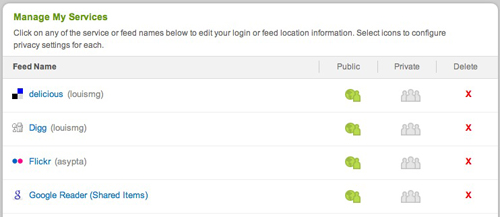
As with the many other alternatives out there, you start your activity on Strands by adding your many services around the Web, starting with the most well-known services, like Twitter, Google Reader and Delicious, but the service also supports several other sites not commonly found elsewhere, including Webshots, BlockBuster, Hype Machine and Meneame.


When you add these services, as with other competitors, Strands creates a feed for you, which can then be subscribed to by other users.

As you currently can only get into Strands by being invited, you will start out with at least one friend, but you can find more users by seeing who your friends follow, or by clicking the people button at the top of the page. Strands, as far as I know, has the best array of ways to discover new followers, showing you who is the most followed, who's new to the site, or who is the top by a specific category, like Blogs, Images, Music or Bookmarks. Each person's profile is displayed with their avatar, gender, age and location. You can also search by name or e-mail.

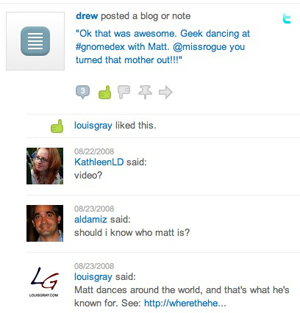
Once you have subscribed to a few people, you can see their activity on Strands' Home screen, which displays, chronologically, the item posted, who added it, the service it originated from. You can then take action on those items with a simple Like or Dislike, indicated by thumbs up or thumbs down, you can comment on the item, click a pushpin to indicate an item is saved, or click an arrow to forward the item to those who follow you. (The equivalent of resharing on FriendFeed)
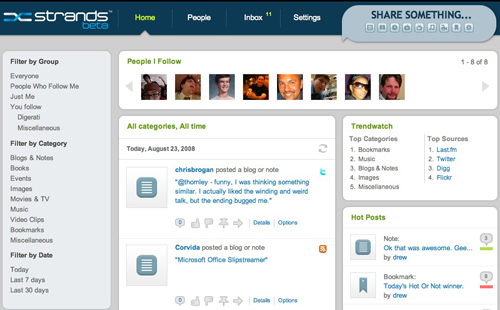
The interface for Strands if both cluttered and spartan at the same time, if that makes any sense.

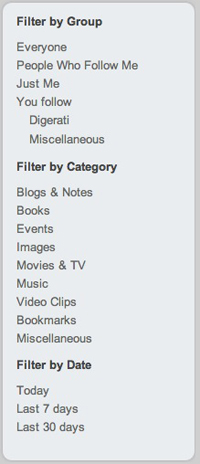
Unlike FriendFeed, which offers a clean white background, soft gray text for comments, but little else, except a top navigation bar, Strands offers a wide array of ways to sift through the noise and find specific items. You can filter your feed by people who just follow you, you can show your own feed, or show subgroups of your friends. For example, I started a group called "Digerati", that includes Chris Brogan, Marshall Kirkpatrick, Corvida and others on the site.

You can also filter by category, including Blogs & Notes, Images, Music, Movies & TV, Bookmarks and others. FriendFeed offers this functionality by service by clicking on the service icon, but it's not spelled out, nor does it group similar services (like Delicious and Magnolia for instance). On top of filters, you also have "Hot Posts" which show items popular with your friends, marked by likes and comments, and the ability to have granularity, so you don't share all services with all people. For example, you may want to share some items with friends, but not family or coworkers.

The many different options on Strands make it useful to find things fast, but it also shoehorns the Home feed into a small center position. Arguably, this is the most important part of the site, so its power is greatly diminished. Strands also doesn't auto-refresh, asking you to click a refresh icon on the page, or in your browser. This gives the site more of a static feeling than other sites which do autorefresh, where it seems new data is constantly coming in.

Also, like most good services today, Strands offers a desktop alternative to the Web site with an Adobe AIR application, which keeps you updated on your friends' activity and watches your iTunes to capture what you're listening to, as well as a bookmarklet.

Does the world need another lifestreaming service? With so many on the market, it's interesting to see what aspects one site will get right or what they'll miss. Strands doesn't have the feeling of community today that FriendFeed does, given its newness and obscurity. And like many engineering-driven services, it can be seen at times to have sacrificed the user experience for more features. I've said previously that "the feature war is the wrong war" for social media, which needs to find new ways to connect people, their likes and their activity. Strands does a good job letting me drill down into specific areas, or in helping find new folks, but I'm hoping they can reduce some of the site clutter, and make the site really come to life.

As the service is in private beta, I have a very small number of invites, so leave your e-mail in the comments if you are interested, and I'll see what I can do.
DISCLOSURE: I was introduced to Strands by Drew Olanoff, the Community Manager at Strands, who started there in July. Drew is also the CTO of ReadBurner, where I am an advisor, and hold a small equity position. While Drew gave me an account to test Strands, he did not request an article, nor review this in any way.