
As I've mentioned several times before, I border on pack rat behavior when it comes to my e-mail. I very rarely tend to throw anything away - unless it's clearly spam or advertising from someone I don't know. For whatever reason, I save Twitter direct messages. I save responses to statuses on Facebook. I save receipts from iTunes purchases. And I definitely save e-mail confirmations from services that tell me when somebody has started to follow me online - whether that be on
Facebook,
Socialmedian,
Twitter,
FriendFeed,
Strands,
Disqus, or practically any one of the services I use with regularity. With an extremely active 2008 final and in the books, I thought I'd dust off my nerd-approved calculator and see what the trends looked like. If you're willing to say that a single data point indicates a trend, I found the results very interesting.
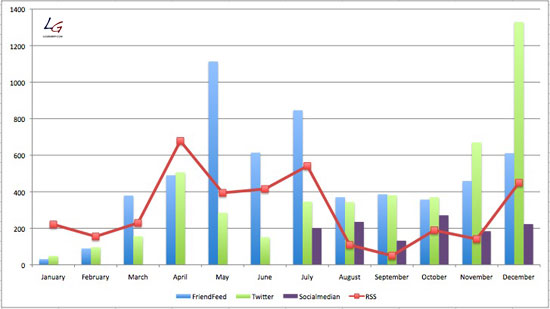
For the purpose of this navel inspection, I tracked four numbers, including new subscribers to my RSS feed, to Twitter, FriendFeed, and halfway through the year, Socialmedian. It was FriendFeed, Twitter and Socialmedian that saw the most activity for me in 2008, and cognitively, I thought I could sense when one service was spiking and another plateauing.
See the below graph:
RSS Data via
BlogPerfume. Some dates to note: 1) I was a FriendFeed user prior to 2008. 2) I joined Twitter mid-way through January of 2008. 3) Socialmedian introduced the "Newsmaker" feature in mid-July of 2008.
At the end of 2007, I had approximately 200 RSS subscribers, and by the end of 2008, that number was approaching 4,000. Interestingly, the 4,000 to 5,000 number is close enough to the number of followers I ended up with on both Twitter and FriendFeed by the end of 2008, with an undoubted extremely high amount of overlap. But while the services are around the same number now, how they got there tells an interesting story.
Early 2008 was relatively quiet in social media. While
MG Siegler and
I had joined FriendFeed, and were cajoling others to join it, in beta, the service was lightly used prior to its opening to the public. At the same time, I was enjoying writing about newcomers to the Web, like
Assetbar and
ReadBurner, and, for the first time, gained notice from some strong Web junkies who helped the site gain visibility and RSS subscribers.
I joined Twitter somewhat reluctantly in January, and its growth was good,but relatively small when compared with FriendFeed's boom, especially from March to May as the service exploded onto the tech scene - including more than 1,000 subscribers in May alone. But as is common with many products, FriendFeed's initial spike settled down into a consistent level after the launch, dropping to a third of its peak, below 400 each month from August to October.
At the same time, Twitter's problems with uptime were reducing my use of the site, and others as well. I saw new followers of less than half April by June, before Twitter too settled in at a level almost equal that of FriendFeed.
In July, Socialmedian added a Newsmaker feature, which saw anywhere from 100 to 300 new followers through the end of the year, not quite the level of Twitter of FriendFeed, but respectable.
After a stable Fall, November and December saw a resurgence across all metrics, likely the result of more posts on louisgray.com, as I added additional writers and expanded the posts' reach. But while FriendFeed's climb was gradual, Twitter has exploded - delivering more than 1,300 new followers in December after almost 700 in November, and January 2009 is on track for even more.
Oh! And I barely mentioned RSS. While my aggregate number was much higher by the end of 2008 than the end of 2007, you can see much of the momentum I had was gained in the first half of this year. It could have been due to their being a limited number of tech geeks in the echo chamber. It could have been due to a higher profile on
Techmeme, which decreased significantly in the second half. And it's always possible I overweighted social media versus the blog in the second half of the year once the twins were born. Not sure. But what I do know is that with the broader team in place, we are reaching new people, so if I couldn't get any bigger on my own, now I've got help.
So, navel gazing aside... does this show that FriendFeed's spike and then reduced profile is set to grow further again, as the trend from October shows? Is Twitter breaking into the mainstream, as November and December suggest? And will Socialmedian ever trump either of those two? Are you nuts enough to keep all this data like I have, and have you seen the same trends?
 Following last week's discussion around 10 ways you can maximize your Google Reader Link Blog, Yuvi from The Statbot went to work and pointed his super-geeky analytical skills at my own link blog, which I've been filling with shares for the better part of two years. Given I can only look at my Google Reader trends over the last 30 days, his data has brought a lot of insight.
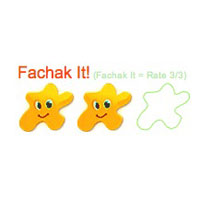 Fachak, at present, is really rough, and really early. There's simply a lot of little things that need to be tweaked, improved, or revised. For example, three little stars appear underneath videos, giving the indication that you can vote for the content. The expectation is that if you click a star as a logged in user, you should be able to submit your own vote. Instead, you're brought to the content drilldown page. When you relocate the stars on the drilldown page, the voting mechanism is again a little bit clunky. No matter which of the stars you hover over, the text "Rate 3 to Fachak It" appears. And when you final select one of the three, your vote is collected, but you're not informed of how your input affected the overall ranking of the content.
  That I am not a fan of Web advertising on Web services and blogs is not a big secret. I was