Silicon Valley Technology Commentary & Archives · Est. 2006 3,032 Posts · 2006–2026

May 19, 2009

May 19, 2009 · 2 MIN READ · BY LOUIS GRAY

Tech Geek Nutrition: Introducing The Amazing Vitamin P

Tech Geek Nutrition: Introducing The Amazing Vitamin P

Editor's Note: It doesn't take a medical degree to know that many of us tech geeks whose lives circle around our computer aren't getting the best nutrition or exercise. With that in mind, I asked my father, an MD who works for the state of California's Department of Corrections, to provide a family favorite, his article on "Vitamin P". This article was previously printed in Stitches, a humor magazine for physicians in the November – December 1992 edition. -- Louis (PDF Available)
Guest Post By Richard N. Gray Jr. M.D.

What do you do when a patient comes to your office stating he doesn’t feel well because his ribosomes are hurting? Obviously, the traditional history is obtained and a physical exam performed. If, after consideration of all entities in the differential diagnosis, the problem turns out to be ribosomalosis, hypovitaminosis P should be suspected, as this is the most common etiology of ribosomalosis(1).


Vitamin P is an obscure, but definitely essential, fat-soluble compound found in such foods as peanuts, potato chips, pies, popcorn, pizza, pop (i.e. psoda pop), pickles, peanut brittle and other such foods. It binds reversibly with the (you guessed it) P-10 receptor protein of the ribosome, stabilizing the organelle, leading to improved protein synthesis. The critical importance of vitamin P is reflected in the fact that it’s measured not in RDA’s but in a recommended allowance weekly, generally called the RAW score. The RAW scores of a variety of foods(2) are listed in the accompanying table.
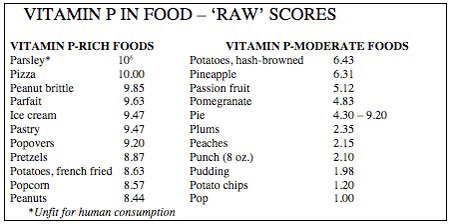

Before you become skeptical about this important nutrient, consider the research done by Dr. Francis(3), who showed that a large quantity of peanuts enhances the advantageous qualities of beer, a known ribosomal stimulant. Also consider the increased needs for vitamin P exhibited by adolescents, who consume huge amounts of foods containing this vital compound.

As with the other fat-soluble vitamins, there is a hypervitaminosis state, but it is rarely encountered unless parley is eaten. Parsley is to vitamin P what polar bear liver is to vitamin A. It simply needs to be avoided.

Also a contraindication to high vitamin P intake is the pregnant state, in which, according to recent research(4), the yin and yang forces are upset. If such a problem is suspected, the obstetrician should order serum yin and yang levels and treat accordingly.

Though much is known about vitamin P, research continues in an effort to expand our knowledge of its antidepressant properties, so it can be more appropriately utilized.

The major question remaining is: why is there so much vitamin P in ice cream?
FOOTNOTES
  1. R Gray, M.D.; Gray’s Nutrition, 3rd Edition, pg. 1492, Laf and Fudgebetter, 1986, Philadelphia.
  2. Unpublished data, Yuba Dietetic Association.
  3. N. Francis, M.D.; “Shotgun Surgery,” Orthopedics & Obstetrics, vol. 6, no. 2, pg. 99; 1981.
  4. I. Dick, M.D.; The Smoking Rabbi, Preface, Six-point Press, 1980, New York.

You can download a PDF copy of the original article introducing Vitamin P here.

May 18, 2009

May 18, 2009 · 1 MIN READ · BY LOUIS GRAY

eSocialWeb Wants You to Share Sites and Services With Friends

eSocialWeb Wants You to Share Sites and Services With Friends

One of the fastest-growing niches in social networks these days is the ability to review products and services and share comments with friends, helping to discover new things and new people. We saw this trend with the debut of Lunch.com last month, and Likaholix in March. Also launching in that timeframe was a smaller site, focusing only on Web sites and Web applications, called eSocialWeb.
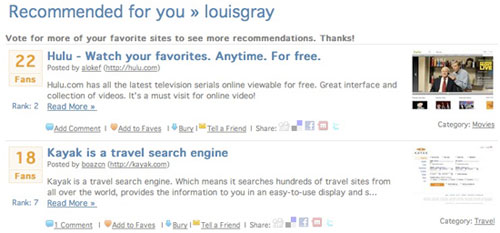
eSocialWeb breaks down Web sites into a set of familiar categories, from Entertainment and Lifestyle to Shoping, News, Technology and Business. Like with Digg, you can submit new entries if they don't already exist in the system, vote up ones that already are on the site, bury them, or add a comment. And like Digg and other services, you can link up with friends and get recommendations based on your own submissions.


Recommendations from within eSocialWeb


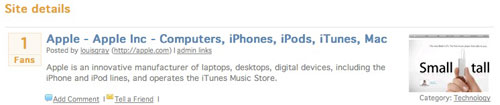
Submitting Apple to eScocialWeb's Index

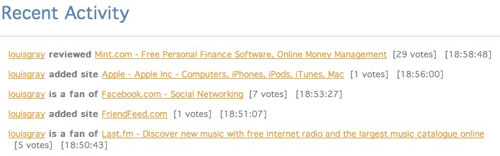
Today, the top sites on the service include Mint.com, the online finance software tool, Hulu, and XKCD, among others. And I found submitting new sites, like Apple, to eSocialWeb very simple, just like with Likaholix. You can also see the most recent activity across the site or by individual.


Recent Activity on eSocialWeb

Does the Web need another social site for friends to trade links? Maybe not. But this is one site that's trying to win a small niche with focus. Check it out at http://www.esocialweb.com. You can find me at louisgray, as always.
May 18, 2009 · 1 MIN READ · BY LOUIS GRAY

Alright, When I Say Go, Hit the Spam Twitter Button With All Accounts

Alright, When I Say Go, Hit the Spam Twitter Button With All Accounts

When a product becomes ubiquitous, it means you get the good with the bad, the well-meaning with the nefarious, the intellectual with the sloppy. As we saw with e-mail being overtaken with aggressive marketers, spam and eventually, viruses, the same activity has propogated to every social network with momentum - including the 419 scam on Facebook we discussed in January, and the many different reports of spam on Twitter. (See: TechCrunch's coverage of similar nonsense earlier today: A Bunch Of Hot Spammers Had The Day Off Of Work LOL.)
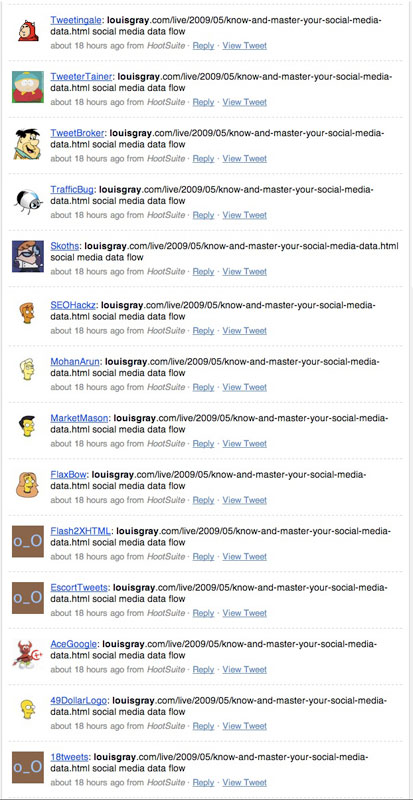
Like any good egotist, I regularly check references back to the site, be they on Google, in my referral stats, and the two T's - Technorati and Twitter. Today, I was amused to find that simultaneously, nearly two dozen different accounts referenced an article this I wrote this last weekend. Never mind that their link didn't work. Never mind that they all used the same exact way to write it, including the exact same description or tags. Even more interesting was the fact that all of the accounts (be they robots or real people) used the exact same Twitter client, HootSuite, and the automated messages look like they were executed in alphabetical order, starting with the account labeled "18tweets" and finishing with "Tweetingale".


The last time we talked about Twitter spam, it was with the issue of repeated following. In that example, theories suggested the repeated followers were to gain visibility and more real followers from duped Twitter accounts. So what are the purposes of this type of nonsense this time? Is it thought that those people searching for these keywords would find these accounts and sign up? It's not as if they pushed any traffic to my story, thanks to their not providing HTTP code.

Yet another "stupid human trick" executed on an increasingly sketchy network.

May 17, 2009

May 17, 2009 · 4 MIN READ · BY LOUIS GRAY

Early Adopters and Finding "The Next Shiny Object"

Early Adopters and Finding "The Next Shiny Object"

About a year ago, I put forth a theory I called "The Five Stages Of Early Adopter Behavior", chronicling how we, as self-proclaimed early adopters, like to find cutting edge products and services, but can go from the most vocal proponents to their most visible detractors in a short amount of time, sometimes putting something in its grave even before the rest of the mainstream has found it exists. A corollary to this theory is that once an acceptable service or product is found, eventually the early adopter group will slip into a comfortable malaise, looking around for the "next shiny object" that will take their attention away from what to them has already become old hat. And this quest, this desire to find what is next, is what drives many of us to sign up for everything under the sun, kick its tires, and debate its worth with our peers. But just because we look for something new doesn't mean everything we use today will eventually be discarded.
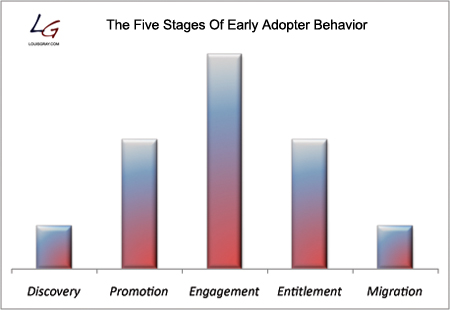

The Five Stages of Early Adopter Behavior (June 2008)

Back in June, I wrote:
"One month's golden boy can be next month's afterthought. One week's addiction can be next week's memory. For a service to succeed, it needs to attract those early adopters who can help propel a strong population, but it needs to do all it can to keep those adopters feeling like partners and mainstream users, before letting neglect fire up their egos so much that they leave you altogether."
You can sit on the sidelines and see this happening everywhere. In fact, much of the backlash against Twitter of late has been from the early adopter community who has been largely ignored, in favor of the celebrity of the week, making those who pushed the service initially feel like they are unwanted.

This lust for the next big thing, and the desire to be first to find it, is much of the reason you see online media write bigger and bolder headlines for products that are fairly incremental to activity, and not game-changers. Be it yet another search engine, a new location awareness tool, or a widget that combines multiple previous offerings, there are presumed "bonus points" for being the first to call it a "Killer".

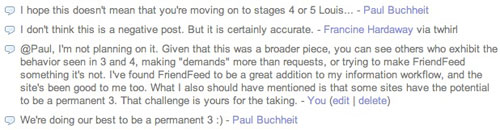
Amidst this, the truth is that some of these products do take hold and become part of our everyday activity - including Google Reader, Facebook, LinkedIn, FriendFeed, the iPhone and others for me, of course, and if they continue to please customers, they don't end up seeing even the most-aggressive users moving from what I called "Engagement" to "Entitlement" and eventually, "Migration". As FriendFeed's Paul Buchheit slyly asked of me last year, "I hope this doesn't mean you're moving on to stages 4 or 5 Louis...", prompting me to say that "some sites have the potential to be a permanent 3," referring to "Engagement".


Can Sites Be a "Permanent 3"? I say, Yes.

And yes, it can be tempting at times to stomp my foot and expect some of the apps I like and use the most to behave a way I want them to, but for the most part, I think I've held off, even as I continue testing any and all newcomers.

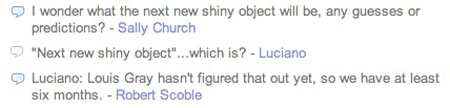
In a thread this week, perennial early adopter Robert Scoble jokingly told one commenter, after they asked what "the next shiny object will be", that "Louis Gray hasn't figured that out yet, so we have at least six months." As if I had that much power...


Looks Like It's Up to Me, Then?

As I see it, we have been lucky enough to find some shiny objects very early that have become active sites for a good number of people. We were the first to report on TweetDeck back in July of 2008, and TweetDeck is arguably the most popular desktop client for Twitter. Its success can even be seen in the development of competitors, such as Seesmic Desktop. We were also the first to report on Socialmedian, which was acquired by XING in December for a cool 7.5 million after seeing strong momentum. We were the first to really dive into the world of shared item aggregators, and were the first to report on ReadBurner, RSSmeme and other competitors. We were the first to highlight the launch of Toluu, a place to share your OPML and discover new feeds. We were the first to talk about Feedly, which is reshaping the way you organize and find data in your Google Reader stream. We were also the first to report on Twazzup, a new search engine for Twitter, as well as other tools.

So what am I saying with all this? Aren't these shiny objects? Didn't TweetDeck change the game? Aren't early adopters enjoying these services that haven't yet been absorbed by the mainstream and celebrities? They are.

Early adopters can do more than just discover new tools. Our job, as it were, is to help take something that's undocumented, and discover its potential and its use. What are we already doing that these new tools make better? What can I do that I couldn't do before? Does this new tool make anything I already do easier, or is it executed in a more clear way? It's not about finding new tools just for the sake of getting one more blog post on the chart. It's about hopefully rewarding developers for their efforts, rewarding early adopters and readers here by their getting early access to things that make a difference, and rewarding ourselves by building out the community in a new place. We are always on the look out for shiny objects. We find them all the time and are happy to share with you. But if I've found one that works for me, you can expect me to latch onto it like a barnacle.