Silicon Valley Technology Commentary & Archives · Est. 2006 3,032 Posts · 2006–2026

May 16, 2009

May 16, 2009 · 4 MIN READ · BY LOUIS GRAY

Know and Master Your Social Media Data Flow

Know and Master Your Social Media Data Flow


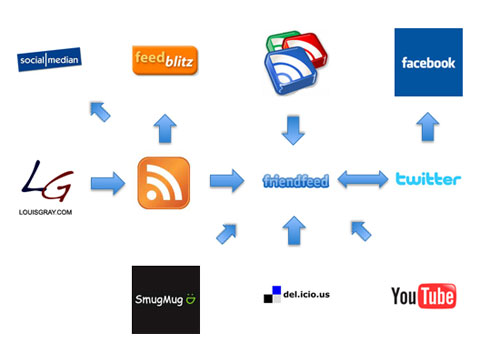
This Is How My Social Media Data Flows. I'll Explain.

If you're anything like me, you are constantly creating social data. From your blog posts and your tweets, your photos and videos, bookmarks and status updates, you are creating new information, big and small. You might do so in spurts, or you might be creating new content throughout the day. But with so many different social networks out there, and friends scattered here, there and everywhere, there's always the potential you're not sending the right data to the right place. But if you start by knowing where your data is flowing now, you can make minor adjustments along the way to get the recipe right.

On March 24th, I told Harry McCracken of Technologizer that if I were to provide any Twitter user one piece of advice, it would be: "Always know where your data flows, and participate where it lands."
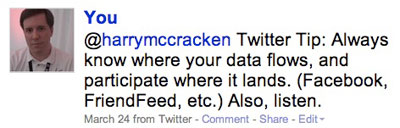

That simple piece of advice is a major challenge to most people. Whether they don't want to step out of their comfort zone, or they believe they only have time for one social network where they participate, most choose one or two places, while neglecting others. Others simply use services like Ping.fm to send all updates to all places at once, a scattershot process to something that probably deserves fine tuning.

My approach to this problem is to always create content while knowing its impact downstream. Here is what I have chosen to do with my data I am creating.

1. Blog Posts

Blog Posts that I create here at louisgray.com are packaged up by RSS, using FeedBurner, and end up in RSS readers. They also are published in headline form or excerpted, on FriendFeed and Socialmedian. Every day, updates in the last 24 hours are bundled up by e-mail and sent to FeedBlitz.

2. Twitter Activity

My Tweets, when posted, be they notifications of new posts (which I do manually, not automatically) or other content, are posted to Twitter and echoed both to Facebook and to FriendFeed.

3. Native FriendFeed Posts

When I post a new item directly to FriendFeed, it echoes to Twitter, which in turn, updates Facebook. Knowing this, I often author the headline using Twitter language, such as @ signs and hashtags, keeping the headline short. I can then, in FriendFeed, edit the headline to use normal language, optimizing the data for where it is consumed.

4. Delicious Bookmarks

Bookmarks I make on Delicious are shared to FriendFeed, and bounced to Twitter and Facebook. I ensure the headline and the source of the article are displayed, and now truncate that to hit Twitter's character limits.

5. Google Reader shared items

Shares I make in my RSS reader not only stick to the link blog, but they impact FriendFeed, Socialmedian, and the shared item counters, like ReadBurner, RSSmeme and now InFeeds.

6. YouTube Videos and SmugMug Photos

The YouTube and SmugMug activity I do is largely family related, so when it gets imported to FriendFeed, using RSS, it is echoed to Twitter and Facebook (like in #3).

7. FaceBook Status Updates

They stay in Facebook, period, which is why I usually just update it using Twitter.

The reason I list each of these specifically is because each stream of data has a different intent and possibly a different audience. Given much of the content flows through Twitter and FriendFeed now, I make a conscious effort to optimize the data for both services. I also recognize that when I post to both services, I just might receive comments and likes on Facebook, which is happening at an increasing pace.

Thinking about the data flow has an impact on how I behave. It is because of FeedBlitz that I prefer to have more than one post in a 24-hour period. I also know that as I am bookmarking sites that cover articles from this blog that I am getting to reward others who write about the same things I do. I recognize that by tweeting too much I could muddy my Facebook and FriendFeed, and have negative repercussions as a result. I also know that I need to make sure the headlines on my SmugMug photos and YouTube videos make sense once they hit Twitter.

It may seem regimented, but once you think about where your data is flowing, you will find a process that works with you. The good news is that RSS is not dead, despite some beliefs otherwise. In fact, it plays a bigger role than ever in terms of shuttling updates to and from services. I have set up my publishing preferences in this way for me because it matches what I believe to be the right data with its right destinations, and when activity from the community participates, I try to be there as soon as I know it has happened, through close monitoring.

And considering this is essentially my social media creation workflow, you might also be interested in the post I wrote last Spring on my own social media consumption workflow. It hasn't changed much at all since.

May 15, 2009

May 15, 2009 · 4 MIN READ · BY LOUIS GRAY

How I Learned to Stop Chasing and Caring About Apple Rumors

How I Learned to Stop Chasing and Caring About Apple Rumors

In college, during a time when Apple's potential demise ran from probable to "extremely likely", my obsession around the Mac was all-consuming. In the early days for customizable Web browsers, my entire browser bar was littered with Macintosh-related bookmarks, from MacCentral and Macintouch to MacWeek, Apple Recon, Apple Insider, ThinkSecret, As the Apple Turns and the big kahuna, MacSurfer, which had practically every Apple-related update from the day's news known to man. Add on to that my constantly participating on Apple stock related chat boards, from Yahoo! Finance to Raging Bull and Investors Hub, to the ultimate in insider Applery, a real-time chat room for discussing Apple stock, called AAPL Talk, and you could see that Cupertino was a major hub of my daily universe.

As I made it my personal mission to help convert PC users to the Mac, and debated the benefits of OpenDoc and CyberDog, constantly reloading VersionTracker to get the up to the minute updates to Mac software, I also was an occasional participant in the darker underworld of Mac rumors, reading the anonymous bulletin boards across the Web which often featured unreleased specs of yet to be issued products, sometimes full quarters in advance. Sometimes they were wrong, but very often they were right. MacWorld Expos would be anticipated, and then arrive, as we saw exactly what we had already predicted on display, and remained decidedly underwhelmed with everything else - unhelpfully dubbing each the weakest MacWorld to date.


Two Rumors that Never Came Close to Making It

The froth around what Apple would or would not do was so palpable that fans would breathlessly demand Cupertino release products that fulfilled their every wish - fantastical items that would never see the light of day. Strawberry iBooks. A Mac Palm Pilot to replace the Newton. An Apple Tablet. The G6. Apple-branded projectors. It all got to be pretty silly - as "sources" often turned out to be any teenage kid with access to Photoshop or a handheld that made blurry video.

Over time, a few things happened. First, most of Apple's updates stopped having relevance for me. I'm not updating my computer all that often, so the month by month specifications race meant very little, and not being a movie or graphics pro, anything in that realm was a waste for me. Second, our small community of rumormongers started to blur in with the rest of the tech media, themselves eager to get a sniff of Steve Jobs' plans days ahead of their unveiling. Third, Apple started to succeed and become one of the more trusted, if not stable, companies, making my mission a much less important one. Now, practically anyone can see the benefits of the platform over the alternative, even as we move more of our activity to the Web, making some of the issues moot.

Harry McCracken of Technologizer recently had a solid post discussing how Apple's long history of acquisition rumors are almost entirely without truth. So too are the many finger to the wind prognostications from those would-be tech journalists and bloggers eager to get a scoop. Apple has done a fantastic job, in most cases, of locking down the rumor flow from the sieve of the old days. That there will be an eventual update to the iPhone is no secret. That the newest Mac Mini had one extra USB port was hardly news. I've even committed something resembling heresy - I've stopped watching the video taped updates from WWDC and other Special Events. Considering the first blog post I ever made on louisgray.com was in anticipation of MacWorld Expo in January of 2006, you can see things have changed.

The net change over the last few years is this: First, there are fewer leaks and news items sneaking out of Cupertino. Second, there are more people looking for them than ever. As a result, there is a ton of noise, and most of it is completely useless. So I've turned off the noise. I don't go to these sites, and I skip over most Apple rumor news when it hits my RSS reader, because it's devoid of truth, largely guesses, fumes and hyperbole. I just wish some of you could have experienced some of the very real excitement and glee the rest of us dedicated fans felt back in the late 90s when we scored early graphics of the next iMac, or heard about the iPod the day before Steve showed it to the world, before the Mac went mainstream, and those of us who were "the crazy ones" started to look normal to the rest of the world.

May 14, 2009

May 14, 2009 · 4 MIN READ · BY LOUIS GRAY

Don't Tempt the Online Mob. They Come Bearing Pitchforks.

Don't Tempt the Online Mob. They Come Bearing Pitchforks.


There's no need for me to recap Twitter's two-day flub as you've already seen it 40 different places. What's most interesting to me about the entire situation is the rapidity of how the user community turned on the service and its founders in response to what was a relatively minor change that was confusingly and sloppily addressed. The response, which loudly came from all corners, mirrored that of previous blowups, which have also included Facebook and Digg as victims - the first around its terms of service and Beacon, and the second, around its blocking of illegal series of numbers that could unlock DVD region codes. Even Google Reader faced a backlash last year from users who expected a different interpretation of what friends were and who could see what.

See also:Every single case dealt with a Web 2.0 service driven largely by user generated or selected content, where the mob was reacting to changes handed down unilaterally from a seeming all-knowing company, without first communicating potential changes, or accurately foreseeing downstream effects. And in most of the examples (Google Reader being practically the only exception), the service had already chipped into its balance of goodwill, leading to a strained relationship with a vocal minority of users, setting the stage for the much larger backlash that was to come.

Did the services that made mistakes and got roundly slammed deserve the punishment? If you ask the users, the answer is yes. In today's world, the online communities that have been built around these popular products have a sense of entitlement, not just to specific features, but that they will be made a part of the process, spoken with and not just spoken to. And if they feel they have been wronged or lied to, all hell can rain down on the company or the individual bearing the broken message.

To me personally, the change in @replies for Twitter was frustrating and annoying, but what ticked me off was more the way in which it was delivered. As with the company's previous comments about following many users being "disingenuous", this week's move seemed like they were once again telling us of a right way and a wrong way to use their product. That their blog post was backtracked upon and respun as a product issue and then a technical issue made us feel lied to, and the team, despite having what by all means is a very successful product, disappointed us again.

Here's the thing: Before I get slammed (again) for being a FriendFeed apologist and/or Twitter hater... the truth is not so black and white. I think Twitter is great for what it is supposed to do - send short messages and help broadcast information quickly. It is now a utility, like e-mail, and we're all assumed to be there. But I, and many others, continue to get frustrated when we see the system and its people fall short of what is an amazing potential. You can have hundreds of millions of users, but the experience itself is diminishing, and the management seems disconnected, in a way that makes them look like they are in love with the latest celebrities to sign up and less enamored with us rank and file who evangelized their product the last few years, pointing out both the good and the bad as it came.

Similar too are the stories of those previously stabbed by the mob. The Digg fanatics believe strongly in their ability to push favorite items forward, and potentially upset the balance of the new world media. Facebook, once deemed a safe place for friends and family to congregate online, found itself on the wrong side of privacy choices and business. Google Reader wrongly hoped that those you e-mailed in GMail would be fine to share your RSS favorites with. In each case, the users believed in the product, wanted it to succeed, but disagreed strongly with the latest moves, and they would not give up until their voices had been heard and made impact.

Designing new products and services, and adding new features to existing ones, is very difficult to do in public, especially when you are trying to walk the fine line of placating existing users while attracting new ones. Twitter, in a flash point of popularity, is especially vulnerable due to the fact their own product, as also are Digg and Facebook, could be used by users to fight back. Did Twitter or Facebook or Digg lose users permanently due to such heated battles? Probably not for long, but the scars do linger, and the trust factor that might once have been there is gone, or at least damaged enough that the mob will keep their torches at the ready, waiting for the next time they're needed.

The world of product development, on the backs of user content, is changing the way people expect to participate. And when they aren't treated as equals, or they are talked down to, people are taking it very seriously, and there are more platforms for conversation than ever, with more people to reach than ever, so any service who is in this space who expects to make even "small settings updates" should strongly think of their potential impact and be ready in case things start to go wrong - fast.
May 14, 2009 · 2 MIN READ · BY LOUIS GRAY

Would You Night Owls Pay a Premium for 24-Hour Commerce?

Would You Night Owls Pay a Premium for 24-Hour Commerce?


If you have a 9-5 job, and any responsibilities at home, be they family, digital, or anything else, you might find the world closed down around you by the time you're ready to go out. In most cities, practically the only things open past 9 or 10 are gas stations, 7-Eleven and possibly a grocery store. Want to pick up something from the electronics store, some new power tools, or even a new pair of slacks? You'll have to wait until tomorrow, but yes, the same hours apply, which means you're pretty much screwed until the weekend, unless you can sneak out on your lunch hour or roll into work late.

I've been a night owl since high school, at least - including a 1:30 to 9:30 a.m. graveyard shift during the summers, and working on the school paper in college starting at midnight. Even now, after putting the twins to bed after a full day, and catching up on all online activity, it's a rare night that we shut down before one - hours after the surrounding city has called it quits.

While I have moved as much of my commerce online as possible, there always remains the elusive item that would be much easier to get in the real world. What would be great is if there were something open for those of us who actually function very well between ten at night and eight the following morning. Whether there is one mega-complex open overnight that hits all the basics - from clothes to food to electronics and house supplies, or a mall in each metro area that does the same, I believe there would be a subset of the population that would flock to it - one that wouldn't mind paying a little bit more for the convenience.

I wouldn't even mind if the store charged one price at 7 p.m. and 20 percent more at 11, so long as they were open when I went. But I hate feeling like a prisoner to somebody else's schedule.