

Silicon Valley Technology Commentary & Archives · Est. 2006 3,032 Posts · 2006–2026

May 22, 2009

May 22, 2009 · 4 MIN READ · BY LOUIS GRAY

Personal Heresy: What OS You Use Is No Longer Critical

Personal Heresy: What OS You Use Is No Longer Critical


Last September, when Google's Chrome Web browser was first introduced, I told you how I spent the day on Windows, just to use it. While Google is making headway in bringing their Web browser to the Mac platform, or so I've been told, it just hasn't happened yet. In the interim, Apple introduced Safari 4 Beta with many of Chrome's much-awaited features, and Safari has remained my browser of choice, as I tend to find Firefox too slow and too bloated, especially as extensions are added.

Today, I came across an article by Rick Klau, who works at Blogger for Google, saying how he was using Chrome on his Mac, also through VMware, but most importantly to me, as a result of Microsoft's new Windows 7 evaluation program, which lets you gain access to the operating system for free for a year. With my nose in the air, I've watched from my Mac laptop the struggle Microsoft has had with Vista, and how users are begging for Windows 7 to arrive. I've seen Steven Hodson and others talk excitedly about what's planned from Redmond, and largely, I haven't cared. I didn't think it applied to me.

But think of what Rick told us. Any Mac OS X user who has VMware Fusion (or Parallels, I assume), can get access to Windows 7 today, just by downloading the 32-bit version of the .ISO file from Microsoft and getting started. No CDs. No hassles. Just an evaluation key, and letting VMware do the work. The geek in me overruled my Mac bigotry today, so guess what? I'm writing this post in Chrome on Windows 7 in VMware on Mac OS X. It just works.
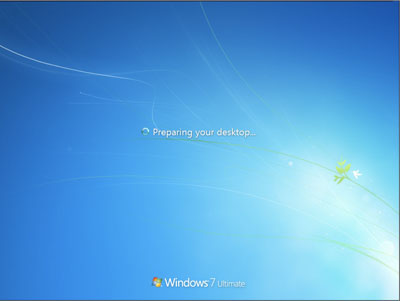

What? Windows 7 installing on my Mac?
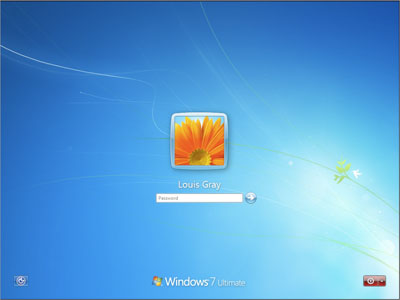

Windows 7? Mac OS X? Does It Matter Any More?


So - back to the focus of the post. For the better part of two decades, I have ranted and raved that Macs are superior, whether it be for the hardware or the OS. The Mac vs. PC commercials on TV are very amusing and help cement the belief I've got a better product. I can largely ignore malware, and know I can get a consistent experience from Mac to Mac for the most part.
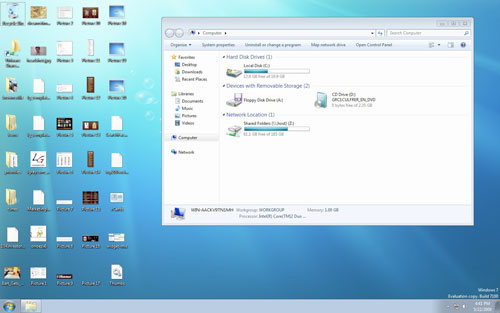

Logged Into Windows 7 And Checking the Computer
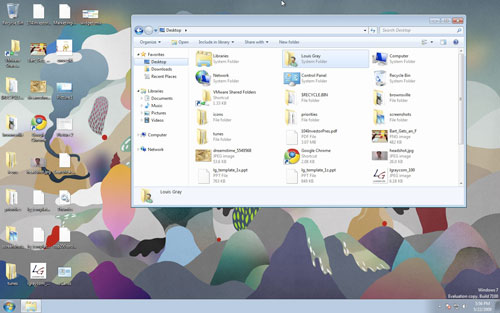

Sharing My Desktop Between Both Mac and Windows


But I'm starting to think more and more that it really doesn't matter any more. I won't be ranting about the cloud and saying all software is dead, but within an hour, I've got my Web browser set up to all the bookmarks and social services I constantly use. I have iTunes in VMware on Windows 7 seeing all my music from the Mac. I have an FTP client I can use to post to the blog. Practically all I really need the Mac for is the Adobe Photoshop family, Microsoft Office and the comfort of knowing my e-mail is saved locally as well as through MobileMe.
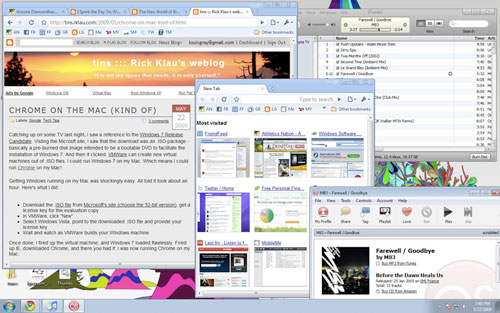

A Typical, Active Web Session, But On Chrome and Windows 7
(Click for a larger image)

I don't feel I need to go feature by feature of Windows 7 and see if it has all the bells and whistles that Mac OS X does. Maybe it does. Maybe it doesn't. But with very few exceptions, I could switch to Windows in this environment, and not lose too much sleep - something that would be made even more possible were I to push all my mail to GMail and take my word processing to Google Docs, for example.

Also in September of 2008, I speculated that the new world of browser choices is all about the hooks, especially from each company's mobile platform. The iPhone loves Safari, as you know. But Safari is also available on Windows, and the iPhone can be synced on iTunes on my Windows 7 partition. Hmm.

The line between what is an Operating System, and what is a Web browser, is getting increasingly blurry. And the traditional benefits of the Mac that always had me red in the face and starving of oxygen when trying to convert non-believers are going away. Maybe that's why I stopped caring about Apple rumors, as I told you last week.

If I do run into somebody willing to listen about what operating system they should choose, I can without hesitation say the Mac, because it's still what I know best, and I have had such a good track record with Apple. But Windows 7, so far, is good enough for most people, provided they can avoid bugs, malware and other irregularities.

So you tell me, am I out of my mind, or finally seeing the light?

May 21, 2009

May 21, 2009 · 3 MIN READ · BY LOUIS GRAY

Twitter's Search Engine Is Very, Very, Broken

Twitter's Search Engine Is Very, Very, Broken

Given all the rumors about Google possibly talking to Twitter about search, or the Mountain View giant taking on the world of real-time, you would think that Twitter's dramatic growth and user adoption would see the microblogging company sitting on a gold mine of a database, as it amasses tweets from around the world and makes them searchable through the search.twitter.com product (formerly Summize). But it appears that the considerable expansion of the company's user base has led to strain on its index, rendering practically anything beyond realtime analysis completely useless, fraught with missing data and error pages.

The promise of Twitter's advanced search capability is tremendous - letting you dice your queries by the sender and recipient, and even limiting the date range for said tweets, the location, hashtags or even emoticons. And at one time, it was a valuable resource. Now, depending on which account you're viewing, the data set could be as small as a week, or oddly, in some cases, not available at all.

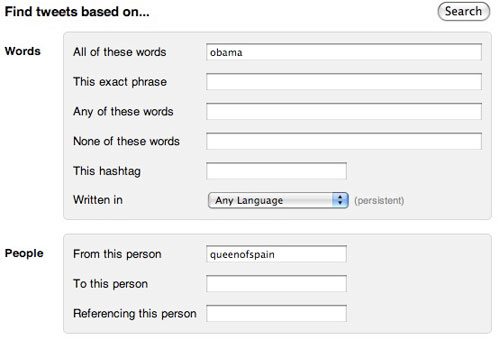
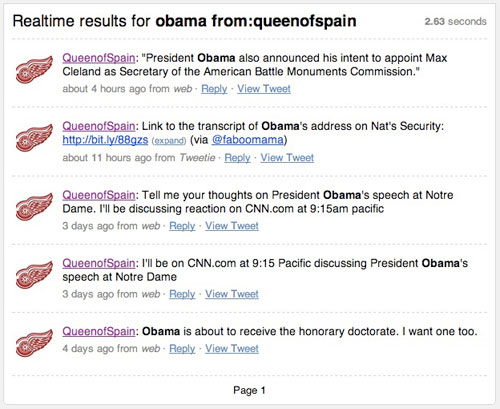
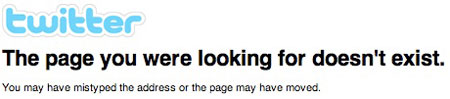
For example, if I search Twitter to find out how many times Erin Vest (@queenofspain) has mentioned the word "Obama", it would show me five total results spanning the last four days. Modifying the same search to start with May 1, 2009 or January 1 and continue to today completely fails, saying I probably "mistyped the address".


Searching Twitter for Erin's Mentions of Obama


Twitter Says Erin Has Said Obama Five Times


Modifying the Date to the Start of January


The Familiar Fail Page From Twitter Search


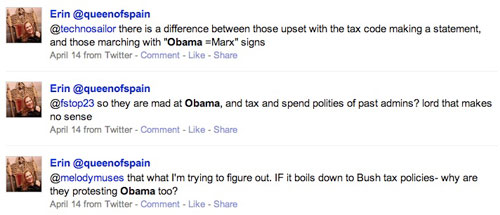
Out of curiosity, I performed the same search for "Obama" from Erin's Twitter account on FriendFeed, finding nearly 500 results, going back to March of 2008.


FriendFeed Shows Erin's Tweets Referencing Obama

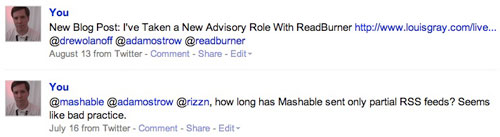
Similarly, Twitter's advanced search says that I have never sent a tweet referencing Adam Ostrow (@adamostrow), yet FriendFeed confirms that I have.


Twitter Says I Have Never Sent a Note to Adam Ostrow


FriendFeed Shows My Tweets to Adam Ostrow

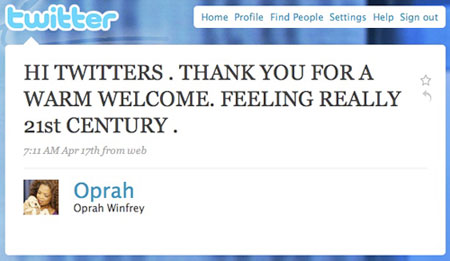
And lest you think Twitter had left behind us early adopters, archiving only tweets from the celebrities, I was surprised to find that you can't find Oprah's famous first tweet. I searched for the phrase "FEELING REALLY 21st CENTURY" from Oprah and found no results.


Where Is Oprah's First Tweet, Twitter?


I Know The Tweet Exists, Right?


In fact, searching for any tweets from Oprah at all showed no results. Oddly, in parallel, I could see 8 days worth of tweets from Ashton Kutcher and at least a few weeks' worth for my account.


Sorry, Oprah, Twitter Stopped Indexing Your Account

Back in February, I said that Twitter was best suited for following topics and listening to its search engine, and less for following people, and I do use Twitter search every day. But if they are to truly reach their potential, the company has got to find a way to find all the data that today, is missing and hard to find. If it's a scalability issue, Twitter has practically become a utility, like e-mail, and a solution is necessary, even if it means teaming up with a company that knows how to grow and scale. Be the suitor Microsoft, Google, Apple or anybody at that level, each offers a better alternative to the rapid dissolution of features and data integrity we are seeing today.

Of note, we did peruse the open API issues page in regards to search for Twitter, as well as reviewing the Get Satisfaction community for Twitter's Search product, but no comments have been made public about this data being unavailable that I can yet find.

We've seen Twitter go up, come down, remove features and add them back. Is this a temporary blip, or should we never again expect search to work the way it's advertised? I hope it comes back soon, and that Twitter becomes a reliable site to exchange messages, knowing they will be preserved, but their track record makes me very nervous that it may never happen.

May 20, 2009

May 20, 2009 · 1 MIN READ · BY LOUIS GRAY

SlideShow: How To Optimize Your Social Data Flow for All Networks

SlideShow: How To Optimize Your Social Data Flow for All Networks

Following on to this weekend's post on knowing and mastering your social media data flow, I updated the information and have created a presentation for download, for easier portability.
This is also the first time I have had the option to use my brand-new presentation template, so please do let me know what you think!

May 19, 2009

May 19, 2009 · 2 MIN READ · BY LOUIS GRAY

Google Reader Extends Statistics On Friends' Sharing Habits

Google Reader Extends Statistics On Friends' Sharing Habits

Sharing items I find interesting in Google Reader is a major part of my social activity, as I help promote discovery of quality information to those who choose to subscribe, in a way, acting as a pro bono information filter on behalf of geeks everywhere. With streams from my Google Reader shares flowing into Socialmedian, FriendFeed, Facebook and the shared item tabulators, like ReadBurner and RSSmeme, I recognize the impact a simple mouse-click can do.

Sharing these feeds means I'm not reading my news in isolation. Friends I've connected with can make comments to my items, and should I choose, I can follow others' shared link blogs as well.


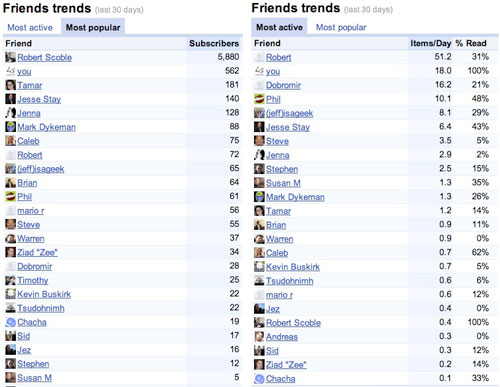
My Friends' Sharing Statistics In Google Reader

Today, the Google Reader team introduced a minor update that lets you now see just how frequently you're getting items from friends, and interestingly, you can now, for the first time in my knowledge, see how many other people are subscribed to their feed (and your own). For example, I learned today that 562 people have subscribed to my Google Reader link blog. That's still more than 5,000 behind Robert Scoble, a longtime evangelist of the practice, but only three others who I follow sport more than 100 connections.

And in case I was worried I was sharing too often, with approximately 18 shares a day, one of my connections, our friend Rob Diana, from Regular Geek, is sharing a cool 51.2 items every 24 hours, while two others are closer to me, with more than 10 shares a day.

It's almost tempting to start playing with the math to see what the downstream impact is of the shares.

If Robert Diana shares 51.2 items a day to 72 people, is that about 3,686 total views added?
If Robert Scoble shares .4 items a day to 5,889 people, does that hit 2,352 total views a day?

You get the idea.

Google Reader is trying to become more social and make the RSS reader a destination, rather than a pass-through. And I like their attempts, but it's clear more could be done. I'd like to be able to view just those feeds I subscribe to, and have the option to view friends' shares later, rather than have them combined in the same feed. I'd like to have e-mail alerts available if somebody commented on my shared items feed. I'd still like to know the most popular shared items, and most popular feeds.

But they are making good headway. Which reminds me... Didn't somebody say RSS was dead?