
Three years in technology can be an eternity. I marvel that just over three years ago, I was telling you that
"RSS Is a Demanding Mistress", showing off a screen capture of my NetNewswire application, powered by Newsgator. At the time, as I complained about having nearly 100 articles to read, I didn't anticipate the impact Google's entering the market with Google Reader would be, and my screenshot now seems quaint. By 2007, I had switched to Google Reader, and despite multiple assaults on Reader in the ensuing two years, you can tell most challengers apart by their epitaph.
In the past few years, I've helped champion more than a few new approaches to the RSS feed reader market, each with its own approach to making the stand-alone process more social.
First there was Assetbar, who had tremendous technology, but a clunky interface, and never really got off the ground. Not too long afterward, we saw Shyftr debut, but following a highly visible controversy over shared comments on full feeds, the company eventually
shut down their interesting product as well, moving instead to RSS filters. Even last week we saw
NewsGator turn off their synching functionality, pointing customers to Google Reader. Yes,
NetNewsWire is still around, and now points to Google Reader, but it's pretty much a legacy app at this point. (In my opinion, of course)
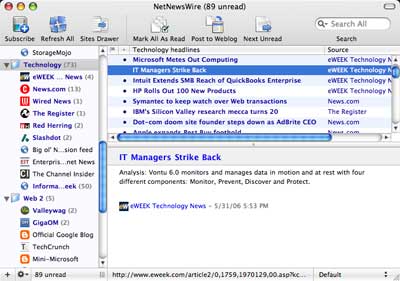
Isn't this cute? (From back in 2006 on NetNewsWire)While some are debating RSS' role in a new world of real-time information discovery, there is no question that Google Reader has won this specific battle. If I exclude
FriendFeed data from my own FeedBurner statistics, the combination of Google Reader and iGoogle accounts for 84 percent of all my RSS readers. In contrast, NewsGator is below 4 percent, and BlogLines checks in at just above 2 percent, with PostRank and Netvibes coming in at just over 1 percent each. Mice nuts.
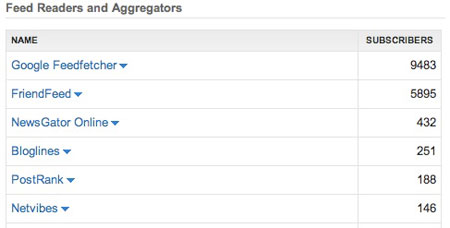
My FeedBurner Stats Show Google Reader and FriendFeed DominateThat's not to mean the RSS ecosystem is in anything resembling a freefall. The recent launches of
My6sense for the iPhone, looking to find the most relevant content, and
Lazyfeed for real-time blog search by topic, show me that not only is innovation alive and well, but blogs and RSS are key components in creating new products. And while Caleb Elston has been quiet of late, I am still using
Toluu every day to share my OPML, and keep track of new blogs I am adding to Reader. Also,
Feedly, which builds upon Google Reader with some very interesting social options, continues to plug away, gaining loyal fans.
But just think of what's happened over the last three years.
In 2006, folks like
Jeremy Zawodny reported Bloglines' share at between 30 and 50 percent. Steve Rubel cited a Pheedo report
showing Bloglines "slipping" from 37 percent to 30. Go back far enough, and you can see it even had the majority of the market way back in 2004,
according to ReadwriteWeb.
By early 2007, Hitwise said that Bloglines had three times the market share of its nearest competitor, which was Rojo. Interestingly,
that report mentioned Google Reader in passing, saying "as of the week ending 1/13/07, it had only 1/13 of the market share of visits of Bloglines." That's right. One thirteenth the share of Bloglines. I should mention that not everybody saw the gulf that wide, as others, including
Bob Lee reported the two were in a practical dead heat the next month.
The last two years have been all about Google Reader, as the search leader and RSS distribution leader, through the acquisition of FeedBurner, also became the RSS consumption leader.
Rojo disappeared in July of 2008, and Bloglines' own stumbles made it that much easier to switch,
forcing Marshall Kirpatrick of ReadWriteWeb to say, "Do you really want Google to nail down complete dominance over the world of RSS? We sure don't."
The onetime debate about whether Google Reader is number one or not is pretty much gone, and Newsgator's turning off their online synching essentially throws in the towel. The once promising
Feedeachother.com has turned off its lights. Shyftr and Assetbar aren't coming back.
A new entrant called Fever is interesting, but looks more like My6sense than a traditional client. RSS is powering aggregation sites like FriendFeed, which in theory, provides 30 to 40 percent of my feed reader count, but when it comes to stand alone, all must stand in awe of Google Reader, for to do battle is futile.
 In terms of sheer volume, there is little I do more online every day than share Google Reader items. According to my Google Reader trends statistics, I have shared 743 separate items in the last 30 days, at a rate of just under 25 a day, including weekends - no doubt adding up to more individual updates than all my blog posts, tweets, Delicious bookmarks and Smugmug updates combined.
 Sometimes, it doesn't seem all that long ago that I myself was in college. On other days, it seems like I am talking about somebody else, when looking back on my time at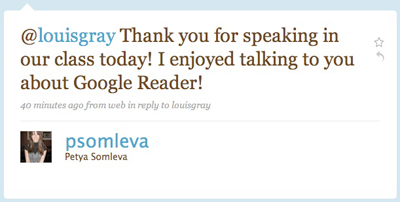
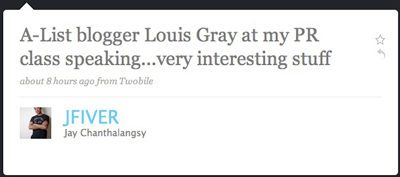
 While at the