Silicon Valley Technology Commentary & Archives · Est. 2006 3,031 Posts · 2006–2026

September 2, 2009

September 2, 2009 · 4 MIN READ · BY LOUIS GRAY

Social Media Is Infrastructure: PR, Marketing, Ads Safe

Social Media Is Infrastructure: PR, Marketing, Ads Safe


Practically the only thing guaranteed that social media will kill is your free time. Maybe it will kill your real-world social life too, but that's only if you choose to have an intimate relationship with your computer, at the pure neglect of the world outdoors. While it's popular and tempting to say that social media is poised to eliminate core business elements, such as marketing, public relations, or advertising, the truth is that the latest Web tools are simply infrastructure, to be used well. More traditional departments in business, and the third party vendors who provide their services, will need to adapt to a changing world, but they aren't going anywhere.

On Thursday, the refrain that PR, Marketing and Advertising "Suck" was debated in a panel I participated in, featuring Loic Le Meur of Seesmic, Guy Kawasaki of AllTop (as moderator), Steve Patrizi of LinkedIn and Renee Blodgett of Magic Sauce Media.

Loic's experience of having hired and fired an expensive (to him) PR firm in his first years promoting in the Valley, combined with his visibility and success that has largely been self-led, as well as a general sense that quality is missing from much of the industry, has seen him question the entire process. In a detailed blog post, Loic cites bad practices including fake reviews and press releases, and contrasts that with how major Web services, like Twitter and Facebook, have largely relied on word of mouth to bring their message to new users. And it was with this background that we participated in Thursday's discussion.

Guy Kawasaki asked each of us how we could successfully market our products if we had no budget, or a very small one - which fell below a typical retainer for any reputable PR firm. Most of us, myself included, recommended utilizing your personal relationships and network if you had no cost. I also recommended reaching out to second-tier bloggers, who can be your product's biggest advocates. Loic said you should get a community manager for low cost to see what people are saying online and respond quickly.


Tap Into Your Personal Network to Save Money

Much of the conversation was framed in terms of listening to services like Twitter, and blogs. It was debated what constituted spamming on Twitter. Renee said that listening for keywords and reaching out to potential customers was a major part of how her clients found prospects - which I agreed with, but others questioned. I said that sending somebody an unsolicited note on Twitter to gauge interest was just fine the first time, and spam the second time. Meanwhile Steve Patrizi kept asking his board of directors for more money.

For as much fun as I have talking about new and cutting edge applications on this site, I recognize that the actual penetration for many of these tools is very small. While some services have started to go mainstream, many other tools, including traditional public relations and advertising, tools as basic as Google AdWords and customized landing pages, are absolutely necessary, especially as you travel up the approval foodchain in the enterprise - trying to convince C-Level buyers to acquire what could be six-figure products. So I tried to discourage some of the over reliance on social media tools for those companies who are trying to reach all their customers.


This Panel Is Going to "Suck" If I Hear Twitter Two More Times

When change happens, people tend to get nervous. It's a fact of life. When you hear examples of bad behavior, it can be easy to assign an entire industry or group of people all the blame.

It is my belief that smart public relations firms, smart marketers and smart advertising firms will not shrink away from the challenges that come with reaching potential influencers and buyers in new places, which require a breadth of awareness, and rapid responses. Those that embrace tools, and recognize them to not be scary - taking to blogging and tweeting and social networking as quickly as they did e-mail and phone calls, will be leaders for the next five to ten years.


What If You Get Negative Feedback?
Practice "Truth In Marketing"

Do PR firms screw up and do ads get ignored? Absolutely. We can each probably think of many cases where that has been the case. But Web sites didn't put those firms out of business, and neither have blogs. Social media won't do so either, unless these firms and individuals are closing their eyes and pretending the tools don't exist. That Loic and others are thinking about the major changes that are underway in our industry is fantastic. That Loic has been able to listen well and leverage his personal brand to help raise visibility for his products has no doubt been very effective. But saying an entire industry "sucks" or is unnecessary is overdoing it. These are tools to be leveraged, and I look forward to each of these industries growing with these tools and delivering new best practices that benefit us all.

See Also:
Loic Le Meur: PR, Marketing and Advertising suck, now what?
Kosmix Blog: Advertising, PR, and Marketing Suck! Now What?
Down the Avenue: Advertising, Marketing and PR Suck: Now What?
Shari Sax: Is Social Media THE ANSWER when traditional marketing “sucks”?

Videos Courtesy: Shari Sax's YouTube Channel

August 31, 2009

August 31, 2009 · 1 MIN READ · BY LOUIS GRAY

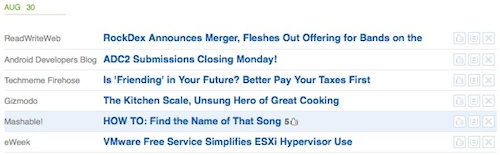
Feedly's RSS-Powered Start Page Includes Reader Conversations

Feedly's RSS-Powered Start Page Includes Reader Conversations

As I've mentioned a few times on the blog, the conversations in Google Reader are playing an ever-increasing role in my information consumption workflow. The RSS reader's enhancements have not been lost on the makers of Feedly, who have been working on a magazine-like start page for the better part of a year, gaining loyal users who appreciate its enhanced interface for subscriptions. This weekend, the company added support for friends and comments that you have in Google Reader, meaning you are not missing the conversation by using Feedly instead.
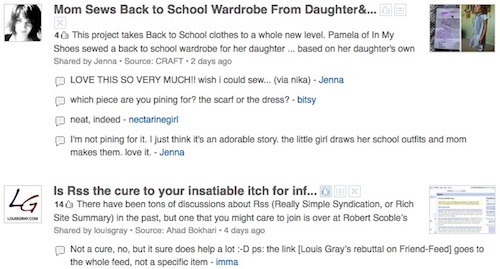
As introduced back in June of 2008 (See: Feedly Brings New Social Experience to Start Page, Leveraging RSS), Feedly operates as a start page or magazine hybrid, consisting of a cover page, a digest, the latest information, and now, "friends" and "comments".


Comments in Google Reader Shares Display in Feedly


Items that are "Liked" In Google Reader are Highlighted in Feedly


Selecting "friends" shows you items recently liked and shared by your contacts, while "comments" exposes the conversations taking place within shared items on Google Reader from your friends. While not every single share spawns a conversation, many of them are, including those on my shared items feed, where I have frequently seen items gain more comments than the original blog post itself of late.

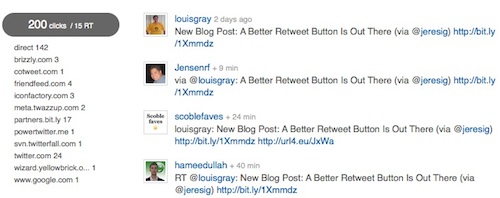
Feedly has also done more than clone Google Reader's utility. They have interestingly added a tool called "Karma", which, if you enter your Twitter ID, will tap into bit.ly, seeing how many clicks a tweet you posted received, as well as how many retweets. It's a good way to see if your activity on that social network is gaining a following.


You Can Gauge Your Twitter "Karma" In Feedly

You can find Feedly at http://www.feedly.com/. For now, the service relies on Firefox, but we've been promised support for Chrome, and maybe other interfaces, is coming.
August 31, 2009 · 3 MIN READ · BY LOUIS GRAY

Fry's Electronics: A Silicon Valley Legend With Legendary Flaws

Fry's Electronics: A Silicon Valley Legend With Legendary Flaws

Despite the fact both retail outlets sell computer equipment, including hardware and software, Fry's Electronics superstores and Apple's retail stores could not be more different. One offers a specialized set of products, and packs its stores to the gills with helpful employees, while giving customers free reign to use their products, and can approve customer purchases through the use of a handheld scanner device. The second offers a dizzying array of products, from vacuums and office chairs to iPod headphones and copper wiring, and its employees haven't won any awards for their product knowledge - while checking out items requires an usher, while your bags are rudely inspected - as if you had the forethought to take on the role of a shoplifter. It's clear which one is which, if you have ever stepped foot in either one - which makes me wonder sometimes why I keep revisiting Fry's, hoping each next experience will trump the last.
Fry's failings are at times comical - including my most recent trip this Saturday. I stopped into the store that afternoon for a simple task, finding Apple's Mac OS X 10.6 (Snow Leopard), which had released the day before. I was unsure whether Fry's in Sunnyvale would have it, but if they did, it would be a longer trip down to the Apple Store at the Valley Fair Mall in San Jose.

Upon entering this geek warehouse, I made a beeline for the Mac area, where Apple products are isolated in a special setting that makes the computers seem more like they belong in a zoo than in the jungle of PC parts and widgets just outside the enclosing aisles.


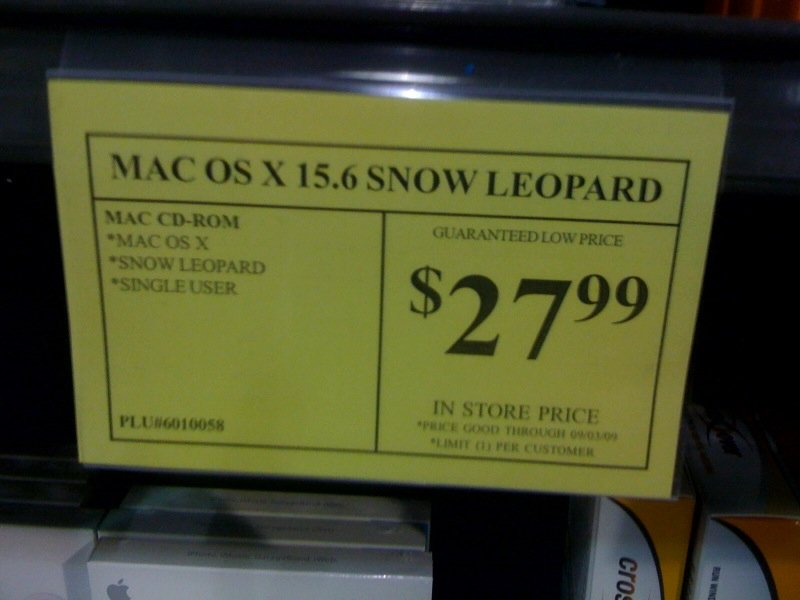
Mac OS X 15.6. From the Future!

To my surprise, there was no banner, or even a sign, announcing Snow Leopard had arrived. I looked to and fro, and didn't see Apple's famous boxes. I asked one employee, who was in the Mac section, for help and she pointed me to a manager, behind a nearby podium. I asked the manager, and she said that she didn't know where Mac OS X 10.6 would be, and maybe her boss would.

After flagging him down, and explaining, he pointed back to his subordinate, saying Mac OS was her department. She said, "Oh! I thought you meant Mapquest!"

Right. Why would I buy software from Mapquest at Fry's?

With renewed vigor around her newly-reminded knowledge, we turned back to the Mac section, and found Snow Leopard cases quietly hiding on the shelf. Below the DVD cases was a simple descriptor: "Mac OS X 15.6 Snow Leopard", for only $27.99. Of course, that would mean the operating system software was five generations into the future, which is outstanding. Or it was a typo. You decide. And that doesn't even go into the label failing to mention it is a DVD install, not a CD-Rom install.

Did Fry's have what I was looking for? Yes. Did it have it at a cheap price? Yes. Was it nearby? Yes. And that's about all I can say in favor of why I continue to return to this geek mecca of annoyance. I know that if I took the time to drive down to the Valley Fair mall, not only would they be posting banners of Mac OS X 10.6's imminent arrival, I would have gotten somebody to help in minutes, scanning me out right away - without trying to upsell me on a warranty, or walking me through an impulse buy section stock full of electric razors and bulk candy.

Fry's is no doubt a mecca for the do it yourself gadget geek. But the contrast between the warehouse mentality shown at Fry's, versus the personal touch felt in Apple Stores has me wondering if next time I'll just make the extra drive and reward their effort.

As for Mac OS X 15.6, I came home disappointed with merely owning Mac OS X 10.6, so I don't get any early adopter cred.

August 30, 2009

August 30, 2009 · 2 MIN READ · BY LOUIS GRAY

Who's to Blame for Snow Leopard Disabling My Adobe CS4 Licensing?

Who's to Blame for Snow Leopard Disabling My Adobe CS4 Licensing?

Yesterday, like many other Mac geek faithful this weekend, I got my hands on a copy of Snow Leopard, the name of Apple's latest operating system upgrade, Mac OS X 10.6. Though I knew it reportedly had few major feature enhancements, all signs online pointed to it being a harmless upgrade. Even comments around Adobe CS3's having issues pointed to clean sailing with CS4. But my experience, so far, has been anything but clean, and it's not exactly sure what caused the issue, or what will be needed to solve it.
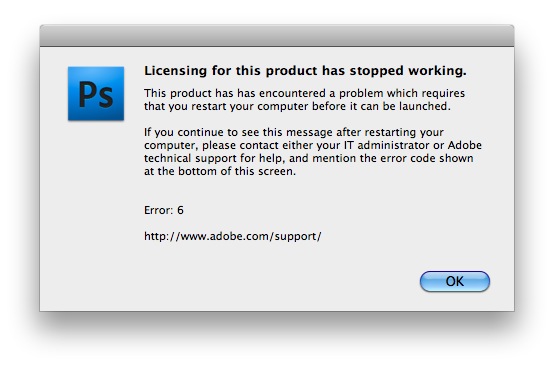
As you may recall, in May, we had to do a little song and dance with Adobe's tech support team to download the full version of the company's CS4 product. But since then, I've been using the product suite practically every day. In fact, practically every blog post you see here features screenshots or graphics that have gone through CS4. But this one won't, unfortunately, and it's like I am operating with one hand behind my back.


My Photoshop CS4 Forgot I Had Permissions to Use It

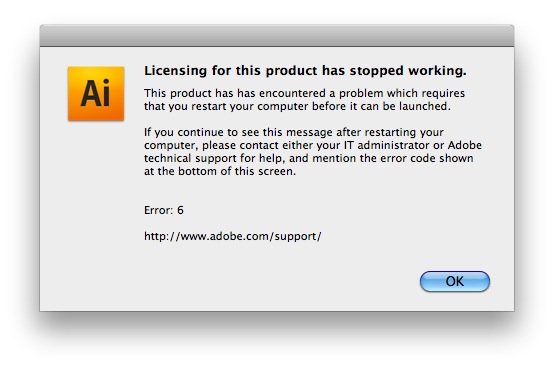
The issue is an odd one. When trying to start up any of the CS4 products, be it PhotoShop, Illustrator, In Design, or the others, I am simply told that "Licensing for this product has stopped working". The error encourages a restart, and yet, following restarts (plural), the issue remains - suggesting I tell tech support, which I will, but am not extremely excited about, especially after May's fun.


Illustrator Mocked My Trying to Launch It As Well

I have to assume that the issue has arisen as a result of Snow Leopard clawing its way on to my Mac. After all, Photoshop worked before the install, and doesn't work after, and nothing else changed. So far, online repositories aren't much help, and it's not clear which of the three players is at fault - Apple, Adobe, or me. (It could always be the user's fault). I have seen others say their CS4 apps are working great with Snow Leopard, but mine sure aren't. Maybe it's because they had the retail boxes, and going for the download version is coming back to bite me. I sure hope not.

I sent a note 1-1 to an Adobe rep who wrote me back in May, and look forward to seeing if she responds Monday. I'd be curious to see if this is a "Louis-only" issue, or if this is more widespread, and see why this is happening. Until then, get used to text only, or big juicy screenshot images with no resizing and cropping.