Silicon Valley Technology Commentary & Archives · Est. 2006 3,031 Posts · 2006–2026

December 24, 2009

December 24, 2009 · 5 MIN READ · BY LOUIS GRAY

My 2009 Tech Predictions: Mixed, But Nailed Real-Time

My 2009 Tech Predictions: Mixed, But Nailed Real-Time

Another yearly tradition here on louisgray.com. Following on to last year's 10 Predictions for 2009 In the World of Tech (and its 2008 predecessor), it makes sense to review how we fared. Recall my 2008 predictions were a complete mess. Unlike some other bloggers, who opt to pick non-controversial items and guess at obvious developments, I like to have fun each year and stretch. That's why I'll never go ten for ten. Besides, that's no fun.

As of Christmas Day 2009, here are how those ten predictions in the world of tech stand:

1) The Real-Time Web Will Become Critical for News and Information Discovery

Right. Critical is a subjective word, but real-time ended up being the word of the year in 2009. It was in real-time that the world shared their reactions to the Obama inauguration, and shared feedback to the Iranian elections. It was in real-time that we saw the aircraft land in the Hudson River, with a picture posted to TwitPic alongside. While it is true that Twitter and other real-time mechanisms lack the fact-checking and robustness of more traditional media, there were many many cases that had CNN and others following real-time's lead. Real-time later became such a big deal it was integrated into Google Search and Bing, so this was a clear win.

2) Businesses Will Be Expected to Be On Social Media If They Have Web Sites

Right. In 2009, the majority of businesses woke up to social media. While there are no doubt many holdouts, and even a bigger number doing a poor job, 2009 was the year that companies realized you could get business done on Facebook, Twitter and other networks. There is still much work to be done, but with tens of thousands of self-proclaimed social media experts out there, and some real help, others will make the leap.

3) Apple Will Introduce A Succession Plan for Steve Jobs as CEO

Wrong. And it's too bad! While Steve Jobs was out due to liver surgery, his position was well covered by Tim Cook, Apple's COO. Cook did such a great job running the company during his absence, the company's stock is at all-time highs, and its cash hoard is multiples greater than it was at the beginning of the year, even during a global recession. It could be assumed that had Steve Jobs passed away in 2009, Cook would have maintained control - and it would make sense that Apple have an internal plan for how Steve would fade to the limelight.

That said, I would still love it even more if Steve Jobs were proven immortal.

4) TechCrunch Will Acquire VentureBeat or Silicon Alley Insider

Wrong. In 2009, TechCrunch instead acquired only one writer, MG Siegler, from VentureBeat, and MG has gone on to be one of the most recognizable faces for the site. In parallel, Silicon Alley Insider went to more of a copy and paste model, and carries many of TechCrunch's articles in excerpt form, making the whole thing more confusing. But TechCrunch didn't find any need to acquire either site and continues in its highly visible position.

5) Android Will Have Less than 20% the Sales of iPhone in 2009

Right. (Unless somebody can prove differently) Despite a surge in Android news and new handset introductions in the latter half of the year, including new models from HTC and Motorola, Apple's iPhone still outsold Android in a big way through the year. Though figures are difficult to get for the newest models, and the trend shows Android gaining in market share, it does not appear that their combination managed to pass 20% of the volume of iPhones in the year. 2010 will no doubt be a different story.

6) A Major Alternative to FeedBurner Will Emerge As the Service Stagnates

Right and Wrong. FeedBurner finally got its act together with Google this year, adopting Pubsubhubbub, and rebranding under the corporate name. In parallel, FeedBlitz launched a serious competitor to FeedBurner which could replace the service outright. It hasn't been a "major" alternative, but absolutely works if you prefer it.

7) FriendFeed and Twitter Will Both Be Independent Through 2009

Wrong. FriendFeed's sale to Facebook took many of its hard-core users by surprise, and its no doubt that many are still reeling, unsure what will happen to the popular aggregator and social network. That I linked FriendFeed and Twitter together in my prediction is unfortunate, as Twitter not only remained independent, but flourished, raising more than $100 million, and ensuring profitability, by some reports, thanks to deals with Google and Microsoft. The company's $1 billion valuation makes it a difficult target for acquisition indeed by any potential suitors.

8) Companies Will Continue Budget and Staff Cuts Through the Third Quarter of 2009

Right. While recent months have seen isolated good news, especially in some parts of Silicon Valley, for the most part, companies have kept their belts tight, and unemployment remains high. While the dramatic job cutting that took place from late 2008 to mid 2009 has slowed, the recovery is not yet in perfect view.

9) An Extremist Group Will Manage to Take Down or Deface the White House Web Site

Wrong. Luckily, I was wrong about this. I don't believe that some groups out there would like to make this happen, but thus far, the White House Web Site has made it through the year unscathed. Of course, that's more than we can say for our good friends at Twitter, who just a week ago were defaced by an Iranian Cyber group.

10) eTrade, Digg, StumbleUpon, Skype and Yahoo! Will All Be Sold.

Wrong. (But A Little Right) Again, I failed by linking all these companies at once. eTrade and Digg stayed independent, and Yahoo! managed to keep its name despite giving up on search to Microsoft. Skype was sold, and StumbleUpon similarly was sold, back to its private investors. In my prediction last year, I said, "eBay will want to ditch its non-core assets like StumbleUpon and Skype" and yes, that happened, but we did not see the list of companies change hands as I had expected.

My 2008 predictions, made in late 2007, saw a massive 1 1/2 answers correct out of 10. Contrasted with that year, I did a little better in this calendar year, especially when it came to the expectations around the economy, real-time, and social media. But I still scored below 50%, with 4 1/2 right. We'll see how I do for 2010 when that post rolls around.

December 24, 2009 · 6 MIN READ · BY LOUIS GRAY

10 Top New Web Services of 2009 (From My Perspective)

10 Top New Web Services of 2009 (From My Perspective)

Last year, I highlighted ten top Web services that debuted in the year, from Socialmedian to BackType and Feedly. Not an all-encompassing list, blogging colleague Robert Scoble asked if "I was right", adding on a few of his own.

With 2009 coming to a close, I thought it made sense to highlight some of my own personal favorites which are gaining traction. Keep in mind that I am not ranking these services necessarily in a most important to least important order, and I am ignoring some other top services (for example, Foursquare, which launched in March, or some Zynga properties), due to my own non-use.

As with 2008, many services debuted in 2009 that were not stand-alone services, but instead, hooked into existing environments, like Twitter and Facebook, or the iPhone.

1) Pubsubhubbub

2009 was all about real-time and moving data more quickly from place to place. No technology or service better epitomized that than Pubsubhubbub, an open protocol engineered from a team of Googlers who were looking to accelerate the delivery of updates between services with near-zero latency. Pubsubhubbub's simplicity and clear benefits resulted in many major services adopting it and virtually eliminating the expected wait times for aggregators and readers to get updates, while also reducing the need for said aggregators to repeatedly poll content sources.

Pubsubhubbub, adopted by Blogger, FeedBurner, Cliqset, FriendFeed and many others, also spurred into action the launch of Dave Winer's RSSCloud, adopted by Wordpress for similar purposes. The launch of Pubsubhubbub also fed the growth of Superfeedr, an increasingly popular utility that aims to deliver real-time notifications via the cloud.

2) Google Wave

Google Wave made a huge splash in 2009. (Review) If you weren't trying it out and aiming to find out what value it actually brought, it was probably because you were begging for an invite and hadn't found one yet. The real-time collaboration tool was mischaracterized by many who thought it could replace e-mail, or different social networks' activity, and it hasn't found too many people relying on it as a core service yet, but its innovation has many looking to see what the end game looks like.

3) Square

Although extremely new, Jack Dorsey's follow-up to Twitter, Square, is very alluring. A simple hardware add-on to the iPhone (and in the future, other mobile devices), Square lets any individual accept credit card transactions, verifies the purchaser, and provides the purchaser with an electronic record of the activity via their Web site.

Dorsey and team skillfully looked at a daunting world of differing devices and managed to find the commonalities between them (an audio port to be specific) and delivered something that could potentially change the game for small merchants and individuals, providing true mobile commerce that doesn't require cash.

4) Echo

The launch of JS-Kit's Echo product was such a big move for the company that they changed their name to reflect it. Echo, recognizing the sea change evident in social media that has moved much of the discussion of content away from core blogs, aggregated downstream activity at the host blog, including retweets and other social network reactions.

In addition, Echo brought real-time to everyone's comment stream, turning a once static entity into a live chat room. You can see Echo in action on popular sites including those from Brian Solis and 1938media.

5) my6sense

With more data coming in from more sources than ever, it is unlikely that most people are following fewer people or feeds at the end of 2009 than they were at the beginning of the year. Combined with a rise in mobile Web access, and you can see how my6sense's digital intuition for RSS feeds, Twitter and Facebook makes sense, surfacing relevant data that is customized just for you.

The company has an iPhone app available, free, now, and has publicly promised that Android development is planned in the short term. Keep in mind that I am helping to advise the service, but I have been impressed with their offering, and see the issue of curation as one that many services will tackle in 2010.

6) Brizzly

Brizzly, a product from Thing Labs, is one of the more novel approaches to consuming one's Twitter and Facebook streams. The first to enable in-line viewing of images and video, the addition of customized trend definitions and novel approaches to direct messages and multiple account support, Brizzly is a compelling Web-based alternative to the standard interface from Twitter and competing clients, such as Seesmic.

Earlier in the year, Thing Labs also introduced Plinky, which while cute, doesn't look to be setting the world on fire.

7) Lazyfeed

For a technology supposedly on its last legs, RSS sure had a lot of very interesting innovation in 2009 (See also: Pubsubhubbub and my6sense). Lazyfeed came on the scene this summer with a real-time approach to feed discovery and the ability to follow several topics at once. A live interface and rapidly displayed content has made the product easily among the most fun ways to take in a lot of information, while keeping things "lazy".

With the slowing of central directories like Technorati, Lazyfeed became one of the best sites for me to use to find new sources who were discussing topics I was interested in, letting me add them to my reading list.

8) Flickchart

In May, Flickchart introduced a site for comparing your favorite movies, across time, genres, or even against your previous picks. Although simple, the "pick your favorite" approach became very addicting, and the site now sports more than 40,000 registered users, who have contributed more than 60 million rankings. (See blog post)

One of the unexpected side benefits of Flickchart for me was finding top movies rated by friends which I had never seen, which spurred me to finally add them to my iTunes or NetFlix.

9) Lunch.com and Simler

I am combining both Lunch.com and Simler, as both sites seem to be in their growth stages, and have similar goals - helping you to find interesting people who share the same interests. Lunch.com asks you for your spheres of interests, and to rank specific items on a -5 to +5 scale. In contrast, Simler asks you to add tags that describe your interests, and links you with those others who have also added the same tags.

Both Lunch.com and Simler suggest that you post new items to topic-oriented pages, and engage in discussion with others in your network. Lunch.com seems to be more product-oriented, while Simler is more focused on more abstract things, such as television, music and technology. Simler, like my6sense, is a client of Paladin.

10) Tweetie

If Brizzly was included, it also makes sense that Tweetie makes the list, even if it has no specific Web-only interface. Tweetie has become the gold standard for Twitter clients on the iPhone, and was among the first to incorporate many of the advanced capabilities introduced by Twitter, including Lists, geolocation, and retweets. Tweetie also has a solid Macintosh version, which I use often.

Also on this year's list but outside of the top 10:
Blippy, Cadmus, Cliqset, Gowalla, Salmon, Twazzup

What did I miss, overlook or understimate in 2009? Let me know. I am sure you have some better ideas.

December 23, 2009

December 23, 2009 · 2 MIN READ · BY LOUIS GRAY

Mozzler Filters Your Social Stream for Links, Displays Media

Mozzler Filters Your Social Stream for Links, Displays Media

For many, Facebook and Twitter have evolved to be much more than just social networks for connecting to people and their status updates. The services have also become top discovery centers for links, including images and videos. But these images, links and videos are floating in the stream alongside status updates, location service check-ins, and replies. If you are looking for links, the other content can be seen as noise, and if you are looking for status updates, it could be a preponderance of links get you annoyed. The advent of Twitter lists, and some early adopters' creation of technology news brands has helped hone in on the "signal" over noise, but a new service from Mozzler, currently in private beta, makes finding links, and displaying rich media, very simple.

Mozzler, like a number of other services, including Brizzly, TweetDeck and Seesmic, lets you combine your Facebook and Twitter streams into a single feed, utilizing Facebook Connect and Twitter OAuth.


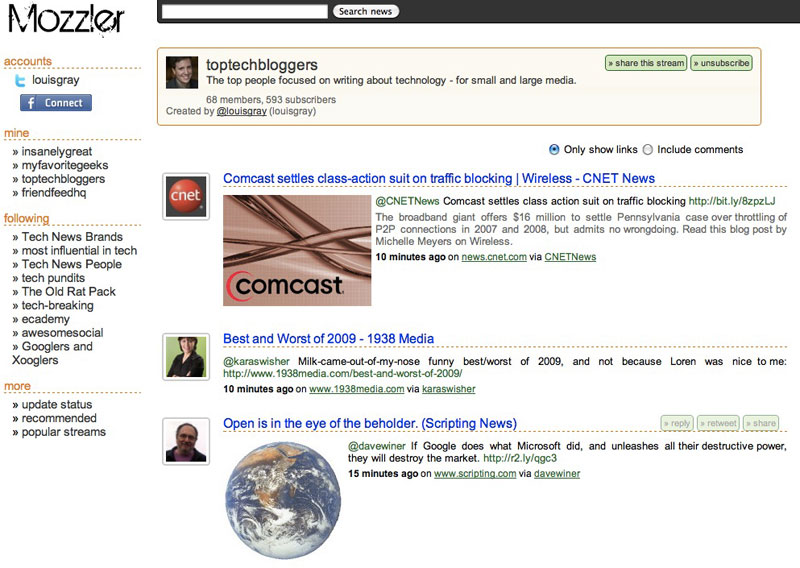
Mozzler Filtering My TechBloggers List for Links
(Click for Full Image)

Upon logging in, Mozzler displays the Twitter lists you have created, those you are following, and also suggests popular streams, highlighting a number of Twitter lists that have crested beyond 500 followers.


Twitter Filtered for Updates With Links Only

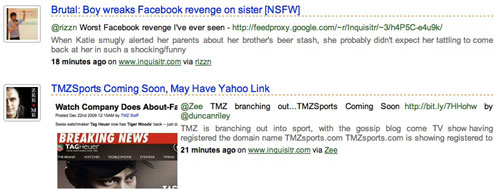
Click on your Twitter ID, and you can see all friends' updates, as with other Twitter clients, and rich media, including photos and video, is displayed in the stream, as it does in Brizzly. But to me, the most interesting wrinkle with Mozzler is the option to "only show links". This eliminates all status updates without links, and all @replies that don't contain a URL.


Rich Media Flows In With Mozzler

Combine a high quality Twitter list with the option to only show updates that contain links, and you have a highly relevant social stream, sorted by time - much like I've highlighted previously with the mytweetsense product by my6sense.


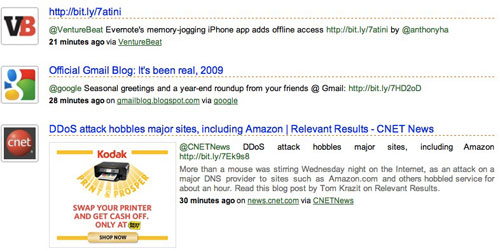
Top Brands on Twitter With Links

Chris Were, founder of Mozzler, sent me an e-mail, saying the service "aims to aggregate all the news from your social network into one place", while "At the same time, it aims to help find new sources of news (whether they be twitter/facebook users/fan pages/lists)."

Chris also said the product has much more to do to improve prior to being opened to the public, but expectations are that it will open up mid-January 2010.


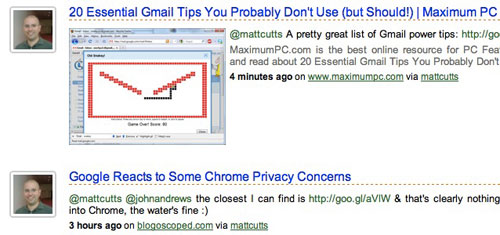
Matt Cutts, Filtered by Mozzler for High Quality

Without jumping back into the fray (again) around what is more relevant to find the best news, RSS or Twitter, Mozzler's ability to showcase tweets with links, combined with the most popular Twitter lists, many of whom feature top news brands, such as my "Top Tech Bloggers" list, makes it a very interesting service. You can even drill down on individual accounts to show link-based tweets or Facebook updates, without everything else.

You can find Mozzler at http://beta.mozzler.com and on Twitter at @mozzler_news. The service is in private beta, and I've been told you can get in to the service if you retweet this post and use the hashtag of #mozzlerbeta.

December 22, 2009

December 22, 2009 · 4 MIN READ · BY LOUIS GRAY

For All the Gloom Around RSS, Readers Continue to Climb

For All the Gloom Around RSS, Readers Continue to Climb

Skimming many of the leading technology outlets, you would think RSS had given up its ghost, making way for new services, like Twitter. Just this week, ReadWriteWeb claimed the RSS reader market was in "disarray" and continued a "decline". This came after a summer in which TechCrunch IT's Steve Gillmor declared RSS dead and suggested that it "rest in peace" and others ditched RSS for microblogging lists. With the world watching Twitter's top names and their Suggested User List-boosted following counts cross well into seven digits, data from FeedBurner and other sources shows RSS counts climbing - in some cases dramatically - for nearly all blogs, and a number of them also sport reader counts in the millions. While the independent market for RSS readers may be in bad shape, having ceded ground to Google Reader, RSS as a utility is actually growing. It's not going down, not by a long shot.

Prior to ReadWriteWeb's alarmist article, back in August, I arrived at similar conclusions, when I said "stand-alone feed readers are collapsing", highlighting the fact that Google Reader, and followers on FriendFeed, dominated my personal statistics.

That Google Reader and iGoogle have reached a dominant position in the market does by no means indicate the technology's death, but instead its maturity - something that, beyond aggregate reader counts, does not take in to account the fact that RSS is the mechanism for getting data between sites practically everywhere, even if it is not called out as such.

In January of 2008, I highlighted the debut of a new service called Rating Burner, which aims to display the most subscribed to blogs that utilize FeedBurner. The site shows not only a leaderboard, but also the change in subscriber data from day to day.

Data from Rating Burner shows green, positive growth across the board for feeds. And while total counts can always be debated as to their accuracy, sites including TechCrunch (with 4 million subscribers), the YouTube blog (with 2.4 million), Smashing Apps (with 1.5 million) and Simply Recipes (1.5 million) are into seven digits. This parallels the top Twitter accounts, who crest in the 4 million range, crowned by screen celebs Ashton Kutcher, Britney Spears and Ellen Degeneres.

Yes, statistics are statistics. The high numbers for these well-known personalities is suspect, thanks to their inclusion on Twitter's Suggested User List, and it is also expected that some top blogs here are bundled and not read every day - adding to their counts. Also true is the fact that not every blog uses FeedBurner, and thus cannot be tracked as well. Many sites point instead to a raw XML file, keeping control. That said, regardless of the data's perfection, the growth in 2009 for RSS subscribers cannot be questioned.

Using BlogPerfume's Feed Analysis tool, I took many top blogs and plugged in their statistics, to see how they grew in 2009. Running their query for the last 12 months provided 11 months worth of data. (Not perfect, but good enough)

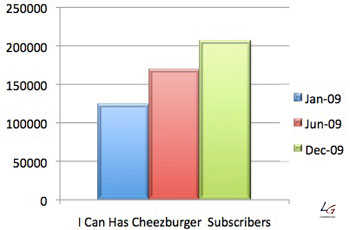
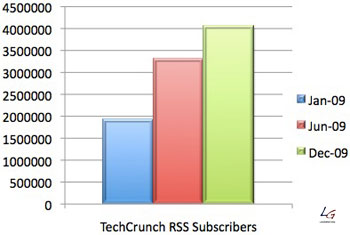
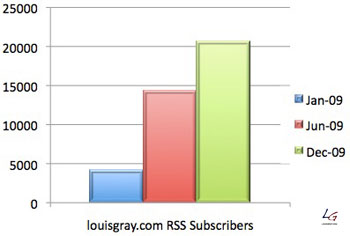
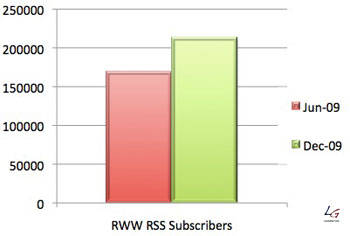
For the charts below, I used three data points to show blogs' subscriber trends:
  • January 22, 2009
  • June 22, 2009
  • December 22, 2009
(Yes, the gap between January and June is 5 months, and the gap between June and December is 6, but you get the idea.)

To run the numbers yourself, simply plug in any FeedBurner enabled feed. (Examples: TechCrunch, Mashable, louisgray.com and I Can Has Cheezburger)


ProBlogger Nearly Double Subscribers in 2009 to ~140k


LOLCats Added 100,000 Readers to 200k+


TechCrunch Doubled from 2 million to 4 million


My Own Stats, Aided by FriendFeed, Quintupled


ReadWriteWeb added 40k from June (Jan. data flawed)


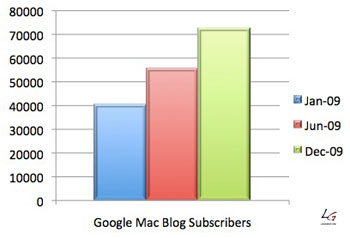
Google's Mac Blog Added 30k Subs to Top 70k.


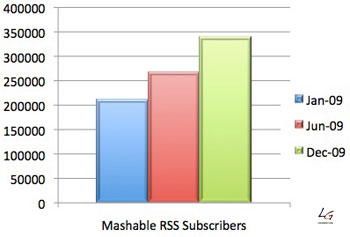
Mashable Added Almost 150k Subs to Near 350k.


Also - keep in mind that my own personal numbers are inflated thanks to FriendFeed, but most non-personal blogs are not.

So what is the point? The point is that while some services (read: Twitter and Facebook) may be getting many people's attention, and while it is also true that Google Reader has the lion's share of the RSS reader market, the current discussion around RSS being less useful, or less important, than in years past, is flawed, period.

Lest this early adopter sound too much like a curmudgeon, just because something is newer does not automatically make it better, nor does it mean that there will be a rapid mass exodus from the previous technology. Just like Twitter can drive good traffic to a Web site, so too can RSS. Just like Twitter can pass along top content, so too can RSS. Just like top followed accounts can get million-plus audiences, so too can RSS. And both are growing in terms of connections, with no reversal in sight. Both are tools to be used well, and both are being used more than ever. The only "disarray" is in the current thinking.