It's routinely shocking to me that so many bloggers think they should try and make a profit from their Web site.
Urged on by the success of mega blog networks like
TechCrunch and spurred forward by stories from
ProBlogger, or corner cases like
Dooce.com,
Daily Kos and others, an inordinate amount of people are hoisting ads on their blogs, from
Google AdSense, from
AdBrite or
Federated Media, in the hope of turning their daily rantings into big dollars that could possibly change their life. It's no surprise that blogging for many has the shiny look of a "get rich quick" scheme, when actuality is far different.
Their hopes are misguided, and for most, a serious reality adjustment is needed.
(Also:
The Web Advertising Bubble Has Got to Pop,
Advertising for Bloggers Has to Change)
Why and Where Do Advertisers Advertise?Advertisers post ads where their potential customers may be lurking. If the demographic you serve doesn't match the demographic the advertiser is looking for, then it doesn't do either of you any good to hustle for leads that won't close.
Advertisers are looking for high traffic areas so their ads can be seen by a wide audience, giving them the highest number of impressions and potential for brand recognition.
Advertisers will pay a premium, be it cost per impression, cost per click or cost per conversion for those sites that can bring the highest quality customer, often found on sites that offer significant differentiation, whether that be popularity, reputation, quality of content, or ownership of a specific niche that nobody else has covered.
Where Bloggers Are Going At it WrongMost sites are not big enough, traffic-wise, to generate significant revenue. Assuming a mid-size blog gets about 1,000 unique visitors per day, and an ad delivers 1 cent per impression, you're only talking ten dollars a day. If you're instead getting 25 cents for a click-through, you would need 4 percent of your visitors to click on an ad to achieve that same ten bucks. And advertising click through rates are usually in the low tenths of a percent, let alone full percents, so most numbers would actually be much less than this. Even if you move any of the dials up by a factor of ten, you're not talking about life-changing money. The Web is full of stories around bloggers who took months to get their first $100 check from Google, the barrier for payment.
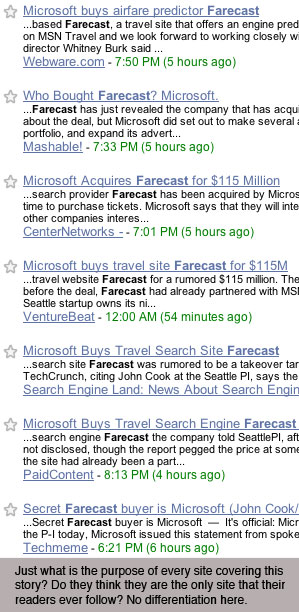
Most sites don't have real significant differentiation interesting to an advertiser. If you look in the tech world, just how many tech bloggers do we really need? How many of them are breaking stories or offering a unique angle for a unique audience that nobody would serve if they completely pulled up stakes and disappeared? Not too many. With the exception of about the top five or ten blog networks, no tech blog offers enough of a pull that an advertiser would consider them a must to invest with. And even among the top networks, the rush to publish is becoming silly to watch, as my RSS feed reader will fill up with near-identical stories, usually written by people who haven't done any original reporting beyond reading a press release, other blogs, or listening to a financial earnings call, if they're really serious. (See the graphic on today's acquisition of FareCast by Microsoft, for example)
On the E-Consultancy Web site,
this issue is bluntly addressed:
"Most bloggers don't make a cent from blogging and the global demand for mostly poorly-written blogs about technology news pales in comparison to the global demand for music."
Yet, some bloggers act as if it's their God-given right to write, post a few ads and start raking in cash. In my opinion, content is absolutely cheap. It costs nothing, except time, to put text on paper or computer screen. In the world of journalism, finding willing reporters for newspapers hasn't really been much of a problem. Instead, there's a dearth of readers, and advertisers, which the Web has helped accelerate, as paper circulations dive and reporters are laid off. And while Google is reporting great earnings, the same rules will hold true online. Bloggers are a dime a dozen in most cases. Those that offer non-unique blogs without significant audience or differentiation might as well not exist as far as ads are concerned. Delivering more posts per day won't fix that. Following the big, successful networks won't do that. Spamming and trackback abuse won't fix that.
Services Offer Real Value, Bloggers Don'tSometimes bloggers on the periphery of an industry get jealousy over seeing the dollars thrown around from mergers and acquisitions, or funding. It is human nature to see when a service might be bought for millions, that fans of the service or bloggers covering it feel they are entitled to a "share". But Web services like
Facebook,
Digg, or
TechMeme are in themselves destination sites that are sticky, pulling in consistent viewers and repeat visits, made even better when these sites have personal, demographic information that helps tailor ads and messaging. These Web services are adding real value to the Web by changing the way we interact and communicate. Bloggers, myself included, are not. We are more like consumers than producers in this case, and the last time I checked, consumers pay, they don't get paid, no matter how excited we might be about a product.
The Focus Must Be Away from AdsIn
a recent discussion on this topic, a blogging peer of mine said, "What's "fair" to me is making enough to cover hosting costs and buy myself some toys every once in a while. I do that, which is enough. But if I couldn't even cover hosting costs, I'd stop blogging."
And to me, I don't possibly see how the word "fair" can come into play. As bloggers, the ad industry, and our readers, truly owe us nothing. If we have opted to start writing, it is on our own choice. What we write about? Again, our choice. Where we opt to be hosted? Usually our choice. Our page layouts? Our choice. Our blogging platform or schedule? Our choice. So how does "fair" come into it? The goals must be somewhere else, whatever they may be for the individual, be it a hobby, setting up for the "next" job, continued writing practice, or enjoying the community.
There are millions of bloggers out there today, screaming for their "fair" share of the advertising pie. And while Google rakes in cash from vendors by the billions, some smaller bloggers are crying foul at the perceived inequalities. But it's more likely they are getting exactly what they deserve when it comes to ads - pennies. They would be better served to pull the ads off their site altogether and find different ways to make money, because for most, blogging will never get them what they want.
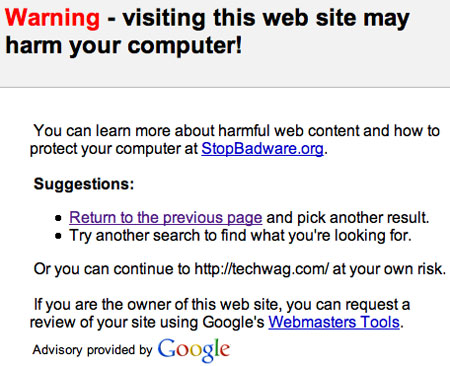
 For many blogs, Google traffic sends the overwhelming majority of visitors. TechWag, a technology blog authored by Dan Morrill, claims Google constitutes upwards of 80 percent of traffic. Or it did... because earlier this week, Google identified his site as harmful, and instead of sending people to his site, would-be visitors are instead warned that by visiting TechWag, their computer could be harmed (See why). As a result, traffic has, as you would expect, evaporated.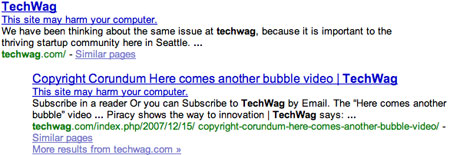
 For the last two baseball seasons, my wife and I had signed up to approximately 40 games a year. We didn't make all of them, but we made a good amount. We spent a lot of Friday evenings and Saturday mornings going up and down I-880 in the East Bay, headed to Oakland. But when news of the twins hit, we knew we had to adjust, taking the total package down to what we thought would be a more manageable 20 games a year. I even planned ahead by leaving a big gap in our ticket schedule around when the kids are expected to show up.
 This coming Sunday, it will have been three months since I did what I once said I would never do, when