Silicon Valley Technology Commentary & Archives · Est. 2006 3,034 Posts · 2006–2026

April 15, 2008

April 15, 2008 · 3 MIN READ · BY LOUIS GRAY

Does Negativity Deliver Credibility? If So, That's Nuts.

Does Negativity Deliver Credibility? If So, That's Nuts.

Over the last 18 months or so, I've gained something of a reputation for being an early adopter more likely to heap praise on early versions of software with clear bugs than to drag services through the mud, calling out their every hole and flaw. I've stated that I do champion the little guy, and when I've found a service I like, there's no question you'll know, because I'll be consistent in my comments on it, highlighting new tweaks and trying to help you understand why I like what I do, and, in the converse, why I might not like other options.

But does my tendency to be positive and shun negativity make me less believable? Should I maintain a ratio of cranky posts to positive ones for variety's sake or to prove I'm not a paid shill on the take? As far as I'm concerned, no. In most cases, rather than drag down services, or dance on the graves of failed startups, I see sites' potential, and recognize the very real people behind services who are working hard to make their products as good as they can.

Marshall Kirkpatrick of ReadWriteWeb jokingly commented on FriendFeed today: "You should write a really harsh review of something tho, just to maintain credibility!"

It's clear my quasi-utopian view isn't held in many corners of the blogosphere. Some revel in negative reviews or tearing people down. Others feel they have a calling to be "balanced", evening out an otherwise positive post by highlighting a service's deficiencies, or if the service happens to be amazing, to pick three random competitors for whom this new arrival will certainly mean curtains. But to be honest, even if I have more readers now than I did three, six or twelve months ago, this is still my personal blog, and should reflect how I feel. When I write up a service, I aim to deliver an accurate portrayal of the news, sites or individuals covered, but I would much rather highlight those companies and services I like than waste my time showing you the services that I didn't like. In essence, my silence in itself can be considered a negative review - and if you think about those topics I do write about, maybe there's a good reason I haven't covered every single service out there under the sun...

This isn't to say I haven't had a few negative posts here and there. I've at times been frustrated with TechCrunch (TechCrunch's Celebrating Failure Doesn't Help Anyone), ValleyWag (Valleywag Thinks My Old Posts are Breaking News) and even TechMeme (Blogrunner Likes Me, TechMeme Hates Me). I wasn't exactly overwhelming in my praise for NotchUp (NotchUp Sells You Out, but Nobody's Buying) and you likely remember my first comments on Fav.or.it. (Fav.or.it Beta Effort is Not My Favorite. Not Even Close.)

But these negative posts are are a rarity.

In fact, Mark Hopkins of Mashable said to one FriendFeed user in search for good PR that it's fairly obvious when I've found a favorite: "Talk to Louis Gray. Forget product evangelist. When he likes something, he's a one man crusade."

If you listened to this week's Elite Tech News podcast, you could probably tell that my positive viewpoints on the Web were frequently outnumbered by those who didn't favor companies, services, or individuals, who feared their content would be stolen, and that tech leaders and bloggers were too money-driven or ego-driven to be trusted. But I would rather accurately portray my intrigue and excitement around new services, even if they're not perfect. I don't think it does me a lot of good to sit down with a service I don't like or can't recommend and put 500 words into it.

You could probably also tell this from the interview Mark Evans posted this morning, Who’s Louis Gray?, which helps explain my background, and shows why I've ended up covering what I do. The tech world is moving faster than just about any market out there which I can think of. There are some amazing folks out there working ridiculous hours trying to make the next big thing. Only a few will make it. But if we tear them down too early, they might never actually reach their full potential, and I don't think it's really worth it, simply to engage in a race for page views.

April 15, 2008 · 3 MIN READ · BY LOUIS GRAY

ReadBurner Fired Back Up With Revamped GUI, Reader Integration

ReadBurner Fired Back Up With Revamped GUI, Reader Integration


ReadBurner is back... with a serious makeover

The short history of ReadBurner, Alexander Marktl's pet project aimed at finding the most shared items on Google Reader has already been one of many twists and turns. First, it was discovered before planned launch, forcing Marktl into a wild one day scramble. The site rapidly gained followers, and competition, aiming to seize onto the shared links tabulating trend. But suddenly, Marktl went silent and on March 5th, said he was to shut the site down for good, or so we thought, only to see it resurrected less than ten days later, following the site's acquisition.

Now, under new ownership, ReadBurner is back with a bang, offering a dramatically improved UI, and a wealth of new features highlighting popular items and sources, as well as the most innovative new wrinkle, full integration of Google Reader within the site, making it more sticky as a destination site than ever, and keeping it one step ahead of Benjamin Golub's RSSMeme, who in ReadBurner's absence, aggregated more shared links feeds than anybody outside the walled garden of Facebook, where Mario Romero's Feedheads app reigns supreme.

The first thing you'll notice with the new and improved ReadBurner is its shiny Web 2.0 look, courtesy of PixelTalent. The new site embraces bright neon orange and blue, making it tempting to wear shades simply to browse the site. Maybe that's the idea, as ReadBurner tries to take what's honestly a very geeky application, on the fringe of blog reading and recommending, and make it seem "cool". Let's be honest though, talking up ReadBurner at most parties outside of Silicon Valley won't get you too many dates.
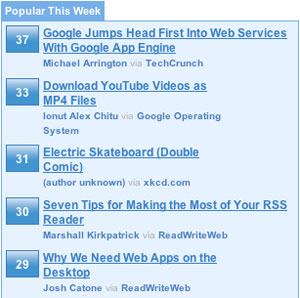
There are three major ways to filter the news, from the Popular (most shared in the last 48 hours), Upcoming (most shared in the last 24 hours) and Most Recent (a fire hose of shared items in near real-time). This is not new. But what is new is the way ReadBurner has now developed Categories (including an Apple category), Sub-Categories and in a TechMeme-like shift, "Related Items". Now, stories in the system are viewed based on their content, and they can be grouped together in story listings and individual item pages.

For example, Steven Hodson's WinExtra post (ReadBurner link) features similar stories from Mashable and SheGeeks. The other stories may not actually link to Steven in the way TechMeme's grouped stories tend to, but they are on the same wavelength.


ReadBurner shows related items.

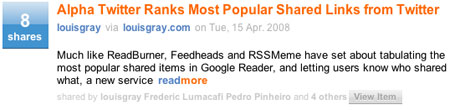
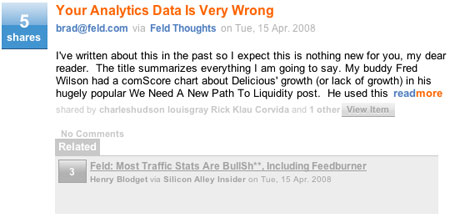
Also new for ReadBurner is the ability for a blog owner to track their own site and how often items are shared. RSSMeme has long had this feature, (see: RSSMeme/louisgray.com) and now ReadBurner is doing the same (see: ReadBurner/louisgray.com). I've found this approach to be a good measure, beyond page views, as to which stories are best reaching my audience.


An item from louisgray.com on ReadBurner.

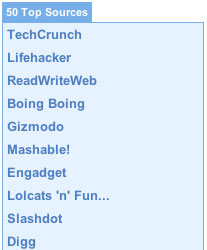
But while this seems intriguing on its own, the new ReadBurner team isn't done. From day one in version 2.0, they've added comments capability with Disqus integration (yes on the headlines and excerpt only, not the full story), as well as detailed statistics showing the top sources, as measured by total shares per story published (Example: 50 shares divided by 8 stories would have a score of 6.25). Unsurprisingly, like with TechMeme and RSSMeme, the household names are dominating this list, from TechCrunch to ReadWriteWeb, Lifehacker, Boing Boing and Gizmodo leading the way.
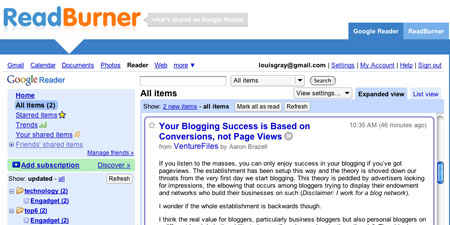
And integrating Google Reader is a great touch. Why go just to the Google Reader site if I can be one click away from ReadBurner? In combination, the pair offer a compelling destination for RSS goodness. I'd considered suggesting to the FriendFeed team that they should go the same way, but ReadBurner looks to have beaten them to the punch.


ReadBurner and Google Reader as one.

Outside of Feedheads, ReadBurner kicked off this rush to shared link aggregation, and with the help of a few friends, it should be back and on course. Be sure to watch the site closely as they continue to add users, tweak the algorithm and find new ways for distributors to leverage their data. We will be. Check them out at www.readburner.com.

April 14, 2008

April 14, 2008 · 2 MIN READ · BY LOUIS GRAY

Alpha Twitter Ranks Most Popular Shared Links from Twitter

Alpha Twitter Ranks Most Popular Shared Links from Twitter

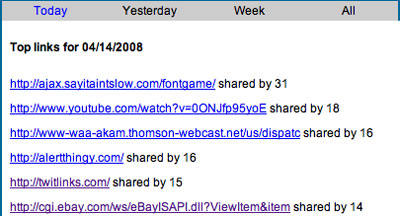
Much like ReadBurner, Feedheads and RSSMeme have set about tabulating the most popular shared items in Google Reader, and letting users know who shared what, a new service called Alpha Twitter is aiming to offer the same service to Twitter users, showing what the most popular "Tweeted" items are today, yesterday, this week, or even all time.

The developer, Luis Figueiredo, (LouMcAfee on Twitter), inspired by a number of other social link sharing services to gain the Web by storm this year, is aiming to fill a hole, helping us gain insight into the thoughts of Twitter Nation.


Today's top shared links on Twitter (Alpha Twitter)

As he wrote me in an e-mail today:

"Services like FriendFeed are indeed very useful and i've always would like to see a service that would display the popular links that are being shared by Twitter users. Such a service didn't exist and there was nothing like it out there, so I've decided to create my own."

The service, Alpha Twitter, is drop-dead simple to use, and to view. But what it lacks in style, it makes up for in simplicity. As with ReadBurner and other sites, it simply adds up how often URLs are shared, and aggregates the data over a 24-hour period. Those with the most shares go to the top. You can even click through the number of shares and see just who "tweeted" the item, and when they did it, which gives you an idea who has the fastest thumbs out there. And just a few days in, the service has already indexed more than a quarter-million Twitter links. It even got a quick mention from Michael Arrington on TechCrunch in a story about TwitLinks.

Figueiredo said Alpha Twitter simply parses all Twitter messages in the public time line, so pages are updated in real-time. The engine parses all Twitter messages in the timeline, searching for the string of "http://" and qualifying messages as containing links. And the service is even smart enough to decipher URL shortening services, including TinyURL. All the URLs and user names of who shared the links are then stored in a database.

The service, which is extremely new, is in the late alpha stage now, and is entering beta this week, Figueiredo says. But it already works now. And we can avoid any concerns about yet another service trying to make money off your content. Luis isn't in it for a buck, but instead says he is providing the site as a service to the community. You can check it out at www.alphatwitter.com or check out his blog at alphatwitter.com/blog.
April 14, 2008 · 2 MIN READ · BY LOUIS GRAY

BlogPulse Offers Insight into Blog Trends, Conversations and Influence

BlogPulse Offers Insight into Blog Trends, Conversations and Influence

While BlogPulse has been around since 2005, I have largely ignored it, relying on Technorati, Google Blog Search and my own internal metrics to gauge momentum, trends and how conversations get shaped. But in light of this weekend's discussion, I was drawn to the site, and found it offers the best, closest, picture to how the story developed, who linked to who, and how a story can gain influence.

You can even see which people, famous or otherwise, are getting cited most frequently, or are the most "bursty", showing they are climing the ranks. (Key People for April 13, 2008)

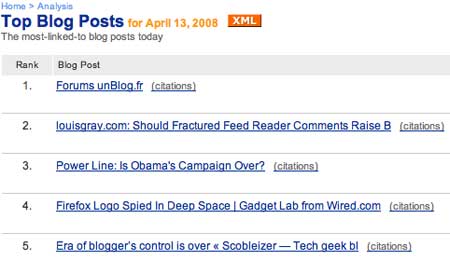
Part of Nielsen BuzzMetrics, BlogPulse highlights the top blog posts, news stories and videos on the Web each day, and offers the ability to search for trends, track conversations across multiple blogs and get profiles of a site. Interestingly, I was alerted by Technorati to the fact that Friday night's post was somehow labeled the second-highest "top blog post" by Nielsen, and Scoble's follow-on "Era of Blogger's Control Is Over" ranked fifth. This was tabulated by the blog posts gaining the most external links. You can see the top forty for today listed on their site, ranging from technology to politics. Unsurprisingly, the weekend discussion on Shyftr figures prominently, with Scoble and me being joined by Tony Hung.


What makes BlogPulse most interesting, at least to me, is the ability to break out conversations between blogs, like a family tree, seeing who linked to who, and how while I may have kicked off the discussion, its clear that Scoble and Hung have their own spheres of influence. Of course, as some reactions linked to all sites, it's not a perfect measure, but BlogPulse is the best I've seen here. (See: BlogPulse: Conversation Tracker)

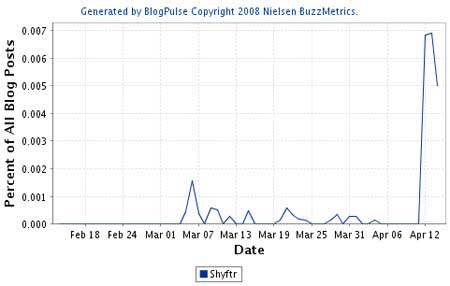
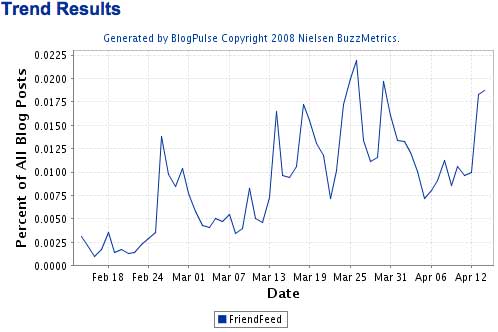
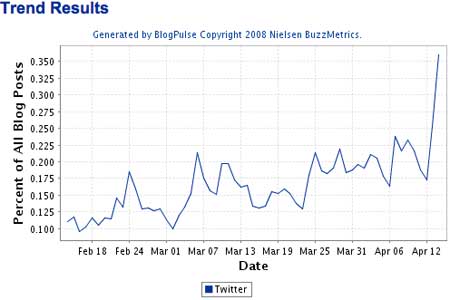
But BlogPulse does more than just track the conversations. Like Technorati, BlogPulse can show charts, displaying if one topic or another is capturing the fancy of the blogosphere as a whole.

Here is the chart showing Shyftr's spike over the weekend:


The same chart for FriendFeed:


And for Twitter:


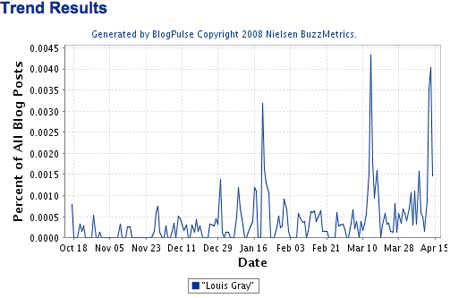
And if you're so inclined, you can even search for yourself, like I did.


Drilling down further, BlogPulse offers site profiles for the many blogs they index. The front page of the site claims nearly 78 million identified blogs, with more than 80 thousand net new in the last 24 hours, with almost 700,000 new posts indexed. Now that would make for a big fat, RSS to-do list, would it not?

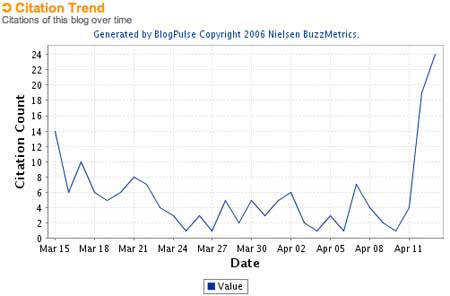
Looking at my BlogPulse profile, common keywords in my recent posts include "TechMeme", "Blogosphere", "Subscriber", "Momentum", "Anticipated", "Linking", "Embedded", and "Screenshot", to name a few. BlogPulse also offers graphs showing the number of posts per day, and how often the site has been cited in the last month. The chart for my site is below:


Can BlogPulse replace Technorati, as many have expressed frustration with the one-time blog search king? Maybe not, but it certainly has a lot of very interesting elements that I like. While it's not new, I'm definitely going to be paying a lot more attention now to BlogPulse than I ever did before. After a crazy blog weekend, it's offered us the best picture of how it all unfolded.