Silicon Valley Technology Commentary & Archives · Est. 2006 3,034 Posts · 2006–2026

May 1, 2008

May 1, 2008 · 2 MIN READ · BY LOUIS GRAY

The StatBot Launches to Analyze Blog and Web Trends, Statistics

The StatBot Launches to Analyze Blog and Web Trends, Statistics

Yuvi Panda, a 17-year-old technology whiz kid from India, has been behind detailed analysis of many high-profile blogs, including Engadget, Robert Scoble, Raymond Chen, Techmeme, Digg, TechCrunch and Matt Cutts. Last month, we connected, and he did me the great favor of looking at louisgray.com, helping me gain more insight into my links, trends and topics.

Now, Yuvi is ready to take what's been a hobby and open it up as a service, for those looking to get custom analysis of their site or other social communities, including Twitter, Flickr, or FriendFeed. Today, "The StatBot" launches, promising a new, statistical look at Web communities including Slashdot, Fark, Engadget, Wikipedia and Firefox. As Yuvi promises on the StatBot site, "The list is endless. Wherever there is a community, I’ll measure it."

First to debut under The StatBot microscope is Robert Scoble's Twitter account.
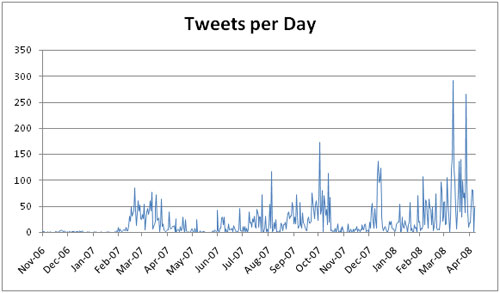

TheStatBot shows Robert's Tweet Pace Is Increasing

Through April 27th of 2008, The StatBot looked at 10,598 tweets from http://twitter.com/scobleizer, spanning 523 days, and comprising 175,543 words, with more than a million characters.
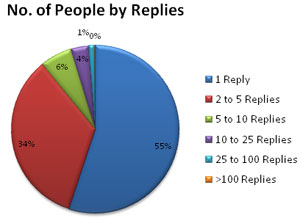
The StatBot shows Robert has already posted almost 5,000 Tweets in 2008, double his historical average. And he's erratic - at times posting hundreds of individual messages a day, and then during lulls, posting less than 10. Robert uses @Replies from Twitter for nearly two out of every three messages, and has sent @replies to more than 2,200 Twitterers, lending more support for my hypothesis last week that a great deal of Scoble's activity was borne due to the high number of people he is following.

This type of fun and interesting analysis is now no longer at his whim, for us to wonder about how reports could look if we just had the time. With the launch of The StatBot, you can now work directly with Yuvi to have him analyze your blog, and your online activity, or to drop a note into his suggestion box.

And with today's note, Yuvi does more than pick apart the world's most well-known Tweeter. He hints at greater things to come. He expects to debut new reports every two days for the next few weeks, and adds a teaser at the end of his first post.

When Yuvi picked apart my site last month, Eric Berlin wrote, "What a great analysis. An automated service that produced this level of detail would go like hotcakes round the blogosphere." Well, it's here, and it has a name: The StatBot. Check out The StatBot at www.thestatbot.com or follow it on Twitter here: twitter.com/thestatbot.

May 1, 2008 · 2 MIN READ · BY LOUIS GRAY

State of the Blog: April 2008 Recap

State of the Blog: April 2008 Recap

April 2008 In Summary (Archive Page)

Total stories published to date: 1,304

Total stories published in April: 38
(About 1.3 per day, up from 1.2 in March)

Total stories in April with comments: 34
(89% of all stories, up from 29 and 76% in March)

Total comments on April posts: 364 (95 on Disqus)
(About 9.6 per post, 10.7 per commented post)


April statistics from SiteMeter, with that service's numbers.
(Why show real data? See blog post)

Technorati Authority Ranking: 571 (up 200)
Feedburner Peak in Month: 1,637 subscribers (up 810)
Feedblitz E-mail Subscribers: 42 subscribers (up 9)
MyBlogLog Members: 203 (up 110)

Twitter Followers: 801 (Up 488)
FriendFeed Followers: 990 (Up 472)

Monthly Traffic Rank in Last 12 (via SiteMeter): 1st overall, by 25%.

Top Five Most Visited April Stories (According to Analog)

1. Should Fractured Feed Reader Comments Raise Blog Owners' Ire?
2. Most Bloggers Don't Deserve Any Ad Revenue
3. FriendFeedMachine Debuts New Approach to FriendFeed
4. What's Your Twitter Noise Ratio?
5. Five More Blogs You Should Be Reading, But Aren't

Others receiving votes: TechMeme Leaderboard's Top Ten: Six Months In, My Social Media Consumption Workflow, Shyftr Responds to Critics, Alters RSS Commenting Strategy, Fav.or.it Beta Effort is Not My Favorite. Not Even Close., FriendFeed's Increased Filtering Clears Deck of Unwanted Junk, and Alpha Twitter Ranks Most Popular Shared Links from Twitter...

Top Five Visited Archive Stories (According to Analog)

1. Elite Bloggers Joining FriendFeed In Droves
2. Toluu Offers Gateway to Friends' RSS Feeds, Recommends New Ones
3. LinkedIn Company Detail Shows Silicon Valley Carousel
4. Our Unborn Kids Will Wear Your Web 2.0 Schwag
5. ReadBurner Lights Up In Simmer Mode

While April again saw personal records fall for blog traffic, it's clear the real growth and engagement is found in Web services, external commenting and linking. Overall traffic grew 25% from March, measured in unique visitors, and individual days saw spikes that rivaled a month's traffic for me less than a year ago. Yet it's activity at FriendFeed, Twitter and Disqus that is really growing. Technorati and MyBlogLog rankings also spiked dramatically in April.

One word of caution, lest it be believed I've started this series to highlight the higher awareness achieved in recent months, be assured that's not the case. I started doing monthly summaries after August of 2007, when I had 103 RSS subscribers, and 40 comments in the month. Hopefully you find these interesting or useful.

To keep on top of things, subscribe via RSS, via e-mail, follow me on Friendfeed or Twitter, or keep watch on our shared link blog!

April 30, 2008

April 30, 2008 · 4 MIN READ · BY LOUIS GRAY

Should Bloggers Open Up Their Statistics?

Should Bloggers Open Up Their Statistics?

The Web makes it incredibly easy to be measured, and to be measured publicly. There are many metrics out there, be they Technorati Authority, based on unique external hyperlinks, total RSS subscribers (via FeedBurner), total Twitter followers, and friends of all types, from FriendFeed to Facebook and back. But while most of us are more than eager to share that data, when it comes to actually sharing the traffic we receive on our blogs, it can be a closely-guarded secret. Talking about visit counts can be seen as off-limits as one's salary.
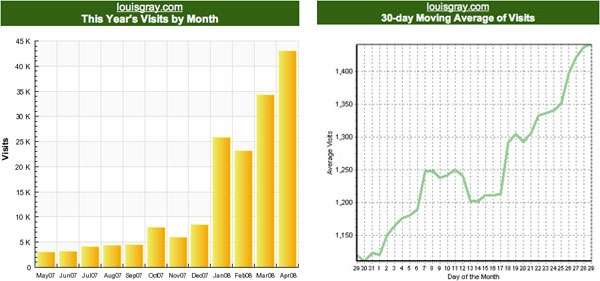
As today is April 30th, wrapping up another month, today offers yet another opportunity to sum up the month's statistics, show trends, and compare to the past. (You'll see a "State of the Blog" post from me on this early tomorrow, as we do each month) But while, to date, I've shown graphs, I usually hide the total number of visitors, page views, etc. And now, I ask openly, why?

I think there are two major reasons that bloggers as a whole don't open up their statistics for others to view:

1) The Inferiority Complex
By sharing my statistics openly, it will now be obvious to the world how little real traffic I get, opening me to ridicule. The emperor has no clothes, it could be said. Also, maybe the traffic I receive isn't seen as "quality" traffic? I still get a lot of visitors from Google image searches looking for R-rated material in vain. Maybe I don't want everybody to see that, and, therefore, take the site less seriously?
But yet, the reverse problem also holds true.

2) The Big Head Complex
By sharing my statistics openly, it could be shown we're bragging, highlighting traffic, growth, and the trends. Smaller bloggers just getting started might see the data as unattainable and could throw potshots.
It all depends on perspective.

So why open up? We've come a long way since free hit counters were the rage back in the mid to late 1990s, and one could up the number just by refreshing a page in the browser. Now, whether your stat package of choice is SiteMeter or Google Analytics, your site traffic has likely been made invisible to your readers, making actual, true, traffic a mystery. But in the interest of openness, data sharing, and collaboration, I think it's time to consider making our blog traffic 100% available and visible.

Advantages:

1) Making traffic details public establishes a data point
Just as it makes sense to visit Salary.com and determine what other people with your title in your geography are commanding, viewing other's statistics can give you a reference point for how you are performing against your peers.
2) Making traffic sources public enables new sites' discovery
One of the most interesting things I find from my statistics are where people are coming from, in the referral logs. It's likely that those people caring enough to send a link my way might be interested in the same topics I am, and, using the transitive property, my readers would be interested in what they are as well.
3) Making content details public shows popularity of topics
Despite one's best efforts, not every single story gets the same amount of solid traffic. There are peaks and valleys. Making this data public could better give guidance to other writers as to what topics are most interesting, might get the most engagement, or views.
Disadvantages:

1) Establishing that data point puts you on a chart somewhere
Whether the total number of unique visitors, page views, referrals is in the hundreds, thousands or hundreds of thousands, by establishing that data publicly, your traffic now becomes part of the conversation, relative to yourself and relative to others, so you'll need to come to terms with this in advance.
2) Exposing traffic details could lead to others' snooping
A good blogger who knows their statistics can get used to specific readers. With a good combination of MyBlogLog, and location-based visits, I have a good idea of who the most frequent visitors are, and I think I know what stories they read, if I get the time to look it up. Maybe others could be as aggressive and figure out the same information. Some visitors might not like having this potential to be snooped expanded to the masses.
3) Your statistics could actually go down
It's one thing to post data at your peak when things are going well. But if you have a slow week or months, and your numbers collapse, there's no hiding it. You can't undo a number once it's out, so that too would be a risk.
So here's what I'm thinking. I have nothing to hide. Tomorrow, when we do our statistical summary for the prior month, I'll use the statistics I have on hand, and expose the sources of the data. We'll see what happens. And maybe, as you go about your efforts, you'll consider opening up. This isn't a question of who's bigger than anybody else or what's good traffic versus bad. I feel that as bloggers, the more data we have available, the more empowered we are. Let me know if this is something you would be eager to participate in, and what your thoughts are.
April 30, 2008 · 1 MIN READ · BY LOUIS GRAY

Broadband Put to Test With 410 MB of Apple Software Updates

Broadband Put to Test With 410 MB of Apple Software Updates

It doesn't seem all that long ago when it could take upwards of an hour to download a 4 megabyte update to Netscape Navigator. And in 1996, I once maxed out my best friend's 1 megabyte e-mail cap by sending him an IRC client as an 800k attachment, forcing him to beg and steal space from the UCLA IT administrators, just to get his e-mail functioning again.
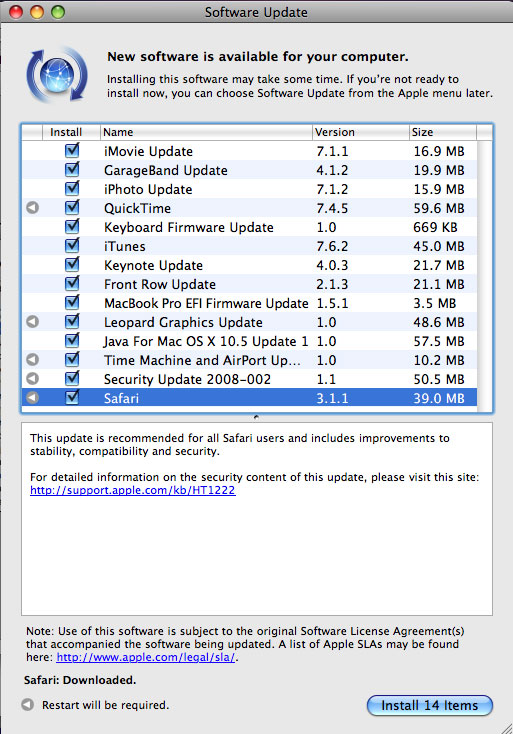
Times change. Tonight, having heard Apple released an update to its Java support in Mac OS X 10.5, I opened up my Software Update, and was astounded to see the number of requested system enhancements, and their size. All told, there were 14 different updates available, totaling 410.069 megabytes - an eyebrow-raising amount, considering that in junior high school, I was comfortable tooling with HyperCard on a Macintosh IIsi with a 20 Megabyte hard drive, with an 80 Megabyte LaCie external drive.


Tonight's Available Updates (Click for Full Size)

In a great example of how far we've come in terms of hard disk space and consumer broadband, Apple's casually requested me to download the equivalent of twenty times the capacity of that same Mac IIsi. And I'll do it. As some of the items require restart, I won't hit the button just this second, but I know my MacBook Pro, with 200 Gigabytes of hard disk space, ten thousand times larger than the old Mac IIsi, is capable of handling this workload.

In the era of terabyte hard drives, 160 gigabyte iPods, and downloadable movies, maybe I should stop being impressed, but every once in a while, it's worth looking backwards to see how far we've come. Now if you don't mind, I've got some Mac updates to install.