Silicon Valley Technology Commentary & Archives · Est. 2006 3,033 Posts · 2006–2026

July 1, 2008

July 1, 2008 · 2 MIN READ · BY LOUIS GRAY

State of the Blog: June 2008 Recap

State of the Blog: June 2008 Recap

June 2008 In Summary (Archive Page)

Total stories published to date: 1,389

Total stories published in June: 38
(About 1.3 per day, down from 1.5 in May)

Total stories in June with comments: 37
(97% of all stories, from 43 and 91% in May)

Total comments on June posts: 493, approx. 15 per post.
(From 456 or 9.7 per post and 10.6 per commented post in May)
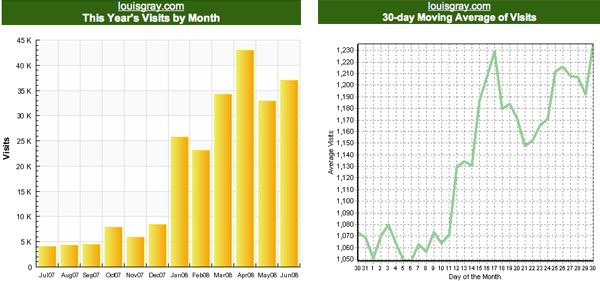

June statistics from SiteMeter, with that service's numbers.
(Why show real data? See blog post)

Technorati Authority Ranking: 788 (up 129)
Feedburner Peak in Month: 2,212 subscribers (up 181)
Feedblitz E-mail Subscribers: 56 subscribers (up 9)
MyBlogLog Members: 280 (up 34)

Twitter Followers: 1,257 (Up 148)
FriendFeed Followers: 2,542 (Up 544)

Monthly Traffic Rank in Last 12 (via SiteMeter):
2nd overall, behind only April '08.

Month over month growth: 12.7%
Year over year growth: 1,074.5%

Top Five Most Visited June Stories (According to Analog)

1. Smart People, Stupid Tweets. Fake News Spreads Fast on Twitter.
2. The Five Stages Of Early Adopter Behavior
3. Why Disqus Is Winning the Web Comment Battles, and What's Next
4. Feedly Brings New Social Experience to Start Page, Leveraging RSS
5. What I Believe: My 10 Web and Blogging Expectations

Others receiving votes: Are Blog Comments Really Conversations, or Are They Just Replies?, The Gray Family Doubles Overnight. Welcome Matthew and Sarah!, Disqus' Downtime Reminds Us of Woes for Data In the Cloud, RSSmeme Creator Served With Legal Threat Over RSS Shares, LOUD3R Launches Massive Semantically-Driven Network, and OneSpot Makes Publishing Personalized Memetrackers Simple...

Most Commented-On Articles, According to Disqus:

1. The Gray Family Doubles Overnight. Welcome Matthew and Sarah! (57 comments)
2. All Dogs Go To Heaven. For Molly, It Took 18+ Years. (41 comments)
3. Smart People, Stupid Tweets. Fake News Spreads Fast on Twitter. (37 comments)
4. Why Disqus Is Winning the Web Comment Battles, and What's Next (34 comments)
5. RSSmeme Creator Served With Legal Threat Over RSS Shares (27 comments)

June of 2008 was a month I'll never forget, obviously - for reasons much bigger than this blog or any dumb statistics. The month started off sadly with our 18 year-old beagle's passing, and culminated in the arrival of our twins. While some thought the doubling of our family overnight would dramatically impact my ability to keep up on the blog and elsewhere, it hasn't yet happened. There are definitely more distractions, and there will be gaps in publishing, thanks to family obligations, but my goal is to keep going. Should be a fun ride.

In between all the changes to the family, it was a great month, where we saw the debut of Feedly, mioNews, NoiseRiver, twitAbit, Loud3r, OneSpot, and FriendBinder, to name a few. Some you will hear about a lot in the coming months, and some, maybe not so much, but they're all trying to make a name for themselves, and they shared part of their stories here.

To keep on top of things, subscribe via RSS, via e-mail, follow me on Friendfeed or Twitter, or keep watch on the shared link blog!

June 30, 2008

June 30, 2008 · 2 MIN READ · BY LOUIS GRAY

mioNews Brings New Foldered Interface to FriendFeed

mioNews Brings New Foldered Interface to FriendFeed

Another day brings another interesting new application using FriendFeed's API, attempting to give a new way for active users to sort their stream. Today's entrant, called mioNews, instead of trying to mimic the spartan FriendFeed interface, as many others have, brings an approach more commonly seen in RSS readers like Google Reader, or even e-mail applications, like Microsoft Outlook. The new, professional, look also comes with some new features to help users indicate stories they both "like" and "hate", as well as the option to follow specific topics.
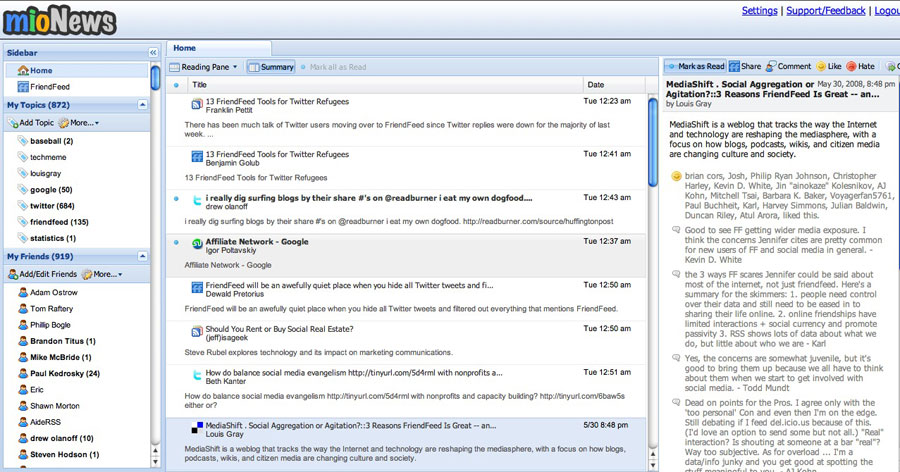

The mioNews Interface: Click for Large version

Since FriendFeed introduced their API in March, we've seen new interfaces developed for mobile phones, iPhones, and the Web, using Ajax. We've seen options to highlight individual stories or users you've said you like, and others that help block individual keywords.

mioNews, authored by Patrick Lightbody, lets you carve up and read the updates in your feed by:

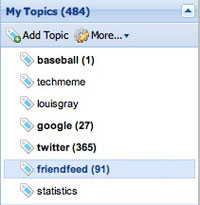
* Selecting topics, which shows the # of stories, and, when clicked, shows the stories in the main pane.
* Grouping friends in specific folders, as you specify.

Like in Google Reader, where you can choose to read full feeds, or just the title, mioNews, lets you show just the titles, or a short summary. Double-clicking on any item takes you to the item itself, be it from Twitter, a blog post, or a share in Google Reader. But more interestingly, you can turn on the site's Reading Pane, and like in Outlook, you can view the entire item, as well as take action on that item, including the ability to share, comment, like, or in a new wrinkle, hate a post. You can even mark all items as read, a feature many on FriendFeed have asked for, so far in vain.


The goal of mioNews, like NoiseRiver and FriendFeedMachine before it, is to help reduce the "noise" problem through giving you more control over selecting what you like and what you don't like. As Patrick writes in the introductory post, "instead of rating people and topics that you like/hate, mioNews asks you to like/hate individual articles. Then, using some autotagging secret sauce, the topics and people are tuned behind the scenes."

Provided you select topics that your friends are talking about in FriendFeed, mioNews will find it. It's no surprise they're often talking about Google, Twitter and FriendFeed. But if you branch out to sports, politics and the day's news, you might find some good gems in that rough.

mioNews' approach to the FriendFeed noise is unique. It might almost get on more desks at corporate, given how closely it approaches the look and feel of standard business applications. And as Patrick says, like NoiseRiver, it too is in alpha and much more is planned. You can keep up on mioNews in their room on FriendFeed here: http://friendfeed.com/rooms/mionews
June 30, 2008 · 2 MIN READ · BY LOUIS GRAY

On the Web, If You're Not Growing, You're Dying

On the Web, If You're Not Growing, You're Dying

Often, perception of a site or service's momentum can be self-fulfilling.
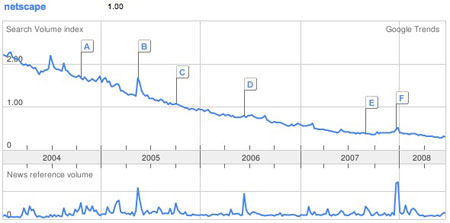
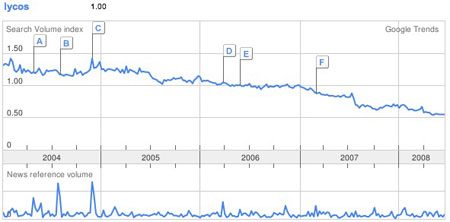
Even over the last two years of my writing on this blog, the companies I cover have changed, as what used to be relevant has become less so, and new hotshots have come to take their place. But while some niche services are on their way to becoming household names, others that could have done so are fading, when compared to their peaks of 1, 2 or even 5 years ago.

One tool showing the decline of brands relative to one another is Google Trends, which measures how frequently a keyword is searched for as a percentage of the total searches on the Web.

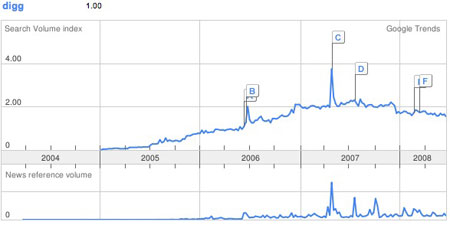
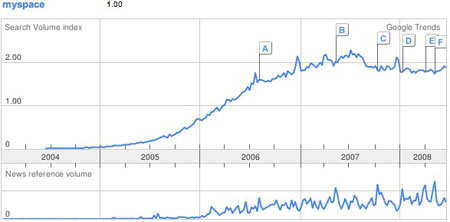
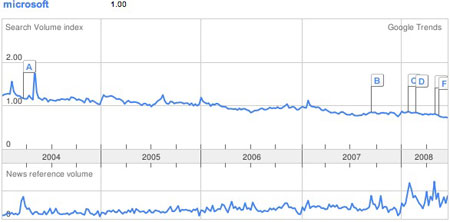
Using Google Trends, you can see the near-death of older Web 1.0 brands, like Netscape, Lycos and Alta Vista, the plateauing of early Web 2.0 brands, like MySpace, and the deflating balloon of weakened brands, such as Technorati, Digg and Microsoft.


Netscape's Downfall... In Graph Form.

And Lycos Follows Suit.

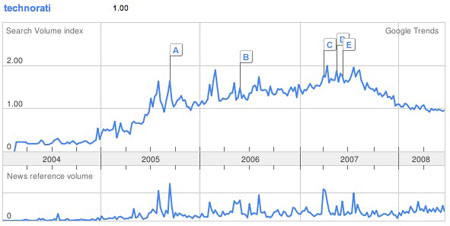
A little more than a week ago, Google Trends made news by introducing the ability to track data on Web sites, but the service's core element helps shed some light on the fact that the interest level in Technorati has been slashed in half in just the last 12 months, that MySpace peaked a year ago, as did Digg.


The Technorati Monster Is Starving.

And Digg Is In a Rut.

MySpace Is Floating in Space.

Meanwhile, as both Google and Yahoo! have continued an upward trajectory of world interest, Microsoft has seen steady decline every year, starting in 2004, when the data was first tracked.


The Only Thing More Depressing is MSFT Stock.

At one time, it was fun to point out that the Technorati monster had escaped, that Technorati wasn't up to challenging Google Blog Search, or to debate whether Digg's relevance was going to decrease with its move away from solely having a tech focus. But Google Trends lays out on the table the tougher news - nobody cares, and the number of people actively looking for news on Digg or Technorati is going down, while many, many other services are rapidly growing.

While the entire market of Web measurements is questionable, from Alexa to Compete.com and all sorts of competitors in between, it'd be interesting to see Google get even more aggressive with their trends, showing the velocity of a term's decline or ascension. Maybe that'd get the point across a little better for those saying their damaged brands aren't in trouble.

And lest you think Google Trends is all bad news, it's not. Take a look at hotter stories, like Twitter, FriendFeed, Facebook or Google itself to see what an up and to the right arrow looks like. But if these brands aren't careful, like some of those listed above, they too could stagnate and fall. And once you slow, you're really just preparing for the inevitable drop.

June 28, 2008

June 28, 2008 · 3 MIN READ · BY LOUIS GRAY

New NoiseRiver App Adds Interest Filters to FriendFeed Stream

New NoiseRiver App Adds Interest Filters to FriendFeed Stream

For those looking for FriendFeed Friday Tips #6, consider this post in lieu of the series. Our visits to see Sarah in the hospital prevented Friday posting. I'll look to be back on track next Friday.

As FriendFeed has grown its user base, the number of people to follow and items they add to their personal streams is increasing. Some are finding the resulting noise to be too much in its native form. While I've aggressively approached this issue by using the "Hide" function, others are looking to new services to take the next step, highlighting, in advance, those items that are most likely to draw your attention. NoiseRiver, a new service released yesterday, updates your stream based on instructions you give, including your liked and hated keywords and individuals, helping draw your eye to the best stuff fast.

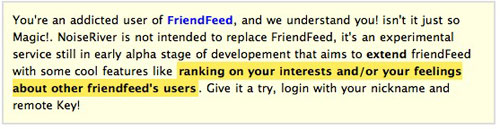
As the author writes, NoiseRiver is not intended to replace FriendFeed outright, but instead, like FriendFeedMachine, FFToGo and other innovative apps, looks to fill a gap, extending the product with new features.


How NoiseRiver Describes Itself

Upon logging into NoiseRiver, you'll see your plain vanilla FriendFeed stream. But where NoiseRiver excels is in learning from hints you provide, including your giving keywords that you're most interested in, and those you are not, in the "My Interests" section. In fact, if you never want to see specific terms, like "Obama", "McCain" or "Fail Whale" again, all you have to do is make them a keyword, pull the slider to the left as far as it will go, signifying you hate a keyword, and check the box that reads, "Hide entries with a very high hated rank? (-100%)".


I Pick Keywords I Want to See Using Sliders

But more than just acting as a smart filter to hide topics you could care less about, NoiseRiver also lets you select terms you like, be they "Google", "RSS", or the iPhone.

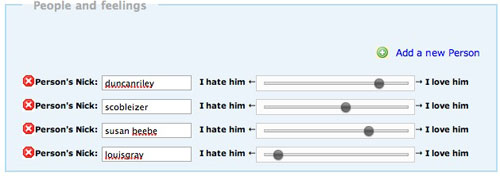
You can also set parallel filters for people. If you have friends whose updates you simply don't want to miss, go to "My Neighborhood", where you can add people's FriendFeed nicknames, and again, move the slider to show how much you care about their entries in FriendFeed.


I Can Choose People's Importance As Well

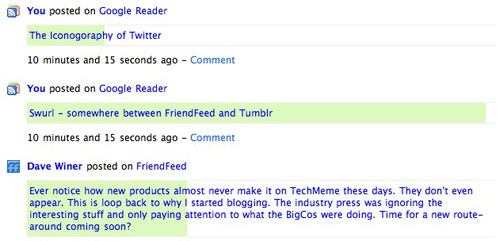
Having applied updates to both your interests and your neighborhood, the result from NoiseRiver is the same FriendFeed you know, but with a colored overlay which guesses how much you will take interest in an item. If I said I like "duncanriley" and "Twitter", the green bar will be well to the right. If I said I like "scobleizer" or "davewiner" a little less, the bar will only go part of the way. NoiseRiver combines both your interests and your neighborhood, rather than having to choose one over the other.


The End Result Highlights My Anticipated Interests

Back in May, I wrote that Content filters were proving evasive for social media sites. In the ensuing month-plus, both FriendFeedMachine and NoiseRiver have taken aim at the problem, by leveraging FriendFeed's flexible API.

As with both FriendFeedMachine and FFToGo, NoiseRiver is no passive experience. All three applications enable you to make comments and like items from their interface, just as you would in FriendFeed. Making comments via NoiseRiver even adds a tag of "via NoiseRiver" in FriendFeed, helping to advertise the new service, as do the others. So if you already like FriendFeed, but want to find a better way to draw your eye to those things you'll like best, and hide the rest, NoiseRiver is a strong option. It's only been out for about 24 hours, so it should be fun to see what other options come next.