 Often, perception of a site or service's momentum can be self-fulfilling.
Even over the last two years of my writing on this blog, the companies I cover have changed, as what used to be relevant has become less so, and new hotshots have come to take their place. But while some niche services are on their way to becoming household names, others that could have done so are fading, when compared to their peaks of 1, 2 or even 5 years ago.
One tool showing the decline of brands relative to one another is Google Trends, which measures how frequently a keyword is searched for as a percentage of the total searches on the Web.
Using Google Trends, you can see the near-death of older Web 1.0 brands, like Netscape, Lycos and Alta Vista, the plateauing of early Web 2.0 brands, like MySpace, and the deflating balloon of weakened brands, such as Technorati, Digg and Microsoft.
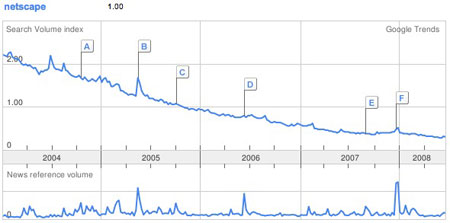
Netscape's Downfall... In Graph Form.
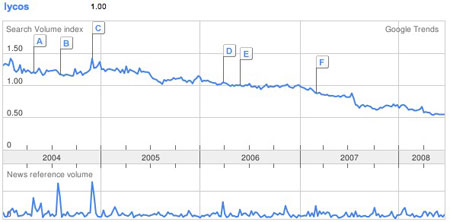
And Lycos Follows Suit.
A little more than a week ago, Google Trends made news by introducing the ability to track data on Web sites, but the service's core element helps shed some light on the fact that the interest level in Technorati has been slashed in half in just the last 12 months, that MySpace peaked a year ago, as did Digg.
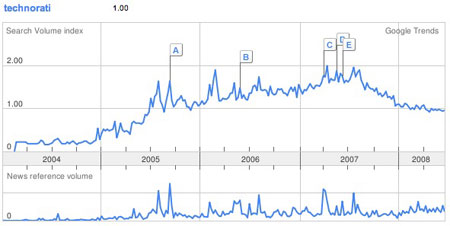
The Technorati Monster Is Starving.
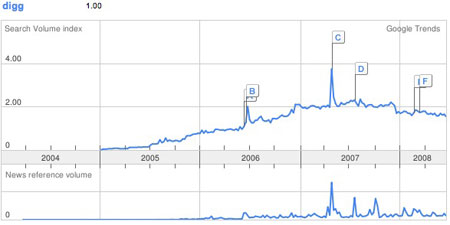
And Digg Is In a Rut.
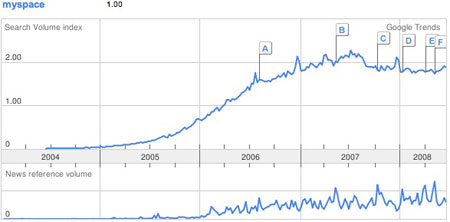
MySpace Is Floating in Space.
Meanwhile, as both Google and Yahoo! have continued an upward trajectory of world interest, Microsoft has seen steady decline every year, starting in 2004, when the data was first tracked.
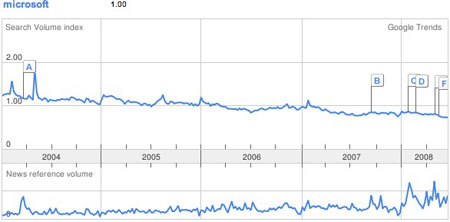
The Only Thing More Depressing is MSFT Stock.
At one time, it was fun to point out that the Technorati monster had escaped, that Technorati wasn't up to challenging Google Blog Search, or to debate whether Digg's relevance was going to decrease with its move away from solely having a tech focus. But Google Trends lays out on the table the tougher news - nobody cares, and the number of people actively looking for news on Digg or Technorati is going down, while many, many other services are rapidly growing.
While the entire market of Web measurements is questionable, from Alexa to Compete.com and all sorts of competitors in between, it'd be interesting to see Google get even more aggressive with their trends, showing the velocity of a term's decline or ascension. Maybe that'd get the point across a little better for those saying their damaged brands aren't in trouble.
And lest you think Google Trends is all bad news, it's not. Take a look at hotter stories, like Twitter, FriendFeed, Facebook or Google itself to see what an up and to the right arrow looks like. But if these brands aren't careful, like some of those listed above, they too could stagnate and fall. And once you slow, you're really just preparing for the inevitable drop.
9 Comments
Are search terms a true indication of a trend? What if I search a site, bookmark it and don't search again?
Is there another trend that newer services are always searched more than older?
They can be used as one data point, for sure. The trends on Google and Yahoo!, and even Friendster, worldwide, are up and to the right. If you can't grow your brand in a time when global use of the Web is increasing, there's something wrong. The graphs above, while not perfect, definitely can show when a brand is dying, and when one is doing well. I believe that these others are an early "tell" in the court of public opinion.
Is this true only because most of web2.0 doesn't actually make any money? Their "revenue" so to speak, then, is their traffic. So since companies have to show growth of some sort - if it isn't actually money (which could grow for a variety of reasons uncorrelated to traffic) for most websites that's going to have to be traffic.
The trends are interesting, no question, but aren't they a bit misleading? For example, most people don't search for the word "Digg" to find its site, at least not more than once. Then they bookmark the URL or else they just memorize it to go back. Therefore, there would be a lot of traffic hitting Digg without resorting to Google as the gateway. Moreover, if you're going to search for news stored on Digg's site, aren't you going to do that directly on their site, most often by scanning the popular or upcoming pages?
The trend may be an indication that there's not a continually growing number of people who are discovering Digg through Google. However, I'll bet there's more Digg growth coming through blog posts, forums, or word of mouth referrals than cold searching in Google.
Just a thought to consider.
Louis, what you showed here is a classic product life-cycle. It's the same everywhere, not only in the web-business (most of you are probably aware of that). However, I would say that Myspace and Digg are currently in the "cash-cow" phase, so their owners should focus either on extending it or on reinventing into the 'star' phase (rather than killing them). Also, it's worth a notice that Digg and Myspace are the only ones that made it (sort of) into mainstream (MSFT excluded, of course) so their reinvention should take place in the mainstream market rather than the geeks. MSFT is obviously in the 'old dog' phase, but hey, everyone knows that ;)
Microsoft and Myspace will do fine, the others I don't think so.
The interesting thing is that the Technorati curve appears to follow a shallow version of the Gartner Hype Cycle.
I think RSS has a lot to do with the decline of search. I search once, find something I like, and RSS it so I go directly to the source and remove the middle man (and time) from my processes. An RSS opt-in reporting system would be nice...
What about website traffice?
http://trends.google.com/we...