Silicon Valley Technology Commentary & Archives · Est. 2006 3,033 Posts · 2006–2026

June 28, 2008

June 28, 2008 · 3 MIN READ · BY LOUIS GRAY

Browzmi Lets You Share Browsing Experience With Friends

Browzmi Lets You Share Browsing Experience With Friends

You name the online activity, and new services are emerging to find ways to let you share that experience with friends. There are new RSS readers with social aspects. There are any number of ways to answer the proverbial "what are you doing?" and keep friends updated, and seemingly, each day, a new site debuts to try and corral all your online updates. 
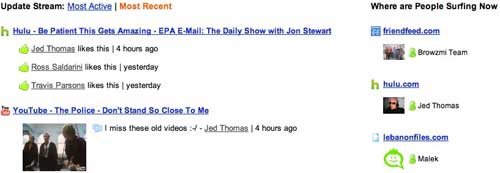
Browzmi, a small site that hasn't gotten much attention, has developed an interesting tool that lets you browse the Web together with friends, adding comments and marking favorites along the way. Unlike FriendFeed, which some aspects of Browzmi look much like, you're not adding your likes and comments to external activity, but instead to the browsed sites themselves. Further extending the social aspects of the site, Browzmi also integrates real-time XMPP-based chat, and provides each user with an RSS feed showing their activity, which can be sent to any RSS-enabled application.

Browzmi was founded in 2006 by Travis Parsons, and over time, working with a 5 person engineering team, based in Russia, Parsons has developed a service that lets friends surf the Web together. As the site's overview states, the goals are lofty:
"Browzmi is providing an environment where friends can explore, share and discover the entire web like they are there together. Browzmi is not attempting to replace your favorite websites - it wants to make your experience across your favorite websites more social by allowing you to go anywhere on the web with your friends."
-- Via Google Docs: Browzmi
There are three major parts to Browzmi. The first is "My Stuff", which includes your profile, your friends, your favorites and your updates. The second is the browser window itself. The third is an "Explore More" tool that shows you what sites your friends are viewing, and their history, while offering links to related items on Flickr and YouTube.


Browzmi shows updates from friends.

When signed into Browzmi, in any Web browser, the central portion is like a "browser within a browser". Put in a URL in the location bar of Browzmi, and it fills the center portion, while adding it to your updates and alerting friends of the new site you've found. Depending what you think of the site, you can give it a quick thumb up or thumb down,  make it a favorite, or add a comment. Browzmi de-duplicates by URL, so it's not uncommon for some sites to have dozens of up or down thumbs, and a good number of comments.
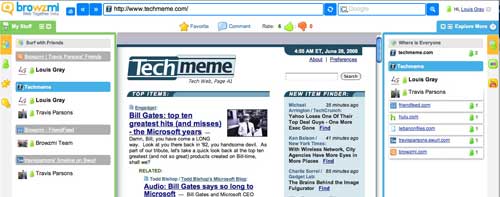

Browsing Techmeme in Browzmi's main window.

The "browser within a browser" functionality of Browzmi is surprisingly strong. It's not an emulator by any means, so any site that looks good in your standard browser looks good in Browzmi, including all plug-ins and Flash, as Browzmi leverages its environment well. You will, however, need to login to sites as cookies are not passed directly to Browzmi from your computer. Also, should you opt to keep all three sections of Browzmi open concurrently, be prepared to have a reduced-width browsing experience. Luckily, you can open or close any section at any time to get parts of your screen back.
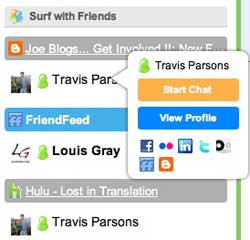
By going to "Surf with friends", you are treated to seeing the most recent sites visited by friends on Browzmi, as well as your own activity. If they like or favorite an item, you'll see it. You can also visit Browzmi's main feed to see the most active sites, or most recent activity overall, and search by keywords for related items.

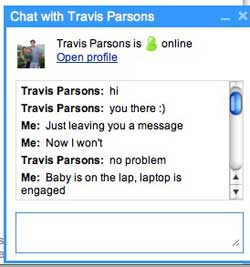
But Surfing with Friends is no passive activity. You don't just have to watch. Click on any friend's name and you can hit the "start chat" button, or view their profile. Starting a chat fires up a small window, similar to that found in Google Talk or in Facebook. This way you can, in real time, share the site you're browsing and talk about it with a friend.

There are nearly 300 users of Browzmi today, so the site is very small, but it absolutely works. If you want to do more than share what items you've liked in Google Reader, and you want to do more than show friends, via Toluu, what feeds you read, you can take things up a notch and browse the Web together using Browzmi. For a service that almost nobody has heard of, it works very well, providing a service where you no longer have to browse alone.

June 25, 2008

June 25, 2008 · 2 MIN READ · BY LOUIS GRAY

Smart People, Stupid Tweets. Fake News Spreads Fast on Twitter.

Smart People, Stupid Tweets. Fake News Spreads Fast on Twitter.

The combination of a rush to publish and a low barrier to entry for microblogging makes posting quick notes to Twitter extremely tempting for people who are trying to break news. In seconds, a rumor can be launched, whether true or not, and hit thousands. If those thousands then, in turn, repost your note, you've got a rapidly snowballing mess to deal with.

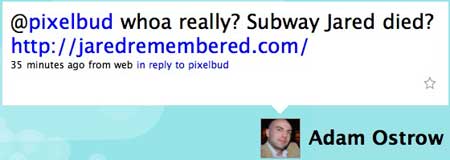
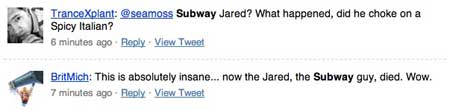
Today, that happened, in real time, when a few popular Twitter users, including Kevin Rose of Digg and Adam Ostrow of Mashable posted a link to a parody site, claiming the famous Jared Fogle from Subway's line of commercials had passed away. The "news", which had long been debunked as an urban legend by Snopes, spread like wildfire, catching otherwise well-respected folks like Dave Winer thinking it was true.


Kevin Rose's Tweet Kicked the Rumor In High Gear


Many, Many Others Followed Suit

(See also: FriendFeed: "I'm so gullible I believed it. Oy. - Dave Winer")

Many have claimed Twitter can break news faster than traditional news media. People were buzzing on Tim Russert's passing away on Twitter before it hit NBC, and Twitter has already proven itself a news source for natural disasters, like earthquakes. But the mainstream media largely likes to prove rumors true and get multiple sources before reporting, to this day. When Twitterers run amok and post any old yarn they've heard, there's no stopping it.

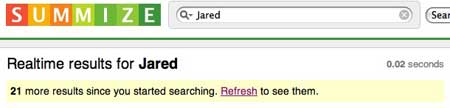
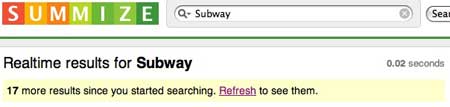
When Kevin Rose posted his Tweet, it had the potential to reach his more than 46,000 followers. The trickle-down effect hit Ostrow's 1,300 or so followers, and Summize showed the gullible Twitter crowd re-reporting the bad news multiple times a minute, reaching who knows how many people?


See: Summize: Search for Jared

See: Summize: Search for Subway

Whether you're writing a blog post or entering something on Twitter, it absolutely makes sense to take a cue from traditional media and check your facts. While the Subway Jared parody is more amusing than critical, it highlights a need for people to take a deep breath before repeating everything they hear. Twitter can be a tool for good, but for mischief as well. I would expect people like Kevin, Adam and others, proven to be intelligent in other areas, could act smart here as well.
June 25, 2008 · 4 MIN READ · BY LOUIS GRAY

We're Home, But One Baby Was Left Behind

We're Home, But One Baby Was Left Behind

This afternoon, my wife and our son Matthew were discharged from Lucille Packard Children's Hospital, four days after the arrival of our twins. And while we're excited to be home, in a comfortable environment, we have had the unenviable position of leaving Sarah, our second twin, behind. While she's expected to gain weight and strength to the point she can round out our home by the end of the week, the gap between what we had expected and what has happened is very real - leaving me feeling we're not going to be fully whole until everybody is home where they belong.

On Friday night, as I saw the pediatricians busily tending to our twins just moments after they were extracted via Caesarean section, they called out the weights of the babies. Matthew, born at 9:01, weighed in at 5 pounds even. It was less than I had hoped, but acceptable. When they called out Sarah's weight, at only four pounds, three ounces, my heart sank. She had come into the world more frail than we had hoped, and would need to work extra hard from day one.


Matthew Gray in the crib in his first night home.

I myself was a premature baby, more than 30 years ago, having been born two months ahead of schedule, and weighing in at four pounds, six ounces. A generation ago, such low birthweight was more life-threatening than it is in today's advanced medical world, and I struggled, to gain weight, to gain respiratory strength, and early on, it wasn't clear if I'd ever have full mental or physical capabilities. As my dad often jokes, "We were told you had a 50% chance of being disabled, and a 50% chance of being mentally challenged. We're still waiting to find out which one it is going to be."

When my wife and I found out we were going to have twins, we were ecstatic. Finding we were pregnant by the end of last year, and that we were having twins was amazing. We've been preparing for it as the months drew closer, as our home is fully prepped for pairs of everything - from outfits to swings, to booster chairs, and car seats. But while we knew twins would come before the full gestational period for a singleton, we certainly didn't think about having not just one, but two, lower birthweight, pre-term babies.


Google's calculator helps us know just how small Sarah is.

So far, while Matthew had met the threshold needed to stay with us since his debut, Sarah has not. While he was in the "Wellness Baby Clinic", Sarah lagged behind, in the "Special Care Nursery". Matthew stayed with us 24/7 each of the last few days, while we only could visit Sarah in 15 to 45-minute increments, to pass along milk, or to hold her and remind her she is as much a part of our family as her brother. She stayed behind, not just because of her low weight, but due to concerns she would be unable to keep her temperature regulated. And while she looks to be on the verge of being healthy enough to come home, it will be days yet. Now, we're here in Sunnyvale, and she, with the other children given a less than ideal start, is working hard at Stanford to get that chance.

It's well known that babies in their first week tend to lose as much as 10 percent of their original birthweight, before gaining it back and eventually, starting an upward trajectory, which for most Americans at least, never stops. But every night, we got an update on Sarah's weight. From 4 pounds, 3 ounces, it crept downward, to 4 pounds, 1 ounce, and eventually, to 3 pounds, 15 ounces, where it is today. Sarah has never, at her heaviest, been as big as I was when I was once considered dangerously small. And yet, we have had to put our trust in the doctors, who expect that she'll fight through the slow start and be with us soon.


Matthew only takes up half what the crib was meant to hold.

Nobody has expressed any great concerns about her humble beginnings, and the hospital is notoriously conservative. I also know that the 3 to 4 pound range isn't quite the drama it once was. But to be discharged today, and leave the hospital with just one baby instead of two makes me feel that in some way, we're already failing as parents. Our car ride home had one empty car seat. Our crib, divided for two, has only one occupant. And Sarah, who arguably needs the most help, is the only one we can't get to.

We're still very happy our twins are here, and despite their size, are healthy. I expect Sarah will be with us in just days, and that this part-time adjustment from zero kids to one to two in a week will seem like a small blip in short time, but while we've bonded with Matthew and know him well, we'll be starting almost from scratch with Sarah, and that just doesn't seem fair.

June 23, 2008

June 23, 2008 · 3 MIN READ · BY LOUIS GRAY

Crowdsource Software Payments to Reward Alert Developers

Crowdsource Software Payments to Reward Alert Developers

Not all software is free, and not all of it should be. Unless you are the type who can break out your C and Python manuals with ease, the time may come where you have an idea for a great application, and you're going to need someone else to do it. Why not leverage others who have the same need, and combine to provide a bounty, by which, if your solution is delivered to satisfaction, the developer or developers can reap the rewards directly from the end-users who will benefit from their product?

As a visible, active, FriendFeed user, I grew jealous by the success WordPress bloggers were having with Glenn Saven's nifty plug-in to show if items had received comments or "likes" from the popular social lifestreaming service. He had single-handedly developed a tool to unify conversations from disparate sources in an elegant way. But, for me, a long-time Blogger user, I was basically faced with a rock and a hard place. Migrate to WordPress, or keep my conversations separate.


This clearly wouldn't do. So, on May 25th, I said I needed a solution, writing:
Needed: FriendFeed Comments + Likes for Blogger (Old and New)

Thomas Hawk and I need your help. The WordPress bloggers are having way too much fun with getting FriendFeed likes and comments into their blog, and we using Blogger (both the old or new) can't yet do it. I am offering a $250 bounty to the developer of a solution good enough I can integrate into my blog. This would not replace Disqus, but go alongside it, as seen at the Inquisitr. Thomas and others, feel free to add to the bounty...
As much as the WordPress advocates wanted me to just switch blogging platforms (and I respect their views), I was looking for somebody to develop a solution that could help other FriendFeed users in the same predicament I was. After all, what was more likely? That you would see a lot of people make an exodus to a new platform for want of a widget, or that many people on Blogger would find the FriendFeed widget useful? I was willing to pay $250 to make this happen, and I wanted others to pay as well.

By June 16th, Pat Hawks had a solution worth paying money for, and Thomas Hawk agreed. He wrote, "I'm good for a match."


In the space of less than 30 days, I had helped spur an alert developer to create a fantastic solution which I have in place today, and one that continues to improve. Pat, for his efforts, not only gained at least the $500 from Thomas and me, but now has a great deal more awareness and respect across the FriendFeed community and the blogosphere at large. I bet that with platforms like FriendFeed, Twitter and others having direct, immediate, connections to people on the "demand" and "supply" side of the fence, this won't be the last time you see a crowdsourced method for getting software developed.


I am all too happy to give Pat $250, and I'm headed to PayPal now. In this age when you have developers trying to compete with free software and Web services, why not encourage them to build something that you would use, and offer them real cash? If you get enough friends together, you could end up with a serious code competition on your hands.

See also: WinExtra: Crowdsourcing a tech interview