



Silicon Valley Technology Commentary & Archives · Est. 2006 3,033 Posts · 2006–2026

July 21, 2008

July 21, 2008 · 2 MIN READ · BY LOUIS GRAY

TweetMeme Returns Following Months-Long Twitter-Forced Outage

TweetMeme Returns Following Months-Long Twitter-Forced Outage


The on again off again cold war that Twitter has been having with its development community has been the subject of much discussion over the last few weeks, especially with the news of reduced unauthenticated API calls, and the new integration of Gnip. But even as Twitter is appearing to get its footing, significant damage has already been done to many services that relied on the microblogging service to survive. One of those was the popular link tracker, TweetMeme, which returned to the Web over the weekend, after months of the service being unavailable, not thanks to developers' neglect, but Twitter's restrictions.

TweetMeme launched in January, gaining significant coverage in the blogosphere, including an article in TechCrunch, who gushed, "The killer Twitter-tracker just arrived and its name is Tweetmeme". But by May, Twitter, under incredible pressure, started disabling developers' access to Jabber and XMPP services, which knocked the service off the Web.

See: Tweetmeme Down Due to Twitter Jabber Problems

At the time, the downtime was expected to only last days, but it turned out to be months.

Service founder Nick Halstead, also the author of Fav.or.it, wrote in a comment on this blog Friday, "Our side project http://www.tweetmeme.com which was the first twitter URL tracker has now been down for months because we were offered the use of the XMPP feed and by the time we had implemented they pulled it. We will not bring it back up again or put development effort into it unless these kind of restrictions are a thing of the past."

The XMPP firehose has famously been limited to only four partners - FriendFeed, Zappos, TwitterVision and Summize, plus Gnip this last week. And Tweetmeme couldn't play on the uneven field, shutting down. But as of yesterday, Halstead reported his team had a work-around, essentially piggy-backing on the search capabilities of Summize itself, now owned by Twitter. (Confused yet?)


Tweetmeme is back in operation now, aiming to show the most popular shared links on Twitter, highlighting the biggest stories on their front page, like Techmeme does, and showing them in order of appearance on the Tweetmeme river, just as Techmeme's river does.

Now that Tweetmeme is back in action, the questions remain - will traffic return, remembering the site's out there, and can it deliver relevant results worth following, as Techmeme has proven it can? And will following Summize's lead be good enough, or will Twitter change the rules again? Hard to know, given the microblogging giant's inconsistencies. That's why many developers are bailing on Twitter altogether.
July 21, 2008 · 5 MIN READ · BY LOUIS GRAY

The Talk About Rules for Social Following Is Getting Out of Hand

The Talk About Rules for Social Following Is Getting Out of Hand


As the world of online "friends" is getting increasingly blurred, and many of us are joining social network after social network, expanding our realm of friends to mean much more than just those we know in real life, artificial rules of etiquette are being created for when you follow someone or add them as a friend, and when you don't. And when two people have different, unequal rules, there is a potential for conflict, or hurt feelings, even when we have the option to step back and realize this is all very silly. No one hard and fast rule works for everybody, and I would expect that the "rules" are different for each network, given the impact "following" can mean.

This whole ruckus about "You didn't follow me! I'm going to unsubscribe!" led me to playfully suggest a new approach this evening:


(See the FriendFeed response to my Tweet here)

The issue of who to friend started well before social networking sites like Friendster and MySpace took hold, and before Twitter and FriendFeed changed the game in terms of how adding somebody as a friend could open a floodgate of information.

Early demands on who to add as a friend were problematic even in the early days of AOL Instant Messenger. Making my AIM address open to family and close friends was one thing, but soon, casual acquaintances would want my AIM address, and logging on to the service left me at their whim for contacting me, or seeing my status. Soon, I was hiding my service, pretending to be away from the desk, or blocking the very same people who still thought we were AIM friends.

With Friendster, the issue of "friending" again came up. Would I accept the friend request from a college roommate I really wasn't all that fond of? What about if there was a girl I had a crush on, who I wanted to follow, but I didn't want to "friend" in case she figured it out? (Complicated, I know)

Suddenly, the issue of friending became less about wanting to actually follow real friends, or peers, and instead, became an arms race - to get the most followers, to follow the most people, to rise up a leaderboard, or feel some kind of achievement because you could claim a friend as a household name.

There became issues with Facebook only accepting 5,000 friends. Twitter saw people set up rules to auto-follow anyone who followed them, even as it became common to follow thousands or tens of thousands. FriendFeed has seen many do the same, even though to follow a person there means not just Twitter updates, but blogs, photos, videos, and dozens more services, in addition to integrated comments.

Soon, the concept of auto-following, and gaining prominence over following a huge number, or being followed by a big name became the norm. While it might make sense for a Robert Scoble or a Duncan Riley to do it, for the rest of us, the firehose of data can be choking. And by opting out of the automatic following process, we can be called on the carpet for not acting the way others expect us to.

A few key examples:This issue is highlighted by services which show you the disparity between those you follow, and who follows you. For Twitter, there are sites like Twitter Karma and Less Friends, and recently, one was developed for FriendFeed, called FriendVenn. Of note, I've used Twitter Karma to get my lists in sync, but haven't been able to use FriendVenn, as it's limited to 3,000 total connections so far, and I'm ahead of that mark, even if I didn't follow anybody on FriendFeed at all.

There's nothing wrong with seeing the disparity in bulk, rather than on a one by one basis, but it's more of a curiosity than a call to action in my mind.
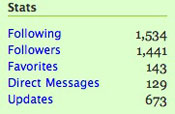
On Twitter, I used to be quite selective about who I would follow. But over time, thanks to the improvement of Summize and Twitter's frequent downtimes, I'm not using the Web interface to watch Tweets, but only to send notes. Now, there's really zero impact to me to following a bazillion people. If it makes them feel good, then I have no problem adding them to my stream. But in reality, unless they say my name, or a search query I'm watching in TweetDeck, I'll probably never see their updates.

FriendFeed is a different story altogether. FriendFeed's best environment is the Web interface, where you see all updates. A FriendFeed follow is a lot "heavier" than a Twitter follow, as you get all the updates from all the disparate services. This means that while you can casually follow tens of thousands on Twitter, it can be a bit overwhelming to follow even a few hundred on FriendFeed, unless you're absolutely comfortable with missing out on some updates. As a result, I've been a little slower to follow people there, even as my in box on some days can be flooded with new followers.

The way I choose to follow people on FriendFeed was first, people I knew, or engaged with elsewhere, second, following people who engaged in my activity through comments and on the feeds of the others I followed, and third, friends that those I follow engaged with, and whom I shared interests.

This more tentative approach means I have only 300+ people I follow on FriendFeed instead of 3,100 or more. I believe that by adding more and more, the fun and engagement will surely be lost, just as it was on Twitter's Web interface when I added so many people, or in Facebook, where I get new friend requests daily from people I'll probably never meet. I expect there are probably some good 250 to 500 new people who I'll find interesting on FriendFeed who might be following me now, but I want to make that choice after seeing their activity, not just on automatic.

Am I really going to overweight my social networks with ladies? Probably not, as fun as that sounds. But am I going to overweight every network with every single follower I possibly can, again, probably not. The way I use Twitter and FriendFeed or Facebook or LinkedIn or any other service that relies so heavily on connections is the way that I do it, period. It's not necessarily the way you should do it, and no one right way is right for all people. But if there is a point where I'm not following you, and you are following me, it's probably not personal, and it shouldn't be made personal. To each their own.


July 19, 2008

July 19, 2008 · 3 MIN READ · BY LOUIS GRAY

It Appears I Won an iPhone 3G from Social Median!

It Appears I Won an iPhone 3G from Social Median!

Last night was not the kindest of schedules. I had the great opportunity to leave the house and see "The Dark Night" yesterday evening, but the film didn't start until 11:15 p.m. Allowing for previews, credits, and the two and a half hour runtime, it was 2 a.m. by the time the movie ended. Following a quick trip to Safeway, I didn't get home until after 2:30 a.m., finding Sarah stirring, but Matthew, luckily, asleep. That left me on feeding duty for Sarah, first, around 4 a.m., and Matthew, just after, finishing about 5 a.m. So, no, I didn't get much sleep. By the time I posted the great guest post from Rob Diana at 5:30 a.m., and made sure all was well, I saw a mysterious tweet from Jason Goldberg, CEO of Social Median, the online social news site, who I first covered back in April.

See below or on Twitter itself:


Having gotten virtually no sleep, and it being about six a.m., the sun rising, I was sure my mind was not in its proper working state. So I asked Jason what was up, and it turns out that Jason and the Social Median team were running a contest, where the service's users would follow "Newsmakers" on the site, and by midnight yesterday, the top two non Social Median employees with the most followers would be the lucky recipients of iPhones.

I knew Social Median had recently made updates, and I've seen quite a few notifications in my e-mail from people following my account there, but, being busy, I hadn't given Social Median enough attention this week, though I had planned to eventually, and I certainly wasn't aware of the give-away, or lobbying for it. So, silly me, I backed into the win. Very cool. Jason even added his own comments on FriendFeed, saying, "This brilliant part is that Louis didn't even try to be *popular* -- our users selected him as their newsmaker on their own."

So now, assuming availability, shipping and receipt, it looks like I'll soon have a brand-new iPhone 3G to play with, courtesy of one of the more interesting new entrants to the market this year in the social media and aggregation space. Now, given that my company pays for the cell phone service on my Blackberry, the question becomes:
  1. Do I open an account with AT&T and pay that way for a new number on my own?
  2. Port the BlackBerry # to the iPhone and hope work pays for it still?
Either way, it sounds like a good problem to have. After being an iPhone holdout for way too long, it looks like I can once again wear my Apple logo gear proudly and claim to be "with it". I'll let you know when it arrives.

Also: If anybody thinks that winning the iPhone is in return for favorable coverage to date, or will lead to future favorable coverage (like a bribe), I don't believe this changes anything. To date, I've written everything about Social|Median in a fair way, and without expectation of any payout. Winning this is a lot of fun, but I plan to keep watching them as I do many other startups in this field. Of course, let me know if you disagree.
July 19, 2008 · 3 MIN READ · BY LOUIS GRAY

Throttled By the Twitter API? Try Something New.

Throttled By the Twitter API? Try Something New.

Guest Post By Rob Diana of Regular Geek (Twitter/FriendFeed)

Well, the microblogging API space sure got interesting in a hurry.

First, on Thursday, Louis Gray reported that Twitter was throttling unauthenticated API requests. This obviously would effect several applications in a very bad way. Later in the day, Dave Winer let everyone know that Identi.ca has implemented the Twitter API. And on Friday, in a surprising move, TechCrunch announced that Twitter is sending the XMPP firehose to new middle man Gnip.

So, what does this mean to you? Well, that is a good question. First, we know what the Twitter API looks like. Identi.ca replicating the API is good for interoperability as well. Yes, they copied the main Twitter API, but have yet to include the searching capabilities that Summize supplies. However, they do have RSS feeds for any search query which does suffice for basic searching. The other big players in the microblogging space, Jaiku and Pownce, also have APIs. But, what do they have to offer?

Jaiku's API contains the usual suspects, the public feed, a user's feed and a user's profile. It also allows for "presence" updates which is helpful for allowing applications like Ping.fm to post to multiple services. It also provides a method to get a user's current "presence", their last item in the "presence" stream and as well as a specific item in the "presence" stream.

Pownce's API is similar as well. There is a public "note" list, a user's note list (which can be filtered for replies, private messages and other coolness) and a user's profile. You can also retrieve a specific note, with replies included optionally, and the list of recipients for the note. For social graph fans, you can get the friends (mutual relationship) of a user, fans of the user and who the user is a fan of. For posting notes, there is the normal post method as well as separate post link, event, file and reply methods.

Interestingly, there is a method to determine the list of users a post can go to. There are some other minor goodies like feeds for the public list and a user as well as simple web post integration. Obviously, this is an API designed with developers in mind. They thought of several different ways to use the application and provided APIs accordingly. The only problem that I could see is that there is no search supported. Hopefully a third party service like Gnip will fill that void, like Summize did for Twitter.

Now that looks like a good foundation, but there are some fundamental problems. It is not obvious that Pownce and Jaiku support something like an XMPP feed, so, there may not be the ability to have the full public stream at all times. This type of thing is critical for interoperability. There is also inconsistent support for threaded messages and other post types (like the Pownce event and file posts). Why haven't we seen a real multi-microblog client? Ping.fm is doing multi-writes, but does not support multi-reads. In the instant messaging world, where the XMPP standard comes from, we do have multi-chat clients and few actually support XMPP! We are starting to see some standardization in this space as well with Identi.ca copying the Twitter API as well. If we consider the Twitter API a defacto standard and we have the XMPP standard for real time transfer, there should be little stopping developers from creating the ultimate micro-blogging client.

Now, the question is, are you willing to wait or do you want to crown someone king?