Silicon Valley Technology Commentary & Archives · Est. 2006 3,033 Posts · 2006–2026

July 25, 2008

July 25, 2008 · 3 MIN READ · BY LOUIS GRAY

FriendFeed Friday Tips #8: How To Post To FriendFeed Via E-mail

FriendFeed Friday Tips #8: How To Post To FriendFeed Via E-mail

By popular demand, I've been asked by other FriendFeed users to highlight how I use the popular social lifestreaming site. So far the series has covered the "Hide" function, the bookmarklet, advanced search, how to integrate with Google Talk, how you can incorporate comments, determine an item's original source and how to learn more about your fellow users.

Since FriendFeed debuted their API this spring, the number of third party applications authored for the fast-growing aggregation service has been rapidly increasing. There have been different Web-based services to give a new look to FriendFeed, from FriendFeedMachine, MioNews and NoiseRiver, a mobile version from FFToGo, and other add-ons, including GreaseMonkey scripts and blog comments integrators. But sometimes, it'd just be a lot easier to start out with the original social network - e-mail.

Gary Burd, a long-time Microsoft employee, and now a member of FriendFeed's small staff, introduced a service that lets you post directly to FriendFeed, using your e-mail, including the attachment of photos or graphics, called Mail2FF, back in late May. He debuted the service prior to joining the Mountain View-based company, and its arrival was well accepted by co-founder Paul Buchheit, who wrote, "Cool! Did you create this Gary? This has been on my "things I personally want" list for a long time."

Using Mail2FF is quite simple, as you can see from a Mail2FF tutorial produced by Ross Miller, an intern at the company for a summer.

Step 1: Write Your Message

Open your e-mail application and compose your message, just like you were sending a regular e-mail. The subject line of your e-mail will be the subject line, and the body of the message will be posted as a comment on your own item.
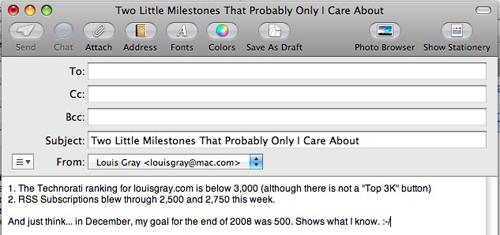

Step 2: Add Pictures

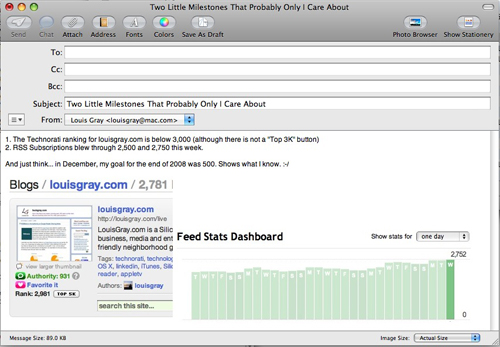
Attach any photos or graphics you would like to accompany the item. They will be placed as part of the item in their full resolution, hosted on Amazon Web services. Up to two images will be displayed on the item, with a blue arrow being displayed if more than two images are attached.

Step 3: Know Where To Send It

Mail2FF uses your own API remote key, which you can find here. To send the message to FriendFeed, you would send it to:

[email protected]

For me, assuming my remote key is purple456monkey, I would send it to:

[email protected]

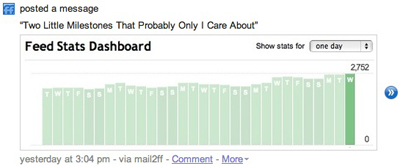
The end result would be displayed like this:

Step 4: Sending the Message to a Room

If you want to get creative, you can even send your message, and images, to a FriendFeed room, rather than the main feed. This is done by adding the room name ahead of your username and remote key.

For example, if the room name is "babyfeed", one I've been using lately, I would send it to:

[email protected]


The result would be just as it is in your own feed, complete with subject line, body content as the first comment and attached images, but sent to the room itself. (See above or the actual posting)

Mail2FF was so clearly a success, it was integrated with FriendFeed's native version for the iPhone released at the end of June. (See: VentureBeat) And when I was stuck at the hospital, finding many of the Web sites I used completely blocked, like Flickr and FTP, Mail2FF was the only way I could send the very first pictures of Matthew and Sarah the world had ever seen. (See: Matthew and Sarah: First Photos (More Coming))

When entries are posted to FriendFeed via Mail2FF, you will see a tag "via Mail2FF", and the items are shown as "internal" FriendFeed postings. You can see some that I've done here, here and here. To get started, head to www.mail2ff.com and give your e-mail a shot.

July 25, 2008 · 4 MIN READ · BY LOUIS GRAY

Can Microblogs Just Talk To Each Other?

Can Microblogs Just Talk To Each Other?

Guest Post By Rob Diana of Regular Geek (Twitter/FriendFeed)

Twitter has had a bad few days. After a few weeks of wonderful stability, we started to see some Fail Whales. Then people started losing followers and subscriptions. Because of this, even more people are moving to alternative micro-blogging services like Identi.ca. Of course there have been several requests for a Twitter friend importer. I think people are getting caught up in the problem and not thinking about the best solution. Previously, I mentioned that Twitter was at the crossroads. In that post I started thinking about a possible solution:
It is now late May and they are just admitting that they have infrastructure problems. Obviously, there are the redundancy and replication issues that can be solved with known techniques. The realtime API needs to be using a replicated database and not affect the main database. This is the part that is concerning me the most as it should have been obvious some time ago.
Another post appeared from Dave Winer where he mentioned that we are inching toward federation.
Right now, today I'm using an approximation to the ideal system. I try to enter my original post on FriendFeed, then I have an agent script running on one of my machines that routes it to Twitter and Identi.ca, with a pointer to the discussion thread on FriendFeed, shortened by bit.ly.
Obviously, this is not a good solution to the Twitter problem either. There are also multi-posting services like Ping.fm and Posty which allow a user to update each of their micro-blogging services with the same message. So, with one click you can update Twitter, Identi.ca, Pownce, Jaiku and Plurk. While that sounds really cool, they only provide one-way updates. Tools like Twhirl are starting to allow posting and retrieving of tweets and dents in one application. This gets a little better, but you still have multiple accounts to deal with.

Federated Microblogging


Federation is the real answer. What does federation do and why is it different from Twitter creating a distributed architecture? A distributed architecture means you have various pieces of the application sitting on different servers. Typically, several parts are replicated or redundant and there are various load balancing devices thrown in to complete the architecture. I am not going to go into tons of detail as books have been written about distributed architectures.

Federation is different from distributed in one simple sense. Federation requires a full copy of the entire system. Federation is the cooperation between various systems to act as one. Wikipedia has a good description of a federated database system.
A federated database system is a type of meta-database management system (DBMS) which transparently integrates multiple autonomous database systems into a single federated database. The constituent databases are interconnected via a computer network, and may be geographically decentralized. Since the constituent database systems remain autonomous, a federated database system is a contrastable alternative to the (sometimes daunting) task of merging together several disparate databases.
If you replace all of the database and database system terminology with microblogging and microblogging system you will understand a federated system. So, how does this help Twitter? It does not, at least not directly. By having a federated system, people can move to Identi.ca or the next clone that appears and not lose their followers. If you think about the concepts of email, you will understand how the federated system would work. My account in the federated system would be [email protected]. A Twitter user could reply from within Twitter directly to me ([email protected]) and I would receive it in whatever client application I had. I could also follow Twitter users, Pownce users or any other microblogging user. By enabling people to communicate across platforms would mean that the server load would be spread across various services, thus decreasing the amount of traffic on Twitter directly.

The one part of the federation that is missing is the routing between servers. This can be accomplished by following the DNS model. A local DNS server has a reference to its parent or master server. This allows new servers to be built and their location and IP address propagated to other servers. This is a very effective solution and it has worked for several years.

Because Twitter and Identi.ca follow the same API, they could act as the root servers in the system. The other option to the Twitter API is the XMPP protocol, which Twitter is using for their realtime API. The protocol choice is important because a federated system requires that all of the systems speak the same language. A federated system would also require a different client application than we have now. As I mentioned earlier, Twhirl fully supports Identi.ca and Twitter. However you are dealing with two different accounts. How cool would it be if you had one microblogging client to chat with people on any service?

July 24, 2008

July 24, 2008 · 1 MIN READ · BY LOUIS GRAY

The Hubris of the Twitterati and Twitterati Wannabes

The Hubris of the Twitterati and Twitterati Wannabes

Guest Post By Cyndy Aleo-Carreira (E-mail / Twitter)

Twitter fails yet again. After a huge site outage, U.S. users woke up this morning to discover what other users already knew: the database was hosed, and subscriptions were a wreck. I appear to be one of the only people with a single concern, however: what happened to the people I was following? I don't remember all of them. I certainly didn't keep a list of the people I was subscribed to. Nor would I want to page through all of them to figure out who is missing if I did.

However, the majority of users are more upset with their follower count. Yes, that's right. People are up in arms over who was following THEM. In this increasingly ridiculous echo chamber, the loss of followers means that a number is lower; a potential audience gone missing.

The tech blogosphere isn't Hollywood, and even Hollywood is pathetic in its idolization of people who work at a particular craft. I don't mind missing followers; if someone finds my 140-characters-max blathering entertaining, then that person will find me again. I don't use Twitter for an audience. To whine about having a few people taken away that follow you is so depressing I can't even manage to put it into words properly.

The functionality of Twitter is useful to me only in how I use it to learn. The majority of my Tweets are conversation, often replies to questions others pose. But I'm depressed at the hubris of what seems to be a number of users, who find the loss of followers damaging to their egos. Social media is supposed to be about conversation. Not pumping up self-importance. I don't know how many followers I had. But I definitely know how many people I'm following are missing.
July 24, 2008 · 2 MIN READ · BY LOUIS GRAY

BallHype Crew Takes a Vote, and Launches BeltwayBlips

BallHype Crew Takes a Vote, and Launches BeltwayBlips


Last week, the increasingly popular Ballhype and Showhype sites were acquired by Future US for a cool $3 million, as the Digg-like sites, focused on sports and entertainment respectively, were seen growing as destination sites for fans of all flavors. Less than 10 days after that news, the Future US team is already seeing dividends from the acquisition, as the husband and wife team, Jason and Erin Gurney, turn their attention toward Washington and politics with the launch of BeltwayBlips.

In the tradition of Ballhype and Showhype, BeltwayBlips aims to bring the hottest political news to the front page by both auto-discovering hot blog conversations through the number of external links, but also adding on users' up or down votes, like Digg. Those hot items receiving many votes in a short amount of time rise to the top, and after some duration, will drop lower in rank.
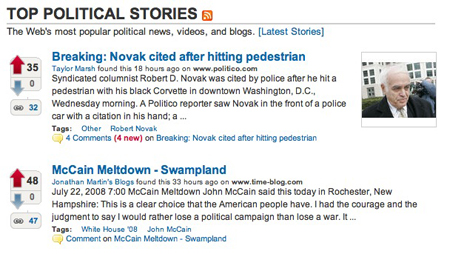
Earlier this year, when meeting with the Gurneys at their home, they said they didn't want to get into more serious issues, like politics or technology, and the pair felt two sites was just about all they can handle. But following the acquisition, Future US has allowed the Gurneys to add to the team of developers, and given them the support to expand their site portfolio.

The addition of politics to the arsenal should make for some very "lively" discussion for sure, given the clear partisanship shown by both the right and the left in today's charged climate. I have concerns that McCain fans will always vote down positive Obama stories, and vice versa, or a few unsavory characters could make the environment unfriendly. While in sports, one can divide their attention between about 30 professional teams in each league, in Washington, you're usually either "with us" or "against us", as has been frequently said.


Headlines reaching the top of BeltwayBlips in the last few days have included the news of Robert Novak being involved in a hit and run accident, rumors of John Edwards fathering a child out of wedlock, and the two presidential candidates taking opposing positions on Iraq. Forget C-SPAN, this political hotbed isn't going to be a snoozefest by any means.

As with Ballhype and Showhype, the site offers the usual array of features, including comment threads, leaderboards for users and blog sources, embedded video links, and the ability to create groups. If you already have an account with one of the *Hype sites, you can log into BeltwayBlips today.