
Silicon Valley Technology Commentary & Archives · Est. 2006 3,033 Posts · 2006–2026

July 29, 2008

July 29, 2008 · 3 MIN READ · BY LOUIS GRAY

The Gray Family Upgrades from Flickr to SmugMug

The Gray Family Upgrades from Flickr to SmugMug

While SmugMug might not have the brand recognition of a Flickr, Shutterfly or Kodak's EasyShare Gallery, the photo and video sharing site has obtained a dedicated following of photographers who are serious about their work. The site has long received praise for its high-quality galleries, unlimited storage, security, and customization, and the company's small team of 30 employees has managed to be profitable since 2005, when many Web companies have been in the red, largely due to their not offering any free versions of their product. When Matthew and Sarah arrived on the scene, at first I was happy to upload the family photos to our free Flickr account, but the site's limitations, especially when it came to the total number of photos, and quality of those photos, made me think seriously about making the move to SmugMug.

Today, I'm happy to say we made the leap. The first batch of almost 150 photos, starting with my wife's very pregnant belly and taking us to the present day, including the first five weeks of Matthew and Sarah, can now be found at http://louisgray.smugmug.com/, where I plan to be maintaining our online photo presence from here on out.
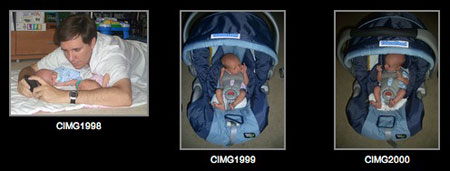

Editing Images In SmugMug Is a Snap

While I still haven't made the leap to buying a professional camera (on the to-do list), I delved into my iPhoto, and exported the original photos taken since late June. All told, the 145 images totaled about 125 megabytes of space, no small chunk. But SmugMug's easy to use interface let me select the folder, and hit upload, and not too long after, I was seeing highest quality photography on the site.
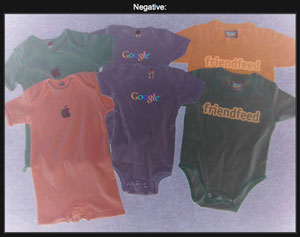
With the photos on the site, I have a tremendous amount of flexibility for manipulating the images - far more than I could with the free version of Flickr. With Flickr, I could edit the title, the tags and the description of photos, but SmugMug lets me rotate the images, add captions, add a watermark, if I wanted, crop photos, and make color effects - for example, displaying the images in black and white, sepia tone or the negative, which can be flat out spooky. I found myself making a lot of bulk changes, rotating kids from laying on their side to facing straight up, and readying the pictures for display.



A Clip From a SmugMug Slideshow

Given I'm not the primary audience for these photographs, how friends and family can see our kids and their updates was key to the switch. First, you can do full-screen slideshows in SmugMug at very high quality, letting you pan right to left through the collection, starting with any photo, second, the thumbnails sent to FriendFeed are significantly better than those from Flickr, and thirdly, any of my relatives can select any number of photos to buy or print out in their preferred size. Now, instead of my relatives begging for prints, they can go off and make their own, assuming I have a good enough shot.


See How SmugMug Appears on FriendFeed

I've been watching SmugMug from the sidelines for the last few years. I've seen the company's great engagement with the blogging community. Don MacAskill has been a strong public face for the company, keeping friends appraised to service enhancements, community activities and any issues that may come up. The company has been very vocal about their support for "the cloud", and has even debuted a new application for the iPhone, called SmugShot. Once I finally get my iPhone, you know I'll be downloading it.

I don't plan to turn this site into a full-time mommyblog just yet, but if you want to see how Matthew and Sarah are progressing, be sure you check out the SmugMug site. There are even RSS feeds for recent photos and recent galleries. Pretty sharp.

July 28, 2008

July 28, 2008 · 4 MIN READ · BY LOUIS GRAY

Me-Too Software and Web Apps Often Find Their Own Niche

Me-Too Software and Web Apps Often Find Their Own Niche

As the price to develop Web applications and communities has decreased, and investment in people is less-demanding, it's no surprise that we've seen a boom in sites with significant similarities - be they social networking, lifestreaming, status updaters, online file storage or virtual worlds. While the rule holds true in software as it does in Silicon Valley, that the vast majority of products may meet a less than optimal fate, the potential payout continues to draw development, with new brand names hitting our RSS feeds on a daily basis.

The seeming onslaught of new services had the omnipresent Chris Brogan asking frustratedly yesterday, "Who's writing all these me too software apps? Do they feel accomplished?" Brogan later gave the services Kwippy and Yokway as examples of two services that had recently come across his view, adding, "(I) just dont' see why we need yet another of something we have in spades. Where's the innovation?"

Sometimes, in this age of instant analysis, determining the differentiation and purpose of a new site can be hard, especially as the bloggers and technology reporters try and grasp the new site and place it in the context of existing applications that are more well-known. (See: Inquisitr: Yokway: Sort of FriendFeed Meets Del.icio.us for one example)

Whether it's in the name of differentiation or competition, it's rare that a developer or startup team will be aiming to make a carbon copy of an existing site. RSSmeme debuted, after ReadBurner, to show the most shared items in Google Reader, and progressed differently, offering a custom FeedFlare and featuring deeper index with more linkblogs than ReadBurner, while ReadBurner partnered with multiple RSS engines, including NewsGator and Netvibes. Facebook was like MySpace and Friendster before it, but initially just for the college set and later high school, before opening up, and later adding a development platform.

There is a long history of services and software that have striking similarities to one another. That a product exists doesn't mean that any potential competing product should walk away and cede the market, delivering a monopoly. As Disqus' CEO Daniel Ha told me back in June, the existence of competitors like SezWho, Intense Debate and JS-Kit help let him know he's in a worthwhile market to pursue, even if it's a rare blogger who has plans to implement multiple commenting engines. The existence of Digg didn't stop Mixx from debuting, and the existence of HotBot, Lycos and Excite didn't look like too much of a hurdle for Google to get going.

Rob Diana of Regular Geek, in the FriendFeed comment thread spawned by Brogan's question, said, "Until someone dominates the space you will see a lot of similar applications," while Clint Ecker wrote, "The market will bear out the niche products and the unsatisfactory ones will fade away and disappear until the community has selected the 'best' service."

But even the selection of a "best service" doesn't mean there won't be more developers trying to crack the market. Plurk and Identi.ca are two recent approaches to microblogging, taking on Twitter. And Cuil's entry into the search market came at a time when Google's enjoyed its largest market share ever. The likelihood of these challenger sites to replace the market behemoths is very small, both short term and longer term, but just about every site and service can develop a dedicated community who swears by it - arguably making the developers' efforts worthwhile. You recently saw this happen when the niche community sites of Ballhype and Showhype, arguably Digg clones, were acquired for $3 million.

From the outside looking in, developers don't see themselves as copycats. Instead, they likely see opportunity, finding weaknesses in a competitor's offering, or finding a new way to seemingly offer the best of both worlds. And just because they aren't enjoying a majority market share in a given metric by a certain time period doesn't mean their efforts were in vain. There's no hard and fast law saying you need to sign up for every lifestreaming service, every social network, every microblogging client and every RSS reader, but as more options and alternatives are out there, there will be a small group of people who prefers the new entrant, whether it be for its GUI, its compatibility with plug-ins, widgets or extensions, or implied productivity.

As an early adopter, I'll usually be checking out most of these services, and I welcome more. It's not about finding how much they're all the same, but determining the differences, and seeing what I can do that's new. I might, sometimes, never use a service again, if I don't find it to do what I had hoped. But often, when I check back in a few months later, I'll find a small community that's calling it home, or see the development didn't stop at day one, making it a richer experience. So, development community, keep it coming. Let's see those new apps, the new innovation, and the new services. It will never be enough.
July 28, 2008 · 2 MIN READ · BY LOUIS GRAY

Can Cuil, Built for the Long-Term, Win the "Instant Analysis" Battle?

Can Cuil, Built for the Long-Term, Win the "Instant Analysis" Battle?

Tonight's biggest technology story is the debut of new alternative search engine, Cuil (pronounced "cool"). In the shadow of the omnipresent Google, the search engine opened up to initial queries today, and so far, visitors don't seem that impressed. The site is already seeing some downtime, which they claim to be the result of "overwhelming interest", but even prior to the outage, its various limitations got the lion's share of attention, masking an otherwise interesting service. And this got me thinking, again, about how, often, blogs and users are keen to make a snap decision as to a product's worth, in the first minutes or hours of its debut. It can lead to a lot of people crying for "epic fail", and not waiting a few weeks, months, or even years, to see it develop, getting closer to its full potential.

More than two years ago, I wrote a post called, "Launching Products in the Age of Instant Analysis", which saw how initial response to Google Finance, Apple's Mac Mini and Microsoft's Origami UMPC platform was overwhelmingly negative, even before most people had ever had the opportunity to buy the latter two in stores. At the time, I noted how some bloggers had achieved their conclusion after only fifteen minutes of using a site, and even tonight, we're seeing the same conclusions reached, not just after fifteen minutes of using a product, but sometimes, even faster, after one failed vanity search or a set of keywords.

Out of curiosity, I of course tried Cuil myself, and came away less than impressed, but I don't have the feeling that this will be the last we'll hear from the Cuil team. While I'm not going completely off the wagon and claiming them to be the heir to the Google/Yahoo!/Microsoft Live Search throne, I'd expect they have plans to expand and tweak their database, invest in their infrastructure, and make their searches more relevant.

A search engine launch is not a one-night affair, and while tonight's debut has been sloppy at best, they might find a niche and gain traction. Don Dodge once famously reported that 1% of the search engine market is worth $1 billion, so finding a place to play and get share is serious business, even if it is against extremely formidable competition. Cuil looks like they lost the first night's chance at getting the "instant analysis" crowd to love their effort, but they've got attention, and maybe, with continued effort, we'll be seeing if the company, built for the long term, can overcome a few hours or days of distress.

July 26, 2008

July 26, 2008 · 3 MIN READ · BY LOUIS GRAY

Roll Your Own Blog Leaderboard With Google Reader Trends

Roll Your Own Blog Leaderboard With Google Reader Trends

Tech bloggers and readers are quite familiar with Techmeme and the site's accompanying leaderboard, which tracks the top 100 sources to the popular news-tracking site over the previous thirty days. Since the leaderboard was initiated, Michael Arrington's TechCrunch has held the top position, accounting for between 5 and 8 percent of all stories. As of Friday night, TechCrunch represented 7.03% of Techmeme's stories in the last 30 days. As a subscriber to the Techmeme Firehose feed in my Google Reader, I see 3,162 items reached Techmeme in the last 30 days, meaning TechCrunch's share was somewhere north of 200 items. But Google Reader does more than show me the items I've received, it also shows me the items I've shared, and the most often shared sources, in effect, giving me the option to record and display my own leaderboard of the top 40 sources that I've shared on my Google Reader shared items blog.
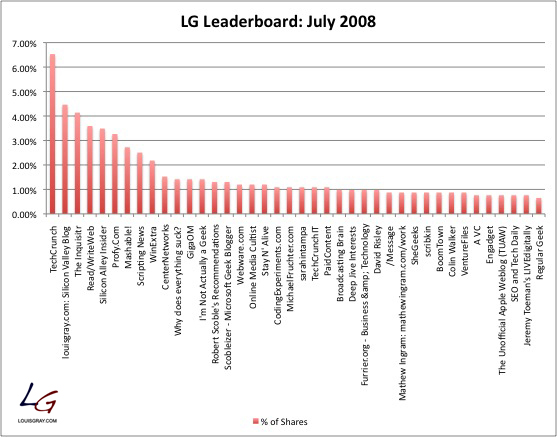
Anybody who uses Google Reader as their RSS feed reader of choice, and who shares items to a link blog can make their own personal leaderboard. While I won't be updating mine multiple times daily, as Gabe Rivera does on Techmeme, and I can only show 40 items, instead of 100, I will, starting tonight, be posting my own LG Leaderboard, for the previous 30 days, and will update this list every month, on the 26th of the month.


First, the dataset:

According to Google Reader, from my 336 subscriptions, over the last 30 days I read 16,386 items and shared 919 items.

Second: The leaders for July of 2008:

Like Techmeme, my #1 shared blog was TechCrunch, thanks to their frequent posting and high number of stories I believe those who follow my link blog would be interested in. Similarly, given my own bias, this blog is in the #2 position. I'd remove it from the leaderboard, but don't want to skew the statistics. Duncan Riley's The Inquisitr has made a strong showing at the #3 position, followed byRead/Write Web at #4 and Silicon Alley Insider at #5. All percentages shown are the result of taking the number of shares in the month per source, divided by the total number of shares. (In this case N/919)

PositionBlog% of Shares
1.TechCrunch6.52%
2.louisgray.com4.46%
3.The Inquisitr4.14%
4.Read/Write Web3.59%
5.Silicon Alley Insider3.48%
6.Profy.com3.26%
7.Mashable!2.72%
8.Scripting News2.50%
9.WinExtra2.18%
10.CenterNetworks1.52%
11.Why Does Everything Suck?1.41%
12.GigaOM1.41%
13.I'm Not Actually a Geek1.41%
14.Robert Scoble's Shared Link Blog1.31%
15.Scobleizer1.31%
16.Webware.com1.20%
17.Online Media Cultist1.20%
18.Stay N' Alive1.20%
19.CodingExperiments.com1.09%
20.MichaelFruchter.com1.09%
21.Sarah In Tampa1.09%
22.TechCrunchIT1.09%
23.PaidContent1.09%
24.Broadcasting Brain0.98%
25.Deep Jive Interests0.98%
26.Furrier.org0.98%
27.David Risley0.98%
28./Message0.87%
29.Mathew Ingram0.87%
30.SheGeeks0.87%
31.Scribkin0.87%
32.BoomTown0.87%
33.Colin Walker0.87%
34.VentureFiles0.87%
35.A VC0.76%
36.Engadget0.76%
37.The Unofficial Apple Weblog0.76%
38.SEO and Tech Daily0.76%
39.Jeremy Toeman's LIVEdigitally0.76%
40.Regular Geek0.65%


All told, these top 40 sources accounted for 595 of the 919 shares over the last 30 days, or 64.7% of the total, meaning the other 296 sources accounted for 324 total shares, or 35.3% of the total. Everybody's leaderboard will be vastly different, for sure. Contrasted with the Techmeme leaderboard, the flagship for measurements like this, I lack a number of more mainstream feeds, like the New York Times, Wall Street Journal, Reuters and Forbes, but in its place, you see a lot more individual bloggers who bring me the news I find interesting. I'll be posting these regularly, and if you would do the same, send me a link in the comments to your list. Could be a great way to find new blogs and news sources. Also, if you think you belong here, add your blog in the comments, and there's a chance you'll be on the leaderboard next month!

You can find my Google Reader shared items link blog here, or see them included in my FriendFeed.