Silicon Valley Technology Commentary & Archives · Est. 2006 3,033 Posts · 2006–2026

July 24, 2008

July 24, 2008 · 2 MIN READ · BY LOUIS GRAY

Twitter Finding New and More Creative Ways to Fail

Twitter Finding New and More Creative Ways to Fail

Just when you thought it was safe to Tweet again, Twitter ran into yet another database problem, which not only resulted in sporadic "Fail Whale" sightings, but dramatically impacted the roster of those following one's updates, as well as those each of us were subscribed to. The latest snafu comes at a time when the growing number of microblogging addicts are seeking alternatives, moving to FriendFeed, Plurk, and increasingly, Identi.ca.

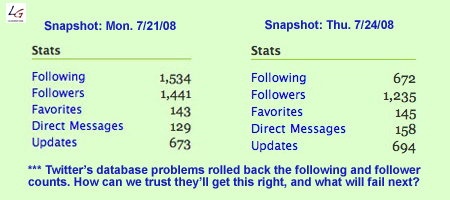
According to a post on the Twitter Status blog, the issue first showed a reduced number of followers on the service, and later, in order to solve the issue, Twitter went into a maintenance mode, warning of lower counts across the board. Amusingly, they claimed that some of the lower counts could be due to the removal of spammers, but in my experience, it's been more than 9 hours since the problem was first identified, and I've seen the number of people I'm following drastically cut, from more than 1,500, down to "only" 672, less than half.


On Monday, when I said "The Talk About Rules for Social Following Is Getting Out of Hand", I had taken a screenshot of my current Twitter ratio, at 1,534 to 1,441, after having worked for a good part of the previous week with Twitter Karma to get my ratio synchronized. Just a few days later, that data is carved to 672 and 1,236, prompting some to try and refollow me, and even more to flock to identi.ca.

Twitter's gotten a lot of abuse on this blog in the past few weeks, as we've gone over issues with developers, uptime and changes to the API, but every time I think they've captured the market on a single route to failure, they find another way.

The team's employees are talking a good game about getting this resolved, but seriously, Twitter, why should we believe you now?

See also:

Why Does Everything Suck: The Nightmare Twitter Scenario May Be Upon Us
Profy: So You Thought Nothing Could Be Worse Than Fail Whale? Now Get Your Followers Back

July 23, 2008

July 23, 2008 · 2 MIN READ · BY LOUIS GRAY

Dell's TinyURL Finds a Porn Star Guru: Fun With Redirects

Dell's TinyURL Finds a Porn Star Guru: Fun With Redirects

Affiliates are the first beneficiaries of custom TinyURLs. Earlier this month, the link shortening service, TinyURL.com, added the capability to customize a URL, effectively letting you replace the usual nonsensical combination of letters and numbers with real words - a long overdue feature which had already been adopted by other services, including bit.ly. At the time, in my coverage of the news, I said it would help people trust URLs, rather than finding themselves sent to a malware site. But, as he commonly does, Allen Stern of CenterNetworks accurately picked apart my theory, correctly saying that despite the customization options, readers could still point any old URL to any old site. (See: TinyURL Adds Custom URLs; Is This Exciting or What?)

Despite my best intentions, Allen was right and I was wrong. So, eager to lead with my chin again, I thought I'd learn from Allen's guidance and see how well brands did in securing their own names, or if smart squatters grabbed hot brand names to hijack traffic. Here are a few I checked out.

TinyURLActual URL
http://www.tinyurl.com/amazonhttp://blogs.zdnet.com/Berlind/?p=917
http://www.tinyurl.com/bestbuyhttp://www.amazon.com/gp/search?ie=UTF8
&keywords=bestbuy
(Custom referral by techlist.com)
http://www.tinyurl.com/centernetworkshttp://www.centernetworks.com
http://www.tinyurl.com/dellhttp://www.pornstarguru.com/page.php?
x=183137&m=1
http://www.tinyurl.com/digghttp://www.digg.com
http://www.tinyurl.com/facebookhttp://www.amazon.com/gp/search?ie=UTF8
&keywords=facebook
(Custom referral by techlist.com)
http://www.tinyurl.com/friendfeedhttp://friendfeed.com/jigarme
http://www.tinyurl.com/fujitsuhttp://www.computers.us.fujitsu.com/Consumer.php
(Custom referral by Affiliate)
http://www.tinyurl.com/googlehttp://www.google.com
http://www.tinyurl.com/hitachihttp://www.hitachigst.com/portal/site/en/
menuitem.8027a91c954924ae4bda9f30eac4f0a0/
http://www.tinyurl.com/ibmhttp://www.rediff.com/entertai/2002
/jun/28varma.htm
http://www.tinyurl.com/iphonehttp://www.tuaw.com/2008/07/03/international-iphone-pricing-guide/
http://www.tinyurl.com/linkedinhttp://www.amazon.com/gp/search?ie=UTF8
&keywords=linkedin
(Custom referral by techlist.com)
http://www.tinyurl.com/mashablehttp://www.sedoparking.com/
wwwtext-link-ads.com
http://www.tinyurl.com/microsofthttp://www.microsoft.com
http://www.tinyurl.com/myspace http://www.amazon.com/gp/search?ie=UTF8
&keywords=myspace
(Custom referral by techlist.com)
http://www.tinyurl.com/orkuthttp://www.amazon.com/gp/search?ie=UTF8
&keywords=orkut
(Custom referral by techlist.com)
http://www.tinyurl.com/reddithttp://www.reddit.com
http://www.tinyurl.com/rediffhttp://www.amazon.com/gp/search?ie=UTF8
&keywords=rediff
(Custom referral by techlist.com)
http://www.tinyurl.com/socialthinghttp://www.friendfeed.com
http://www.tinyurl.com/stumbleuponhttp://www.amazon.com/gp/search?ie=UTF8
&keywords=stumbleupon
(Custom referral by techlist.com)
http://www.tinyurl.com/techcrunchhttp://www.techmeme.com
http://www.tinyurl.com/techmemehttp://www.bitgain.com/techmeme
http://www.tinyurl.com/valleywaghttp://valleywag.com/5024969/viacom-unleashes-pr
-thunder-on-san-franciscos-press-corps
http://www.tinyurl.com/yahoohttp://www.creators.com/comics_show.cfm?comicname=oc
http://www.tinyurl.com/youtubehttp://www.youtube.com

As you can see, entrepreneurial Amazon.com affiliates grabbed the aliases for a number of tech sites, from Facebook, LinkedIn and MySpace to Best Buy. Clicking these undoubtedly gives the squatter a kick-back if you purchase any of the books from Amazon.com, so watch your cookies. Some other folks clearly thought it was funny to point the TechCrunch alias to Techmeme, and another from SocialThing to FriendFeed. Meanwhile, Jigar Mehta is the "lucky" recipient of the FriendFeed TinyURL himself.

Brands that did manage to get their own TinyURLs in time included Digg, Google and Microsoft, while interestingly, TinyURL didn't have any information on Apple, Blackberry or others, neither offering the ability to create a new URL with those aliases, or to preview them, so they appear to have been whacked from the database. I had naively hoped that by opening up custom TinyURLs, people could increase their trust of these Web shortcuts, and I've been using them myself to announce new posts, but for the typical cyber scammers out there, it just opened up a new field of opportunity for redirection and annoyance. It's no wonder that Edelman's Steve Rubel sent an internal note to the company telling the PR agency to warn clients and get them to snap up their own TinyURLs before it was too late.
July 23, 2008 · 5 MIN READ · BY LOUIS GRAY

Nine Ways to Enlarge the Social Media Audience

Nine Ways to Enlarge the Social Media Audience

Guest post by Mark Dykeman of Broadcasting Brain (FriendFeed/Twitter)

Let's take a moment to pause from our normal pontifications about A-Lists, aggregators, egoism, elitism, monetization, commercialization, capitalization, and such and talk about something bigger. This is something that would ultimately benefit the overall audience that we all share today and something that would act like the fabled tide that lifts all boats.

Let's make the social media audience bigger. Let's get more readers, more engaged commentators, and more bloggers. Let's permeate into even more sectors of interest. Let's aim for every adult in the world to be an active reader of blogs.


You might think that I'm joking, but I'm not. I think it's in every blogger's interest to make the blogosphere, and its reading audience, bigger.

Why do we need to expand?
  • Attrition - eventually we'll move on for one reason or another (yes, I'm thinking very long term here) and the blogosphere's audience will eventually be reduced to a smaller, weaker size
  • Increase adoption and acceptance of blogging as a serious, valid form of content creation to a significant population that doesn't view it as being significant
  • New blood and new ideas can help refresh us all and combat the echo chamber effect IF we are also prepared to accept the need to retread some old ground to educate the newcomers
  • To introduce people to new creative outlets to give them the opportunities for personal development and self-actualization
If we believe that it's worthwhile to expand the size of the blogosphere, and social media in general, how can we make it happen? Here are some suggestions to welcome more people into the community (or communities):

1. Continue To Make Our Technology Easier and Simpler to Use

Blogging has come a long way, particularly with content management platforms like Blogger, Wordpress, and Moveable Type, but there's still a learning curve, particularly if you want to do more than type and format and include links. New developments continue (Profy looks like a step in the right direction) and will need to continue. If we compare the development of blogs to that of automobiles, I don't think we've quite hit the power steering era yet.

2. Look Outward, Not Inward

We need to look outside of our niches for new and useful ideas. Tech blogging, as an example, tends to be the stomping grounds of the earliest adopters of technologies and tools, but maybe the members of this niche aren't always the best at how to communicate and persuade. Maybe we don't think of the most creative ideas to combine images, text, audio, and video.

3. Partner With Complementary Skills to Achieve More

Maybe tech bloggers can help other niches with the tools and in turn can get coaching on the “softer” skills of blogging. This encourages movement and sharing between niches which could have other beneficial effects.

4. Sell the Benefits to the Unconverted, but in Practical Ways

How can we help real-life organizations and communities in need? Can we help them communicate better with each other? Can we help them disseminate accurate information? Can we help them learn and teach each other? In short, can we show them how to use technology to address some of their existing problems?

5. Encourage Listening and Participation

Hutch Carpenter proposed that bloggers become more social and better networked as their “careers” progress, but after a certain stage the audience of people that they listen to begins to shrink again. This is a natural phenomenon that occurs to anyone as their schedules load up with requests and “must do” items. In my opinion we must continually try to fight that urge, otherwise we develop tunnel vision and lose sight of what is happening around us.

6. Apprenticeship

What about volunteering to take new users under our wings and be a resource to them, but in a more proactive way? Maybe create a general “helper” community for new users, or to promote these things better to the entire world. I proposed the concept of a social media apprentice a number of months ago. Maybe we need to work it in large numbers.

7. Focus on Long Term Payback

The networking component of social media is sometimes overlooked and undervalued. It seems that a lot of people enter social media with the primary intent of earning income purely through their blog. Some people are clever with the use of copy and advertising (or gobbledygook and advertising) to make a quick buck. Most of those people will eventually alienate any possible audience that would come voluntarily, when in fact, the most valuable “win” in social media is the strength of the personal network that you build. This is why LinkedIn is quite possibly the ultimate social media application because it has a very practical, serious purpose that many other applications don't have.

8. Jettison Your Bratty Side

Let's be blunt: there's a lot of posturing and acting that occurs in certain segments of the social media communities. Yes, there's no doubt that people reap certain rewards by behaving in certain ways to please the crowd. Unfortunately, those rewards don't spread very far - they tend to reward the actor. Will that work in the long run? For some, it probably will (unfortunately). For most of us, it's not worth it to tarnish your character in such a manner. Civility, respect, and compassion will probably go a lot further, unless, of course, you're the type of person who enjoys being manipulated by MSM (main stream media) techniques.

9. Keep Exploring - There's Always a Cutting Edge Somewhere

The frontiers that we can explore are only limited by our creativity, determination, and resourcefulness. Other people will want to see where you are going and what you are doing.

Fairness is in the eye of the beholder

We can complain that the early settlers took all of the good land, staked the best claims, and have put a stranglehold on the riches so that no one else can do well. Perhaps it's true. But consider this:
  • For every Wal-Mart, a K-Mart may suffer, but a Target and countless niche retailers can thrive
  • For every IBM, there's a Microsoft that comes along and reinvents an industry by being nimble, clever, and focused
  • For every Microsoft, there's an Apple, a Google, and a Yahoo that changes the world under their noses.
However, increasing the size of your market, and your audience, is a key ingredient in any growth strategy.

What do you think? Why not share your thoughts?

July 22, 2008

July 22, 2008 · 7 MIN READ · BY LOUIS GRAY

Bloggers' Interactions With Readers Decrease With Prominence

Bloggers' Interactions With Readers Decrease With Prominence

Guest post by Hutch Carpenter of I'm Not Actually a Geek (FriendFeed/Twitter).

I had an interesting discussion with Robert Seidman on FriendFeed about whether bloggers need to actually interact with their readers. Here are two comments Robert made on the subject:
Hutch: here's one for you to ponder. If Seth [Godin] is the smartest guy on the Internet (and I think he is), why isn't he on FriendFeed? : ) He also doesn't allow conversation on his blog posts!
Interactions aren't really ever needed when the content by itself is really valuable. But why do so many people make such a big deal about "the conversation" then? So on the one hand you want to say it is a big huge honking deal, but on the other hand not so much?
Robert is right about this. Interactions really aren't a requirement for bloggers. Think about the core essence of blogging: things that you care about. Whether you get anyone else caring is secondary.

But of course, it's really not that simple, is it? You blog because you feel like you've something of value to impart, be it telling the world about feeding your cats or nailing the next trend in technology. A point I made to Robert was that interactions are important for learning. Assuming you are a student of life, you will need interactions with others to test out ideas and to learn different facts and perspectives.

Interactions with readers, wherever they occur, are also an important part of maintaining "presence" on the Web. No beginning blogger should have the conceit that people will just show up to read his or her blog. You've got to establish yourself out there by making your blog posts, and thinking, visible to a wider audience.

But at some point, bloggers seem to move into a different point in their blogging career. They no longer need the interactions with readers so much. They've arrived. And in the case of Jason Calacanis, after arriving, they leave.

One observation to make is this: the level of interaction seems to vary by the blogger's level of established reputation. As a blogger gets more well-known on the Web, the level of interaction declines.

In fact, I'd wager that blogger interactions follow a predictable curve.

Bloggers' Interactions Vary by Blogging Stage

The chart below graphs the level of blogger interaction with different levels of being "established":
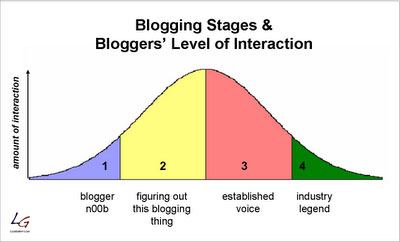

Four stages are depicted along the X axis. Left-to-right, the stages indicate increasing degrees of success in blogging. "Success" in this case being defined as establishing a voice that resonates with the audience you want.

And what are "interactions"?
  • Allowing blog comments
  • Responding to blog comments
  • Commenting on FriendFeed about your blog
  • Tweeting links to your blog posts
  • Digging your blog
  • Stumbling your blog
  • Pimping your blog on others' blogs
With that, let's run through the four stages of the blogger.

1. Blogger n00b

When you start out blogging, you don't know much. Most likely, you're somewhat sheepish about your writing, but you press on because you know that's the only to get better. No one leaves comments on your blog. And you're too embarrassed to try or don't even know the different ways to raise awareness of your blog.

You're not interacting a lot. But that's a good thing. You need the time to get some seasoning.
2. Figuring Things Out

OK, you're through the n00b stage. People occasionally leave a comment on your blog. Someone actually linked to a blog post of yours. You've noticed those "digg this" buttons on blogs. You're gaining confidence. "Hey - I actually can put two sentences together!"And it appears at least some people care about what you write. This is the stage where interactions are ascendant. You're carving out your piece of the webscape, and finding fellow travelers. You're learning who the A-Listers are, and how Techmeme works.

In this stage, bloggers do a ton of interacting. It's a wonderful time. The trial and error of it is liberating. You post crazy stuff, and see how it plays. You'll find surprising success every so often, as some site picks up your blog posts. As you rise up the curve in this stage, you find success by being out there. The more you interact with readers everywhere, the more established you become.

It's in this stage where you really discover your blogging voice. Discussions with others, and seeing what plays out there really help you in this process.

3. Established Voice

When you hit this stage, congratulations. You are now a bona fide figure on the scene. And there's a change in posture when it comes to interactions. Stage 3 bloggers still interact with their readers. But you're not going to see them doing all the other types of interactions: tweeting blog posts, digging them, etc.

Fred Wilson strikes me as a blogger in this stage. He has certainly achieved a wide following with his blog A VC. And he replies to commenters on his blog. So he's maintaining a decent level of interaction. But do you think he's digging his posts? Leaving comments elsewhere with links to his blog?

Fred is a solid Stage 3 blogger. He knows his voice, he delivers quality content and he's become something of a household name among the digerati. He gains new readers based on those qualities, not his interactions. But he's also an ongoing student, trying out ideas to help make him a stronger venture capitalist.

Two characteristics of Stage 3 bloggers also emerge:
  • The sheer volume of readers makes keeping up with all of them impossible.
  • A new kind of reader shows up, people who exhibit troll-like behavior.
It's these two dynamics that cause some bloggers to head onto the next stage.

4. Industry Legend

Go to Seth Godin's blog and try to leave a comment. Or comment on Marc Andreessen's blog. Robert Seidman's comment at the top of this post mentioned that he thought Seth is the smartest guy on the Internet. I personally am very impressed with Marc Andreessen, both for his entrepreneurial accomplishments and his blogging.

In Stage 4, the blogger is less a student of life, and more a professor.

You're also going to come under fire for your lack of interaction. A lot of people question the lack of interaction by top bloggers. Duncan Riley wrote this comment on FriendFeed in response to Louis Gray's post about rules for social following:
Louis, I still think you're the exception to the rule, maybe Scoble to, because you interact with people even if you don't follow them. I still think though that many in the so-called A-List don't care about their followers aside from bragging rights, which is why reciprocity isn't unreasonable as a mark of respect.
The blogger really is playing a different game at Stage 4. At this point, you've become established in the market, you're busy with a lot of non-blogging endeavors, you've got too many readers to count, the trolls love to come at you and you've become expert in a field.

Not surprisingly, your interactions decline. Jason Calacanis folds up his blogging tent. Seth Godin and Marc Andreessen don't accept comments. Even Robert Scoble feels it.

Robert Scoble is a Stage 4 blogger who interacts more than anyone on earth. He is truly the exception that proves the rule. But the limits of his interaction have been tested as well. In a post entered this morning, he decries the types of comments he receives on his blog as those from people "with an axe to grind". Digg readers' comments "are simply disgusting cesspools."

In a post I wrote a couple months ago, How Do Solo Bloggers Break into the Techmeme 100?, I noted that stars in the non-blogging world would immediately have a huge following. Assuming any blogging skill, they would pretty quickly have a presence on the web. Their star power would carry into blogging.

I would expect them to immediately go to Stage 4 on the blogging cycle as well. If Yahoo CEO Jerry Yang decides to start blogging, don't expect him to have any "conversations" with his readers.

What Do You Think?

The blogger lifecycle is not a perfect description. Many bloggers don't ride the edge of the curve (or in the case of Robert Scoble, sit above it). But as general framework for considering when blogger interactions are more likely, I think it does the job.

As a Stage 2 blogger myself, I'd love to hear your thoughts! You can find me regularly posting at http://bhc3.wordpress.com/ and interacting on FriendFeed.