Silicon Valley Technology Commentary & Archives · Est. 2006 3,033 Posts · 2006–2026

November 17, 2008

November 17, 2008 · 7 MIN READ · BY LOUIS GRAY

15 Tips on Improving Search Engine Visibility

15 Tips on Improving Search Engine Visibility

By Mike Fruchter of MichaelFruchter.com (Twitter/FriendFeed)

I will first start by stating I am not an SEO expert.

Over the years, I have studied and tested various methods, guidelines and techniques for generating search engine traffic. Back in 1997, I took on paid clients and SEO became a full time career for a few years. AltaVista was the dominant leader in search in those days. Learning how to control and manipulate the engines to get front page search results became my main objective and an obsession. Today, things are a lot different, as there is basically one dominant leader in search, and the playing field is more level than it's ever been.

Most of these practices and techniques are still very much relevant today as they were then, so I thought I would touch upon a few of the key ones.

1) Start with your domain name.

You have heard it before a million times, register a .com domain name. The domain spelling should be as equivalent to someone typing that word in a search engine. It should be relatively short and easy to spell as well. Try to avoid hyphens and or any unnecessary or unusual character variations. Most search engines still to this day give a lot more weight to .com extensions, as opposed to other TLDs. Keeping the domain name easy to spell and avoiding hyphens is more for branding purposes, than SEO. Search visibility can still be achieved with a confusing, long character riddled domain that makes no sense at all, but will someone be able to find it, and most importantly remember it without the assistance of a search engine?

2) Establish quality inbound and outbound links.

Search engines, more specifically Google, ranks your site based on the amount of inbound links it has from other sites. Spend time and get authoritative sites linking back to you. Inbound links from these sites are worth their weight in gold. Links from an authoritative site also influence ranking. More weight is given to these inbound links because these sites are considered a trusted and or leading source as they are considered the most influential on a particular subject matter, e.g. Wikipedia.org

3) Understand PageRank.

Websites that Google believes are important and influential receive higher PageRank. A Higher PageRank can influence better search results and rankings. Authoritative sites, for example, usually have a high PageRank. PageRank is worth taking note of, but should not be your main focal point. You can check a site's PageRank by going here, or by installing the Google Toolbar.

4) Put relevant keywords on all of your Web addresses.

Make sure any content you publish on the web has the keywords of the subject or story headline formatted in the permalink/web URL. If your are writing a post, for example, about how FriendFeed was just acquired by Google, you would format the URL similar to this, http://www.yoursite.com/friendfeed/google-acquires-friendfeed.html, or http://www.yoursite.com/google-acquires-friendfeed.html. Notice the sub-directory in bold has the keyword of the story subject. Take advantage of whatever you can to give as much URL mention of the target keyword as possible.

5) Headlines and page titles should always contain the target keywords.

In combination with having the relevant keywords in your URL, the same emphasis, if not more, needs to be placed on placement of keywords in your headlines and page titles. If you do no optimization at all, at the very least always practice these three guidelines. It's also a good idea to put the relevant keywords of focus first in the headline and page title, and if possible somewhere in the start of your story content. Failure to practice these guidelines will leave your site buried pages deep in the search results, rendering it almost nonexistent, at least to the search engines.

6) Start a Blog.

Blogs are a major source and very relevant source of information for millions of people daily. Blogs are also influencing consumer's decisions to buy products. Think about the last time you searched for something on Google. There is a high probability that you found your information on, or were referred from a blog. Search engines, specifically Google love blogs for the rapid amount of fresh and timely content they produce. Setting up a blog is very easy, and if tweaked correctly can be a powerful tool for search engine traffic generation. Configure your permalink structure immediately after installing your blog. Spend five minutes tweaking the basic admin settings. I would also recommend installing and using plugins such as the "All in One SEO Pack" available for WordPress. Now you can focus on producing the quality content that will get your site linked to and noticed. Give and get as much "link love" as possible. Become an expert in your field and let your content reflect that. Use the power of RSS to convert that search engine click into a return visitor.

7) Use keywords as anchor text when linking.

Anchor text is weighted highly in search engine algorithms and subsequent search results. Anchor text gives the user and search engines descriptive information about the content of a hyperlinks destination. Use Anchor text keywords, especially as often as possible when linking to pages. Avoid using "click here" at all costs, this will do nothing to increase or improve visibility.

8) Install Web Analytics software.

Flying blind is foolish. You need to first measure, and understand your traffic patterns and behaviors before you can seek to improve it. Installing Google Analytics should be your starting point.

9) Utilize Sitemaps.

Sitemaps, are basically a list of all the pages pertaining to a particular site. This protocol allows you to notify Google about URLs on your website that are available for crawling and indexing, that may otherwise have not been discoverable by Google's normal crawling process. They also should help with getting your site crawled in a more timely fashion.

10) Use Google Webmaster Tools.

Google's Webmaster Tools, allows you to see your website the way Googlebot sees it. The tools provide data on finding out which sites link to yours, finding search queries that list your site as a result and finding which of your site's pages are indexed, and also showing you any errors Google encountered while crawling your site. Those are the core features, but there is more under the hood. The goal is to make your site as Google friendly as possible. The more data you are armed with and utilize, the better your chances are for higher visibility in search results.

11) Produce and publish quality content with some frequency.

Write quality content and publish on a regular basis. Sites that publish more frequently are seen as more reliable than sites that seldom do. This also helps for you to increase the amount of content on your site, which in turn yields more indexed pages, which then yields more visibility, increasing the quantity of search clicks to your pages.

12) Use Headline tags.

Headline tags (h1, h2, etc.) are a great place to use your targeted keywords, phrases and secondary keywords. Search engines recognize that headline tags are more important than the surrounding text, therefore they assign greater value to keywords found within them.

13) Don't forget about the other engines.

Google, the gorilla, produces the biggest quantity of search traffic for the majority, but don't forget about Yahoo & MSN. It's at least worth the effort to stay current on both of their publishing guidelines. Yahoo has a resource for web publishers, as does Microsoft to help you better optimize your pages for their engines.

14) Consistency is the name of the game.

Focus on what works and run with it. There is not one single magic bullet for achieving better search results. It's a combination of these practices and understanding what criteria the search engines look for when indexing your pages. Search is all about optimizing for the relevant keywords or phrase, master this practice and it will pay off. Don't expect results instantly. It takes time to build up your content, establish inbound links, tweak and re-tweak.

15) It gets better by using social media.

Guess what? If you are active in social media, you are probably already ahead of the game. Social networking profiles such as Facebook, LinkedIn, and Twitter all get favorably indexed, and always rank on the top of the search results. This is especially great if your goal is for personal branding. Being active and maintaining consistency, should easily allow you to own your name in Google. Social media is probably the most invaluable tool you could use for traffic generation, if executed correctly. User generated content and the applications that power them such as, blogs, wikis,video, social networking sites, bookmarking, microblogging, etc are the leading mechanisms for search engine traffic, and will only increase as time goes on.

Image courtesy of Silent under Creative Commons license.

Read more by Mike Fruchter at MichaelFruchter.com.

November 17, 2008 · 3 MIN READ · BY LOUIS GRAY

Twitterank's Leaderboard: Odd, Mysterious and Broken

Twitterank's Leaderboard: Odd, Mysterious and Broken

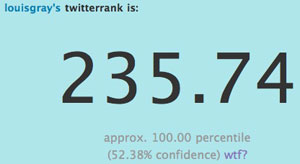
The launch of a leaderboard for the once-feared Twitterank was inevitable. After all, in the online world, if you can measure something and give it a score, then by all means the next step is to rank people from high to low, and provide a leaderboard. It's happened with blog "influence" (Technorati). It's happened with mentions on Techmeme. It's even happened with how frequently people's items are shared on Google Reader (Feedheads, RSSmeme and ReadBurner). As ranking one's Twitter influence has been tried several times by a bunch of different sites, from Twinfluence to Twitter Grader, Twitterank was practically destined to join the crowd. On Friday, the site launched a "Top 50" list and after watching the dust settle a bit, I have to be extremely amused by the results.
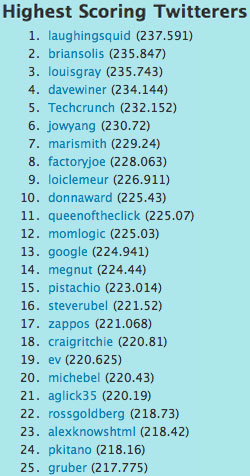

Every ranking system has its flaws. And considering Twitterank's algorithm is both secret and changing, according to its author, Ryo Chijiiwa, initial hiccups are no surprise. But glancing at the top 50 tells me that Twitterank must measure influence in a very odd way, contrary to just about every other measure I've seen out there.

For example, according to Twitterank, the #1, highest scoring person in all the world is Scott Beale of Laughing Squid. (@laughingsquid) Scott's account garners a score of 237.591. His own Twitter account shows he (as of Monday after midnight) is following 1,636 people, has 19,307 followers, and has made 5,285 updates. This does not rank him among the top 50 on Twinfluence in total reach, but he does reach #20 on Twitter Grader.

In the #2 position on Twitterank is Brian Solis (@briansolis), who weighs in with a score of 235.847, and Twitter activity of 582 following, 8,033 followers and 3,524 updates. This activity garners him the #43 position on Twinfluence and #22 overall on Twitter Grader.

While Twitterater's top list does have a lot of "household names" like Dave Winer, Michael Arrington, Jeremiah Owyang and Steve Rubel, there are some big oddities, including at least one account that has never sent a message on Twitter at all.


Let's be honest, there's no way I should be this high.

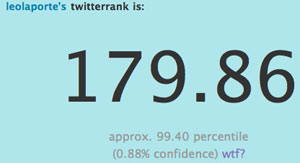
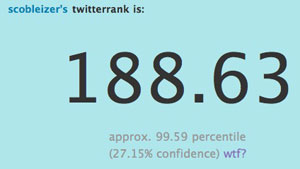
For example, Loic Lemeur (not pictured, but at 226.91) actually ranks below me in the rankings, despite his following and being followed by almost five times as many people, and sending ten times the amount of updates. Meanwhile, Leo Laporte gets a 179.87 ranking, well off the top 50 list, despite having more than 60,000 followers, behind only president-elect Barack Obama and Kevin Rose of Digg (that I know of). And the ever-present Robert Scoble gets only a 188.63, also keeping him off the Top 50.


Leo Laporte, with 60,000 followers, misses the leaderboard?


And Scoble, Mr. Twitter, doesn't break 200 either?

So how does that make any sense? I was going to guess that Scott Beale ranked highly thanks to his high followers to following ratio, but Leo Laporte's ratio is an astonishing 120 to 1, so that, in theory would rank higher. And Scoble's real numbers are off the charts in almost every metric.

Another canary in the coal mine - the account of @google, which ranks #13 overall, according to Twitterank's Top 50, but has only 366 followers, isn't following anyone and has never updated their Twitter account.

So... @google, a user with no updates, has a higher Twitterank than does Scoble, who tops out at 39,000 followers, and more than 15,000 updates. Whatever you think about the content of Robert's tweets, whether they be too frequent or too off-topic, to say that an unused account is among the top in the world is as they say in the Web world... a big FAIL.

That Twitterank has an algorithm which measures something is clear as it gets some of the names you'd expect, but there are still a lot of questions around this service. Right now, it's basically a toy, and has little value.

November 16, 2008

November 16, 2008 · 3 MIN READ · BY LOUIS GRAY

Brand Reputation Management Is Not a Monday-Friday Gig

Brand Reputation Management Is Not a Monday-Friday Gig


The concept of a workweek starting at 8 a.m. on Monday and concluding at 5 p.m. the following Friday is cute, but not all that realistic in most cases. Whether you're in sales or engineering, marketing or technical support, there seem to always be tasks that need your attention outside of the listed business week in the company handbook. With the rise of the Web and realtime response and discussion across social networks, managing a brand's reputation is absolutely a 24 by 7 operation. Sometimes, as a groundswell takes on your company, or your products, waiting until Monday to react is simply not an option, for the damage will already have been done.

Today's victim is the pain reliever Motrin, who posted a condescending ad that had many parents seeing red. The ad, posted on their main Web site, essentially stated that carrying one's baby in a sling or backpack would cause undue pain, requiring their product. While delivering a need and solution makes sense, they unnecessarily mocked babywearing as being in fashion, and making you appear like a real mom. The condescending ad ignored the reality of needing to go "hands-free" simply to function, fashion be darned. As a father of twins, I may not be a mom, but I often carry one of the kids around in a sling or a baby carrier, whether to do dishes, or just to type without having to go one-handed. And Motrin's ad was misguided. After my wife viewed it, she said she was surprised the ad got through a series of reviews and passed.

(See the video archived on YouTube)

While not incensed as many mothers said they were, and in a household that didn't have Motrin in the medicine cabinet anyway, we discovered the ad through the power of Twitter, which was ablaze with mommybloggers slamming the campaign. (See: #motrinmoms)

On a weekend not dominated by major news, Motrin's brand got stomped on, and waiting around until Monday to pick up the pieces would be too late. After almost a day of getting dissed, the Web site finally went down tonight, either through exceeded demand, or by way of the company's intervention.

When I talk to brand managers about social media, I recommend three clear steps:
  1. Understand
  2. Observe
  3. Act
They need to understand that your brand is at the mercy of its constituents. And you need to be using monitoring tools to rapidly discover and act upon how it is being used or mentioned - no matter what day it is.

Some basics to get started:These alerts will be automatically sent to you around the clock, even if the doors to your office are closed and the lights are off. Be aware of these services, monitor what is being said, and after all this, act. Don't just react, but do so thoughtfully.

And if you were curious to see just how I look wearing a baby carrier, check out the photo on FriendFeed.

See also:
Marketing Mystic: In Motrin moms debacle, the winner is Twitter
The Standard: Motrin learns there's a downside to viral advertising
November 16, 2008 · 3 MIN READ · BY LOUIS GRAY

Incredible Web Efforts Made to Shield Victims of Santa Clara Shooting

Incredible Web Efforts Made to Shield Victims of Santa Clara Shooting

Note: I recognize this is an extremely sensitive issue, and one that continues to develop, so the words I use here are measured. Condolences to all affected by this horrible incident.
On Friday, as you most likely know, an employee of Santa Clara-based SiPort, who had lost his job that morning, returned to the office and took the lives of three of his former colleagues, the CEO, VP of Operations and head of human resources. In such a difficult economic climate as we are facing now, many saw the horrible incident as one emblematic of the tough times. Michael Arrington of TechCrunch called it "a Sad Day in Silicon Valley." Knowing the startup culture well, and living in Sunnyvale, neighboring Santa Clara, I've been watching the story, and was somewhat relieved to learn tonight that the alleged perpetrator had been brought into custody, having been captured in Mountain View.

The human tragedy here, when taken out of the macroeconomic view, is devastating. The three lives were not statistics or meant to be examples. These were people with families, with jobs and goals, people who were taken from the Earth way too soon, and in a horrific way.

But as information consumers, looking to learn as much as we could about this incident as news developed, to be both informed, and alert, as the suspect was not apprehended until this evening, it has been interesting to see how much effort has been taken to reduce the information available to the public in terms of learning about the company or the victims themselves. Almost immediately, on Friday night, SiPort shut down all pages of its Web site, with the exception of the main page, including hiding the management page. And today, the entire site itself is empty (unless you view the Google cache).

With today's Web world leaning toward one of transparency and posting copious amounts of information, it's no surprise that the victims of the shooting had created online profiles, including on the career-oriented site of LinkedIn. VP of Operations Brian Pugh and human resources lead Marilyn Lewis, who lost their lives Friday, had posted online resumes. (Pugh, Lewis)


The Mercury News' Early Version Cited LinkedIn as the Source

In fact, it was via LinkedIn that reporters garnered much of their data on the victims themselves. An early version of a story in the San Jose Mercury News stated, "Lewis, who lived in a San Jose, worked at NeoScale Systems before joining SiPort in November. 2006. In a LinkedIn profile, she wrote," but in a subsequent filing of the story, this piece was amended instead to say, "In an online profile, she wrote."


Subsequent Updates Did Not Mention LinkedIn

Just past Midnight on Sunday morning, LinkedIn's Web site is down, so it's not clear if the online career site has been asked to either take down or modify their profiles, but the effort by the Mercury News to remove the reference to LinkedIn in their article seems to have been done to discourage curious Web viewers from further invading the deceased's data. The way in which these victims lost their lives is well outside of the focus of Mike Fruchter's Mashable article from last month, What Happens to Our Social Profiles After We Die?, but the data we do post on the Web about our home, work and hobbies is something that cannot be hidden, or erased, even after we might be gone.

(Update: LinkedIn is back up, and both profiles still are there, without changes)

The incident is horrible, and very close to home, geographically, as well as in terms of understanding the issues of stress, strife with colleagues and the demands one's career can place on the rest of your life. I also understand the desire for families to want privacy and for news media and others to be extremely sensitive to the victims, but to pull the data, or make it more difficult to learn about the human side of this tragedy may make it more difficult to relate to, not less. It is also very interesting to see how efforts are made to pull data and have it disappear from a Web that is built to not lose it.