Silicon Valley Technology Commentary & Archives · Est. 2006 3,032 Posts · 2006–2026

March 11, 2009

March 11, 2009 · 3 MIN READ · BY LOUIS GRAY

Google Reader Adds Comments for Social Conversations

Google Reader Adds Comments for Social Conversations

Google Reader, the RSS feed engine that has become a major hub in my daily information gathering, pulling in feeds from the hundreds of blogs and Web sites I follow, is taking a step forward in terms of making the service more social, by integrating private conversations between friends. With today's release, every post and every share has an option to add a comment, which will be displayed to your friends who you are connected to.

Google Reader, which started out as a data silo, where you could passively read your news in isolation, has since expanded to include shared link blogs, the addition of notes, and the ability to follow friends and their items within Reader. Items from my shared link blog play a critical role in populating my profile on a variety of social services, including Socialmedian, FriendFeed and Facebook, as well as social news sites including RSSmeme and ReadBurner.

And now, you can make comments and have a conversation with friends, without having to e-mail articles out, and without having your private conversations aired in public on the original blog.
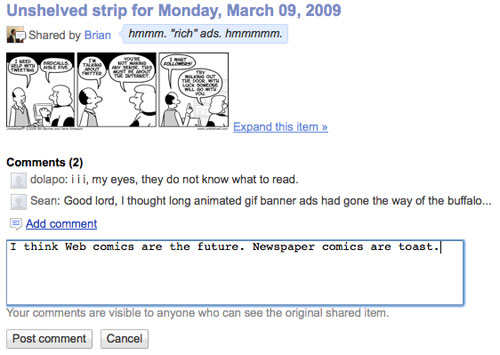

Making a comment on a shared item in Google Reader
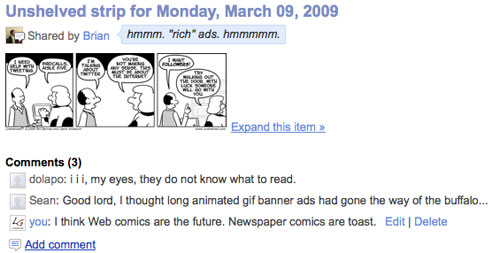


The comment, added to a shared item in Google Reader

Last year, we saw a great deal of controversy around publishers like Shyftr, who, at the time, ran a service that displayed comments along with full feeds. In that case, many blog owners felt that Shyftr was potentially making money (through ads) on their content, and hijacking comments. The Google Reader team, who I met with today at their headquarters in Mountain View, is very keen to do the right thing, and is not confusing public, centralized, comments with the private conversations available in today's release. And, so far, there are still no ads.
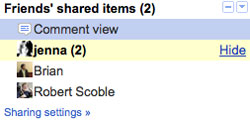
If you are a Google Reader user, you can see a new item called "Comment View" below "Friends Shared Items". If friends have made comments you haven't seen, the item will be in bold. You don't yet have a parenthetical number showing how many comments are left unread, as you do with total available items. (1000+ anyone?), but you can see if conversations are happening, either on your shared items or those of your friends.

As a Google Reader junkie, I was worried that conversations happening in my shared feeds would bump them back into my "unread" items and make me have to see items more than once. But Google Reader is not doing that. Read items stay read, but are available in the "Comment View".
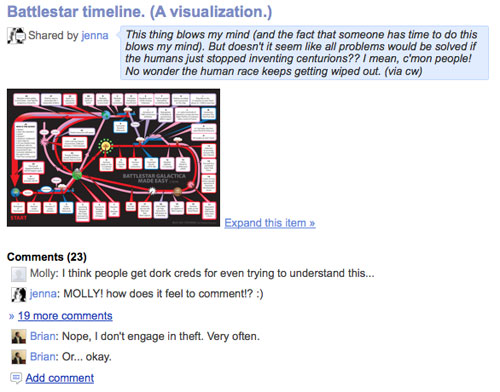

A Popular Comment Thread in Google Reader
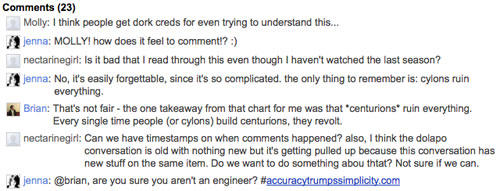


The Expanded Comment Thread in Google Reader

As you make comments within the shared items of Google Reader, those comments are visible to all friends of the original person who shared the item - and you can see comments by other people on those items, even if you are not friends with them yourself, but unlike Notes, they aren't exportable to services like FriendFeed, so they stay internal to the Reader.

You can see which friends are connected to you, as their names will be links to their Google profile, and those who are not friends display only a gray avatar. And today's post by the Reader team clarifies that, at launch, this is English-only, and not yet available in the "All Items" feed. But you can probably expect those to come with time.

The new addition is yet another way that Google Reader is looking to get more social. They've come a long way since my original post two years ago now that asked them to integrate trends, recommendations and more social features. And from today's meeting, it's clear much more is coming to what is now clearly the gold standard for the online RSS experience.

March 11, 2009 · 2 MIN READ · BY LOUIS GRAY

Google's Move to Behavior Ad Targeting Should be Excellent for All

Google's Move to Behavior Ad Targeting Should be Excellent for All

Today's Tech Web is ablaze with discussion around Google's announcement that they will be moving more toward behavioral targeted advertising in its offerings, letting advertisers learn more about the users they are messaging to, and, hopefully, letting consumers see advertisements that are more accurate, more targeted, and more interesting. If done well, advertisers will see higher click-through rates, consumers will be less irritated with off-topic ads, and Google will continue to make even more money.

Thanks to some of my more direct comments on advertising, I might be seen as being anti-ads in general, but that's really not the case. As often as I skip commercials and avoid ad banners, that's as much a function of them being completely nonsensical and having nothing to do with me as it is a function of some holy war against the market.

In June of 2008, I posted a comment using GMail/Google Talk to FriendFeed, saying, “I've seen a lot of stories lately around behavioral targeted advertising, and privacy. But in theory, wouldn't you rather see more relevant ads? Isn't this a good thing?"

It was my position that people were (and are) worried about passing data to a central source, and having Big Brother watch their online activity, but that I felt the concerns were overwrought. I have a tendency first, to trust services, and second, to expect the notion of privacy has changed dramatically in a world where we post all our particulars to LinkedIn and Facebook anyway.

At the time, responses ranged from Susan Beebe's direct, "I HATE online ADS . period. They suck big time," to Mark Krynsky's more diplomatic take, when he said, "I think it's a win for both advertisers and users and since I realize that ads are what allow me to receive great free content and services I welcome them."

Ads aren't going away. While my previous comments centered around what people should expect in terms of revenue from ads, or the ads being completely unqualified, today's move by Google signals a giant shift change in terms of what people should expect in this market. They're not the first company to embrace behavioral targeted advertising, but as the biggest, it should have wide ramifications.

I hope that this move means I will see fewer banner ads for dancing monkeys and silhouettes offering me low mortgages, and more ads for tech gear and sports items. I hope that Google's new direction means fewer false guesses of my interests, based on keywords in the content I'm reading, and more correct guesses, based on sites I visit - and trust me, I'm on the Web practically all day long, so the wrongness adds up. I for one welcome our new behavioral advertising overlords.
March 11, 2009 · 3 MIN READ · BY LOUIS GRAY

Kosmix Introduces Meehive to Deliver Personalized News Pages

Kosmix Introduces Meehive to Deliver Personalized News Pages

With printed newspapers going the way of the dodo, Web services have long battled to find a replacement for the ink-stained papers of yesteryear, hoping to leverage the rapidity of the Web with personalized customization. In the 90s, many search engines turned into Web portals, hoping to find readers' eyeballs would be "sticky" and spend lots of time on their site. In this decade, the move has been more to RSS-powered solutions, like Google News, or trusting the aggregation of behavior, either from friends or the Web at large - in social sites like Digg or FriendFeed. And for me, I've never quite found the right solution.
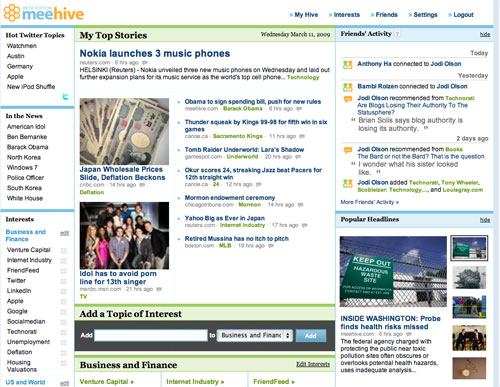
I tend to turn toward the firehose of Google Reader, FriendFeed and Twitter to get the immediate news, but struggle at finding one single destination to browse all the top news, based on topics I've entered. Meehive, a new offering from Kosmix.com, has taken strides in this direction with a product they call Meehive, which you can find at www.meehive.com.


My Personalized MeeHive Daily Hive

Meehive is nothing if not diligent in trying to make you the perfect news site. Upon registration, users are walked through a series of preference pages, where you can choose, based on the topic at hand, from Business and Finance items, to Sports, to Entertainment, and US & World, Lifestyle, and others. You can also add RSS feeds directly to the site, like you can with portals from My Yahoo!.

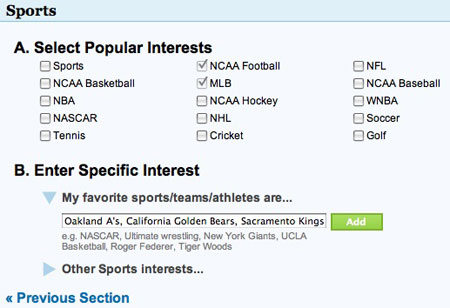
When you walk through these selections, you can choose from the pre-defined checkboxes Meehive offers, or you can add your own items. For example, in sports, I said I was most interested in Major League Baseball and NCAA Football, but more specifically, prefer news about the Oakland A's and Cal Bears. Similarly, I was able to, in the Business and Finance section, set up interests on Web sites like Twitter, Technorati, Google and Apple. This gave my Daily Hive a much more personalized feel than the standard CNN or Google News.


In addition to my preselected interests, Meehive incorporates trends from the world at large. It shows trending topics on Twitter, and stories in the news at large, so even if I haven't set up a topic for American Idol, which I promise never to do under penalty of death, I can click the "In the News" keyword "American Idol" and find all I want on Fox's insult to the American people.

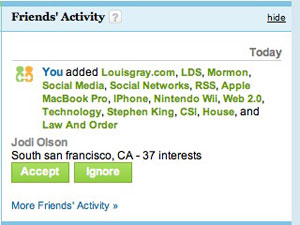
And as you can expect, like practically every other social site out there, you can find friends on Meehive and get connected, to see their own interests. I can click through to a personalized page for Anthony Ha or Jason Kincaid, for example. In fact, in TechCrunch's article from this morning, you can see that Jason's screenshot includes my own activity in the top right, as we were connected. (My MeeHive is Here)

As much as you might think I'm overloaded with information from the Web, I'm not, honestly. I find that often my first tendency after reading through my Google Reader items is to want to go back to the site and start again, only to find them empty. It's possible, with MeeHive up and running, that when I've hit zero on Google Reader, and tapped out my FriendFeed and Twitter, I can have a destination to find out what the rest of the world is doing outside my little bubble.

March 10, 2009

March 10, 2009 · 2 MIN READ · BY LOUIS GRAY

The Word on SXSW 2009 is at SXSWerds.com

The Word on SXSW 2009 is at SXSWerds.com

By Ken Stewart of ChangeForge (Twitter/FriendFeed)

Need to get the word on South by Southwest 2009? Get SXSWerds.com, a targeted social media platform, brought to you by BlogWerds Media, dedicated to the niche content vertical of SXSW to deliver what's happened, what's happening, and what's happening next.

Co-founder Eric Berlin, who also writes here on louisgray.com, has positioned the Werds-brand as a highly-targeted content aggregation coupled with social media tools for what's coming next.

According to Eric:

"BlogWerds Media believes that the evolution of social media means getting focused on valuable yet underserved content niches. While a select few blogs and news memes get repetitive attention from 'all things to all people' content aggregators and social news sites, the vast majority of news stories and social media participation simply gets lost in the ether."

What is SXSWerds?

Think Alltop + Digg, devoted to a niche like SXSW, with the Werd-spiders fetching the latest and greatest information on all things SXSW just for you. Simply browse and read the latest and greatest stories, tweets, videos, and you name it as they unfold - or rely on crowdsourcing to deliver vetted content to you.

After logging in, you have a chance to vote on your favorite articles, run searches using my new favorite blog search tool Lijit, step out to Twitter search on relevant tweet entries, and quite literally, drink in the fire hose of content coming at you.

If SXSW 2009 coverage is not your bag, try a few of the other BlogWerds' niche properties, including:

  • BlogWerds.com - Companies are online. Many have blogs. BlogWerds covers those company blogs.

  • NewsWerds.com - Newspapers are online. Many have blogs. NewsWerds covers those online newspapers.

  • ObamaWerds.com - Barack Obama buzz + social media = ObamaWerds

  • AmericanIdolWerds.com - American Idol buzz + social media = AmericanIdolWerds

  • SurvivorWerds.com - Survivor buzz + social media = SurvivorWerds.com

If you can't make it to SXSW this year, or if you just want to catch-up on the panel discussions you might have missed while catching a tune, mosey on over to SXSWerds and get the werd on what's hot and what's not at SXSW.


Ken Stewart’s website, ChangeForge, focuses on the collision between the constantly changing worlds of business and technology in an information-centric world. Ken is always interested in connecting; To discover the many ways you may connect with him, visit him at DandyID.