 The current generation of Web users is sharing more than ever online - in ways my parent's generation would visibly flinch over. They are sharing their locations, their relationships, their personal photos, and their thoughts in real time. They are posting their updates to Facebook, to Twitter, and to MySpace, as they move toward being ever more transparent. On another level, personal brands are being built with transparency as the foundation, as they share personal photos, their music preferences, family news, and a constant stream of comments and observations on the world. And in parallel, companies are being pushed by an army of self-appointed social media experts to become more open and transparent themselves. But as with every new approach, there's a right way and a wrong way to do things.
Steven Hodson of WinExtra tonight questioned, "Just what is all this transparency getting us anyway?" Meanwhile, Silicon Valley gossip rag, Gawker, knocks transparency so often that it has its own tag. (See here)
At the SXSW conference last week, I sat down with Michael Sean Wright of Nice Fish Films for a 30-45 minute interview, streamed live on Ustream. During that interview, Michael commended me for being transparent. To paraphrase his comments, he said that not only was I blogging, but I was frequently sharing pictures of my kids, showing what music I was listening to on Last.fm, and making comments on blogs big and small across the Web.
But here's the thing. While I do intend to be transparent and share with you what I'm thinking, or what factors are in play when I say what I do, or where I might have bias, I am sharing only a subset of everything I do. I have intentionally filtered out information about my personal life and work life which I decided wouldn't add value to you, or wouldn't add value for me to share. For as much as I may be "putting everything out there", you're not seeing much from my hours at the office. You're not getting live tweets from me during church meetings, and you're not getting the minutiae of the day - from what television I'm watching, where I'm driving, or what my wife and I are discussing - even when it's tempting to quote her out of context and send it to Twitter.
The net result is that everything I share with you is intended to add value - either to you where you can learn something for yourself or about me, or to me, where it might further enhance this theoretical term so many people are calling "a personal brand". To say what I share with you is calculated might be overdoing it, but I am very cognizant of how what I am doing or saying is potentially interpreted downstream. I am hyperaware of how when I update something on FriendFeed, that it may also flow to Twitter or Facebook. I know that when I make a comment on Disqus, it is searchable by Google, and by BackType, and copied to FriendFeed. I know when I hit share on Google Reader, that it represents my endorsement of that content or find it interesting, and see the result shared to Socialmedian or other aggregation services.
If you want to be transparent, and build a personal brand you are proud of, you must always be thinking about filtering what gets into your stream, and how it could benefit you and your audience. Even for as much as I share photos of Matthew and Sarah, it's a subset of all those we have, and I try not to overabuse the privilege on the social networks where we participate. Even though I share songs I love listening to on Last.fm, I don't hit that button too frequently. Even though I have made nearly 2,000 updates to Twitter in just over a year's time, I am conscious of not overdoing it, impacting my followers, and confusing them in terms of what I stand for.
Earlier this week, Hutch Carpenter showed us how you can tweet your way out of a job by not thinking about how being transparent can negatively affect you. Similarly, ValleyWag uncovered photos that one tech employee chose to share with the world from his Honeymoon that would make you blush. In each case, the transgressor's transparency had not been filtered in such a way that benefitted them - but stepped well beyond the line of what's intelligent. But it shouldn't take a big mistake that costs you a job or your privacy to make you think about how transparency is possibly hurting you. Choose your filters, and you can mold the way you are interpreted into something you are proud of.
 For some time now,
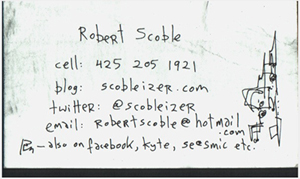
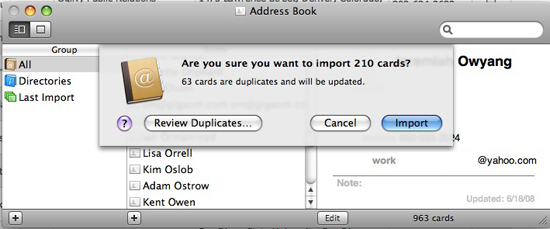
 Like many of you no doubt, over the last several years, I've amassed a solid collection of business cards, from both work and social engagements. I have business cards in boxes, in piles on my desk, on my dresser and table at home, and in virtually every zipper pocket of my laptop bag. I have business cards from Web companies that haven't launched yet, and I have business cards from companies that have already gone out of business since we shook hands and traded paper. And while I always thought someday I would sit down and input each one by hand into my address book, it never happened. That's why when I heard about
 But CloudContacts' true value comes from mainly two areas. The first is the one you would expect, where you can download all your contacts (in CSV file, VCards or as Yahoo! and GMail contacts), and the second is that when you click on "view" next to any card, you not only see a picture of the scanned business card, but you also get as much data out of the Web as CloudContacts could find, from a picture in Google Maps showing their address, to searches on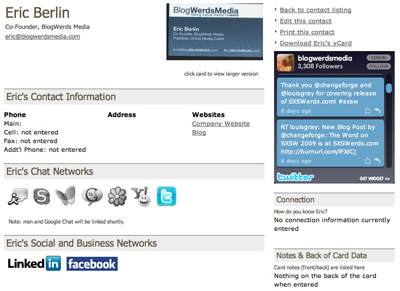
 One of the major trends I've been irked by at the last few events I have attended is the general lack of blog posts and reactions to panels and keynote speakers. While in years past, one could expect solid reaction stories from attendees, many are instead choosing to "live tweet" the proceedings, or with the right equipment, are recording it and posting the results as a podcast or YouTube embed. While I was at the