Silicon Valley Technology Commentary & Archives · Est. 2006 3,032 Posts · 2006–2026

March 27, 2009

March 27, 2009 · 3 MIN READ · BY LOUIS GRAY

False Alarm on Credit Fraud Solved by My E-mail Hoarding

False Alarm on Credit Fraud Solved by My E-mail Hoarding

This evening, my wife handed me the phone, saying "It's Chase bank. They say there is suspicious activity on your account and to call them." Having never run into issues with fraud or identity theft, I've been lucky so far, despite liberally spreading my credit card details all over the Web, in a myriad of e-commerce sites and online services. With our recent travels, and my wife's own activity on the card, I thought there was a good chance this would be a false positive, which it was, but I came extremely close to canceling my card, and would have, had it not been for my often-mentioned e-mail pack rate behavior.

When I called into the fraud center, after identifying myself, the automated voice asked about some "odd" activities - one from a "record store" and another from an online eMarketing firm. Both sounded odd, so I ended up with an operator. As she explained to me, the "record store" was actually Apple's iTunes, to the tune of $.99. No problem. But the other one? It turned out it was based in South Africa, and had charged me $1.07. That was an odd number, but small, and I didn't recognize the firm. It sounded like "Quirky Marketing" or "Quirk iMarketing". Something...

When I said I didn't recognize the name of the service, the operator strongly advised me to cancel the card immediately. But I wasn't so sure. There was still the possibility I had made a mistake, and $1.07 didn't seem like a big deal. She again pushed me to cancel the card, saying if somebody in South Africa had my data, the next purchase could be a big one.

I asked her not to cancel the card, but after asking people on Twitter what they thought I should do, and seeing a near-unanimous response that I should follow the bank's advice, I was feeling like my smug naivete was going to catch up to me.

Searching Google for the firm name I thought she had mentioned found nothing memorable. And the South African connection sounded very weird. But there was one last place I could look - in my e-mail. As mentioned many times, I've saved practically all my useful e-mail going back more than a decade - making it an extremely deep personal database. So I searched for the term the woman had mentioned on the phone: "Quirk".

It turned up an e-mail confirmation from Quirk eMarketing from September 2008, for a product I had checked out called "BrandsEye". BrandsEye I would have remembered, but the "Quirk eMarketing" I'd largely forgotten. Their site left much to be desired, but my e-mail showed I'd signed up to a service that would charge 7 South African Rands a month to monitor online mentions. Depending on the exchange rate, one month's bill would be $1.01, and another would be $1.07. And while that didn't trigger any fraud alerts in September through February, today, it did. (Likely due to some other activity my wife initiated)

When I had gotten the online confirmation of my purchase back on September 28th of 2008, I moved the e-mail to my "Commerce" folder and saved it. I didn't know if I would ever need it again, but today, it came in extremely handy, and I won't be canceling my credit card. Phew!

March 27, 2009 · 2 MIN READ · BY LOUIS GRAY

New FeedFlare Displays FriendFeed Likes and Comment Counts

New FeedFlare Displays FriendFeed Likes and Comment Counts

Bloggers who are tied into social media sites have long used FeedBurner's FeedFlare functionality to help promote their blog posts, from pushing visitors to Digg or Stumble posts, add them to Delicious, or e-mail them to friends. But increasingly, information from external social networks is being fed back to the blog itself - from the number of retweets a post may have received to the number of Google Reader users who shared the item, for example. A new custom feedflare, designed by Kevin Fox, the lead designer of FriendFeed, and the artist behind popular sites such as GMail and Google Reader, is now available to display the likes and comments your post might have gotten on FriendFeed. It's already running on this site, and can be seen on his RSS feed as well.


FriendFeed Activity Displayed on My Site

The FeedFlare can be displayed on your site, on your RSS feed, or both - and clicking on the comments and likes statistics takes you to where your blog post is shared on FriendFeed, bridging visitors of your site to the conversation there.

Setting up the FeedFlare for FriendFeed likes and comments is not a one-click process, so if you are interested, here's how you do it:
  1. Download this compressed .zip file. It contains the three documents you need, and an "About" file. Unzip the file and you will see a folder titled "friendfeedflare".
  2. Open the file "flare.php". Next to where it says USERNAME, replace "notlouisgray" with your FriendFeed user name.
  3. Open the file "friendflare.xml" and replace the pathname of "http://www.yourdomain.com/directory/flare.php" with where you will host the flare.php file. For example, I host mine at http://www.louisgray.com/feed/flare.php.
  4. Upload the files "flare.php", "friendflare.xml" and "friendfeed.php" to a directory on your site which matches the path you provided in step 3.
  5. Log in to your FeedBurner account, and go to the "FeedFlare" section in the "Optimize" tab.
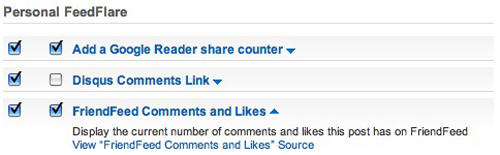
  6. At the bottom of the page, where you have the option to add a "Personal FeedFlare", paste in the URL of your XML file. (e.g. http://www.louisgray.com/feed/friendflare.xml)
  7. Hit "Add New Flare" and then "Save".

The FeedFlare Displayed In FeedBurner

At this point, the likes and comment counts on your items will be displayed on your blog or RSS feed. They will continue to accrue until you have 30 newer items in your blog feed.

A year or so ago, the blogosphere lit up around how social sites were stealing the conversation away from blogs, and operating in silos. With tools like this, and Disqus and BackType's integration of FriendFeed comments, the disparate conversations are becoming ever more unified.

If you like this FeedFlare, be sure to check out Kevin Fox's FriendFeed here, or his personal blog at fury.com. And if you get it up and running, it'd be great to see it on your site, so post your blog URL in the comments.
March 27, 2009 · 1 MIN READ · BY LOUIS GRAY

Rackspace Stock Undergoes the Scoble Effect Following Robert's Hire

Rackspace Stock Undergoes the Scoble Effect Following Robert's Hire

In the two weeks following Robert Scoble's official announcement that he was to be joining Rackspace, Inc. and embarking on a new project called Building 43, the company's stock has jumped by more than 30 percent, rising at a pace three times that of the NASDAQ, as the broader market tries to recover from a horrific year. And while yes, the argument should be made the two are not connected, the rise in the company's stock has added approximately $300 million to Rackspace's market cap. If Robert were responsible for even 1% of the jump, he would already have delivered $3 million of net value to the company.
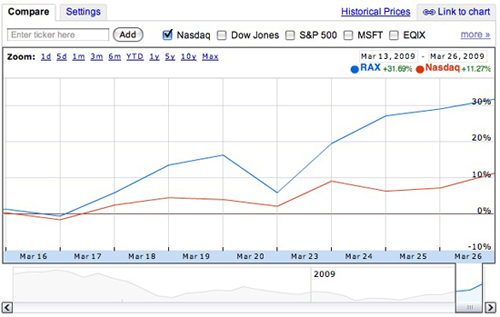

Rackspace's 2-week Rise Has Been Impressive

While Scoble hasn't been blogging as much as he used to, in his most-impactful years, simply getting linked to would deliver what smaller bloggers called "The Scoble Effect", as new visitors to the site could dramatically outnumber their regulars. And it's fun to think just maybe he can do the same for the Web hosting firm.

At the close of trading on Friday, March 13th, the last day before Scoble's news was unveiled, Rackspace stock closed at $5.98 a share. At the end of trading today, the shares closed at $7.81 apiece, a move up of 30.6% in two weeks. In fact, according to Google Finance, Rackspace stock has been up on 8 of the 10 trading days following his announcement.


Meanwhile, Microsoft Has Been Slowly Sinking

In contrast, Microsoft, the last public company where Scoble worked, having left their offices in June of 2006, has seen their stock decline more than 15 percent since he left. Of course, so has just about everyone else...

March 26, 2009

March 26, 2009 · 1 MIN READ · BY LOUIS GRAY

Facebook Adds More Filters to Home Feed

Facebook Adds More Filters to Home Feed

By Jesse Stay of Stay N' Alive (Twitter/FriendFeed)

It would appear that some time in the last hour, Facebook has added more filters to the Home Page feed. If you mouse over the upper-right of any feed entry, you'll notice the "X" is missing, and instead, there's a drop-down that says "Hide". Click on that, and you'll notice the option to hide all of a user's posts, or just particular feed item types.

For instance, if you just want to hide a person's Delicious bookmarks or Google Reader shares, that will appear next to the Feed item entry for that share. Right now the types of posts seem to be limited, and Facebook has not provided an explanation as to the extent of the filters.


In this example, I can hide the user, or the service.

This change is just one step in a line of improvements Facebook has mentioned they were moving towards, in light of users' near revolt over the social network's new interface. In addition to more filtering capabilities, Facebook is still looking to make the Feed more real-time and is improving the highlights on the right-hand side of the Home Page. The new filters seem to be quite limited at the moment, but my hope is that we'll begin to see many more options to enable you to have greater control over the data you see as you log into Facebook.

Read more by Jesse Stay at Stay N' Alive.